
Advanced Higher Textual Analysis workshop FOCUS ON NARRATIVE

- Slides: 25
Advanced Higher Textual Analysis workshop FOCUS ON NARRATIVE POINT OF VIEW
Narrative point of view is one of the techniques that you may choose to write about if you decide to do Prose Fiction in the Textual Analysis part of the exam.
What is Narrative Point of View? Essentially means “the way in which the author decides to tell the story” or “how the author presents the reader with the plot, characters, dialogue, actions, setting and events”.
When writing about narrative point of view, you have to analyse and evaluate how the author uses point of view to convey his/her ideas and themes in the extract. Your aim is to provide mature and insightful analysis and evaluation on the narrative point of view, using evidence from the extract.
There are large number of different types of point of view Three main categories: First person point of view Second Third person point of view
1. First-person points of view The narrator speaks as “I” and the narrative is limited to what he or she knows, experiences, infers or can find out by talking to other characters. There are three subclasses: The first-person narrator who is not directly involved with, but witnesses, the story he/she relates to the reader. The first-person narrator who is a minor or peripheral participant in the story he/she relates to the reader. The first-person narrator who is the central character of the story.
2. Second-person points of view The story is told by the narrator to someone he/she refers to by the second-person pronoun “you”. The person to whom the narrator is addressing could be, for example: Another character in the text The reader The narrator himself/herself
3. Third-person points of view The narrator is someone outside and uninvolved in the story who refers to the characters by name or using pronouns such as “he”, “she”, “they”. There are two main subclasses: a) The omniscient point of view b) The limited point of view
a) The omniscient point of view The narrator knows everything that needs to be known about the characters and events of the story. The narrator is able to: -move in time and place; -shift from character to character -report the speech, actions, thoughts, feelings, motives and states of consciousness of the characters.
The omniscient narrator’s point of view is usually accurate, reliable and authoritative and the reader can, therefore, trust his/her version of events. (However, see “unreliable narrator”).
b) The limited point of view The narrator tells the story from a third-person point of view, but restricts his/her narration to what is perceived, thought, remembered and felt by a single character within the story. The events and actions of the story are told via one character.
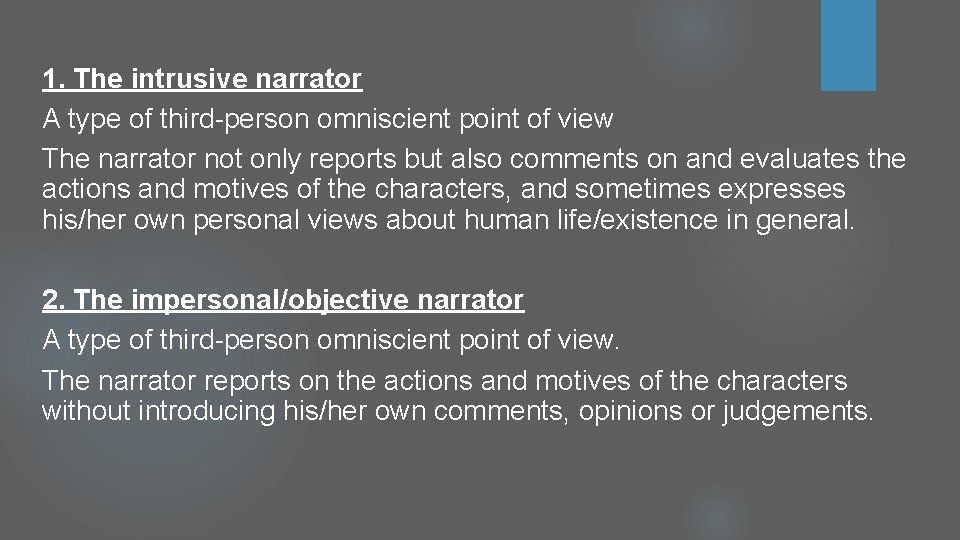
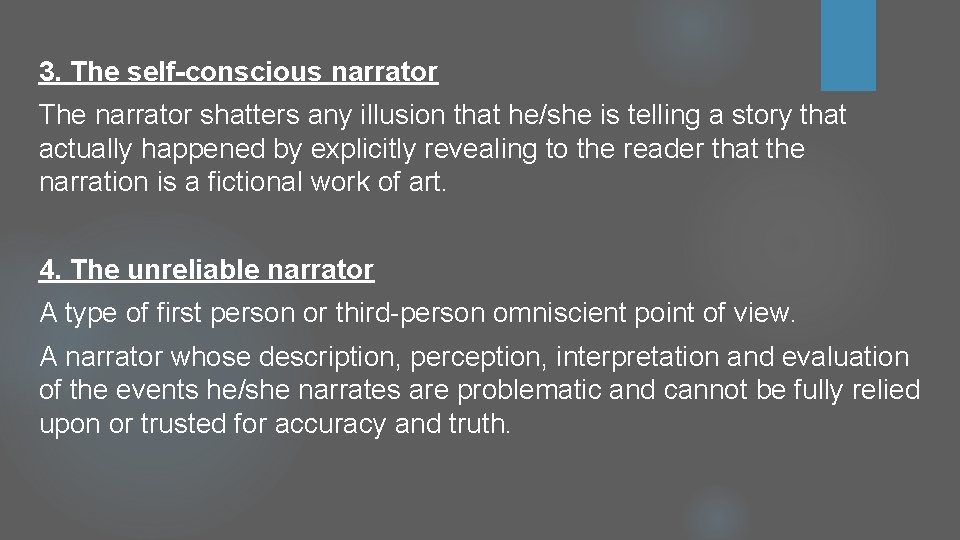
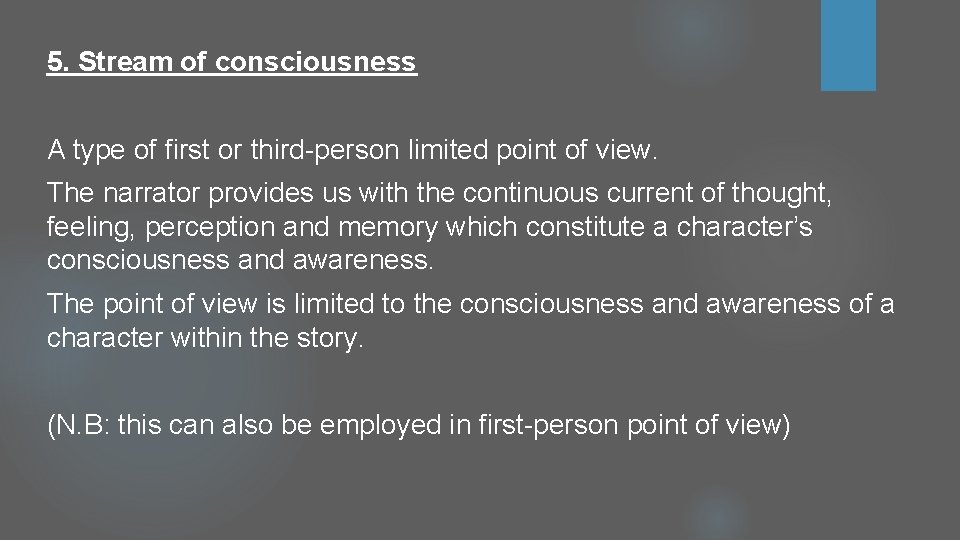
Other narrative styles 1. The intrusive narrator 2. The impersonal/objective narrator 3. The self-conscious narrator 4. The unreliable narrator 5. Stream of consciousness
1. The intrusive narrator A type of third-person omniscient point of view The narrator not only reports but also comments on and evaluates the actions and motives of the characters, and sometimes expresses his/her own personal views about human life/existence in general. 2. The impersonal/objective narrator A type of third-person omniscient point of view. The narrator reports on the actions and motives of the characters without introducing his/her own comments, opinions or judgements.
3. The self-conscious narrator The narrator shatters any illusion that he/she is telling a story that actually happened by explicitly revealing to the reader that the narration is a fictional work of art. 4. The unreliable narrator A type of first person or third-person omniscient point of view. A narrator whose description, perception, interpretation and evaluation of the events he/she narrates are problematic and cannot be fully relied upon or trusted for accuracy and truth.
5. Stream of consciousness A type of first or third-person limited point of view. The narrator provides us with the continuous current of thought, feeling, perception and memory which constitute a character’s consciousness and awareness. The point of view is limited to the consciousness and awareness of a character within the story. (N. B: this can also be employed in first-person point of view)
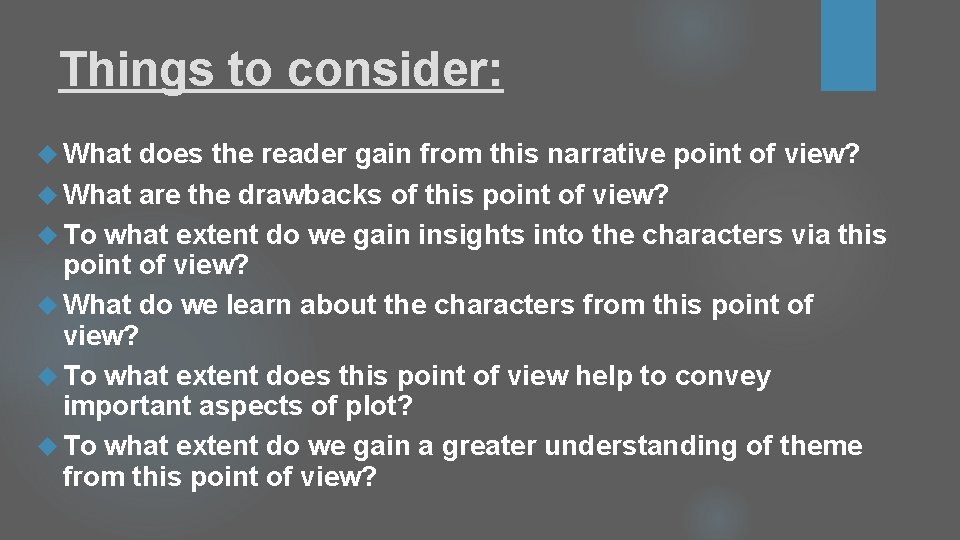
Things to consider: What does the reader gain from this narrative point of view? What are the drawbacks of this point of view? To what extent do we gain insights into the characters via this point of view? What do we learn about the characters from this point of view? To what extent does this point of view help to convey important aspects of plot? To what extent do we gain a greater understanding of theme from this point of view?
Exercise- unreliable narrator “One Flew Over the Cuckoo’s Nest” by Ken Kesey
Quote from the text Narrative Point of View Analysis and evaluation
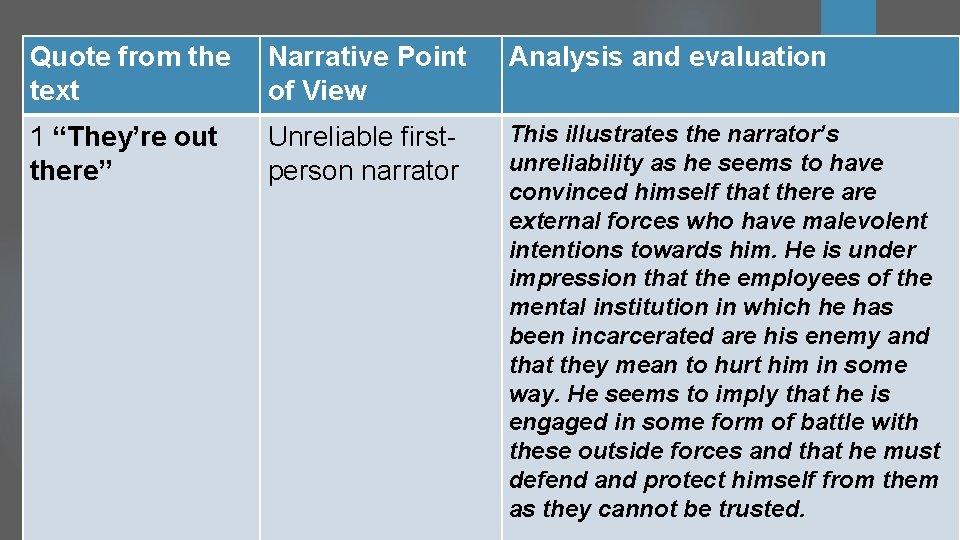
Quote from the text Narrative Point of View Analysis and evaluation 1 “They’re out there” Unreliable firstperson narrator This illustrates the narrator’s unreliability as he seems to have convinced himself that there are external forces who have malevolent intentions towards him. He is under impression that the employees of the mental institution in which he has been incarcerated are his enemy and that they mean to hurt him in some way. He seems to imply that he is engaged in some form of battle with these outside forces and that he must defend and protect himself from them as they cannot be trusted.
Using the notes that you have taken so far, write a detailed paragraph analysing and evaluating Ken Kesey’s use of narrative point of view in this extract.
Exercise “The Remains of the Day” by Kazuo Ishiguro In this extract, the butler, Stevens, is reminiscing about his relationship in the past with the housekeeper of Darlington Hall, Miss Kenton.
Discuss the use of narrative point of view in this extract Quote from the extract 1 2 3 Analysis and evaluation
Quote from the text Narrative Point of View Analysis and evaluation
Using the notes that you have taken so far, write a detailed paragraph analysing and evaluating Ishiguro’s use of narrative point of view in this extract.