
Advanced Higher History Course Assessment Overview Question paper

![Example of: Interpretation [of source content] The source says the masses of workers have](https://slidetodoc.com/presentation_image_h/dcdf9d8abfe7cb91c1bd6d5953a2f86a/image-28.jpg "Example of: Interpretation [of source content] The source says the masses of workers have")
![Interpretation [of source content] (2) The source also states “the masses of soldiers were](https://slidetodoc.com/presentation_image_h/dcdf9d8abfe7cb91c1bd6d5953a2f86a/image-29.jpg "Interpretation [of source content] (2) The source also states “the masses of soldiers were")
![Interpretation [of source content] (3) The source says too that ‘socialists who for four](https://slidetodoc.com/presentation_image_h/dcdf9d8abfe7cb91c1bd6d5953a2f86a/image-30.jpg "Interpretation [of source content] (3) The source says too that ‘socialists who for four")
![The ‘How fully does [Source] explain [event]? What is it asking? Asking candidates to](https://slidetodoc.com/presentation_image_h/dcdf9d8abfe7cb91c1bd6d5953a2f86a/image-44.jpg "The ‘How fully does [Source] explain [event]? What is it asking? Asking candidates to")
![How fully does [source] explain…? Judgement (which should be quantitative) Source B reveals… to](https://slidetodoc.com/presentation_image_h/dcdf9d8abfe7cb91c1bd6d5953a2f86a/image-45.jpg "How fully does [source] explain…? Judgement (which should be quantitative) Source B reveals… to")
![How much do [sources] reveal about differing interpretations of. . . The two-source question](https://slidetodoc.com/presentation_image_h/dcdf9d8abfe7cb91c1bd6d5953a2f86a/image-68.jpg "How much do [sources] reveal about differing interpretations of. . . The two-source question")
![How much so [sources] reveal about differing interpretations of…? Assertion (Quantitative) Interpretation of First](https://slidetodoc.com/presentation_image_h/dcdf9d8abfe7cb91c1bd6d5953a2f86a/image-69.jpg "How much so [sources] reveal about differing interpretations of…? Assertion (Quantitative) Interpretation of First")



- Slides: 112
Advanced Higher History: Course Assessment Overview
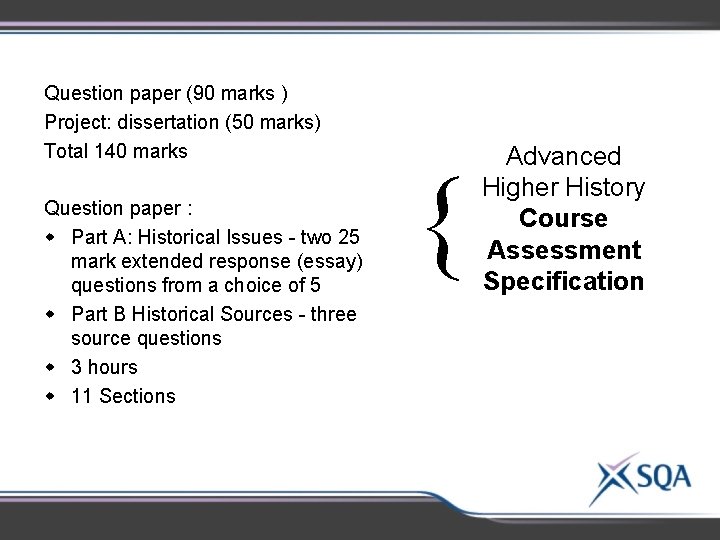
Question paper (90 marks ) Project: dissertation (50 marks) Total 140 marks Question paper : w Part A: Historical Issues - two 25 mark extended response (essay) questions from a choice of 5 w Part B Historical Sources - three source questions w 3 hours w 11 Sections { Advanced Higher History Course Assessment Specification
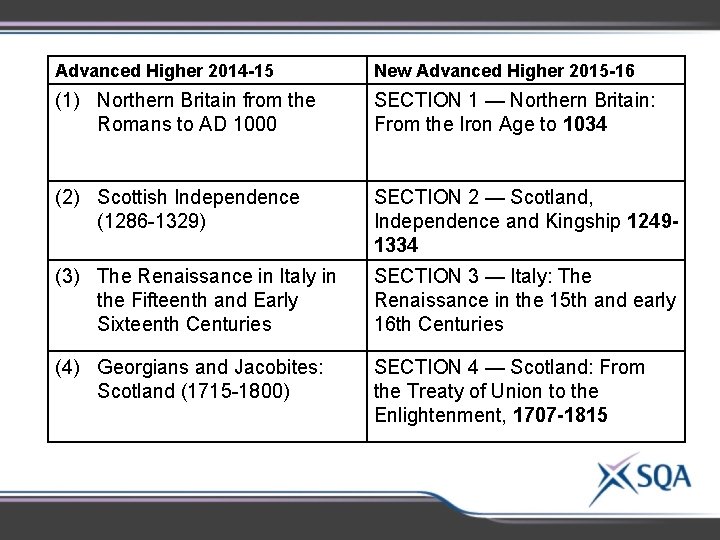
Advanced Higher 2014 -15 New Advanced Higher 2015 -16 (1) Northern Britain from the Romans to AD 1000 SECTION 1 — Northern Britain: From the Iron Age to 1034 (2) Scottish Independence (1286 -1329) SECTION 2 — Scotland, Independence and Kingship 12491334 (3) The Renaissance in Italy in the Fifteenth and Early Sixteenth Centuries SECTION 3 — Italy: The Renaissance in the 15 th and early 16 th Centuries (4) Georgians and Jacobites: Scotland (1715 -1800) SECTION 4 — Scotland: From the Treaty of Union to the Enlightenment, 1707 -1815
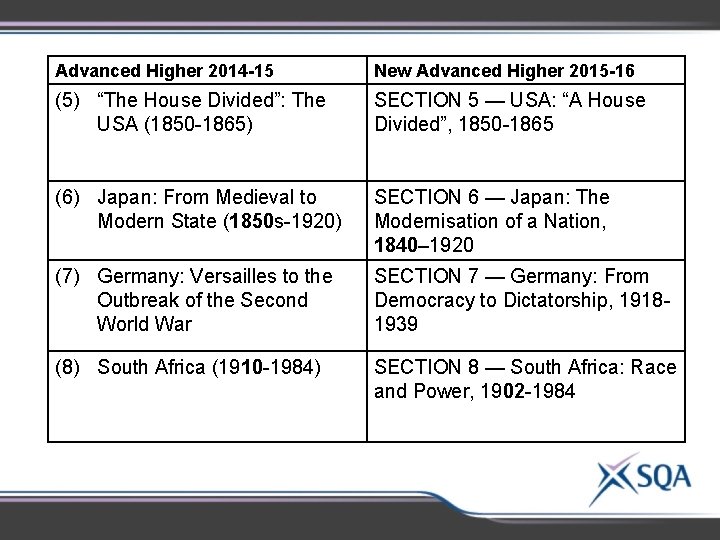
Advanced Higher 2014 -15 New Advanced Higher 2015 -16 (5) “The House Divided”: The USA (1850 -1865) SECTION 5 — USA: “A House Divided”, 1850 -1865 (6) Japan: From Medieval to Modern State (1850 s-1920) SECTION 6 — Japan: The Modernisation of a Nation, 1840– 1920 (7) Germany: Versailles to the Outbreak of the Second World War SECTION 7 — Germany: From Democracy to Dictatorship, 19181939 (8) South Africa (1910 -1984) SECTION 8 — South Africa: Race and Power, 1902 -1984
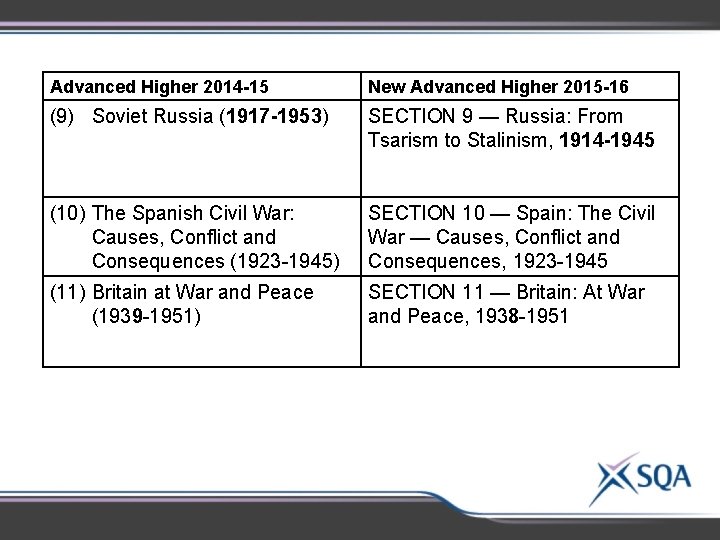
Advanced Higher 2014 -15 New Advanced Higher 2015 -16 (9) Soviet Russia (1917 -1953) SECTION 9 — Russia: From Tsarism to Stalinism, 1914 -1945 (10) The Spanish Civil War: Causes, Conflict and Consequences (1923 -1945) SECTION 10 — Spain: The Civil War — Causes, Conflict and Consequences, 1923 -1945 (11) Britain at War and Peace (1939 -1951) SECTION 11 — Britain: At War and Peace, 1938 -1951
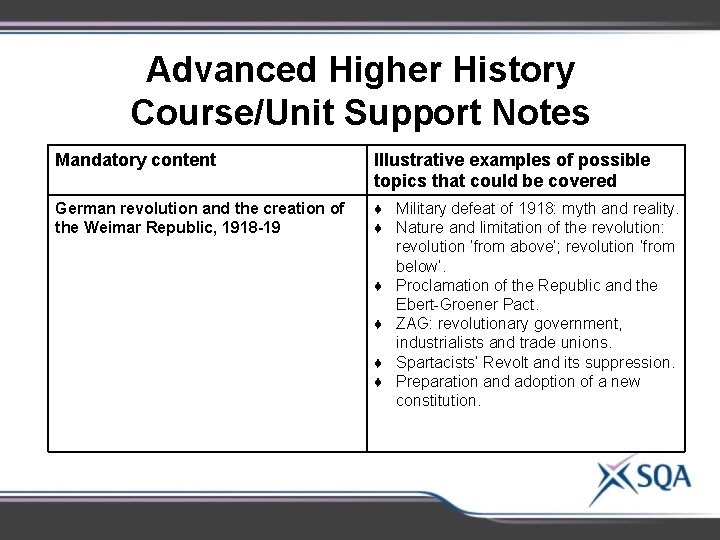
Advanced Higher History Course/Unit Support Notes Mandatory content Illustrative examples of possible topics that could be covered German revolution and the creation of the Weimar Republic, 1918 -19 ♦ Military defeat of 1918: myth and reality. ♦ Nature and limitation of the revolution: revolution ‘from above’; revolution ‘from below’. ♦ Proclamation of the Republic and the Ebert-Groener Pact. ♦ ZAG: revolutionary government, industrialists and trade unions. ♦ Spartacists’ Revolt and its suppression. ♦ Preparation and adoption of a new constitution.
Advanced Higher History Question Paper Part A — HISTORICAL ISSUES — 50 marks 25 mark (extended response/essay) question
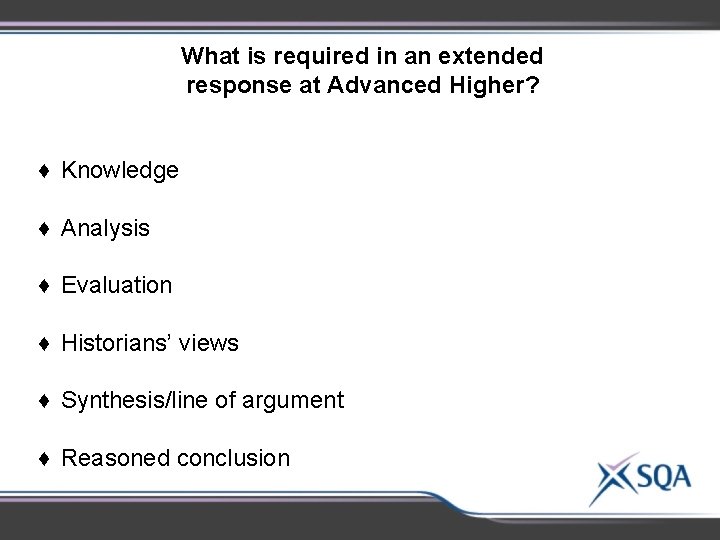
What is required in an extended response at Advanced Higher? ♦ Knowledge ♦ Analysis ♦ Evaluation ♦ Historians’ views ♦ Synthesis/line of argument ♦ Reasoned conclusion
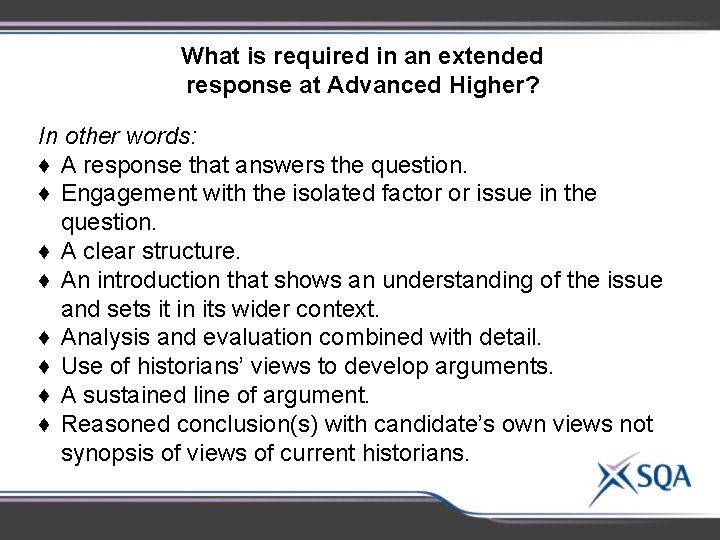
What is required in an extended response at Advanced Higher? In other words: ♦ A response that answers the question. ♦ Engagement with the isolated factor or issue in the question. ♦ A clear structure. ♦ An introduction that shows an understanding of the issue and sets it in its wider context. ♦ Analysis and evaluation combined with detail. ♦ Use of historians’ views to develop arguments. ♦ A sustained line of argument. ♦ Reasoned conclusion(s) with candidate’s own views not synopsis of views of current historians.
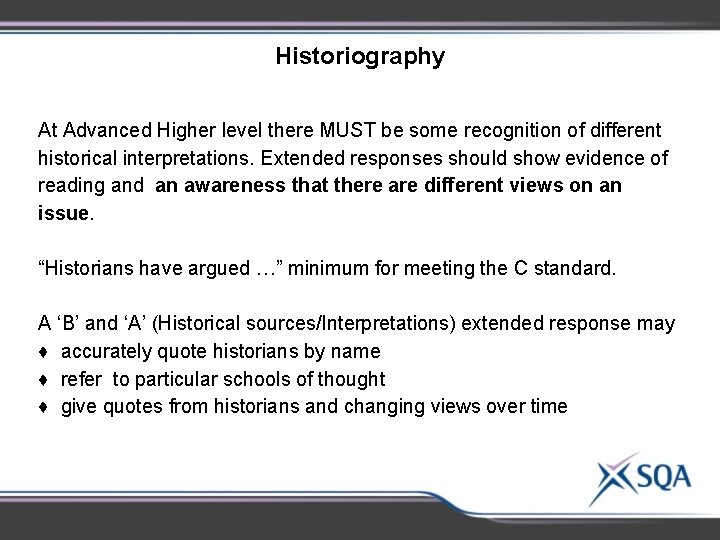
Historiography At Advanced Higher level there MUST be some recognition of different historical interpretations. Extended responses should show evidence of reading and an awareness that there are different views on an issue. “Historians have argued …” minimum for meeting the C standard. A ‘B’ and ‘A’ (Historical sources/Interpretations) extended response may ♦ accurately quote historians by name ♦ refer to particular schools of thought ♦ give quotes from historians and changing views over time
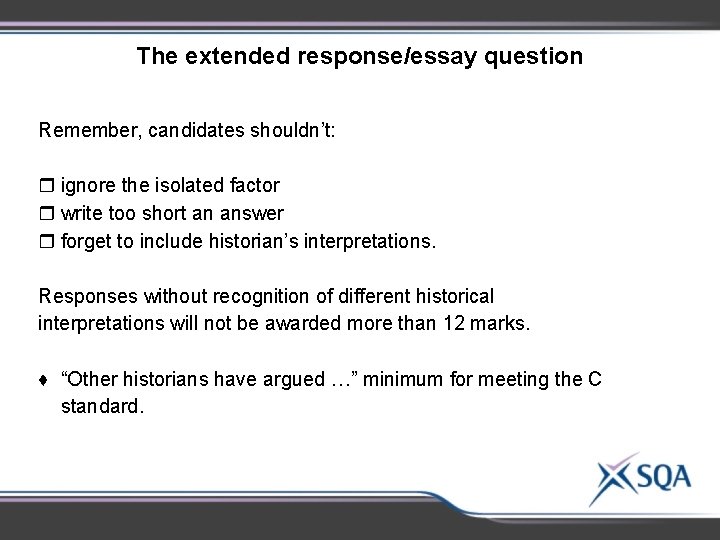
The extended response/essay question Remember, candidates shouldn’t: ignore the isolated factor write too short an answer forget to include historian’s interpretations. Responses without recognition of different historical interpretations will not be awarded more than 12 marks. ♦ “Other historians have argued …” minimum for meeting the C standard.
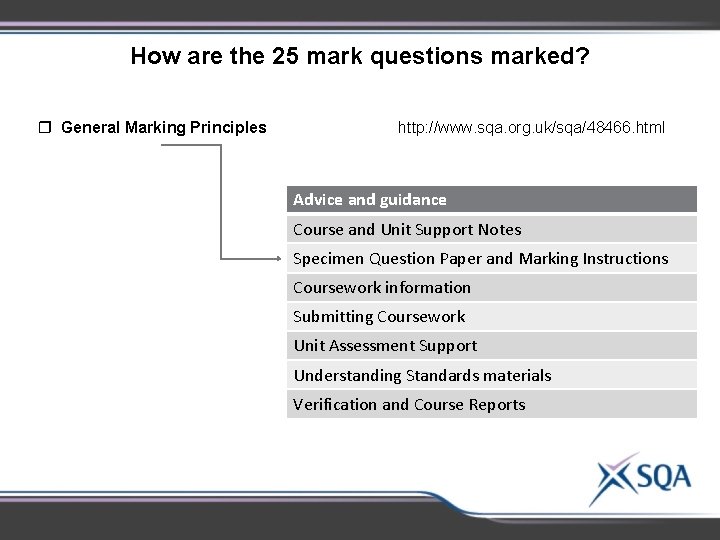
How are the 25 mark questions marked? General Marking Principles http: //www. sqa. org. uk/sqa/48466. html Advice and guidance Course and Unit Support Notes Specimen Question Paper and Marking Instructions Coursework information Submitting Coursework Unit Assessment Support Understanding Standards materials Verification and Course Reports
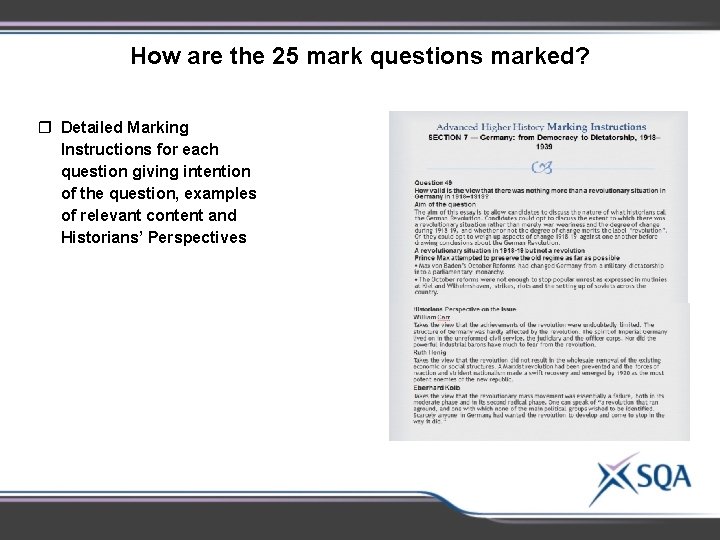
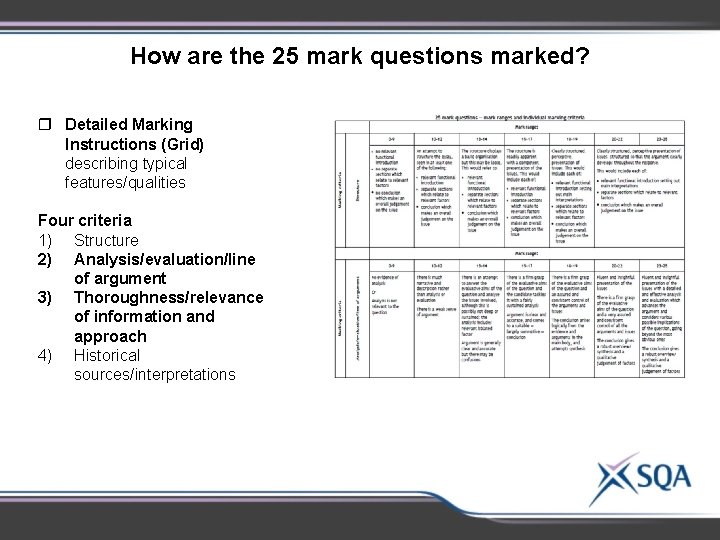
How are the 25 mark questions marked? Detailed Marking Instructions for each question giving intention of the question, examples of relevant content and Historians’ Perspectives
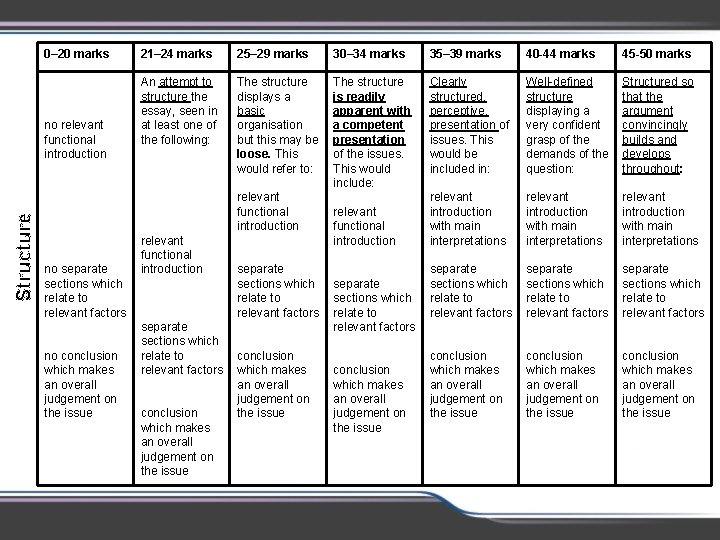
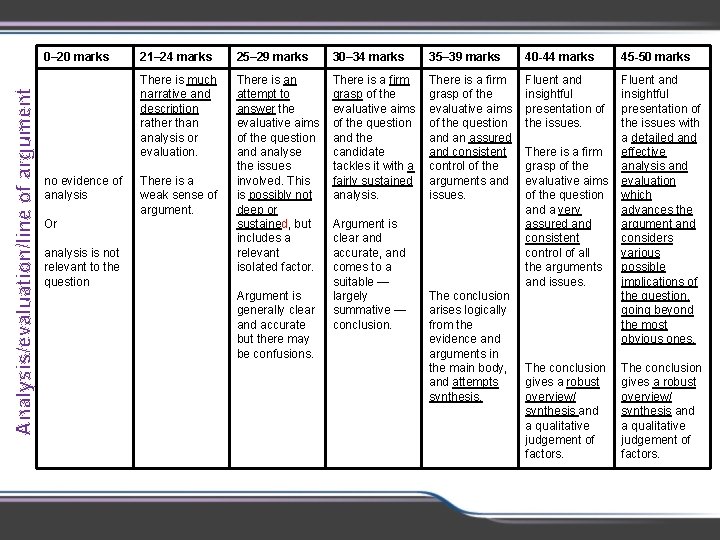
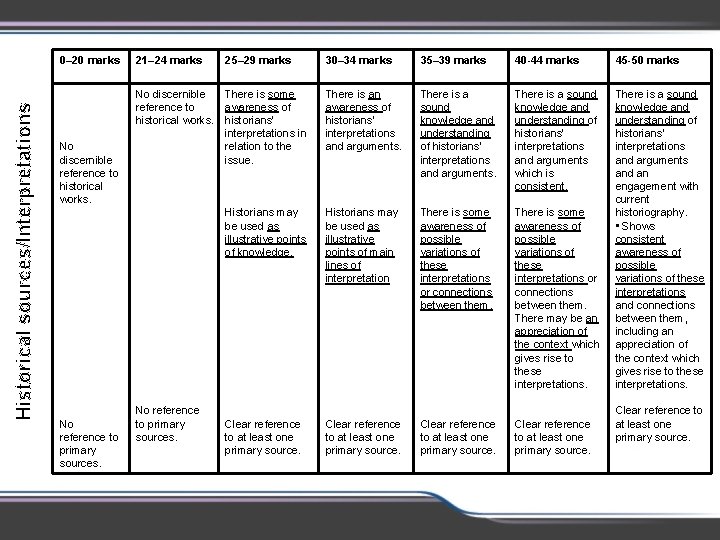
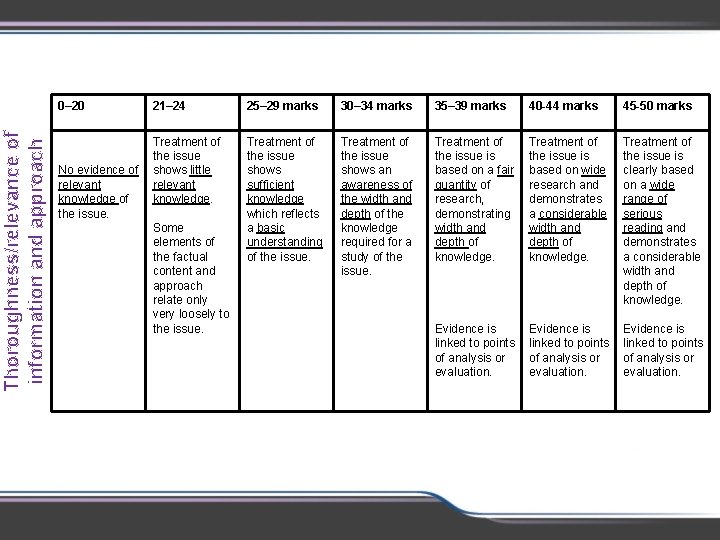
How are the 25 mark questions marked? Detailed Marking Instructions (Grid) describing typical features/qualities Four criteria 1) Structure 2) Analysis/evaluation/line of argument 3) Thoroughness/relevance of information and approach 4) Historical sources/interpretations
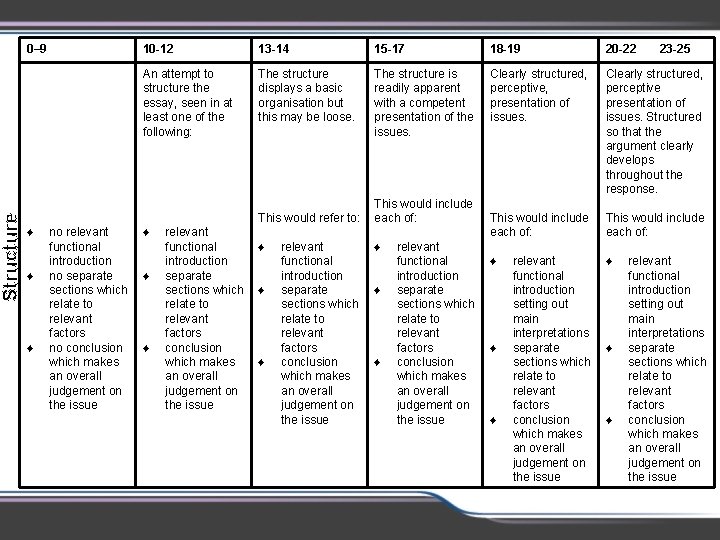
Structure 0– 9 10 -12 13 -14 15 -17 18 -19 20 -22 23 -25 An attempt to structure the essay, seen in at least one of the following: The structure displays a basic organisation but this may be loose. The structure is readily apparent with a competent presentation of the issues. Clearly structured, perceptive, presentation of issues. Clearly structured, perceptive presentation of issues. Structured so that the argument clearly develops throughout the response. This would include each of: This would refer to: ♦ ♦ ♦ no relevant ♦ functional introduction no separate ♦ sections which relate to relevant factors no conclusion ♦ which makes an overall judgement on the issue relevant functional ♦ introduction separate sections which ♦ relate to relevant factors conclusion which makes ♦ an overall judgement on the issue This would include each of: relevant ♦ functional introduction separate ♦ sections which relate to relevant factors conclusion ♦ which makes an overall judgement on the issue relevant functional ♦ introduction separate sections which relate to relevant factors ♦ conclusion which makes an overall judgement on the issue ♦ relevant ♦ functional introduction setting out main interpretations separate ♦ sections which relate to relevant factors conclusion ♦ which makes an overall judgement on the issue relevant functional introduction setting out main interpretations separate sections which relate to relevant factors conclusion which makes an overall judgement on the issue
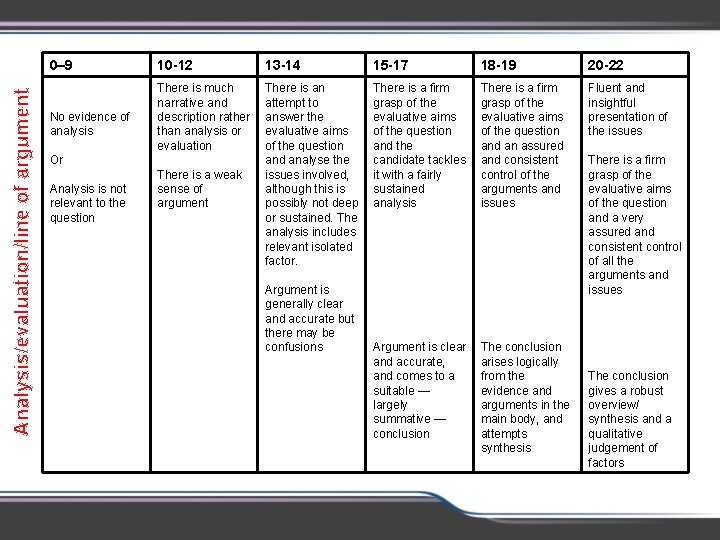
Analysis/evaluation/line of argument 0– 9 No evidence of analysis 10 -12 13 -14 15 -17 18 -19 20 -22 There is much narrative and description rather than analysis or evaluation There is an attempt to answer the evaluative aims of the question and analyse the issues involved, although this is possibly not deep or sustained. The analysis includes relevant isolated factor. There is a firm grasp of the evaluative aims of the question and the candidate tackles it with a fairly sustained analysis There is a firm grasp of the evaluative aims of the question and an assured and consistent control of the arguments and issues Fluent and insightful presentation of the issues Argument is clear and accurate, and comes to a suitable — largely summative — conclusion The conclusion arises logically from the evidence and arguments in the main body, and attempts synthesis Or Analysis is not relevant to the question There is a weak sense of argument Argument is generally clear and accurate but there may be confusions There is a firm grasp of the evaluative aims of the question and a very assured and consistent control of all the arguments and issues The conclusion gives a robust overview/ synthesis and a qualitative judgement of factors
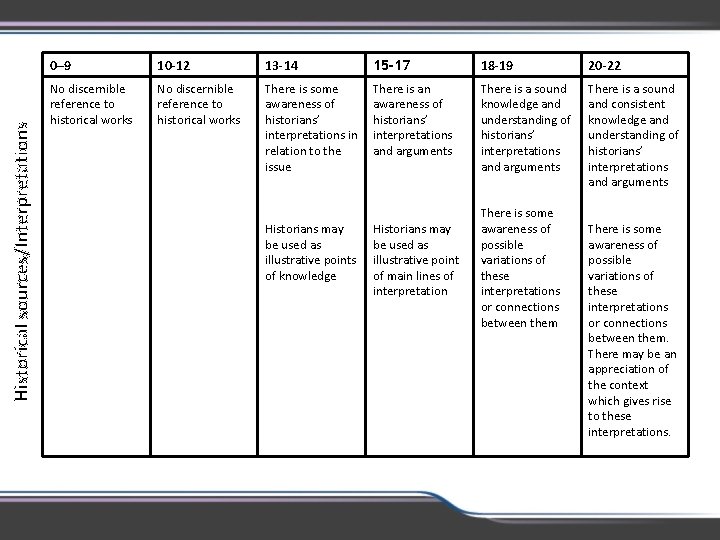
Historical sources/Interpretations 0– 9 10 -12 13 -14 15 -17 18 -19 20 -22 No discernible reference to historical works There is some awareness of historians’ interpretations in relation to the issue There is an awareness of historians’ interpretations and arguments There is a sound knowledge and understanding of historians’ interpretations and arguments There is a sound and consistent knowledge and understanding of historians’ interpretations and arguments Historians may be used as illustrative points of knowledge Historians may be used as illustrative point of main lines of interpretation There is some awareness of possible variations of these interpretations or connections between them. There may be an appreciation of the context which gives rise to these interpretations.
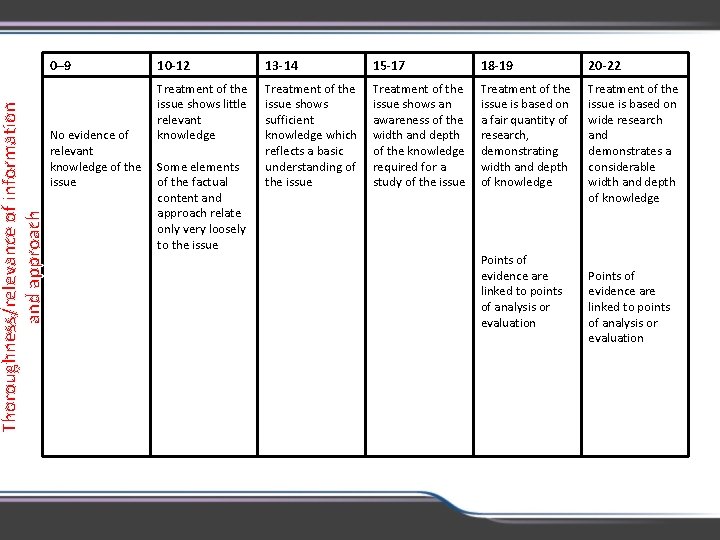
Thoroughness/relevance of information and approach 0– 9 No evidence of relevant knowledge of the issue 10 -12 13 -14 15 -17 18 -19 20 -22 Treatment of the issue shows little relevant knowledge Treatment of the issue shows sufficient knowledge which reflects a basic understanding of the issue Treatment of the issue shows an awareness of the width and depth of the knowledge required for a study of the issue Treatment of the issue is based on a fair quantity of research, demonstrating width and depth of knowledge Treatment of the issue is based on wide research and demonstrates a considerable width and depth of knowledge Some elements of the factual content and approach relate only very loosely to the issue Points of evidence are linked to points of analysis or evaluation
Advanced Higher History Part B — HISTORICAL SOURCES— 40 marks
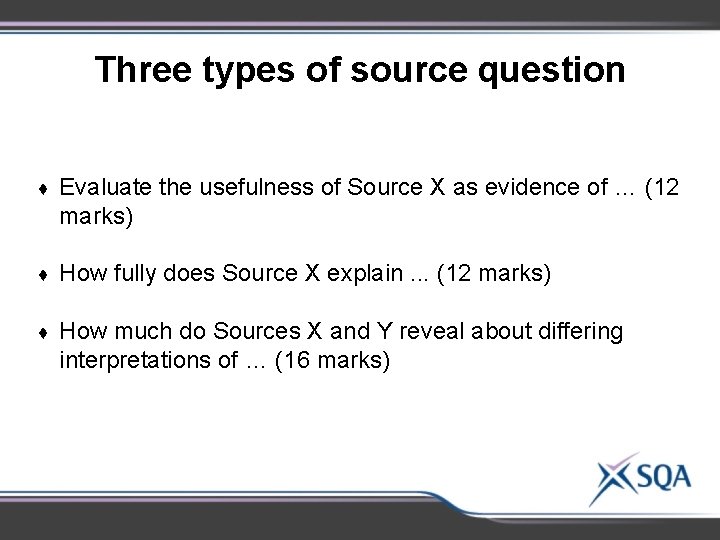
Three types of source question ♦ Evaluate the usefulness of Source X as evidence of … (12 marks) ♦ How fully does Source X explain. . . (12 marks) ♦ How much do Sources X and Y reveal about differing interpretations of … (16 marks)
The ‘Evaluate the usefulness of…’ question 12 marks
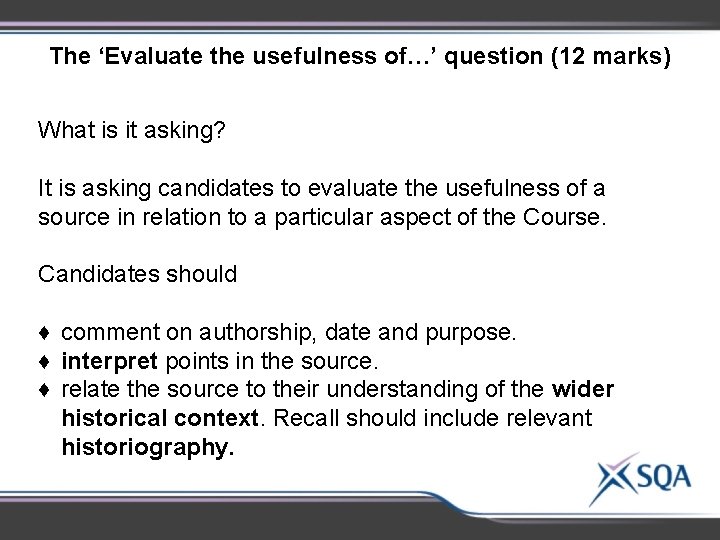
The ‘Evaluate the usefulness of…’ question (12 marks) What is it asking? It is asking candidates to evaluate the usefulness of a source in relation to a particular aspect of the Course. Candidates should ♦ comment on authorship, date and purpose. ♦ interpret points in the source. ♦ relate the source to their understanding of the wider historical context. Recall should include relevant historiography.
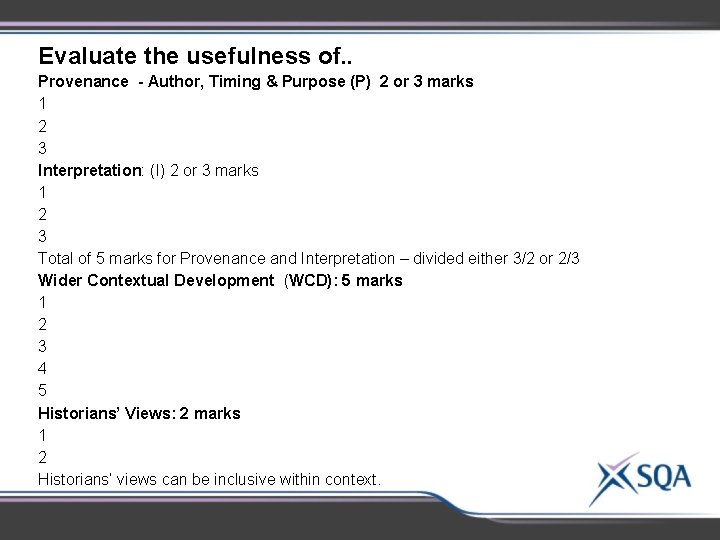
Evaluate the usefulness of. . Provenance - Author, Timing & Purpose (P) 2 or 3 marks 1 2 3 Interpretation: (I) 2 or 3 marks 1 2 3 Total of 5 marks for Provenance and Interpretation – divided either 3/2 or 2/3 Wider Contextual Development (WCD): 5 marks 1 2 3 4 5 Historians’ Views: 2 marks 1 2 Historians’ views can be inclusive within context.
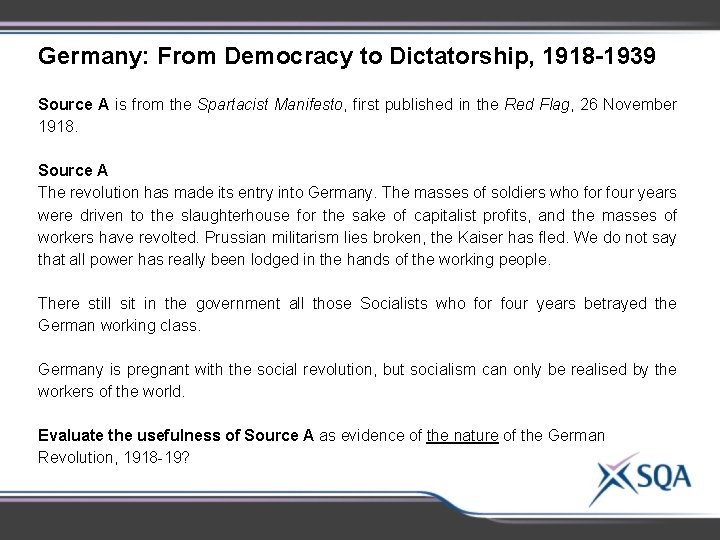
Germany: From Democracy to Dictatorship, 1918 -1939 Source A is from the Spartacist Manifesto, first published in the Red Flag, 26 November 1918. Source A The revolution has made its entry into Germany. The masses of soldiers who for four years were driven to the slaughterhouse for the sake of capitalist profits, and the masses of workers have revolted. Prussian militarism lies broken, the Kaiser has fled. We do not say that all power has really been lodged in the hands of the working people. There still sit in the government all those Socialists who for four years betrayed the German working class. Germany is pregnant with the social revolution, but socialism can only be realised by the workers of the world. Evaluate the usefulness of Source A as evidence of the nature of the German Revolution, 1918 -19?
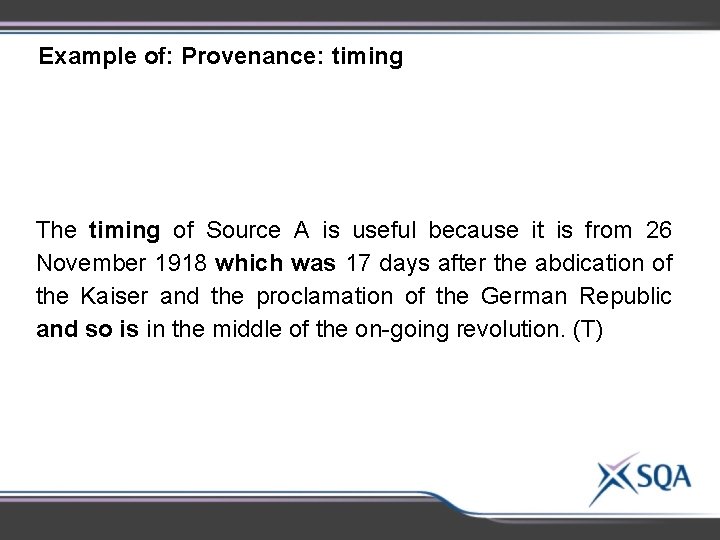
Example of: Provenance: timing The timing of Source A is useful because it is from 26 November 1918 which was 17 days after the abdication of the Kaiser and the proclamation of the German Republic and so is in the middle of the on-going revolution. (T)
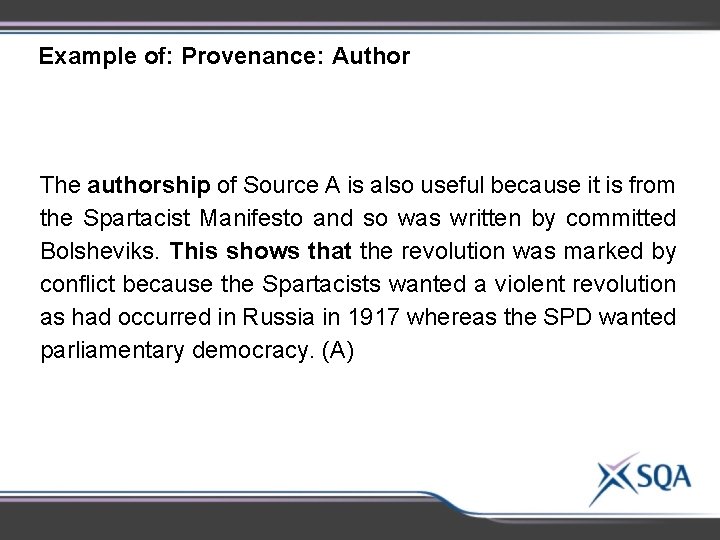
Example of: Provenance: Author The authorship of Source A is also useful because it is from the Spartacist Manifesto and so was written by committed Bolsheviks. This shows that the revolution was marked by conflict because the Spartacists wanted a violent revolution as had occurred in Russia in 1917 whereas the SPD wanted parliamentary democracy. (A)
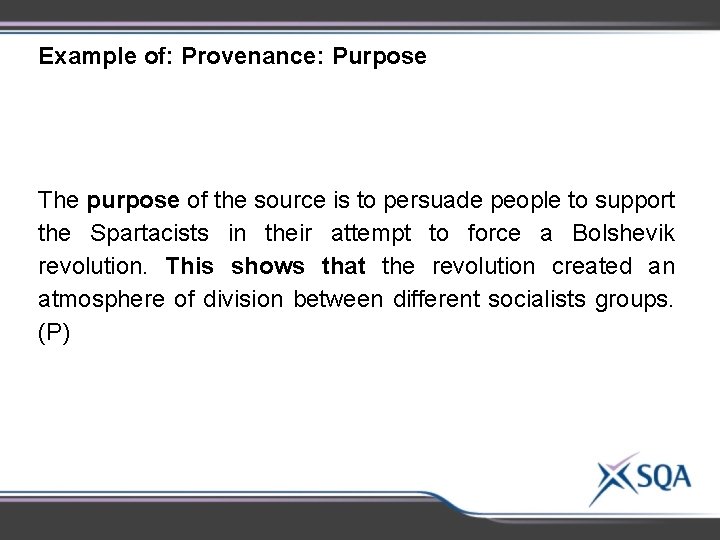
Example of: Provenance: Purpose The purpose of the source is to persuade people to support the Spartacists in their attempt to force a Bolshevik revolution. This shows that the revolution created an atmosphere of division between different socialists groups. (P)
Example of: Interpretation [of source content] The source says the masses of workers have revolted. This makes it useful because it suggests that the revolution was popular among the working classes in particular. (I)
Interpretation [of source content] (2) The source also states “the masses of soldiers were forced into the slaughterhouse for the sake of capitalist profits”. This makes it useful because it shows the revolution was both a reaction to the war and was anti-capitalist in its nature. (I)
Interpretation [of source content] (3) The source says too that ‘socialists who for four years betrayed the working class’. This makes it useful because it shows that those groups calling for revolution did not agree with one another about how the revolution should take place or the type of socialism that should be implemented. (I)
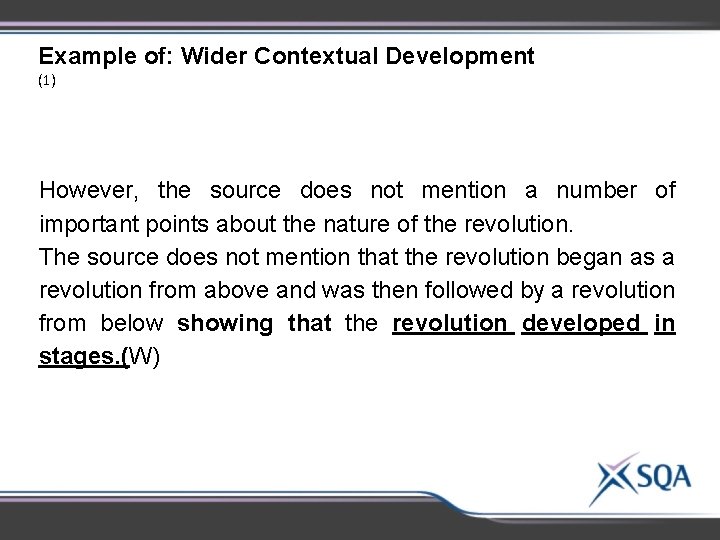
Example of: Wider Contextual Development (1) However, the source does not mention a number of important points about the nature of the revolution. The source does not mention that the revolution began as a revolution from above and was then followed by a revolution from below showing that the revolution developed in stages. (W)
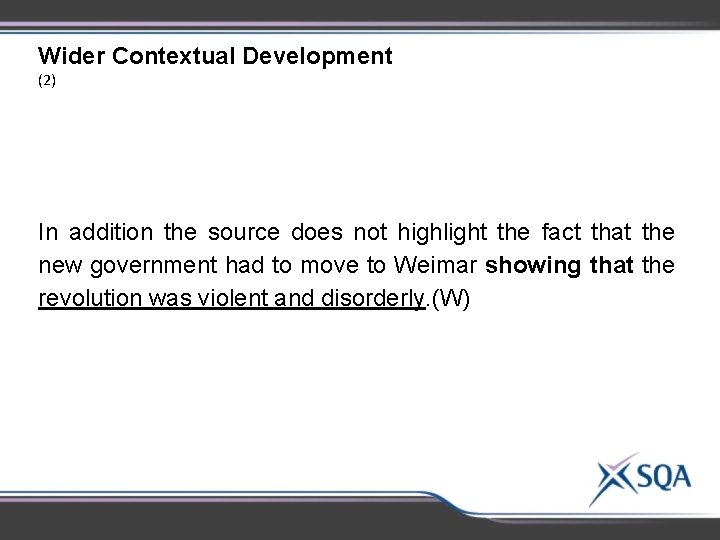
Wider Contextual Development (2) In addition the source does not highlight the fact that the new government had to move to Weimar showing that the revolution was violent and disorderly. (W)
Wider Contextual Development (3) It does not mention that there was strong opposition to the revolution from the Old Elites and this reflects the fact that the revolution was, politically, a cause of deep division between the left and right. (W)
Wider Contextual Development (4) Although Germany did change because of the revolution (from a monarchy to a republic, for example) in other ways it did not change at all. For example, as a result of the Ebert. Groener pact (10 Nov 1918) the army remained unreformed and still at the centre of politics. So during the revolution there was change but also continuity. (W)
Wider Contextual Development (5) Finally, the source does not mention that the revolution from below was sparked by mutinies at Kiel and Wilhelmshaven which led to strike in the cities and the setting up of soviets across Germany. This shows the revolution was led by workers and sailors, and that it was based on popular discontent and the demand for democratic change. (W)
Example of: Historians’ views (1) Lee argues that the revolutionary was really evolutionary in nature because many of the changes that occurred had already begun before the war. (H)
Historians’ views (1) Carr argues that the revolution was limited because much of the structure of Germany remained unaffected by the revolution. (H)
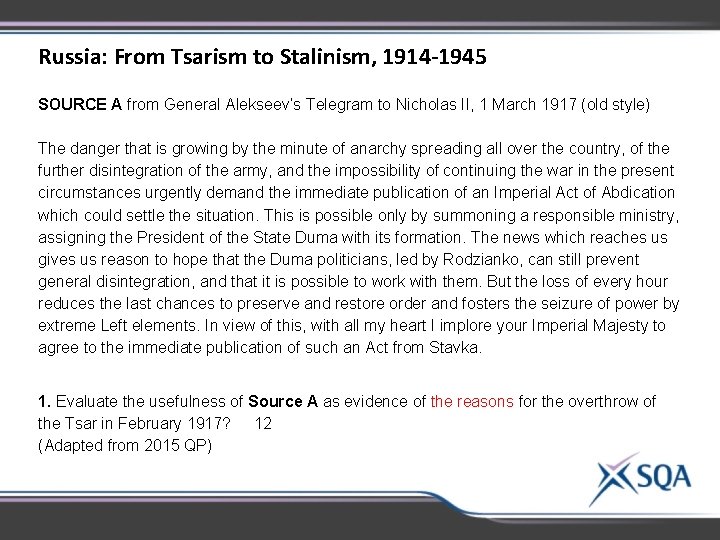
Russia: From Tsarism to Stalinism, 1914 -1945 SOURCE A from General Alekseev’s Telegram to Nicholas II, 1 March 1917 (old style) The danger that is growing by the minute of anarchy spreading all over the country, of the further disintegration of the army, and the impossibility of continuing the war in the present circumstances urgently demand the immediate publication of an Imperial Act of Abdication which could settle the situation. This is possible only by summoning a responsible ministry, assigning the President of the State Duma with its formation. The news which reaches us gives us reason to hope that the Duma politicians, led by Rodzianko, can still prevent general disintegration, and that it is possible to work with them. But the loss of every hour reduces the last chances to preserve and restore order and fosters the seizure of power by extreme Left elements. In view of this, with all my heart I implore your Imperial Majesty to agree to the immediate publication of such an Act from Stavka. 1. Evaluate the usefulness of Source A as evidence of the reasons for the overthrow of the Tsar in February 1917? 12 (Adapted from 2015 QP)
Example of: Provenance: Author The authorship of Source A is useful as evidence of the reasons for the overthrow of the Tsar because the source was written by one of the Tsarist Generals, General Alekseev, a leading General in the Russian military who had the support of many. This ensures the source is useful because it was written by someone very close to the Tsar who would have been well informed of the threats facing the Tsar, thus meaning the source is likely to be accurate and useful.
Example of: Provenance: Purpose However, the purpose of the source may lead to it not being so useful in explaining the reasons for the overthrow of the Tsar because it is known that General Alekseev was possibly involved in a plot alongside Duma politicians to remove the Tsar from power. This may limit the usefulness of the source because it may exaggerate threats posed to the Tsar in an attempt to increase the chances of the Tsar wishing to step down as leader as the factors stated in the source may in fact not be as bad as the source states.
Example of: Interpretation of source content and Historians’ views Source A is again useful because it states within it that “the danger that is growing by the minute of anarchy spreading all over the country” and this is useful as due to the Tsar’s poor running of the nation, both as a political and military leader it can be said that his autocracy failed and that this is a significant factor leading to his overthrow. The threat of disorder as a result of the failure of the Tsar’s authority can be noted as a major factor, as Figes states “Nicholas was the source of all problems” as he ruled an “autocracy without an autocrat” therefore this aspect of the source proves to be useful.
Example of: Wider contextual development and Historians’ views However the usefulness of the source as evidence of the reasons for the overthrow of the Tsar may be slightly limited as it fails to mention the increasing levels of social unrest in Russia as a result of the lack of food, as Figes states that the revolution was “born in the bread queues”. Due to Russia’s involvement in the war, most of the supplies were going to feed the army, leaving little food for the civilians in cities such as Petrograd and Moscow, as the unrest of these people also contributed to the overthrow of the Tsar, thus limiting the usefulness of the source.
The ‘How Fully…’ question 12 marks
The ‘How fully does [Source] explain [event]? What is it asking? Asking candidates to contextualise a source and establish a judgement of the overall value of the source. Candidates should ♦ interpret the main views of the source ♦ identify and explain the immediate and wider factors necessary to provide a full explanation of the events the question is focused on. ♦ include relevant historiography
How fully does [source] explain…? Judgement (which should be quantitative) Source B reveals… to some extent/ a lot about/ not very much about Interpretation (I) 3 marks 1 2 3 Wider contextual development (WCD) 7 marks 1 2 3 4 5 6 7 Historians’ Views (H) 2 marks 1 2
Germany: From Democracy to Dictatorship, 1918 -1939 SOURCE A from Recollections of the German Revolution of 1919 by Arnold Brecht (1970) A military army of Spartacists would have inevitably led to the establishment of a Communist system in Germany, and it was this that Ebert and Scheidemann wanted to avoid. They were convinced opponents of such a system, in the interests both of the working classes and their own ideals of freedom and justice. By far the largest section of the working classes was behind them in this and certainly had no reason to feel that they were betrayed by them. A moderate revolution is far more difficult to carry through than one which is radical, extremist and determined to use any methods to achieve its ends. . . Ebert and the Social Democrats acted in accordance with their beliefs and the upright desire to put Germany and the German people back on their feet after a dreadful defeat; they did this to the best of their knowledge and belief. How fully does Source A explain the reasons for the suppression of the Spartacist Revolt in January 1919? 12
Example of: Judgement/Introductory sentence Source A explains the reasons for the suppression of the Spartacist revolt to some extent.
Example of: Interpretation (Content) (1) The source says that the success of Spartacism would have meant the establishment of a Communist system, which Ebert and Scheidemann wanted to avoid. This was a key reason for the suppression of the Spartacist Revolt because Ebert hated Bolshevism and had seen what had happened in Russia and knew that most Germans feared Bolshevism. (I)
Interpretation (Content) (2) The source also says that Ebert and the SPD had the largest section of the working classes behind them. This was a reason for the suppression of the Spartacists because Ebert was confident that he would have popular support. (I)
Interpretation (Content) (3) Furthermore the source says Ebert and the SPD believed that suppressing the Spartacists would help put the German people back on their feet. This shows that one of the reasons the Spartacists were suppressed was because they were causing unrest and therefore instability. (I)
Example of: Wider Contextual Development (1) The Spartacist Revolt took place in January 1919 and placed the regime under p a lot of pressure. Ebert tended to exaggerate the size of the threat, which was one reason he wanted the Spartacists to be suppressed (because he feared the spread of their influence). (W)
Wider Contextual Development (2) The Spartacists were suppressed by the Army with assistance from the Freikorps. This explains why the Spartacists were suppressed so brutally. The Army and the Freikorps were ultra-nationalist and hated Bolshevism. (W)
Wider Contextual Development (3) That Ebert was able to crush Spartacism so easily in Jan 1919 was partly because on 10 November 1918 he had made a pact over the telephone with the Head of the Army, Groener, in which he agreed not to reform the officer corps in return for getting the promise that the army would support the republic. (W)
Wider Contextual Development (4) Luxembourg and Liebknecht disagreed about the timing of a Bolshevik revolution but Luxembourg went along the Liebknecht which meant that the Spartacists were indeed not organised or strong enough to challenge the new regime and so were crushed. (W)
Wider Contextual Development (5) Ebert was keen to secure the support of the old elite and so crushing Spartacism would be a clear demonstration to the old elite that he would not tolerate disruption caused by the extreme left. (W)
Wider Contextual Development (6) Furthermore, Ebert had scheduled democratic elections for January 1919 and he did not want that democratic process to be disrupted by the Spartacists and so ordered the suppression of their revolt. (W)
Wider Contextual Development (6) Ebert was also terrified of the prospect of civil war in Germany. He saw what was happening in Russia where the country had descended into chaos, bloodshed on a massive scale, and did not want this to happen in Germany. (W)
Wider Contextual Development (7) Ebert was also terrified of the prospect of civil war in Germany. He saw what was happening in Russia where the country had descended into chaos, bloodshed on a massive scale, and did not want this to happen in Germany. (W)
Example of: Historians’ views (1) Evans argued that Ebert crushed the Spartacists because he (Ebert) hated Communism and so would not tolerate it. (H)
Historians’ views (2) Carr argues that Ebert crushed the Spartacists because they were a clear challenge to the authority of the government and so he thought prompt action needed to be taken. (H)
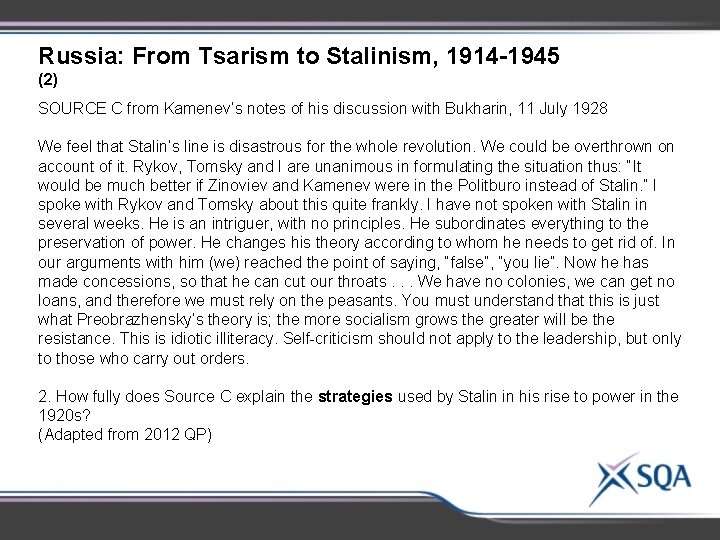
Russia: From Tsarism to Stalinism, 1914 -1945 (2) SOURCE C from Kamenev’s notes of his discussion with Bukharin, 11 July 1928 We feel that Stalin’s line is disastrous for the whole revolution. We could be overthrown on account of it. Rykov, Tomsky and I are unanimous in formulating the situation thus: “It would be much better if Zinoviev and Kamenev were in the Politburo instead of Stalin. ” I spoke with Rykov and Tomsky about this quite frankly. I have not spoken with Stalin in several weeks. He is an intriguer, with no principles. He subordinates everything to the preservation of power. He changes his theory according to whom he needs to get rid of. In our arguments with him (we) reached the point of saying, “false”, “you lie”. Now he has made concessions, so that he can cut our throats. . . We have no colonies, we can get no loans, and therefore we must rely on the peasants. You must understand that this is just what Preobrazhensky’s theory is; the more socialism grows the greater will be the resistance. This is idiotic illiteracy. Self-criticism should not apply to the leadership, but only to those who carry out orders. 2. How fully does Source C explain the strategies used by Stalin in his rise to power in the 1920 s? (Adapted from 2012 QP)
Example of: Judgement/Introductory sentence Source C explains the strategies used by Stalin in his rise to power in the 1920 s to an extent.
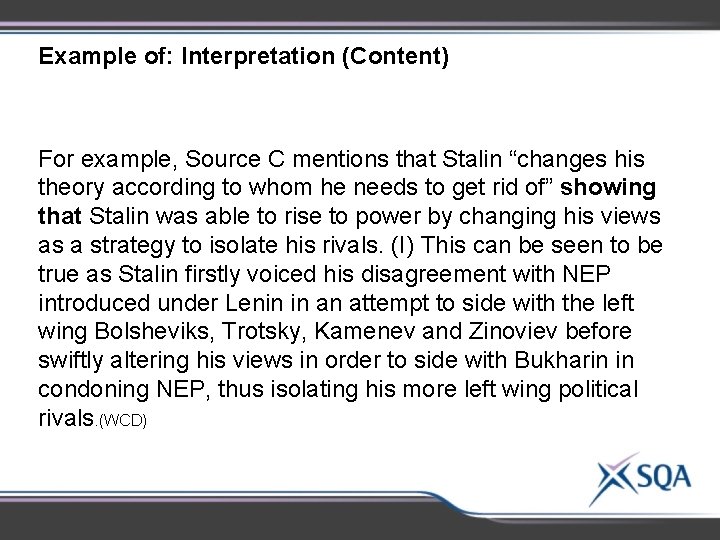
Example of: Interpretation (Content) For example, Source C mentions that Stalin “changes his theory according to whom he needs to get rid of” showing that Stalin was able to rise to power by changing his views as a strategy to isolate his rivals. (I) This can be seen to be true as Stalin firstly voiced his disagreement with NEP introduced under Lenin in an attempt to side with the left wing Bolsheviks, Trotsky, Kamenev and Zinoviev before swiftly altering his views in order to side with Bukharin in condoning NEP, thus isolating his more left wing political rivals. (WCD)
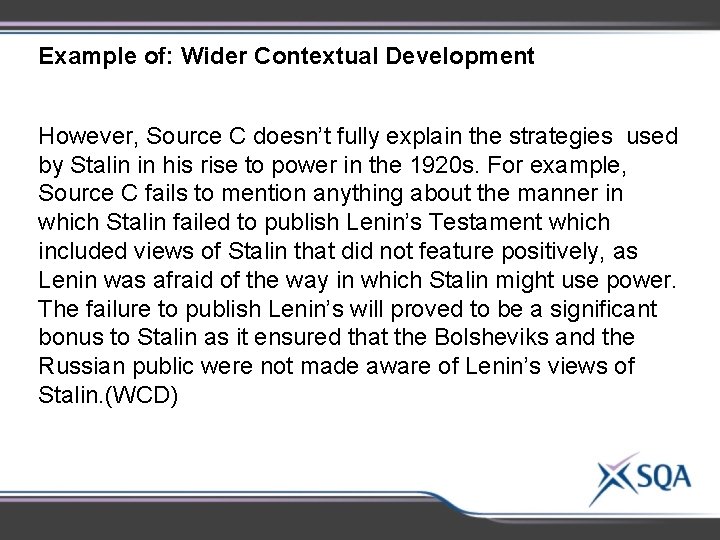
Example of: Wider Contextual Development However, Source C doesn’t fully explain the strategies used by Stalin in his rise to power in the 1920 s. For example, Source C fails to mention anything about the manner in which Stalin failed to publish Lenin’s Testament which included views of Stalin that did not feature positively, as Lenin was afraid of the way in which Stalin might use power. The failure to publish Lenin’s will proved to be a significant bonus to Stalin as it ensured that the Bolsheviks and the Russian public were not made aware of Lenin’s views of Stalin. (WCD)
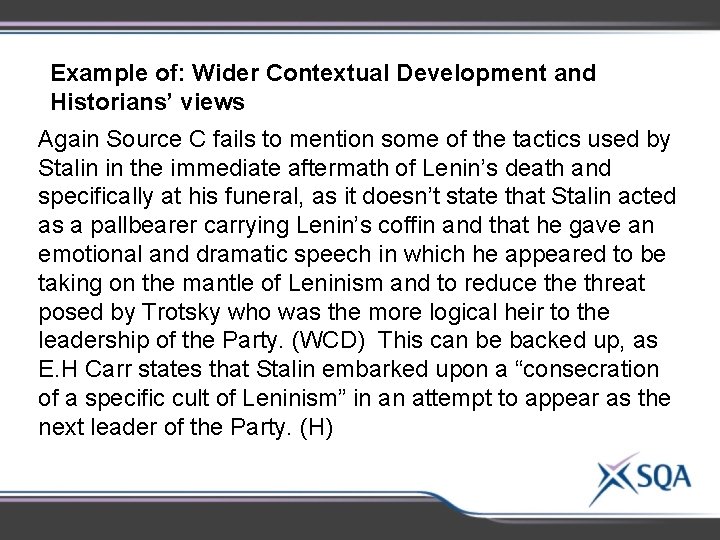
Example of: Wider Contextual Development and Historians’ views Again Source C fails to mention some of the tactics used by Stalin in the immediate aftermath of Lenin’s death and specifically at his funeral, as it doesn’t state that Stalin acted as a pallbearer carrying Lenin’s coffin and that he gave an emotional and dramatic speech in which he appeared to be taking on the mantle of Leninism and to reduce threat posed by Trotsky who was the more logical heir to the leadership of the Party. (WCD) This can be backed up, as E. H Carr states that Stalin embarked upon a “consecration of a specific cult of Leninism” in an attempt to appear as the next leader of the Party. (H)
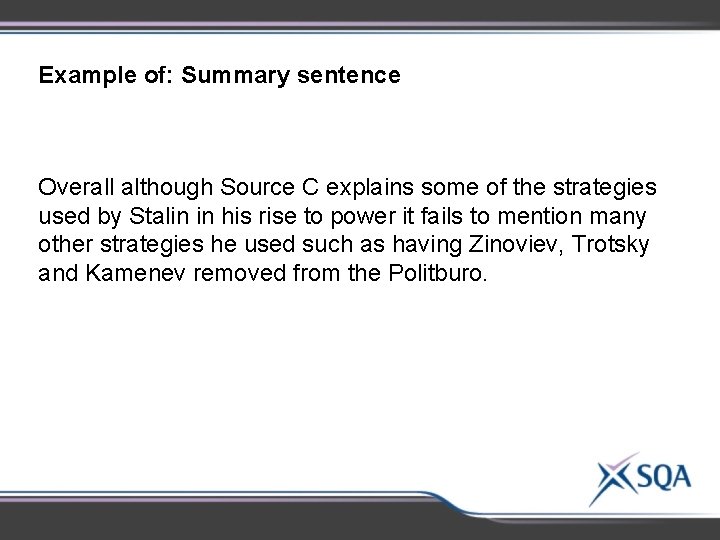
Example of: Summary sentence Overall although Source C explains some of the strategies used by Stalin in his rise to power it fails to mention many other strategies he used such as having Zinoviev, Trotsky and Kamenev removed from the Politburo.
The ‘ 2 source’ question 16 marks
How much do [sources] reveal about differing interpretations of. . . The two-source question marks) (16 What is it asking? Asking candidates to establish the views of two sources, making a judgement of the quality of each source’s interpretation of a specific issue. Candidates should ♦ identify and explain the main interpretations of the two sources (three clear points from each source) ♦ develop the source points/interpretations by introducing the wider context (i. e. relevant recall) ♦ introduce recalled knowledge to contextualise the content/interpretations of the sources. ♦ Include relevant historiography and/or comment on the provenance of the sources.
How much so [sources] reveal about differing interpretations of…? Assertion (Quantitative) Interpretation of First Source: 3 marks ♦ Overall view Then three points of detailed evidence 1 2 3 Interpretation of Second of Source; 3 marks ♦ Overall view Then three points of detailed evidence 1 2 3 WCD: 8 marks Historians’ Views: 2 marks
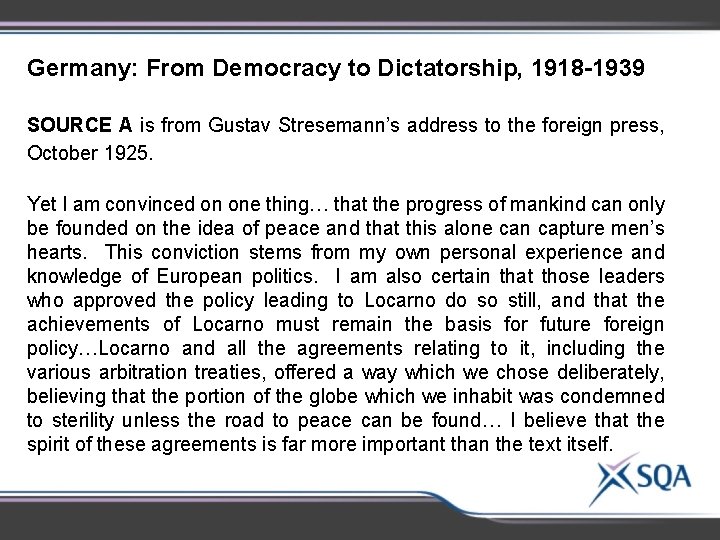
Germany: From Democracy to Dictatorship, 1918 -1939 SOURCE A is from Gustav Stresemann’s address to the foreign press, October 1925. Yet I am convinced on one thing… that the progress of mankind can only be founded on the idea of peace and that this alone can capture men’s hearts. This conviction stems from my own personal experience and knowledge of European politics. I am also certain that those leaders who approved the policy leading to Locarno do so still, and that the achievements of Locarno must remain the basis for future foreign policy…Locarno and all the agreements relating to it, including the various arbitration treaties, offered a way which we chose deliberately, believing that the portion of the globe which we inhabit was condemned to sterility unless the road to peace can be found… I believe that the spirit of these agreements is far more important than the text itself.
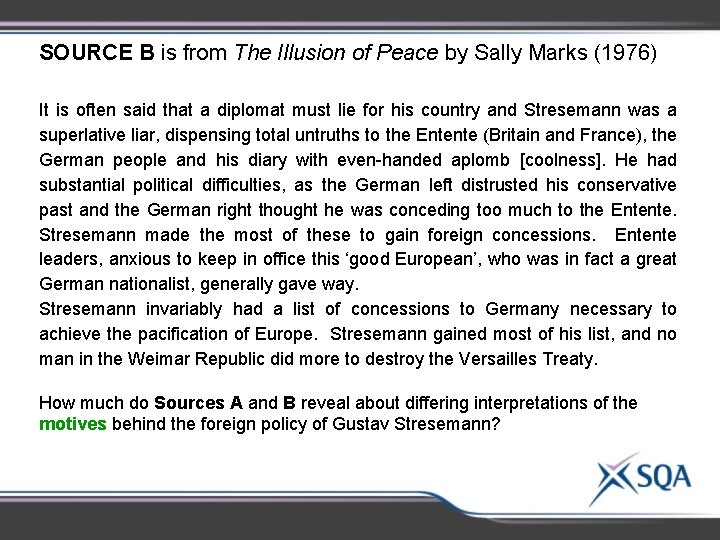
SOURCE B is from The Illusion of Peace by Sally Marks (1976) It is often said that a diplomat must lie for his country and Stresemann was a superlative liar, dispensing total untruths to the Entente (Britain and France), the German people and his diary with even-handed aplomb [coolness]. He had substantial political difficulties, as the German left distrusted his conservative past and the German right thought he was conceding too much to the Entente. Stresemann made the most of these to gain foreign concessions. Entente leaders, anxious to keep in office this ‘good European’, who was in fact a great German nationalist, generally gave way. Stresemann invariably had a list of concessions to Germany necessary to achieve the pacification of Europe. Stresemann gained most of his list, and no man in the Weimar Republic did more to destroy the Versailles Treaty. How much do Sources A and B reveal about differing interpretations of the motives behind the foreign policy of Gustav Stresemann?
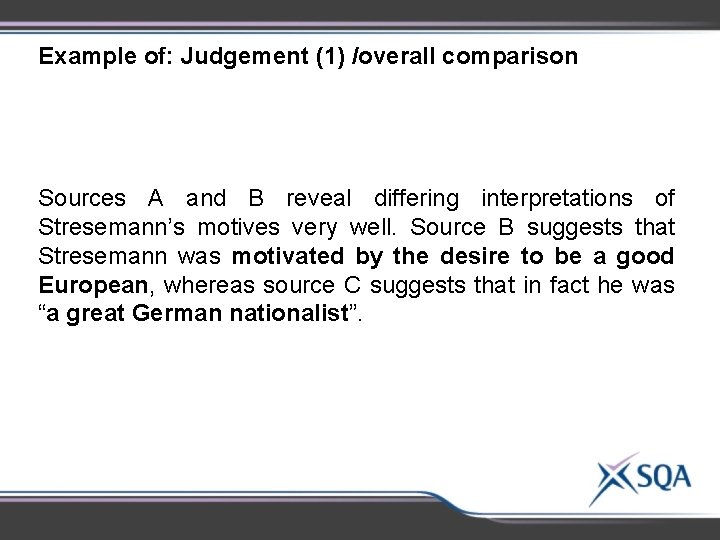
Example of: Judgement (1) /overall comparison Sources A and B reveal differing interpretations of Stresemann’s motives very well. Source B suggests that Stresemann was motivated by the desire to be a good European, whereas source C suggests that in fact he was “a great German nationalist”.
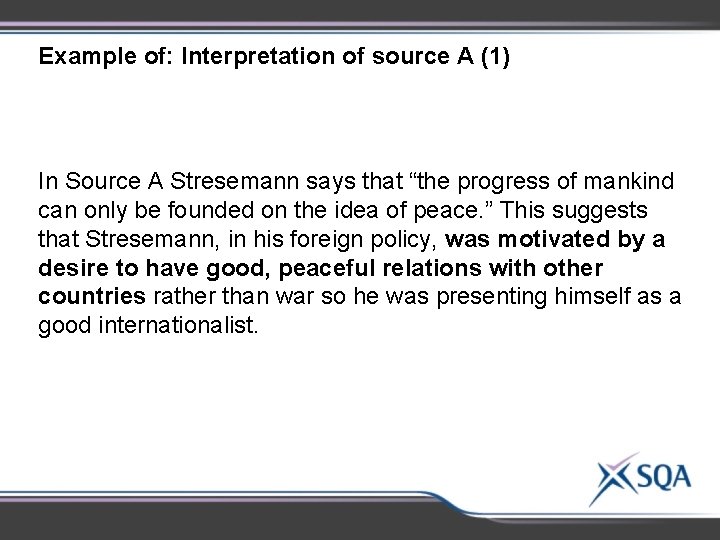
Example of: Interpretation of source A (1) In Source A Stresemann says that “the progress of mankind can only be founded on the idea of peace. ” This suggests that Stresemann, in his foreign policy, was motivated by a desire to have good, peaceful relations with other countries rather than war so he was presenting himself as a good internationalist.
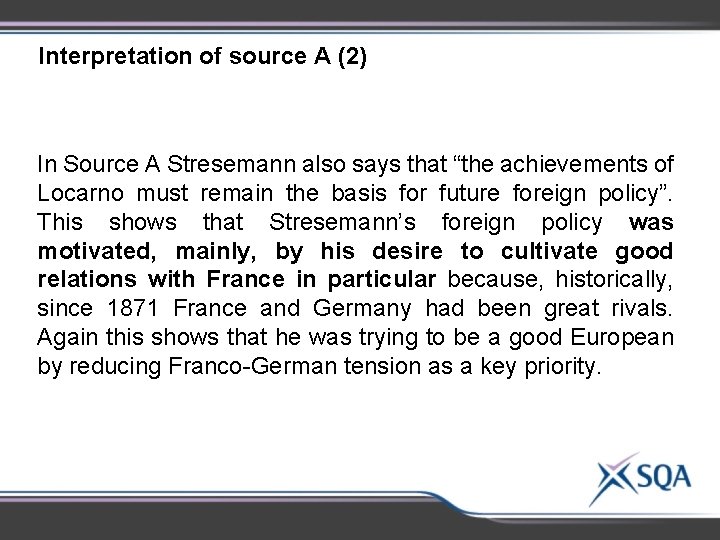
Interpretation of source A (2) In Source A Stresemann also says that “the achievements of Locarno must remain the basis for future foreign policy”. This shows that Stresemann’s foreign policy was motivated, mainly, by his desire to cultivate good relations with France in particular because, historically, since 1871 France and Germany had been great rivals. Again this shows that he was trying to be a good European by reducing Franco-German tension as a key priority.
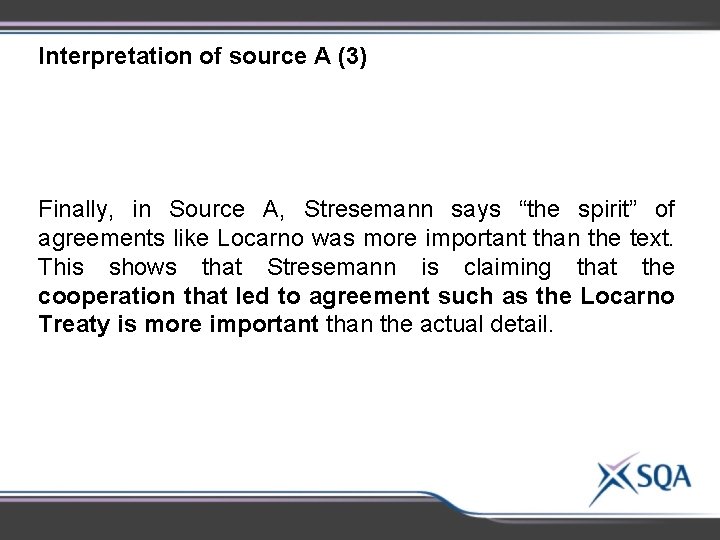
Interpretation of source A (3) Finally, in Source A, Stresemann says “the spirit” of agreements like Locarno was more important than the text. This shows that Stresemann is claiming that the cooperation that led to agreement such as the Locarno Treaty is more important than the actual detail.
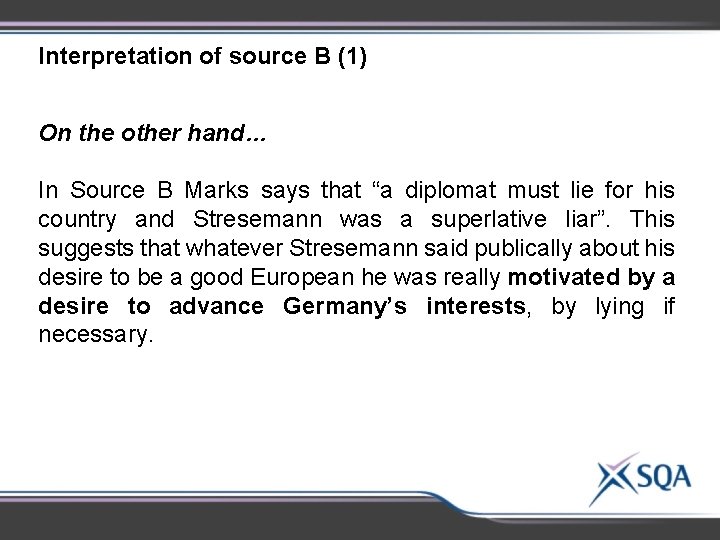
Interpretation of source B (1) On the other hand… In Source B Marks says that “a diplomat must lie for his country and Stresemann was a superlative liar”. This suggests that whatever Stresemann said publically about his desire to be a good European he was really motivated by a desire to advance Germany’s interests, by lying if necessary.
Interpretation of Source B (2) Furthermore, in Source B Marks says that Stresemann had substantial political difficulties… at home and made the most of these to gain foreign concessions. He pressurised the Allies (who wanted to keep him in office) by saying that if he was not successful in his foreign policy then he would be kicked out of office. This suggests that Stresemann’s foreign policy was motivated by resolving issues on a national level and not achieving peace in Europe.
Interpretation of Source B (3) Finally, in Source B Marks says “no man in the Weimar Republic did more to destroy the Versailles Treaty. ” This shows that his foreign policy was fuelled by the desire to please the German people through destroying the Versailles treaty, which they hated, and which was an international Treaty so he was in fact a nationalist first and foremost.
Judgement (2) However, Sources B and C leave out important illustrations of the debate about the motives behind Stresemann’s foreign policy.
Example of: Wider Contextual Development The Sources make no mention either of the fact that the Locarno Pact (1925) was an international treaty which fixed the western borders of Germany, thereby ensuring Franco. German relations and maintaining peace highlighting Stresemann’s good Europeanism. It could be argued that Locarno is the best example of Stresemann’s motives because it shows that he was happy to sacrifice German interests to please France. (WCD) Yet Locarno left open the question of Germany’s eastern borders and so left open the question of future German expansion eastwards – traditional nationalist ambition. (WCD)
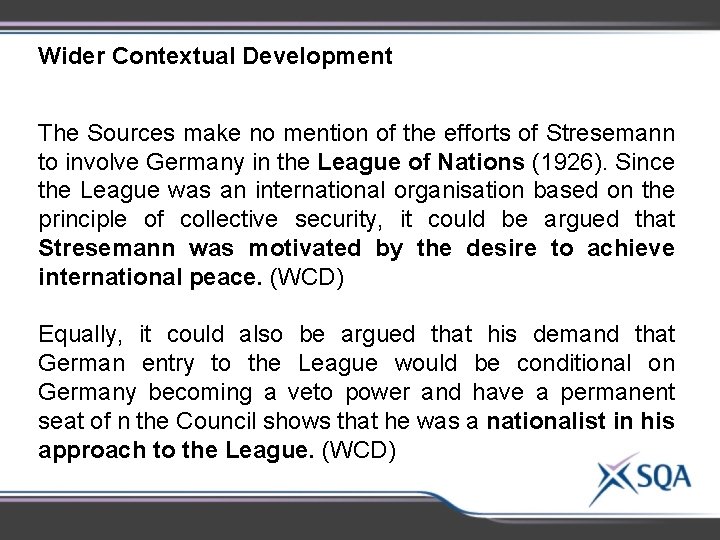
Wider Contextual Development The Sources make no mention of the efforts of Stresemann to involve Germany in the League of Nations (1926). Since the League was an international organisation based on the principle of collective security, it could be argued that Stresemann was motivated by the desire to achieve international peace. (WCD) Equally, it could also be argued that his demand that German entry to the League would be conditional on Germany becoming a veto power and have a permanent seat of n the Council shows that he was a nationalist in his approach to the League. (WCD)
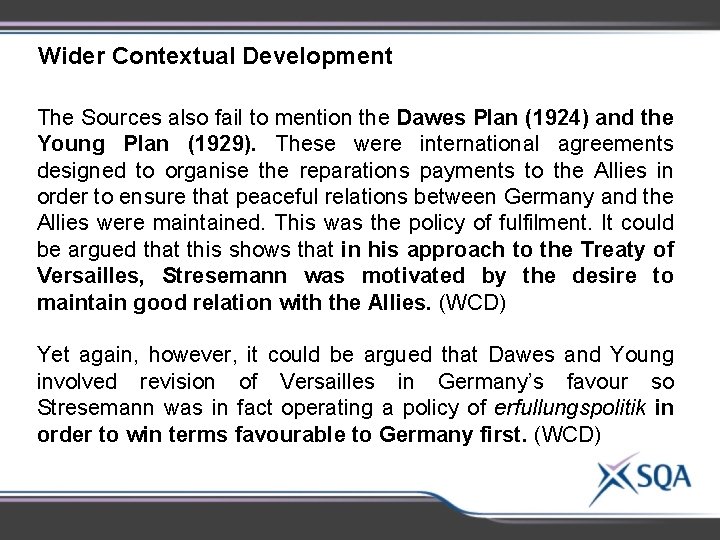
Wider Contextual Development The Sources also fail to mention the Dawes Plan (1924) and the Young Plan (1929). These were international agreements designed to organise the reparations payments to the Allies in order to ensure that peaceful relations between Germany and the Allies were maintained. This was the policy of fulfilment. It could be argued that this shows that in his approach to the Treaty of Versailles, Stresemann was motivated by the desire to maintain good relation with the Allies. (WCD) Yet again, however, it could be argued that Dawes and Young involved revision of Versailles in Germany’s favour so Stresemann was in fact operating a policy of erfullungspolitik in order to win terms favourable to Germany first. (WCD)
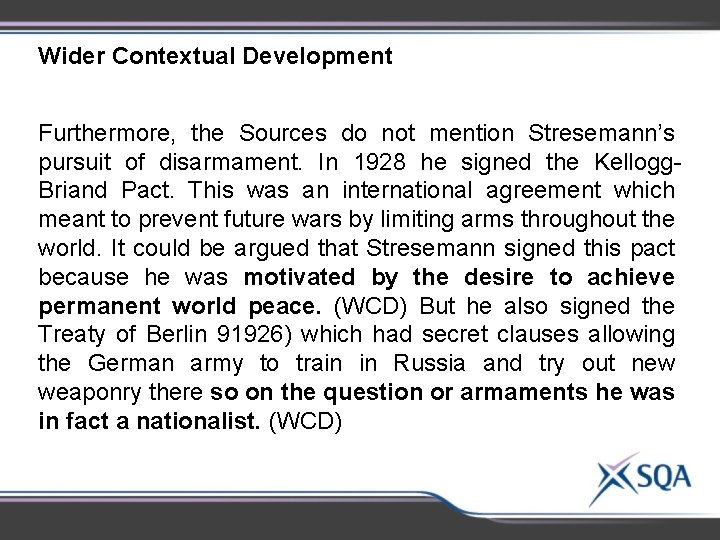
Wider Contextual Development Furthermore, the Sources do not mention Stresemann’s pursuit of disarmament. In 1928 he signed the Kellogg. Briand Pact. This was an international agreement which meant to prevent future wars by limiting arms throughout the world. It could be argued that Stresemann signed this pact because he was motivated by the desire to achieve permanent world peace. (WCD) But he also signed the Treaty of Berlin 91926) which had secret clauses allowing the German army to train in Russia and try out new weaponry there so on the question or armaments he was in fact a nationalist. (WCD)
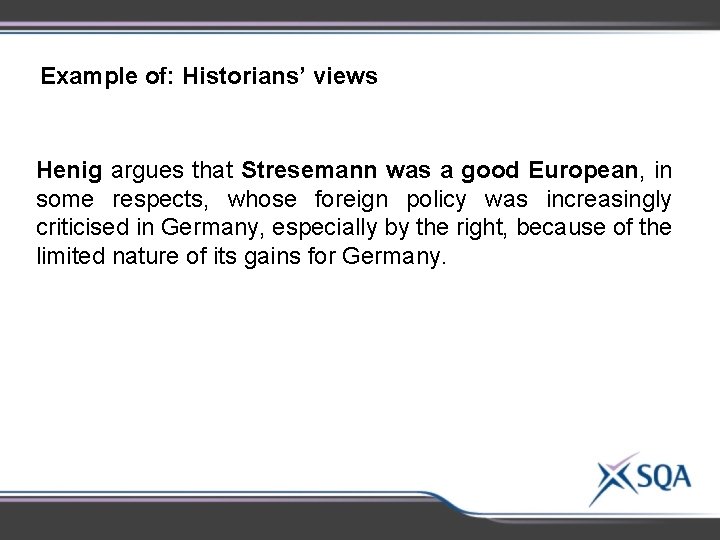
Example of: Historians’ views Henig argues that Stresemann was a good European, in some respects, whose foreign policy was increasingly criticised in Germany, especially by the right, because of the limited nature of its gains for Germany.
Historians’ views Lee argues that Stresemann was motivated both by a wish to be a good European and to advance the interests of Germany and that his foreign policy could be described as pragmatic or realist nationalism.
Advanced Higher History The Project (Dissertation) 50 marks out of a total of 140 marks (approx. one third of overall marks)
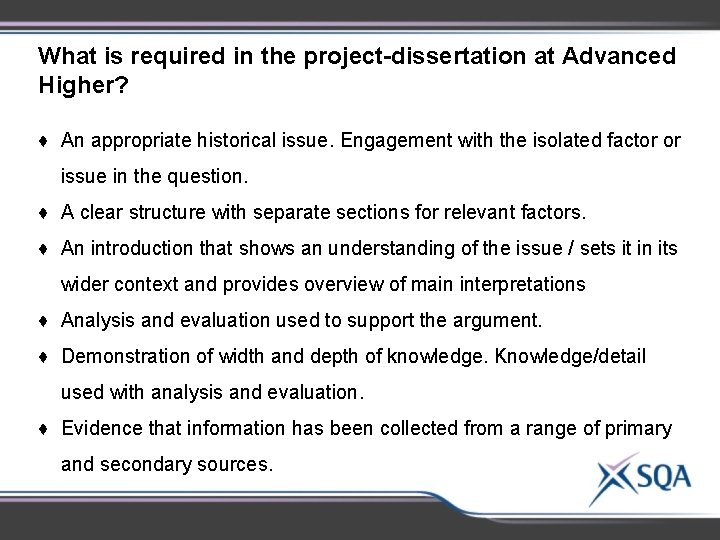
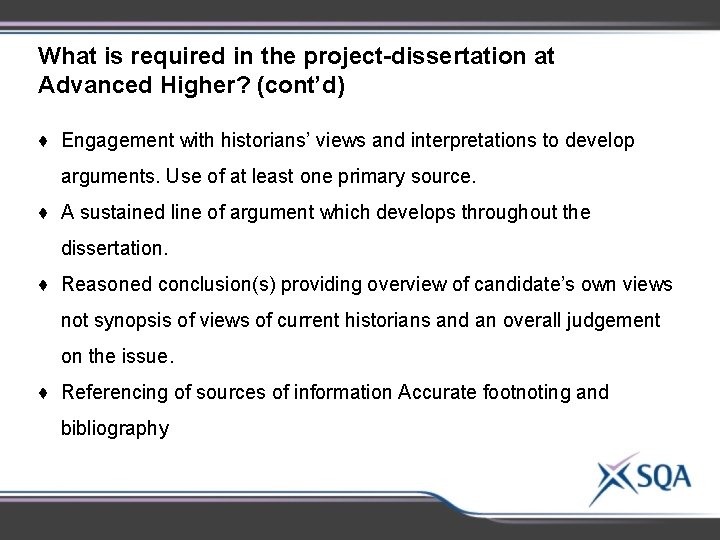
What is required in the project-dissertation at Advanced Higher? ♦ An appropriate historical issue. Engagement with the isolated factor or issue in the question. ♦ A clear structure with separate sections for relevant factors. ♦ An introduction that shows an understanding of the issue / sets it in its wider context and provides overview of main interpretations ♦ Analysis and evaluation used to support the argument. ♦ Demonstration of width and depth of knowledge. Knowledge/detail used with analysis and evaluation. ♦ Evidence that information has been collected from a range of primary and secondary sources.
What is required in the project-dissertation at Advanced Higher? (cont’d) ♦ Engagement with historians’ views and interpretations to develop arguments. Use of at least one primary source. ♦ A sustained line of argument which develops throughout the dissertation. ♦ Reasoned conclusion(s) providing overview of candidate’s own views not synopsis of views of current historians and an overall judgement on the issue. ♦ Referencing of sources of information Accurate footnoting and bibliography
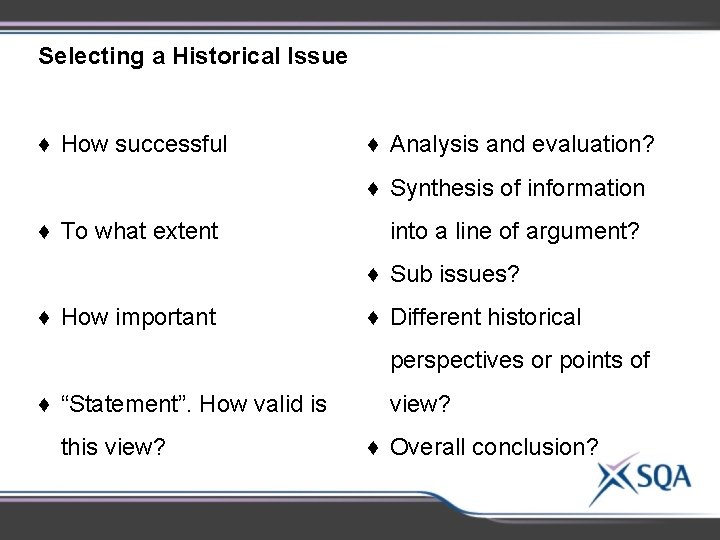
Selecting a Historical Issue ♦ How successful ♦ Analysis and evaluation? ♦ Synthesis of information ♦ To what extent into a line of argument? ♦ Sub issues? ♦ How important ♦ Different historical perspectives or points of ♦ “Statement”. How valid is this view? ♦ Overall conclusion?
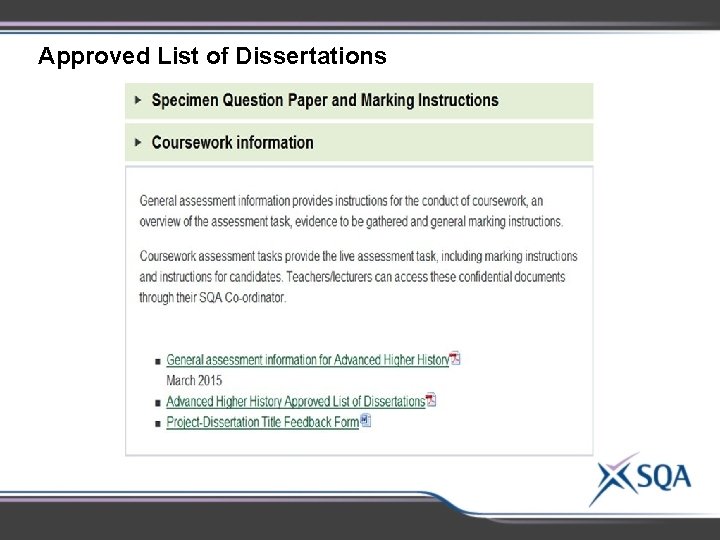
Approved List of Dissertations
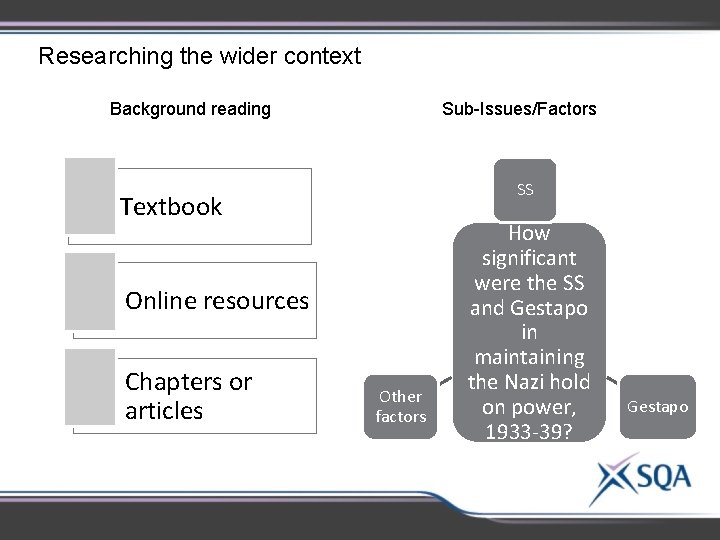
Researching the wider context Background reading Sub-Issues/Factors SS Textbook Online resources Chapters or articles Other factors How significant were the SS and Gestapo in maintaining the Nazi hold on power, 1933 -39? Gestapo
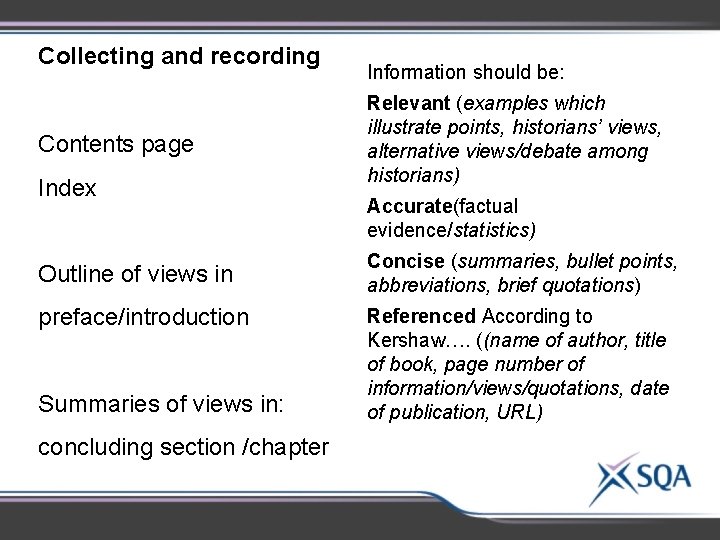
Collecting and recording Contents page Index Outline of views in preface/introduction Summaries of views in: concluding section /chapter Information should be: Relevant (examples which illustrate points, historians’ views, alternative views/debate among historians) Accurate(factual evidence/statistics) Concise (summaries, bullet points, abbreviations, brief quotations) Referenced According to Kershaw…. ((name of author, title of book, page number of information/views/quotations, date of publication, URL)
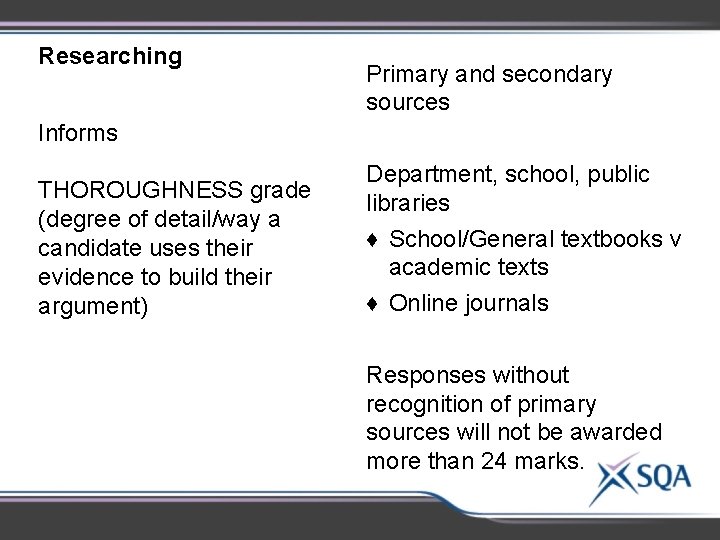
Researching Primary and secondary sources Informs THOROUGHNESS grade (degree of detail/way a candidate uses their evidence to build their argument) Department, school, public libraries ♦ School/General textbooks v academic texts ♦ Online journals Responses without recognition of primary sources will not be awarded more than 24 marks.
Historiography To obtain more than 24 marks, there must be a reference (however minor) Informs Historical sources /Interpretations grade Historical views Interpretations At Advanced Higher level, there must be clear evidence of wide research and reading, and therefore some awareness that there are different views on an issue to historiography. Awareness of historical debates/historians’ arguments (rather than just quoting) Engagement with historians’ interpretations Historians’ views embedded throughout the dissertation (points supported with evidence and with views of historians, as paragraphs develop) Textbooks and wider reading
Structure Introduction The introduction should: ♦ contextualise/ demonstrate an understanding of the issue ♦ Highlight the key arguments and areas of debate ♦ present the writer’s line of argument to be proved in the chapters in the main body ♦ clarify the approach and order of coverage
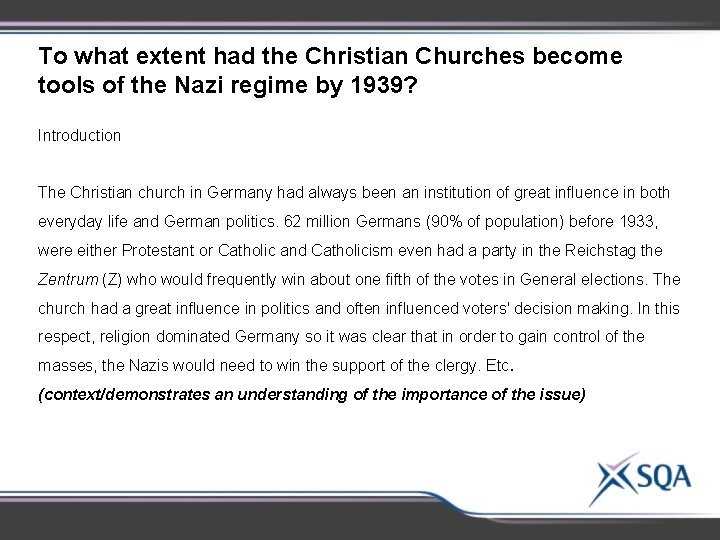
To what extent had the Christian Churches become tools of the Nazi regime by 1939? Introduction The Christian church in Germany had always been an institution of great influence in both everyday life and German politics. 62 million Germans (90% of population) before 1933, were either Protestant or Catholic and Catholicism even had a party in the Reichstag the Zentrum (Z) who would frequently win about one fifth of the votes in General elections. The church had a great influence in politics and often influenced voters' decision making. In this respect, religion dominated Germany so it was clear that in order to gain control of the masses, the Nazis would need to win the support of the clergy. Etc. (context/demonstrates an understanding of the importance of the issue)
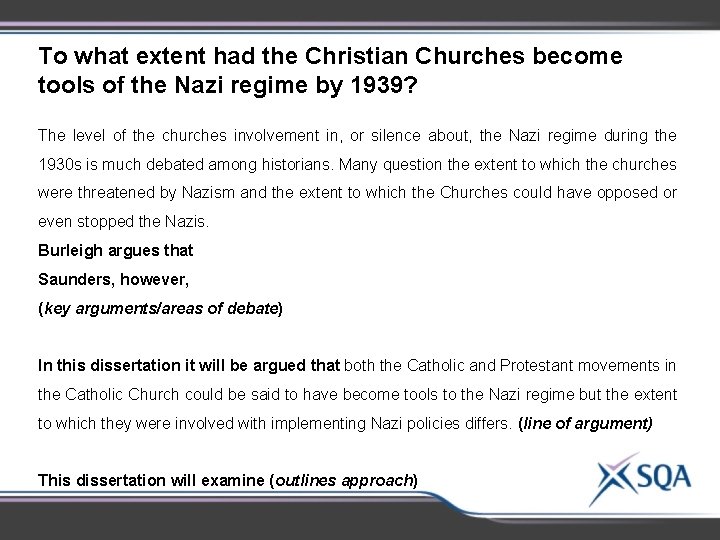
To what extent had the Christian Churches become tools of the Nazi regime by 1939? The level of the churches involvement in, or silence about, the Nazi regime during the 1930 s is much debated among historians. Many question the extent to which the churches were threatened by Nazism and the extent to which the Churches could have opposed or even stopped the Nazis. Burleigh argues that Saunders, however, (key arguments/areas of debate) In this dissertation it will be argued that both the Catholic and Protestant movements in the Catholic Church could be said to have become tools to the Nazi regime but the extent to which they were involved with implementing Nazi policies differs. (line of argument) This dissertation will examine (outlines approach)
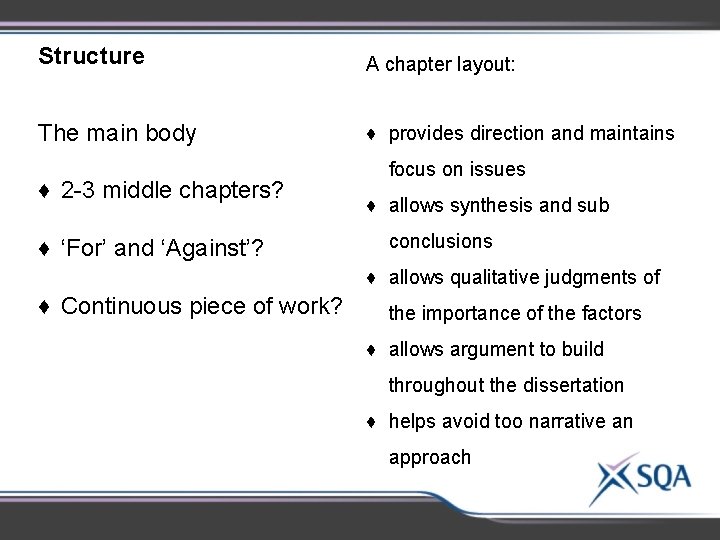
Structure A chapter layout: The main body ♦ provides direction and maintains ♦ 2 -3 middle chapters? ♦ ‘For’ and ‘Against’? focus on issues ♦ allows synthesis and sub conclusions ♦ allows qualitative judgments of ♦ Continuous piece of work? the importance of the factors ♦ allows argument to build throughout the dissertation ♦ helps avoid too narrative an approach
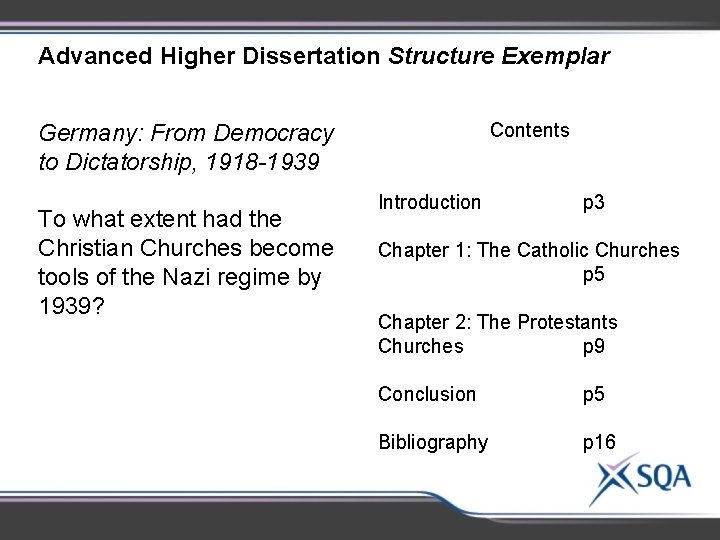
Advanced Higher Dissertation Structure Exemplar Germany: From Democracy to Dictatorship, 1918 -1939 To what extent had the Christian Churches become tools of the Nazi regime by 1939? Contents Introduction p 3 Chapter 1: The Catholic Churches p 5 Chapter 2: The Protestants Churches p 9 Conclusion p 5 Bibliography p 16
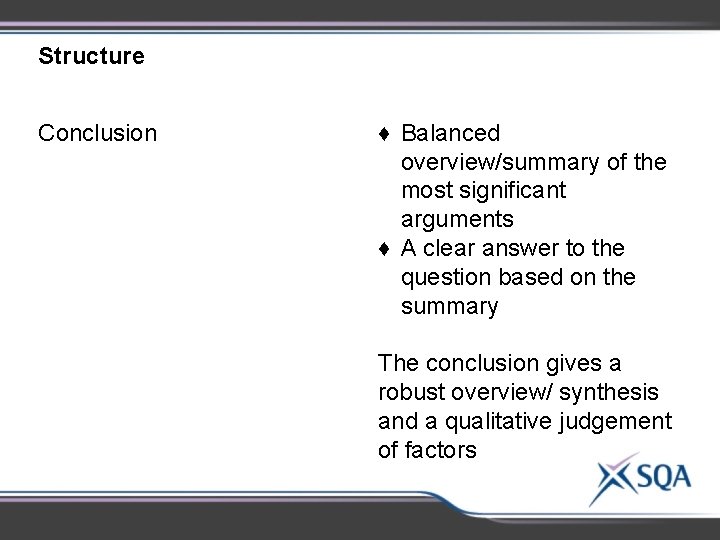
Structure Conclusion ♦ Balanced overview/summary of the most significant arguments ♦ A clear answer to the question based on the summary The conclusion gives a robust overview/ synthesis and a qualitative judgement of factors
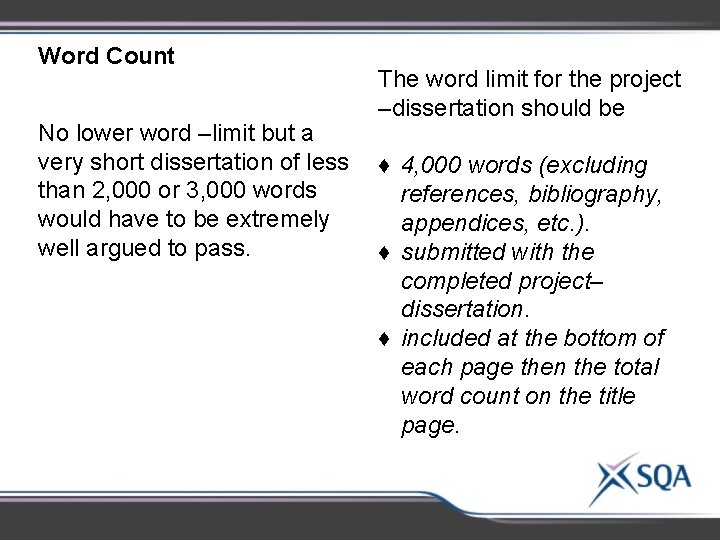
Word Count The word limit for the project –dissertation should be No lower word –limit but a very short dissertation of less ♦ 4, 000 words (excluding than 2, 000 or 3, 000 words references, bibliography, would have to be extremely appendices, etc. ). well argued to pass. ♦ submitted with the completed project– dissertation. ♦ included at the bottom of each page then the total word count on the title page.
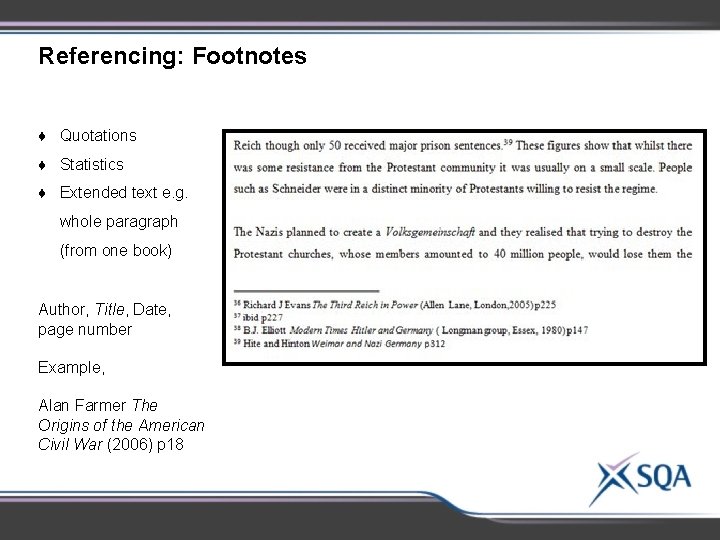
Referencing: Footnotes ♦ Quotations ♦ Statistics ♦ Extended text e. g. whole paragraph (from one book) Author, Title, Date, page number Example, Alan Farmer The Origins of the American Civil War (2006) p 18
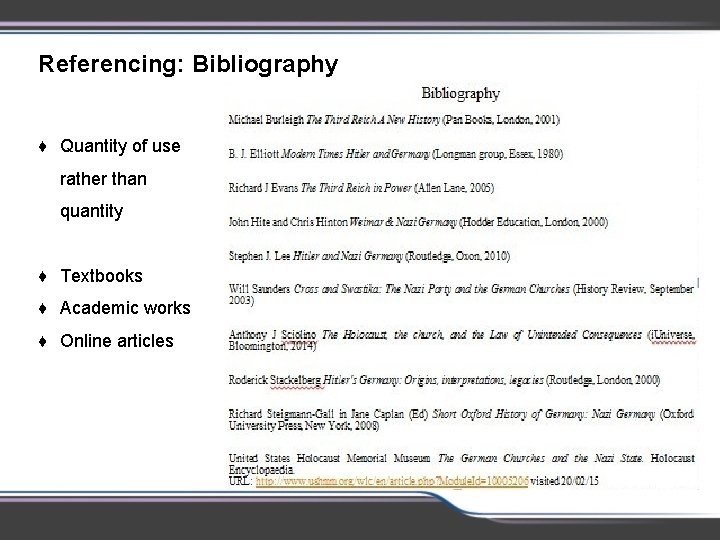
Referencing: Bibliography ♦ Quantity of use rather than quantity ♦ Textbooks ♦ Academic works ♦ Online articles
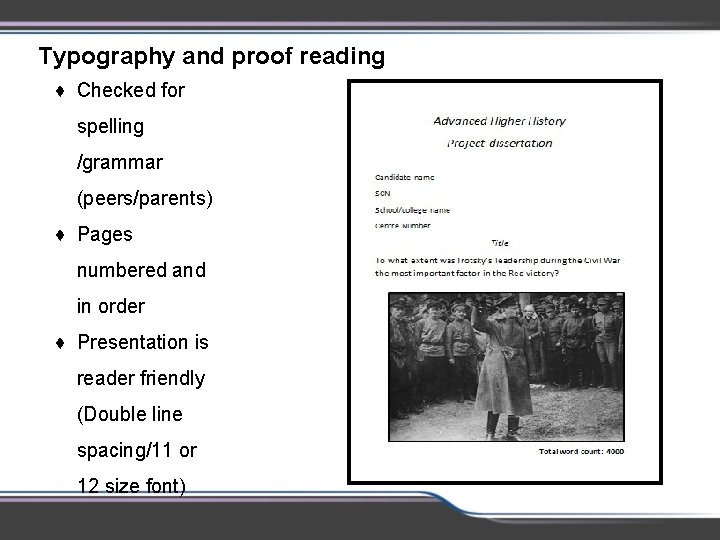
Typography and proof reading ♦ Checked for spelling /grammar (peers/parents) ♦ Pages numbered and in order ♦ Presentation is reader friendly (Double line spacing/11 or 12 size font)
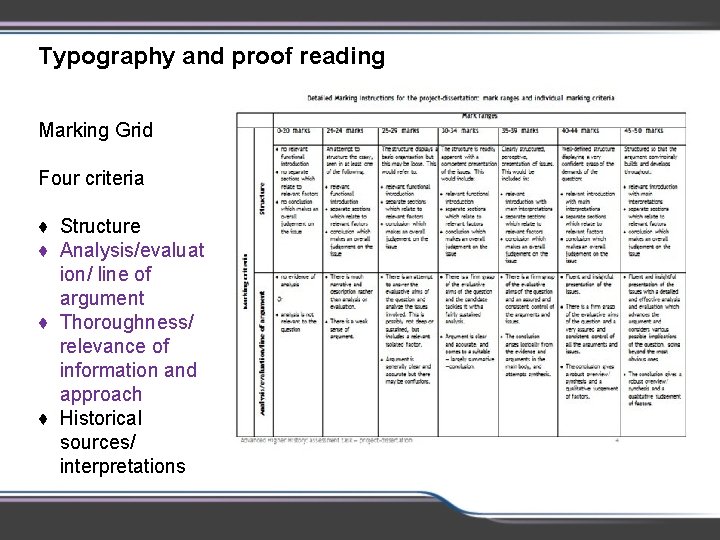
Typography and proof reading Marking Grid Four criteria ♦ Structure ♦ Analysis/evaluat ion/ line of argument ♦ Thoroughness/ relevance of information and approach ♦ Historical sources/ interpretations
0– 20 marks Structure no relevant functional introduction 21– 24 marks 25– 29 marks 30– 34 marks 35– 39 marks 40 -44 marks 45 -50 marks An attempt to structure the essay, seen in at least one of the following: The structure displays a basic organisation but this may be loose. This would refer to: The structure is readily apparent with a competent presentation of the issues. This would include: Clearly structured, perceptive, presentation of issues. This would be included in: Well-defined structure displaying a very confident grasp of the demands of the question: Structured so that the argument convincingly builds and develops throughout: relevant introduction with main interpretations separate sections which relate to relevant factors conclusion which makes an overall judgement on the issue relevant functional introduction no separate sections which relate to relevant factors no conclusion which makes an overall judgement on the issue relevant functional introduction separate sections which relate to relevant factors conclusion which makes an overall judgement on the issue
Analysis/evaluation/line of argument 0– 20 marks no evidence of analysis Or analysis is not relevant to the question 21– 24 marks 25– 29 marks 30– 34 marks 35– 39 marks 40 -44 marks There is much narrative and description rather than analysis or evaluation. There is an attempt to answer the evaluative aims of the question and analyse the issues involved. This is possibly not deep or sustained, but includes a relevant isolated factor. There is a firm grasp of the evaluative aims of the question and the candidate tackles it with a fairly sustained analysis. There is a firm grasp of the evaluative aims of the question and an assured and consistent control of the arguments and issues. Fluent and insightful presentation of the issues. There is a weak sense of argument. Argument is generally clear and accurate but there may be confusions. Argument is clear and accurate, and comes to a suitable — largely summative — conclusion. The conclusion arises logically from the evidence and arguments in the main body, and attempts synthesis. 45 -50 marks Fluent and insightful presentation of the issues with a detailed and There is a firm effective grasp of the analysis and evaluative aims evaluation of the question which and a very advances the assured and argument and consistent considers control of all various the arguments possible and issues. implications of the question, going beyond the most obvious ones. The conclusion gives a robust overview/ synthesis and a qualitative judgement of factors.
Historical sources/Interpretations 0– 20 marks No discernible reference to historical works. No reference to primary sources. 21– 24 marks 25– 29 marks 30– 34 marks 35– 39 marks 40 -44 marks 45 -50 marks There is an awareness of historians’ interpretations and arguments. There is a sound knowledge and understanding of historians’ interpretations and arguments which is consistent. Historians may be used as illustrative points of knowledge. Historians may be used as illustrative points of main lines of interpretation There is some awareness of possible variations of these interpretations or connections between them. There may be an appreciation of the context which gives rise to these interpretations. There is a sound knowledge and understanding of historians’ interpretations and arguments and an engagement with current historiography. • Shows consistent awareness of possible variations of these interpretations and connections between them, including an appreciation of the context which gives rise to these interpretations. Clear reference to at least one primary source. No discernible There is some reference to awareness of historical works. historians’ interpretations in relation to the issue. No reference to primary sources. Clear reference to at least one primary source.
Thoroughness/relevance of information and approach 0– 20 21– 24 Treatment of the issue No evidence of shows little relevant knowledge of knowledge. the issue. Some elements of the factual content and approach relate only very loosely to the issue. 25– 29 marks 30– 34 marks 35– 39 marks 40 -44 marks 45 -50 marks Treatment of the issue shows sufficient knowledge which reflects a basic understanding of the issue. Treatment of the issue shows an awareness of the width and depth of the knowledge required for a study of the issue. Treatment of the issue is based on a fair quantity of research, demonstrating width and depth of knowledge. Treatment of the issue is based on wide research and demonstrates a considerable width and depth of knowledge. Treatment of the issue is clearly based on a wide range of serious reading and demonstrates a considerable width and depth of knowledge. Evidence is linked to points of analysis or evaluation.
SQA Support Advanced Higher History: ♦ Course Assessment Specification ♦ Project-dissertation General assessment information ♦ Approved List of Dissertations ♦ External Assessment Report 2015 (contains advice on the Dissertation for 2016)
SQA Support ♦ Advanced Higher History Projectdissertation Assessment task (General and Detailed Marking Instructions (Marking Grid) and Instructions for candidates) ♦ Unit Assessment Support Researching Historical Issues Package 1: portfolio approach
WWW. sqa. org. uk│0303 333 0330