
Advanced Global Imaging Radiometer Objectives Improved separation of
Advanced Global Imaging Radiometer Objectives • Improved separation of in-water constituents through expanded spectral range and resolution • Improved atmospheric correction – aerosols, bright targets, ozone Measurement Characteristics • • • • Geophysical Parameters Pigment absorption Phytoplankton carbon Net primary production Export production Dissolved Organic Carbon CDOM photochemistry Slope of CDOM absorption Particulate Organic Carbon Particle size spectrum Particulate beam attenuation Carbon loading & dispersal Solar radiation & Kd Particulate inorganic carbon Functional groups HABs Eutrophication …. others…. LEO, 2 -day global coverage, noon/sun-synchronous polar orbit Minimum 20 aggregated wavebands 350 – 1400 nm, +ozone band 1 km spatial resolution SNR 1500: 1 (UV) to ~ 500 NIR 200 tilt to minimize sun glint contamination Polarization scrambler to minimize polarization sensitivity (tenths of a percent) Minimal & well-characterized spectral response (in-band & out-of-band) Minimal & well-characterized focal plane electronic cross-talk Minimal & well-characterized stray light Well-characterized response as a function of scan angle Sequential sampling to minimize image stripping No band saturation over bright targets Solar and lunar on-orbit calibration Complete sensor optical model Data system for near real-time processing, distribution, algorithm evaluations, & periodic reprocessing. Comprehensive calibration/validation program
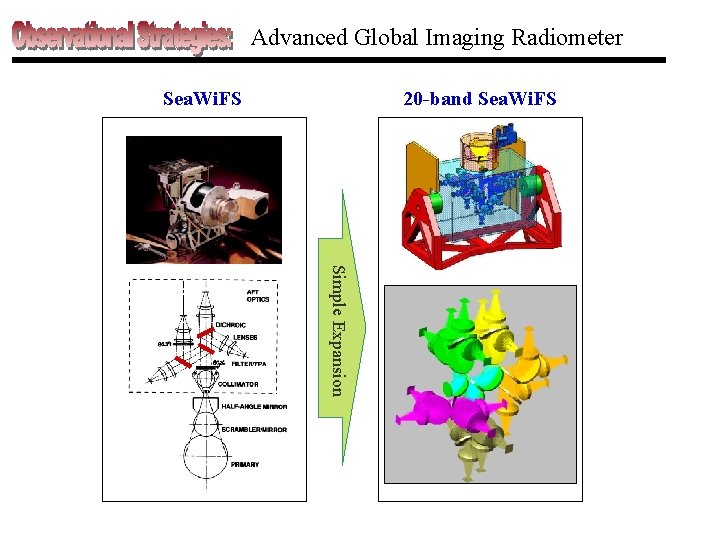
Advanced Global Imaging Radiometer Sea. Wi. FS 20 -band Sea. Wi. FS Simple Expansion

Advanced Global Imaging Radiometer Hyperspectral Primary telescope • Multiple grating spectrometer • 5 nm resolution from 350 to 800 nm • Discrete bands from 800 to 1400 nm (20 – 50 nm bandwidth) Aft Optics • On-board or post-download binning • Full spectral download = 1 Tb science data per day • 300 Mbps X-band transfer to polar ground station • On-ground 20 nm binned data for standard global products • High resolution data for regional applications, events, science development
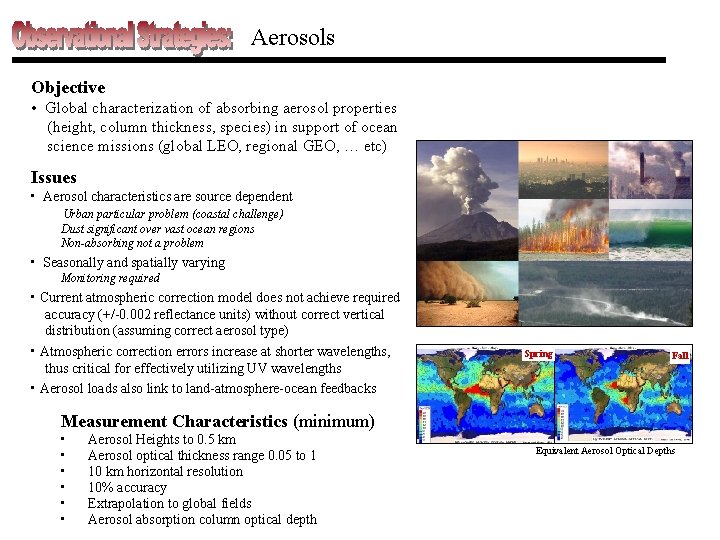
Aerosols Objective • Global characterization of absorbing aerosol properties (height, column thickness, species) in support of ocean science missions (global LEO, regional GEO, … etc) Issues • Aerosol characteristics are source dependent Urban particular problem (coastal challenge) Dust significant over vast ocean regions Non-absorbing not a problem • Seasonally and spatially varying Monitoring required • Current atmospheric correction model does not achieve required accuracy (+/-0. 002 reflectance units) without correct vertical distribution (assuming correct aerosol type) • Atmospheric correction errors increase at shorter wavelengths, thus critical for effectively utilizing UV wavelengths • Aerosol loads also link to land-atmosphere-ocean feedbacks Spring Fall Measurement Characteristics (minimum) • • • Aerosol Heights to 0. 5 km Aerosol optical thickness range 0. 05 to 1 10 km horizontal resolution 10% accuracy Extrapolation to global fields Aerosol absorption column optical depth Equivalent Aerosol Optical Depths
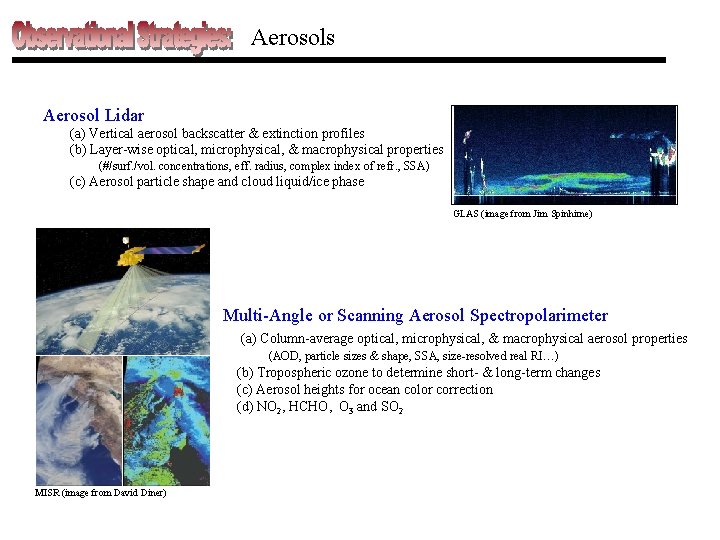
Aerosols Aerosol Lidar (a) Vertical aerosol backscatter & extinction profiles (b) Layer-wise optical, microphysical, & macrophysical properties (#/surf. /vol. concentrations, eff. radius, complex index of refr. , SSA) (c) Aerosol particle shape and cloud liquid/ice phase GLAS (image from Jim Spinhirne) Multi-Angle or Scanning Aerosol Spectropolarimeter (a) Column-average optical, microphysical, & macrophysical aerosol properties (AOD, particle sizes & shape, SSA, size-resolved real RI…) (b) Tropospheric ozone to determine short- & long-term changes (c) Aerosol heights for ocean color correction (d) NO 2, HCHO, O 3 and SO 2 MISR (image from David Diner)
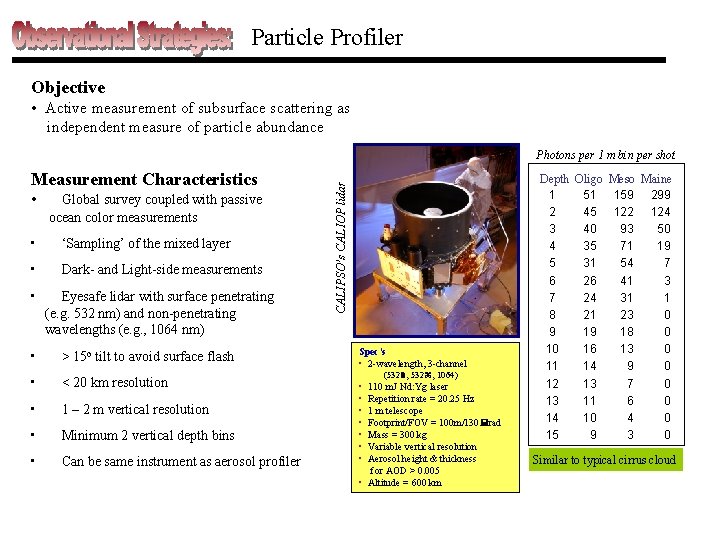
Particle Profiler Objective • Active measurement of subsurface scattering as independent measure of particle abundance Measurement Characteristics • Global survey coupled with passive ocean color measurements • ‘Sampling’ of the mixed layer • Dark- and Light-side measurements • Eyesafe lidar with surface penetrating (e. g. 532 nm) and non-penetrating wavelengths (e. g. , 1064 nm) • > 15 o tilt to avoid surface flash • < 20 km resolution • 1 – 2 m vertical resolution • Minimum 2 vertical depth bins • Can be same instrument as aerosol profiler CALIPSO’s CALIOP lidar Photons per 1 m bin per shot Spec’s • 2 -wavelength, 3 -channel (532 , 1064) • • 110 m. J Nd: Yg laser Repetition rate = 20. 25 Hz 1 m telescope Footprint/FOV = 100 m/130 rad Mass = 300 kg Variable vertical resolution Aerosol height & thickness for AOD > 0. 005 • Altitude = 600 km Depth Oligo Meso Maine 1 51 159 299 2 45 122 124 3 40 93 50 4 35 71 19 5 31 54 7 6 26 41 3 7 24 31 1 8 21 23 0 9 19 18 0 10 16 13 0 11 14 9 0 12 13 7 0 13 11 6 0 14 10 4 0 15 9 3 0 Similar to typical cirrus cloud
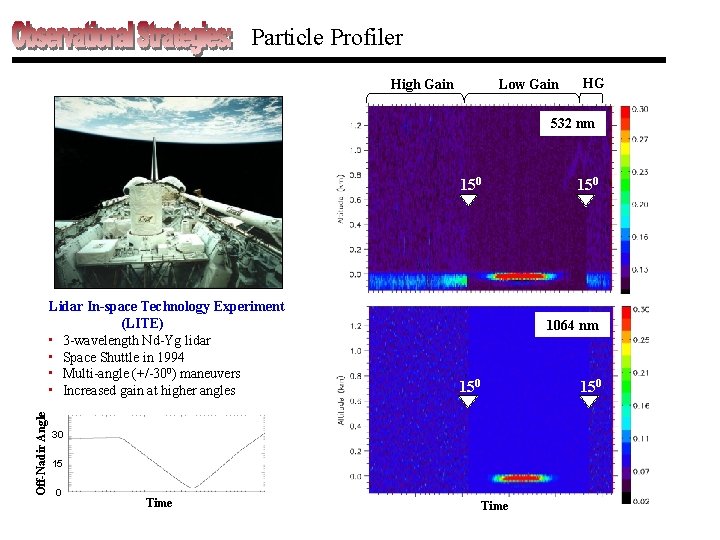
Particle Profiler High Gain Low Gain HG 532 nm 150 Off-Nadir Angle Lidar In-space Technology Experiment (LITE) • 3 -wavelength Nd-Yg lidar • Space Shuttle in 1994 • Multi-angle (+/-300) maneuvers • Increased gain at higher angles 150 1064 nm 150 30 15 0 Time
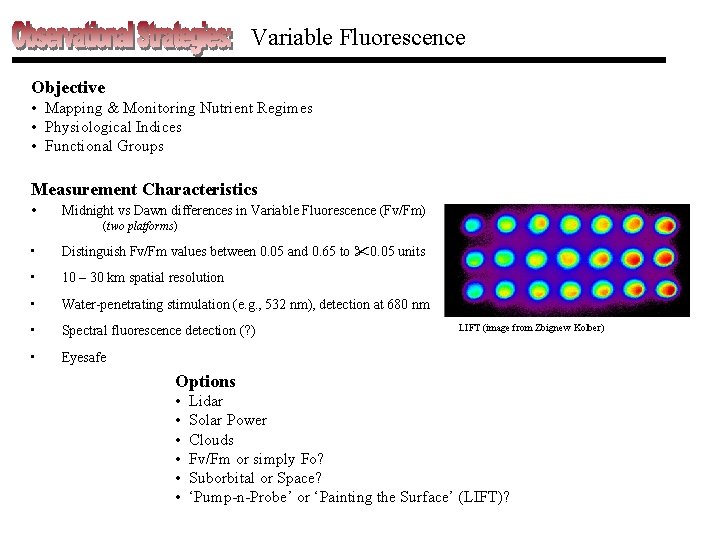
Variable Fluorescence Objective • Mapping & Monitoring Nutrient Regimes • Physiological Indices • Functional Groups Measurement Characteristics • Midnight vs Dawn differences in Variable Fluorescence (Fv/Fm) (two platforms) • Distinguish Fv/Fm values between 0. 05 and 0. 65 to 0. 05 units • 10 – 30 km spatial resolution • Water-penetrating stimulation (e. g. , 532 nm), detection at 680 nm • Spectral fluorescence detection (? ) • Eyesafe LIFT (image from Zbignew Kolber) Options • • • Lidar Solar Power Clouds Fv/Fm or simply Fo? Suborbital or Space? ‘Pump-n-Probe’ or ‘Painting the Surface’ (LIFT)?
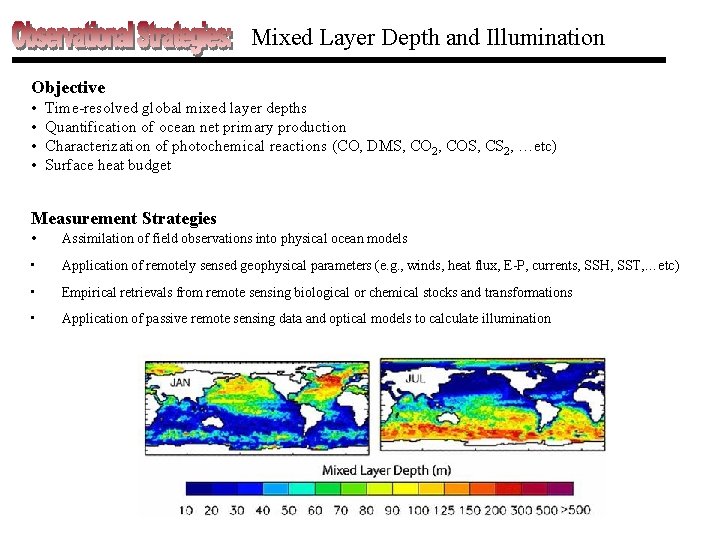
Mixed Layer Depth and Illumination Objective • • Time-resolved global mixed layer depths Quantification of ocean net primary production Characterization of photochemical reactions (CO, DMS, CO 2, COS, CS 2, …etc) Surface heat budget Measurement Strategies • Assimilation of field observations into physical ocean models • Application of remotely sensed geophysical parameters (e. g. , winds, heat flux, E-P, currents, SSH, SST, …etc) • Empirical retrievals from remote sensing biological or chemical stocks and transformations • Application of passive remote sensing data and optical models to calculate illumination
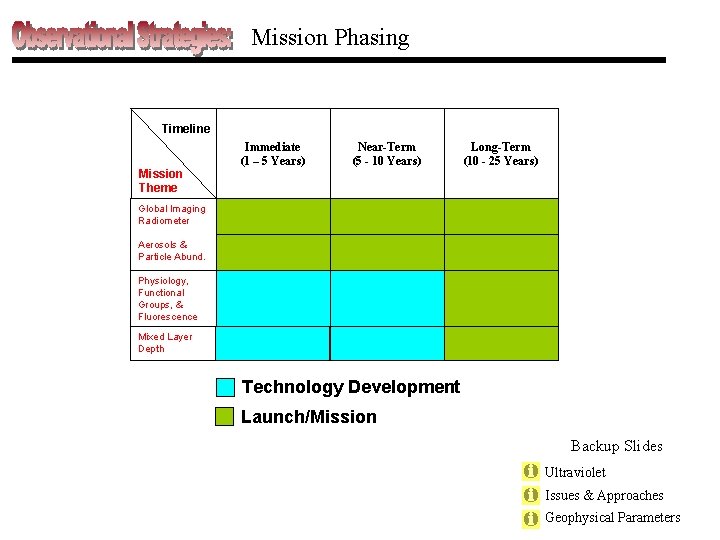
Mission Phasing Timeline Mission Themes Immediate (1 – 5 Years) Near-Term (5 - 10 Years) Long-Term (10 - 25 Years) Global Imaging Radiometer Aerosols & Particle Abund. Physiology, Functional Groups, & Fluorescence Mixed Layer Depth Technology Development Launch/Mission Backup Slides Ultraviolet Issues & Approaches Geophysical Parameters
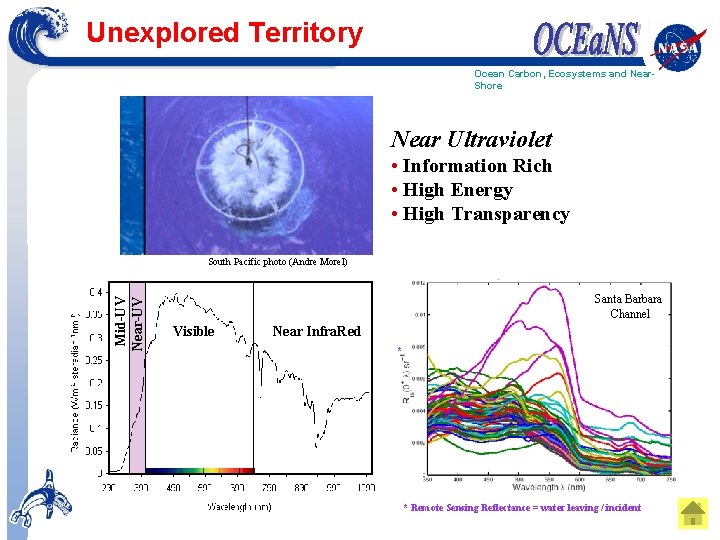
Unexplored Territory Ocean Carbon, Ecosystems and Near. Shore Near Ultraviolet • Information Rich • High Energy • High Transparency Mid-UV Near-UV South Pacific photo (Andre Morel) Santa Barbara Channel Visible Near Infra. Red * * Remote Sensing Reflectance = water leaving / incident
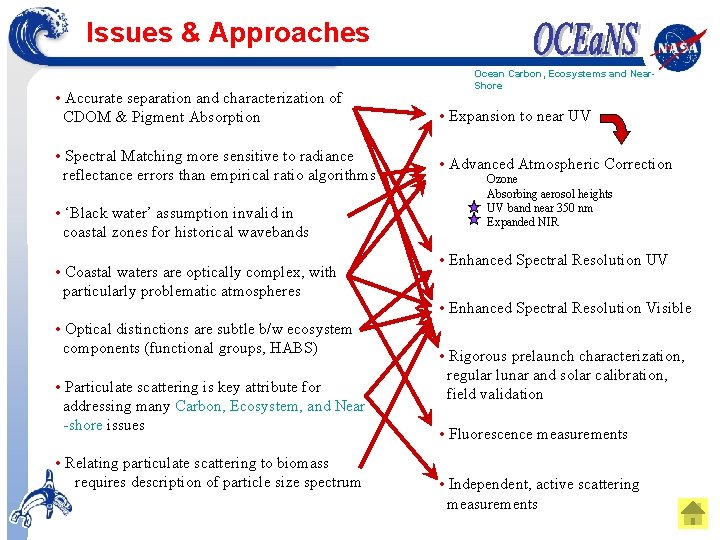
Issues & Approaches • Accurate separation and characterization of CDOM & Pigment Absorption • Spectral Matching more sensitive to radiance reflectance errors than empirical ratio algorithms • ‘Black water’ assumption invalid in coastal zones for historical wavebands • Coastal waters are optically complex, with particularly problematic atmospheres • Optical distinctions are subtle b/w ecosystem components (functional groups, HABS) • Particulate scattering is key attribute for addressing many Carbon, Ecosystem, and Near -shore issues • Relating particulate scattering to biomass requires description of particle size spectrum Ocean Carbon, Ecosystems and Near. Shore • Expansion to near UV • Advanced Atmospheric Correction Ozone Absorbing aerosol heights UV band near 350 nm Expanded NIR • Enhanced Spectral Resolution UV • Enhanced Spectral Resolution Visible • Rigorous prelaunch characterization, regular lunar and solar calibration, field validation • Fluorescence measurements • Independent, active scattering measurements
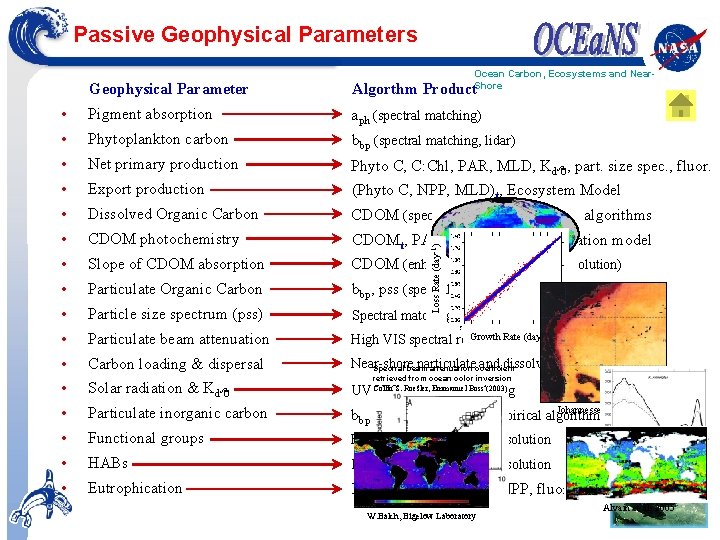
Passive Geophysical Parameters Ocean Carbon, Ecosystems and Near. Shore Algorthm Product • Pigment absorption aph (spectral matching) • Phytoplankton carbon bbp (spectral matching, lidar) • Net primary production Phyto C, C: Chl, PAR, MLD, Kd , part. size spec. , fluor. • Export production (Phyto C, NPP, MLD)t, Ecosystem Model • Dissolved Organic Carbon CDOM (spectral matching), empirical algorithms • CDOM photochemistry • Slope of CDOM absorption CDOMt, PAR, MLD, Kd , Degredation model CDOM (enhanced spectral UV/VIS resolution) • Particulate Organic Carbon 0 0. 5 1. 0 1. 5 2. 0 bbp, pss (spectral matching, lidar) Growth Rate (div d-1) • Particle size spectrum (pss) Spectral matching with enhanced VIS resolution • Particulate beam attenuation Growth Rate. Lidar (day ) High VIS spectral resolution, • Carbon loading & dispersal Near-shore particulate and dissolved carbont Spectral beam attenuation coefficient • Solar radiation & Kd Collin S. Roesler, Emmanuel Boss (2003) UV/VIS radiances, modeling • Particulate inorganic carbon Johannessen et al. 2003 bbp (spectral matching), empirical algorithm • Functional groups High VIS (UV? ) spectral resolution • HABs High VIS (UV? ) spectral resolution • Eutrophication Near-shore Phyto C & NPP, fluorescence GLAS profile data Loss Rate (day-1) Geophysical Parameter -1 retrieved from ocean color inversion W. Balch, Bigelow Laboratory Alvain et al. 2005
- Slides: 13