
ADVANCED EV 3 PROGRAMMING LESSON EV 3 Classroom

![What is PID? Proportional [Error] How bad is the situation now? Integral Have my](https://slidetodoc.com/presentation_image_h/0ddd56fac170e62a01e34e84d8d15423/image-6.jpg "What is PID? Proportional [Error] How bad is the situation now? Integral Have my")
- Slides: 22
ADVANCED EV 3 PROGRAMMING LESSON EV 3 Classroom: PID Line Follower
Lesson Objectives Learn the limitations of proportional control Learn what PID means Learn how to program PID and how to tune Prerequisites: Math Blocks, Color Sensor Calibration, Data Wires, Variables, Proportional Control We highly recommend knowledge of Algebra at a minimum. PID is a calculus-based concept and students should understand why it is used and the math behind it before using it. Please use Presentation Mode as there are lots of animations. © 2020 EV 3 Lessons. com, Last edit 12/27/2019
When does Proportional Control Have Trouble? What would a human do? What would proportional control do? On line go straight On white turn left Moving across line turn right On white turn left Getting further from line turn even more! Moving across line go straight! On white turn left Getting further from line turn left the same amount! LIGHT READING = © 2020 EV 3 Lessons. com, Last edit 12/27/2019 50% 100%
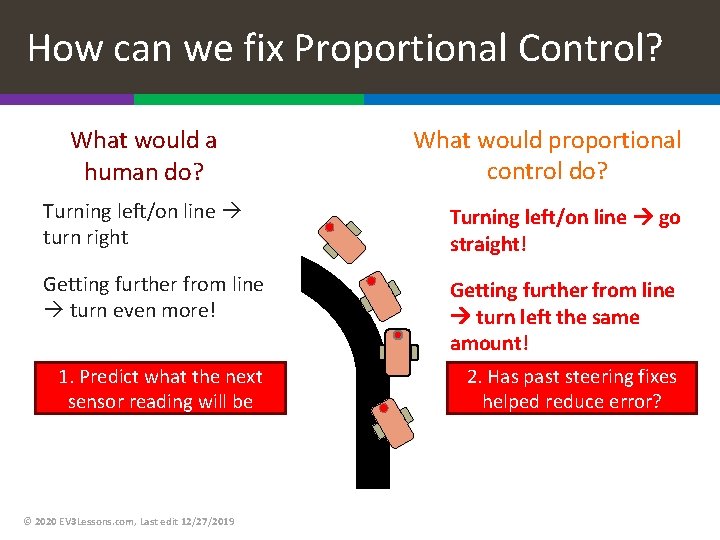
How can we fix Proportional Control? What would a human do? What would proportional control do? Turning left/on line turn right Turning left/on line go straight! Getting further from line turn even more! Getting further from line turn left the same amount! 2. Has past steering fixes helped reduce error? 1. Predict what the next sensor reading will be © 2020 EV 3 Lessons. com, Last edit 12/27/2019
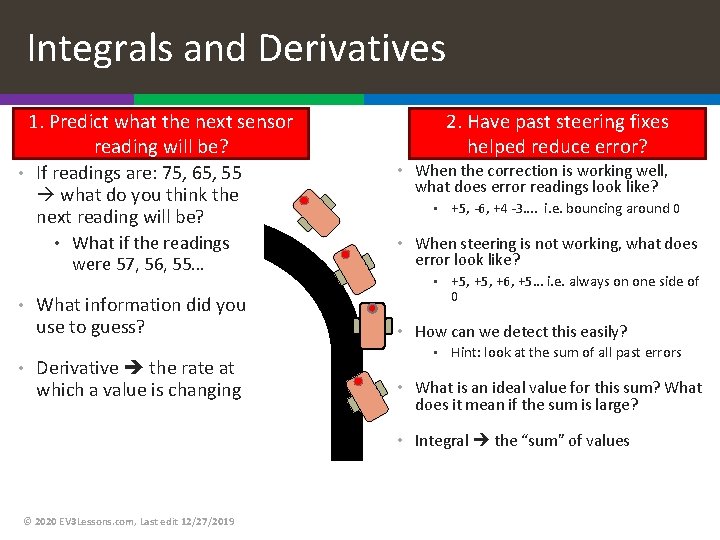
Integrals and Derivatives 1. Predict what the next sensor reading will be? • If readings are: 75, 65, 55 what do you think the next reading will be? • What if the readings were 57, 56, 55… • What information did you use to guess? • Derivative the rate at which a value is changing 2. Have past steering fixes helped reduce error? • When the correction is working well, what does error readings look like? • +5, -6, +4 -3…. i. e. bouncing around 0 • When steering is not working, what does error look like? • +5, +6, +5… i. e. always on one side of 0 • How can we detect this easily? • Hint: look at the sum of all past errors • What is an ideal value for this sum? What does it mean if the sum is large? • Integral the “sum” of values © 2020 EV 3 Lessons. com, Last edit 12/27/2019
What is PID? Proportional [Error] How bad is the situation now? Integral Have my past fixes helped fix things? Derivative How is the situation changing? PID control combine the error, integral and derivative values to decide how to steer the robot © 2020 EV 3 Lessons. com, Last edit 12/27/2019
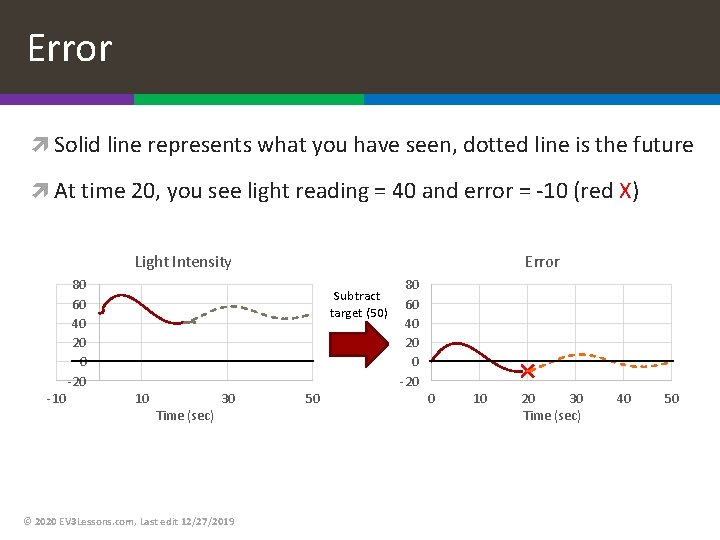
Error Solid line represents what you have seen, dotted line is the future At time 20, you see light reading = 40 and error = -10 (red X) Light Intensity Error 80 60 40 20 0 -20 -10 Subtract target (50) 10 Time (sec) 30 © 2020 EV 3 Lessons. com, Last edit 12/27/2019 50 80 60 40 20 0 -20 0 10 20 30 Time (sec) 40 50
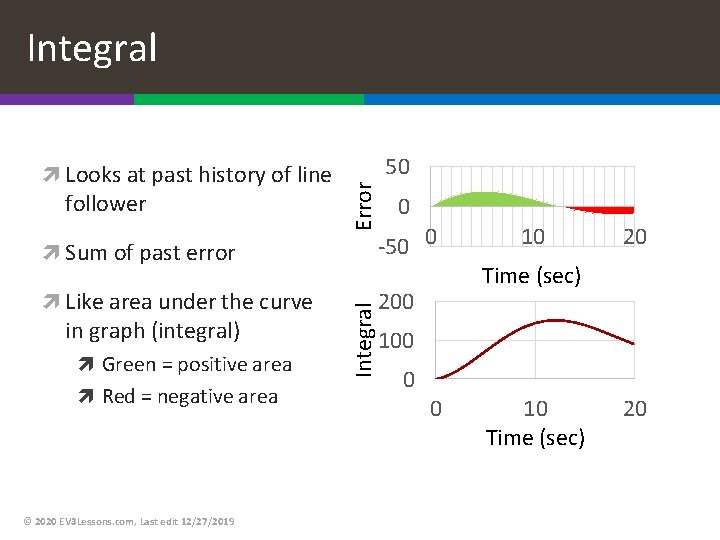
Integral follower 50 Error Looks at past history of line 0 Like area under the curve 200 in graph (integral) Green = positive area Red = negative area © 2020 EV 3 Lessons. com, Last edit 12/27/2019 Integral Sum of past error -50 0 10 20 Time (sec) 100 0 0 10 Time (sec) 20
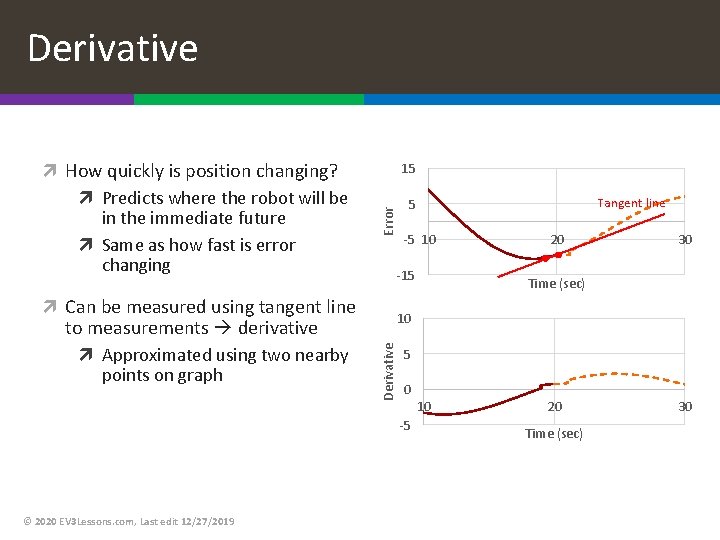
Derivative 15 Error How quickly is position changing? Predicts where the robot will be in the immediate future Same as how fast is error changing 30 Time (sec) Derivative 5 0 10 -5 © 2020 EV 3 Lessons. com, Last edit 12/27/2019 20 10 to measurements derivative points on graph -5 10 -15 Can be measured using tangent line Approximated using two nearby Tangent line 5 20 Time (sec) 30
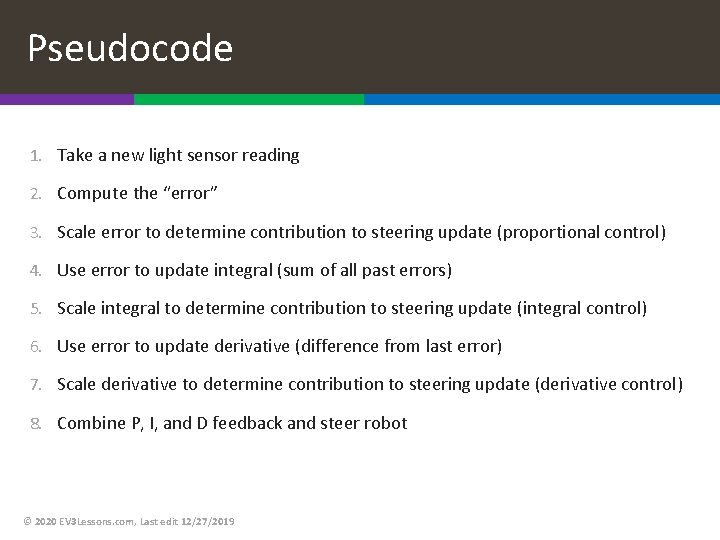
Pseudocode 1. Take a new light sensor reading 2. Compute the “error” 3. Scale error to determine contribution to steering update (proportional control) 4. Use error to update integral (sum of all past errors) 5. Scale integral to determine contribution to steering update (integral control) 6. Use error to update derivative (difference from last error) 7. Scale derivative to determine contribution to steering update (derivative control) 8. Combine P, I, and D feedback and steer robot © 2020 EV 3 Lessons. com, Last edit 12/27/2019
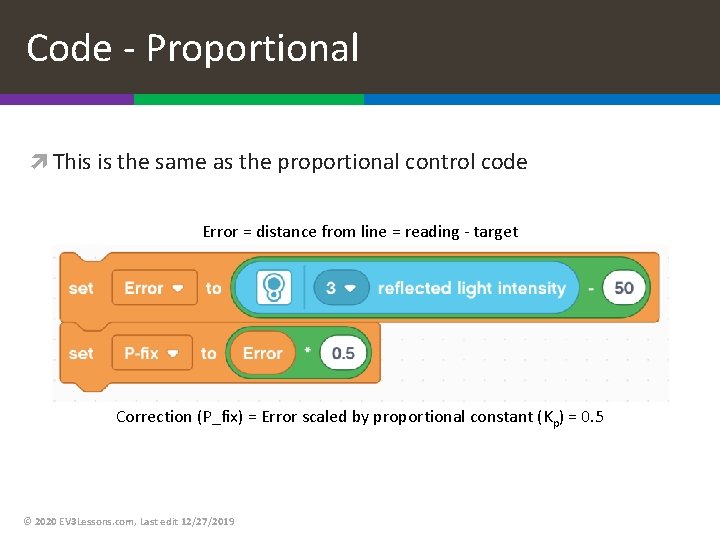
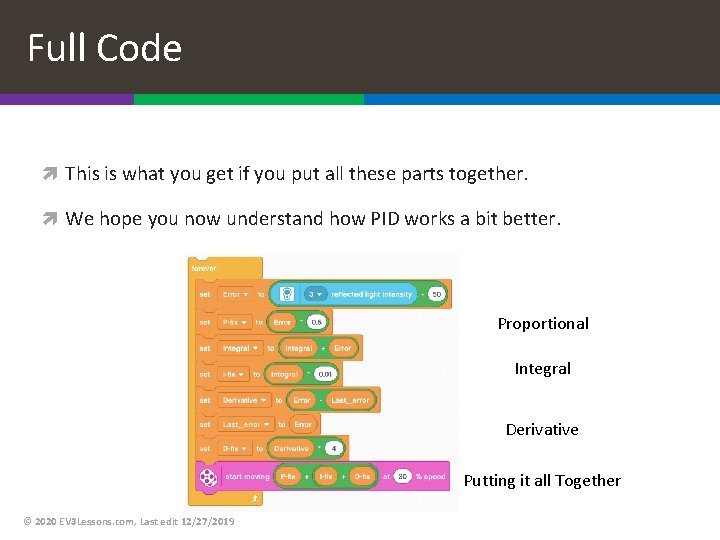
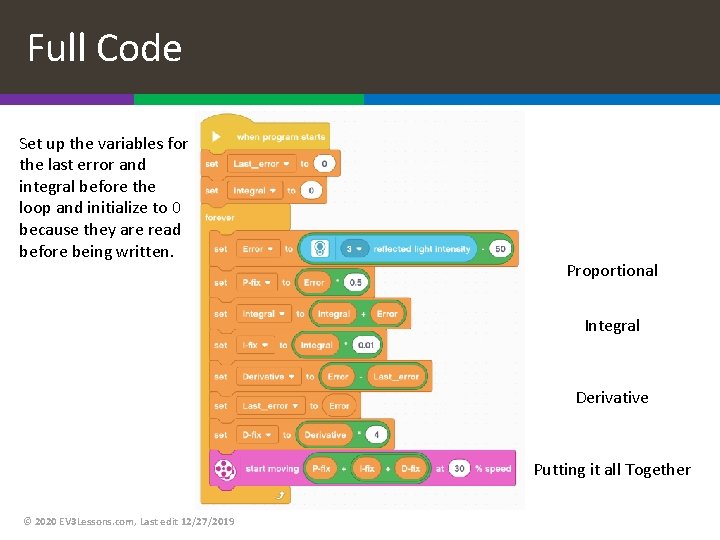
Code - Proportional This is the same as the proportional control code Error = distance from line = reading - target Correction (P_fix) = Error scaled by proportional constant (Kp) = 0. 5 © 2020 EV 3 Lessons. com, Last edit 12/27/2019
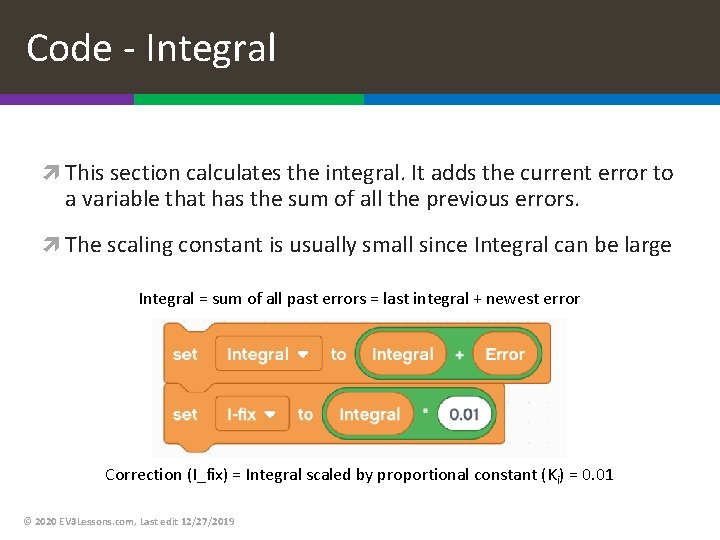
Code - Integral This section calculates the integral. It adds the current error to a variable that has the sum of all the previous errors. The scaling constant is usually small since Integral can be large Integral = sum of all past errors = last integral + newest error Correction (I_fix) = Integral scaled by proportional constant (Ki) = 0. 01 © 2020 EV 3 Lessons. com, Last edit 12/27/2019
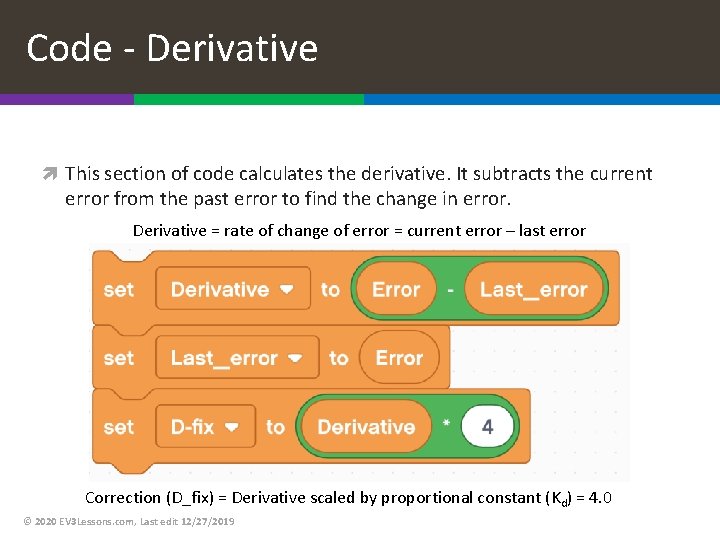
Code - Derivative This section of code calculates the derivative. It subtracts the current error from the past error to find the change in error. Derivative = rate of change of error = current error – last error Correction (D_fix) = Derivative scaled by proportional constant (Kd) = 4. 0 © 2020 EV 3 Lessons. com, Last edit 12/27/2019
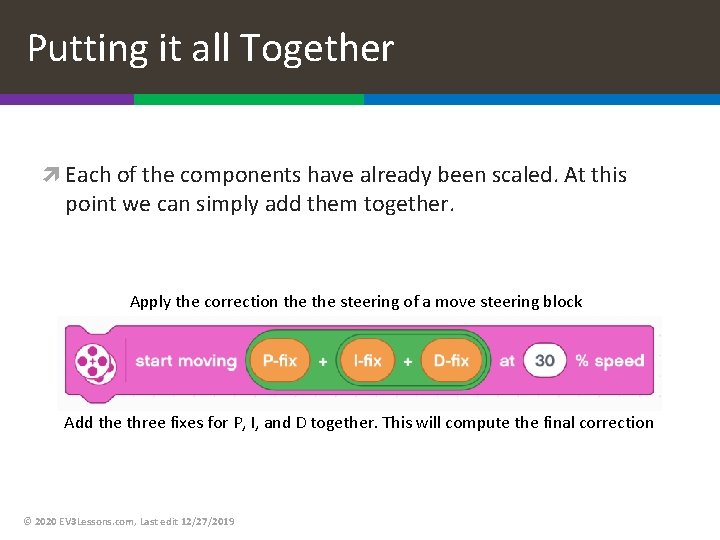
Putting it all Together Each of the components have already been scaled. At this point we can simply add them together. Apply the correction the steering of a move steering block Add the three fixes for P, I, and D together. This will compute the final correction © 2020 EV 3 Lessons. com, Last edit 12/27/2019
Full Code This is what you get if you put all these parts together. We hope you now understand how PID works a bit better. Proportional Integral Derivative Putting it all Together © 2020 EV 3 Lessons. com, Last edit 12/27/2019
Full Code Set up the variables for the last error and integral before the loop and initialize to 0 because they are read before being written. Proportional Integral Derivative Putting it all Together © 2020 EV 3 Lessons. com, Last edit 12/27/2019
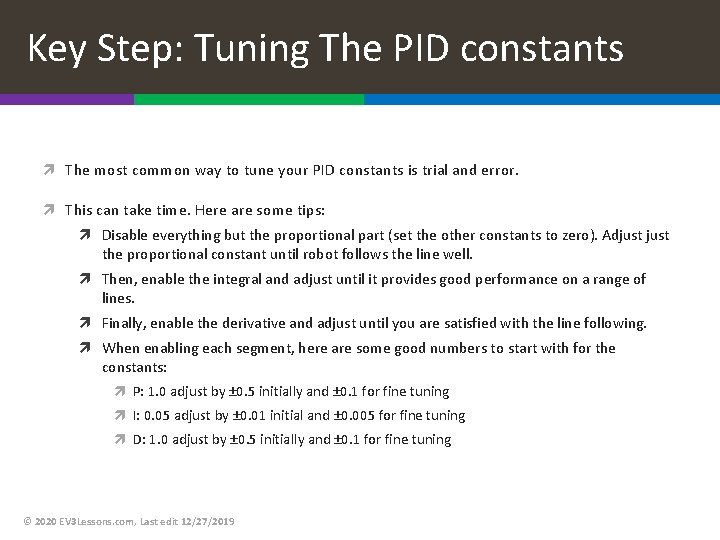
Key Step: Tuning The PID constants The most common way to tune your PID constants is trial and error. This can take time. Here are some tips: Disable everything but the proportional part (set the other constants to zero). Adjust the proportional constant until robot follows the line well. Then, enable the integral and adjust until it provides good performance on a range of lines. Finally, enable the derivative and adjust until you are satisfied with the line following. When enabling each segment, here are some good numbers to start with for the constants: P: 1. 0 adjust by ± 0. 5 initially and ± 0. 1 for fine tuning I: 0. 05 adjust by ± 0. 01 initial and ± 0. 005 for fine tuning D: 1. 0 adjust by ± 0. 5 initially and ± 0. 1 for fine tuning © 2020 EV 3 Lessons. com, Last edit 12/27/2019
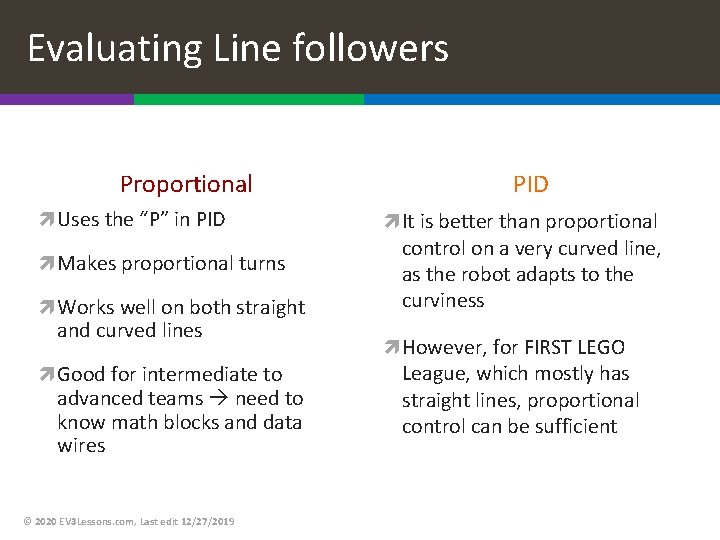
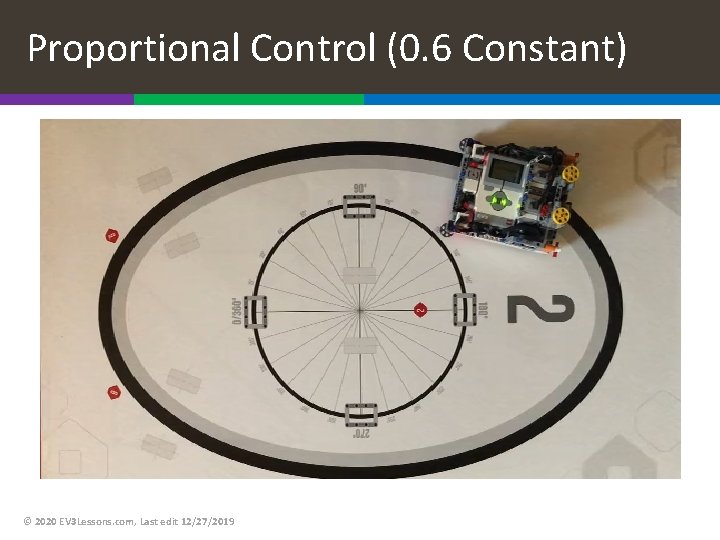
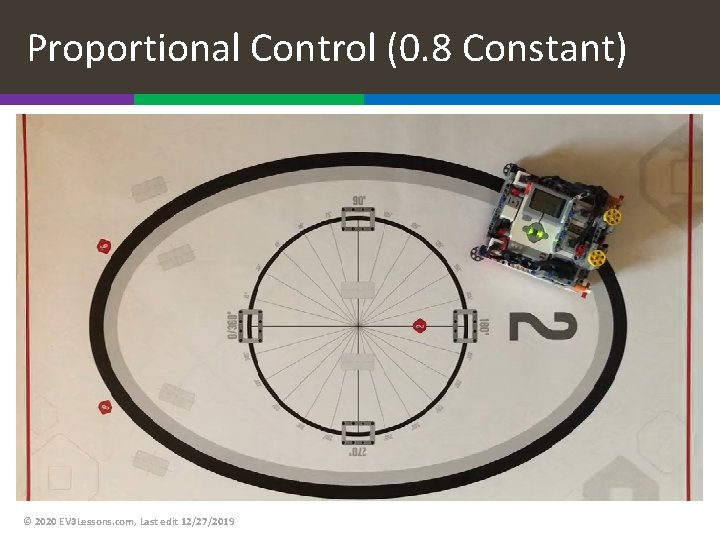
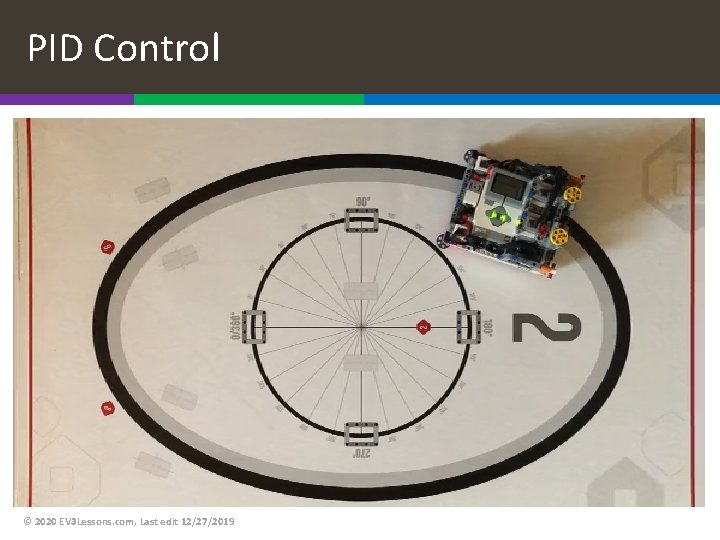
Evaluating Line followers Proportional Uses the “P” in PID Makes proportional turns Works well on both straight and curved lines Good for intermediate to advanced teams need to know math blocks and data wires © 2020 EV 3 Lessons. com, Last edit 12/27/2019 PID It is better than proportional control on a very curved line, as the robot adapts to the curviness However, for FIRST LEGO League, which mostly has straight lines, proportional control can be sufficient
Proportional Control (0. 6 Constant) © 2020 EV 3 Lessons. com, Last edit 12/27/2019
Proportional Control (0. 8 Constant) © 2020 EV 3 Lessons. com, Last edit 12/27/2019
PID Control © 2020 EV 3 Lessons. com, Last edit 12/27/2019
CREDITS This tutorial was created by Sanjay Seshan and Arvind Seshan More lessons at www. ev 3 lessons. com This work is licensed under a Creative Commons Attribution. Non. Commercial-Share. Alike 4. 0 International License. © 2020 EV 3 Lessons. com, Last edit 12/27/2019