
Advanced Energy Project AEP Course Lecture 2 Sam
![Cover letter structure Dear [Name / Job title] Para 1: What are you applying](https://slidetodoc.com/presentation_image_h2/b946a41dfd4bbc45da4d0117c41e47ac/image-11.jpg "Cover letter structure Dear [Name / Job title] Para 1: What are you applying")

- Slides: 27
Advanced Energy Project (AEP) Course Lecture 2 Sam Cross & Dr Tiia Sahrakorpi 17 September 2019
Writing cover letters and motivation letters Dr Tiia Sahrakorpi
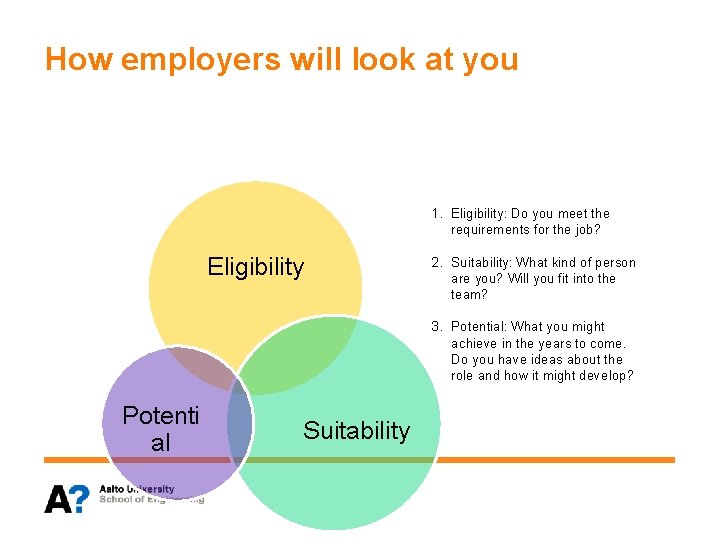
How employers will look at you 1. Eligibility: Do you meet the requirements for the job? Eligibility 2. Suitability: What kind of person are you? Will you fit into the team? 3. Potential: What you might achieve in the years to come. Do you have ideas about the role and how it might develop? Potenti al Suitability
The number one rule: Nobody wants to read your autobiography.
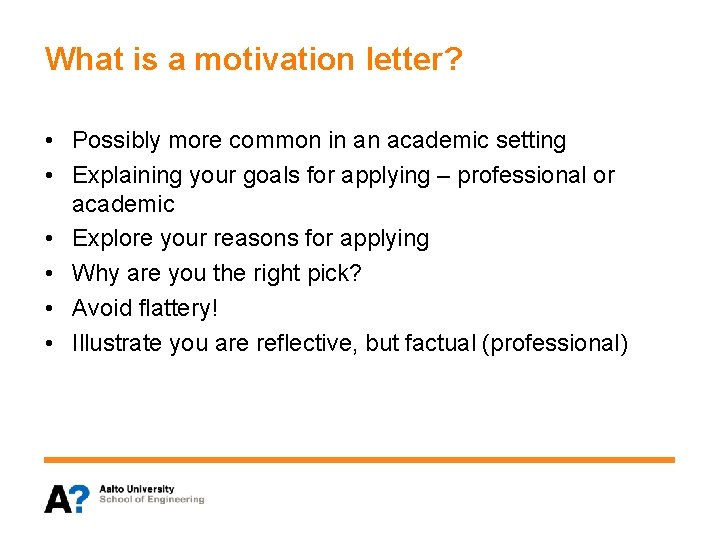
What is a motivation letter? • Possibly more common in an academic setting • Explaining your goals for applying – professional or academic • Explore your reasons for applying • Why are you the right pick? • Avoid flattery! • Illustrate you are reflective, but factual (professional)
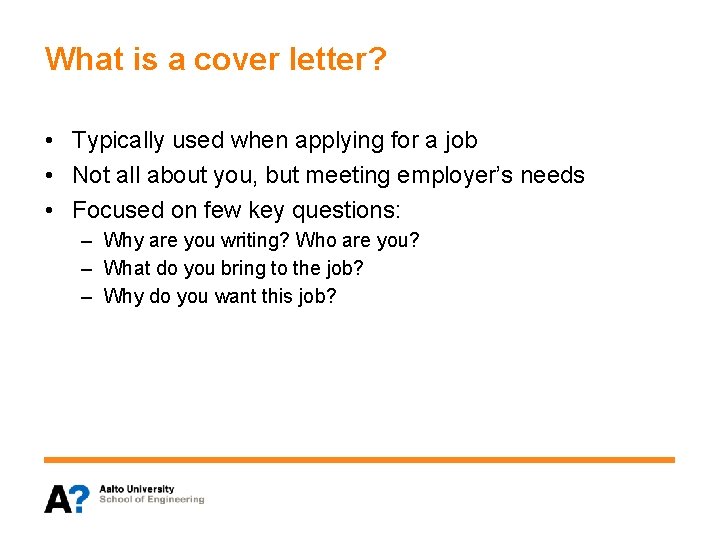
What is a cover letter? • Typically used when applying for a job • Not all about you, but meeting employer’s needs • Focused on few key questions: – Why are you writing? Who are you? – What do you bring to the job? – Why do you want this job?
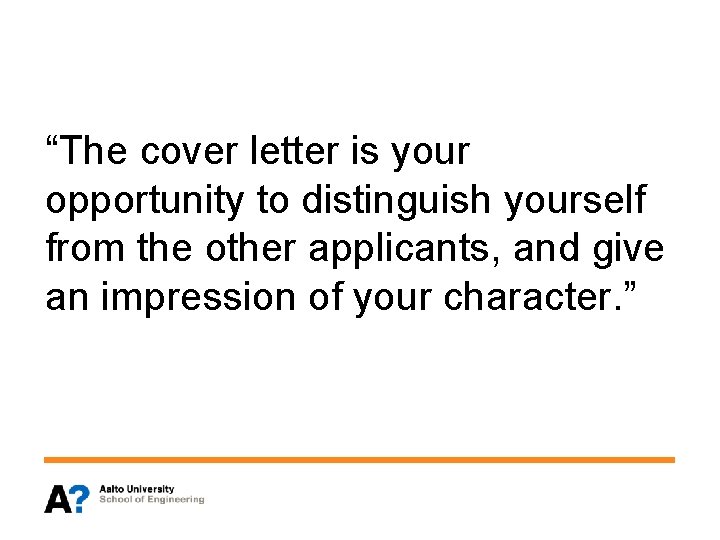
“The cover letter is your opportunity to distinguish yourself from the other applicants, and give an impression of your character. ”
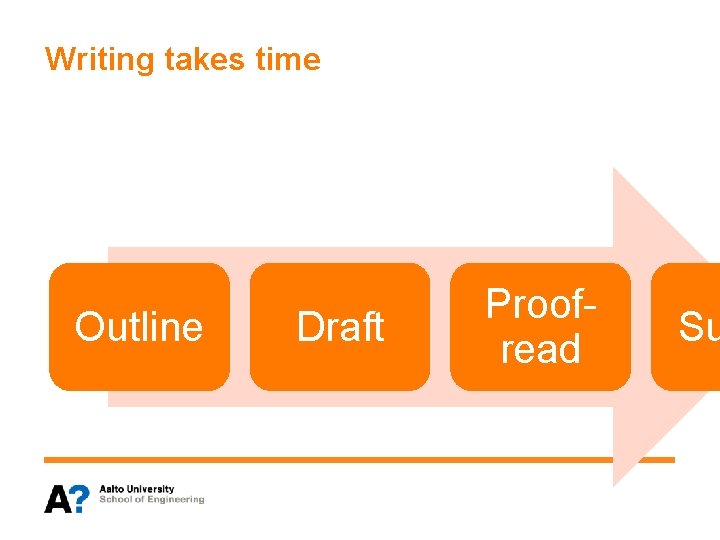
Writing takes time Outline Draft Proofread Su
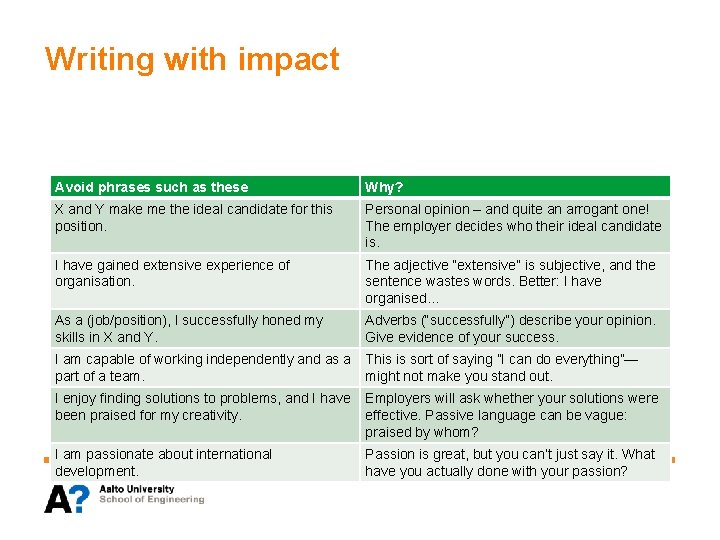
Writing with impact Avoid phrases such as these Why? X and Y make me the ideal candidate for this position. Personal opinion – and quite an arrogant one! The employer decides who their ideal candidate is. I have gained extensive experience of organisation. The adjective ”extensive” is subjective, and the sentence wastes words. Better: I have organised… As a (job/position), I successfully honed my skills in X and Y. Adverbs (“successfully”) describe your opinion. Give evidence of your success. I am capable of working independently and as a part of a team. This is sort of saying ”I can do everything”— might not make you stand out. I enjoy finding solutions to problems, and I have been praised for my creativity. Employers will ask whether your solutions were effective. Passive language can be vague: praised by whom? I am passionate about international development. Passion is great, but you can’t just say it. What have you actually done with your passion?
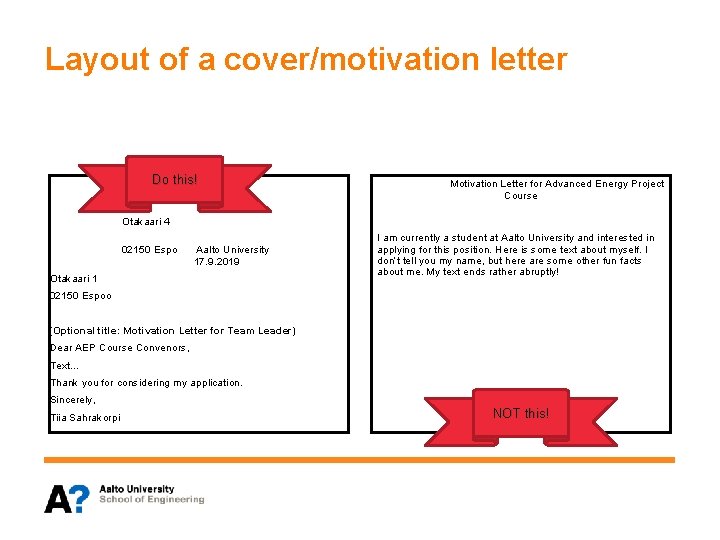
Layout of a cover/motivation letter Do this! Tiia Sahrakorpi Motivation Letter for Advanced Energy Project Course Otakaari 4 02150 Espo Aalto University 17. 9. 2019 Otakaari 1 I am currently a student at Aalto University and interested in applying for this position. Here is some text about myself. I don’t tell you my name, but here are some other fun facts about me. My text ends rather abruptly! 02150 Espoo (Optional title: Motivation Letter for Team Leader) Dear AEP Course Convenors, Text… Thank you for considering my application. Sincerely, Tiia Sahrakorpi NOT this!
Cover letter structure Dear [Name / Job title] Para 1: What are you applying for? Where did you hear about the job? Who are you? What’s your headline? Para 2: What do you bring to the role? What’s your evidence for those claims? Para 3: Why do you want to do this particular job at this particular organisation? What’s your vision for this role? Para 4: Conclusions, eg. Dates you’re available Yours sincerely / Yours faithfully, [Your name]
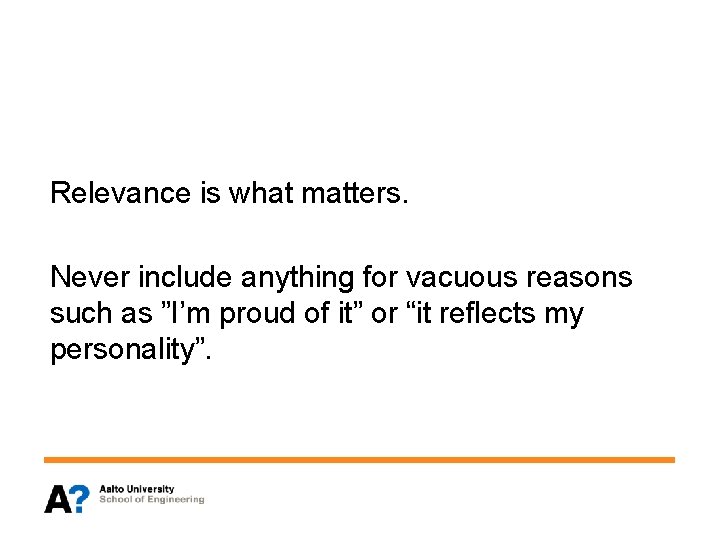
Relevance is what matters. Never include anything for vacuous reasons such as ”I’m proud of it” or “it reflects my personality”.
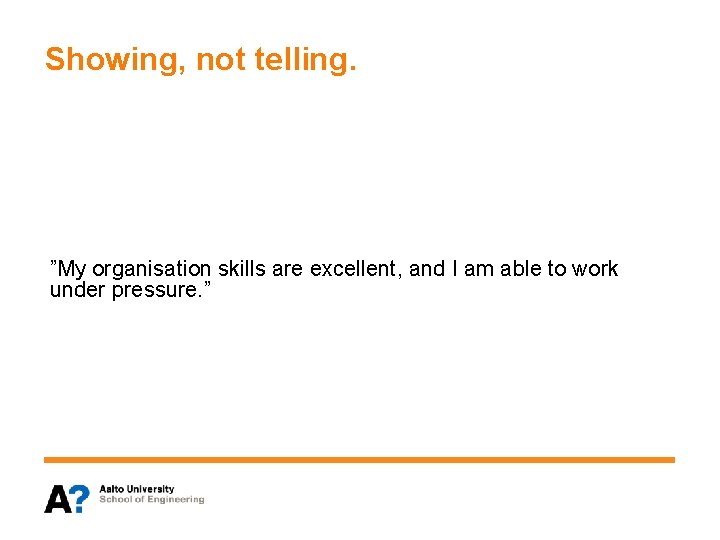
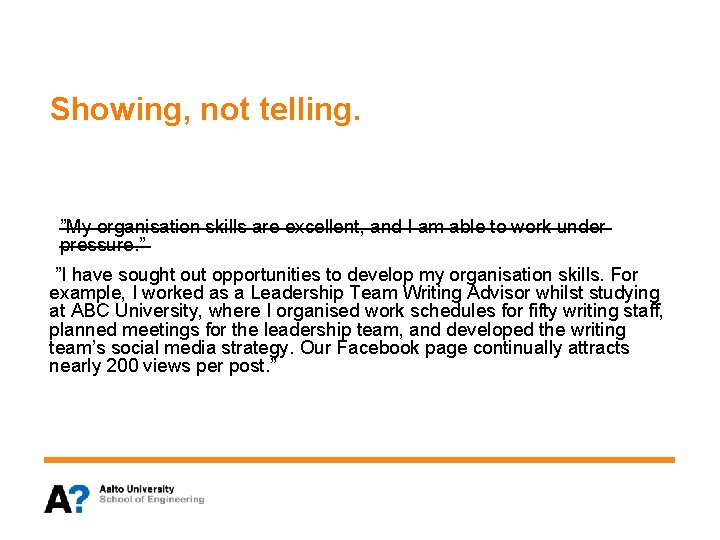
Showing, not telling. ”My organisation skills are excellent, and I am able to work under pressure. ”
Showing, not telling. ”My organisation skills are excellent, and I am able to work under pressure. ” ”I have sought out opportunities to develop my organisation skills. For example, I worked as a Leadership Team Writing Advisor whilst studying at ABC University, where I organised work schedules for fifty writing staff, planned meetings for the leadership team, and developed the writing team’s social media strategy. Our Facebook page continually attracts nearly 200 views per post. ”
Tell good stories
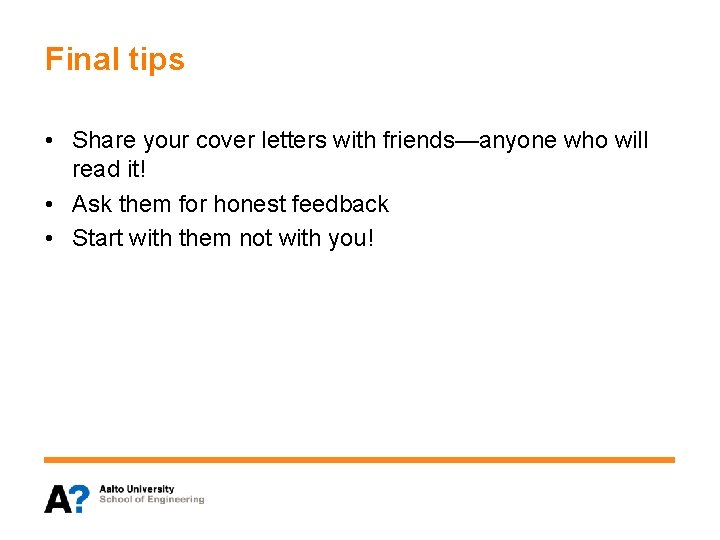
Final tips • Share your cover letters with friends—anyone who will read it! • Ask them for honest feedback • Start with them not with you!
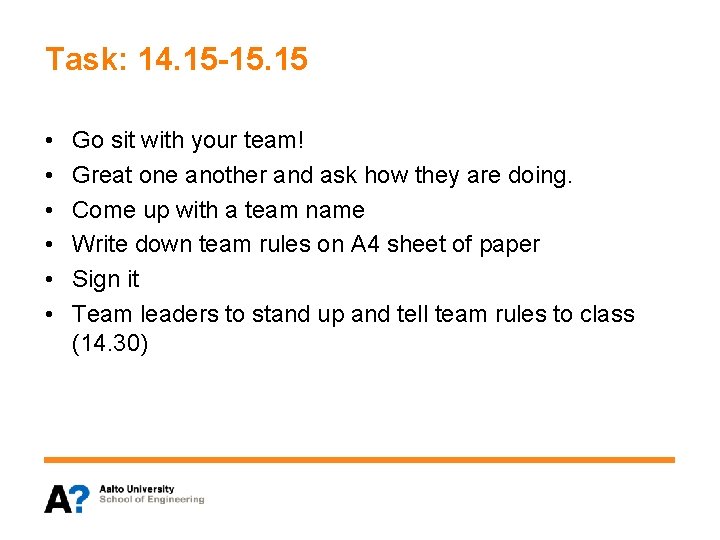
Task: 14. 15 -15. 15 • • • Go sit with your team! Great one another and ask how they are doing. Come up with a team name Write down team rules on A 4 sheet of paper Sign it Team leaders to stand up and tell team rules to class (14. 30)
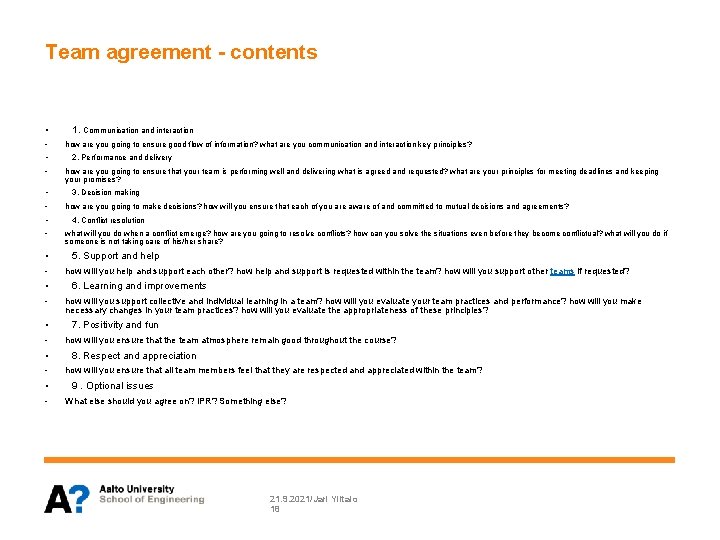
Team agreement - contents • • - • - 1. Communication and interaction how are you going to ensure good flow of information? what are you communication and interaction key principles? 2. Performance and delivery how are you going to ensure that your team is performing well and delivering what is agreed and requested? what are your principles for meeting deadlines and keeping your promises? 3. Decision making how are you going to make decisions? how will you ensure that each of you are aware of and committed to mutual decisions and agreements? 4. Conflict resolution what will you do when a conflict emerge? how are you going to resolve conflicts? how can you solve the situations even before they become conflictual? what will you do if someone is not taking care of his/her share? 5. Support and help how will you help and support each other? how help and support is requested within the team? how will you support other teams if requested? 6. Learning and improvements how will you support collective and individual learning in a team? how will you evaluate your team practices and performance? how will you make necessary changes in your team practices? how will you evaluate the appropriateness of these principles? 7. Positivity and fun how will you ensure that the team atmosphere remain good throughout the course? 8. Respect and appreciation how will you ensure that all team members feel that they are respected and appreciated within the team? 9. Optional issues What else should you agree on? IPR? Something else? 21. 9. 2021/Jari Ylitalo 18
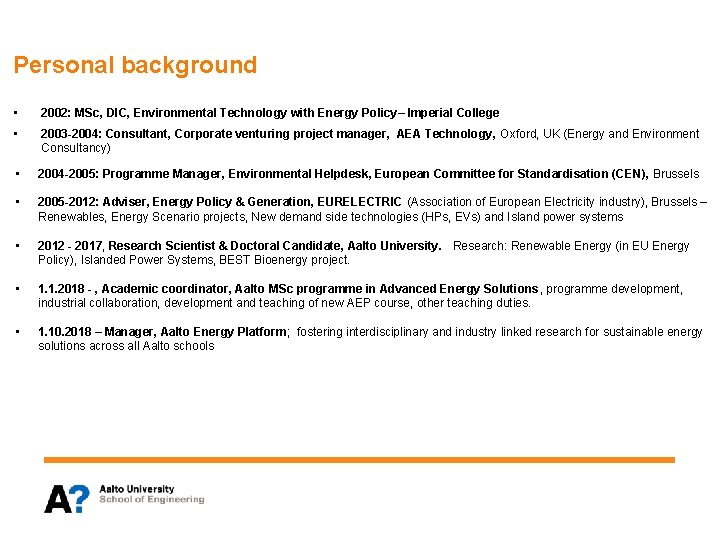
Personal background • 2002: MSc, DIC, Environmental Technology with Energy Policy– Imperial College • 2003 -2004: Consultant, Corporate venturing project manager, AEA Technology, Oxford, UK (Energy and Environment Consultancy) • 2004 -2005: Programme Manager, Environmental Helpdesk, European Committee for Standardisation (CEN), Brussels • 2005 -2012: Adviser, Energy Policy & Generation, EURELECTRIC (Association of European Electricity industry), Brussels – Renewables, Energy Scenario projects, New demand side technologies (HPs, EVs) and Island power systems • 2012 - 2017, Research Scientist & Doctoral Candidate, Aalto University. Research: Renewable Energy (in EU Energy Policy), Islanded Power Systems, BEST Bioenergy project. • 1. 1. 2018 - , Academic coordinator, Aalto MSc programme in Advanced Energy Solutions, programme development, industrial collaboration, development and teaching of new AEP course, other teaching duties. • 1. 10. 2018 – Manager, Aalto Energy Platform; fostering interdisciplinary and industry linked research for sustainable energy solutions across all Aalto schools
Perspectives on energy consulting from working career “storytelling approach”
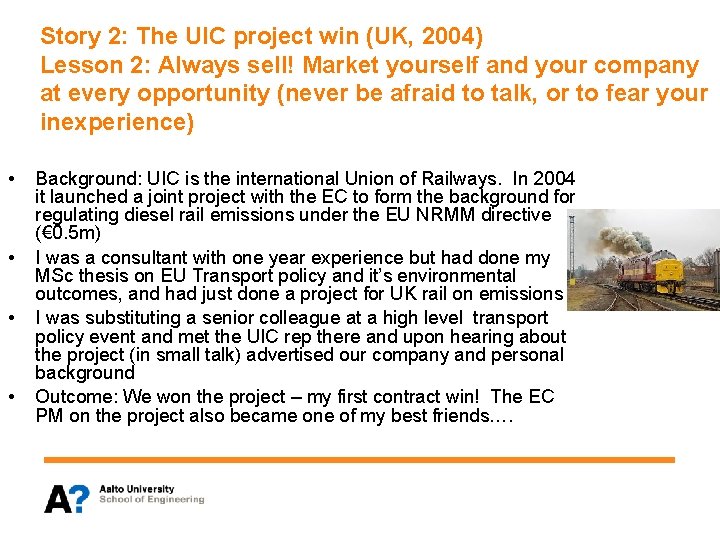
Story 2: The UIC project win (UK, 2004) Lesson 2: Always sell! Market yourself and your company at every opportunity (never be afraid to talk, or to fear your inexperience) • • Background: UIC is the international Union of Railways. In 2004 it launched a joint project with the EC to form the background for regulating diesel rail emissions under the EU NRMM directive (€ 0. 5 m) I was a consultant with one year experience but had done my MSc thesis on EU Transport policy and it’s environmental outcomes, and had just done a project for UK rail on emissions I was substituting a senior colleague at a high level transport policy event and met the UIC rep there and upon hearing about the project (in small talk) advertised our company and personal background Outcome: We won the project – my first contract win! The EC PM on the project also became one of my best friends….
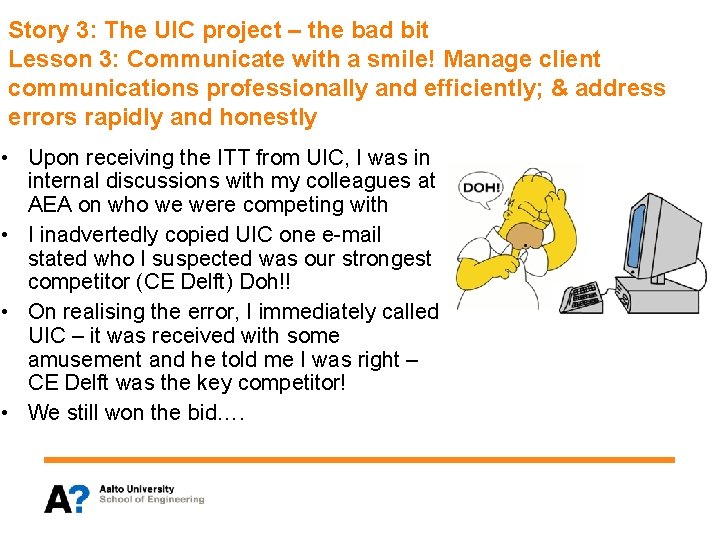
Story 3: The UIC project – the bad bit Lesson 3: Communicate with a smile! Manage client communications professionally and efficiently; & address errors rapidly and honestly • Upon receiving the ITT from UIC, I was in internal discussions with my colleagues at AEA on who we were competing with • I inadvertedly copied UIC one e-mail stated who I suspected was our strongest competitor (CE Delft) Doh!! • On realising the error, I immediately called UIC – it was received with some amusement and he told me I was right – CE Delft was the key competitor! • We still won the bid….
Story 4: How “Koen-up” a project (Brussels, 2008 -9) Lesson 4: It is their problem!: The lead contractor is responsible for delivery – don’t let them blame their own sub-contractors • • • I was EURELECTRIC PM responsible for awarded and managing a contract for producing long run low carbon scenarios for the energy sector (€ 1 mn contract, split to 3 different consortia for Supply, Demand & Modelling) The Demand consortia consisted of 7 universities, but the lead uni – with whom we contracted (“Koen”), was constantly delayed and didn’t want to take responsible – they want us to directly push the other members in the consortia This is NOT correct – the contractor you contract with is responsible for delivery – they must manage their own sub-contractors and not try to get the client to do it!
Story 5: Beware of the independent/mad professor! Energy Modelling – The academic who preferred to use their own input data rather than the ones we provided! (Brussels, 2010) Lesson 5: Check th small print: Are your consultants delivering what you asked for? Check the details very carefully • I appointed a consultant to do energy modelling work for EURELECTRIC using input data supplied by us (e. g. capital cost of power plants) • Consultant decided not to use the data, but their own (!) • I only noticed this when they presenting our results internal to utilities and before we went public – none of whom spotted the problem • Outcome: Consultant forced to re-do work with our input data
Story 6: The Pöyry case (2008 – ongoing) Lesson 6: Keep the peace: Always be professional & dip with your contractors (whether pushing or complimenting) – they might hire you one day… • • Background: When I worked for EURELECTRIC, I awarded several consultancy projects to Pöyry I had a good working relationship with the company, their work was f good quality and criticisms were efficiently addresses However, while me boss #1 worked with Pöyry similarly to me, boss #2 created a negative atmosphere client<>contractor (with me in the middle as client-side PM!) Outcome was still good though; after leaving EURELECTRIC and starting at Aalto, I was offered an associate consultant contract with Pöyry which is still ongoing….
Exercise for next week – The downfall of British Leyland. . • Watch the documentary “Who killed the British Motor industry” https: //www. youtube. com/watch? v=b 9 zt. Ulve 9 jc • Further clips: • Speke plant closure (worker attitude): https: //www. youtube. com/watch? v=IBoky. Z 0 w. Omc • Top Gear clip on British Leyland cars (Now): https: //www. youtube. com/watch? v=bf 7 q 8 l. WEd-o Answer the following questions in Presemo: presemo. aalto. fi/britishleyland - What issues contributed to downfall of British Leyland’ - Who do you blame most – unions, managers, designers or engineers? - What could be the relevant lessons to maintaining industrial competiveness in today’s world (you could use the example of any industrial sector which comes to mind) - What would you have done differently as British Leyland CEO in the late 1970 s…
Thanks for your attention! Sam Cross samuel. cross@aalto. fi #Sam. JBCross Linkedin: https: //fi. linkedin. com/in/sam-cross-7574 a 0 Researchgate: https: //www. researchgate. net/profile/Sam_Cross 21/09/2021 27