
Advanced development techniques Dependency Injection Test Doubles Moq
Advanced development techniques Dependency Injection Test Doubles, Moq V 1. 1 1
„Testing = I will try it manually” V 1. 1 2
„The tester will test the code” V 1. 1 3
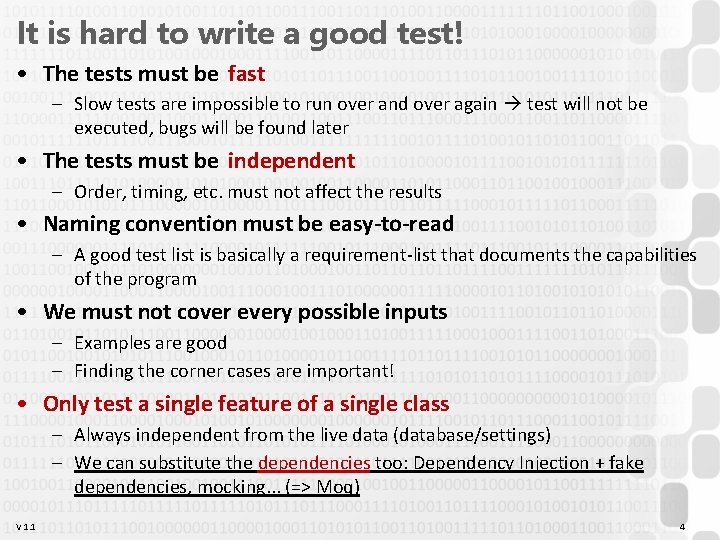
It is hard to write a good test! • The tests must be fast – Slow tests are impossible to run over and over again test will not be executed, bugs will be found later • The tests must be independent – Order, timing, etc. must not affect the results • Naming convention must be easy-to-read – A good test list is basically a requirement-list that documents the capabilities of the program • We must not cover every possible inputs – Examples are good – Finding the corner cases are important! • Only test a single feature of a single class – Always independent from the live data (database/settings) – We can substitute the dependencies too: Dependency Injection + fake dependencies, mocking. . . (=> Moq) V 1. 1 4
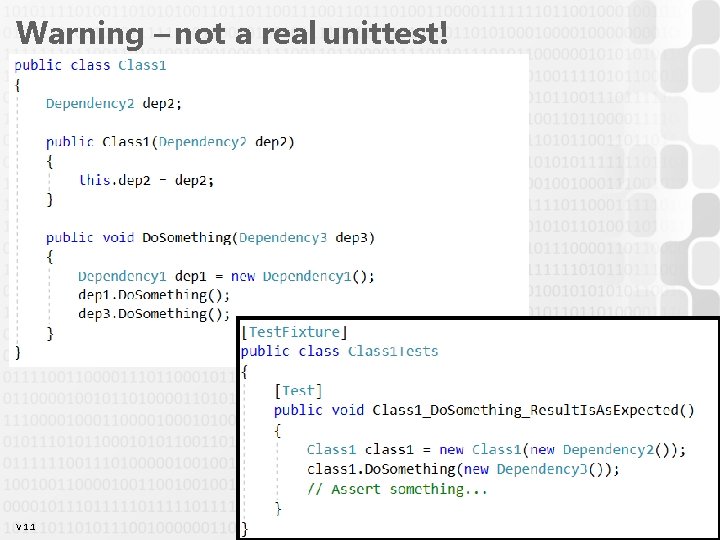
Warning – not a real unittest! V 1. 1 5
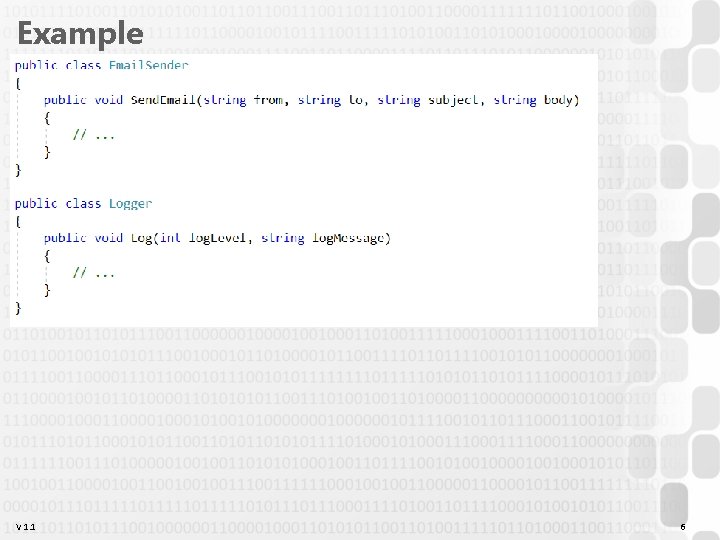
Example V 1. 1 6
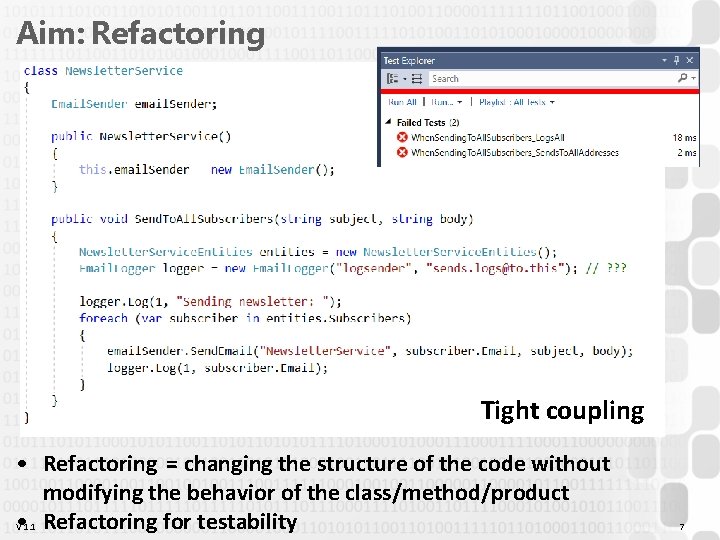
Aim: Refactoring Tight coupling • Refactoring = changing the structure of the code without modifying the behavior of the class/method/product • 1. 1 Refactoring for testability V 7
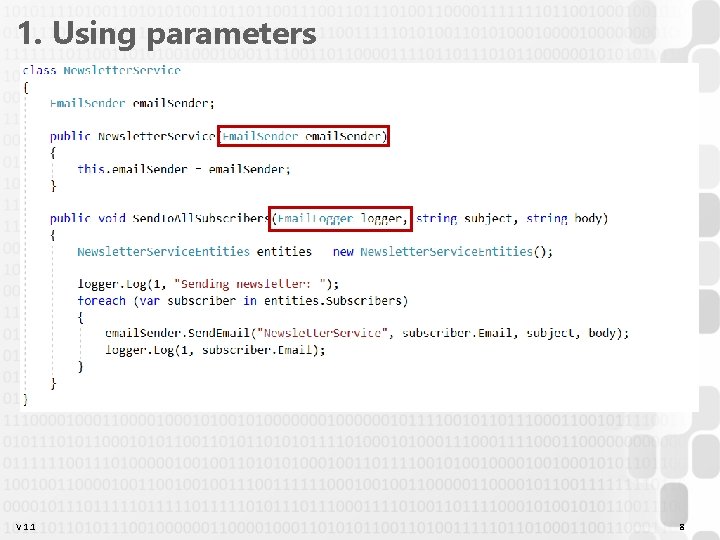
1. Using parameters V 1. 1 8
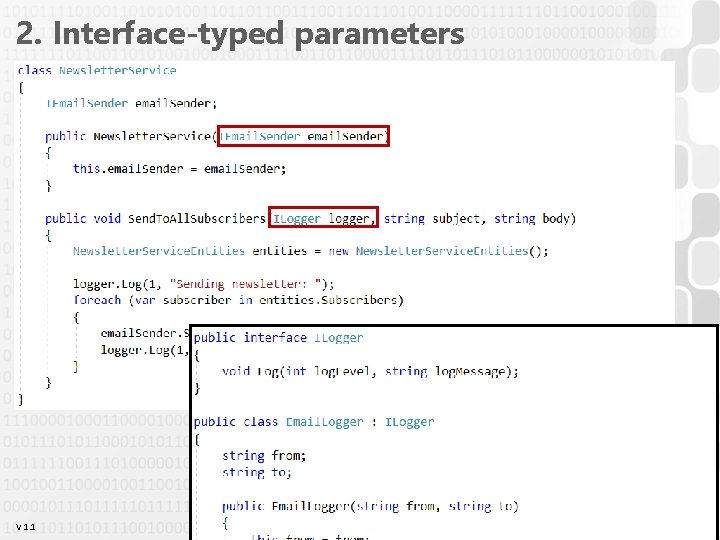
2. Interface-typed parameters V 1. 1 9
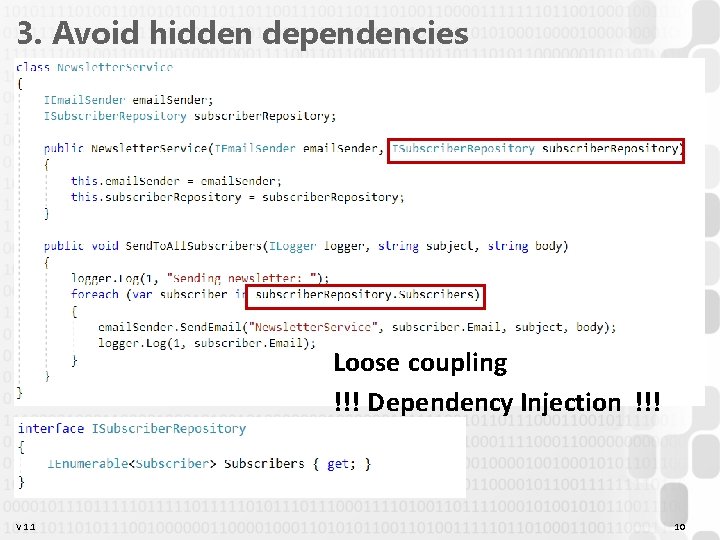
3. Avoid hidden dependencies Loose coupling !!! Dependency Injection !!! V 1. 1 10
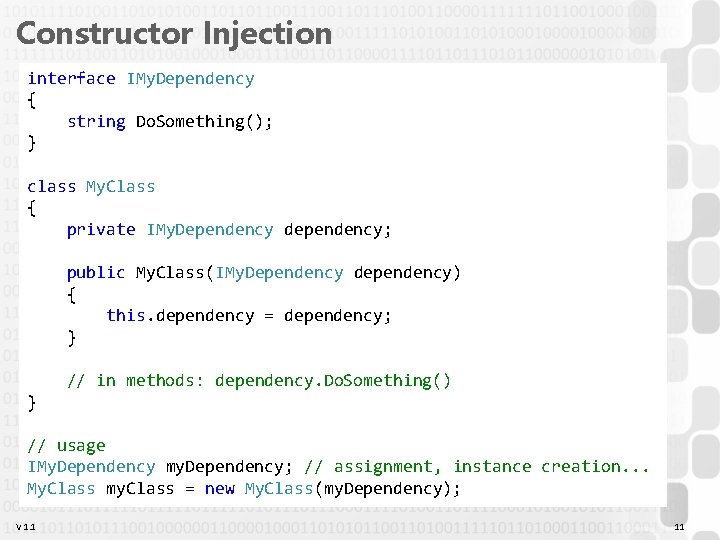
Constructor Injection interface IMy. Dependency { string Do. Something(); } class My. Class { private IMy. Dependency dependency; public My. Class(IMy. Dependency dependency) { this. dependency = dependency; } // in methods: dependency. Do. Something() } // usage IMy. Dependency my. Dependency; // assignment, instance creation. . . My. Class my. Class = new My. Class(my. Dependency); V 1. 1 11
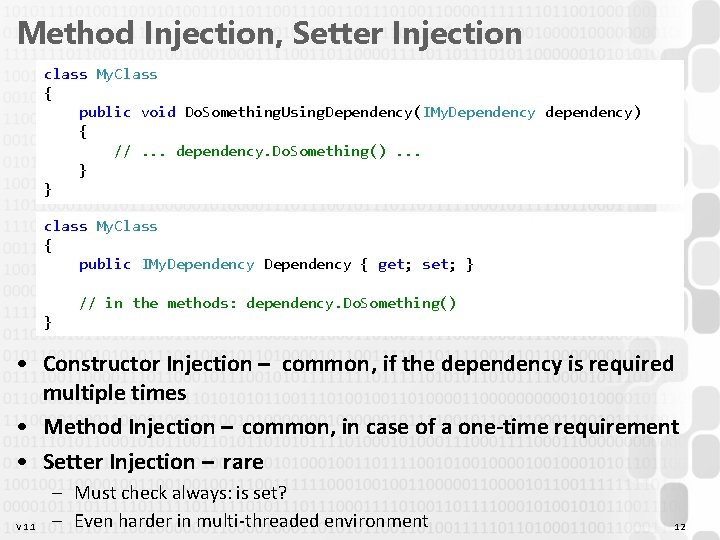
Method Injection, Setter Injection class My. Class { public void Do. Something. Using. Dependency(IMy. Dependency dependency) { //. . . dependency. Do. Something(). . . } } class My. Class { public IMy. Dependency { get; set; } // in the methods: dependency. Do. Something() } • Constructor Injection – common, if the dependency is required multiple times • Method Injection – common, in case of a one-time requirement • Setter Injection – rare V 1. 1 – Must check always: is set? – Even harder in multi-threaded environment 12
Dependency Injection „ I give you dependency injection for five-year-olds. When you go and get things out of the refrigerator for yourself, you can cause problems. You might leave the door open, you might get something Mommy or Daddy doesn't want you to have. You might even be looking for something we don't even have or which has expired. What you should be doing is stating a need, "I need something to drink with lunch, " and then we will make sure you have something when you sit down to eat. ” https: //stackoverflow. com/questions/1638919/how-to-explaindependency-injection-to-a-5 -year-old/1638961#1638961 (Injection vs Inversion, In this semester we only need the Injection) 13 V 1. 1
Dependency Injection • We provide the dependencies of the classes externally – via interfaces, which allows us – To exchange the dependency later at any time to another class – while keeping the interface – To perform “truly” independent individual unit-tests • When testing, we replace the dependency with a known and simple object solely created for the tests – The class will be independent from the dependency – Speed: we use a simple class representing only the tested methods instead of a complex logic – Independent: 1 test 1 exchange-object, usable for all operations – Various techniques: Dummy, Stub, Spy, Fake, Mock: Same interface, different philosophy V 1. 1 14
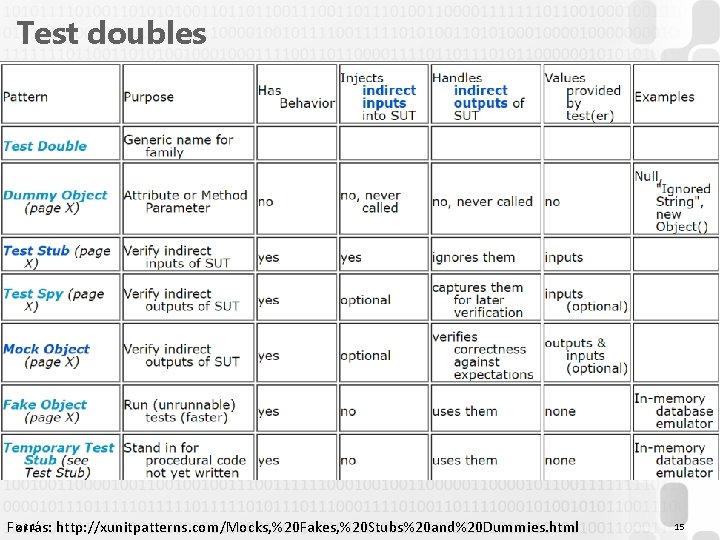
Test doubles V 1. 1 Forrás: http: //xunitpatterns. com/Mocks, %20 Fakes, %20 Stubs%20 and%20 Dummies. html 15
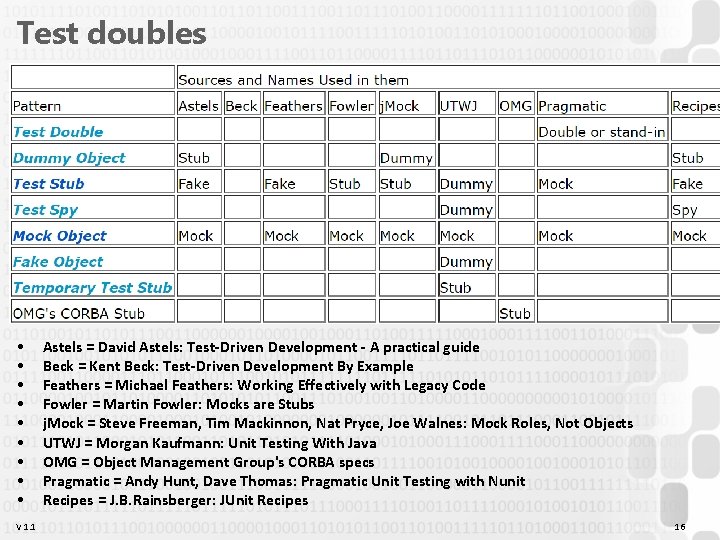
Test doubles • • • V 1. 1 Astels = David Astels: Test-Driven Development - A practical guide Beck = Kent Beck: Test-Driven Development By Example Feathers = Michael Feathers: Working Effectively with Legacy Code Fowler = Martin Fowler: Mocks are Stubs j. Mock = Steve Freeman, Tim Mackinnon, Nat Pryce, Joe Walnes: Mock Roles, Not Objects UTWJ = Morgan Kaufmann: Unit Testing With Java OMG = Object Management Group's CORBA specs Pragmatic = Andy Hunt, Dave Thomas: Pragmatic Unit Testing with Nunit Recipes = J. B. Rainsberger: JUnit Recipes 16
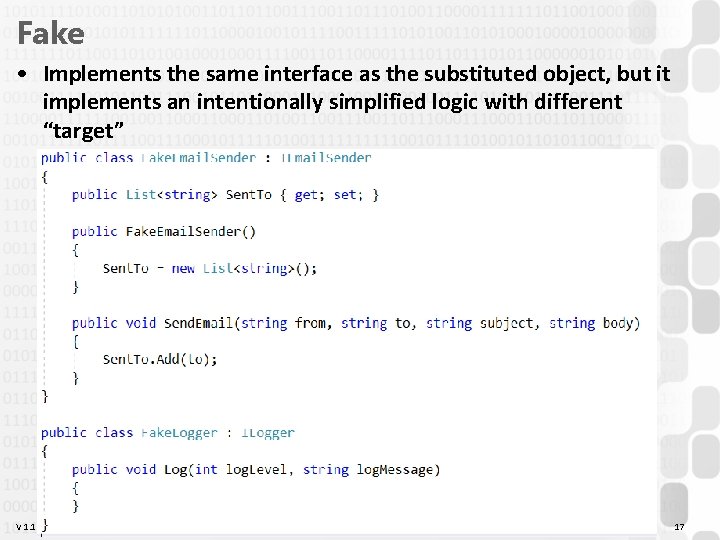
Fake • Implements the same interface as the substituted object, but it implements an intentionally simplified logic with different “target” V 1. 1 17
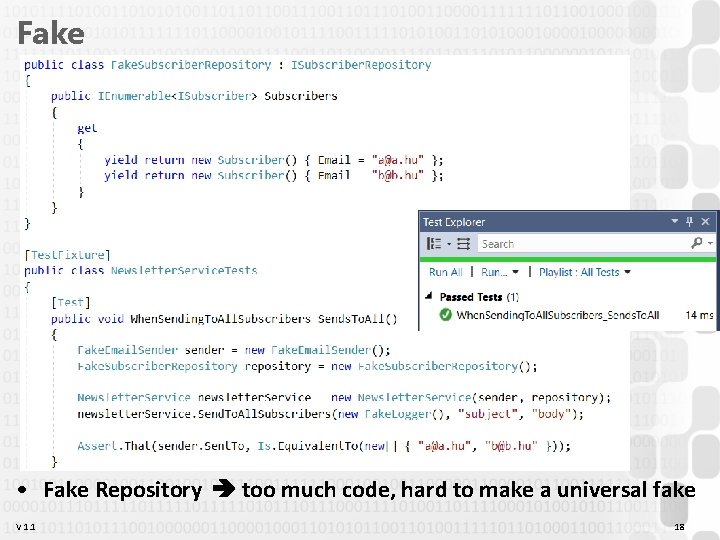
Fake • Fake Repository too much code, hard to make a universal fake V 1. 1 18
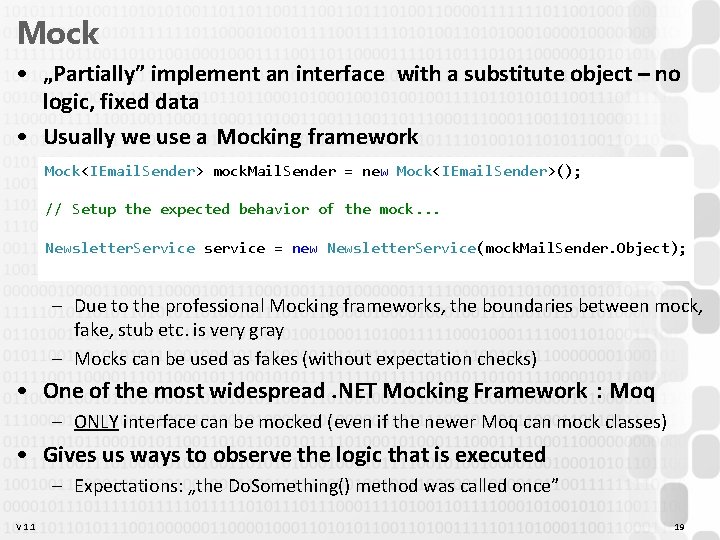
Mock • „Partially” implement an interface with a substitute object – no logic, fixed data • Usually we use a Mocking framework Mock<IEmail. Sender> mock. Mail. Sender = new Mock<IEmail. Sender>(); // Setup the expected behavior of the mock. . . Newsletter. Service service = new Newsletter. Service(mock. Mail. Sender. Object); – Due to the professional Mocking frameworks, the boundaries between mock, fake, stub etc. is very gray – Mocks can be used as fakes (without expectation checks) • One of the most widespread. NET Mocking Framework : Moq – ONLY interface can be mocked (even if the newer Moq can mock classes) • Gives us ways to observe the logic that is executed – Expectations: „the Do. Something() method was called once” V 1. 1 19
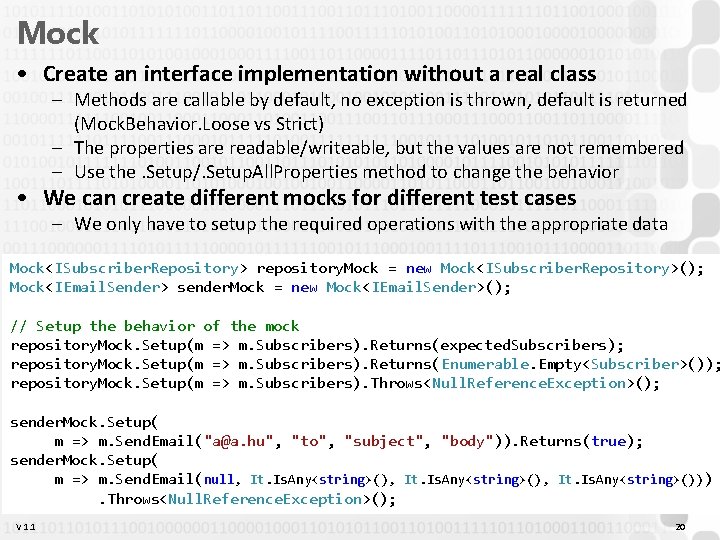
Mock • Create an interface implementation without a real class – Methods are callable by default, no exception is thrown, default is returned (Mock. Behavior. Loose vs Strict) – The properties are readable/writeable, but the values are not remembered – Use the. Setup/. Setup. All. Properties method to change the behavior • We can create different mocks for different test cases – We only have to setup the required operations with the appropriate data Mock<ISubscriber. Repository> repository. Mock = new Mock<ISubscriber. Repository>(); Mock<IEmail. Sender> sender. Mock = new Mock<IEmail. Sender>(); // Setup the behavior of the mock repository. Mock. Setup(m => m. Subscribers). Returns(expected. Subscribers); repository. Mock. Setup(m => m. Subscribers). Returns(Enumerable. Empty<Subscriber>()); repository. Mock. Setup(m => m. Subscribers). Throws<Null. Reference. Exception>(); sender. Mock. Setup( m => m. Send. Email("a@a. hu", "to", "subject", "body")). Returns(true); sender. Mock. Setup( m => m. Send. Email(null, It. Is. Any<string>(), It. Is. Any<string>())). Throws<Null. Reference. Exception>(); V 1. 1 20
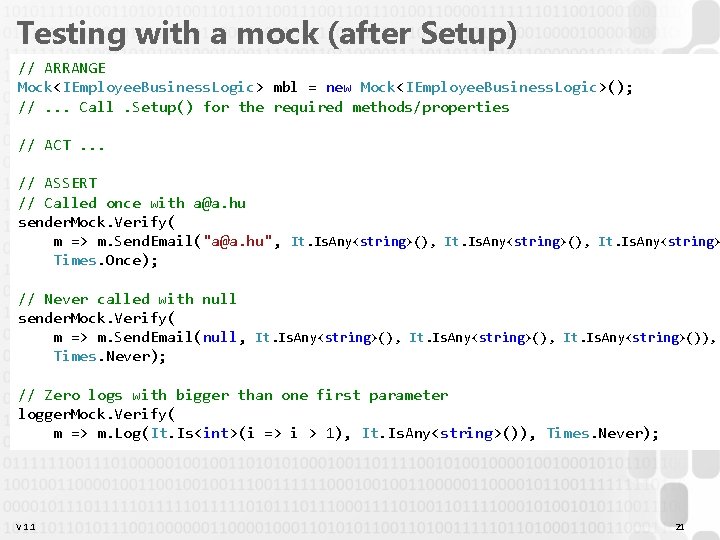
Testing with a mock (after Setup) // ARRANGE Mock<IEmployee. Business. Logic> mbl = new Mock<IEmployee. Business. Logic>(); //. . . Call. Setup() for the required methods/properties // ACT. . . // ASSERT // Called once with a@a. hu sender. Mock. Verify( m => m. Send. Email("a@a. hu", It. Is. Any<string>(), It. Is. Any<string> Times. Once); // Never called with null sender. Mock. Verify( m => m. Send. Email(null, It. Is. Any<string>(), It. Is. Any<string>()), Times. Never); // Zero logs with bigger than one first parameter logger. Mock. Verify( m => m. Log(It. Is<int>(i => i > 1), It. Is. Any<string>()), Times. Never); V 1. 1 21
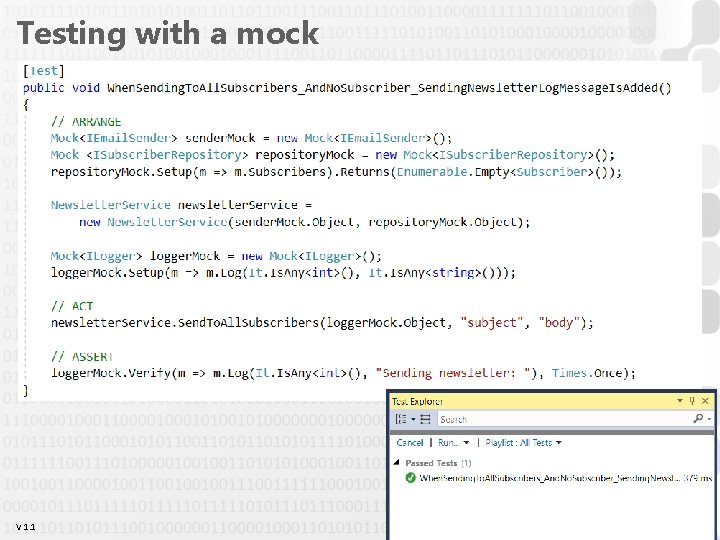
Testing with a mock V 1. 1 22
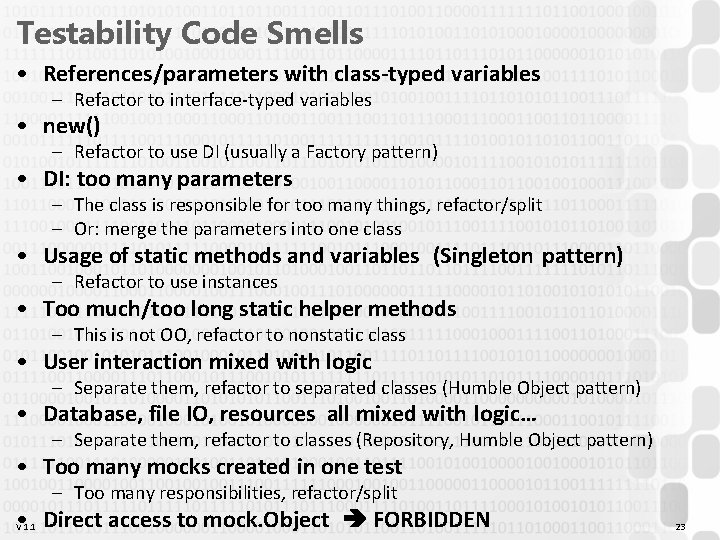
Testability Code Smells • References/parameters with class-typed variables – Refactor to interface-typed variables • new() – Refactor to use DI (usually a Factory pattern) • DI: too many parameters – The class is responsible for too many things, refactor/split – Or: merge the parameters into one class • Usage of static methods and variables (Singleton pattern) – Refactor to use instances • Too much/too long static helper methods – This is not OO, refactor to nonstatic class • User interaction mixed with logic – Separate them, refactor to separated classes (Humble Object pattern) • Database, file IO, resources all mixed with logic… – Separate them, refactor to classes (Repository, Humble Object pattern) • Too many mocks created in one test – Too many responsibilities, refactor/split • Direct access to mock. Object FORBIDDEN V 1. 1 23
Exercise • Create a business logic for the Cars and Brands tables – Access the data using a Repository – Create the interfaces that describe the expected repository operations – The logic should be capable of filtering for a brand calculate the averages for brands • To test the logic, do NOT access the real database ! – Using Moq, during the Arrange phase create a mocked repository – The data access method of the repository should return data suitable for the current test case – During the test, we should check if the logic returns with good values, and also that it correctly uses the data access methods of the repository V 1. 1 24
V 1. 1 25
- Slides: 25