
Advanced Database Techniques 2010 Martin Kersten Stefan Manegold
Advanced Database Techniques 2010 Martin Kersten Stefan Manegold Fabian Groffen Jenny Zhang http: //www. cwi. nl/~manegold/teaching/adt 2010
Advanced Database Techniques • Prerequisite knowledge – Linux, C – Relational data model – SQL – Relational algebra – Data structures (b-tree, hash) – Latex • What is the practical experience?
Code bases • Database management systems are BIG software systems – Oracle, SQL-server, DB 2 >1 M lines – Postgre. SQL 300 K lines – My. SQL 500 K lines – Monet. DB 900 K lines (300 K *. mx) – SQLite 60 K lines • Programmer teams for DBMS kernels range from a few to a few hundred
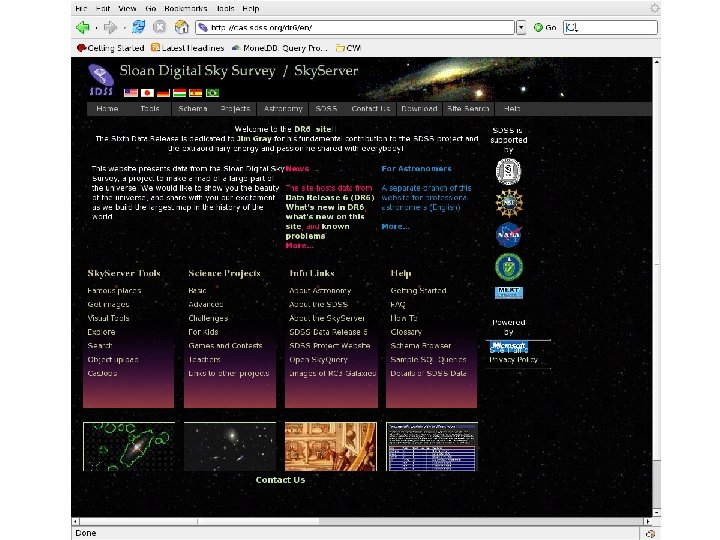
Database sizes • • • i. Phone 7. 000 records for audio SAP a catalog of > 12. 000 relations Ebay simple click stream of 2. 5 Peta. Byte Google ? ? 1 M machines Physics (HEP) 1 petabyte/year Astronomy Skyserver
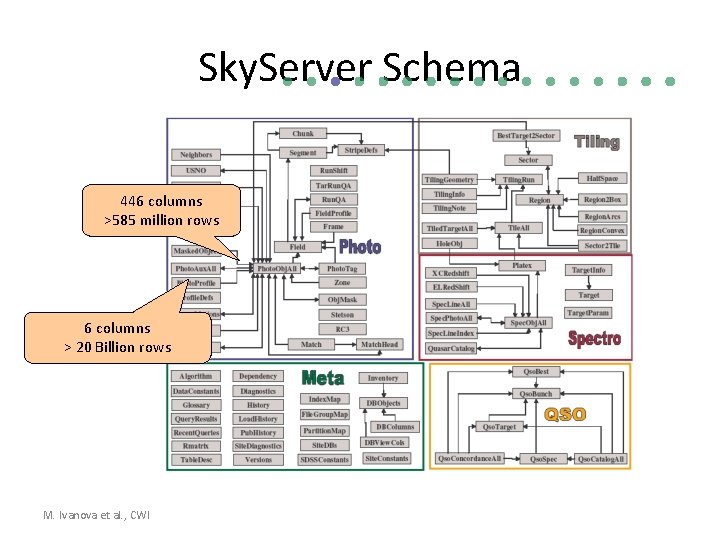
Sky. Server Schema 446 columns >585 million rows 6 columns > 20 Billion rows M. Ivanova et al. , CWI
Database Challenges • Scale to very large database on very large distributed platforms • Use the hardware in an optimal way
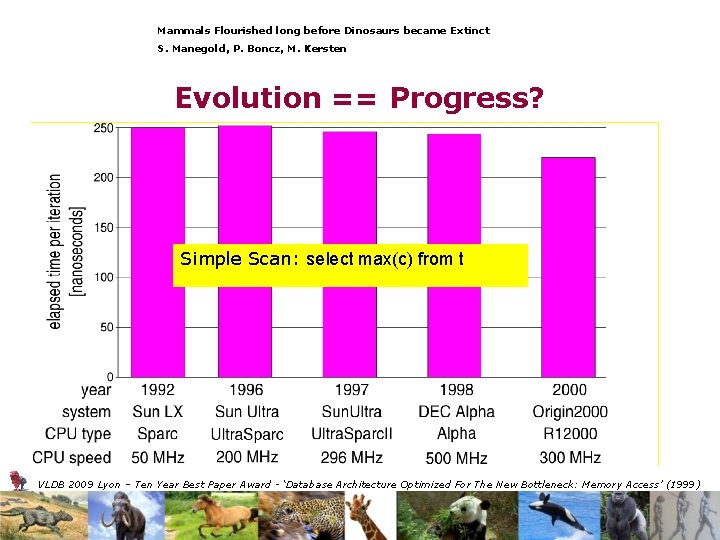
Mammals Flourished long before Dinosaurs became Extinct S. Manegold, P. Boncz, M. Kersten Evolution == Progress? Simple Scan: select max(c) from t VLDB 2009 Lyon – Ten Year Best Paper Award - ‘Database Architecture Optimized For The New Bottleneck: Memory Access’ (1999)
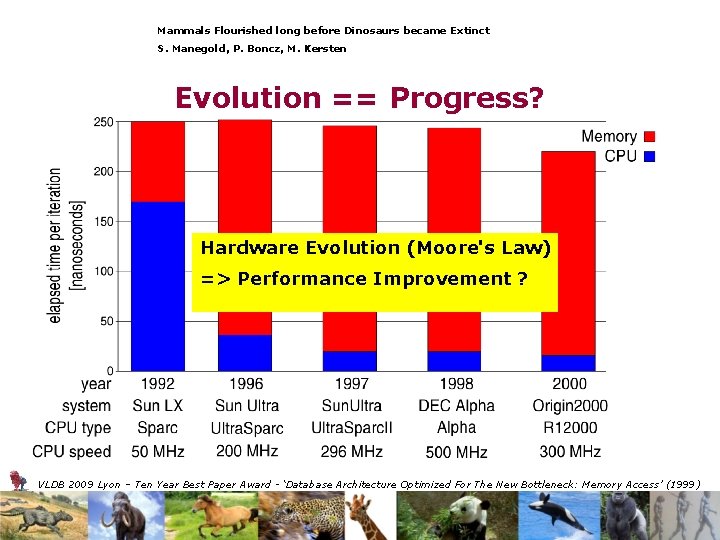
Mammals Flourished long before Dinosaurs became Extinct S. Manegold, P. Boncz, M. Kersten Evolution == Progress? Hardware Evolution (Moore's Law) => BUTPerformance Software Stagnation Improvement ! ? VLDB 2009 Lyon – Ten Year Best Paper Award - ‘Database Architecture Optimized For The New Bottleneck: Memory Access’ (1999)
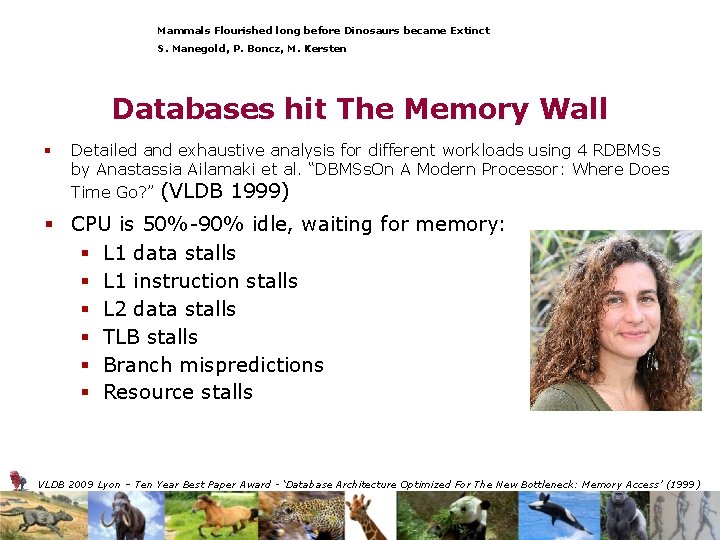
Mammals Flourished long before Dinosaurs became Extinct S. Manegold, P. Boncz, M. Kersten Databases hit The Memory Wall Detailed and exhaustive analysis for different workloads using 4 RDBMSs by Anastassia Ailamaki et al. “DBMSs. On A Modern Processor: Where Does Time Go? ” (VLDB 1999) CPU is 50%-90% idle, waiting for memory: L 1 data stalls L 1 instruction stalls L 2 data stalls TLB stalls Branch mispredictions Resource stalls VLDB 2009 Lyon – Ten Year Best Paper Award - ‘Database Architecture Optimized For The New Bottleneck: Memory Access’ (1999)
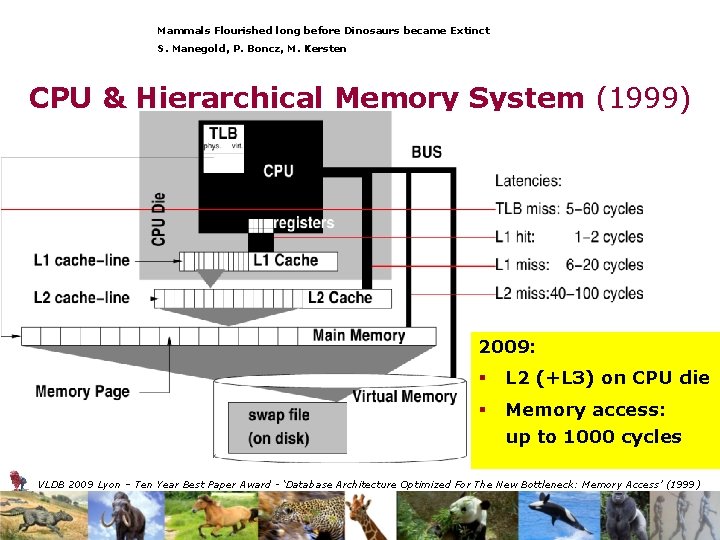
Mammals Flourished long before Dinosaurs became Extinct S. Manegold, P. Boncz, M. Kersten CPU & Hierarchical Memory System (1999) 2009: L 2 (+L 3) on CPU die Memory access: up to 1000 cycles VLDB 2009 Lyon – Ten Year Best Paper Award - ‘Database Architecture Optimized For The New Bottleneck: Memory Access’ (1999)
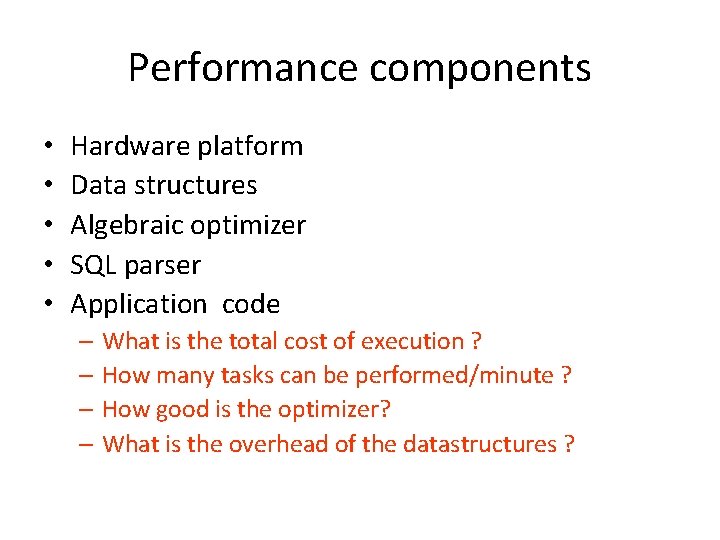
Performance components • • • Hardware platform Data structures Algebraic optimizer SQL parser Application code – What is the total cost of execution ? – How many tasks can be performed/minute ? – How good is the optimizer? – What is the overhead of the datastructures ?
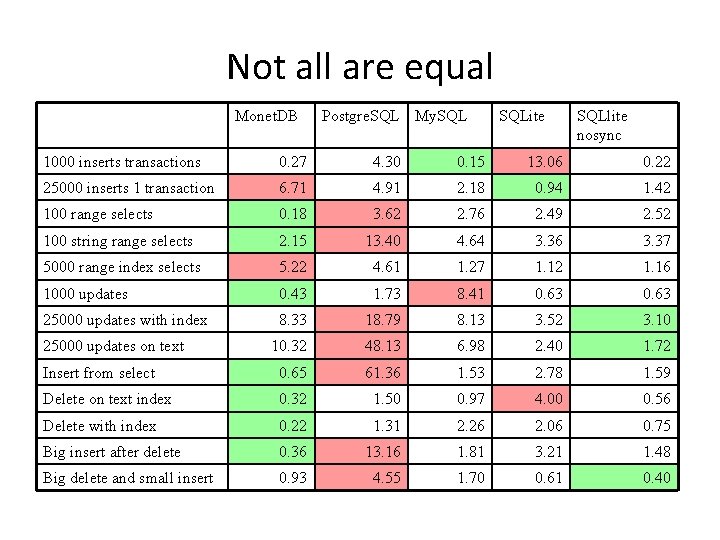
Not all are equal Monet. DB Postgre. SQL My. SQLite SQLlite nosync 1000 inserts transactions 0. 27 4. 30 0. 15 13. 06 0. 22 25000 inserts 1 transaction 6. 71 4. 91 2. 18 0. 94 1. 42 100 range selects 0. 18 3. 62 2. 76 2. 49 2. 52 100 string range selects 2. 15 13. 40 4. 64 3. 36 3. 37 5000 range index selects 5. 22 4. 61 1. 27 1. 12 1. 16 1000 updates 0. 43 1. 73 8. 41 0. 63 25000 updates with index 8. 33 18. 79 8. 13 3. 52 3. 10 10. 32 48. 13 6. 98 2. 40 1. 72 Insert from select 0. 65 61. 36 1. 53 2. 78 1. 59 Delete on text index 0. 32 1. 50 0. 97 4. 00 0. 56 Delete with index 0. 22 1. 31 2. 26 2. 06 0. 75 Big insert after delete 0. 36 13. 16 1. 81 3. 21 1. 48 Big delete and small insert 0. 93 4. 55 1. 70 0. 61 0. 40 25000 updates on text
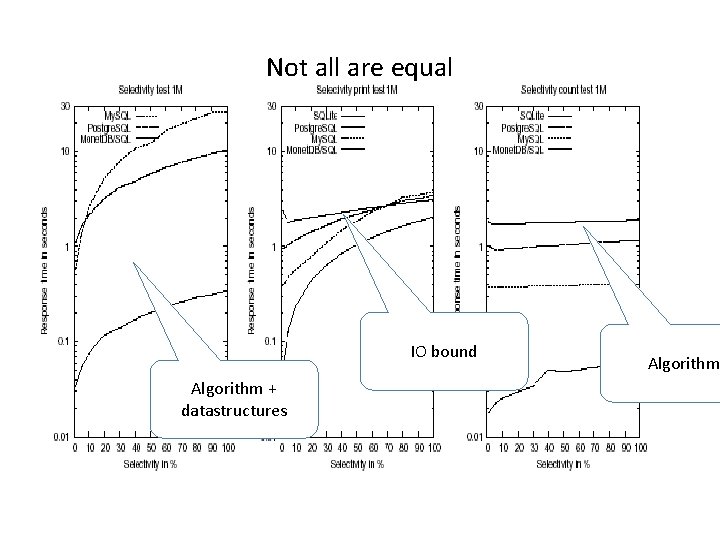
Not all are equal IO bound Algorithm + datastructures Algorithm
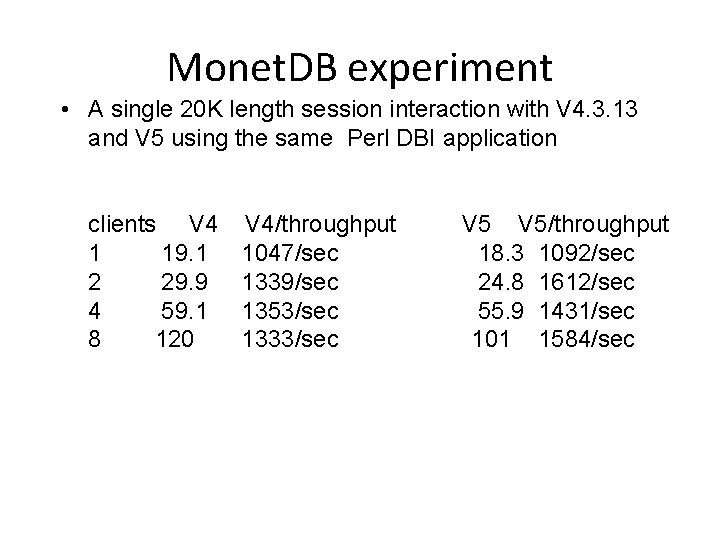
Monet. DB experiment • A single 20 K length session interaction with V 4. 3. 13 and V 5 using the same Perl DBI application clients V 4/throughput V 5/throughput 1 19. 1 1047/sec 18. 3 1092/sec 2 29. 9 1339/sec 24. 8 1612/sec 4 59. 1 1353/sec 55. 9 1431/sec 8 120 1333/sec 101 1584/sec
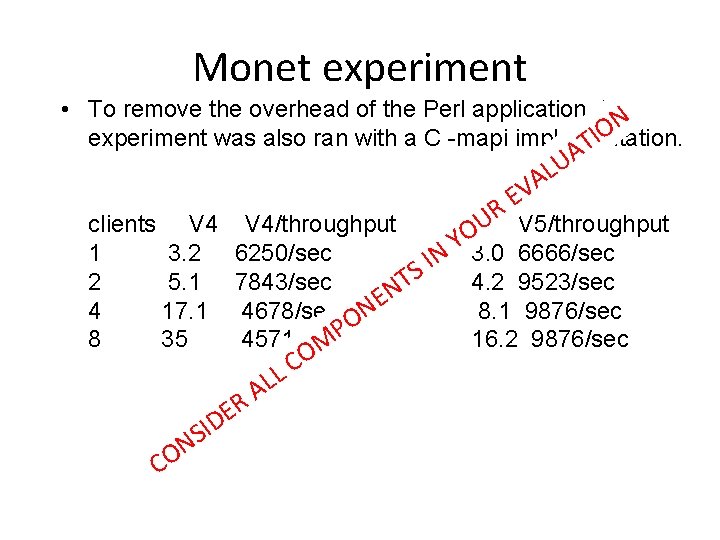
Monet experiment • To remove the overhead of the Perl application, the N O I experiment was also ran with a C -mapi implementation. T R A V E A U L U clients V 4/throughput V 5/throughput O Y 1 3. 2 6250/sec 3. 0 6666/sec N I S T 2 5. 1 7843/sec 4. 2 9523/sec N E 4 17. 1 4678/sec 8. 1 9876/sec N O P 8 35 4571/sec 16. 2 9876/sec M O C L L A R N O C E D SI
Gaining insight • Study the code base (inspection+profiling) – Often not accessible outside development lab • Study individual techniques (data structures+simulation) – Focus of most Ph. D research in DBMS • Detailed knowledge becomes available, but ignores the total cost of execution. • Study as a black box – Develop a representative application framework • Benchmarks !
Performance Benchmarks • Suites of tasks used to quantify the performance of software systems • Important in comparing database systems, especially as systems become more standards compliant.
Performance Benchmarks • Commonly used performance measures: – Response time (delay from submission of transaction to return of result) – Throughput (transactions per second, or tps) – Availability or mean time to failure – Speedup (linear->twice as much resources reduces time half) – Scaleup (response time remains constant with increasing load and resources) – Sizeup (doubling the size does not double required resources)
Benchmark design • Benchmark suite structures – Simple, one shot experiment • time to set-up a connection with a db server • Selection processing for multiple selectivity factors – Complex, multi-target experiments • Geared at supporting a particular domain • To study the behavior of the DBMS software
Benchmark Design • Multi-target benchmark components: – An application context – A database schema – A database content – A query workload • These components can be fixed upfront or be generated dynamically
Benchmark design • The key question for any benchmark – The ratio for its design – Its ability to differentiate systems – Its ability to highlight problematic areas – Its repeatability on multiple platforms
Wisconsin benchmark • Designed in 1981 to study the query performance of database algorithms on a single user system • Used extensively over the last 20 years to assess maturity of a kernel • The results published caused legal problems for the authors
Wisconsin Benchmark • Wisconsin Benchmark components – Single schema – Relations: ONEKTUP, TENKTUP 1, TENKTUP 2 – Workload: 32 simple SQL queries – Metric: response time • Key design issue is to be able to predict the outcome of a query – DBMS testing; optimizer cost-model design
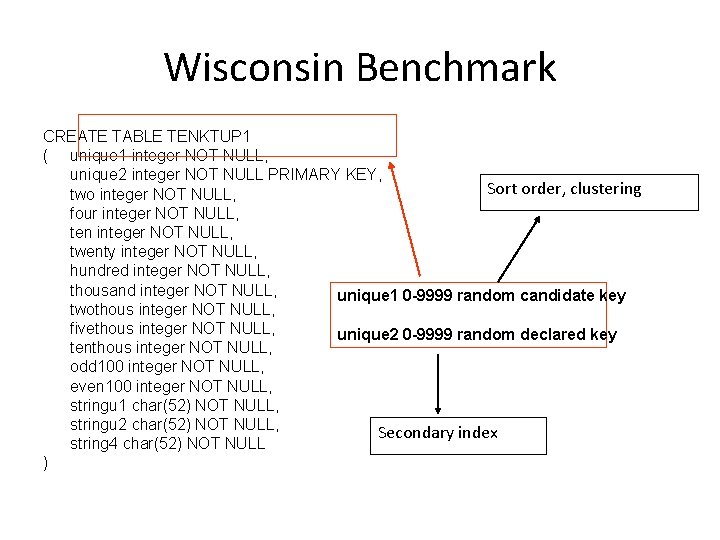
Wisconsin Benchmark CREATE TABLE TENKTUP 1 ( unique 1 integer NOT NULL, unique 2 integer NOT NULL PRIMARY KEY, Sort order, clustering two integer NOT NULL, four integer NOT NULL, ten integer NOT NULL, twenty integer NOT NULL, hundred integer NOT NULL, thousand integer NOT NULL, unique 1 0 -9999 random candidate key twothous integer NOT NULL, fivethous integer NOT NULL, unique 2 0 -9999 random declared key tenthous integer NOT NULL, odd 100 integer NOT NULL, even 100 integer NOT NULL, stringu 1 char(52) NOT NULL, stringu 2 char(52) NOT NULL, Secondary index string 4 char(52) NOT NULL )
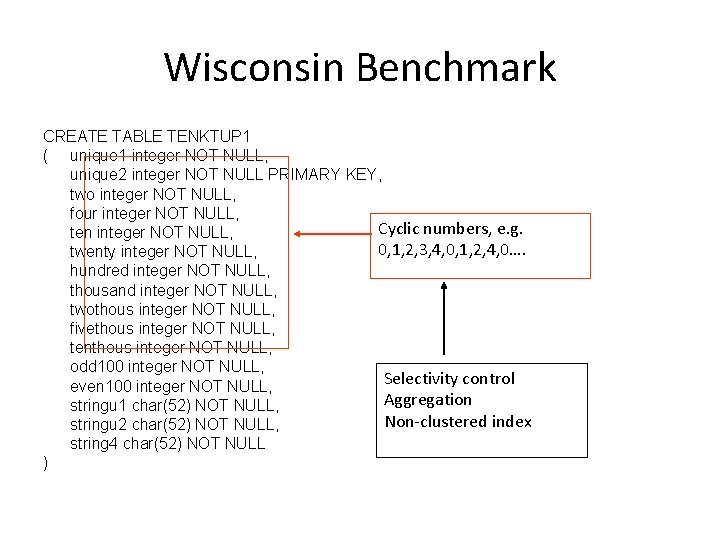
Wisconsin Benchmark CREATE TABLE TENKTUP 1 ( unique 1 integer NOT NULL, unique 2 integer NOT NULL PRIMARY KEY, two integer NOT NULL, four integer NOT NULL, Cyclic numbers, e. g. ten integer NOT NULL, 0, 1, 2, 3, 4, 0, 1, 2, 4, 0…. twenty integer NOT NULL, hundred integer NOT NULL, thousand integer NOT NULL, twothous integer NOT NULL, fivethous integer NOT NULL, tenthous integer NOT NULL, odd 100 integer NOT NULL, Selectivity control even 100 integer NOT NULL, Aggregation stringu 1 char(52) NOT NULL, Non-clustered index stringu 2 char(52) NOT NULL, string 4 char(52) NOT NULL )
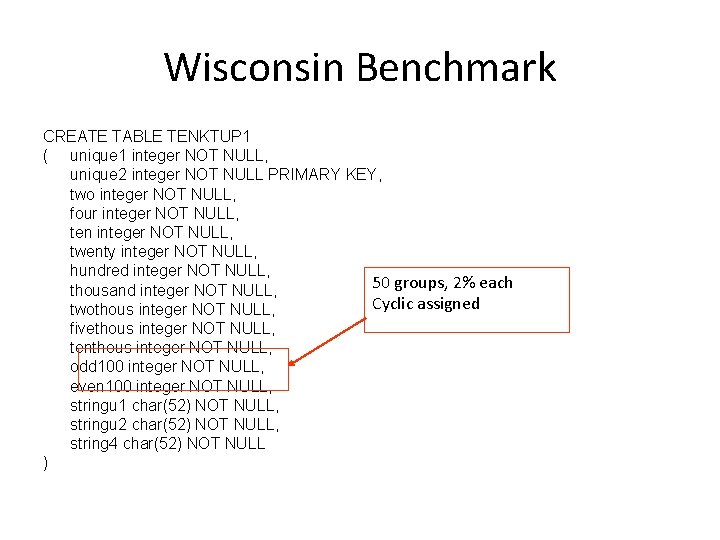
Wisconsin Benchmark CREATE TABLE TENKTUP 1 ( unique 1 integer NOT NULL, unique 2 integer NOT NULL PRIMARY KEY, two integer NOT NULL, four integer NOT NULL, ten integer NOT NULL, twenty integer NOT NULL, hundred integer NOT NULL, 50 groups, 2% each thousand integer NOT NULL, Cyclic assigned twothous integer NOT NULL, fivethous integer NOT NULL, tenthous integer NOT NULL, odd 100 integer NOT NULL, even 100 integer NOT NULL, stringu 1 char(52) NOT NULL, stringu 2 char(52) NOT NULL, string 4 char(52) NOT NULL )
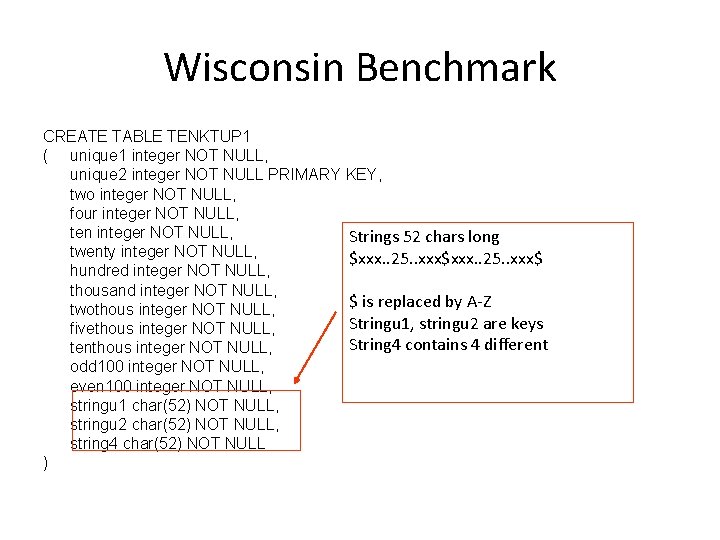
Wisconsin Benchmark CREATE TABLE TENKTUP 1 ( unique 1 integer NOT NULL, unique 2 integer NOT NULL PRIMARY KEY, two integer NOT NULL, four integer NOT NULL, ten integer NOT NULL, Strings 52 chars long twenty integer NOT NULL, $xxx. . 25. . xxx$ hundred integer NOT NULL, thousand integer NOT NULL, $ is replaced by A-Z twothous integer NOT NULL, Stringu 1, stringu 2 are keys fivethous integer NOT NULL, String 4 contains 4 different tenthous integer NOT NULL, odd 100 integer NOT NULL, even 100 integer NOT NULL, stringu 1 char(52) NOT NULL, stringu 2 char(52) NOT NULL, string 4 char(52) NOT NULL )
Wisconsin Benchmark • Comments on old database structure – Tuple size (203 bytes) dictated by the page size – Relation size dictated by low memory, e. g. a 2 megabyte database was almost a complete disk • Redesign and scaling up – Relation size increased to 100 K and beyond – Cyclic values -> random to generate more realistic distribution – Strings start with 7 different char from A-Z
Wisconsin Benchmark • Query benchmark suite aimed at performance of – Selection with different selectivity values – Projection with different percentage of duplicates – Single and multiple joins – Simple aggregates and aggregate functions – Append, delete, modify • Queries may use (clustered) index
Wisconsin Benchmark The speed at which a database system can process a selection operation depends on a number of factors including: 1) The storage organization of the relation. 2) The selectivity factor of the predicate. 3) The hardware speed and the quality of the software. 4) The output mode of the query.
Wisconsin Benchmark The selection queries in the Wisconsin benchmark explore the effect of each and the impact of three different storage organizations : 1) Sequential (heap) organization. 2) Primary clustered index on the unique 2 attribute. (Relation is sorted on unique 2 attribute) 3) Secondary, dense, non-clustered indices on the unique 1 and one. Percent attributes.
Wisconsin Benchmark Query 1 (no index) & Query 3 (clustered index) - 1% selection INSERT INTO TMP SELECT * FROM TENKTUP 1 WHERE unique 2 BETWEEN 0 AND 99 Query 2 (no index) & Query 4 (clustered index) - 10% selection INSERT INTO TMP SELECT * FROM TENKTUP 1 WHERE unique 2 BETWEEN 792 AND 1791
Wisconsin Benchmark Query 5 - 1% selection via a non-clustered index INSERT INTO TMP SELECT * FROM TENKTUP 1 WHERE unique 1 BETWEEN 0 AND 99 Query 6 - 10% selection via a non-clustered index INSERT INTO TMP SELECT * FROM TENKTUP 1 WHERE unique 1 BETWEEN 792 AND 1791
Wisconsin Benchmark The join queries in the benchmark were designed to study the effect of three different factors: 1) The impact of the complexity of a query on the relative performance of the different database systems. 2) The performance of the join algorithms used by the different systems. 3) The effectiveness of the query optimizers on complex queries.
Wisconsin Benchmark Join. ABprime - a simple join of relations A and Bprime where the cardinality of the Bprime relation is 10% that of the A relation. Join. ASel. B - this query is composed of one join and one selection. A and B have the same number of tuples. The selection on B has a 10% selectivity factor, reducing B to the size of the Bprime relation in the Join. ABprime query. The result relation for this query has the same number of tuples as the corresponding Join. ABprime query.
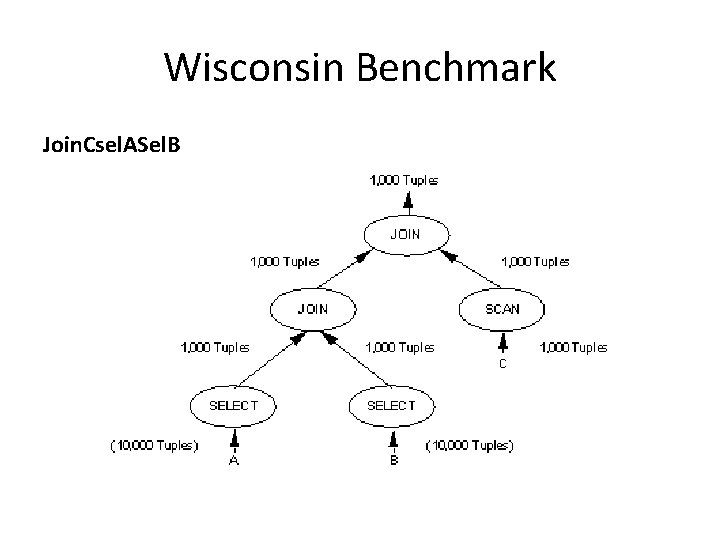
Wisconsin Benchmark Join. Csel. ASel. B
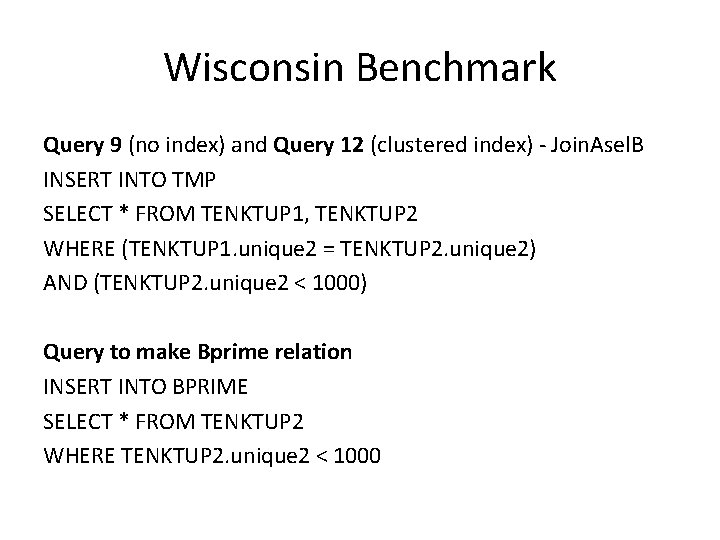
Wisconsin Benchmark Query 9 (no index) and Query 12 (clustered index) - Join. Asel. B INSERT INTO TMP SELECT * FROM TENKTUP 1, TENKTUP 2 WHERE (TENKTUP 1. unique 2 = TENKTUP 2. unique 2) AND (TENKTUP 2. unique 2 < 1000) Query to make Bprime relation INSERT INTO BPRIME SELECT * FROM TENKTUP 2 WHERE TENKTUP 2. unique 2 < 1000
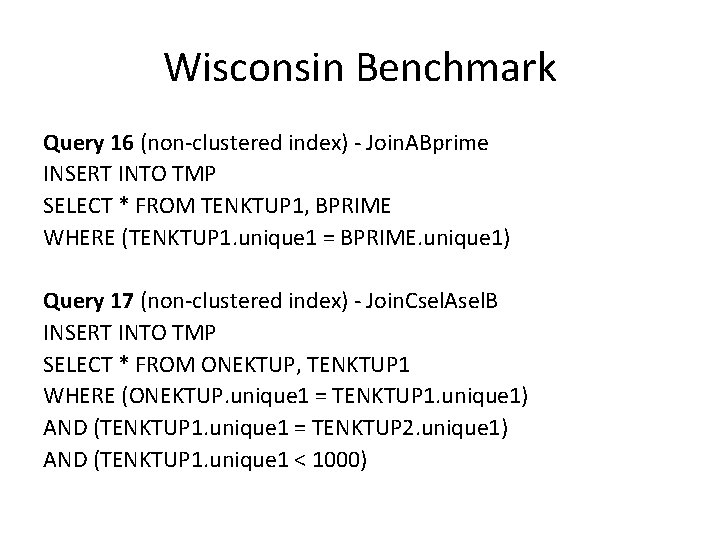
Wisconsin Benchmark Query 16 (non-clustered index) - Join. ABprime INSERT INTO TMP SELECT * FROM TENKTUP 1, BPRIME WHERE (TENKTUP 1. unique 1 = BPRIME. unique 1) Query 17 (non-clustered index) - Join. Csel. Asel. B INSERT INTO TMP SELECT * FROM ONEKTUP, TENKTUP 1 WHERE (ONEKTUP. unique 1 = TENKTUP 1. unique 1) AND (TENKTUP 1. unique 1 = TENKTUP 2. unique 1) AND (TENKTUP 1. unique 1 < 1000)
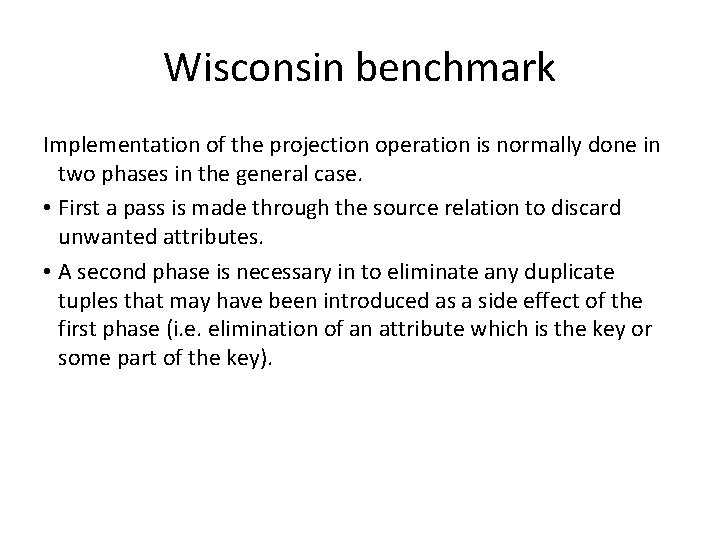
Wisconsin benchmark Implementation of the projection operation is normally done in two phases in the general case. • First a pass is made through the source relation to discard unwanted attributes. • A second phase is necessary in to eliminate any duplicate tuples that may have been introduced as a side effect of the first phase (i. e. elimination of an attribute which is the key or some part of the key).
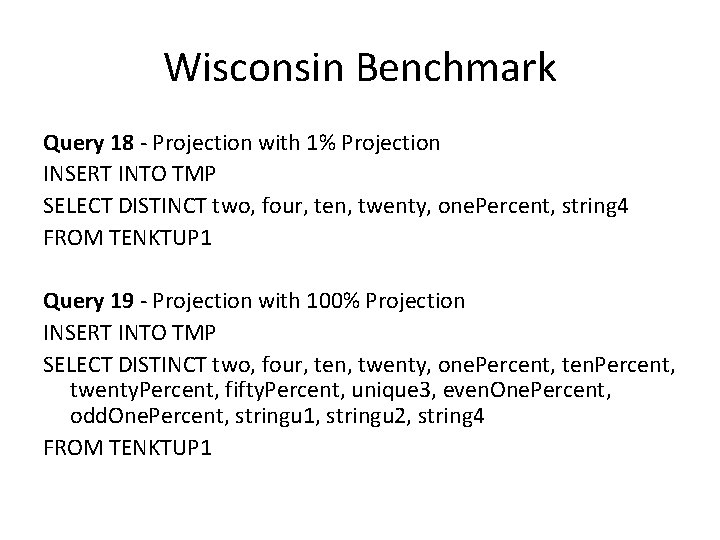
Wisconsin Benchmark Query 18 - Projection with 1% Projection INSERT INTO TMP SELECT DISTINCT two, four, ten, twenty, one. Percent, string 4 FROM TENKTUP 1 Query 19 - Projection with 100% Projection INSERT INTO TMP SELECT DISTINCT two, four, ten, twenty, one. Percent, ten. Percent, twenty. Percent, fifty. Percent, unique 3, even. One. Percent, odd. One. Percent, stringu 1, stringu 2, string 4 FROM TENKTUP 1
Metric Selections • Criteria – Easy to explain in mathematical terms to users – Non-hypersensitivity – Scalability translates to easy change of metric – Balance to capture delta changes in outlier positions – Easy translation to operational decisions
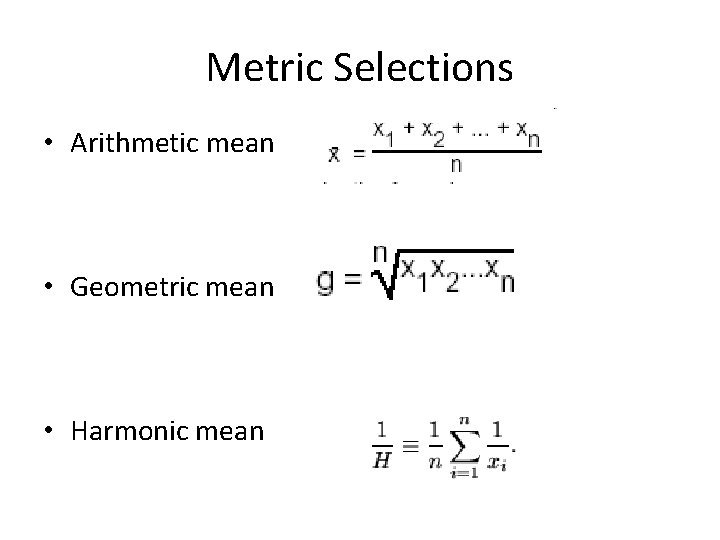
Metric Selections • Arithmetic mean • Geometric mean • Harmonic mean
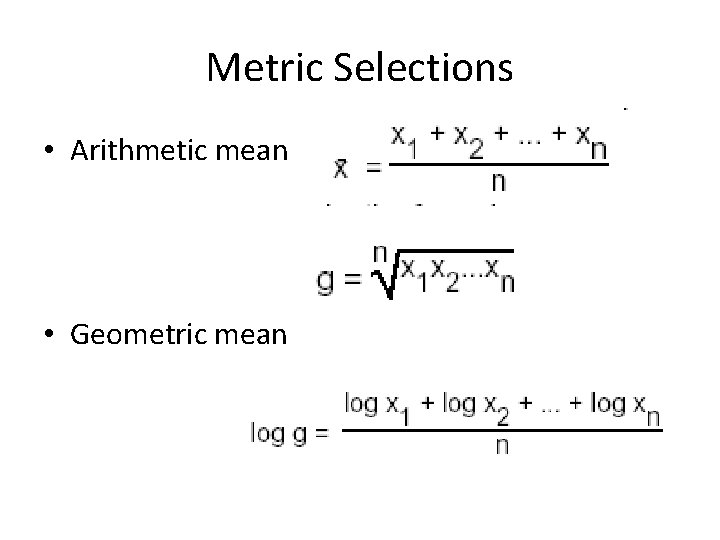
Metric Selections • Arithmetic mean • Geometric mean
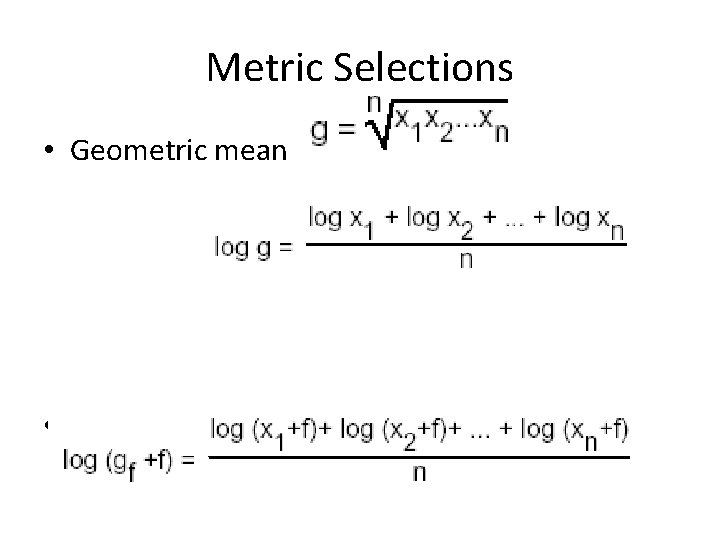
Metric Selections • Geometric mean • Move away from zero to “level” impact
Database Application Classes • Online transaction processing (OLTP) – requires high concurrency and clever techniques to speed up commit processing, to support a high rate of update transactions. • Decision support applications – including online analytical processing, or OLAP applications, require good query evaluation algorithms and query optimization. • Embedded applications – Requires small footprint, small database storage
Benchmarks Suites • The Transaction Processing Council (www. tpc. org) benchmark suites are widely used. – TPC-A and TPC-B: simple OLTP application modeling a bank teller application with and without communication • Not used anymore – TPC-C: complex OLTP application modeling an inventory system • Current standard for OLTP benchmarking
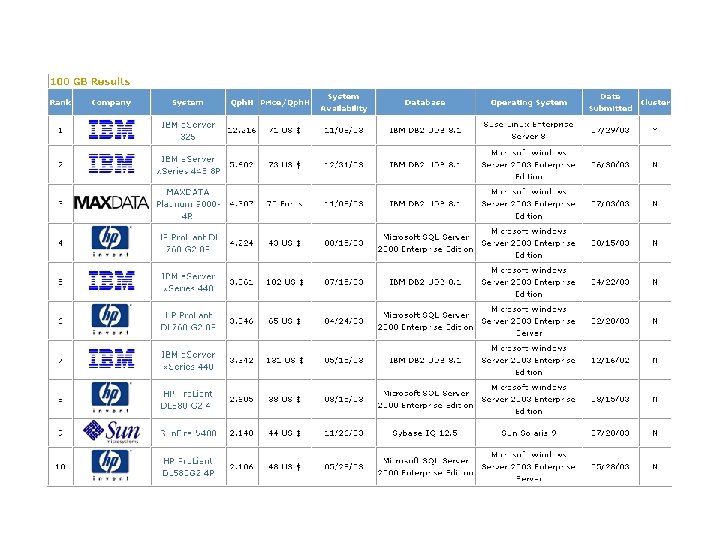
Benchmarks Suites (Cont. ) • TPC benchmarks (cont. ) – TPC-D: complex decision support application • Superceded by TPC-H and TPC-R – TPC-H: (H for ad hoc) • Models ad hoc queries which are not known beforehand – Total of 22 queries with emphasis on aggregation • prohibits materialized views • permits indices only on primary and foreign keys – TPC-R: (R for reporting) same as TPC-H, but without any restrictions on materialized views and indices – TPC-W: (W for Web) End-to-end Web service benchmark modeling a Web bookstore, with combination of static and dynamically generated pages
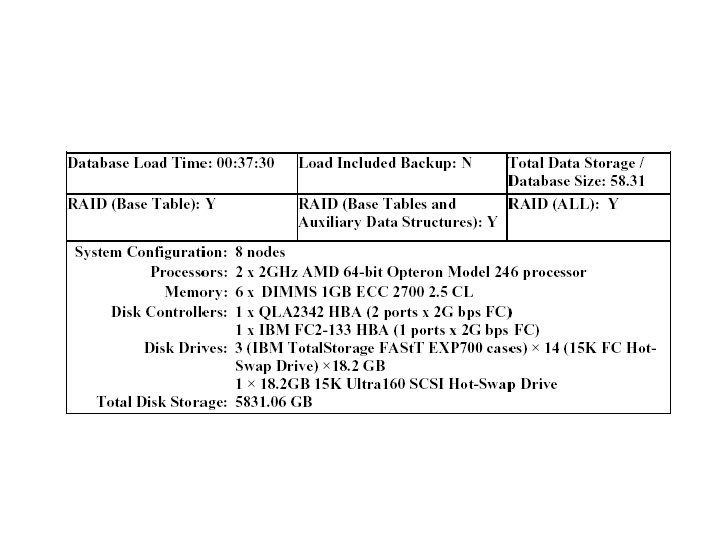
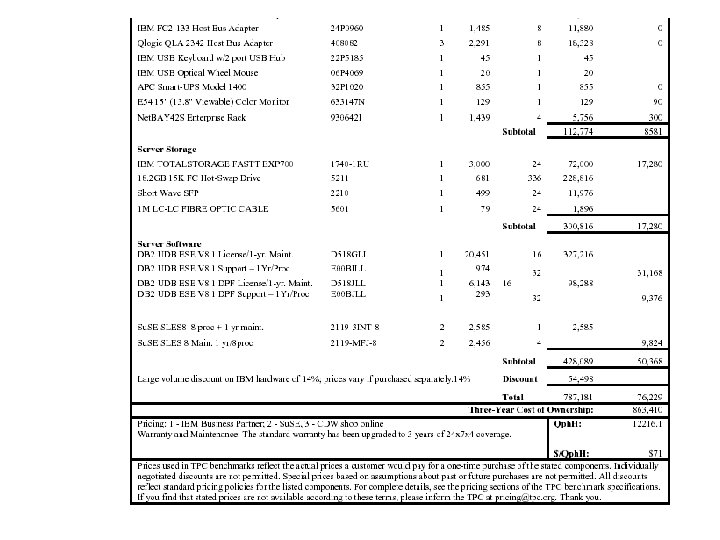
TPC Performance Measures • TPC performance measures – transactions-per-second with specified constraints on response time – transactions-per-second-per-dollar accounts for cost of owning system • TPC benchmark requires database sizes to be scaled up with increasing transactions-per-second – reflects real world applications where more customers means more database size and more transactions-persecond • External audit of TPC performance numbers mandatory – TPC performance claims can be trusted
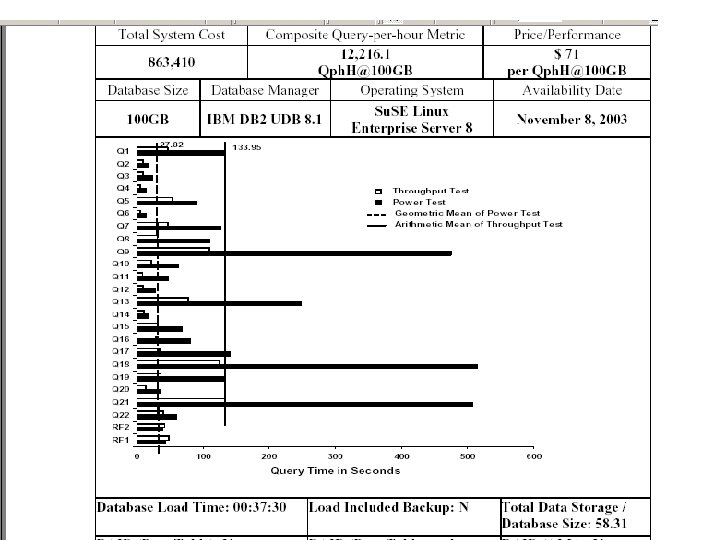
TPC Performance Measures • Two types of tests for TPC-H and TPC-R – Power test: runs queries and updates sequentially, then takes mean to find queries per hour – Throughput test: runs queries and updates concurrently • multiple streams running in parallel each generates queries, with one parallel update stream – Composite query per hour metric: square root of product of power and throughput metrics – Composite price/performance metric
Take aways • Databases from small to extreme large • DBMS are highly complex systems • Performance is a user benefit, but also a cost reduction method • Proper (micro) benchmarks are the yardsticks
- Slides: 55