
Advanced Database Design and Implementation Dr Mohamed Ahmed
Advanced Database Design and Implementation Dr. Mohamed Ahmed Mohamed Ali University of Khartoum Faculty of Mathematical Sciences Advanced Database Design and Implementation 1
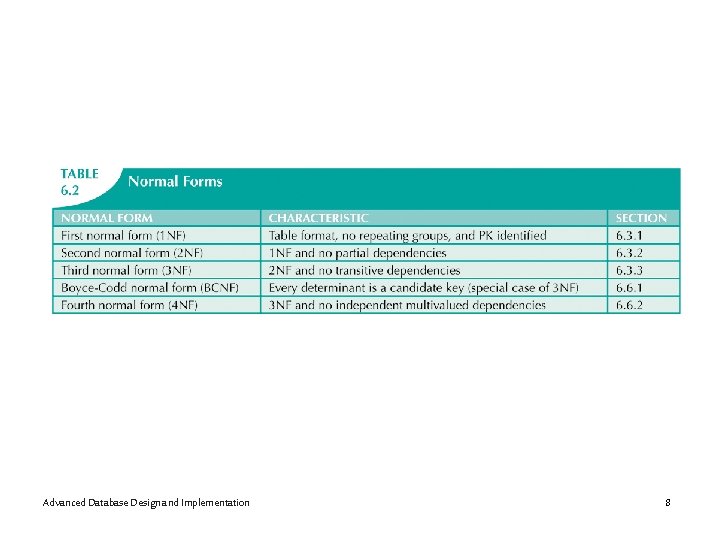
Database Tables and Normalization • Normalization – Process for evaluating and correcting table structures to minimize data redundancies • Reduces data anomalies – Series of stages called normal forms: • First normal form (1 NF) • Second normal form (2 NF) • Third normal form (3 NF) Advanced Database Design and Implementation 2
Database Tables and Normalization (cont’d. ) • Normalization (continued) – 2 NF is better than 1 NF; 3 NF is better than 2 NF – For most business database design purposes, 3 NF is as high as needed in normalization – Highest level of normalization is not always most desirable • Denormalization produces a lower normal form – Increased performance but greater data redundancy Advanced Database Design and Implementation 3
The Need for Normalization • Example: company that manages building projects – Charges its clients by billing hours spent on each contract – Hourly billing rate is dependent on employee’s position – Periodically, report is generated that contains information such as displayed in Table 6. 1 Advanced Database Design and Implementation 4

Advanced Database Design and Implementation 5
The Need for Normalization (cont’d. ) • Structure of data set in Figure 6. 1 does not handle data very well • Table structure appears to work; report is generated with ease • Report may yield different results depending on what data anomaly has occurred • Relational database environment is suited to help designer avoid data integrity problems Advanced Database Design and Implementation 6
The Normalization Process • • Each table represents a single subject No data item will be unnecessarily stored in more than one table All nonprime attributes in a table are dependent on the primary key Each table is void of insertion, update, and deletion anomalies Advanced Database Design and Implementation 7
Advanced Database Design and Implementation 8
The Normalization Process (cont’d. ) • Objective of normalization is to ensure that all tables are in at least 3 NF • Higher forms are not likely to be encountered in business environment • Normalization works one relation at a time • Progressively breaks table into new set of relations based on identified dependencies Advanced Database Design and Implementation 9
Advanced Database Design and Implementation 10
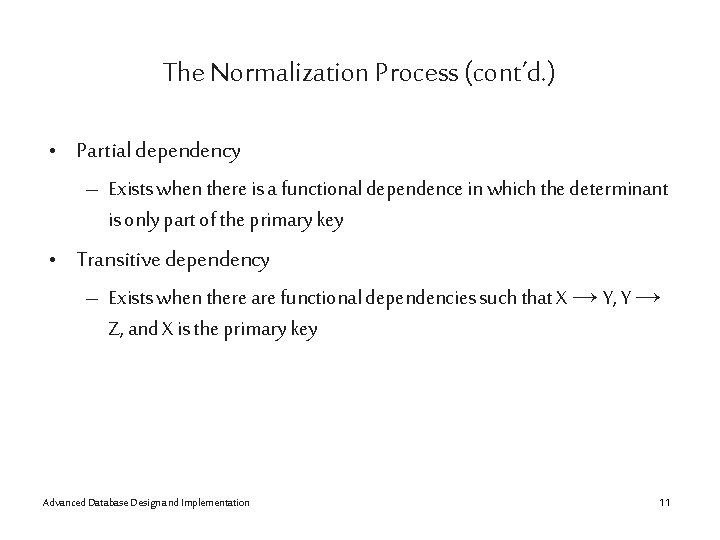
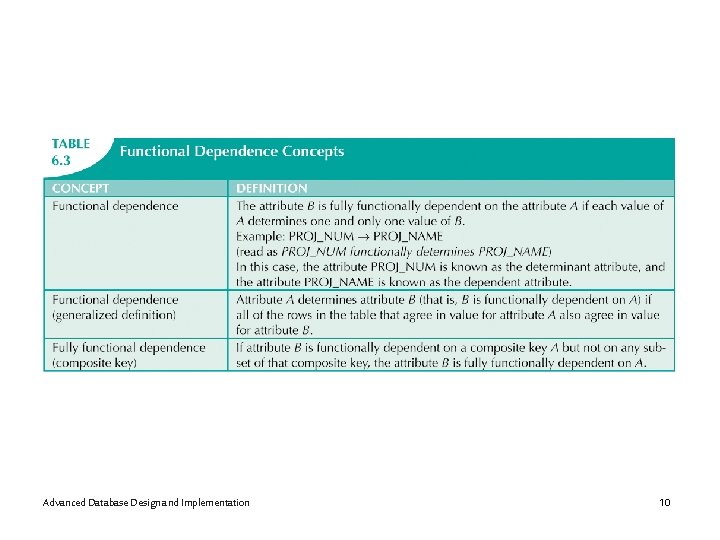
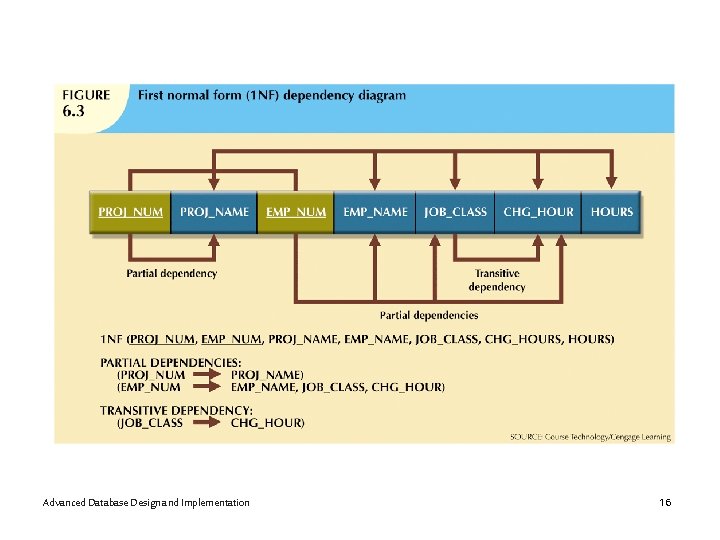
The Normalization Process (cont’d. ) • Partial dependency – Exists when there is a functional dependence in which the determinant is only part of the primary key • Transitive dependency – Exists when there are functional dependencies such that X → Y, Y → Z, and X is the primary key Advanced Database Design and Implementation 11
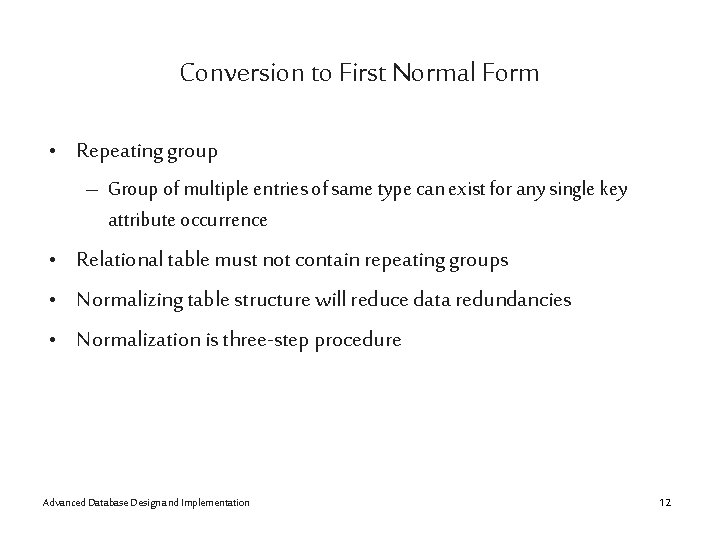
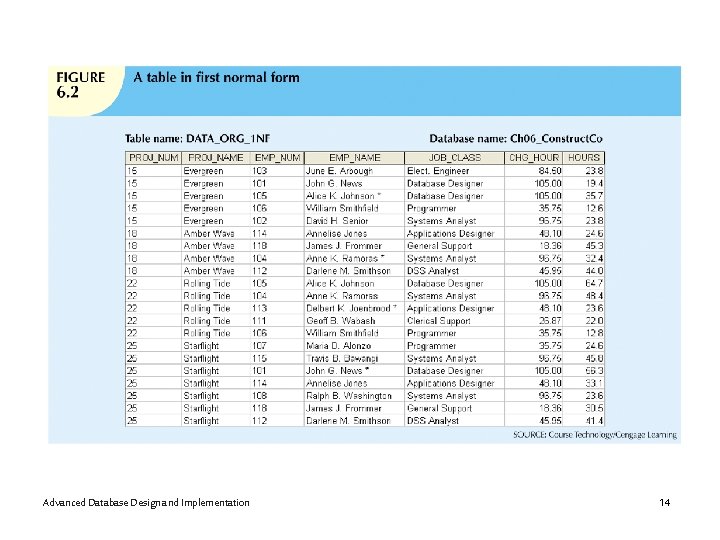
Conversion to First Normal Form • Repeating group – Group of multiple entries of same type can exist for any single key attribute occurrence • Relational table must not contain repeating groups • Normalizing table structure will reduce data redundancies • Normalization is three-step procedure Advanced Database Design and Implementation 12
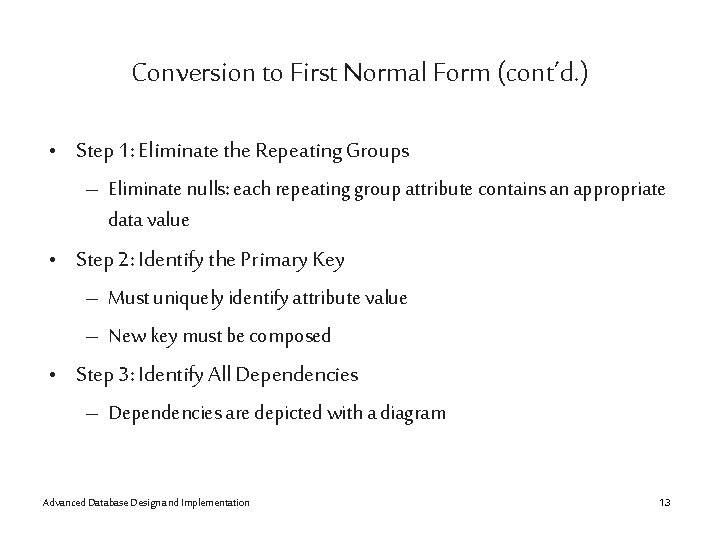
Conversion to First Normal Form (cont’d. ) • Step 1: Eliminate the Repeating Groups – Eliminate nulls: each repeating group attribute contains an appropriate data value • Step 2: Identify the Primary Key – Must uniquely identify attribute value – New key must be composed • Step 3: Identify All Dependencies – Dependencies are depicted with a diagram Advanced Database Design and Implementation 13
Advanced Database Design and Implementation 14
Conversion to First Normal Form (cont’d. ) • Dependency diagram: – Depicts all dependencies found within given table structure – Helpful in getting bird’s-eye view of all relationships among table’s attributes – Makes it less likely that you will overlook an important dependency Advanced Database Design and Implementation 15
Advanced Database Design and Implementation 16
Conversion to First Normal Form (cont’d. ) • First normal form describes tabular format: – All key attributes are defined – No repeating groups in the table – All attributes are dependent on primary key • All relational tables satisfy 1 NF requirements • Some tables contain partial dependencies – Dependencies are based on part of the primary key – Should be used with caution Advanced Database Design and Implementation 17
Conversion to Second Normal Form • Step 1: Make New Tables to Eliminate Partial Dependencies – Write each key component on separate line, then write original (composite) key on last line – Each component will become key in new table • Step 2: Reassign Corresponding Dependent Attributes – Determine attributes that are dependent on other attributes – At this point, most anomalies have been eliminated Advanced Database Design and Implementation 18
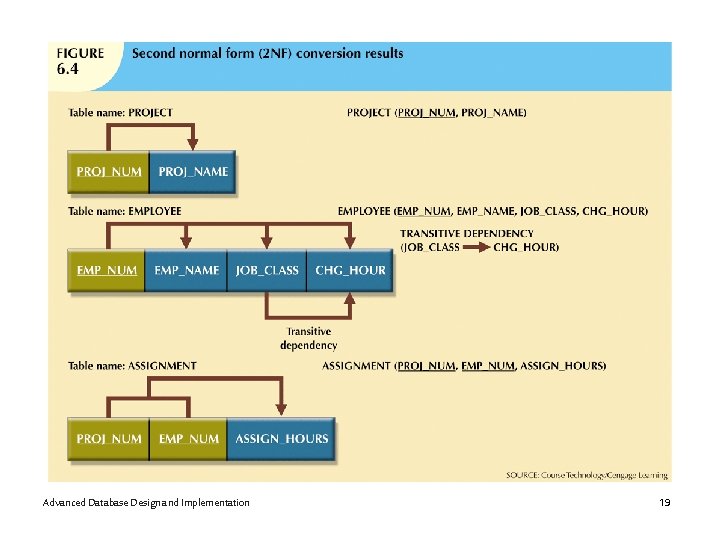
Advanced Database Design and Implementation 19
Conversion to Second Normal Form (cont’d. ) • Table is in second normal form (2 NF) when: – It is in 1 NF and – It includes no partial dependencies: • No attribute is dependent on only portion of primary key Advanced Database Design and Implementation 20
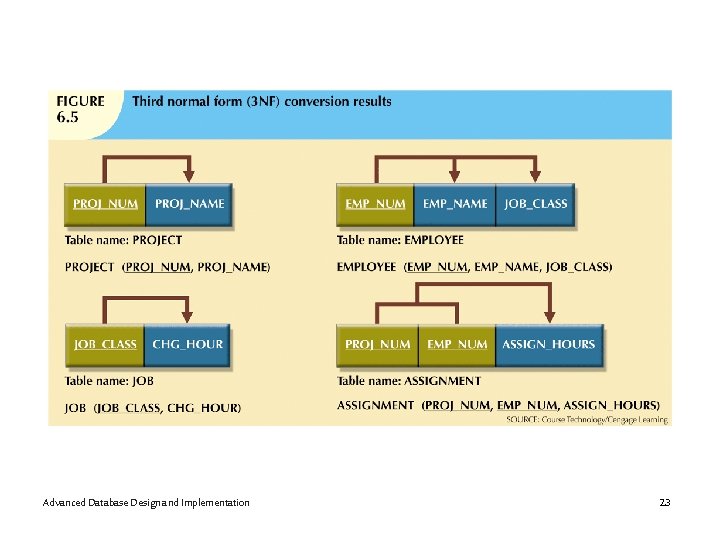
Conversion to Third Normal Form • Step 1: Make New Tables to Eliminate Transitive Dependencies – For every transitive dependency, write its determinant as PK for new table – Determinant: any attribute whose value determines other values within a row Advanced Database Design and Implementation 21
Conversion to Third Normal Form (cont’d. ) • Step 2: Reassign Corresponding Dependent Attributes – Identify attributes dependent on each determinant identified in Step 1 • Identify dependency – Name table to reflect its contents and function Advanced Database Design and Implementation 22
Advanced Database Design and Implementation 23
Conversion to Third Normal Form (cont’d. ) • A table is in third normal form (3 NF) when both of the following are true: – It is in 2 NF – It contains no transitive dependencies Advanced Database Design and Implementation 24
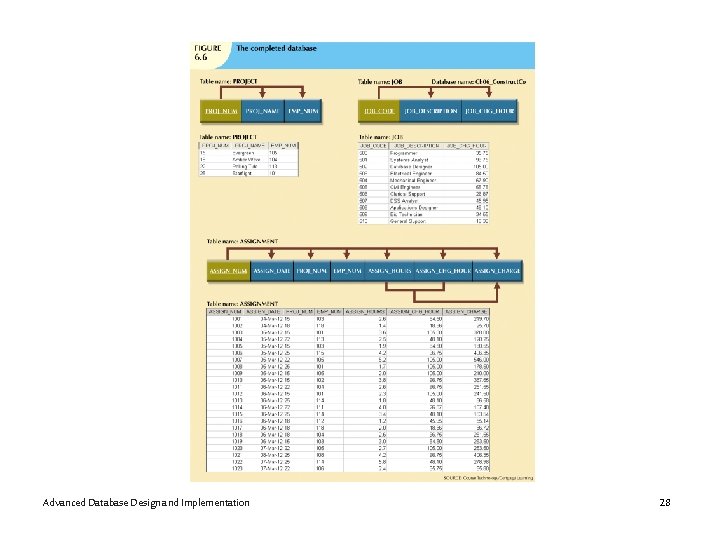
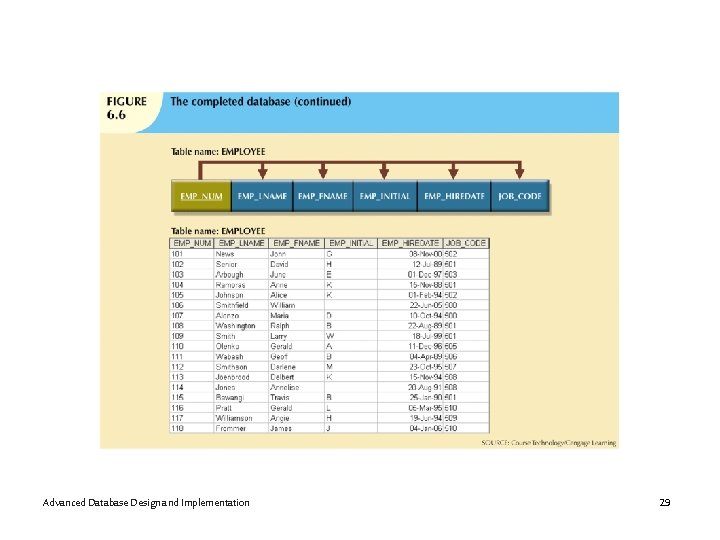
Improving the Design • Table structures should be cleaned up to eliminate initial partial and transitive dependencies • Normalization cannot, by itself, be relied on to make good designs • Valuable because it helps eliminate data redundancies Advanced Database Design and Implementation 25
Improving the Design (cont’d. ) • Issues to address, in order, to produce a good normalized set of tables: – – Evaluate PK Assignments Evaluate Naming Conventions Refine Attribute Atomicity Identify New Attributes Advanced Database Design and Implementation 26
Improving the Design (cont’d. ) – – Identify New Relationships Refine Primary Keys as Required for Data Granularity Maintain Historical Accuracy Evaluate Using Derived Attributes Advanced Database Design and Implementation 27
Advanced Database Design and Implementation 28
Advanced Database Design and Implementation 29
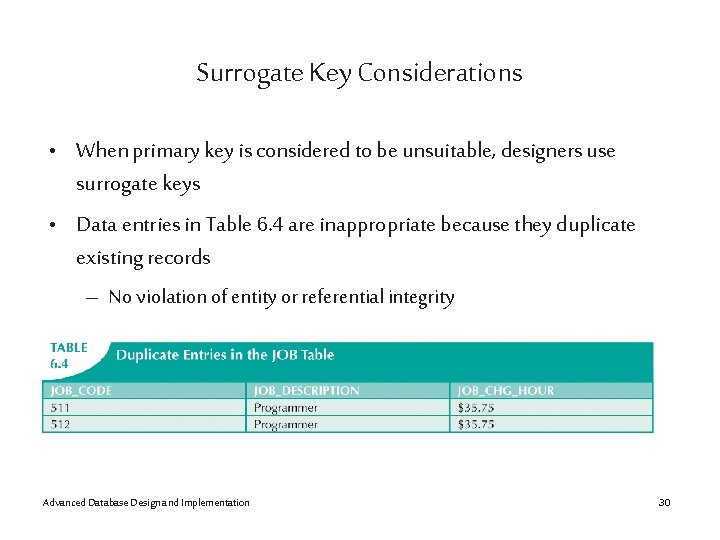
Surrogate Key Considerations • When primary key is considered to be unsuitable, designers use surrogate keys • Data entries in Table 6. 4 are inappropriate because they duplicate existing records – No violation of entity or referential integrity Advanced Database Design and Implementation 30
Higher-Level Normal Forms • Tables in 3 NF perform suitably in business transactional databases • Higher-order normal forms are useful on occasion • Two special cases of 3 NF: – Boyce-Codd normal form (BCNF) – Fourth normal form (4 NF) Advanced Database Design and Implementation 31
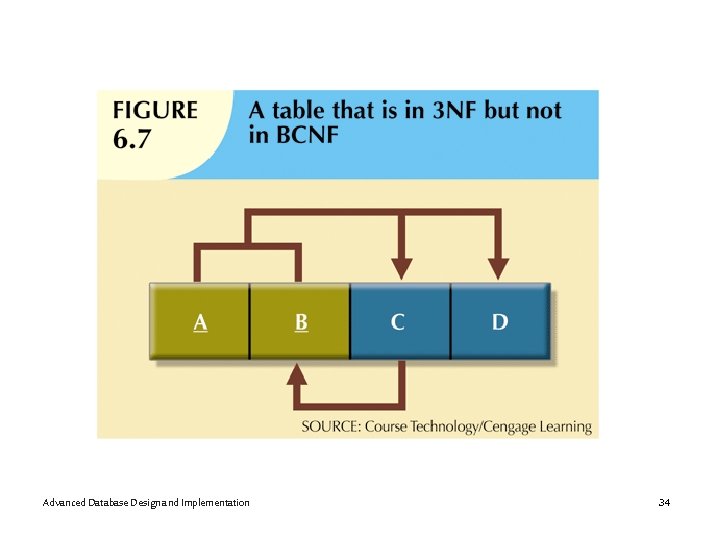
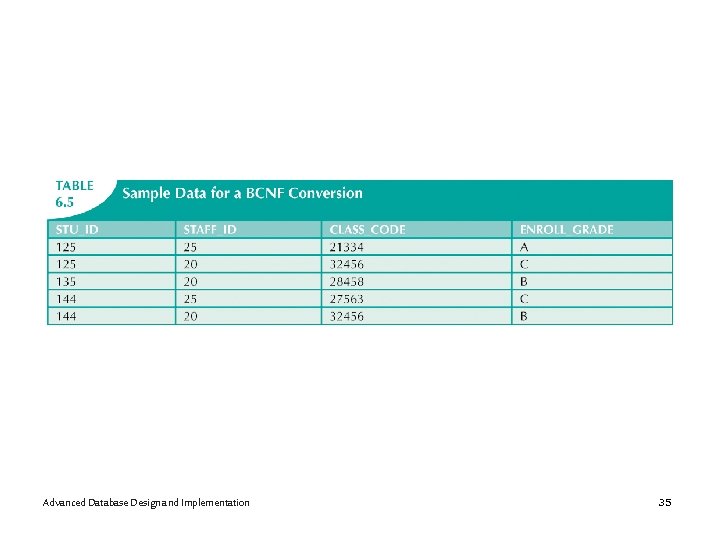
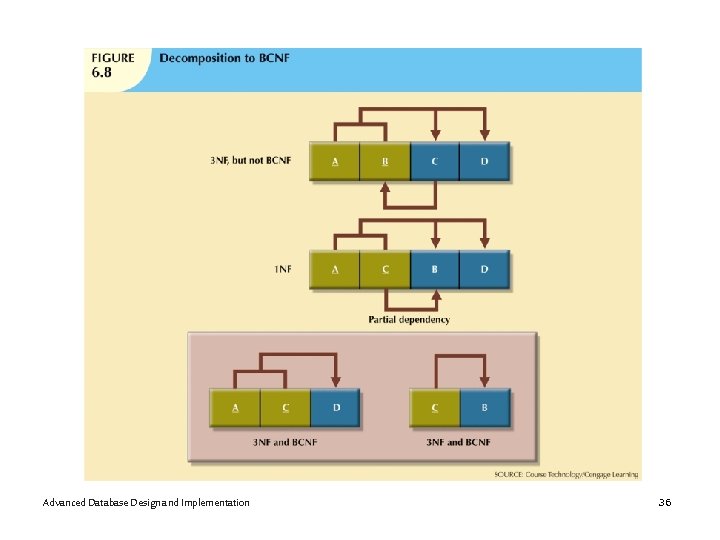
The Boyce-Codd Normal Form • Every determinant in table is a candidate key – Has same characteristics as primary key, but for some reason, not chosen to be primary key • When table contains only one candidate key, the 3 NF and the BCNF are equivalent • BCNF can be violated only when table contains more than one candidate key Advanced Database Design and Implementation 32
The Boyce-Codd Normal Form (cont’d. ) • Most designers consider the BCNF as a special case of 3 NF • Table is in 3 NF when it is in 2 NF and there are no transitive dependencies • Table can be in 3 NF and fail to meet BCNF – No partial dependencies, nor does it contain transitive dependencies – A nonkey attribute is the determinant of a key attribute Advanced Database Design and Implementation 33
Advanced Database Design and Implementation 34
Advanced Database Design and Implementation 35
Advanced Database Design and Implementation 36
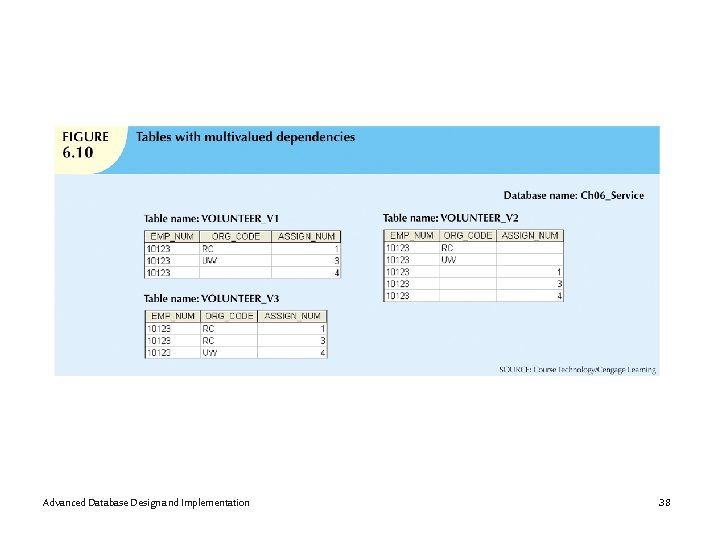
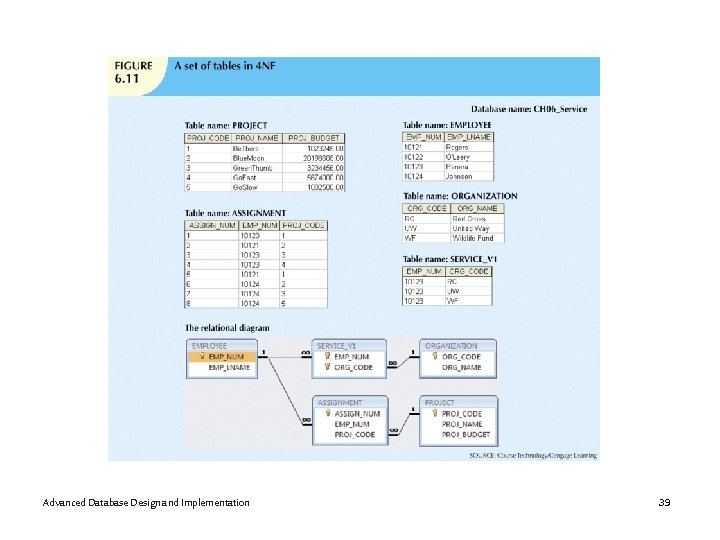
Fourth Normal Form (4 NF) • Table is in fourth normal form (4 NF) when both of the following are true: – It is in 3 NF – No multiple sets of multivalued dependencies • 4 NF is largely academic if tables conform to following two rules: – All attributes dependent on primary key, independent of each other – No row contains two or more multivalued facts about an entity Advanced Database Design and Implementation 37
Advanced Database Design and Implementation 38
Advanced Database Design and Implementation 39
Normalization and Database Design • Normalization should be part of the design process • Make sure that proposed entities meet required normal form before table structures are created • Many real-world databases have been improperly designed or burdened with anomalies • You may be asked to redesign and modify existing databases Advanced Database Design and Implementation 40
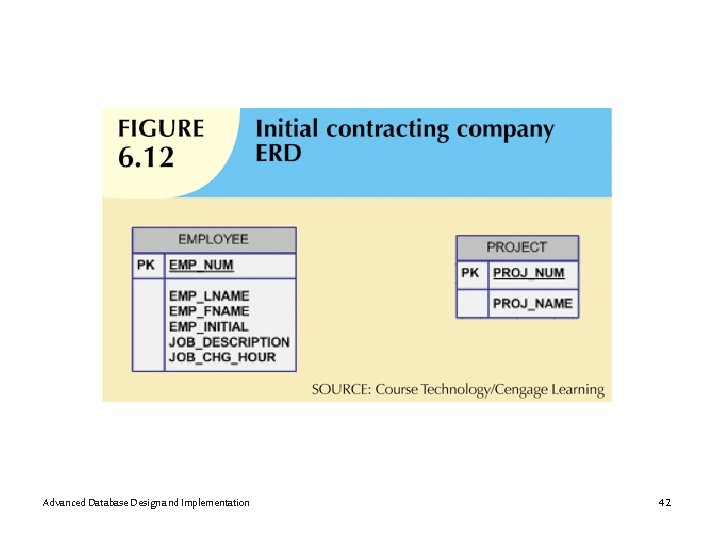
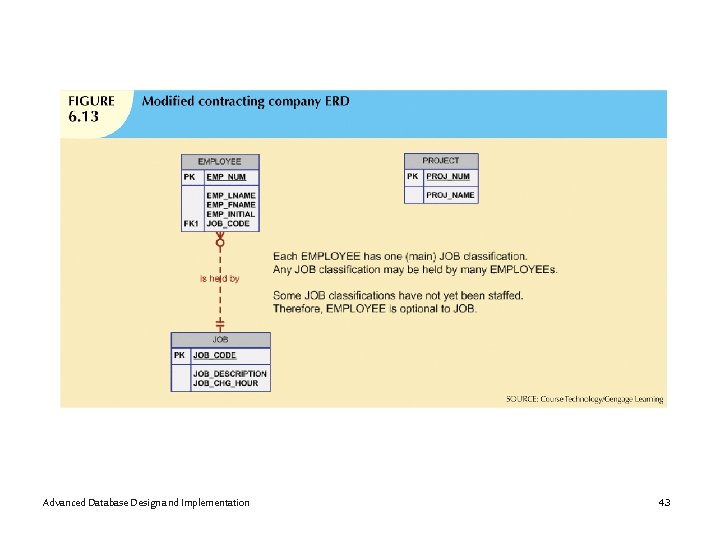
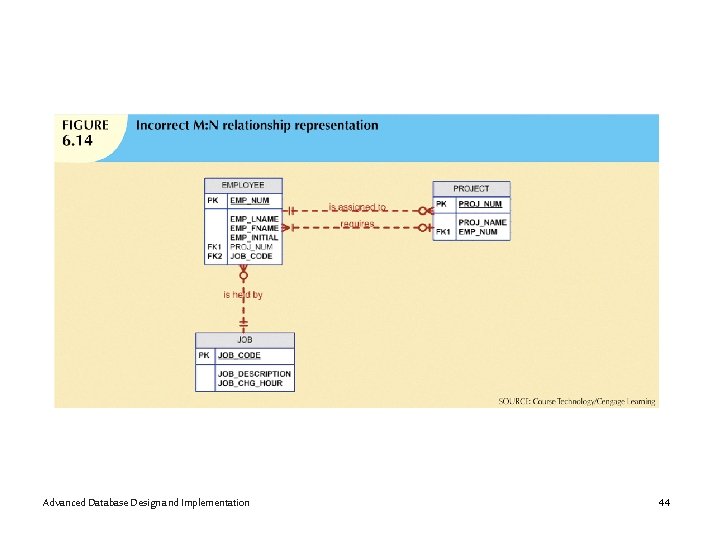
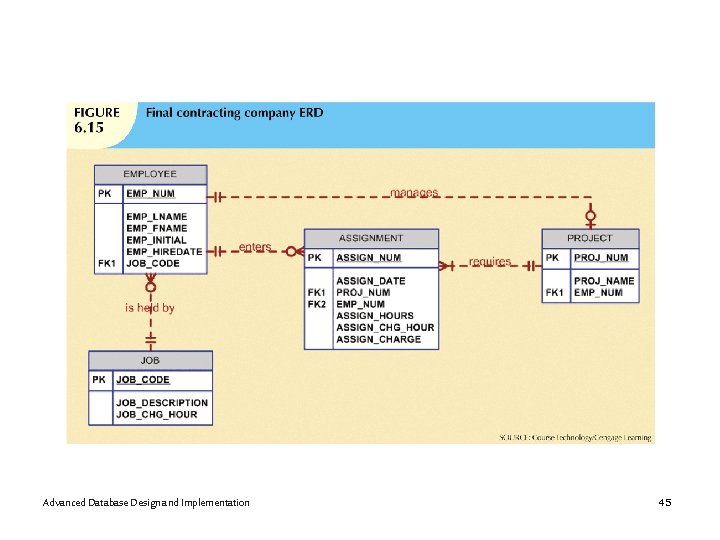
Normalization and Database Design (cont’d. ) • ER diagram – Identify relevant entities, their attributes, and their relationships – Identify additional entities and attributes • Normalization procedures – Focus on characteristics of specific entities – Micro view of entities within ER diagram • Difficult to separate normalization process from ER modeling process Advanced Database Design and Implementation 41
Advanced Database Design and Implementation 42
Advanced Database Design and Implementation 43
Advanced Database Design and Implementation 44
Advanced Database Design and Implementation 45
Advanced Database Design and Implementation 46
Denormalization • Creation of normalized relations is important database design goal • Processing requirements should also be a goal • If tables are decomposed to conform to normalization requirements: – Number of database tables expands Advanced Database Design and Implementation 47
Denormalization (cont’d. ) • Joining the larger number of tables reduces system speed • Conflicts are often resolved through compromises that may include denormalization • Defects of unnormalized tables: – Data updates are less efficient because tables are larger – Indexing is more cumbersome – No simple strategies for creating virtual tables known as views Advanced Database Design and Implementation 48
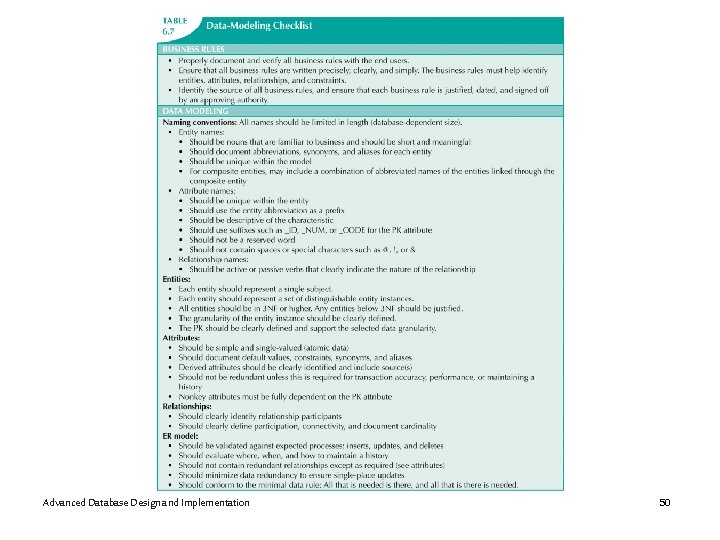
Data-Modeling Checklist • Data modeling translates specific real-world environment into data model – Represents real-world data, users, processes, interactions • Data-modeling checklist helps ensure that data-modeling tasks are successfully performed • Based on concepts and tools learned in Part II Advanced Database Design and Implementation 49
Advanced Database Design and Implementation 50

Assignment • Read Section 5. 4 (Design Cases) - Coronel Ref. • Project start : 14 March 2018 • Presentation time : Sat 12 May 2018 Advanced Database Design and Implementation 51

END Advanced Database Design and Implementation 52
- Slides: 52