
Advanced Data Structures Random topics Gerth finds interesting
- Slides: 12
Advanced Data Structures (Random topics Gerth finds interesting. . . ) Gerth Stølting Brodal 1
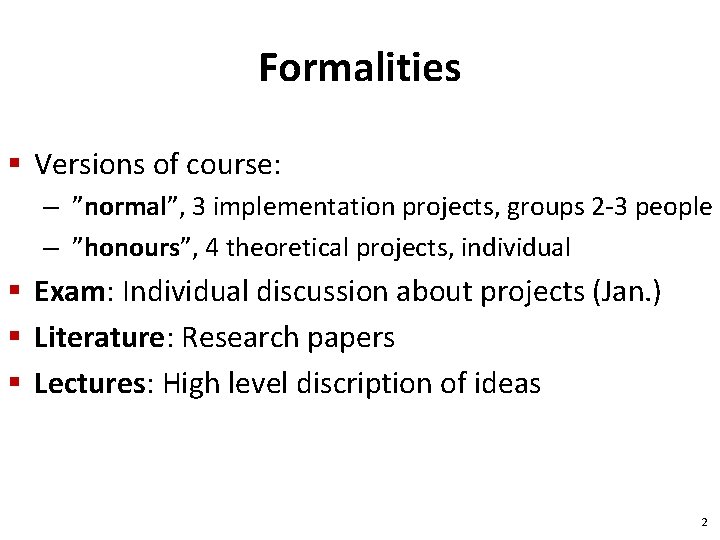
Formalities § Versions of course: – ”normal”, 3 implementation projects, groups 2 -3 people – ”honours”, 4 theoretical projects, individual § Exam: Individual discussion about projects (Jan. ) § Literature: Research papers § Lectures: High level discription of ideas 2
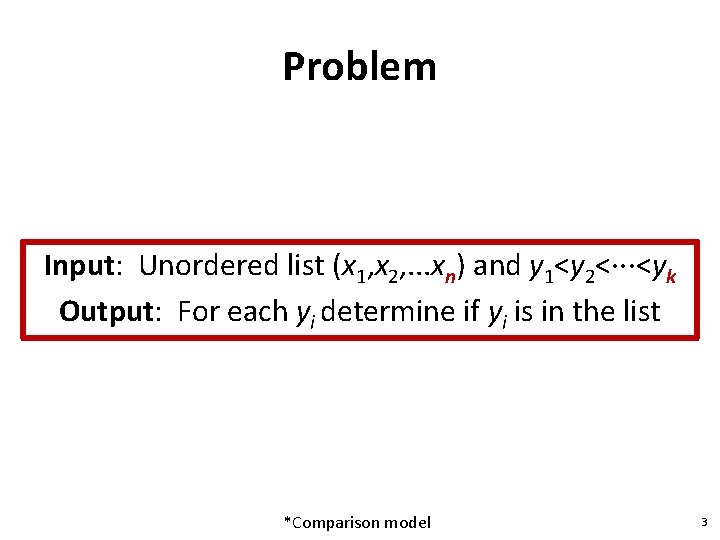
Problem Input: Unordered list (x 1, x 2, . . . xn) and y 1<y 2<∙∙∙<yk Output: For each yi determine if yi is in the list *Comparison model 3
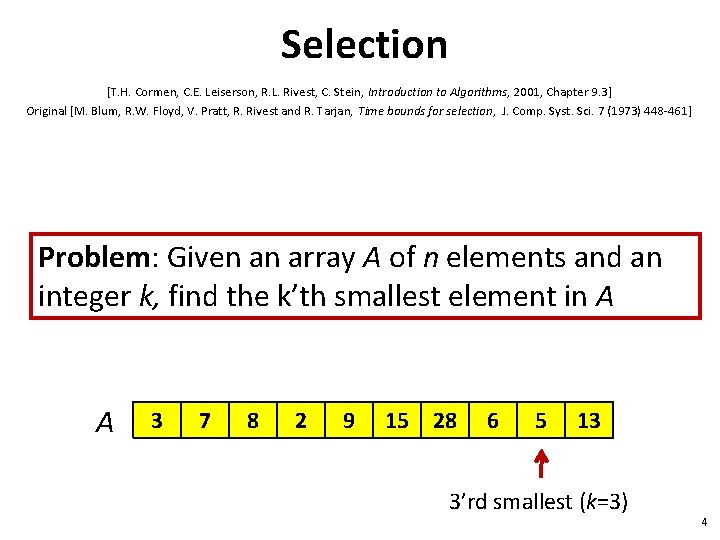
Selection [T. H. Cormen, C. E. Leiserson, R. L. Rivest, C. Stein, Introduction to Algorithms, 2001, Chapter 9. 3] Original [M. Blum, R. W. Floyd, V. Pratt, R. Rivest and R. Tarjan, Time bounds for selection, J. Comp. Syst. Sci. 7 (1973) 448 -461] Problem: Given an array A of n elements and an integer k, find the k’th smallest element in A A 3 7 8 2 9 15 28 6 5 13 3’rd smallest (k=3) 4
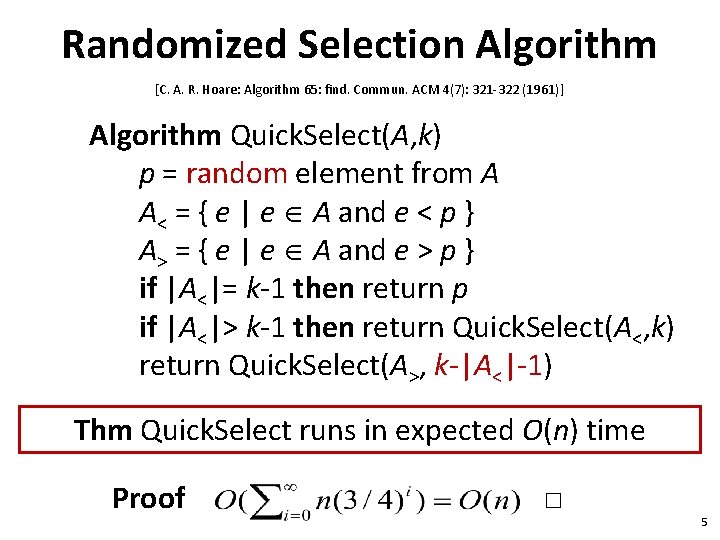
Randomized Selection Algorithm [C. A. R. Hoare: Algorithm 65: find. Commun. ACM 4(7): 321 -322 (1961)] Algorithm Quick. Select(A, k) p = random element from A A< = { e | e A and e < p } A> = { e | e A and e > p } if |A<|= k-1 then return p if |A<|> k-1 then return Quick. Select(A<, k) return Quick. Select(A>, k-|A<|-1) Thm Quick. Select runs in expected O(n) time Proof □ 5
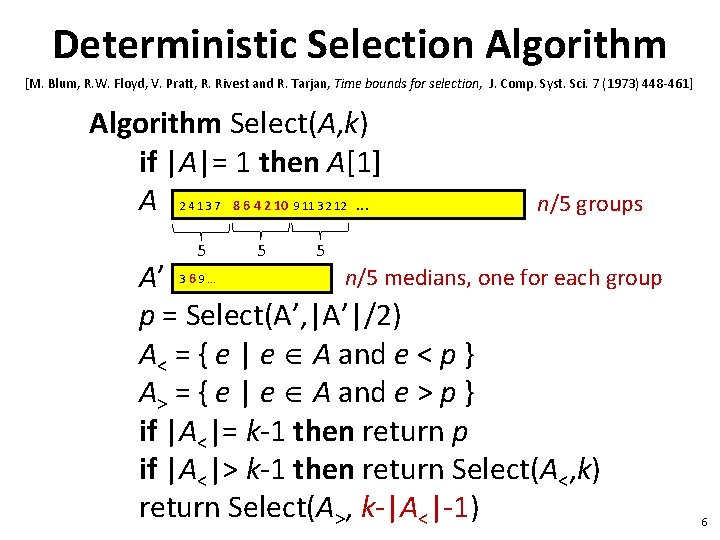
Deterministic Selection Algorithm [M. Blum, R. W. Floyd, V. Pratt, R. Rivest and R. Tarjan, Time bounds for selection, J. Comp. Syst. Sci. 7 (1973) 448 -461] Algorithm Select(A, k) if |A|= 1 then A[1] 8 6 4 2 10 A. . . 24137 5 9 11 3 2 12 5 n/5 groups 5 n/5 medians, one for each group A’ 6 p = Select(A’, |A’|/2) A< = { e | e A and e < p } A> = { e | e A and e > p } if |A<|= k-1 then return p if |A<|> k-1 then return Select(A<, k) return Select(A>, k-|A<|-1) 3 9. . . 6
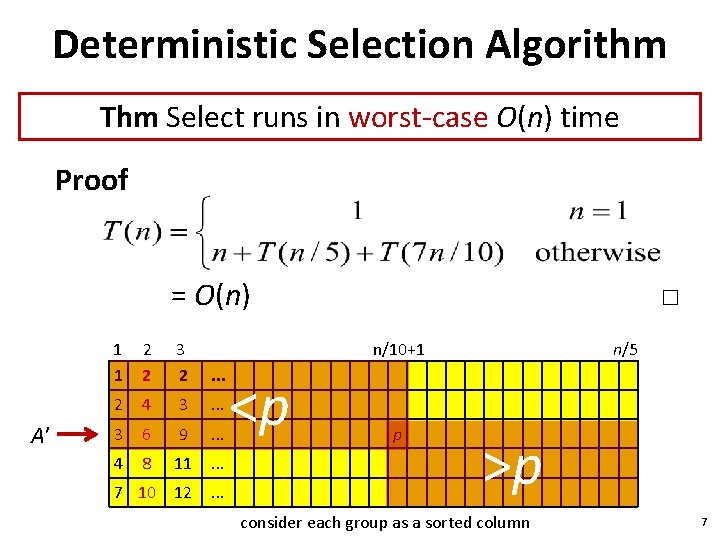
Deterministic Selection Algorithm Thm Select runs in worst-case O(n) time Proof = O(n) A’ 1 1 2 2 3 2 . . . 2 4 3 . . . 3 6 9 . . . 4 8 11 . . . 7 10 12 . . . □ n/10+1 <p p n/5 >p consider each group as a sorted column 7
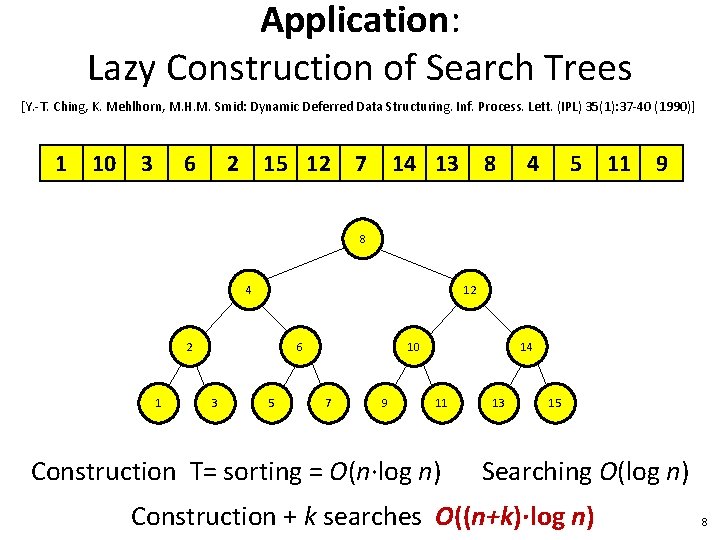
Application: Lazy Construction of Search Trees [Y. -T. Ching, K. Mehlhorn, M. H. M. Smid: Dynamic Deferred Data Structuring. Inf. Process. Lett. (IPL) 35(1): 37 -40 (1990)] 1 10 3 6 2 15 12 7 14 13 8 4 5 11 9 8 4 12 2 1 6 3 5 10 7 9 14 11 Construction T= sorting = O(n∙log n) 13 15 Searching O(log n) Construction + k searches O((n+k)∙log n) 8
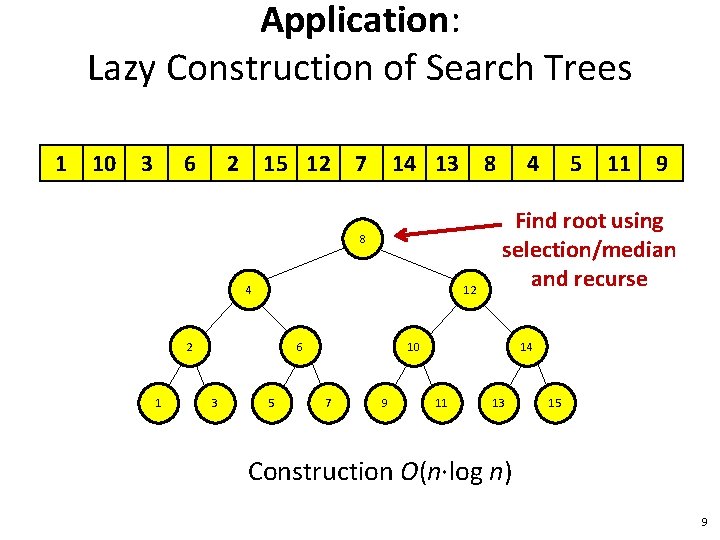
Application: Lazy Construction of Search Trees 1 10 3 6 2 15 12 7 14 13 8 8 4 12 2 1 6 3 5 4 9 11 9 Find root using selection/median and recurse 10 7 5 14 11 13 15 Construction O(n∙log n) 9
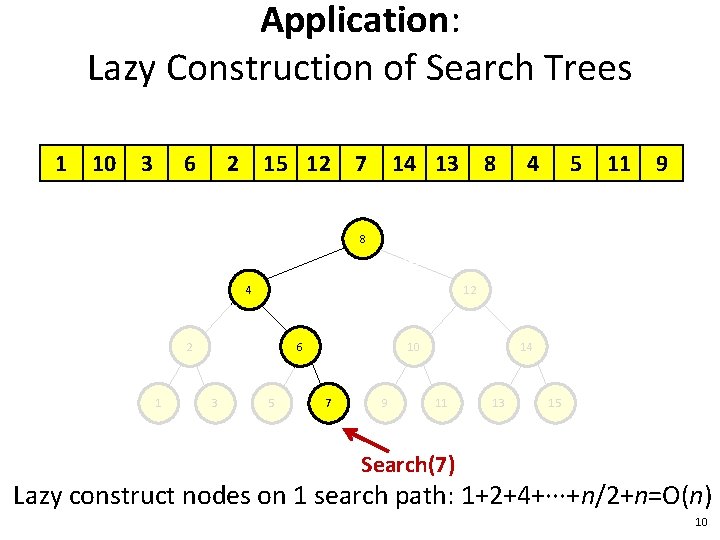
Application: Lazy Construction of Search Trees 1 10 3 6 2 15 12 7 14 13 8 4 5 11 9 8 % 4 12 2 1 6 3 5 10 7 9 % 11 13 14 15 Search(7) Lazy construct nodes on 1 search path: 1+2+4+∙∙∙+n/2+n=O(n) 10
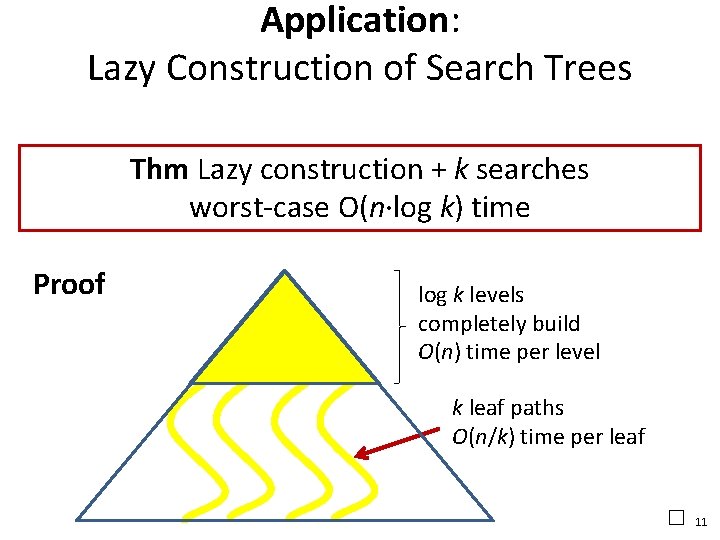
Application: Lazy Construction of Search Trees Thm Lazy construction + k searches worst-case O(n∙log k) time Proof log k levels completely build O(n) time per level k leaf paths O(n/k) time per leaf □ 11
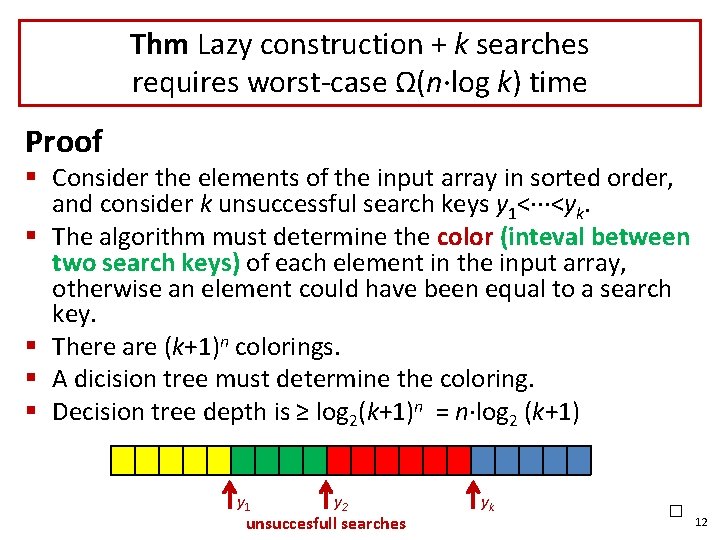
Thm Lazy construction + k searches requires worst-case Ω(n∙log k) time Proof § Consider the elements of the input array in sorted order, and consider k unsuccessful search keys y 1<∙∙∙<yk. § The algorithm must determine the color (inteval between two search keys) of each element in the input array, otherwise an element could have been equal to a search key. § There are (k+1)n colorings. § A dicision tree must determine the coloring. § Decision tree depth is ≥ log 2(k+1)n = n∙log 2 (k+1) y 1 y 2 unsuccesfull searches yk □ 12