
Advanced Cryptography Promise and Challenges Shai Halevi IBM
Advanced Cryptography: Promise and Challenges Shai Halevi, IBM Research ACM-CCS, October 2018

What's "Advanced Cryptography"? • Cryptography beyond encryption, signatures – Protecting computation, not just data
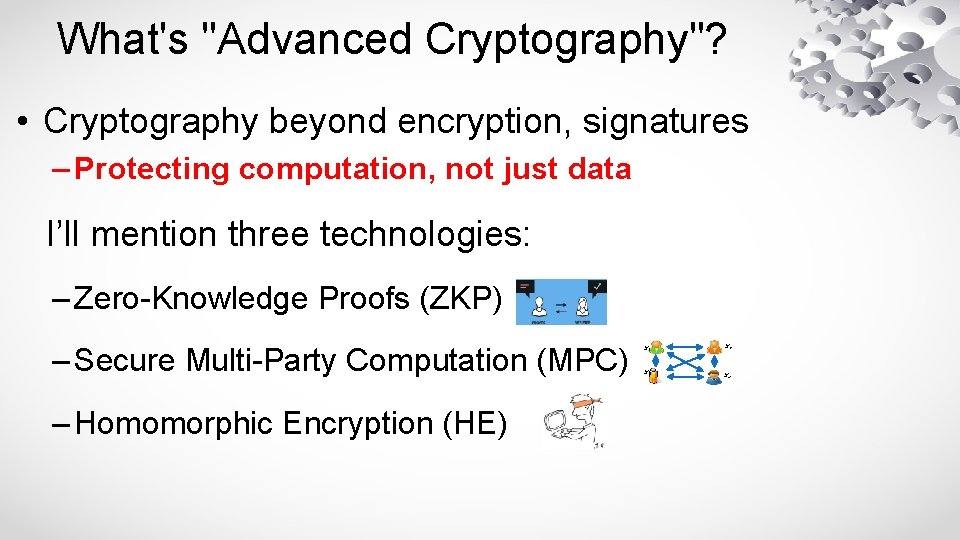
What's "Advanced Cryptography"? • Cryptography beyond encryption, signatures – Protecting computation, not just data I’ll mention three technologies: – Zero-Knowledge Proofs (ZKP) – Secure Multi-Party Computation (MPC) – Homomorphic Encryption (HE) x 1 x 3 x 2 x 4
What's "Advanced Cryptography"? • Cryptography beyond encryption, signatures – Protecting computation, not just data I’ll mention three technologies: – Zero-Knowledge Proofs (ZKP) – Secure Multi-Party Computation (MPC) – Homomorphic Encryption (HE) Not in this talk: – Searchable Encryption – Oblivious RAM (ORAM) – Attribute-Based Encryption (ABE) –. . .
Advanced Cryptography is Needed
Advanced Cryptography is Needed Fast enough to be useful
Advanced Cryptography is Needed Fast enough to be useful Not "generally usable" yet
Advanced Crypto Tools • Zero-Knowledge (ZK) • Secure Multi-Party Computation (MPC) • Homomorphic Encryption (HE)
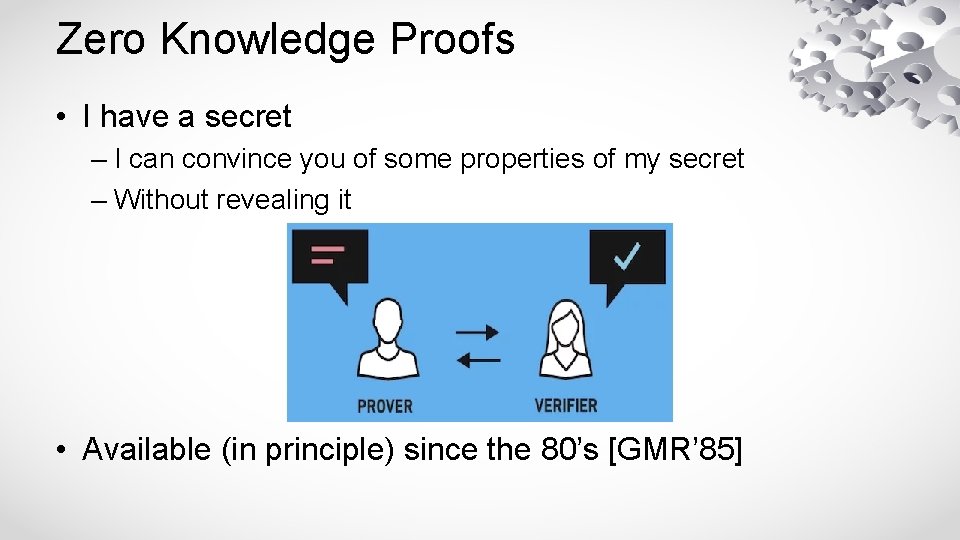
Zero Knowledge Proofs • I have a secret – I can convince you of some properties of my secret – Without revealing it • Available (in principle) since the 80’s [GMR’ 85]
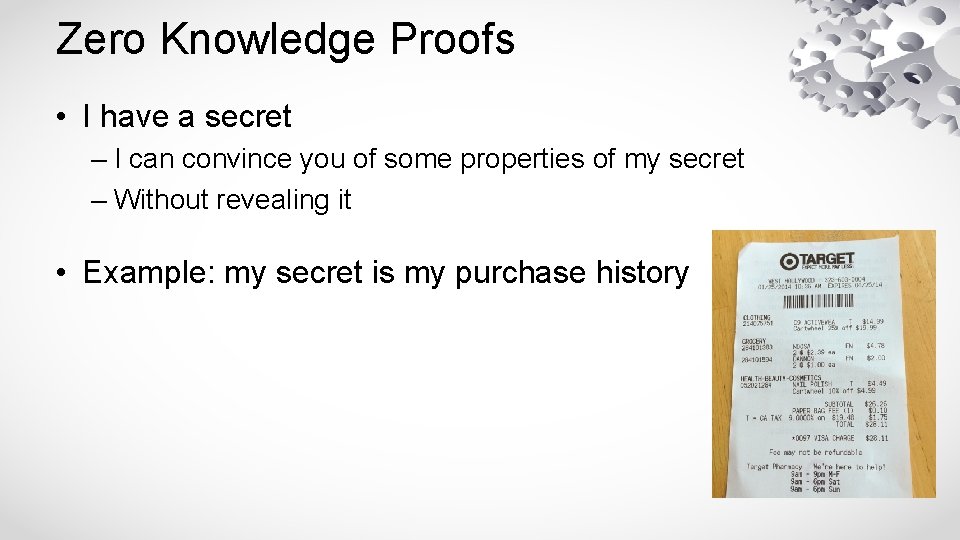
Zero Knowledge Proofs • I have a secret – I can convince you of some properties of my secret – Without revealing it • Example: my secret is my purchase history
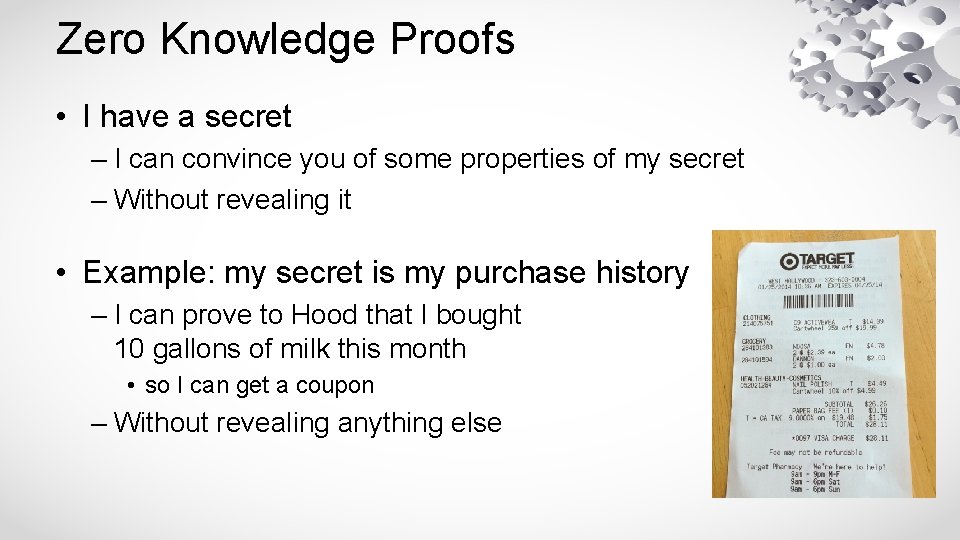
Zero Knowledge Proofs • I have a secret – I can convince you of some properties of my secret – Without revealing it • Example: my secret is my purchase history – I can prove to Hood that I bought 10 gallons of milk this month • so I can get a coupon – Without revealing anything else
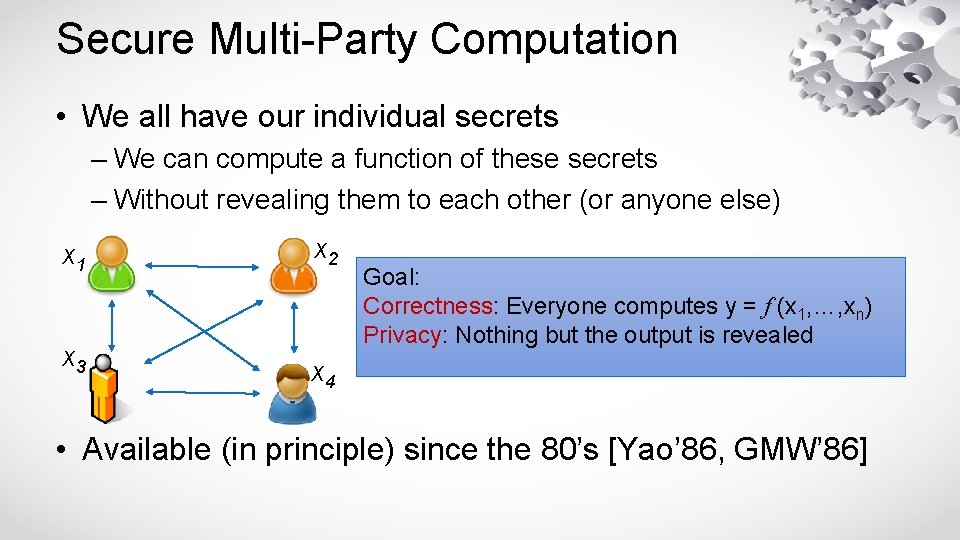
Secure Multi-Party Computation • We all have our individual secrets – We can compute a function of these secrets – Without revealing them to each other (or anyone else) x 1 x 3 x 2 Goal: Correctness: Everyone computes y = f (x 1, …, xn) Privacy: Nothing but the output is revealed x 4 • Available (in principle) since the 80’s [Yao’ 86, GMW’ 86]
Secure Multi-Party Computation • We all have our individual secrets – We can compute a function of these secrets – Without revealing them to each other (or anyone else) • Example: medical data – Evaluating the effectivness of a treatment f ( patient 1 Data, patient 2 Data, . . . ) = effective/not-effective – Data for different patients held by different clinics – Can compute this without revealing any private data
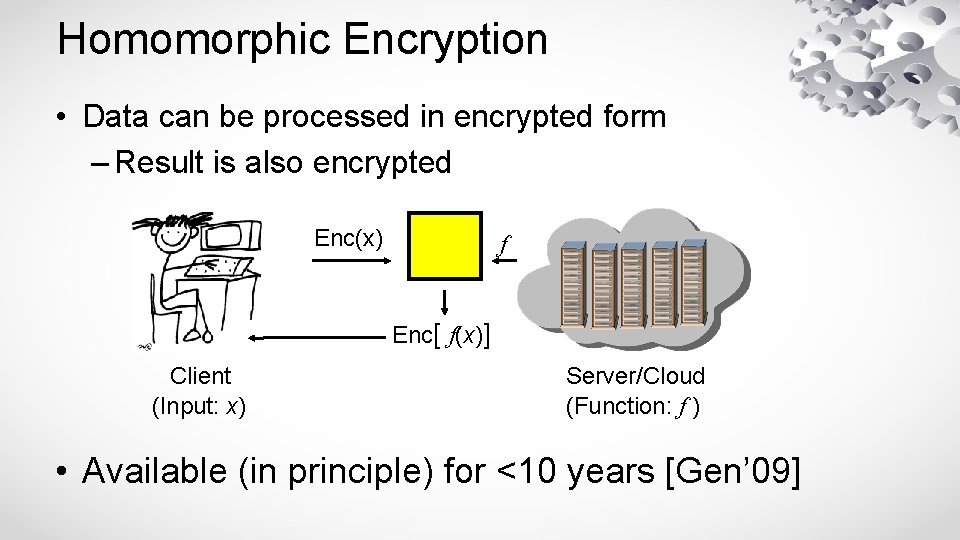
Homomorphic Encryption • Data can be processed in encrypted form – Result is also encrypted Enc(x) f Enc[ f(x)] Client (Input: x) Server/Cloud (Function: f ) • Available (in principle) for <10 years [Gen’ 09]
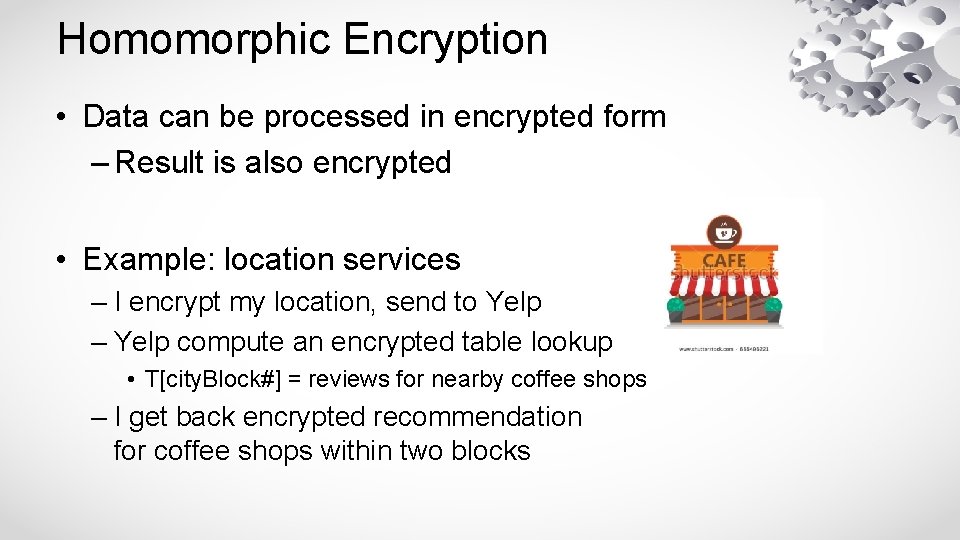
Homomorphic Encryption • Data can be processed in encrypted form – Result is also encrypted • Example: location services – I encrypt my location, send to Yelp – Yelp compute an encrypted table lookup • T[city. Block#] = reviews for nearby coffee shops – I get back encrypted recommendation for coffee shops within two blocks
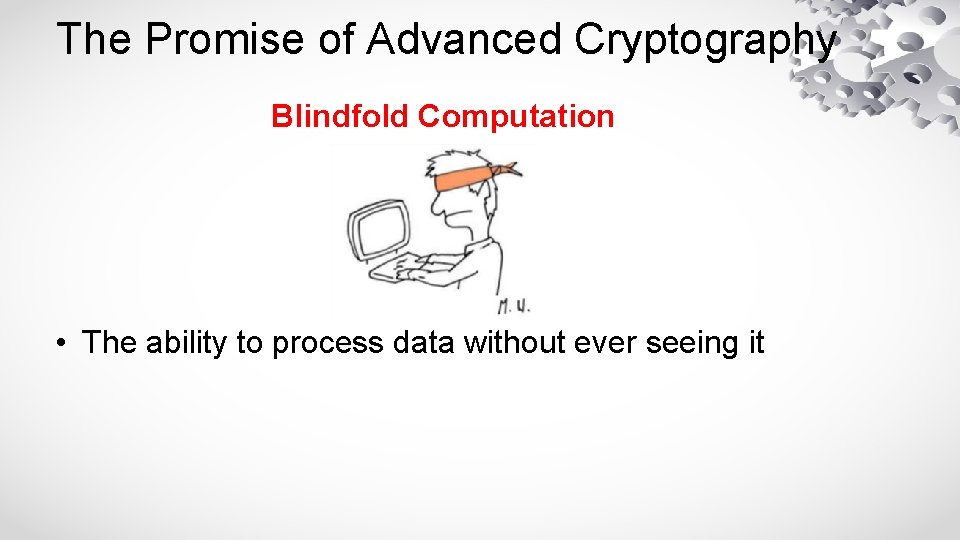
The Promise of Advanced Cryptography Blindfold Computation • The ability to process data without ever seeing it
The Need for Advanced Cryptography
Your Privacy for Sale • We give up information in return for services – E. g. , location for directions, restaurant recommendation, health data for "personalized medicine", financials for tax and investment services, purchace history for better ads and coupons, . . .
Your Privacy for Sale • We give up information in return for services – E. g. , location for directions, restaurant recommendation, health data for "personalized medicine", financials for tax and investment services, purchace history for better ads and coupons, . . . • Personalized services require personal information – or so we are told
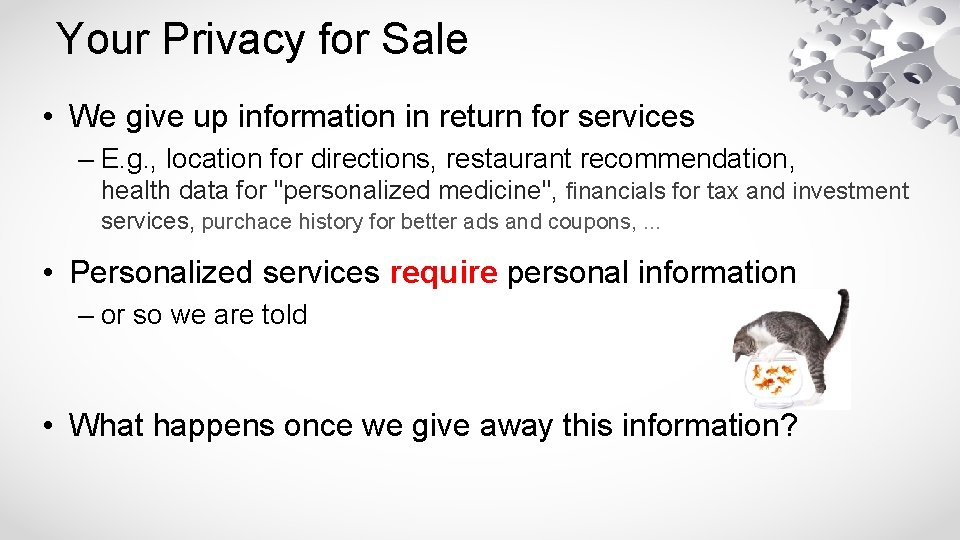
Your Privacy for Sale • We give up information in return for services – E. g. , location for directions, restaurant recommendation, health data for "personalized medicine", financials for tax and investment services, purchace history for better ads and coupons, . . . • Personalized services require personal information – or so we are told • What happens once we give away this information?
Data Abuse is the New Normal • The entire IT industry is busy making it easier – Larger collections, better ways to link, process them • Data abuse, not “data breach” – Overwhelming motivation to use whatever data can be found – If the data is available, it will be (ab)used
Data Abuse is the New Normal • The entire IT industry is busy making it easier – Larger collections, better ways to link, process them • It will only get worse – We cannot provide opportunity for easy abuse, seriously expect it not to happen
Data Abuse is the New Normal • The entire IT industry is busy making it easier – Larger collections, better ways to link, process them IT, security p rofessionals • We need all the tools we can get to push back – “Advanced Crypto” is an under-utilized tool in our box
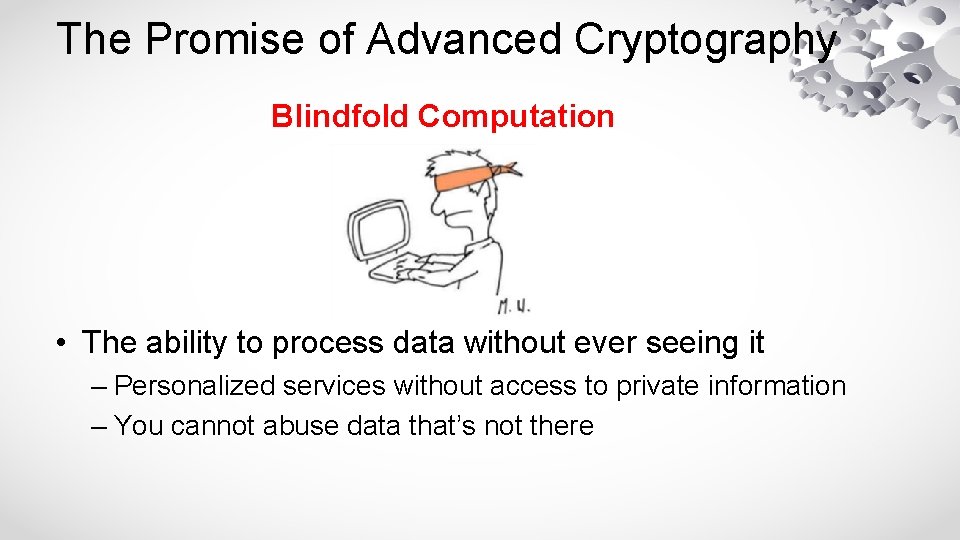
The Promise of Advanced Cryptography Blindfold Computation • The ability to process data without ever seeing it – Personalized services without access to private information – You cannot abuse data that’s not there
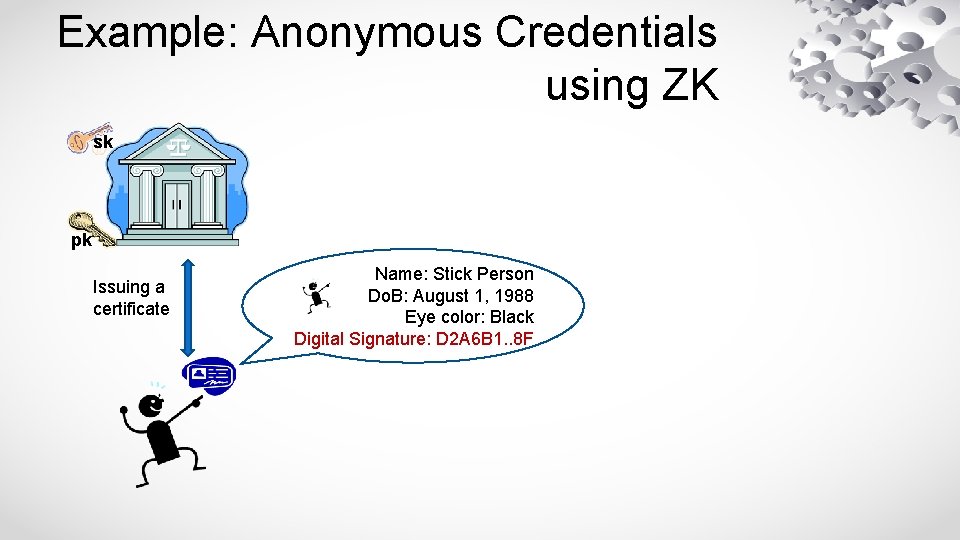
Example: Anonymous Credentials using ZK sk pk Issuing a certificate Name: Stick Person Do. B: August 1, 1988 Eye color: Black Digital Signature: D 2 A 6 B 1. . 8 F
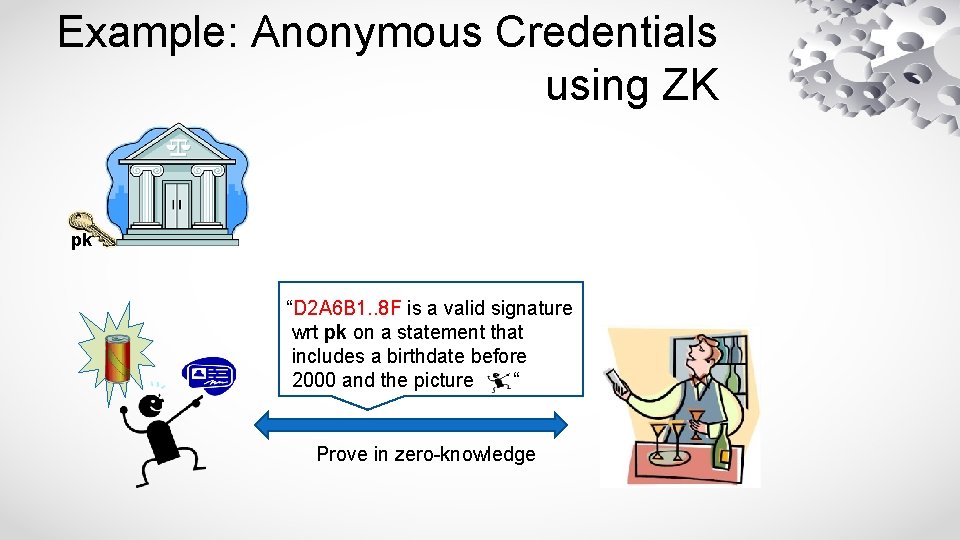
Example: Anonymous Credentials using ZK pk “D 2 A 6 B 1. . 8 F is a valid signature wrt pk on a statement that includes a birthdate before 2000 and the picture “ Prove in zero-knowledge
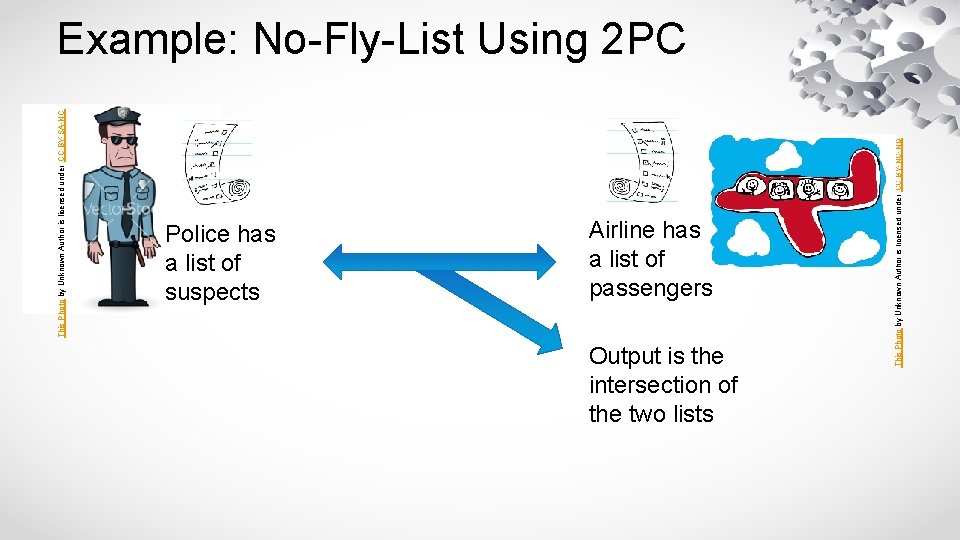
Police has a list of suspects Airline has a list of passengers Output is the intersection of the two lists This Photo by Unknown Author is licensed under CC BY-NC-ND This Photo by Unknown Author is licensed under CC BY-SA-NC Example: No-Fly-List Using 2 PC
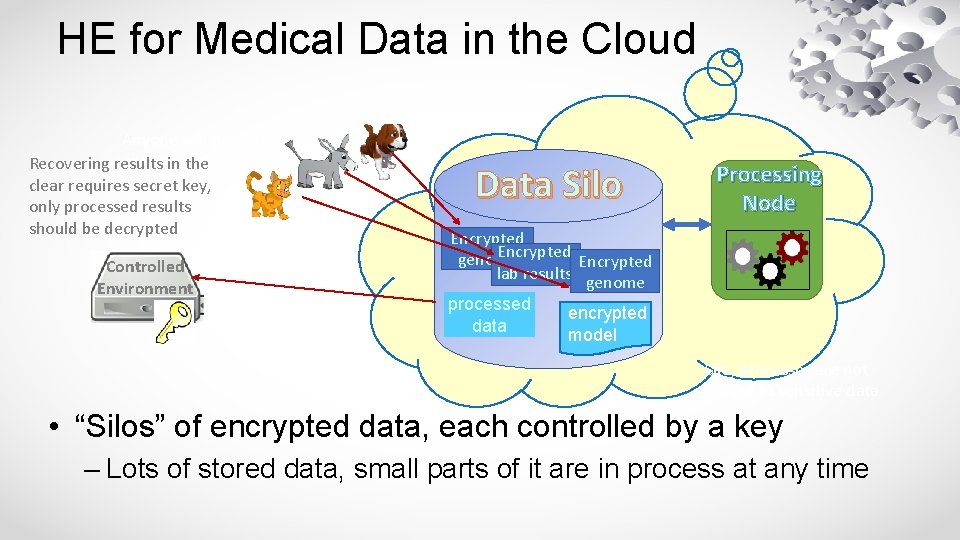
HE for Medical Data in the Cloud Anyone can deposit encrypted Recovering results in thedata in silo clear requires secret key, only processed results should be decrypted Controlled Environment Data Silo Processing Node Encrypted genome Encrypted lab results genome processed encrypted data model Silo, processor are not exposed to sensitive data • “Silos” of encrypted data, each controlled by a key – Lots of stored data, small parts of it are in process at any time
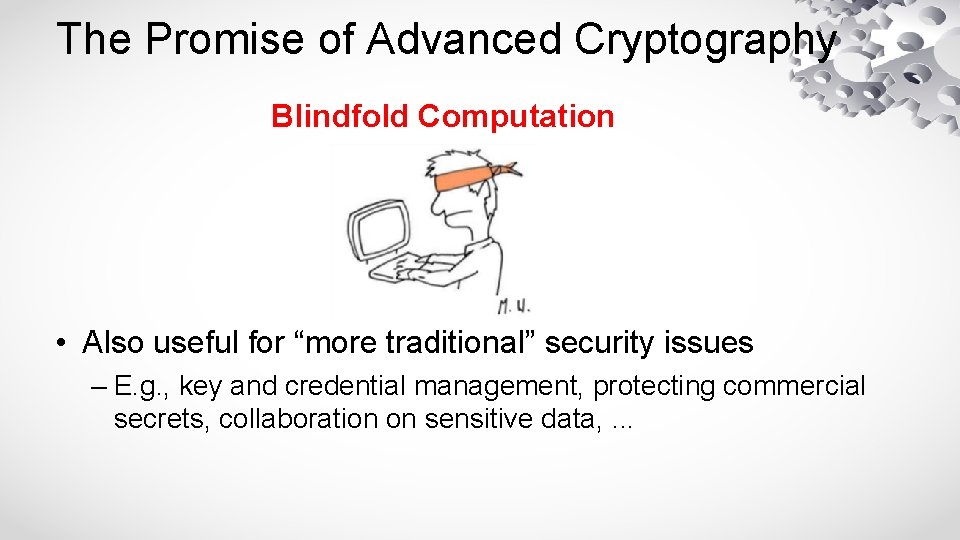
The Promise of Advanced Cryptography Blindfold Computation • Also useful for “more traditional” security issues – E. g. , key and credential management, protecting commercial secrets, collaboration on sensitive data, . . .
Fast Enough to be Useful
Performance of Advanced Cryptography • Improving performance has been a major research topic over the last 30 years – Tremendous progress, many orders of magnitude • For most tasks, there is a cryptographic solution with adequate performance – Although designing it may take a team of experts
Some Speed Examples • Lots of examples, meant to demonstrate feasibility of doing “many things” with reasonable performance – It’s okay to feel a little dizzy after example #17, 352… • The point is not to compare them – They operate in very different settings: “general-purpose” vs. specific functions, different security guarantees, different performance profiles, etc. My apologies if I didn’t include your awesome work in this list
Some ZK Speed Examples • Proving a 100, 000 -gate predicate in 1. 8 sec Improved Non-Interactive Zero Knowledge with Applications […] (KKW, CCS 2018) From this conference
Some ZK Speed Examples • Proving a 227 -gate predicate on a 64 -cluster in ~1. 5 hours DIZK: A Distributed Zero Knowledge Proof System (WZCPS, USENIX Security 2018)
Some ZK Speed Examples • “I know a pre-image of 0 x. A 4 E… 1 under SHA” – Proving at 100 pre-images/sec, verifying at 5000/sec Ligero: Lightweight Sublinear Arguments Without a Trusted Setup (AHIV, CCS 2017) • Useful, e. g. , for blockchains – Can prove things about the hash values in the blocks
![• DNA match against a database (zk-STARK, [BBHR, 2018]) Police has a forensic](http://slidetodoc.com/presentation_image/5fdb96d9560b4cab473c39ed20d15c19/image-36.jpg "• DNA match against a database (zk-STARK, [BBHR, 2018]) Police has a forensic")
• DNA match against a database (zk-STARK, [BBHR, 2018]) Police has a forensic DNA database Public commitment 0 x 3 b 2 a 108 a Presidential “the sample whose candidate hash is 0 xe 677 d 398 a DNA sample does not match anything in the database whose hash Public is 0 x 3 b 2 a 108 a” commitment 0 xe 677 d 398 – Size-100, 000 DB, proving in ~1 hour, verifying in milliseconds This Photo by Unknown Author is licensed under CC BY-NC Some ZK Speed Examples
ZK Proofs in the Wild • Digital currencies (z. Coin, Zcash, . . . ) – Proving that I have sufficiently many unspent coins on the ledger Soon to be – Constructing proof in ~1 min*, verification in a few msec * much faster • Anonymous credentials (e. g. , idemix) – Proving that I possess a credential, takes 1 -30 seconds • Private payments in the Brave browser (using Anonize) • Tax bracket proofs (Deloitte/QEDit) – Commitments to my financial data posted to ledger – Then I can prove that I belong to a certain tax bracket • …
x 2 Some MPC Speed Examples x 1 x 3 x 4 • 10 -party linear regression with • For mo st protoc ols, the b is comm ottleneck unication rather th Ø So pe an comp rformanc utatio e is me asures fo r LAN vs W n AN Data is shared among the parties, each holding 400, 000 points
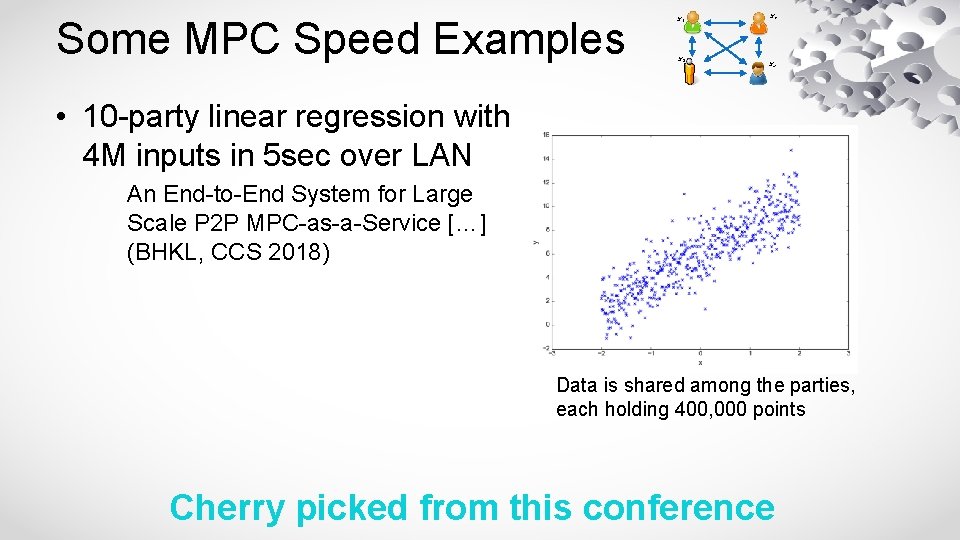
Some MPC Speed Examples x 1 x 3 x 2 x 4 • 10 -party linear regression with 4 M inputs in 5 sec over LAN An End-to-End System for Large Scale P 2 P MPC-as-a-Service […] (BHKL, CCS 2018) Data is shared among the parties, each holding 400, 000 points Cherry picked from this conference
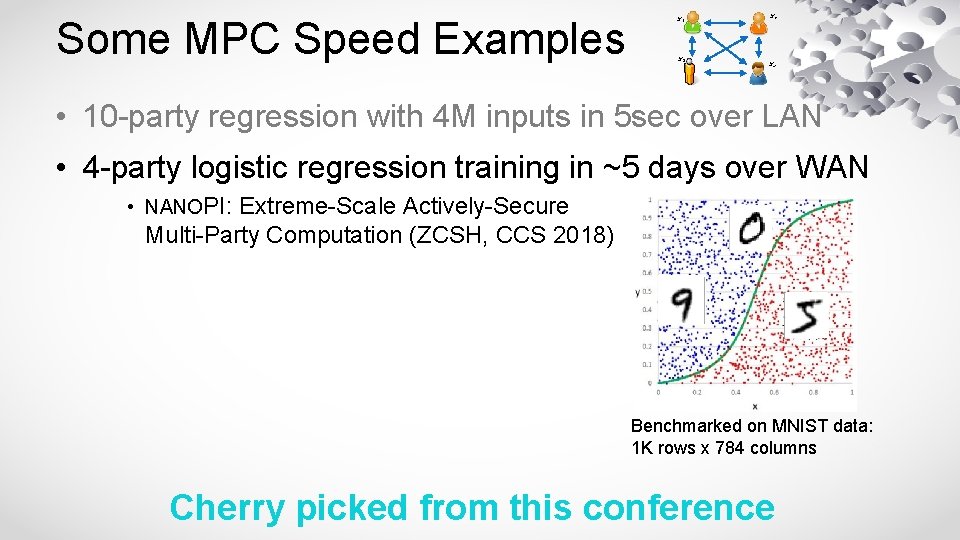
Some MPC Speed Examples x 1 x 3 x 2 x 4 • 10 -party regression with 4 M inputs in 5 sec over LAN • 4 -party logistic regression training in ~5 days over WAN • NANOPI: Extreme-Scale Actively-Secure Multi-Party Computation (ZCSH, CCS 2018) Benchmarked on MNIST data: 1 K rows x 784 columns Cherry picked from this conference
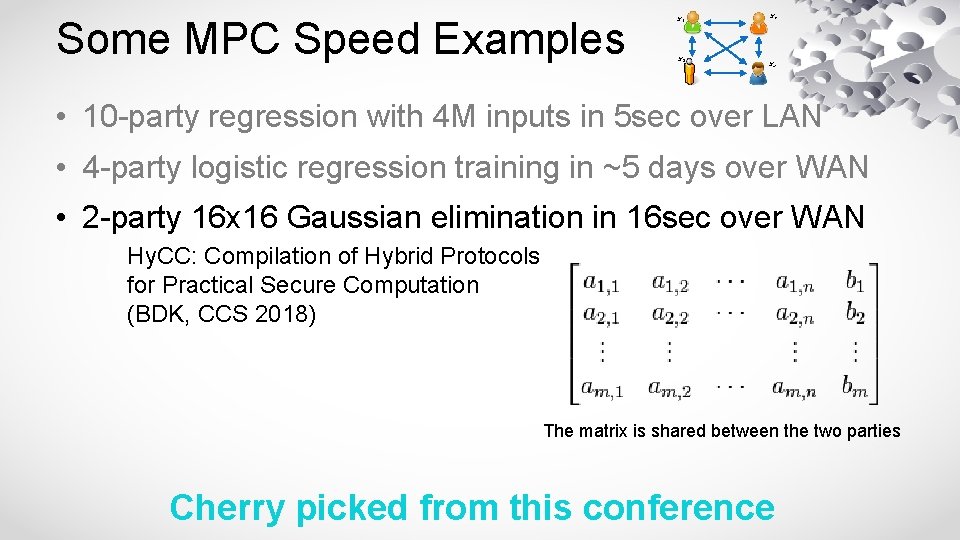
Some MPC Speed Examples x 1 x 3 x 2 x 4 • 10 -party regression with 4 M inputs in 5 sec over LAN • 4 -party logistic regression training in ~5 days over WAN • 2 -party 16 x 16 Gaussian elimination in 16 sec over WAN Hy. CC: Compilation of Hybrid Protocols for Practical Secure Computation (BDK, CCS 2018) The matrix is shared between the two parties Cherry picked from this conference
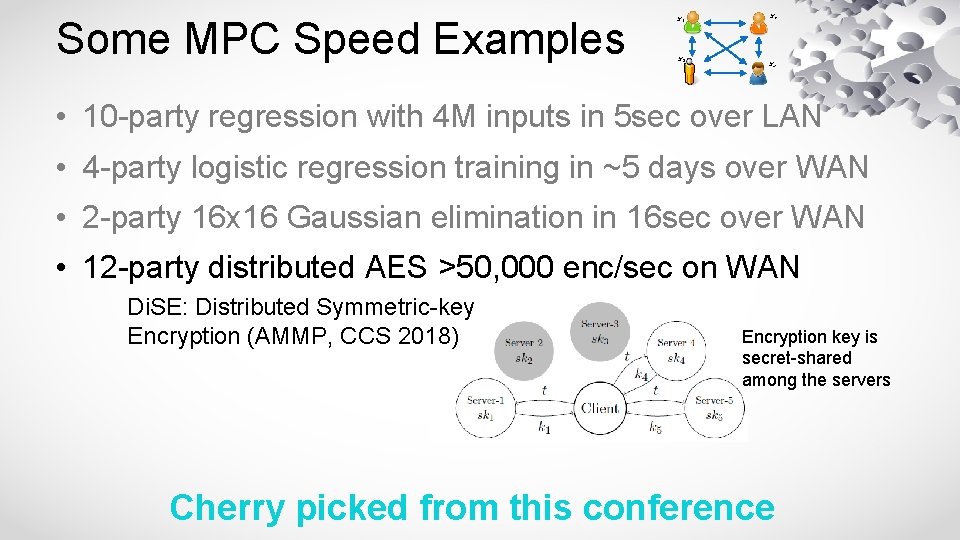
Some MPC Speed Examples x 1 x 3 x 2 x 4 • 10 -party regression with 4 M inputs in 5 sec over LAN • 4 -party logistic regression training in ~5 days over WAN • 2 -party 16 x 16 Gaussian elimination in 16 sec over WAN • 12 -party distributed AES >50, 000 enc/sec on WAN Di. SE: Distributed Symmetric-key Encryption (AMMP, CCS 2018) Encryption key is secret-shared among the servers Cherry picked from this conference
More MPC Systems, Use-Cases • Tax Fraud Detection System (Sharemind) – Analyzing one month of the Estonian economy in ten days “How the Estonian Tax and Customs Board Evaluated a Tax Fraud Detection System Based on Secure Multi-party Computation” (BJSV, FC 2015) • Virtual HSMs (Unbound), MPC replacing hardware – RSA, ECDSA, AES, …, comparable speed to hardware HSM
More MPC Systems, Use-Cases • Tax Fraud Detection System (Sharemind) – Analyzing one month of the Estonian economy in ten days “How the Estonian Tax and Customs Board Evaluated a Tax Fraud Detection System Based on Secure Multi-party Computation” (BJSV, FC 2015) • Virtual HSMs (Unbound), MPC replacing hardware – RSA, ECDSA, AES, …, comparable speed to hardware HSM • Similar patients in a genomic database (i. DASH 2016) – Best 5 matches against 4000 patients, 1000 markers, in ~30 sec “Privacy-Preserving Search of Similar Patients in Genomic Data” (AHLR, Po. PETS 2018) • Clearing-price auction on Hyperledger Fabric, 10 -20 sec “Initial Public Offering (IPO) on Permissioned Blockchain using Secure Multiparty Computation” (BDHHJMZ 2018)
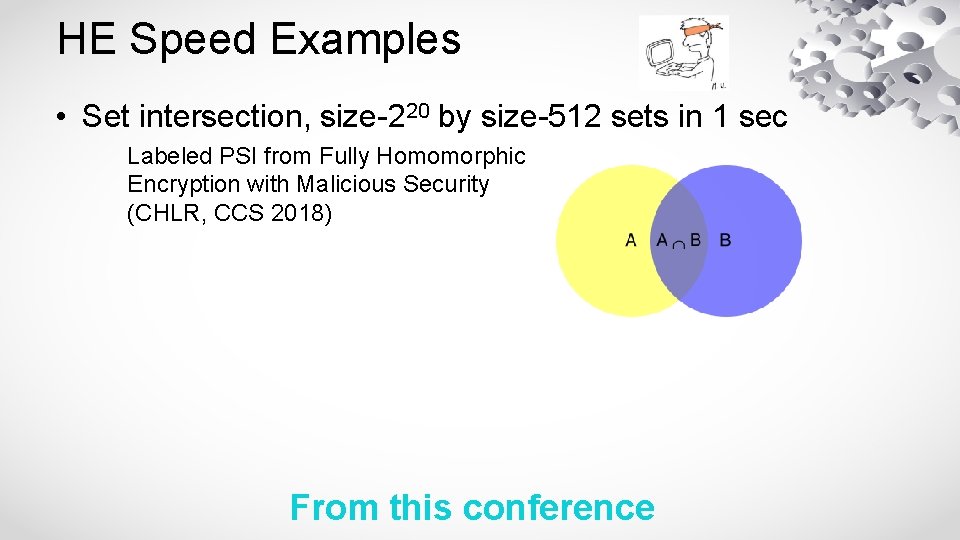
HE Speed Examples • Set intersection, size-220 by size-512 sets in 1 sec Labeled PSI from Fully Homomorphic Encryption with Malicious Security (CHLR, CCS 2018) From this conference
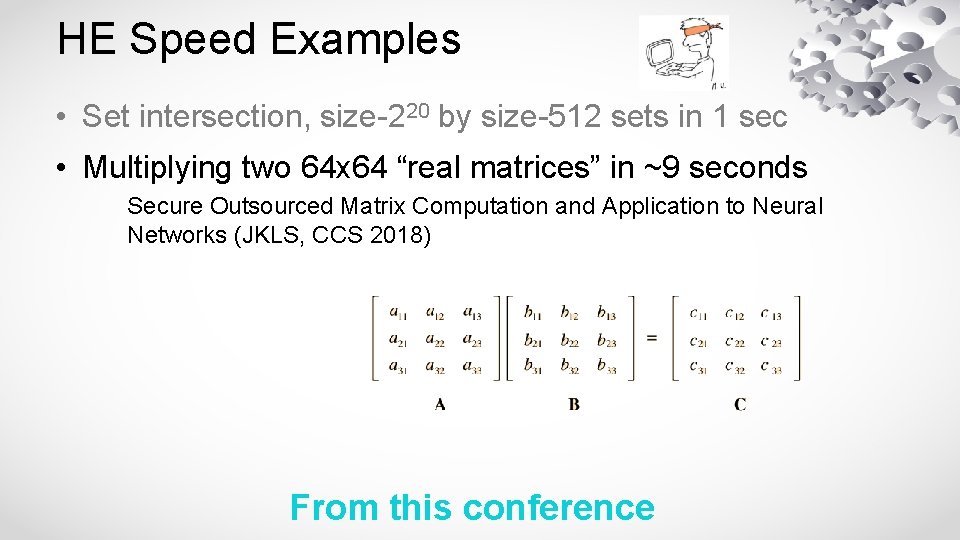
HE Speed Examples • Set intersection, size-220 by size-512 sets in 1 sec • Multiplying two 64 x 64 “real matrices” in ~9 seconds Secure Outsourced Matrix Computation and Application to Neural Networks (JKLS, CCS 2018) From this conference
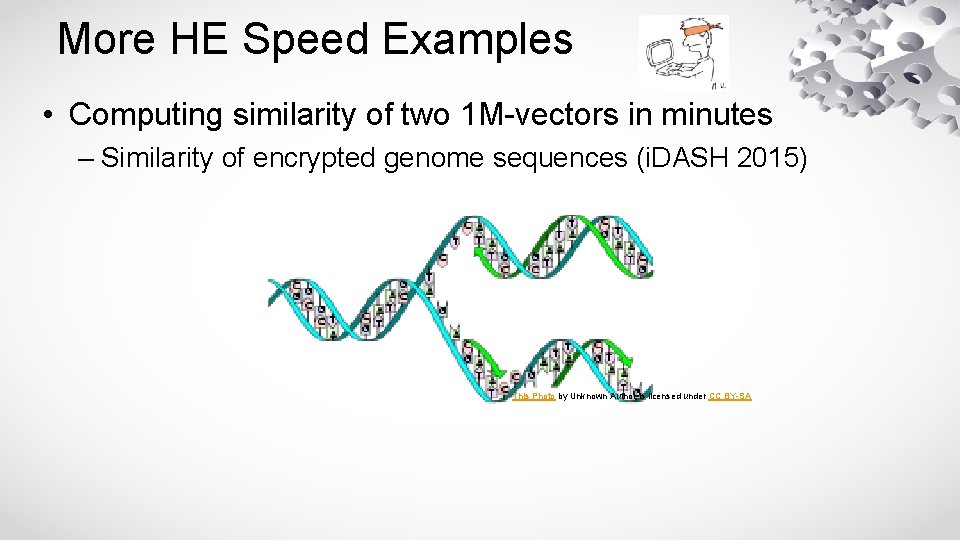
More HE Speed Examples • Computing similarity of two 1 M-vectors in minutes – Similarity of encrypted genome sequences (i. DASH 2015) This Photo by Unknown Author is licensed under CC BY-SA
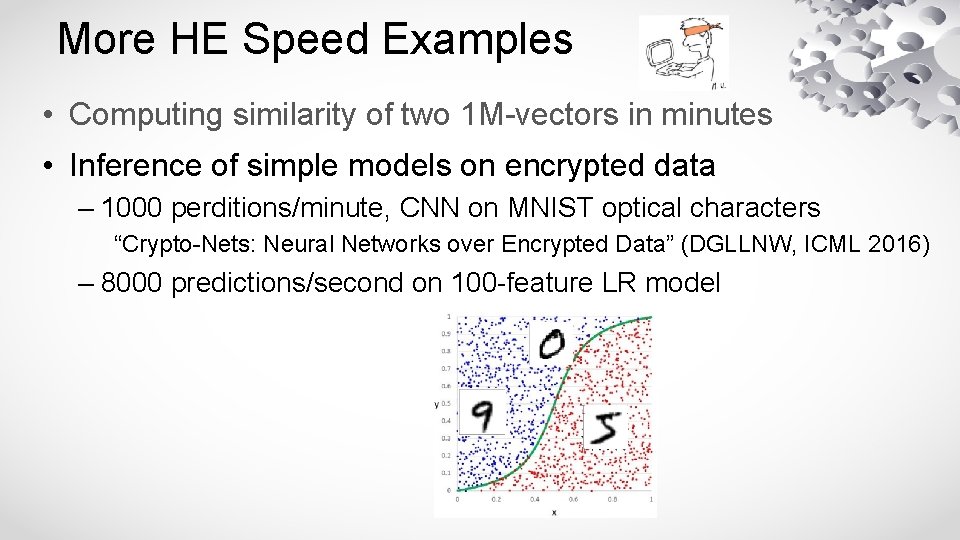
More HE Speed Examples • Computing similarity of two 1 M-vectors in minutes • Inference of simple models on encrypted data – 1000 perditions/minute, CNN on MNIST optical characters “Crypto-Nets: Neural Networks over Encrypted Data” (DGLLNW, ICML 2016) – 8000 predictions/second on 100 -feature LR model
More HE Speed Examples • Computing similarity of two 1 M-vectors in minutes • Inference of simple models on encrypted data – 1000 perditions/minute, CNN on MNIST optical characters – 8000 predictions/second on 100 -feature LR model • Training a logistic-regression model on genome data – Under 10 minutes with 10 -15 features, ~1000 rows (i. DASH 2017) “Logistic Regression Model Training based on the Approximate Homomorphic Encryption” (KSKLC, BMC Medical Genomics 2018) – 15 -30 minutes to train 30, 000 models w/ 5 features (i. DASH 2018)
Such awesome performance, how come we’re not seeing these tools everywhere? This Photo by Unknown Author is licensed under CC BY-SA
Not “Generally Usable" Yet
Complexity of Advanced Cryptography • Distributed computing is already complex enough, “advanced crypto” adds secrecy considerations • Good performence requires extreme optimizations – Straightforward implementation will be exceedingly slow – Small application-level changes can make a big difference in how to best optimize for it • Tension between simplicity/usability and performance
Implementations • Many software libraries for ZKP / MPC / HE – Most of them open-source • Very hard to compare them, decide which technology/implementation to use for what purpose – Different tools, data models, computation models, performance profiles, security guarantees, . . . – Hardly any accepted benchmarks • Many of the libraries are written for speed, not usability
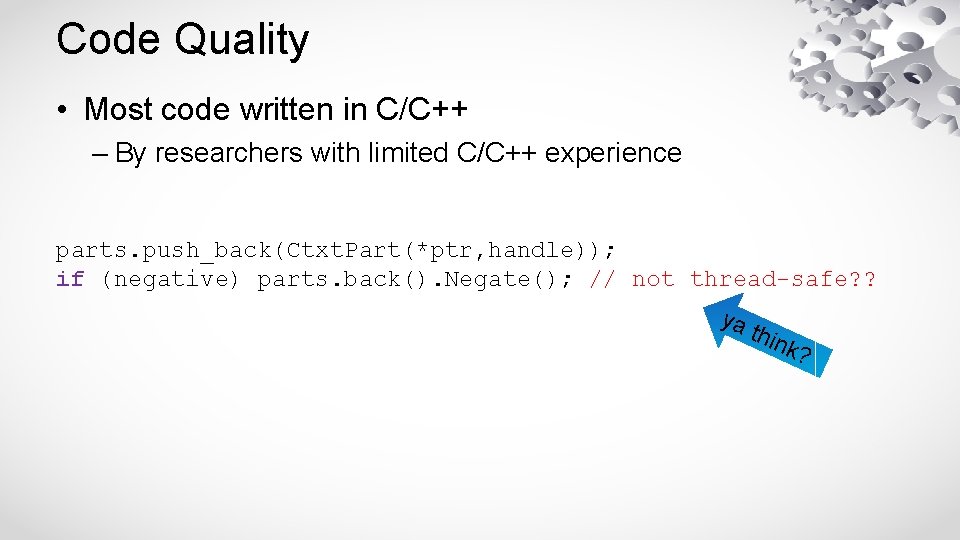
Code Quality • Most code written in C/C++ – By researchers with limited C/C++ experience parts. push_back(Ctxt. Part(*ptr, handle)); if (negative) parts. back(). Negate(); // not thread-safe? ? ya thin k?
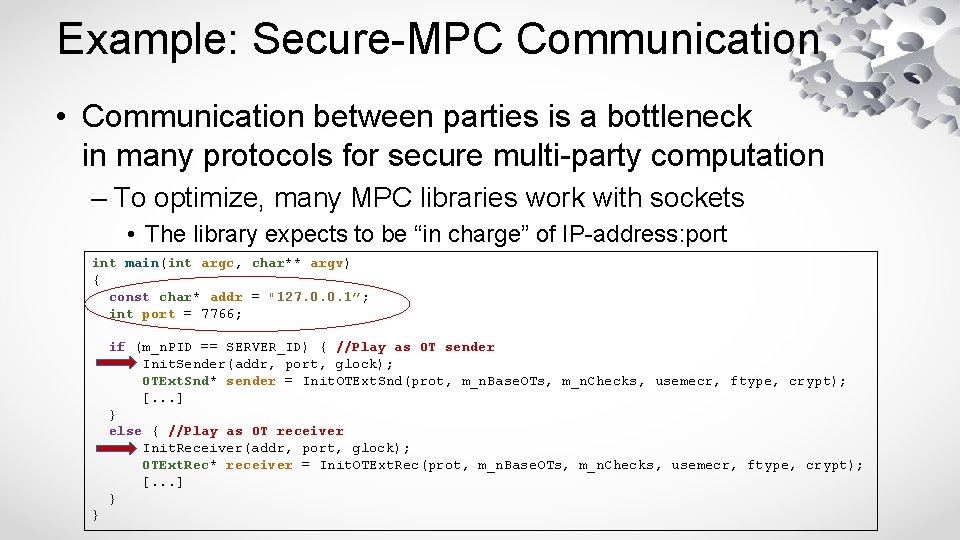
Example: Secure-MPC Communication • Communication between parties is a bottleneck in many protocols for secure multi-party computation – To optimize, many MPC libraries work with sockets • The library expects to be “in charge” of IP-address: port int main(int argc, char** argv) { const char* addr = "127. 0. 0. 1”; int port = 7766; if (m_n. PID == SERVER_ID) { //Play as OT sender Init. Sender(addr, port, glock); OTExt. Snd* sender = Init. OTExt. Snd(prot, m_n. Base. OTs, m_n. Checks, usemecr, ftype, crypt); [. . . ] } else { //Play as OT receiver Init. Receiver(addr, port, glock); OTExt. Rec* receiver = Init. OTExt. Rec(prot, m_n. Base. OTs, m_n. Checks, usemecr, ftype, crypt); [. . . ] } }
Example: Secure-MPC Communication • Communication between parties is a bottleneck in many protocols for secure multi-party computation – To optimize, many MPC libraries work with sockets • What if my system has its own communication layer? – E. g. working over https, g. RPC, … • Retrofitting existing libraries to use “abstract channels” is a lot of work, may degrade performance – Your best option is to look for another library
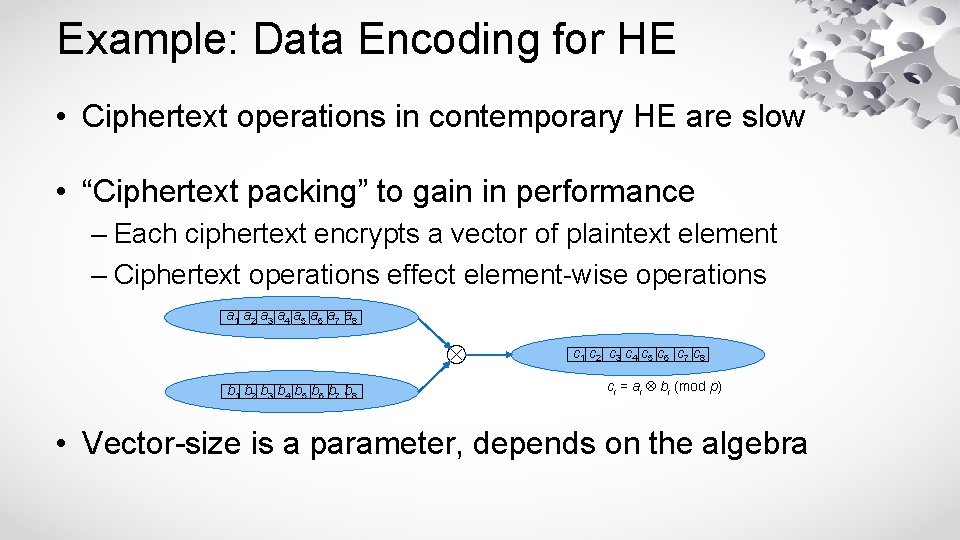
Example: Data Encoding for HE • Ciphertext operations in contemporary HE are slow • “Ciphertext packing” to gain in performance – Each ciphertext encrypts a vector of plaintext element – Ciphertext operations effect element-wise operations a 1 a 2 a 3 a 4 a 5 a 6 a 7 a 8 b 1 b 2 b 3 b 4 b 5 b 6 b 7 b 8 c 1 c 2 c 3 c 4 c 5 c 6 c 7 c 8 ci = ai bi (mod p) • Vector-size is a parameter, depends on the algebra
Example: Data Encoding for HE • Lots of flexibility in setting the parameters – Determine plaintext modulus, vector-size, more – Choosing the right parameters is an art form • Even with parameters set, where to put each piece of data requires a careful design – Could get orders-of-magnitude performance difference between different packing schemes • Almost no tool support for making these choices
Taming the Complexity • How to make advanced cryptography usable to non-expert programmers? • Usable “toolbox libraries” for common tasks – Low level: arithmetic, sorting, linear algebra, … – Mid level: graphs algorithms, set intersection, ML tools, … – Domain specific tasks (medical, financial, …) • Design libraries as “middleware” – One component in larger systems – Don’t assume that the library “owns” the relevant resources
Taming the Complexity • How to make advanced cryptography usable to non-expert programmers? • Frameworks, compiler support – Some work over last 10+years • e. g. , Fairplay, Sharemind, Obliv-C, … – Considerable work reported in this conference • • An End-to-End System for Large Scale P 2 P MPC-as-a-Service[…] (BHKL) Hy. CC: Compilation of hybrid protocols for Practical Secure[…] (BDK) Generalizing the SPDZ Compiler. For Other Protocols (ABFKLOT) ALCHEMY: A Language and Compiler for HE […] (CPS)
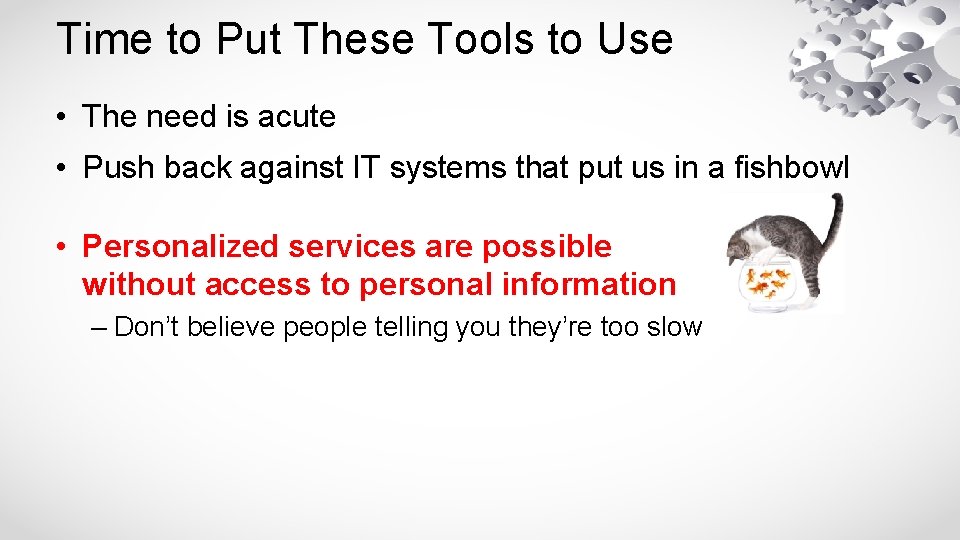
Time to Put These Tools to Use • The need is acute • Push back against IT systems that put us in a fishbowl • Personalized services are possible without access to personal information – Don’t believe people telling you they’re too slow
Time to Put These Tools to Use • Cryptographers must put emphasis on usability and “mundane” software engineering aspects – Although improving performance is still important • System builders should try to use what tools exist – Complain bitterly to your fellow cryptographers if their tools are too hard to use • For now, keep designing one-off systems – Hopefully, some generalizations will emerge – These technologies are best suited for that type of applications
Time to Put These Tools to Use • Some starting points to access these technologies: – Zero-Knowledge: https: //zkp. science/ – Secure-MPC: https: //github. com/rdragos/awesome-mpc and http: //www. multipartycomputation. com – HE: http: //homomorphicencryption. org/ • We really need HOWTO documents – With application focus – Any volunteers to write them?
Incentives for Blindfold Computation? • Customer demand? – Seems unlikely • Government regulation? – Maybe, in some cases • Developers wanting to do the right thing? – That’s us, we have some choice in the systems that we build – Don’t build systems that require users to hand over their data § It will be abused
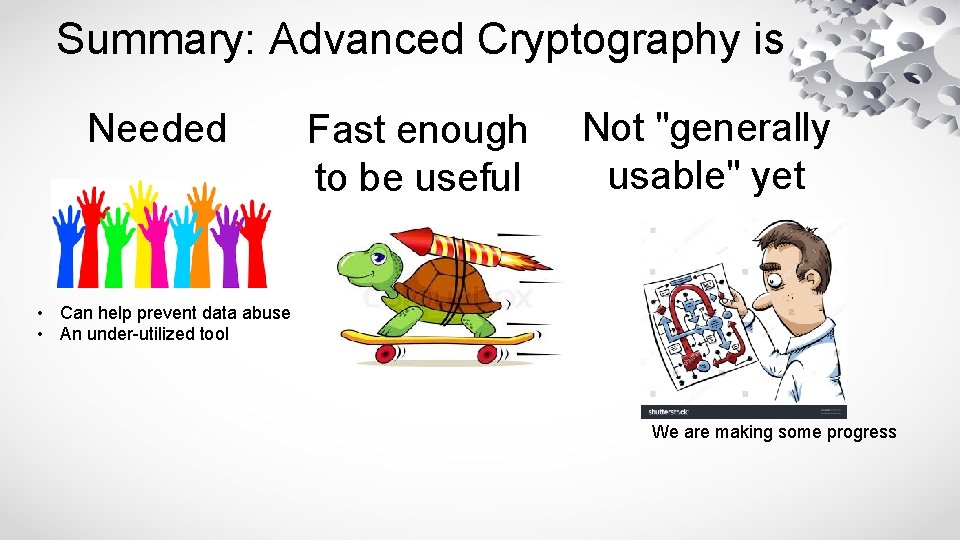
Summary: Advanced Cryptography is Needed Fast enough to be useful Not "generally usable" yet • Can help prevent data abuse • An under-utilized tool We are making some progress
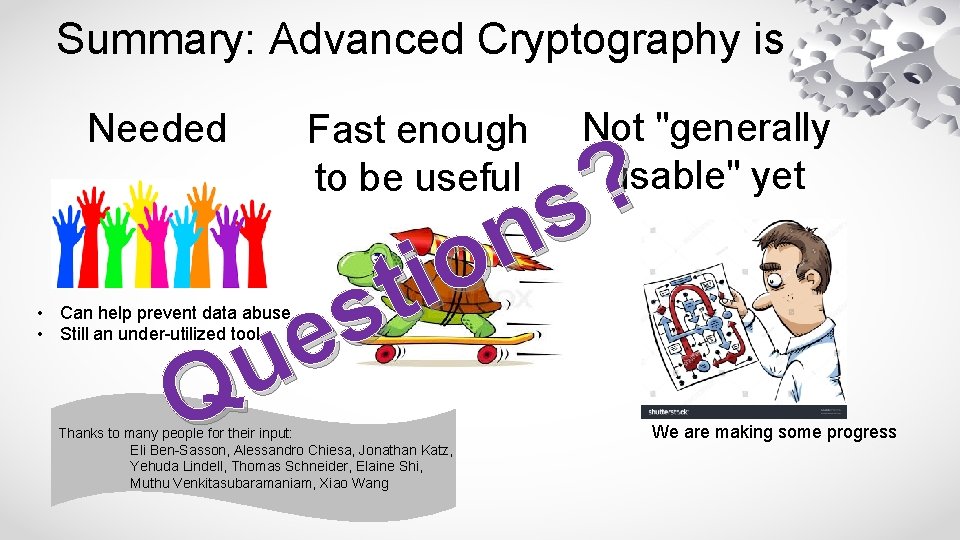
Summary: Advanced Cryptography is Needed Fast enough to be useful Not "generally usable" yet ? s n o i t s e u Q • Can help prevent data abuse • Still an under-utilized tool Thanks to many people for their input: Eli Ben-Sasson, Alessandro Chiesa, Jonathan Katz, Yehuda Lindell, Thomas Schneider, Elaine Shi, Muthu Venkitasubaramaniam, Xiao Wang We are making some progress
- Slides: 66