
Advanced Counting Techniques CSC2259 Discrete Structures Konstantin Busch
Advanced Counting Techniques CSC-2259 Discrete Structures Konstantin Busch - LSU 1

Recurrence Relations Sequence Recurrence relation: For any Konstantin Busch - LSU 2

Example: Recurrence relation Solutions to recurrence relation: Konstantin Busch - LSU 3
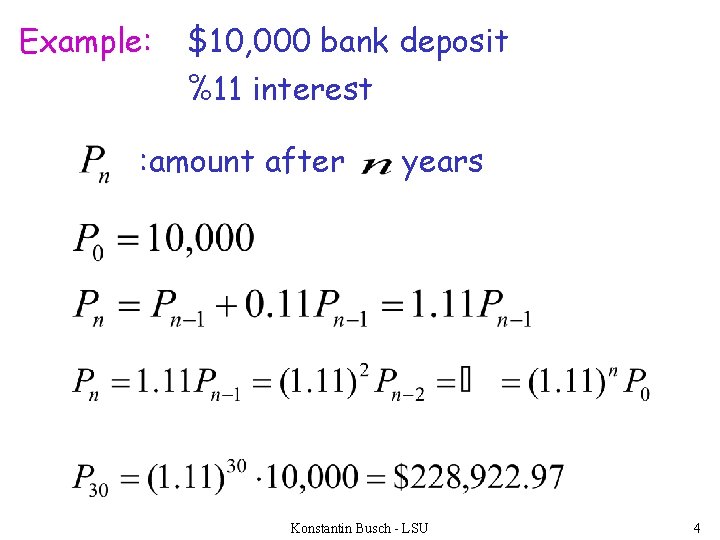
Example: $10, 000 bank deposit %11 interest : amount after years Konstantin Busch - LSU 4

Example: Fibonacci sequence Konstantin Busch - LSU 5
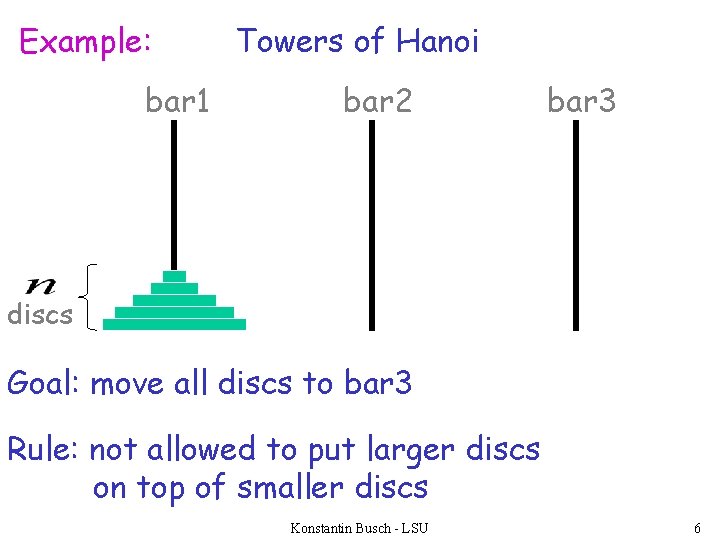
Example: bar 1 Towers of Hanoi bar 2 bar 3 discs Goal: move all discs to bar 3 Rule: not allowed to put larger discs on top of smaller discs Konstantin Busch - LSU 6
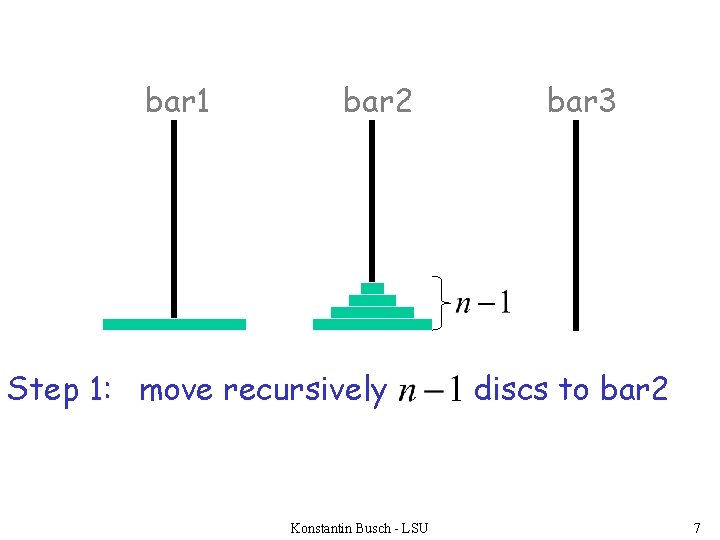
bar 1 bar 2 Step 1: move recursively Konstantin Busch - LSU bar 3 discs to bar 2 7
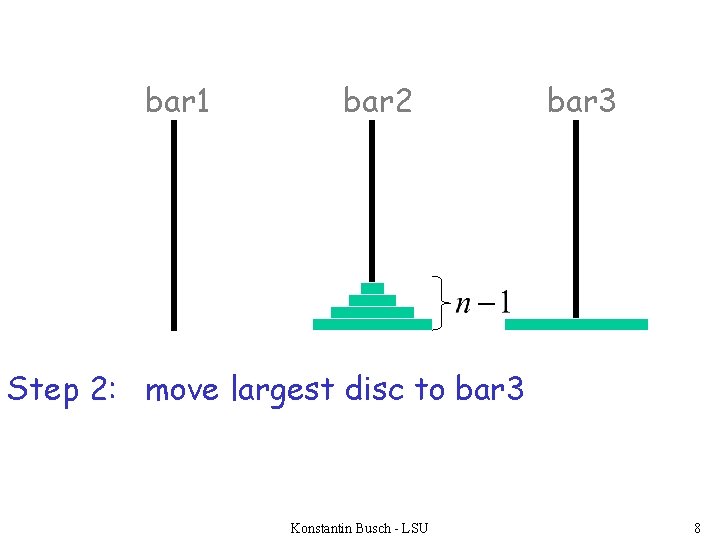
bar 1 bar 2 bar 3 Step 2: move largest disc to bar 3 Konstantin Busch - LSU 8

bar 1 Step 3: bar 2 move recursively Konstantin Busch - LSU bar 3 discs to bar 3 9
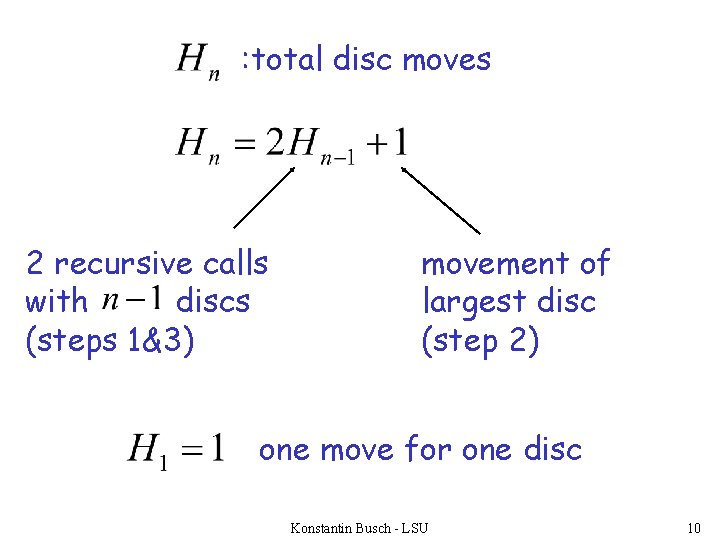
: total disc moves 2 recursive calls with discs (steps 1&3) movement of largest disc (step 2) one move for one disc Konstantin Busch - LSU 10
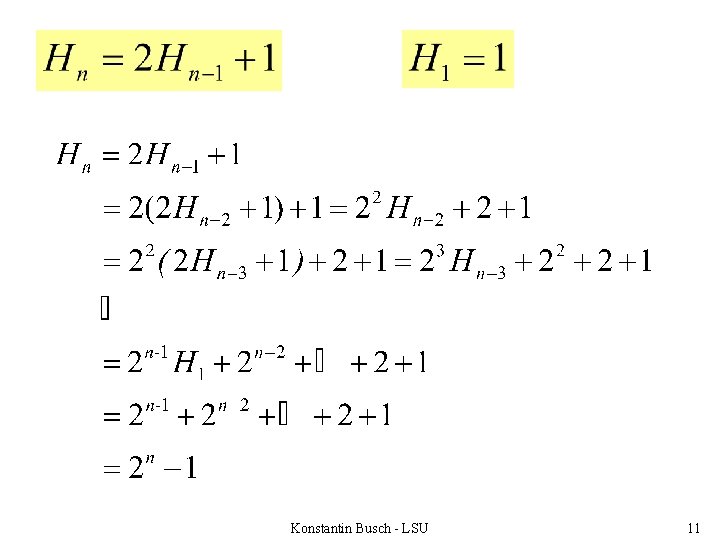
Konstantin Busch - LSU 11
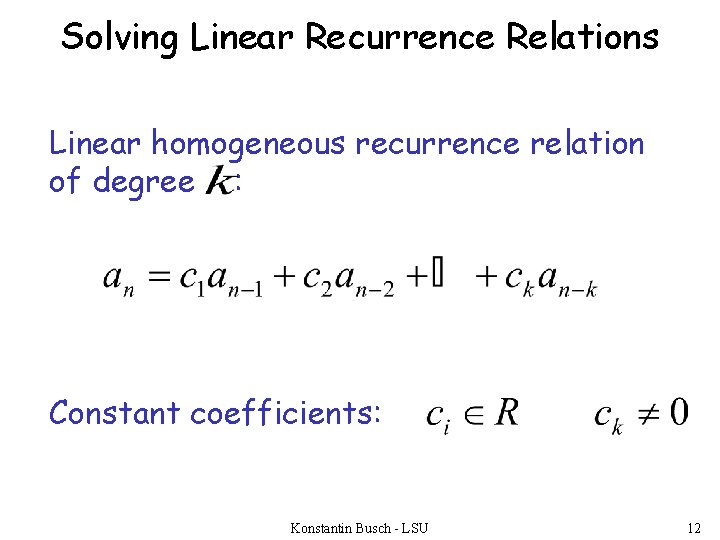
Solving Linear Recurrence Relations Linear homogeneous recurrence relation of degree : Constant coefficients: Konstantin Busch - LSU 12
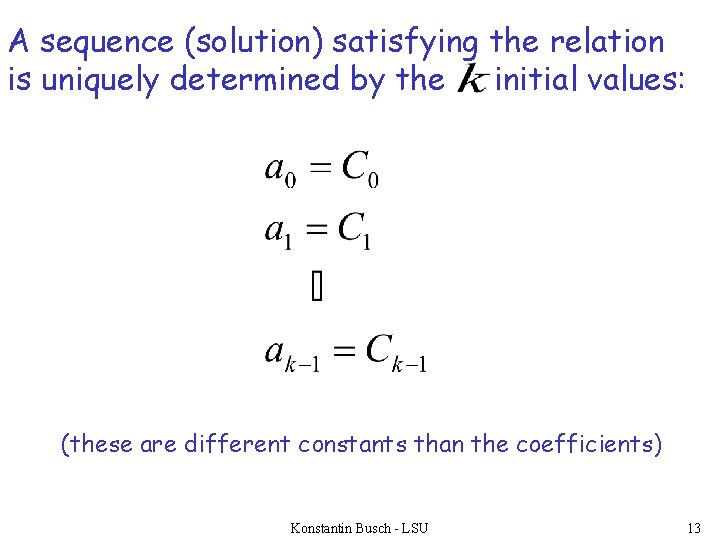
A sequence (solution) satisfying the relation is uniquely determined by the initial values: (these are different constants than the coefficients) Konstantin Busch - LSU 13
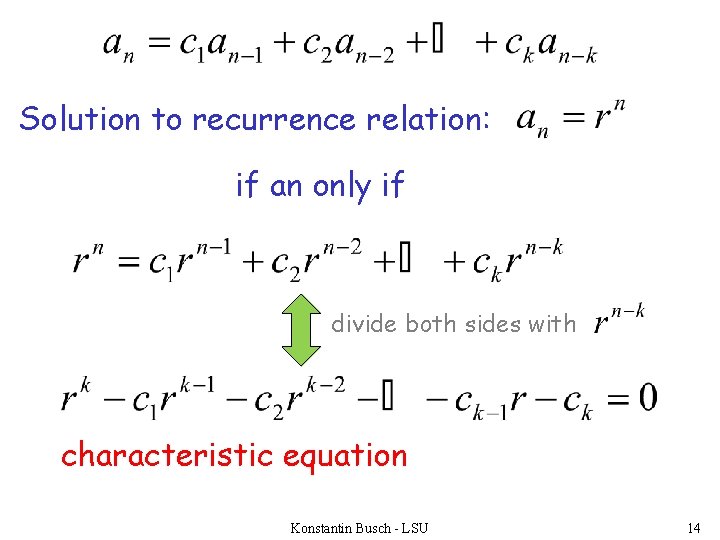
Solution to recurrence relation: if an only if divide both sides with characteristic equation Konstantin Busch - LSU 14
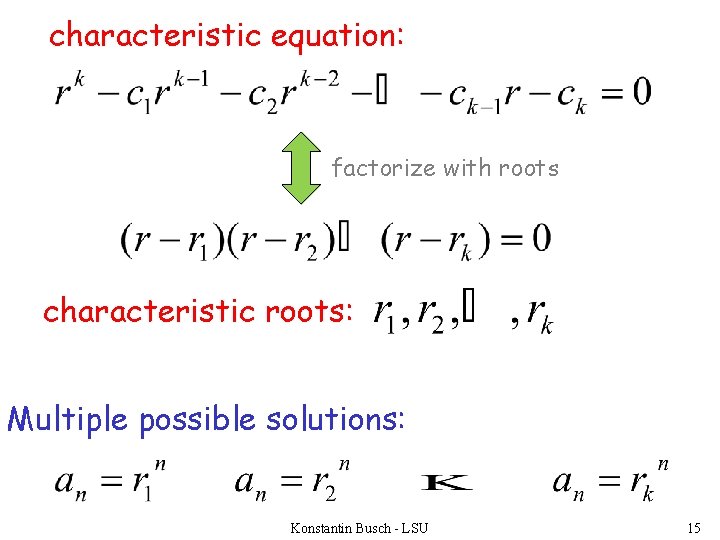
characteristic equation: factorize with roots characteristic roots: Multiple possible solutions: Konstantin Busch - LSU 15
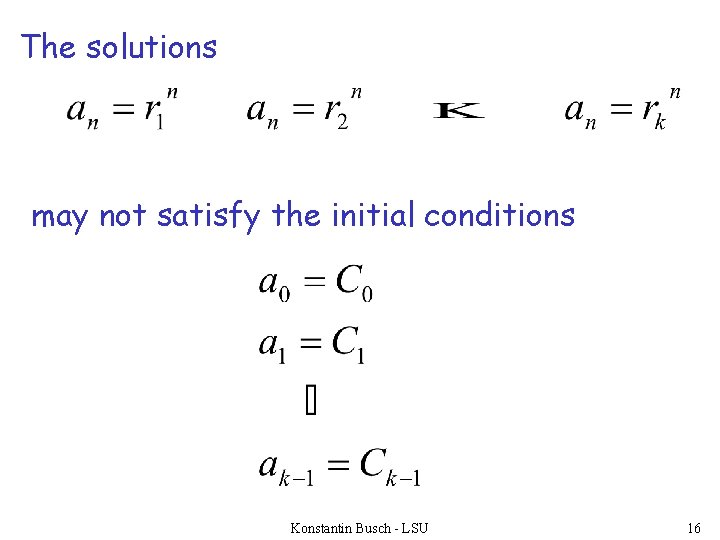
The solutions may not satisfy the initial conditions Konstantin Busch - LSU 16
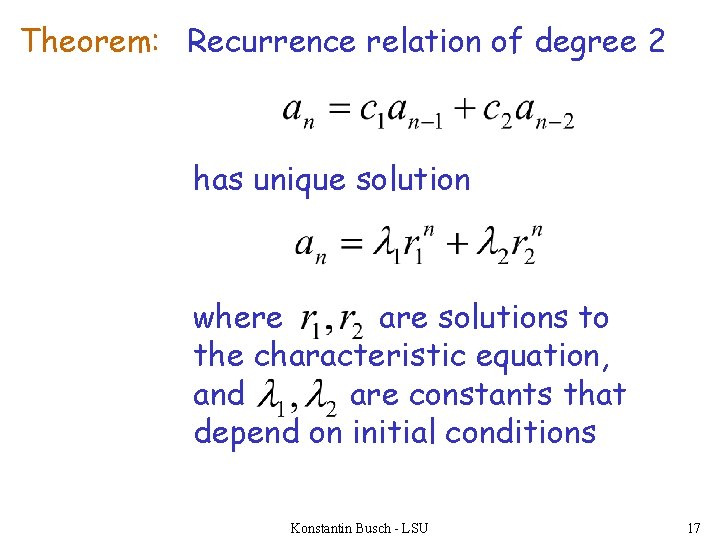
Theorem: Recurrence relation of degree 2 has unique solution where are solutions to the characteristic equation, and are constants that depend on initial conditions Konstantin Busch - LSU 17
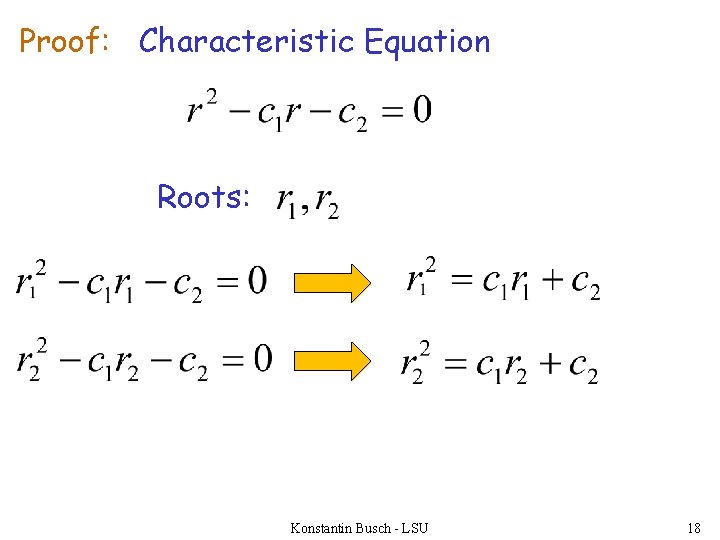
Proof: Characteristic Equation Roots: Konstantin Busch - LSU 18
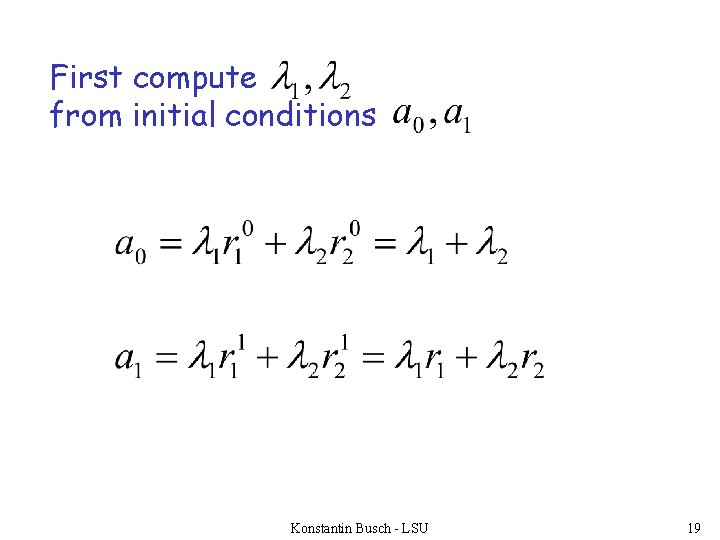
First compute from initial conditions Konstantin Busch - LSU 19
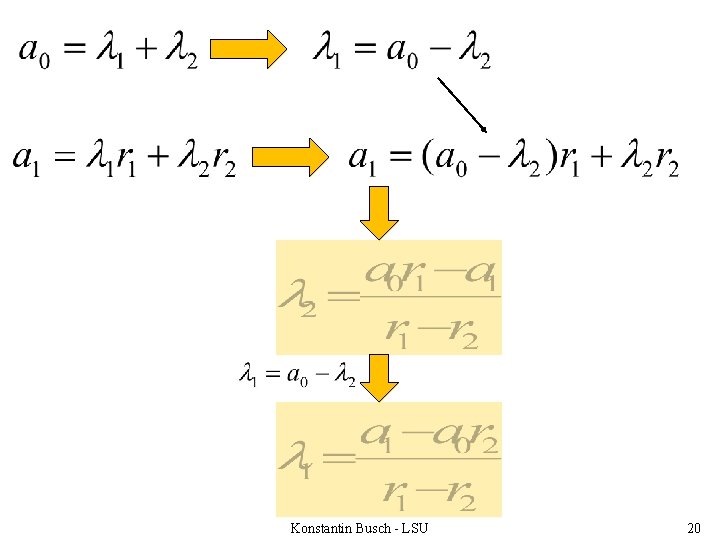
Konstantin Busch - LSU 20
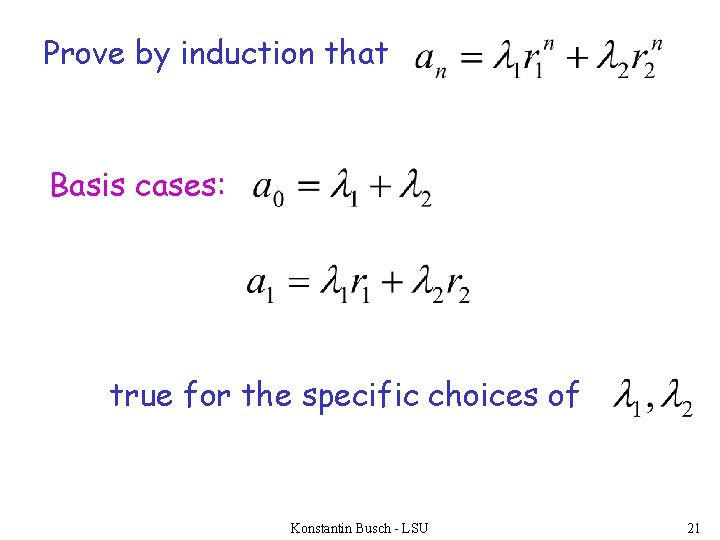
Prove by induction that Basis cases: true for the specific choices of Konstantin Busch - LSU 21
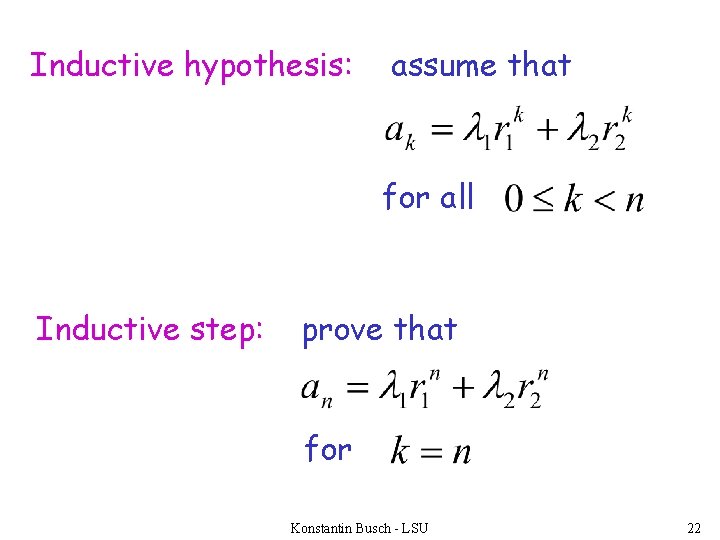
Inductive hypothesis: assume that for all Inductive step: prove that for Konstantin Busch - LSU 22
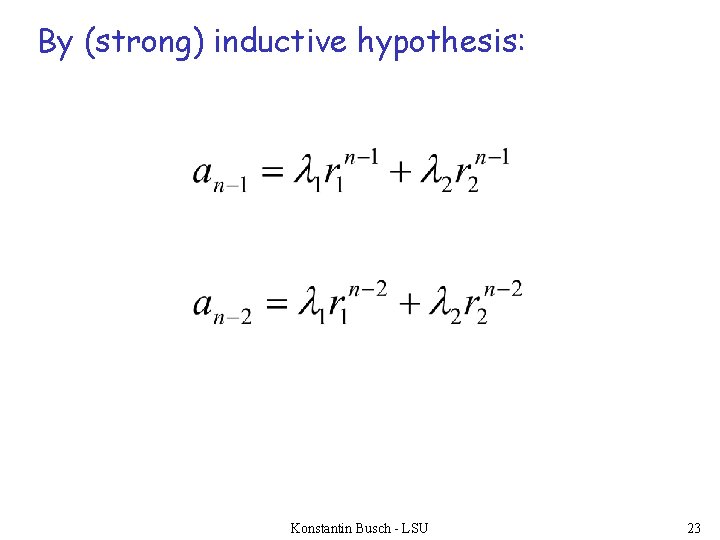
By (strong) inductive hypothesis: Konstantin Busch - LSU 23
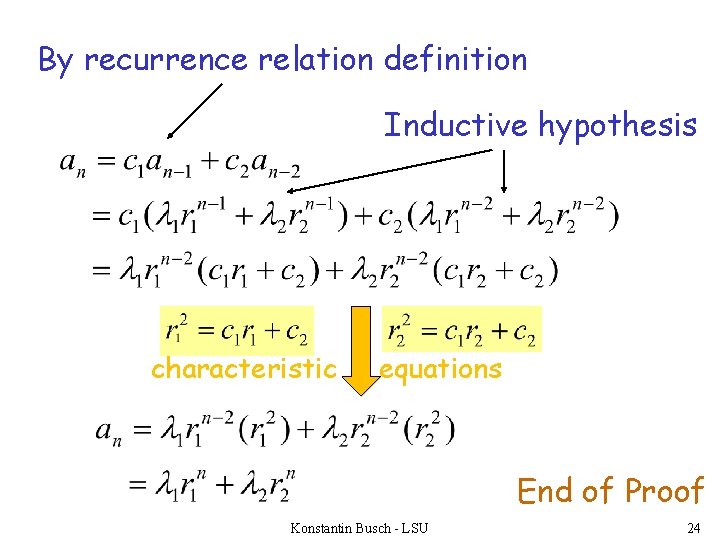
By recurrence relation definition Inductive hypothesis characteristic equations End of Proof Konstantin Busch - LSU 24
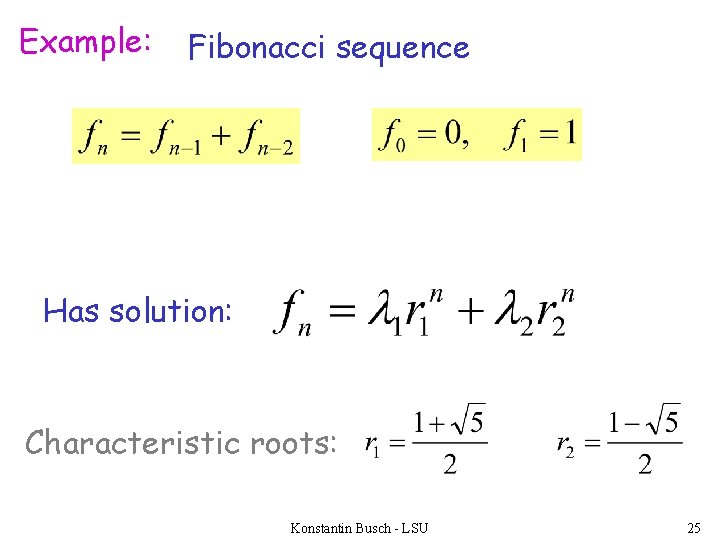
Example: Fibonacci sequence Has solution: Characteristic roots: Konstantin Busch - LSU 25
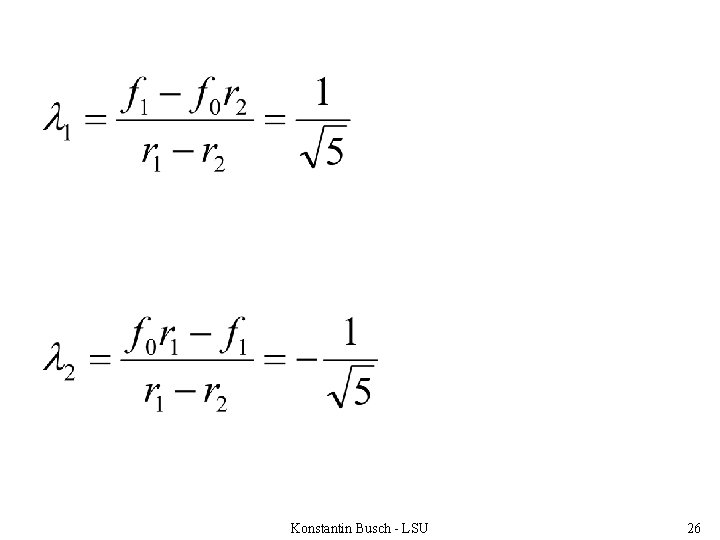
Konstantin Busch - LSU 26
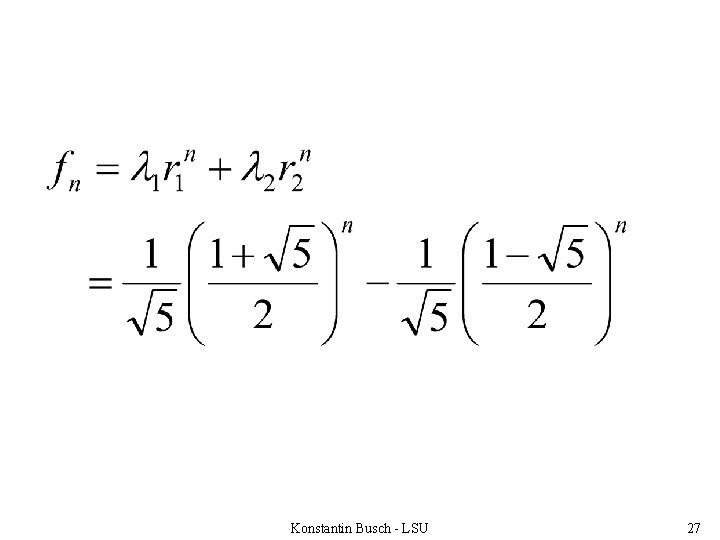
Konstantin Busch - LSU 27
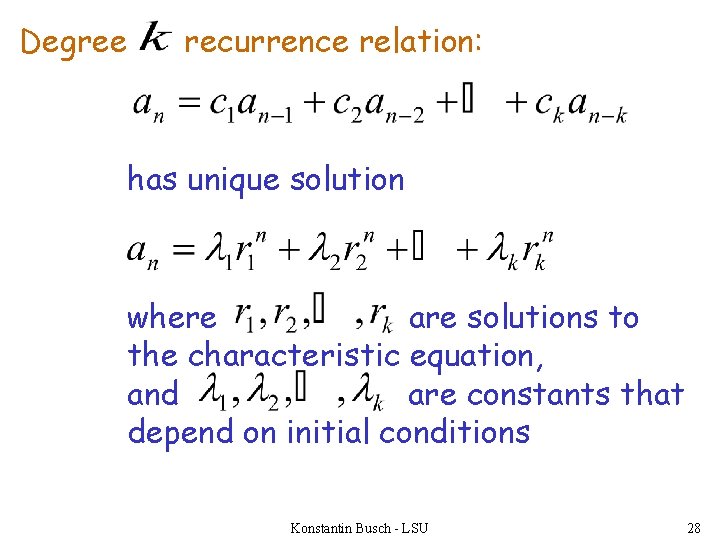
Degree recurrence relation: has unique solution where are solutions to the characteristic equation, and are constants that depend on initial conditions Konstantin Busch - LSU 28
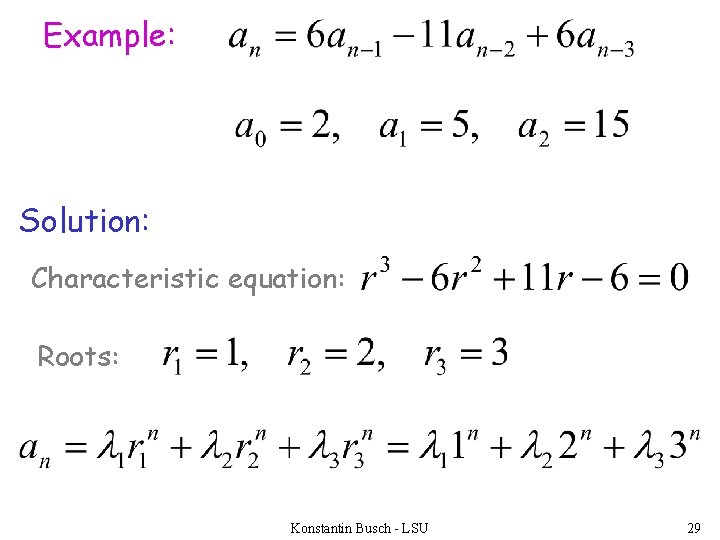
Example: Solution: Characteristic equation: Roots: Konstantin Busch - LSU 29
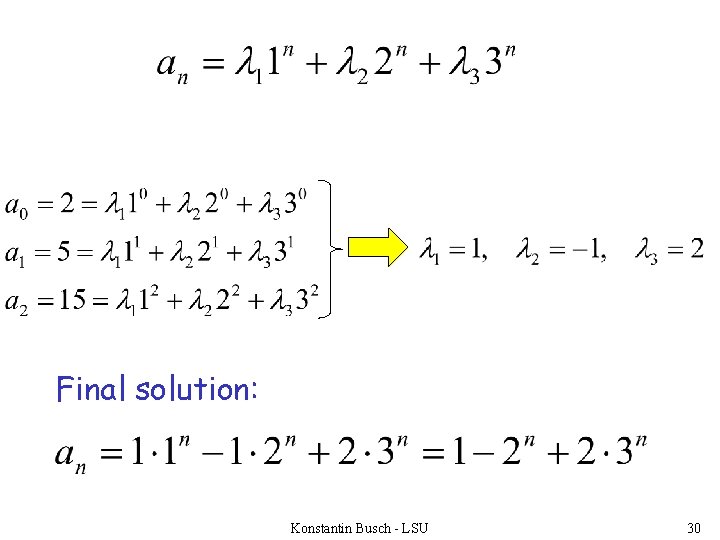
Final solution: Konstantin Busch - LSU 30
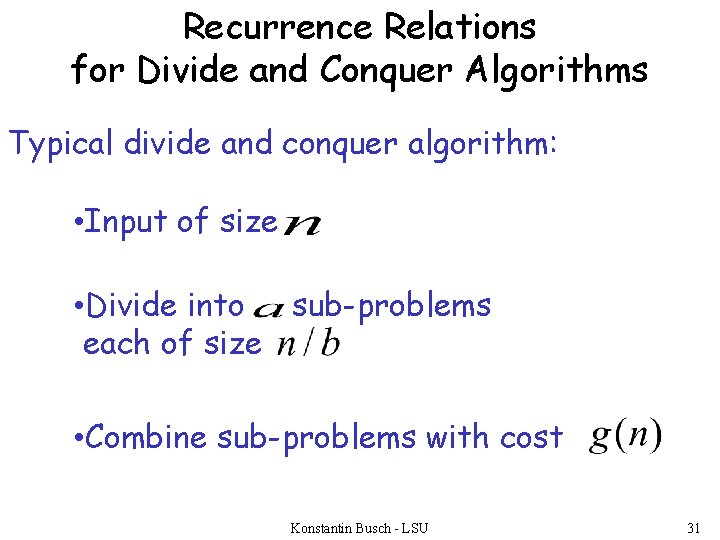
Recurrence Relations for Divide and Conquer Algorithms Typical divide and conquer algorithm: • Input of size • Divide into sub-problems each of size • Combine sub-problems with cost Konstantin Busch - LSU 31
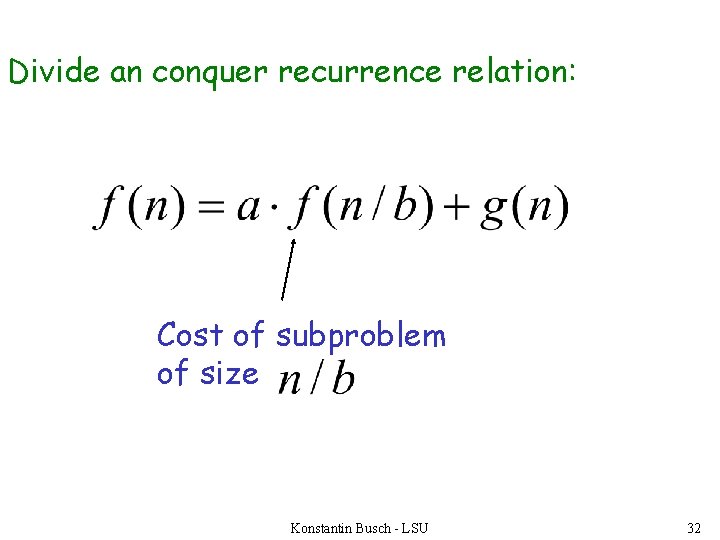
Divide an conquer recurrence relation: Cost of subproblem of size Konstantin Busch - LSU 32
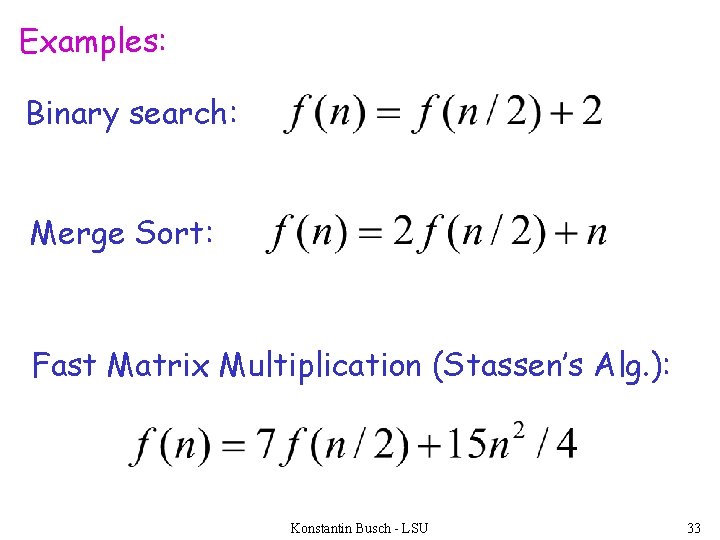
Examples: Binary search: Merge Sort: Fast Matrix Multiplication (Stassen’s Alg. ): Konstantin Busch - LSU 33
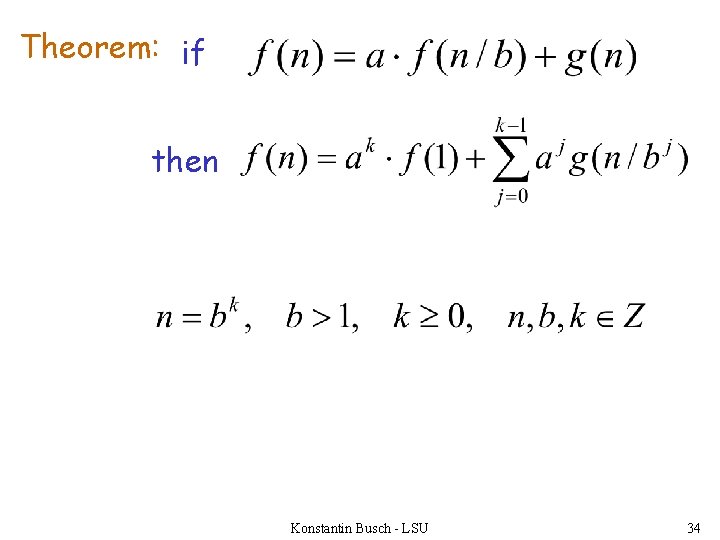
Theorem: if then Konstantin Busch - LSU 34
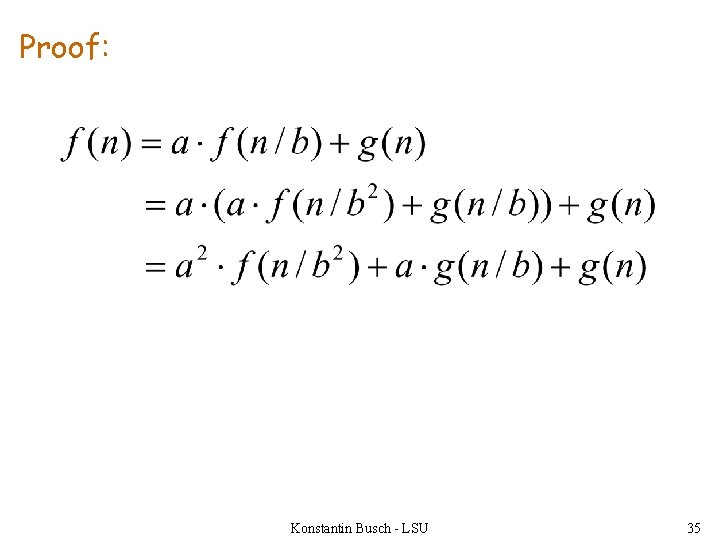
Proof: Konstantin Busch - LSU 35
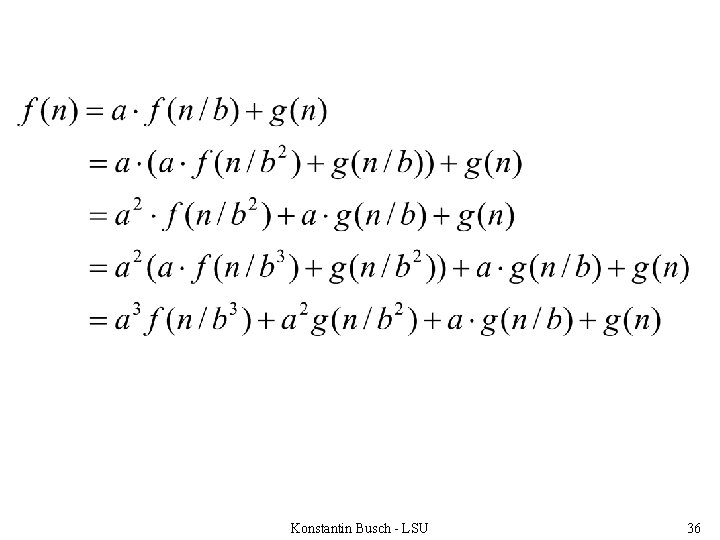
Konstantin Busch - LSU 36
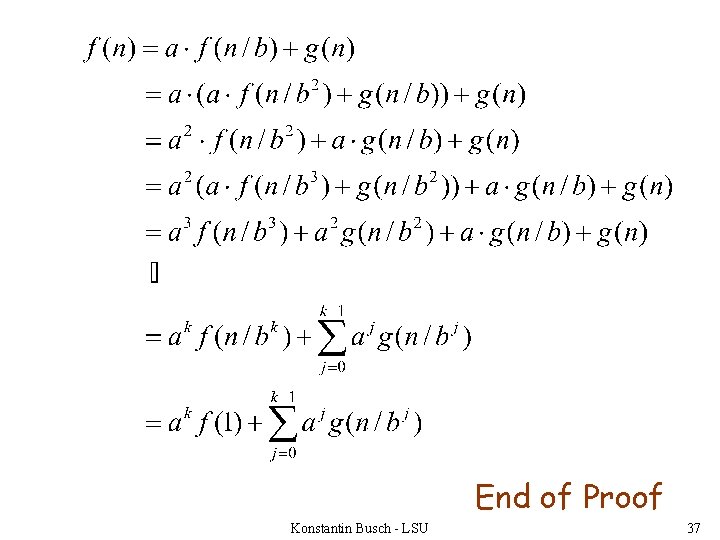
End of Proof Konstantin Busch - LSU 37
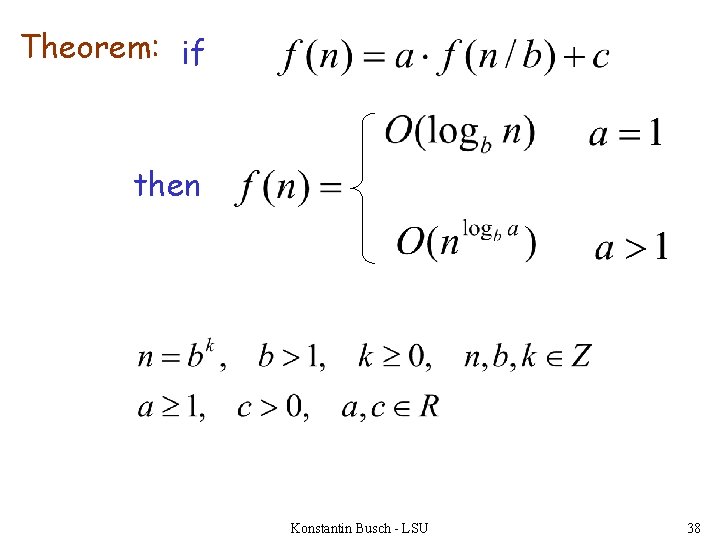
Theorem: if then Konstantin Busch - LSU 38
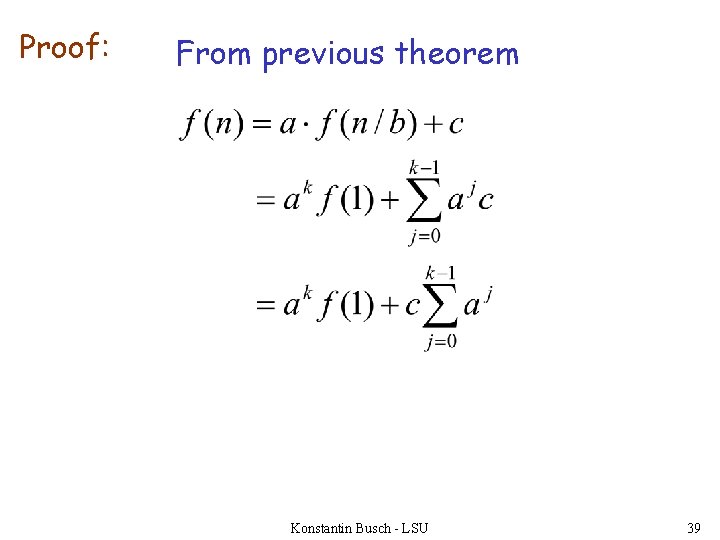
Proof: From previous theorem Konstantin Busch - LSU 39
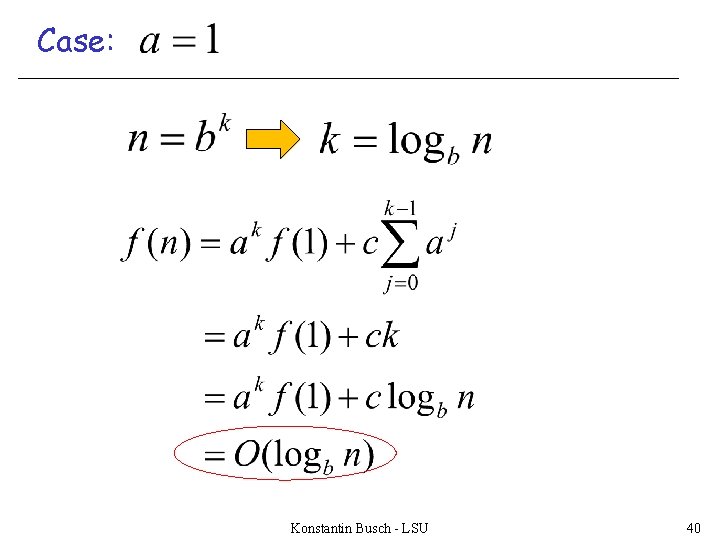
Case: Konstantin Busch - LSU 40
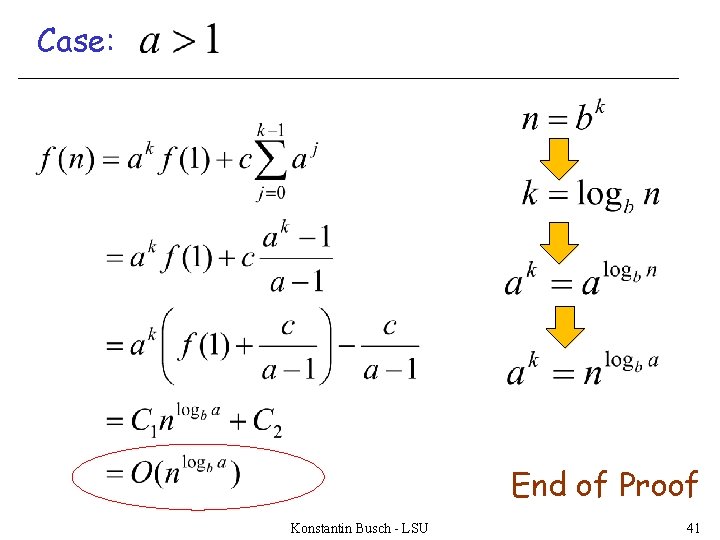
Case: End of Proof Konstantin Busch - LSU 41
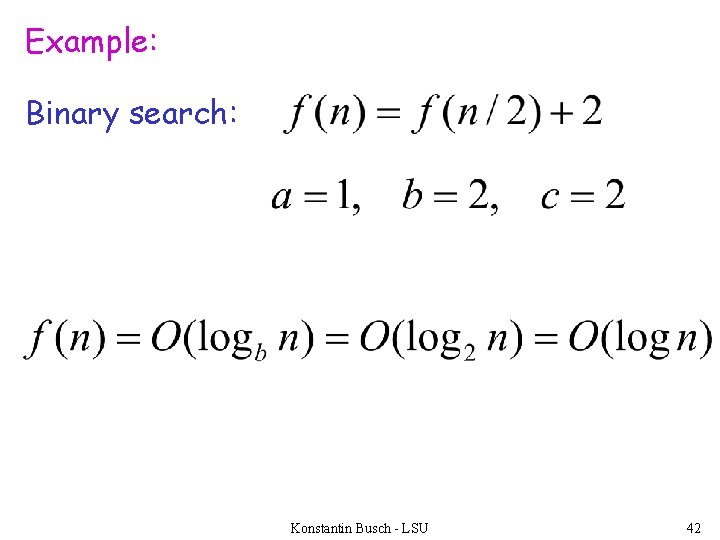
Example: Binary search: Konstantin Busch - LSU 42
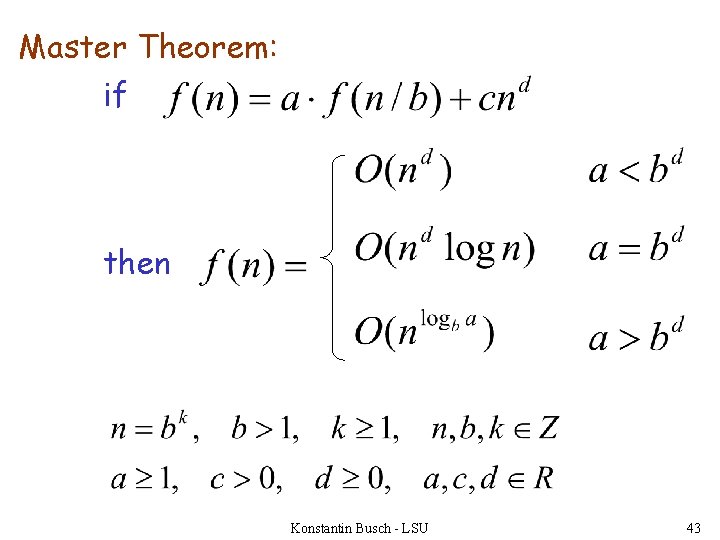
Master Theorem: if then Konstantin Busch - LSU 43
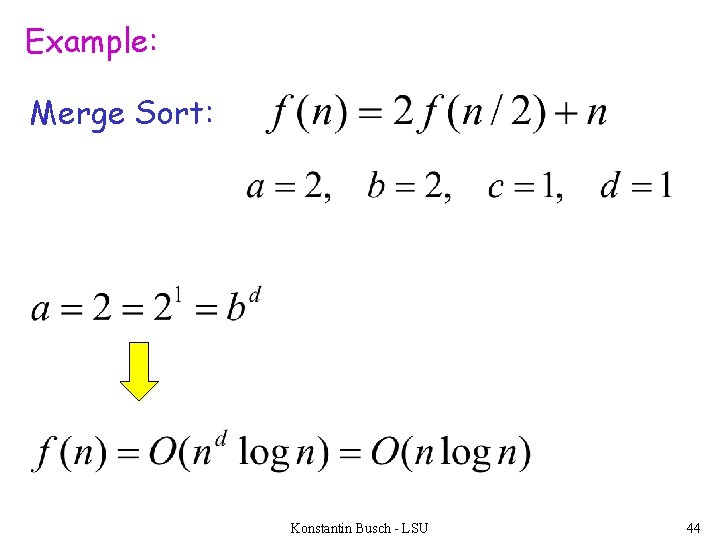
Example: Merge Sort: Konstantin Busch - LSU 44
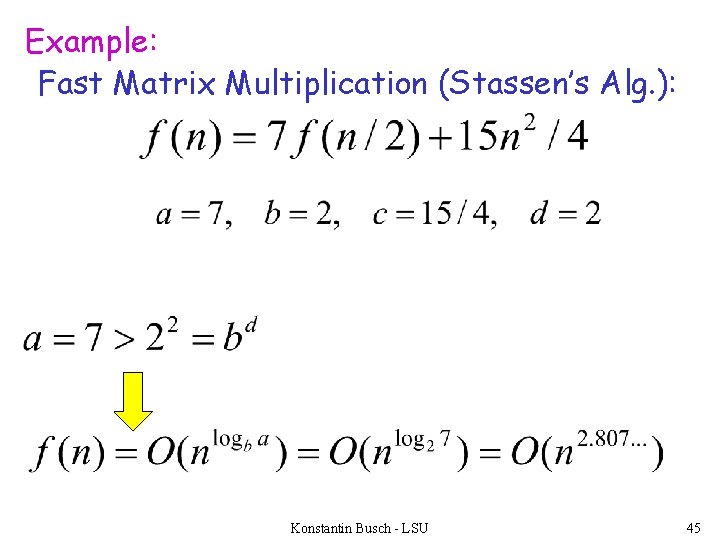
Example: Fast Matrix Multiplication (Stassen’s Alg. ): Konstantin Busch - LSU 45
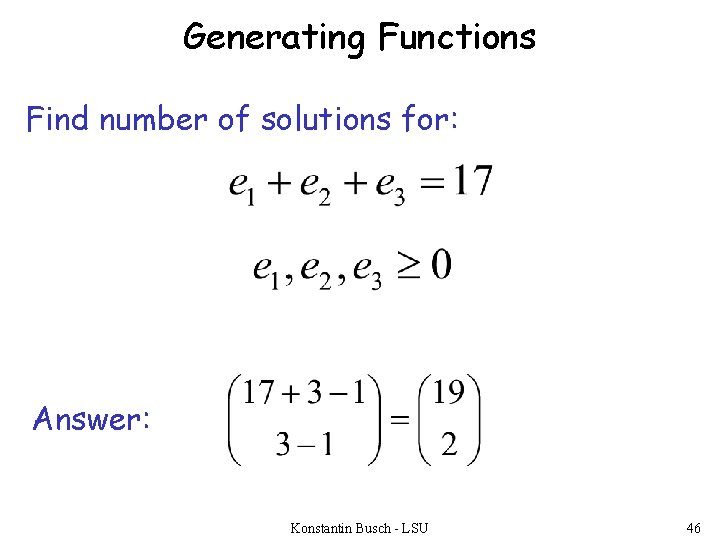
Generating Functions Find number of solutions for: Answer: Konstantin Busch - LSU 46
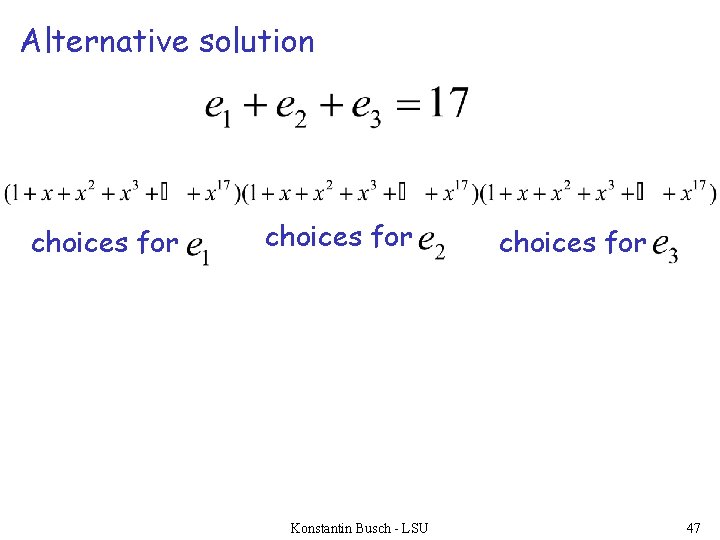
Alternative solution choices for Konstantin Busch - LSU choices for 47
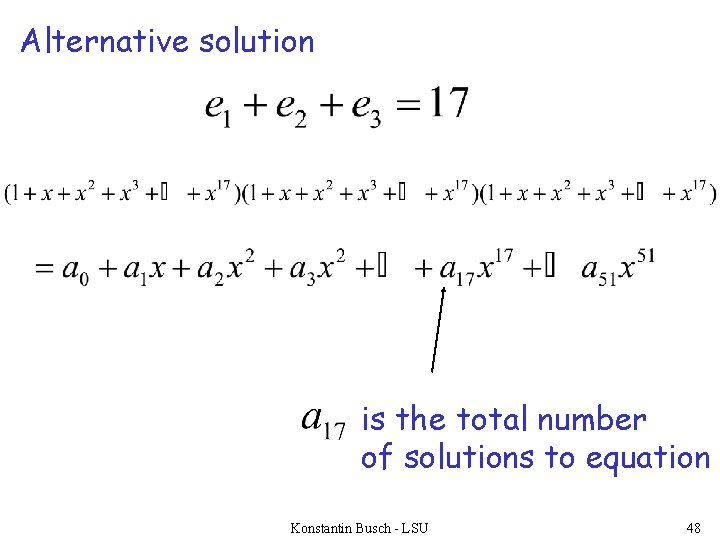
Alternative solution is the total number of solutions to equation Konstantin Busch - LSU 48
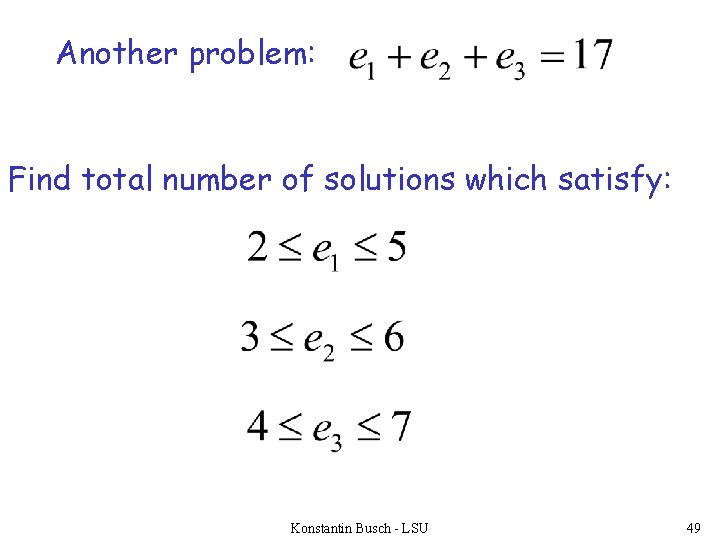
Another problem: Find total number of solutions which satisfy: Konstantin Busch - LSU 49
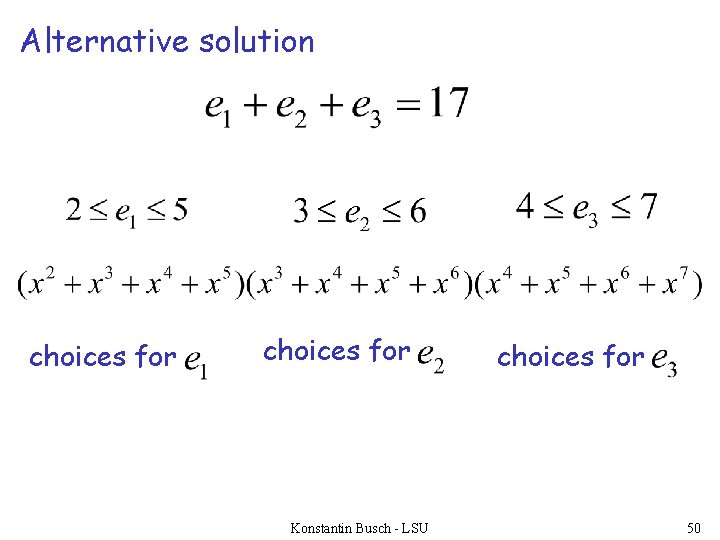
Alternative solution choices for Konstantin Busch - LSU choices for 50
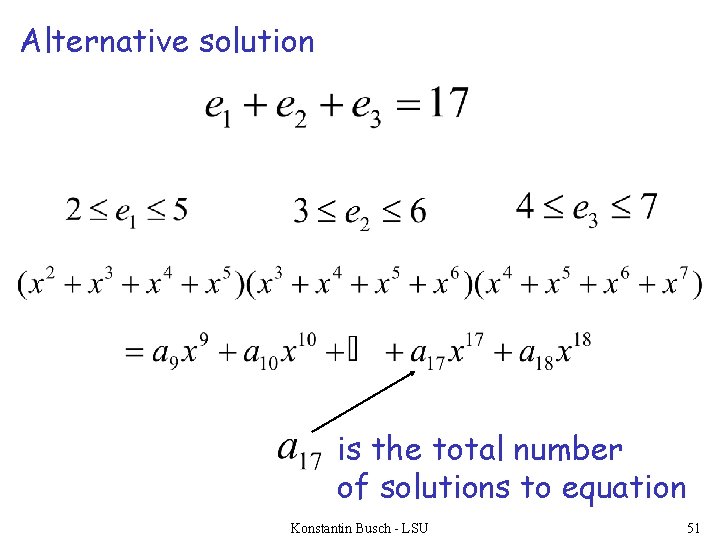
Alternative solution is the total number of solutions to equation Konstantin Busch - LSU 51
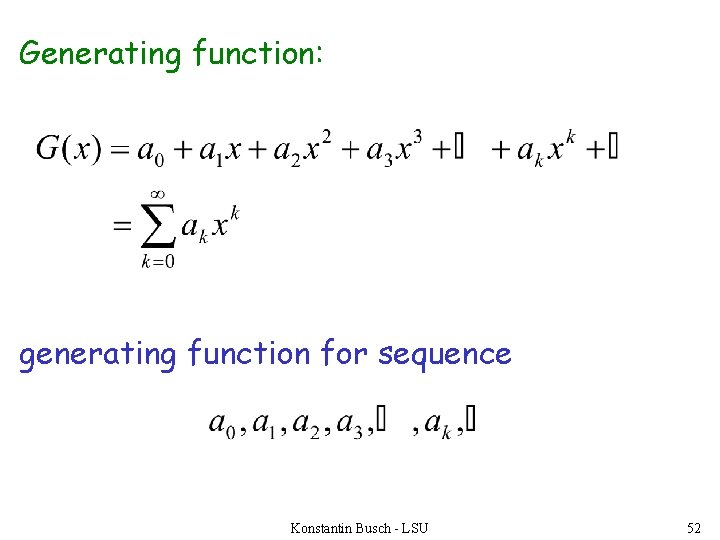
Generating function: generating function for sequence Konstantin Busch - LSU 52
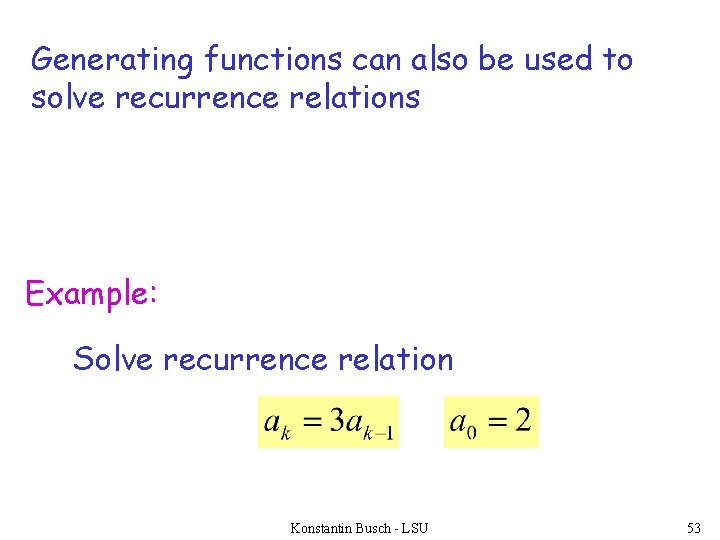
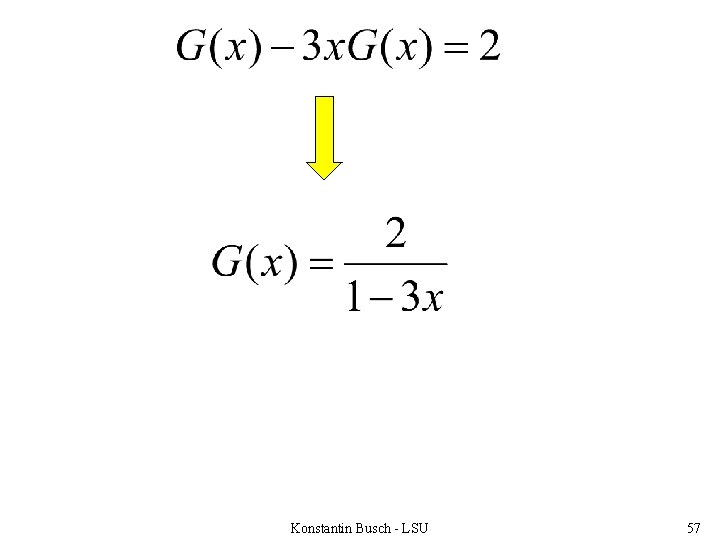
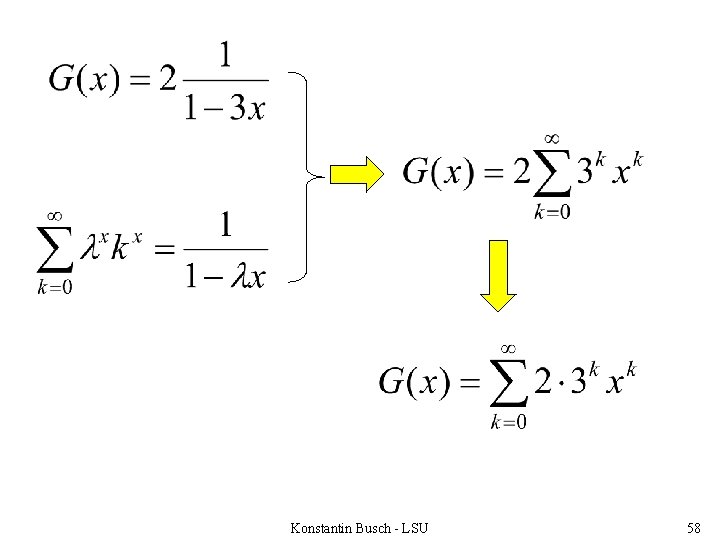
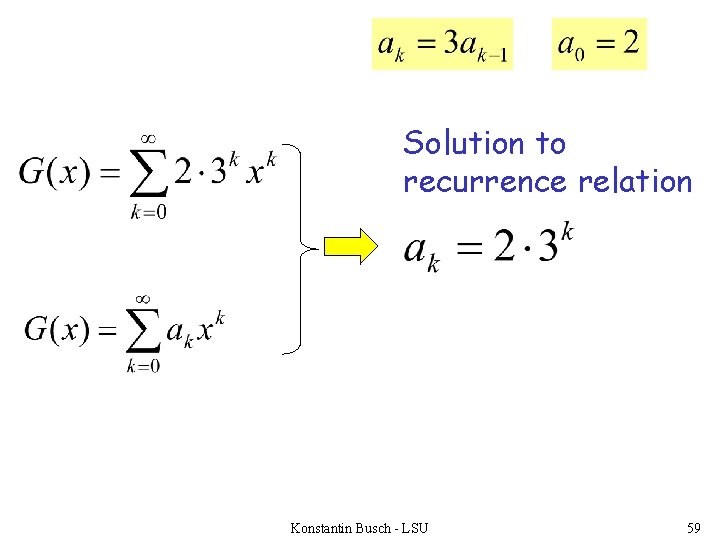
Generating functions can also be used to solve recurrence relations Example: Solve recurrence relation Konstantin Busch - LSU 53
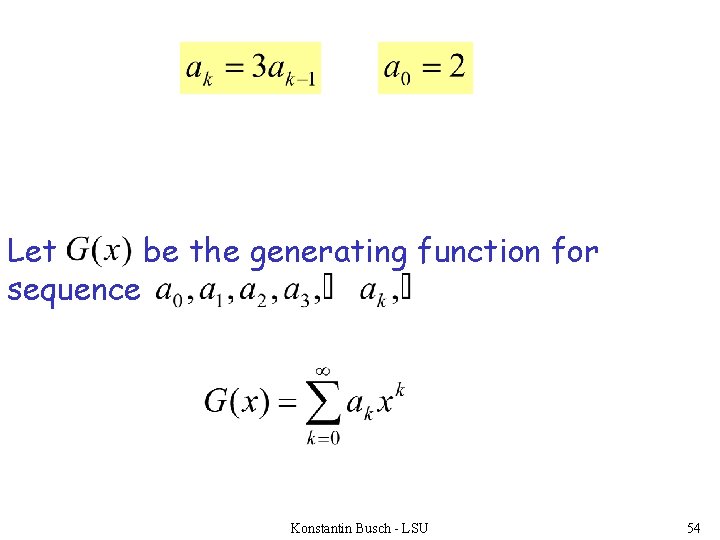
Let be the generating function for sequence Konstantin Busch - LSU 54
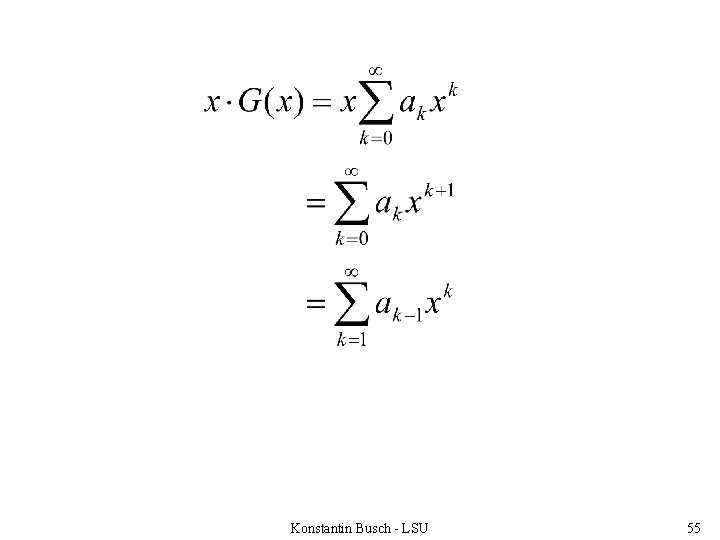
Konstantin Busch - LSU 55
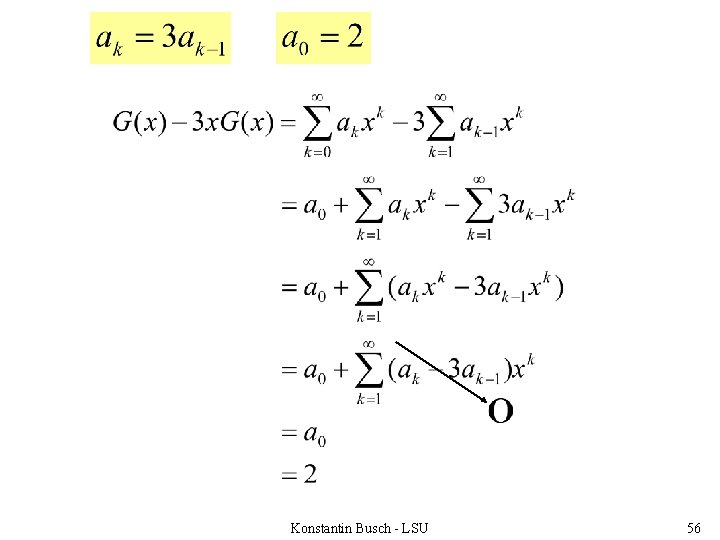
Konstantin Busch - LSU 56
Konstantin Busch - LSU 57
Konstantin Busch - LSU 58
Solution to recurrence relation Konstantin Busch - LSU 59
Inclusion-Exclusion Konstantin Busch - LSU 60
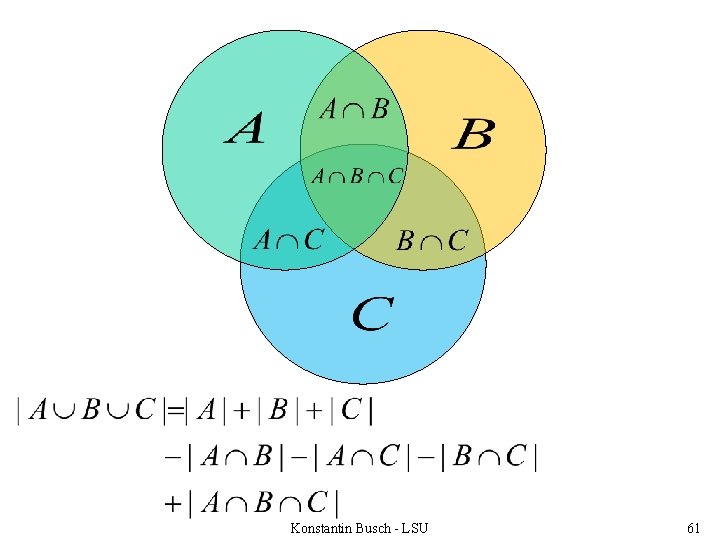
Konstantin Busch - LSU 61
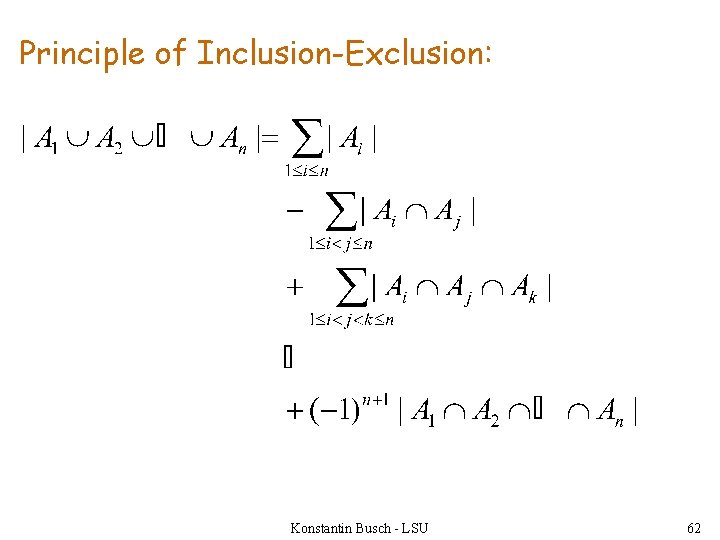
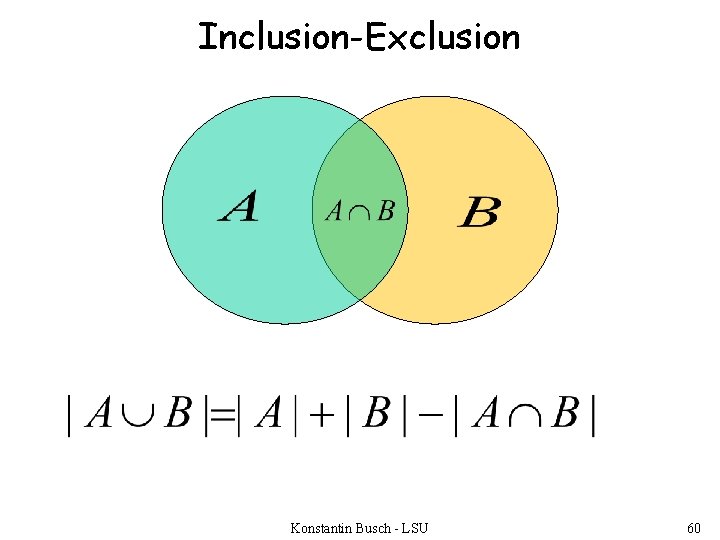
Principle of Inclusion-Exclusion: Konstantin Busch - LSU 62
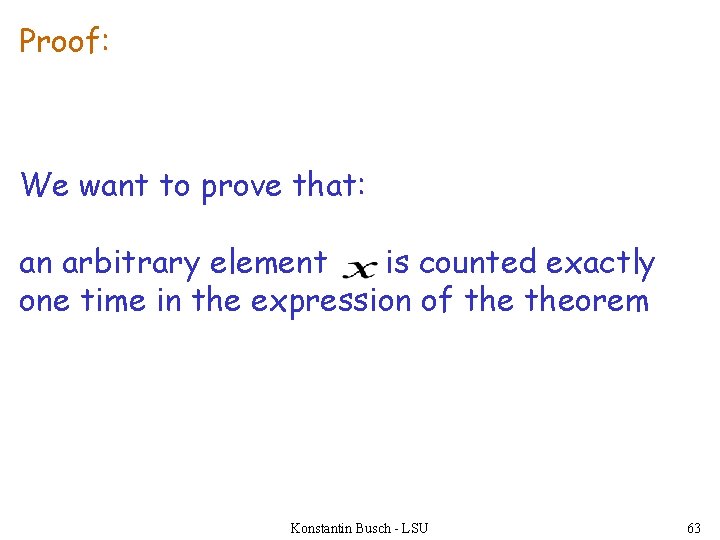
Proof: We want to prove that: an arbitrary element is counted exactly one time in the expression of theorem Konstantin Busch - LSU 63
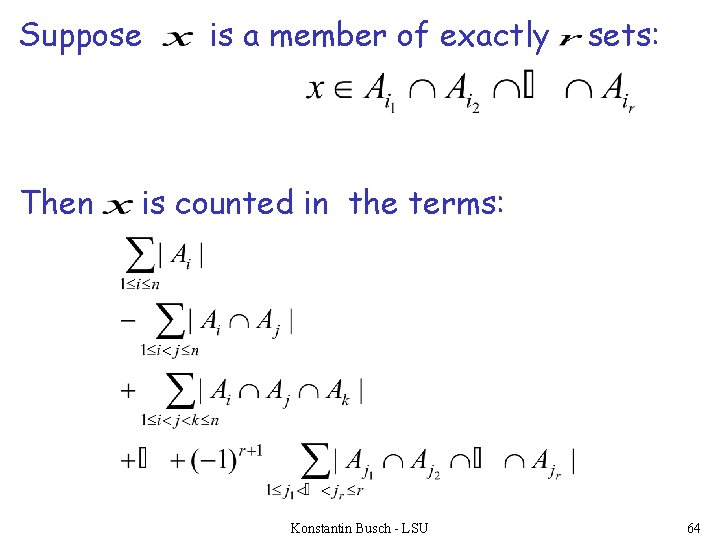
Suppose Then is a member of exactly sets: is counted in the terms: Konstantin Busch - LSU 64
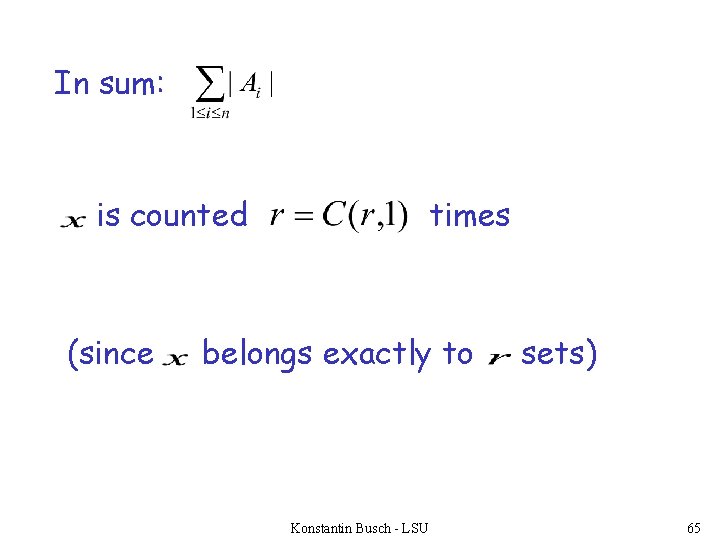
In sum: is counted (since times belongs exactly to Konstantin Busch - LSU sets) 65
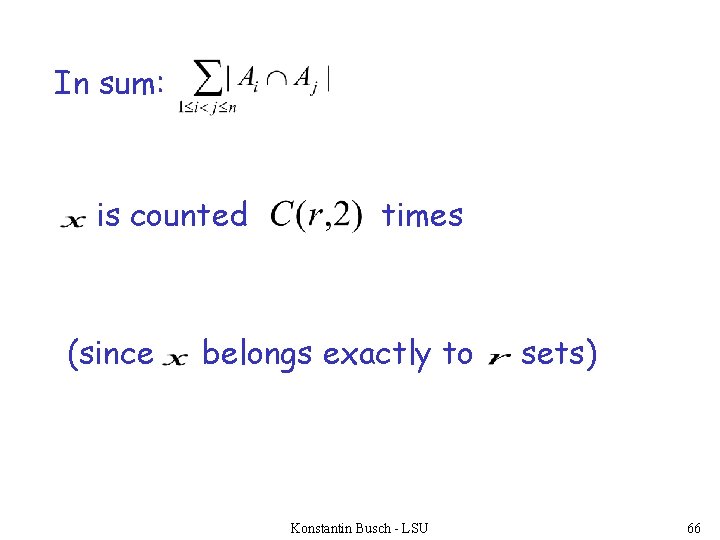
In sum: is counted (since times belongs exactly to Konstantin Busch - LSU sets) 66
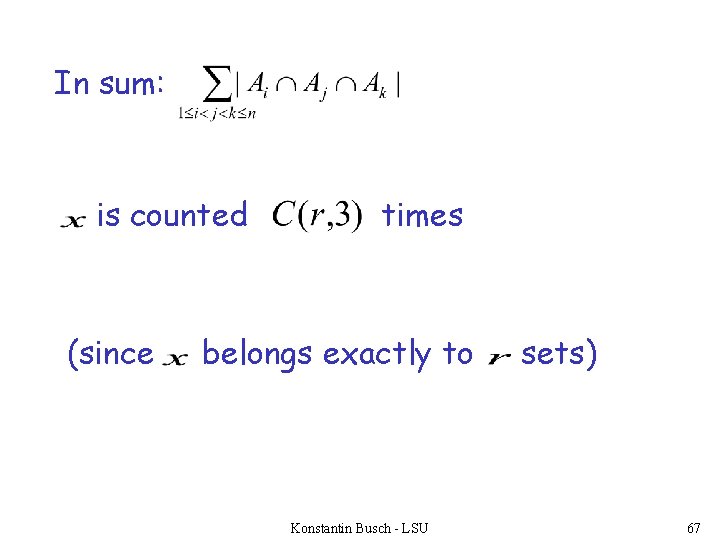
In sum: is counted (since times belongs exactly to Konstantin Busch - LSU sets) 67
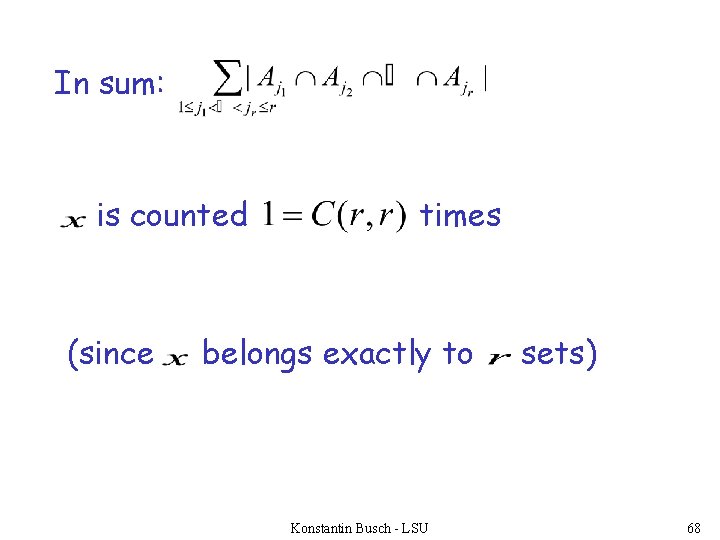
In sum: is counted (since times belongs exactly to Konstantin Busch - LSU sets) 68
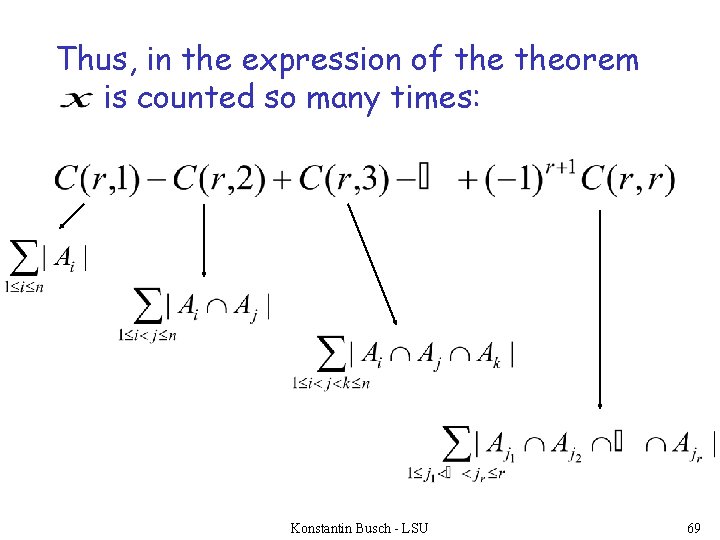
Thus, in the expression of theorem is counted so many times: Konstantin Busch - LSU 69
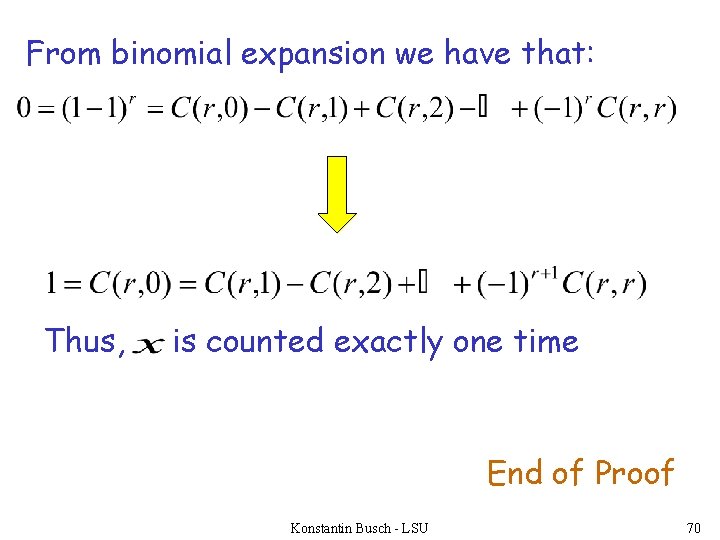
From binomial expansion we have that: Thus, is counted exactly one time End of Proof Konstantin Busch - LSU 70
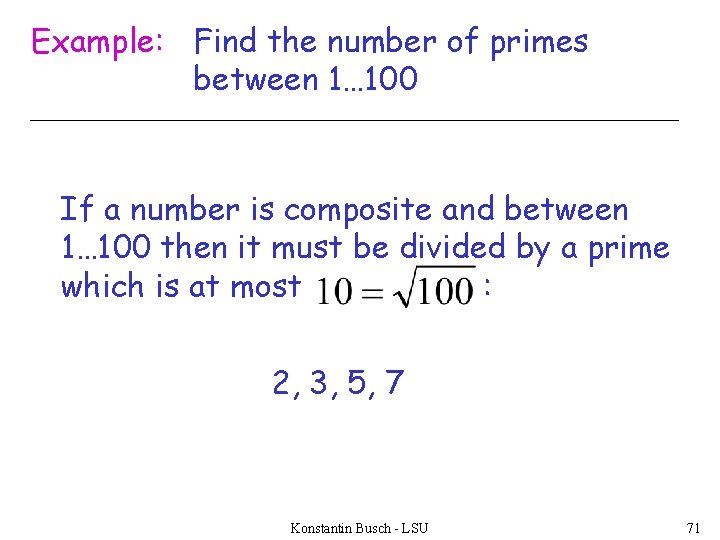
Example: Find the number of primes between 1… 100 If a number is composite and between 1… 100 then it must be divided by a prime which is at most : 2, 3, 5, 7 Konstantin Busch - LSU 71
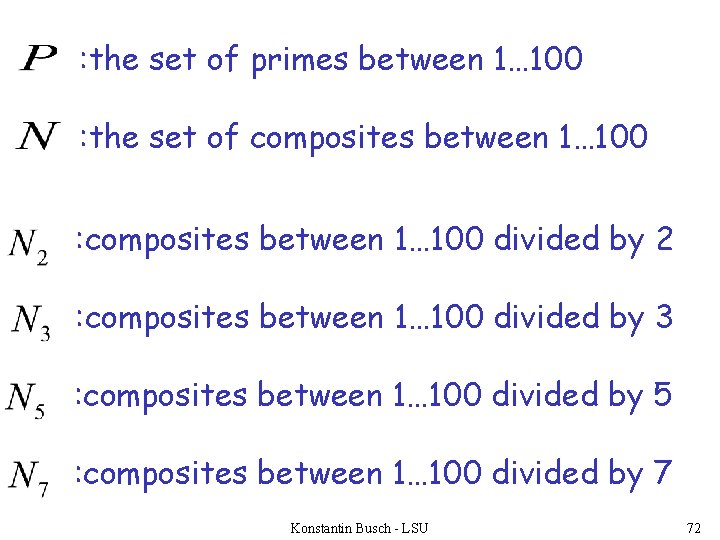
: the set of primes between 1… 100 : the set of composites between 1… 100 : composites between 1… 100 divided by 2 : composites between 1… 100 divided by 3 : composites between 1… 100 divided by 5 : composites between 1… 100 divided by 7 Konstantin Busch - LSU 72
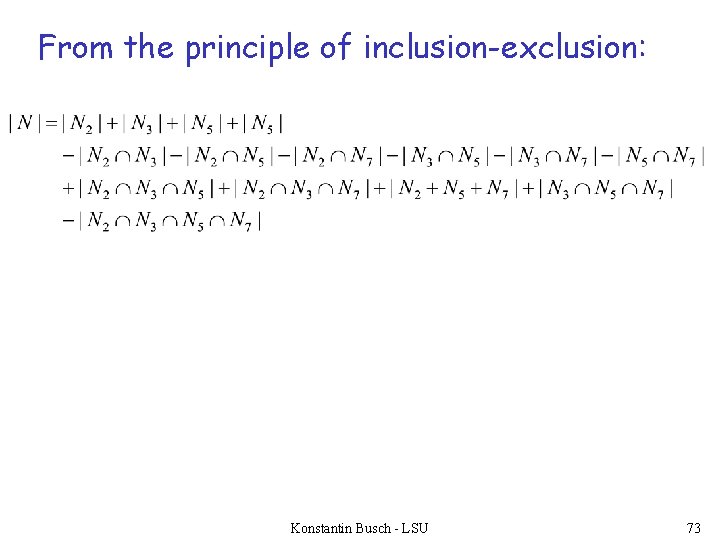
From the principle of inclusion-exclusion: Konstantin Busch - LSU 73
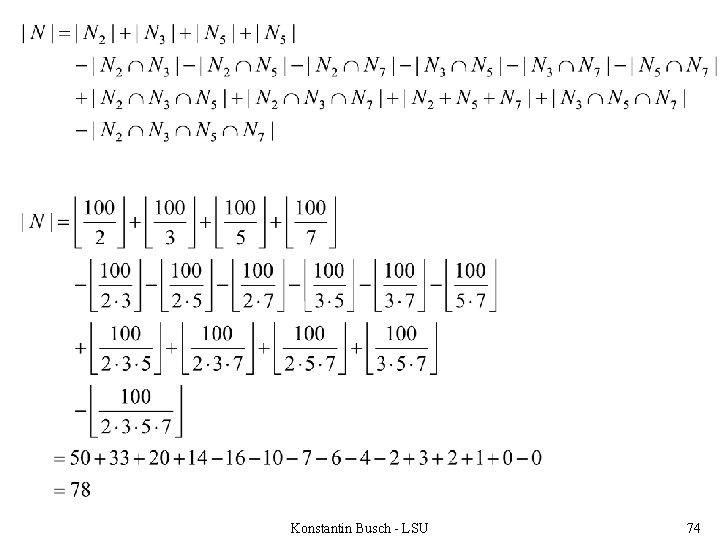
Konstantin Busch - LSU 74
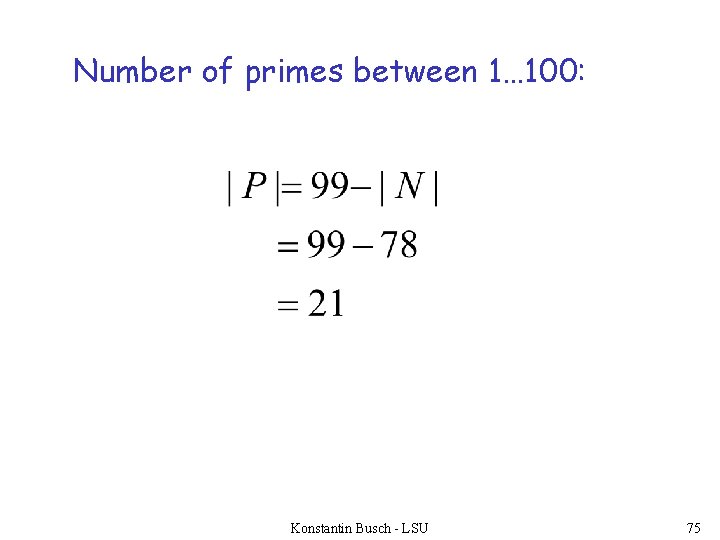
Number of primes between 1… 100: Konstantin Busch - LSU 75
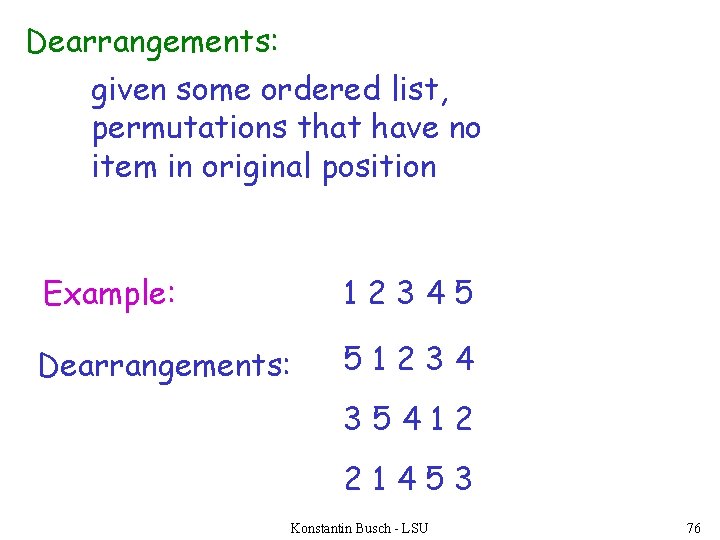
Dearrangements: given some ordered list, permutations that have no item in original position Example: 12345 Dearrangements: 51234 35412 21453 Konstantin Busch - LSU 76
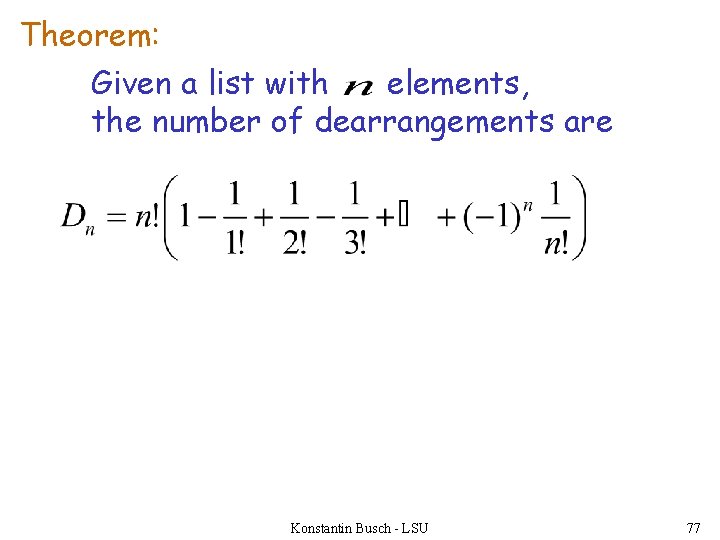
Theorem: Given a list with elements, the number of dearrangements are Konstantin Busch - LSU 77
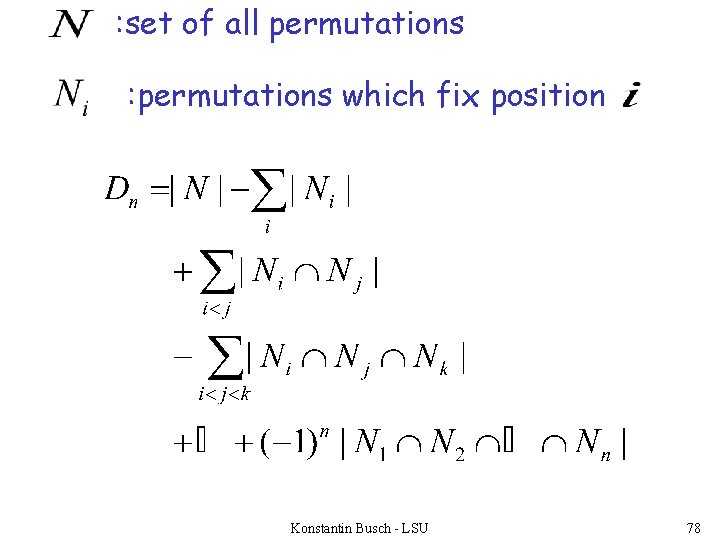
: set of all permutations : permutations which fix position Konstantin Busch - LSU 78
- Slides: 78