
Advanced Computers Network Multiple Access Techniques and Handoff

- Slides: 44
Advanced Computers Network Multiple Access Techniques and Handoff Lecture-2 Instructor : Mazhar Hussain 1
FDMA : Frequency division Multiple Access TDMA : Time division Multiple Access CDMA : Code division Multiple Access 2
Introduction n n n Multiple access schemes are used to allow many users to share simultaneously a finite amount of radio spectrum Sharing of spectrum is required to increase capacity For high quality communication this sharing of spectrum should not degrade performance of the system high performance duplexing generally required frequency domain time domain 3
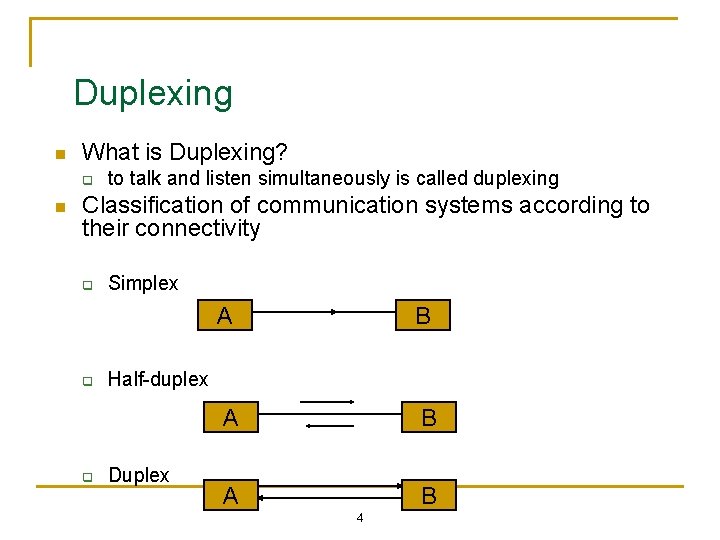
Duplexing n What is Duplexing? q n to talk and listen simultaneously is called duplexing Classification of communication systems according to their connectivity q q q Simplex A B A B Half-duplex Duplex 4
Duplexing Contd… n Duplexing may be done using q q frequency domain technique time domain technique 5
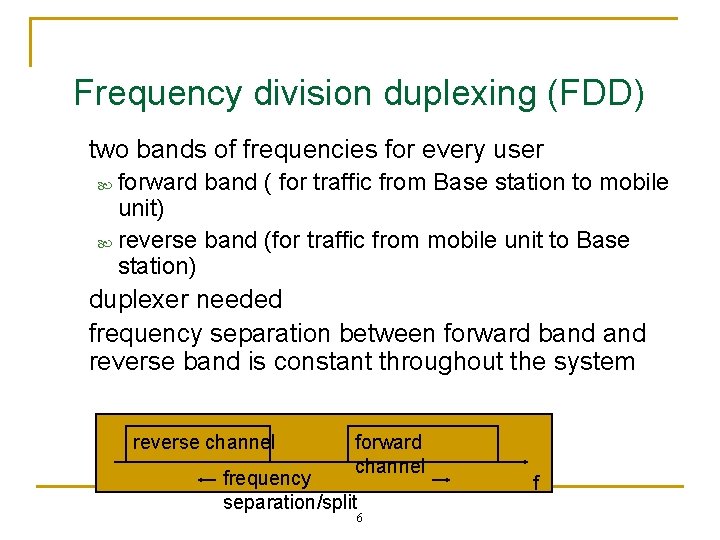
Frequency division duplexing (FDD) two bands of frequencies for every user forward band ( for traffic from Base station to mobile unit) reverse band (for traffic from mobile unit to Base station) duplexer needed frequency separation between forward band reverse band is constant throughout the system reverse channel forward channel frequency separation/split 6 f
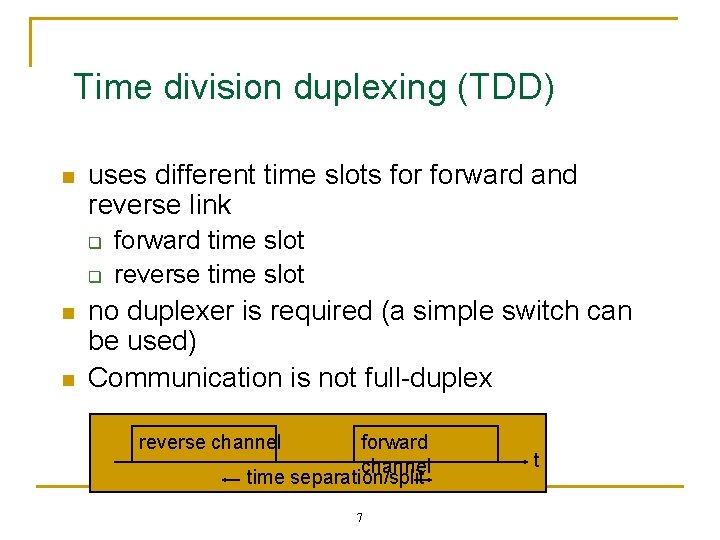
Time division duplexing (TDD) n uses different time slots forward and reverse link q q n n forward time slot reverse time slot no duplexer is required (a simple switch can be used) Communication is not full-duplex reverse channel forward channel time separation/split 7 t
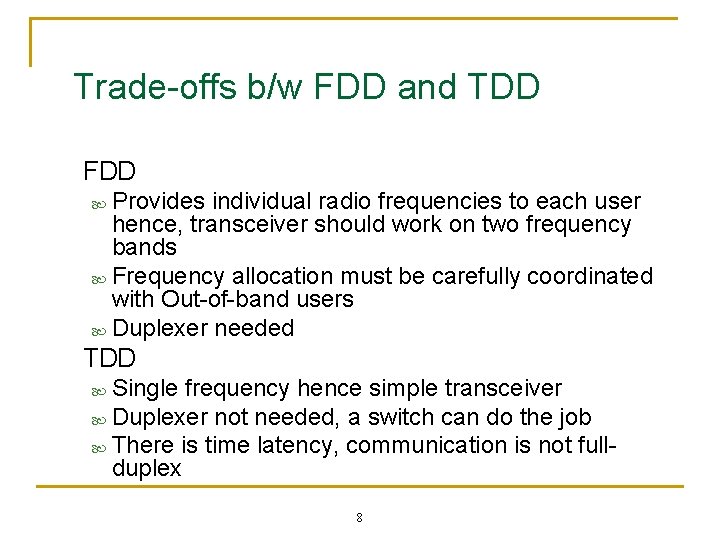
Trade-offs b/w FDD and TDD FDD Provides individual radio frequencies to each user hence, transceiver should work on two frequency bands Frequency allocation must be carefully coordinated with Out-of-band users Duplexer needed TDD Single frequency hence simple transceiver Duplexer not needed, a switch can do the job There is time latency, communication is not fullduplex 8
Multiple Access Techniques in Wireless Communication System n n n Frequency division multiple access (FDMA) Time division multiple access (TDMA) Code division multiple access (CDMA) Space division multiple access (SDMA) grouped as: q q narrowband systems wideband systems 9
Narrowband systems n n Bandwidth of the signal is narrow compared with the coherence bandwidth of the channel In NB systems available radio spectrum is divided into large number of narrowband channels usually FDD (large frequency split) q q Narrowband FDMA Narrowband TDMA 10
Narrowband systems n n n Narrowband FDMA q a user is assigned a particular channel which is not shared by other users q if FDD is used then each channel has a forward and reverse link (called FDMA/FDD) Narrowband TDMA q Allows users to share the same channel but allocates a unique time slot to each user FDMA/FDD FDMA/TDD TDMA/FDD TDMA/TDD 11
Narrowband systems n n FDMA/FDD FDMA/TDD TDMA/FDD TDMA/TDD 12
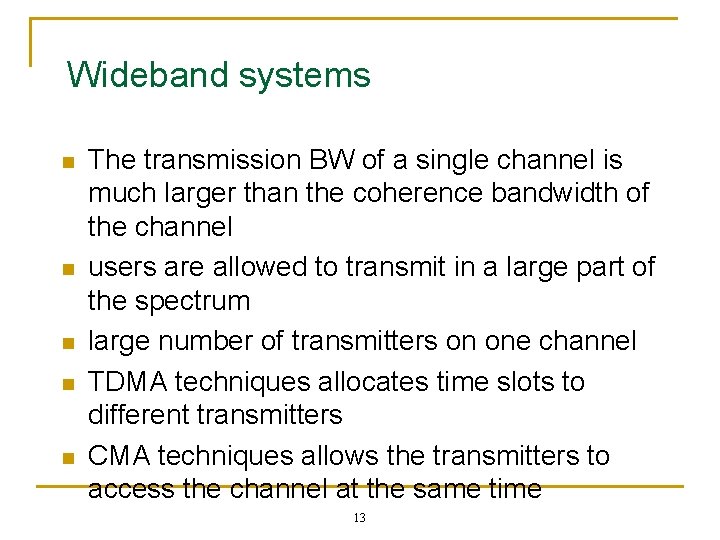
Wideband systems n n n The transmission BW of a single channel is much larger than the coherence bandwidth of the channel users are allowed to transmit in a large part of the spectrum large number of transmitters on one channel TDMA techniques allocates time slots to different transmitters CMA techniques allows the transmitters to access the channel at the same time 13
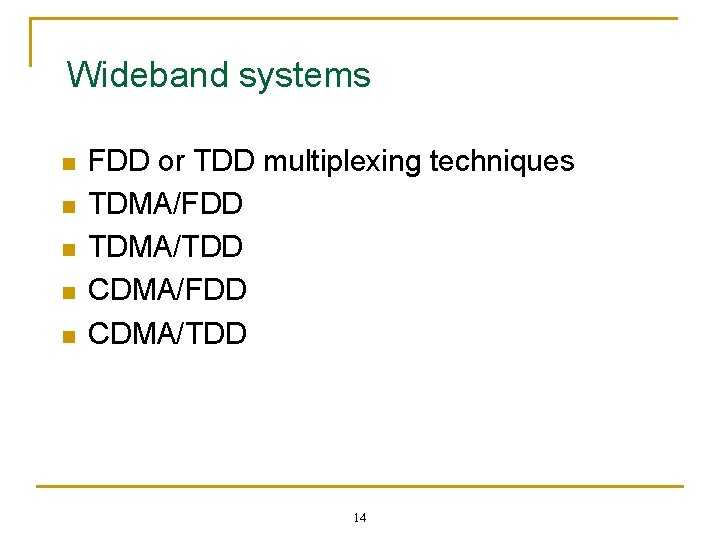
Wideband systems n n n FDD or TDD multiplexing techniques TDMA/FDD TDMA/TDD CDMA/FDD CDMA/TDD 14
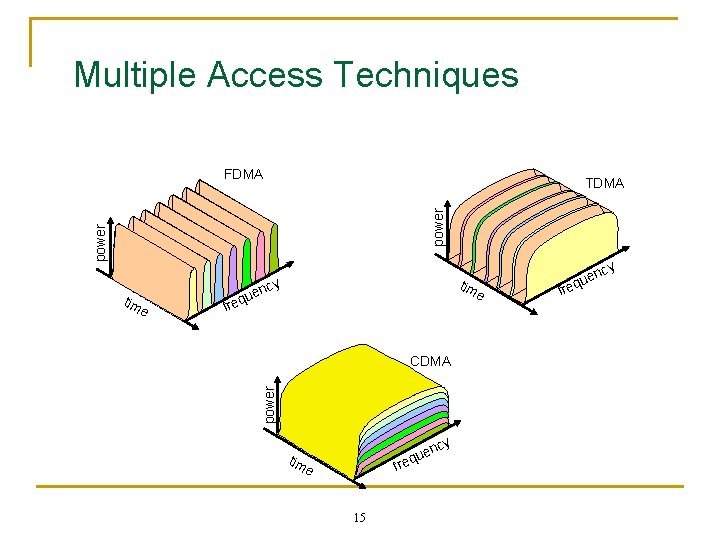
Multiple Access Techniques FDMA power TDMA e tim e f CDMA power tim cy en u q re y nc e u eq tim fr e 15 fr en u q e cy
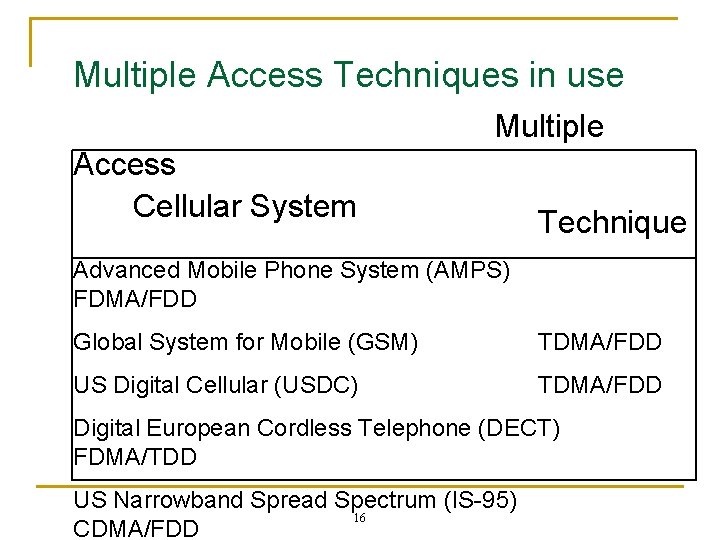
Multiple Access Techniques in use Multiple Access Cellular System Technique Advanced Mobile Phone System (AMPS) FDMA/FDD Global System for Mobile (GSM) TDMA/FDD US Digital Cellular (USDC) TDMA/FDD Digital European Cordless Telephone (DECT) FDMA/TDD US Narrowband Spread Spectrum (IS-95) 16 CDMA/FDD
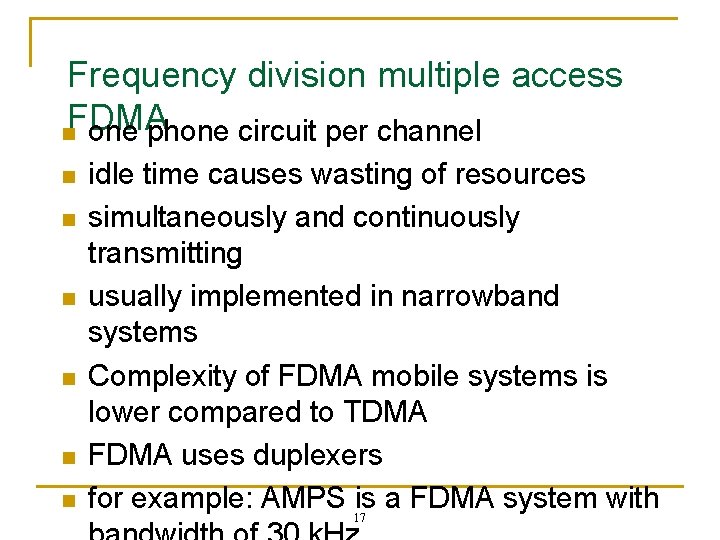
Frequency division multiple access FDMA n one phone circuit per channel n n n idle time causes wasting of resources simultaneously and continuously transmitting usually implemented in narrowband systems Complexity of FDMA mobile systems is lower compared to TDMA FDMA uses duplexers for example: AMPS is a FDMA system with 17
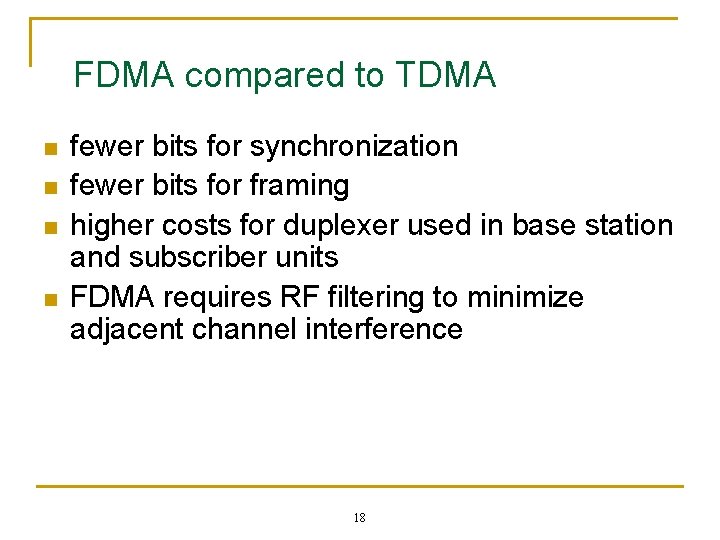
FDMA compared to TDMA n n fewer bits for synchronization fewer bits for framing higher costs for duplexer used in base station and subscriber units FDMA requires RF filtering to minimize adjacent channel interference 18
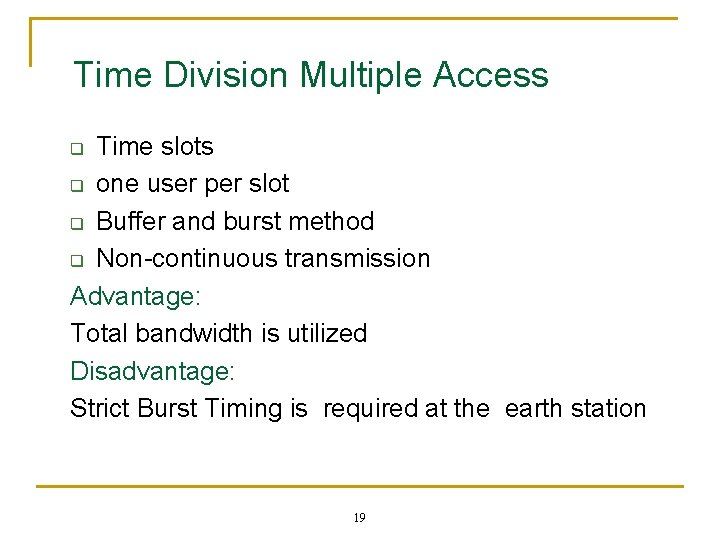
Time Division Multiple Access Time slots q one user per slot q Buffer and burst method q Non-continuous transmission Advantage: Total bandwidth is utilized Disadvantage: Strict Burst Timing is required at the earth station q 19
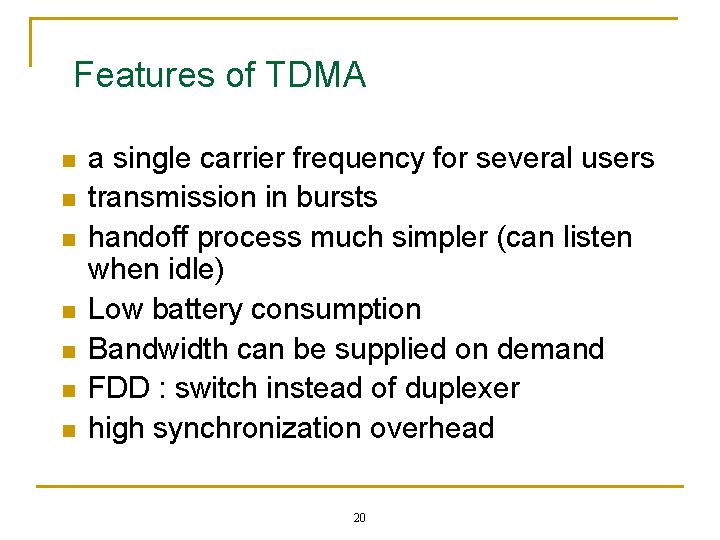
Features of TDMA n n n n a single carrier frequency for several users transmission in bursts handoff process much simpler (can listen when idle) Low battery consumption Bandwidth can be supplied on demand FDD : switch instead of duplexer high synchronization overhead 20
CDMA n n Narrowband signals is multiplied by a very large bandwidth signal called the spreading signal. The spreading signal is pseudo noise code sequence that has a chip rate which is orders of magnitudes greater than data rate of the message All users use the same carrier frequency and transmit simultaneously Each user has its own pseudo random code word which is approximately orthogonal to other codewords 21
CDMA n n n n Receiver performs time co-relation All other codewords appear as noise Receiver needs to know the code word used by transmitter Many users same frequency, TDD or FDD Soft capacity(capacity increases linearly) Self-jamming Near far problem 22
Handoff in Cellular Systems
What is a Handoff? n n n Handoff refers to a process of transferring an ongoing call or data session from one channel connected to the core network to another. Process of transferring a MS from one base station to another. Also called as ‘Handover’.
Reasons for a Handoff to be conducted n n To avoid call termination: call drops When the capacity for connecting new calls of a given cell is used up. Interference in the channels. When the user behaviors change. q Speed and mobility.
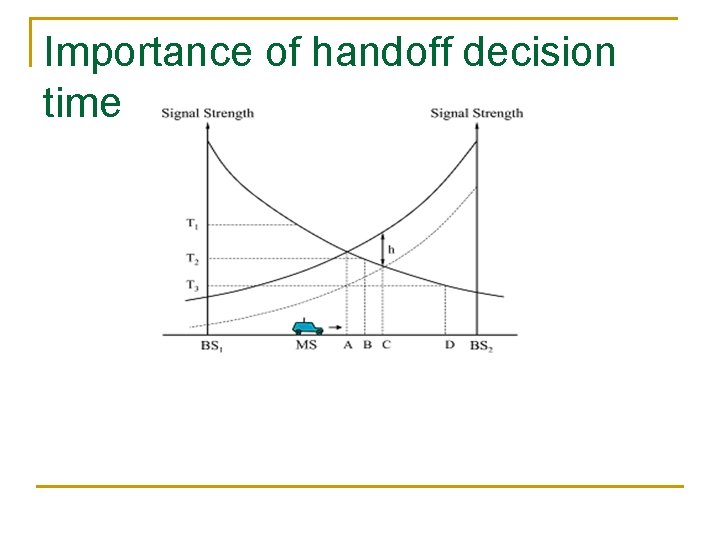
Importance of handoff decision time
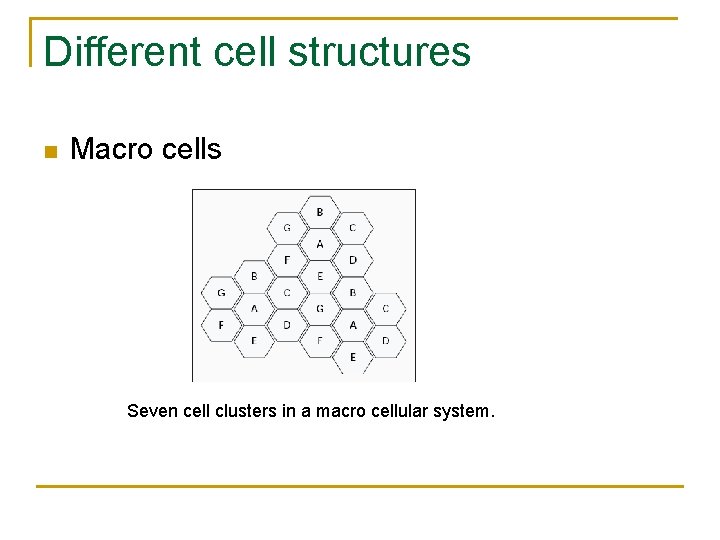
Different cell structures n Macro cells Seven cell clusters in a macro cellular system.
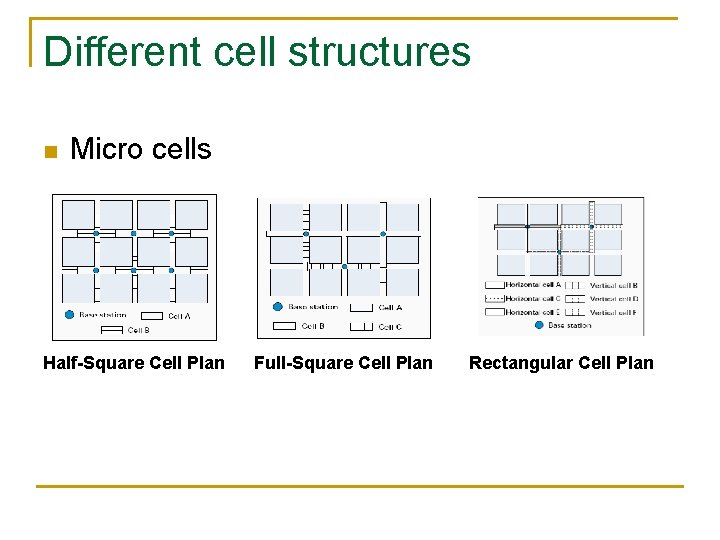
Different cell structures n Micro cells Half-Square Cell Plan Full-Square Cell Plan Rectangular Cell Plan
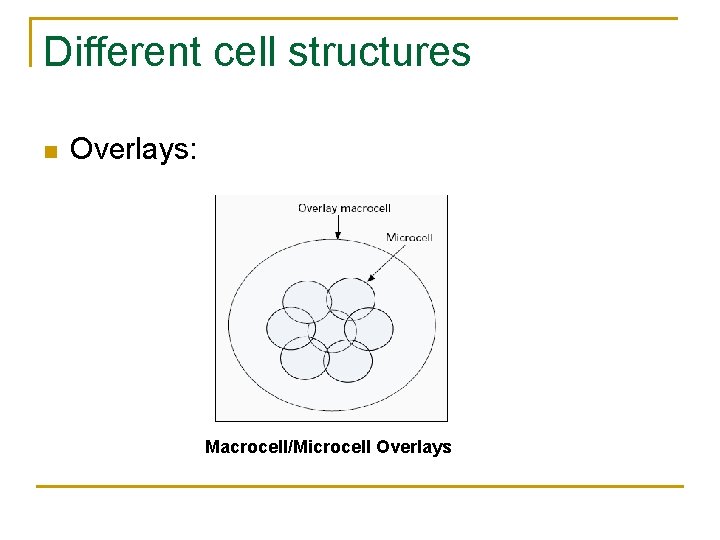
Different cell structures n Overlays: Macrocell/Microcell Overlays
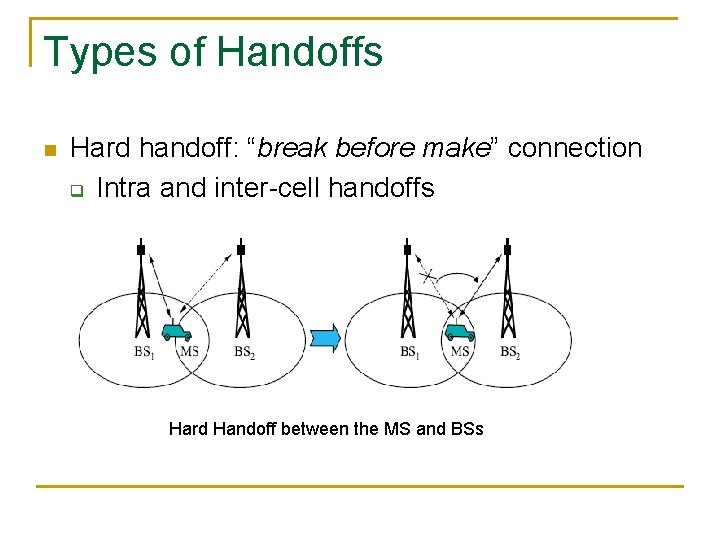
Types of Handoffs n Hard handoff: “break before make” connection q Intra and inter-cell handoffs Hard Handoff between the MS and BSs
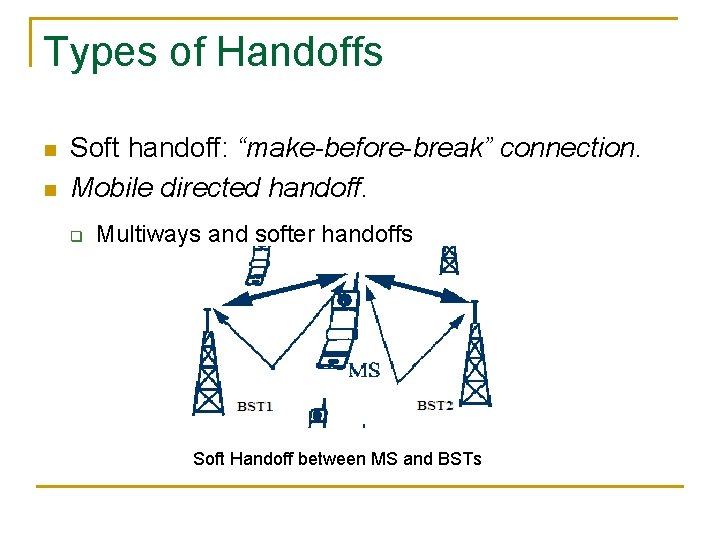
Types of Handoffs n n Soft handoff: “make-before-break” connection. Mobile directed handoff. q Multiways and softer handoffs Soft Handoff between MS and BSTs
Handoff Prioritization: n Two basic methods of handoff prioritization are : q q Guard Channels Queuing of Handoff
Performance evaluation approaches n Three basic mechanisms used to evaluate the performance of handoff algorithms include: q q q Analytical approach, Simulation approach, and Emulation approaches
The Analytical approach n n n This approach is valid only under some specified constraints In real world situations this approach is complex and mathematically intractable. The level crossings of the difference between the RSSs from two BSs were modeled as Poisson processes for stationary signal strength measurements. An analytical model is developed for analyzing performance of handoff algorithms based on both absolute and relative signal strength measurements and compares analytical results with simulation results. BS becomes a candidate only if its signal strength is strongest among all the BSs under consideration.
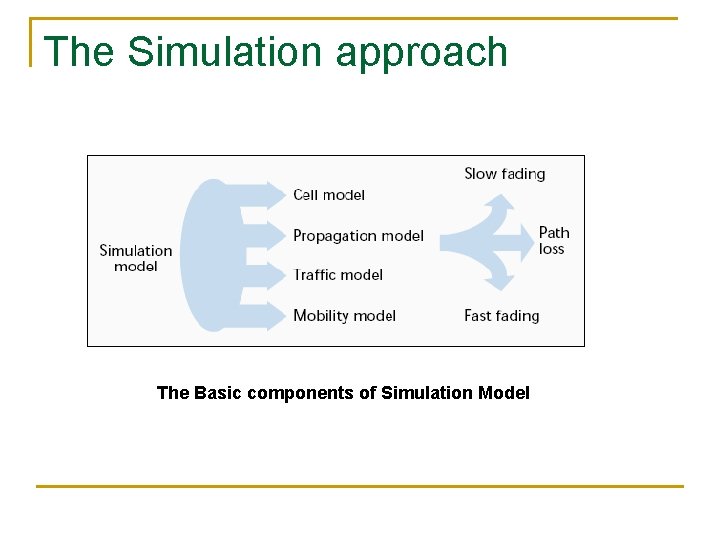
The Simulation approach n n This simulation approach is the most commonly used handoff evaluation mechanism. This approach provides a common testbed for comparison of different handoff algorithms, and also provides insight into the behavior of the system. Software simulation provides fast, easy, and costeffective evaluation. Simulation approach uses one or more of the available four basic components.
The Simulation approach The Basic components of Simulation Model
The Emulation approach n n n The emulation approach uses a software simulator consisting of a handoff algorithm to process measured variables. This approach has the advantage of giving better insight into the behavior of the radio channels and more accurate data. The main disadvantages are that this approach requires periodic measurement efforts and is not suitable for comparison of different handoff algorithms on the same platform.
Conclusion n n Need handoffs in cellular systems, in order to reduce call terminations. Provide Qo. S support.
Questions
Mobile stations are now expanding their types of gadgets. From traditional cell phones to PDAs, Laptops, GPS, Palm tops etc. , many more gadgets can now be called as mobile stations which travel in between cells. Since the inputs, outputs and the identifying modules differ in each type of mobile stations, will the same Design for Handoff would work how strategies are theseofscenarios n The fine mainor design handoff arehandled. q q Signal strength Cell structures
What are different system structures of a cell? n Macro, micro, macro/micro overlays
What happens if a user, after completion of his communication wants to disconnect and at the same time there is a handoff to other cell? (Will the purposeful termination detection be done by the first cell or the other cell to which the signal has been handed off? ) n The Serving BST handles it. Hand off is not a one time process, so either of the BSTs handle the mobile stations call. At a particular time the station which is having more signal strength will handle the call. Even the termination is being handled by either of the base stations.
In types of handoff, there is “break before make” i. e. hard handoff & “make before break” that is soft handoff. So, which one of the two type is better and under which circumstances for each scenario? If possible, explain with example. n Soft handoff is advantageous over hard handoff because the mobile does not lose contact with the system during handoff execution, also unnecessary call terminations doesn’t occur. No one likes unnecessary call terminations. Hard handoff is advantageous when system performance is not effected even if the mobile system has to reconnect to the BST.