
Advanced Computer Science ACS Cambridge MPhil Part III
Advanced Computer Science (ACS) Cambridge MPhil & Part III WELCOME & INDUCTION 2 ND OCTOBER 2017 ALAN BLACKWELL ACS COURSE DIRECTOR
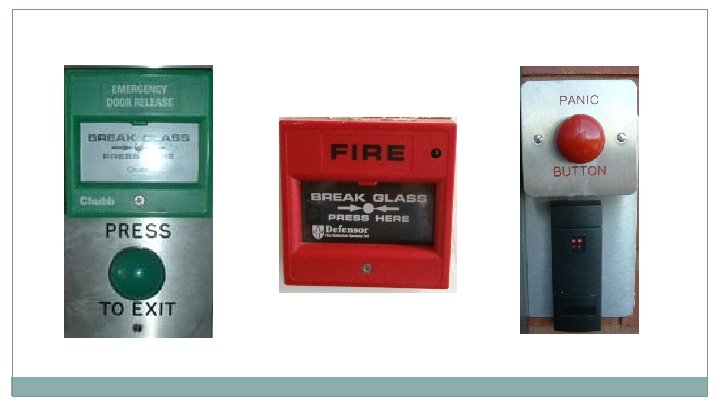
Where are the fire alarms and exits? � How can you get out of the building now? � What should you do when the alarm goes off? � When is the weekly fire alarm test?
Overview WHAT IS ACS?
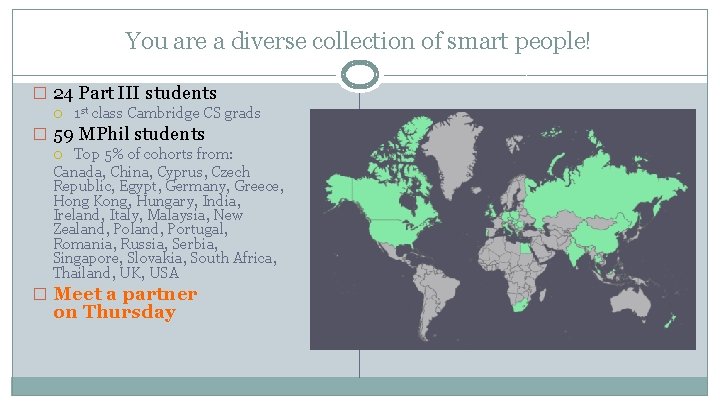
You are a diverse collection of smart people! � 24 Part III students 1 st class Cambridge CS grads � 59 MPhil students Top 5% of cohorts from: Canada, China, Cyprus, Czech Republic, Egypt, Germany, Greece, Hong Kong, Hungary, India, Ireland, Italy, Malaysia, New Zealand, Portugal, Romania, Russia, Serbia, Singapore, Slovakia, South Africa, Thailand, UK, USA � Meet a partner on Thursday
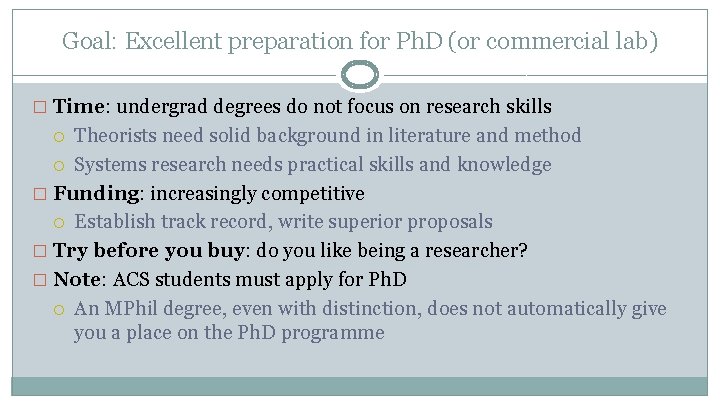
Goal: Excellent preparation for Ph. D (or commercial lab) � Time: undergrad degrees do not focus on research skills Theorists need solid background in literature and method Systems research needs practical skills and knowledge � Funding: increasingly competitive Establish track record, write superior proposals � Try before you buy: do you like being a researcher? � Note: ACS students must apply for Ph. D An MPhil degree, even with distinction, does not automatically give you a place on the Ph. D programme
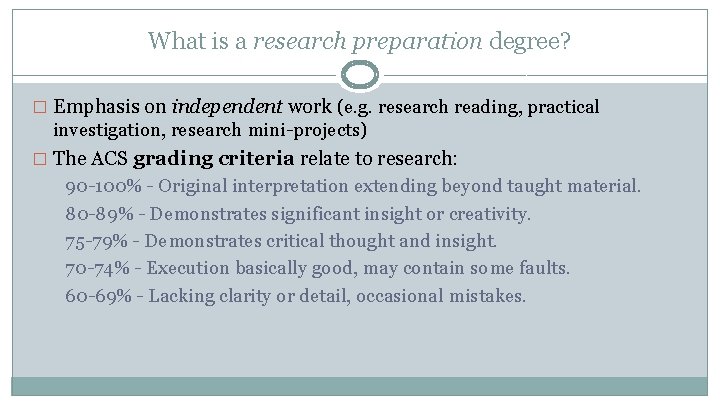
What is a research preparation degree? � Emphasis on independent work (e. g. research reading, practical investigation, research mini-projects) � The ACS grading criteria relate to research: 90 -100% - Original interpretation extending beyond taught material. 80 -89% - Demonstrates significant insight or creativity. 75 -79% - Demonstrates critical thought and insight. 70 -74% - Execution basically good, may contain some faults. 60 -69% - Lacking clarity or detail, occasional mistakes.
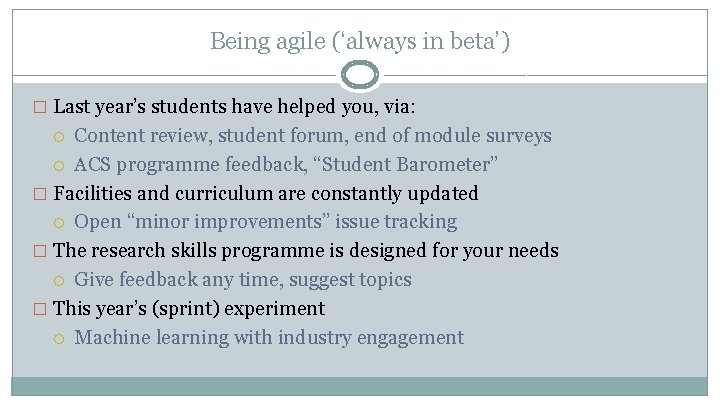
Being agile (‘always in beta’) � Last year’s students have helped you, via: Content review, student forum, end of module surveys ACS programme feedback, “Student Barometer” � Facilities and curriculum are constantly updated Open “minor improvements” issue tracking � The research skills programme is designed for your needs Give feedback any time, suggest topics � This year’s (sprint) experiment Machine learning with industry engagement
ACS has many contact points � Course director (Alan Blackwell - afb 21@cam. ac. uk) � Module lecturers � Project supervisors � Course advisers or Part III Director of Studies � Examiners (2017/18 chair: Dr Robert Watson) � Graduate education office (Lise, Joy, Marketa) � Computer system admin (sys-admin@cl. cam. ac. uk)
Course Content INDIVIDUALLY CUSTOMISED PROGRAMME OF STUDY
Assessment by lecturers – customised by course � 5 taught modules Each module is marked out of 100 Marks come from a mix of lab course work, research mini-projects, term papers, take home tests, and in-house tests Assessed work submitted online via Moodle, or on paper to Graduate Education Office (GEO) � Individual project weighted as 7 modules Report marked by supervisor and internal examiner � To pass, you must score 60% in taught modules and project
Research Skills Programme (Part III optional) � Small number of compulsory units (ACS only) 1. Academic style (CU 1) � Pre-course 2. via Moodle Writing practicals (CU 2, CU 3) � This Thursday and next Thursday at 15: 00 � With a partner – meet them at 14: 50 � Bring your own laptop to these sessions 3. 4. Academic presenting (CU 4) Elevator pitch and networking (CU 5)
Research Skills Programme (Part III optional) � Plus many practical options … … mathematical writing, system performance, Unix tools, chip design, commercial collaboration, philosophy, funding, politics, soldering, open source, 3 D prototyping, intellectual property … � Choose 7 optional units Book in advance Document your learning Collect attendance record � Provide ideas and feedback
Follow current CS research � Wednesday Seminars Major figures in industry and academia Every Wednesday afternoon in Michaelmas term � https: //talks. cam. ac. uk/show/index/6180 Keep records in Research Skills log-book � Women@CL initiative Informal networking lunch and talk on two Thursdays per term � https: //talks. cam. ac. uk/show/archive/11550 � Industry tech-talks With Computer Lab Industry Supporters’ Club � https: //talks. cam. ac. uk/show/index/50582
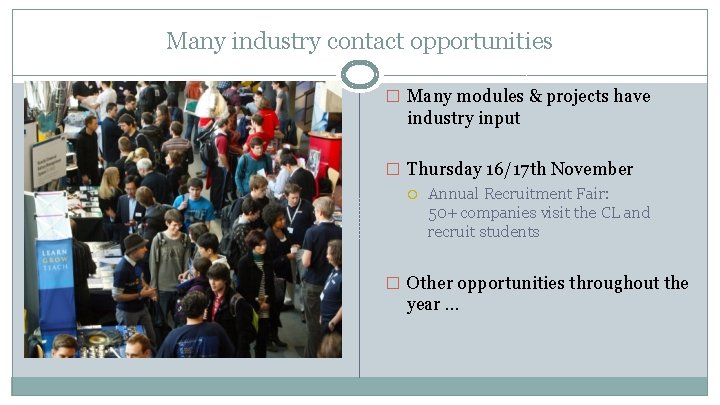
Many industry contact opportunities � Many modules & projects have industry input � Thursday 16/17 th November Annual Recruitment Fair: 50+ companies visit the CL and recruit students � Other opportunities throughout the year. . .
End of term option � M 005 Critical Coding for Digital Humanities Co-teaching course, working in pairs with grad students / post-docs / faculty in humanities At end of term, while your projects are being graded No course credit (because all work has already been completed), but recognised teaching credit as Cambridge Demonstrator � Contact me if interested
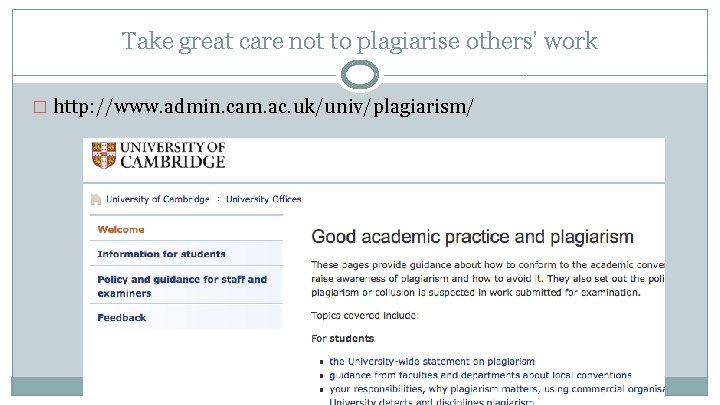
Take great care not to plagiarise others’ work � http: //www. admin. cam. ac. uk/univ/plagiarism/

Organisation WHAT TO DO AND WHEN
Workload management � Because the ACS emphasises: … a fully individualised programme of study; and … teaching timetable allowing any combination of modules � … you must manage your own particular work programme! Typical module: 16 hours in classes, 64 hours independent study Practical work and deadlines will overlap Discuss your workload plan with supervisor / adviser / Do. S � Anticipate research risks (including project) Prioritise and plan risky parts first
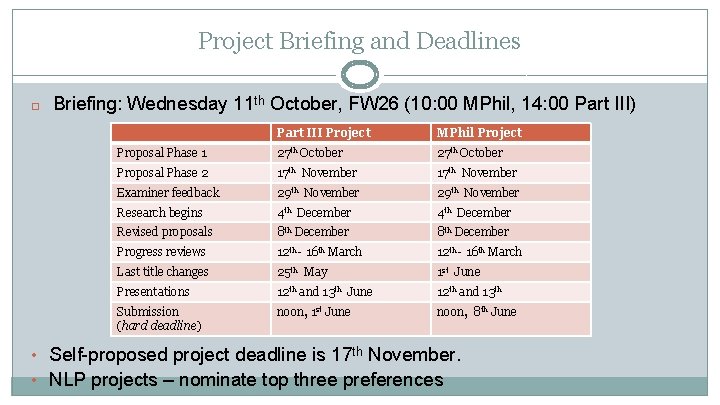
Project Briefing and Deadlines � Briefing: Wednesday 11 th October, FW 26 (10: 00 MPhil, 14: 00 Part III) Part III Project MPhil Project Proposal Phase 1 27 th October Proposal Phase 2 17 th November Examiner feedback 29 th November Research begins 4 th December Revised proposals 8 th December Progress reviews 12 th - 16 th March Last title changes 25 th May 1 st June Presentations 12 th and 13 th June 12 th and 13 th Submission (hard deadline) noon, 1 st June noon, 8 th June • Self-proposed project deadline is 17 th November. • NLP projects – nominate top three preferences
Note severe penalties for missing deadlines � Coursework penalty = n/10 x mark where n is the number of days late, rounded up to the nearest integer � Take-home tests: no submission, zero marks � Project: no submission means outright failure � No deadline extensions save for exceptional circumstances (illness or other grave reason) Your college tutor can help … … it is essential to keep us informed and keep records
Challenge with Support � Our mission is to provide excellent students with substantial challenges. We are ambitious, and so are you … … but welfare and support are essential. � In Cambridge, your college is your support infrastructure: Social, wellbeing, relaxation, pastoral care Any kind of personal, medical problem: TALK TO YOUR COLLEGE!
Explore, and make the Computer Lab your home � Classes in SW 01, SW 02, FS 07, FS 09, FW 26, LT 1, LT 2 or Engineering May start five past hour, finish five to the hour � Lots of space across department for you Locker storage in ACS lab area SW 02 Quiet hot desk area in SW 04 (inside SW 02) Relax in the “fish bowl”, cafe, or mezzanine balcony � Note the Computer Lab has its own network / servers etc Basic wireless is “wgb”; “eduroam” is better Sys-admin team provide briefing booklet � Building accessible via University Card 24/7
Social programme and colleges � Learn and use the Cambridge traditions � Science careers are based on networking Including mixing across disciplines � Invite other ACS students to your college � Exploit the generous resources Meeting rooms Sports facilities Fine dining Societies Libraries � Every college is different – enjoy the diversity and opportunities

Next Steps THE NEXT FEW DAYS
Confirm your module assignment � Talk with your Course Adviser/Project Supervisor or Do. S for advice NOTE CONSTRAINTS OF AVAILABILITY � Today only: Discuss selections with Adviser/Do. S Any change, they can notify Graduate Education Office (GEO) � From tomorrow: Consult Adviser/Do. S, then GEO. GEO will check availability / compatibility of new module You ask course lecturer to agree & sign Module Change form You return signed form to GEO for logging on Cam. SIS. � Many practical & reading group (‘P’/’R’) modules allocate coursework and presentation schedules in Week 1, so later change may not be possible. � No changes after 18 th October (Michaelmas) or 1 st December (Lent modules)
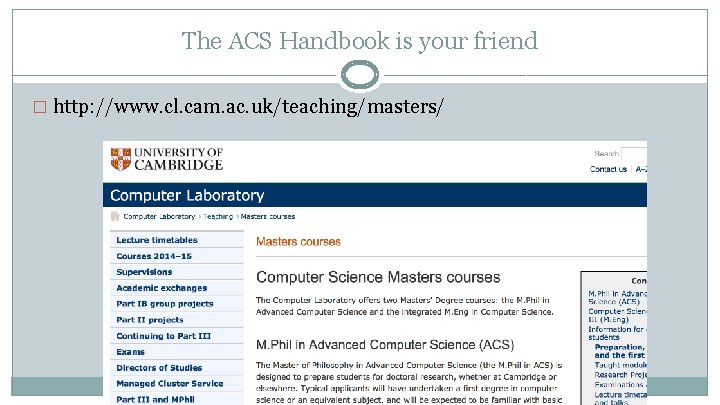
The ACS Handbook is your friend � http: //www. cl. cam. ac. uk/teaching/masters/
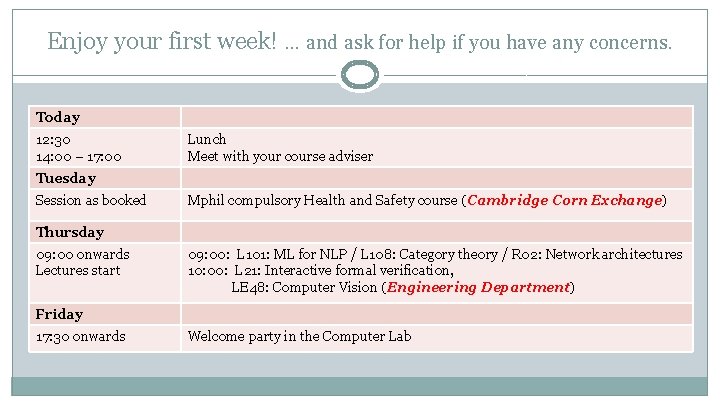
Enjoy your first week! … and ask for help if you have any concerns. Today 12: 30 14: 00 – 17: 00 Lunch Meet with your course adviser Tuesday Session as booked Mphil compulsory Health and Safety course (Cambridge Corn Exchange) Thursday 09: 00 onwards Lectures start 09: 00: L 101: ML for NLP / L 108: Category theory / R 02: Network architectures 10: 00: L 21: Interactive formal verification, LE 48: Computer Vision (Engineering Department) Friday 17: 30 onwards Welcome party in the Computer Lab
Questions? ALAN BLACKWELL MPHIL COURSE DIRECTOR AFB 21@CAM. AC. UK
- Slides: 29