
Advanced Computer Graphics Fall 2009 CS 294 Rendering


- Slides: 51
Advanced Computer Graphics (Fall 2009) CS 294, Rendering Lecture 4: Monte Carlo Integration Ravi Ramamoorthi http: //inst. eecs. berkeley. edu/~cs 294 -13/fa 09 Acknowledgements and many slides courtesy: Thomas Funkhouser, Szymon Rusinkiewicz and Pat Hanrahan
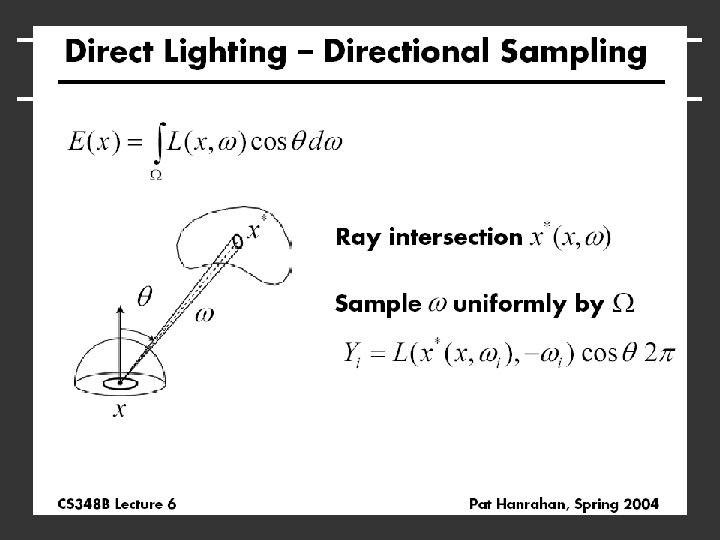
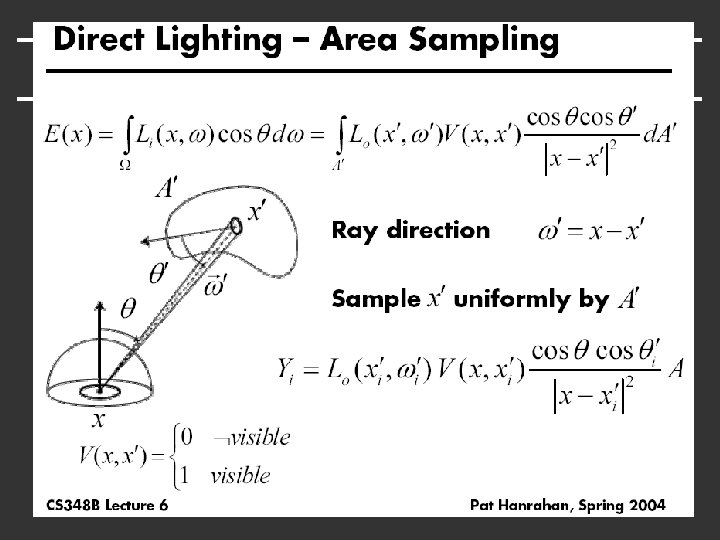
Motivation Rendering = integration § Reflectance equation: Integrate over incident illumination § Rendering equation: Integral equation Many sophisticated shading effects involve integrals § § Antialiasing Soft shadows Indirect illumination Caustics
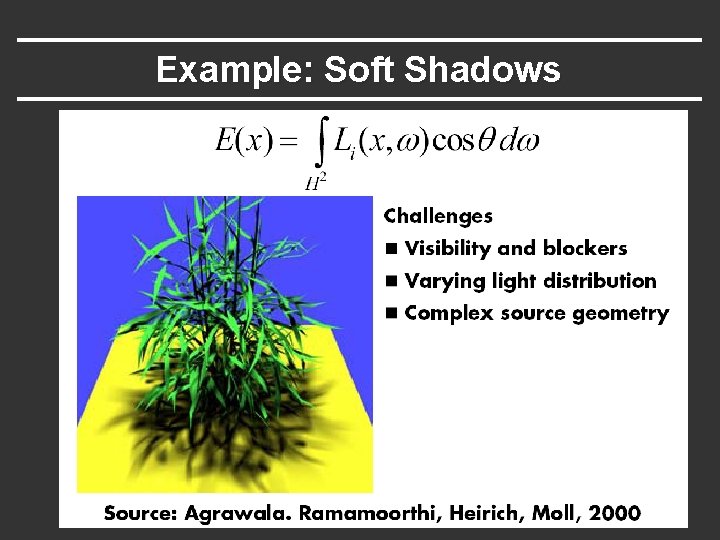
Example: Soft Shadows
Monte Carlo § Algorithms based on statistical sampling and random numbers § Coined in the beginning of 1940 s. Originally used for neutron transport, nuclear simulations § Von Neumann, Ulam, Metropolis, … § Canonical example: 1 D integral done numerically § Choose a set of random points to evaluate function, and then average (expectation or statistical average)
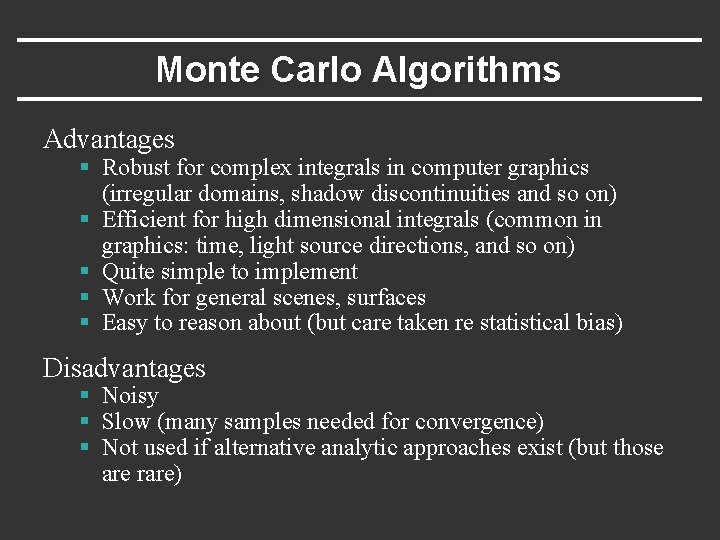
Monte Carlo Algorithms Advantages § Robust for complex integrals in computer graphics (irregular domains, shadow discontinuities and so on) § Efficient for high dimensional integrals (common in graphics: time, light source directions, and so on) § Quite simple to implement § Work for general scenes, surfaces § Easy to reason about (but care taken re statistical bias) Disadvantages § Noisy § Slow (many samples needed for convergence) § Not used if alternative analytic approaches exist (but those are rare)
Outline § Motivation § Overview, 1 D integration § Basic probability and sampling § Monte Carlo estimation of integrals
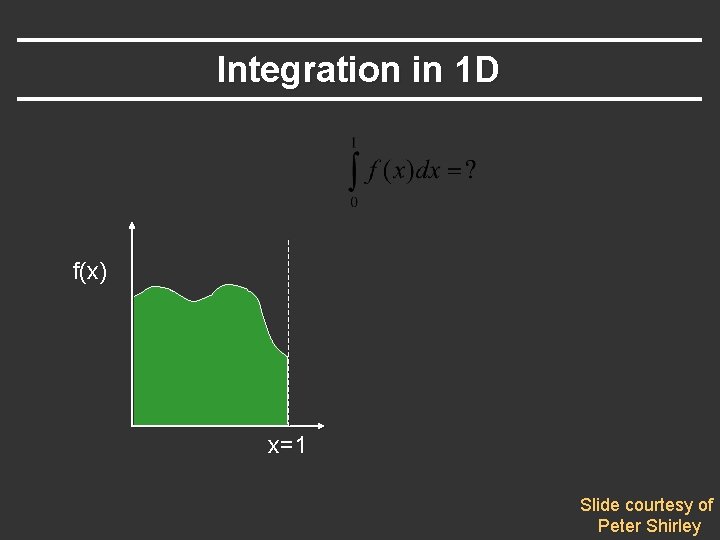
Integration in 1 D f(x) x=1 Slide courtesy of Peter Shirley
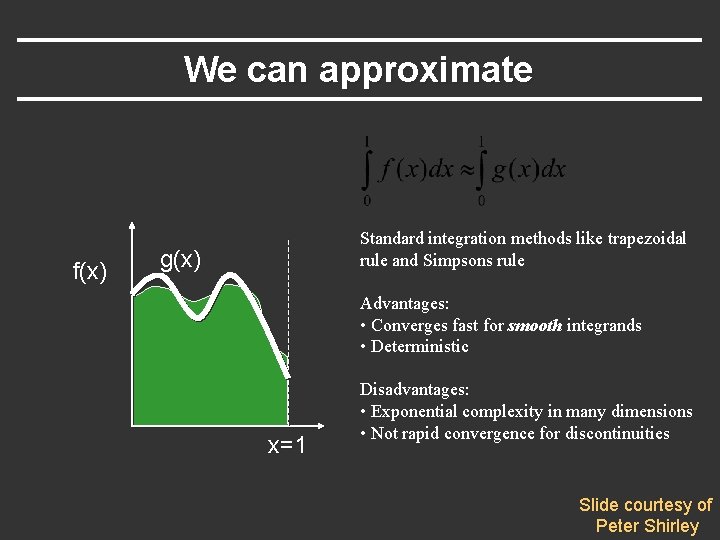
We can approximate f(x) Standard integration methods like trapezoidal rule and Simpsons rule g(x) Advantages: • Converges fast for smooth integrands • Deterministic x=1 Disadvantages: • Exponential complexity in many dimensions • Not rapid convergence for discontinuities Slide courtesy of Peter Shirley
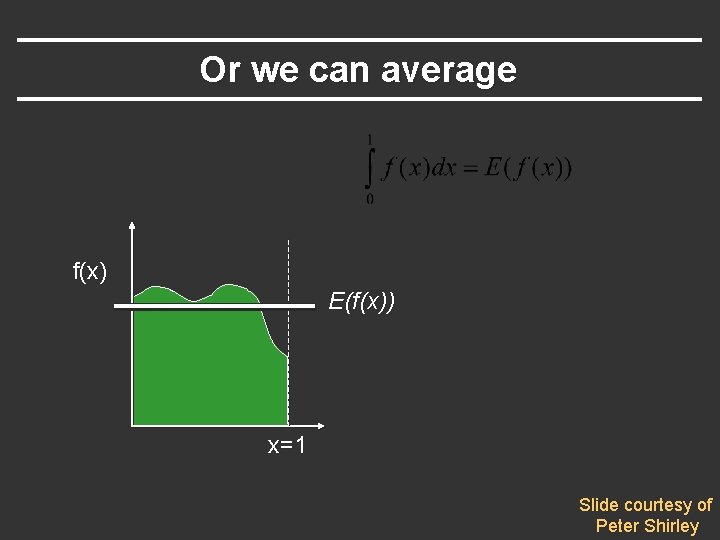
Or we can average f(x) E(f(x)) x=1 Slide courtesy of Peter Shirley
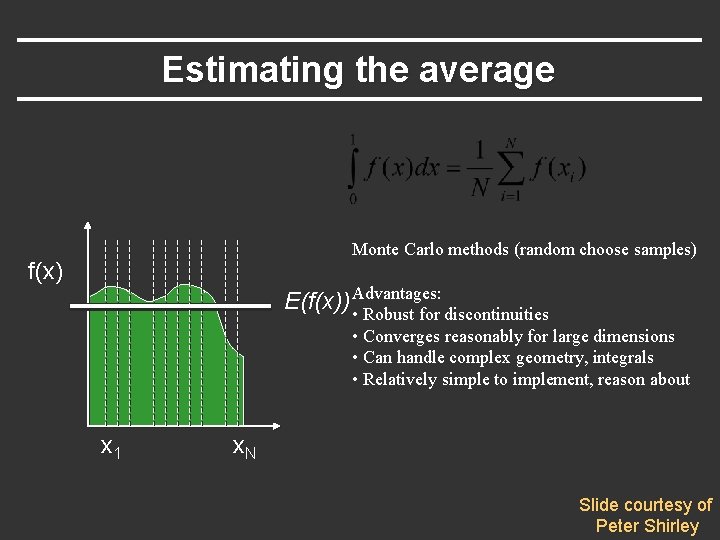
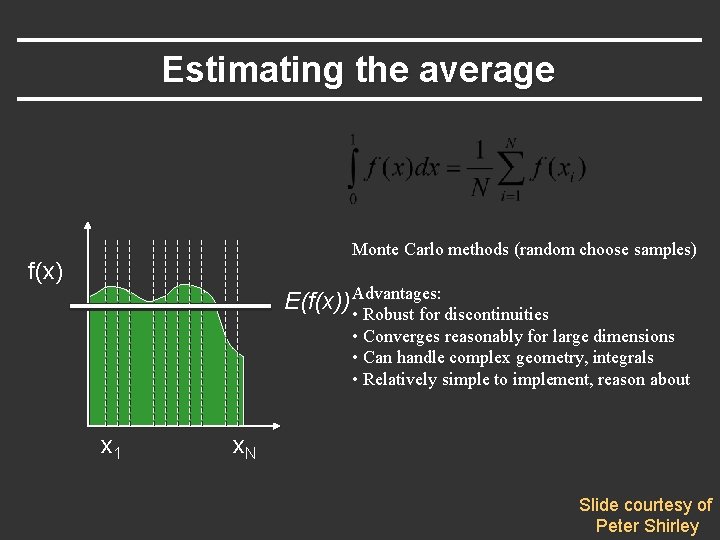
Estimating the average Monte Carlo methods (random choose samples) f(x) E(f(x)) Advantages: • Robust for discontinuities • Converges reasonably for large dimensions • Can handle complex geometry, integrals • Relatively simple to implement, reason about x 1 x. N Slide courtesy of Peter Shirley
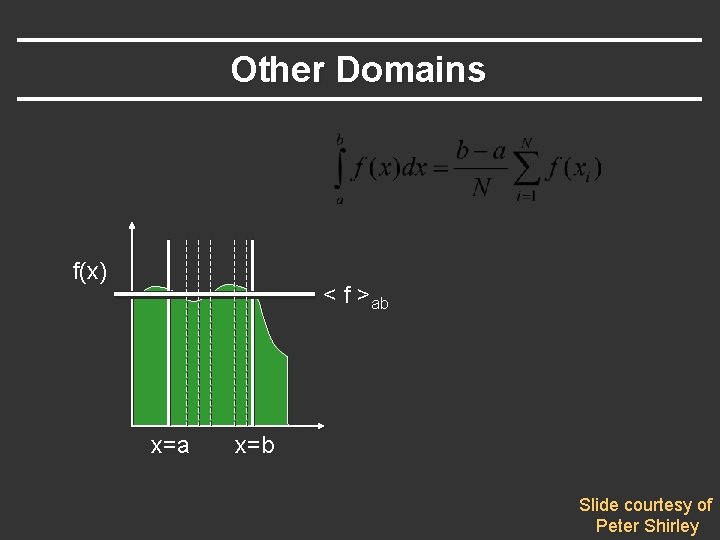
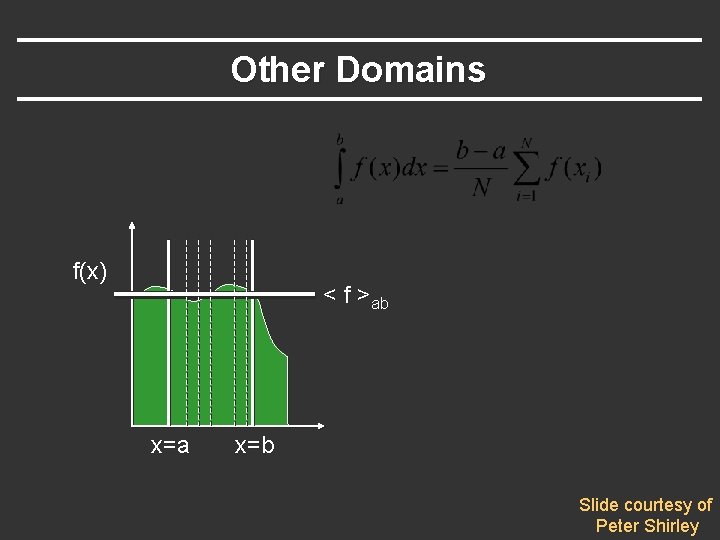
Other Domains f(x) < f >ab x=a x=b Slide courtesy of Peter Shirley
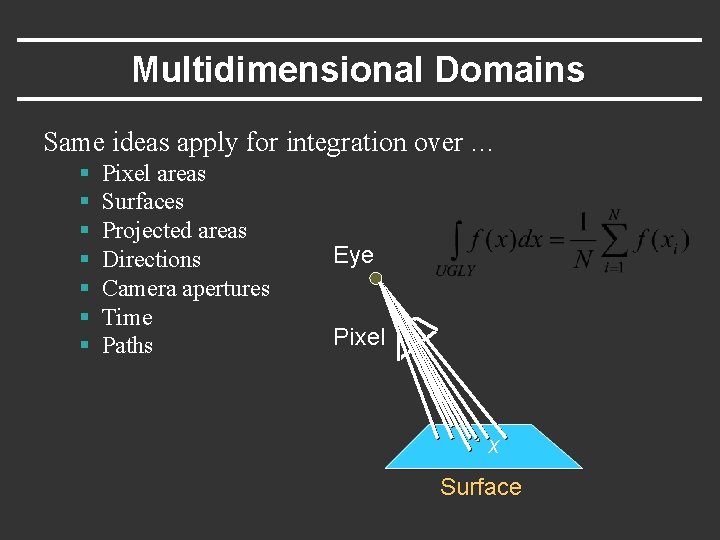
Multidimensional Domains Same ideas apply for integration over … § § § § Pixel areas Surfaces Projected areas Directions Camera apertures Time Paths Eye Pixel x Surface
Outline § Motivation § Overview, 1 D integration § Basic probability and sampling § Monte Carlo estimation of integrals
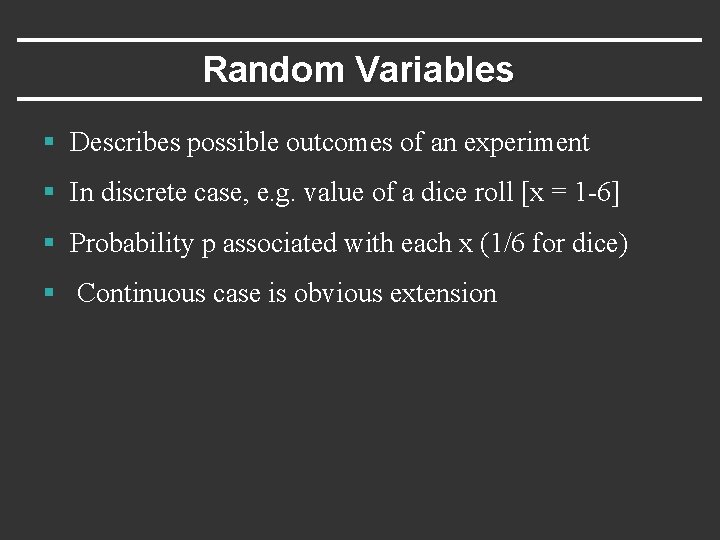
Random Variables § Describes possible outcomes of an experiment § In discrete case, e. g. value of a dice roll [x = 1 -6] § Probability p associated with each x (1/6 for dice) § Continuous case is obvious extension
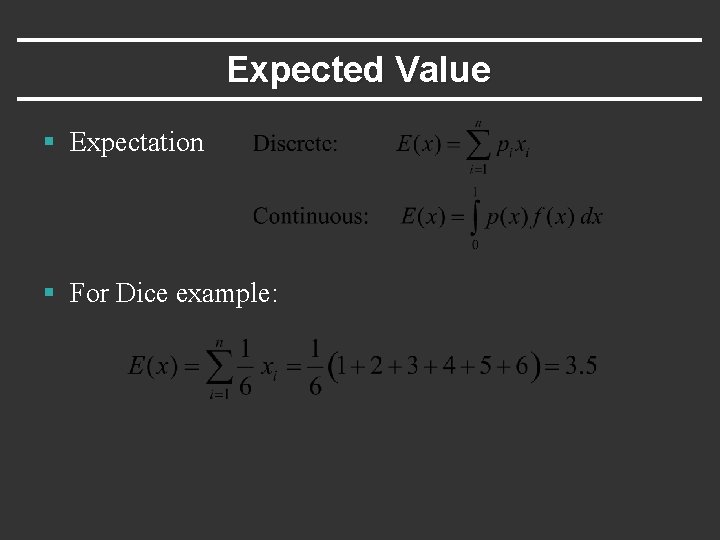
Expected Value § Expectation § For Dice example:
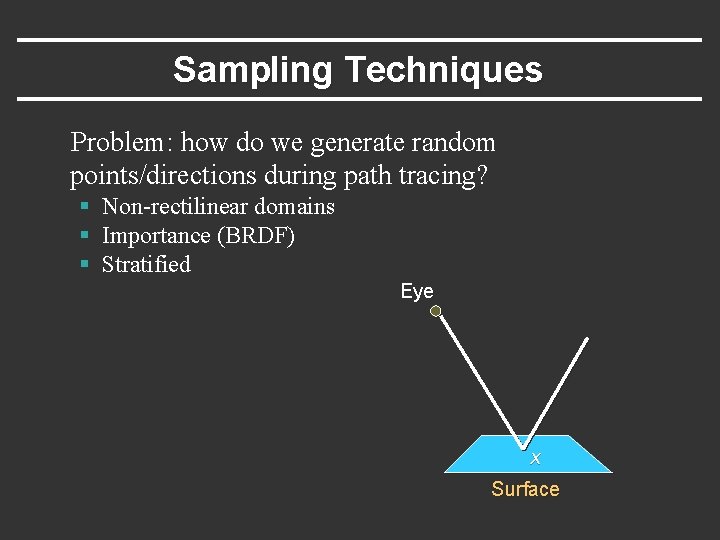
Sampling Techniques Problem: how do we generate random points/directions during path tracing? § Non-rectilinear domains § Importance (BRDF) § Stratified Eye x Surface
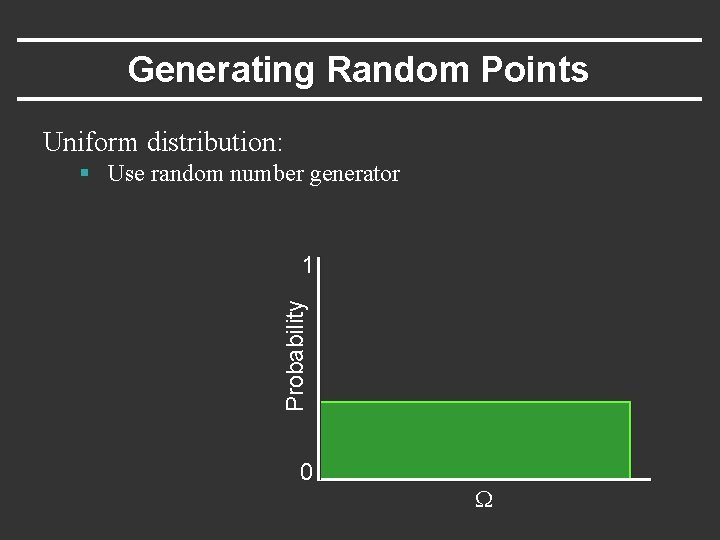
Generating Random Points Uniform distribution: § Use random number generator Probability 1 0 W
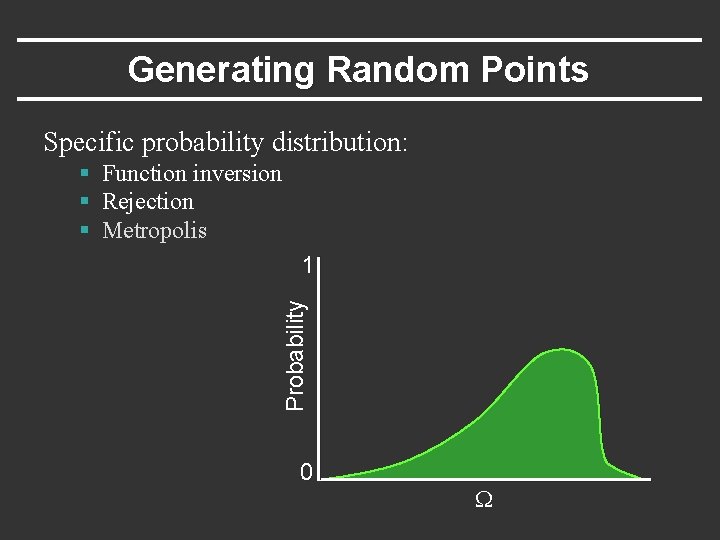
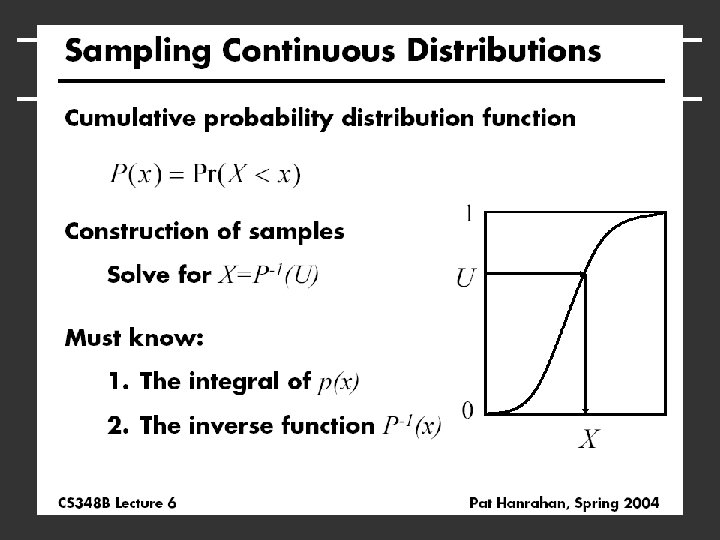
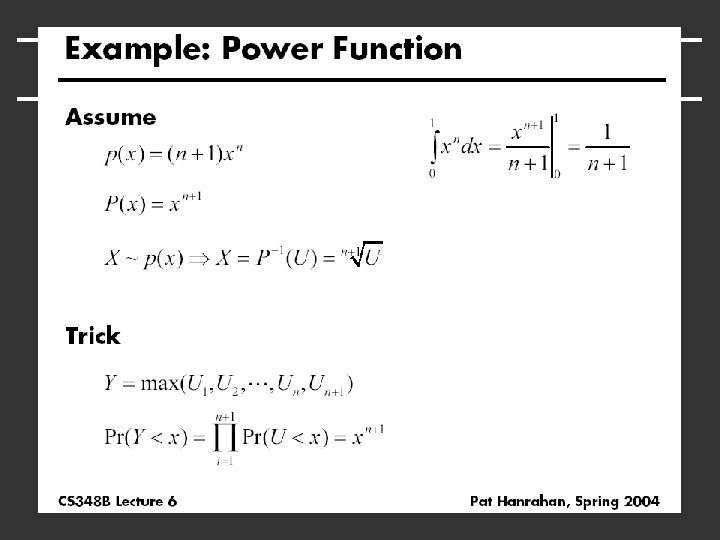
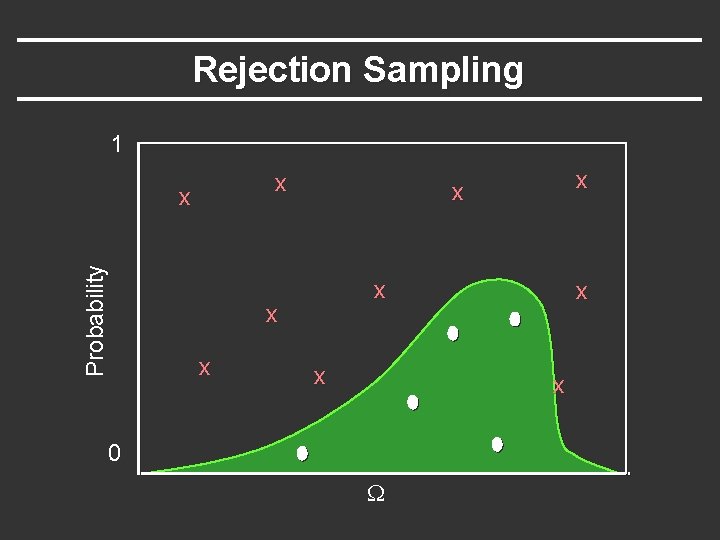
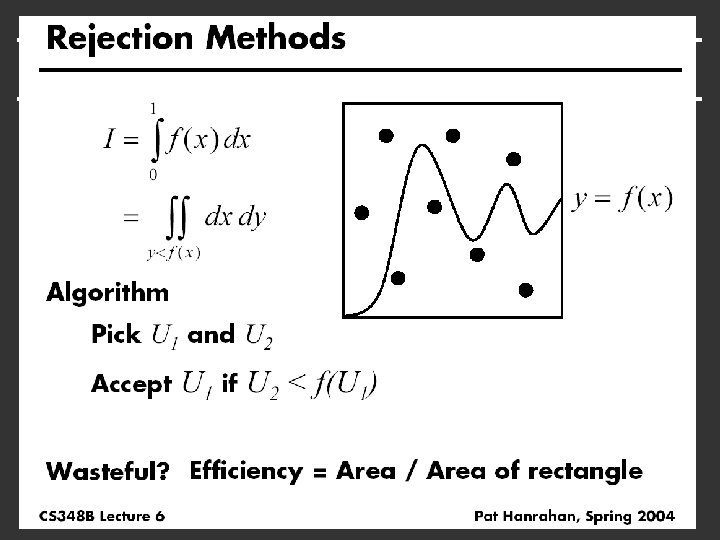
Generating Random Points Specific probability distribution: § Function inversion § Rejection § Metropolis Probability 1 0 W
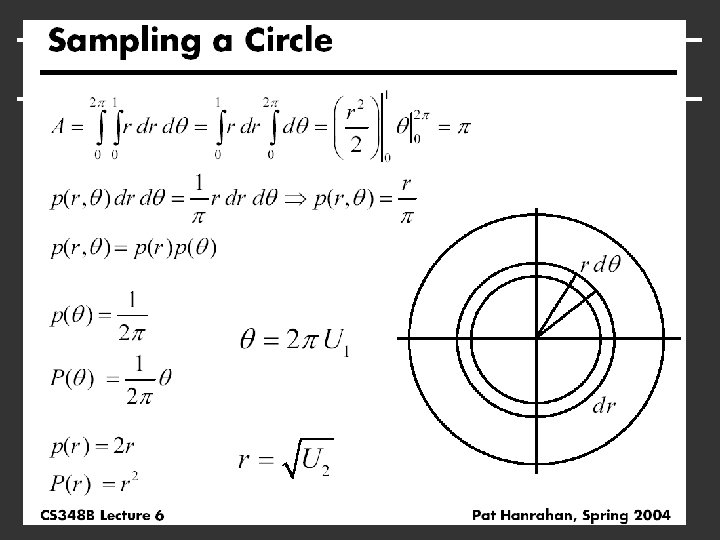
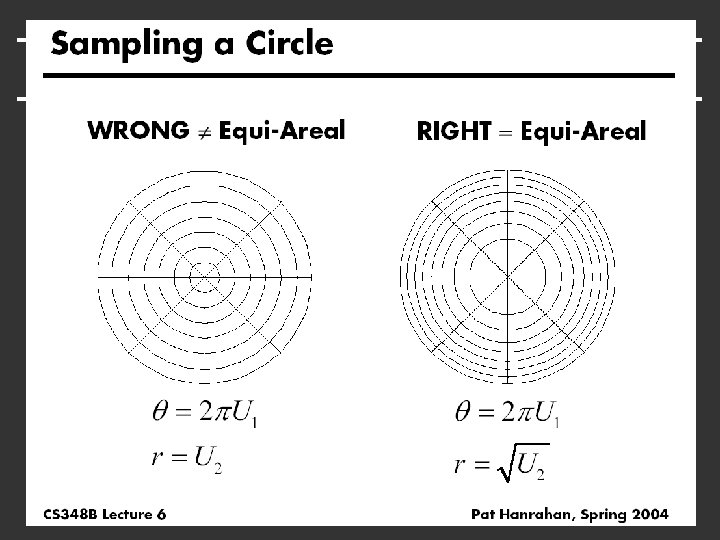
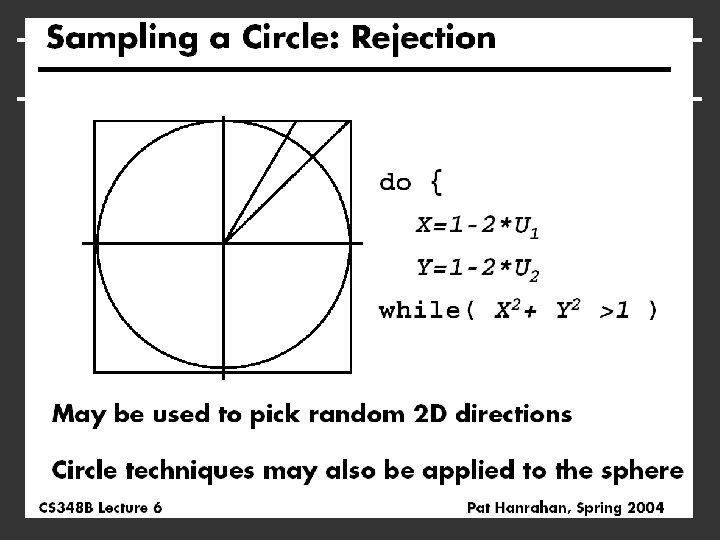
Common Operations Want to sample probability distributions § Draw samples distributed according to probability § Useful for integration, picking important regions, etc. Common distributions § § § Disk or circle Uniform Upper hemisphere for visibility Area luminaire Complex lighting like an environment map Complex reflectance like a BRDF
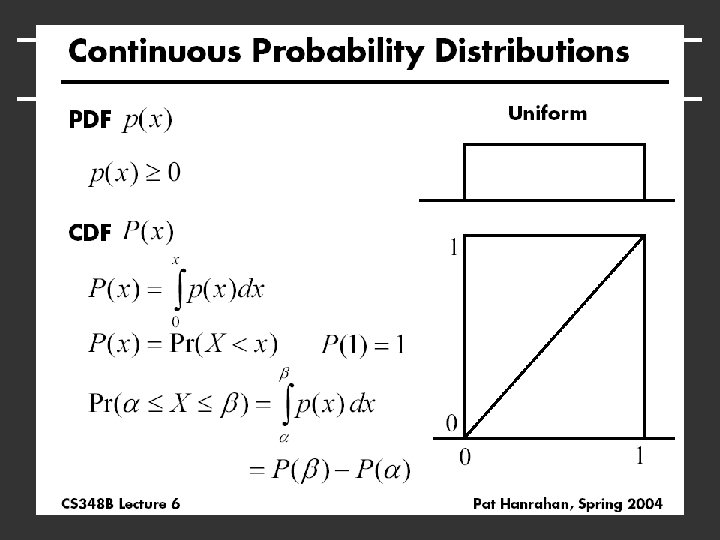
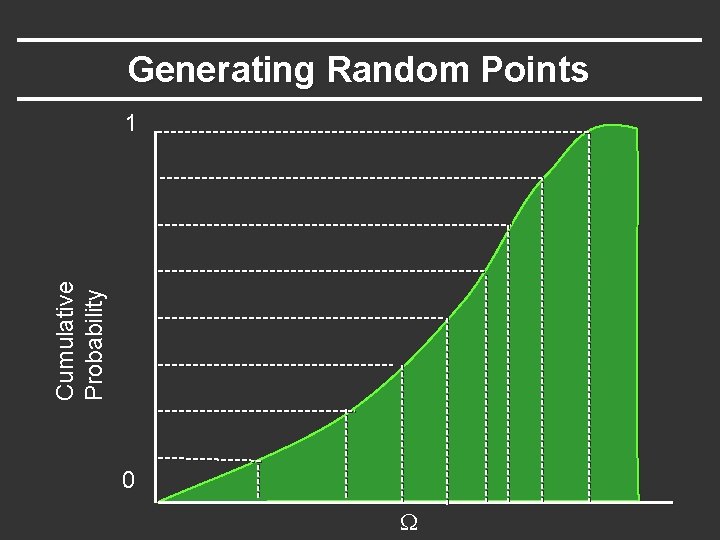
Generating Random Points Cumulative Probability 1 0 W
Rejection Sampling 1 x Probability x x x x x 0 W
Outline § Motivation § Overview, 1 D integration § Basic probability and sampling § Monte Carlo estimation of integrals
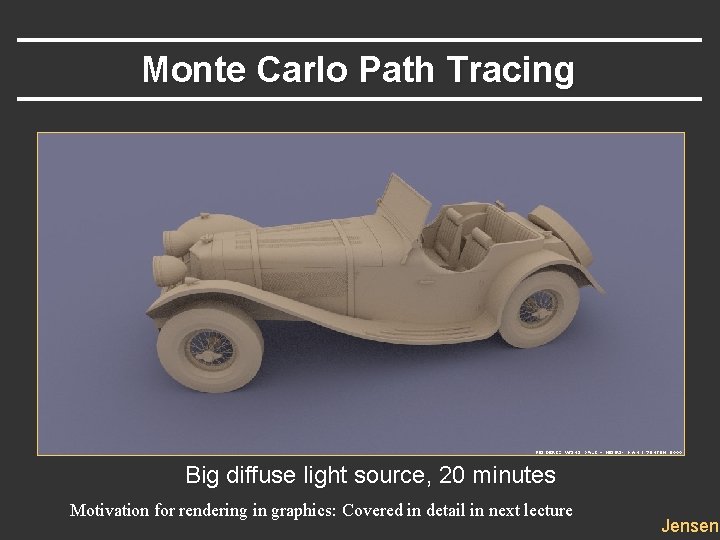
Monte Carlo Path Tracing Big diffuse light source, 20 minutes Motivation for rendering in graphics: Covered in detail in next lecture Jensen
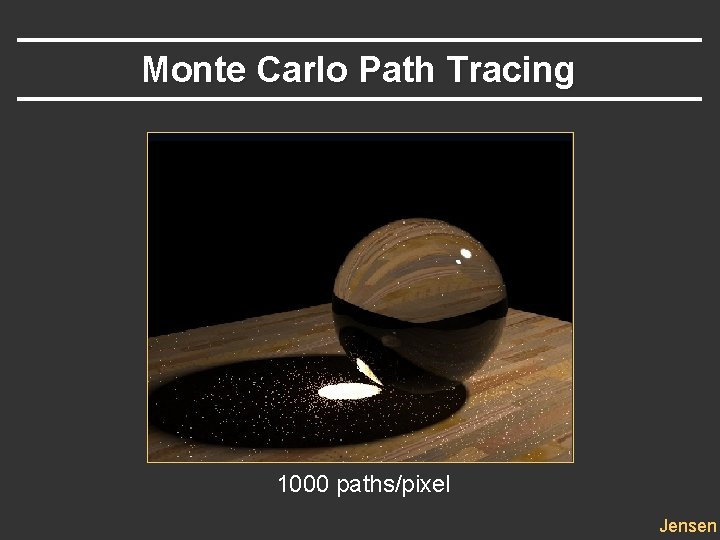
Monte Carlo Path Tracing 1000 paths/pixel Jensen
Estimating the average Monte Carlo methods (random choose samples) f(x) E(f(x)) Advantages: • Robust for discontinuities • Converges reasonably for large dimensions • Can handle complex geometry, integrals • Relatively simple to implement, reason about x 1 x. N Slide courtesy of Peter Shirley
Other Domains f(x) < f >ab x=a x=b Slide courtesy of Peter Shirley
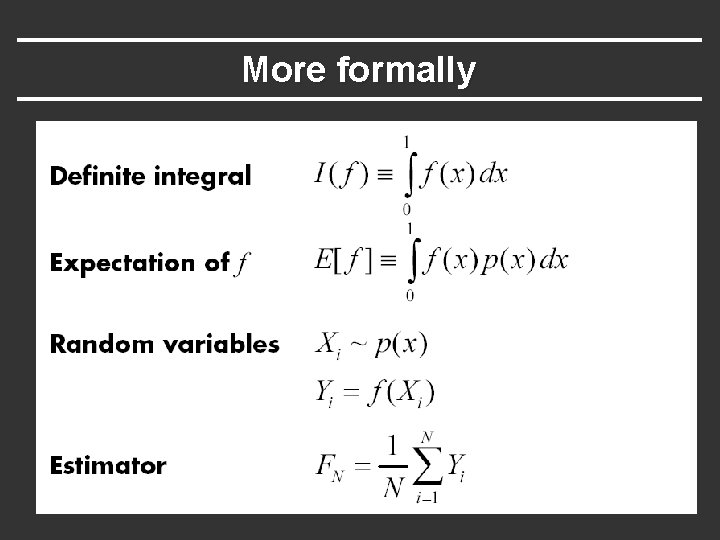
More formally
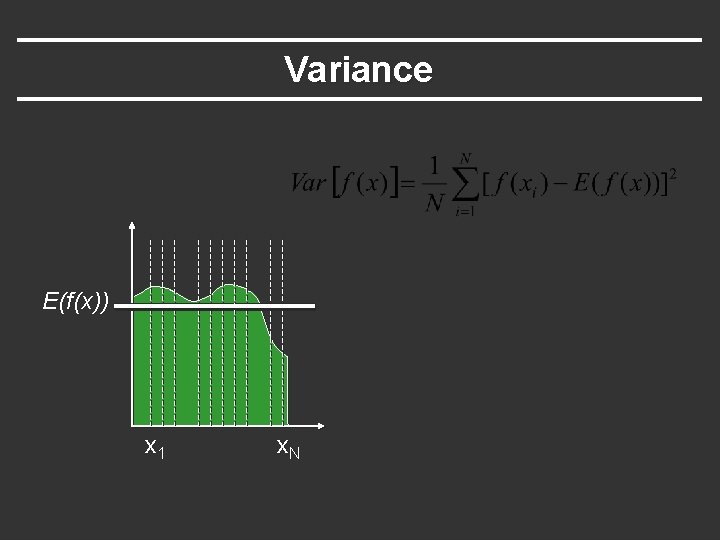
Variance E(f(x)) x 1 x. N
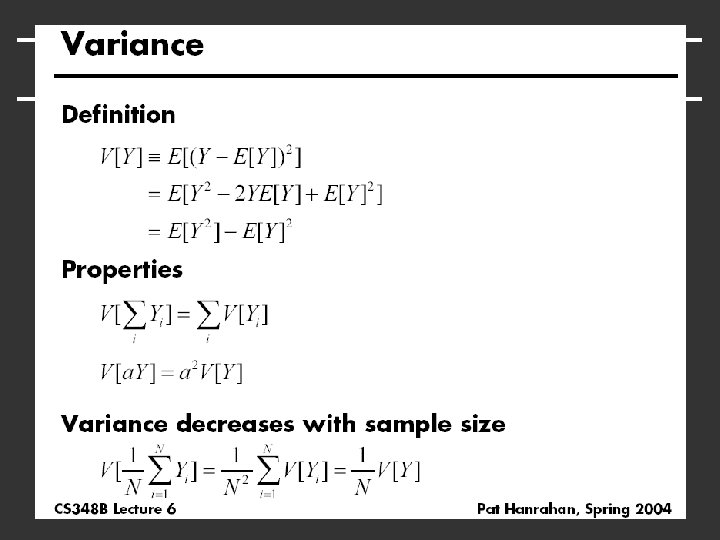
Variance for Dice Example? § Work out on board (variance for single dice roll)
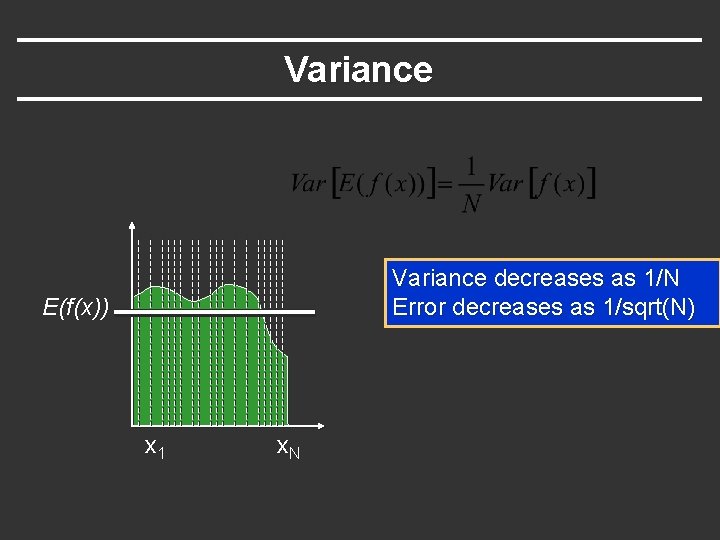
Variance decreases as 1/N Error decreases as 1/sqrt(N) E(f(x)) x 1 x. N
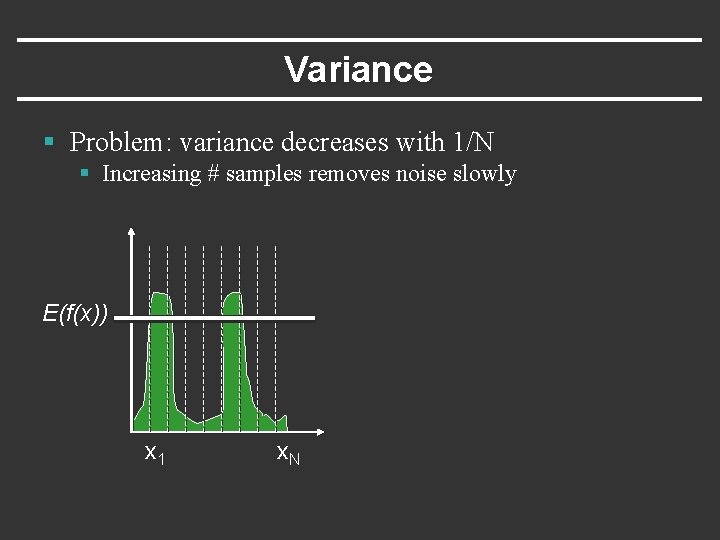
Variance § Problem: variance decreases with 1/N § Increasing # samples removes noise slowly E(f(x)) x 1 x. N
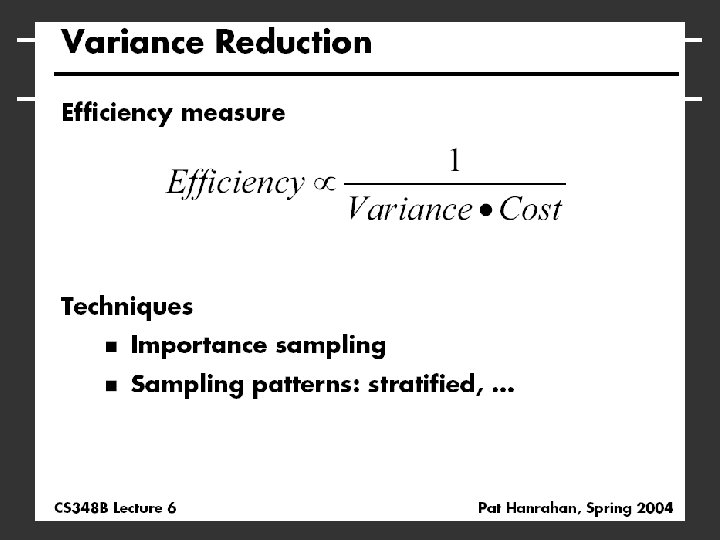
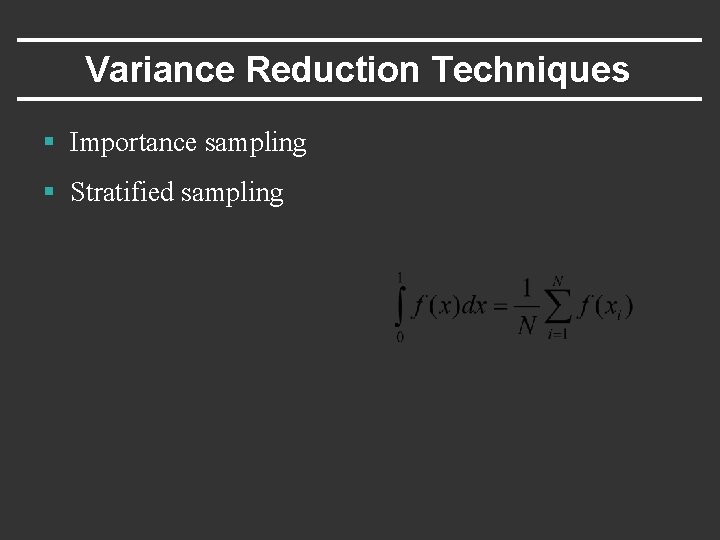
Variance Reduction Techniques § Importance sampling § Stratified sampling
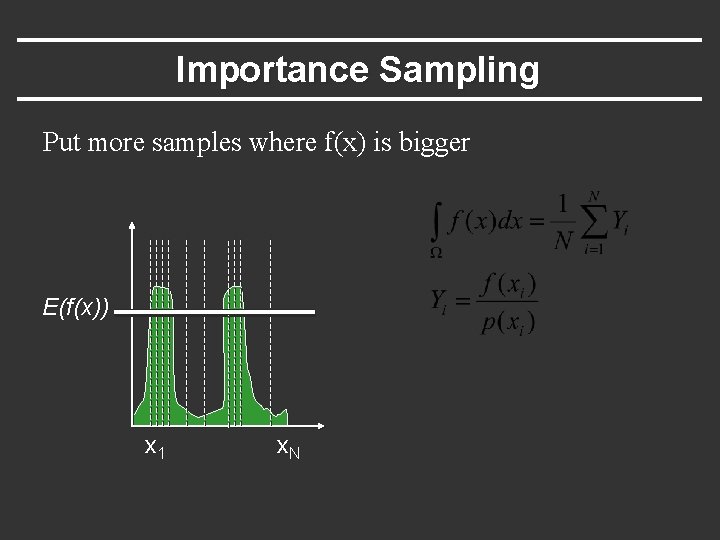
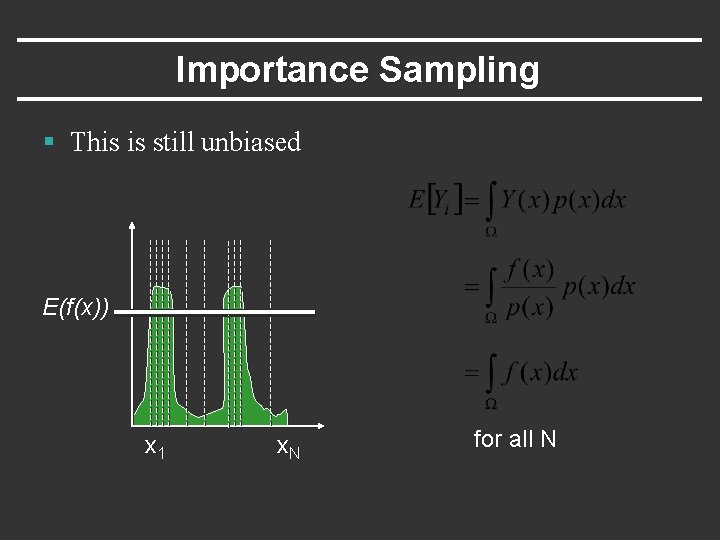
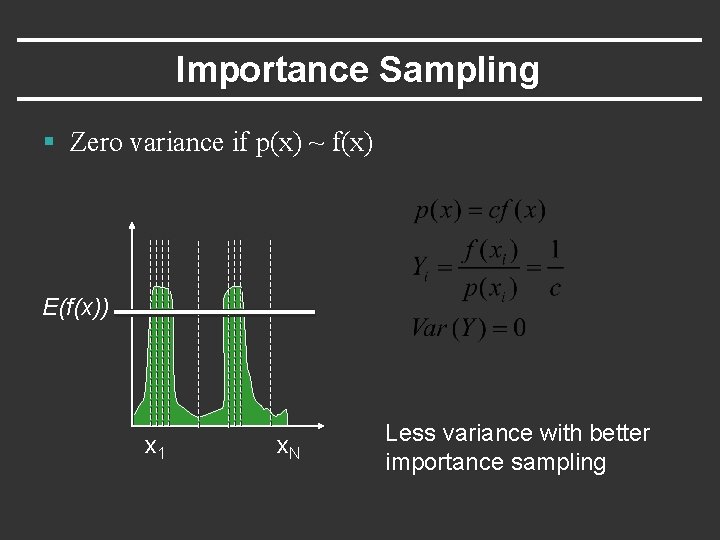
Importance Sampling Put more samples where f(x) is bigger E(f(x)) x 1 x. N
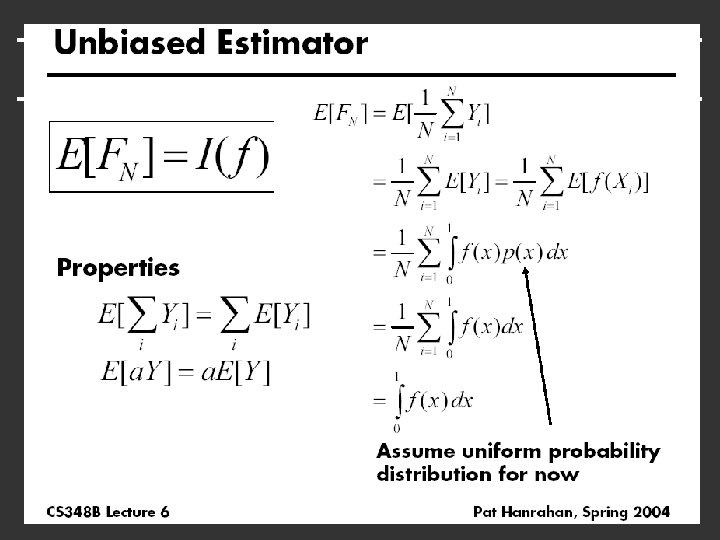
Importance Sampling § This is still unbiased E(f(x)) x 1 x. N for all N
Importance Sampling § Zero variance if p(x) ~ f(x) E(f(x)) x 1 x. N Less variance with better importance sampling
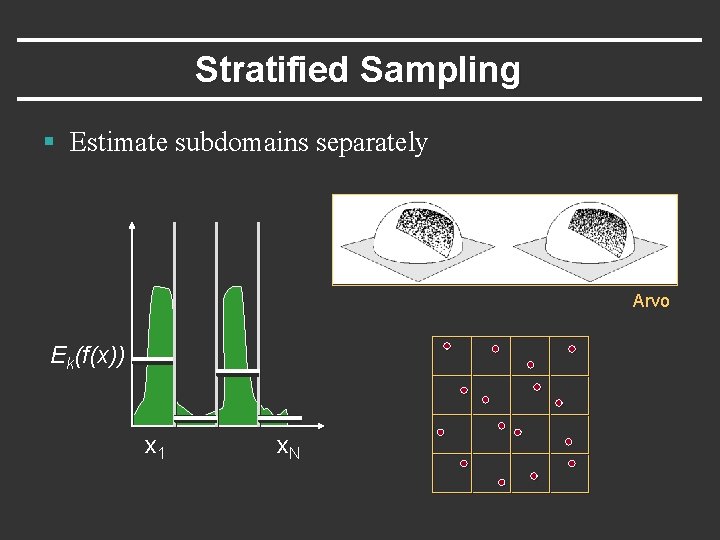
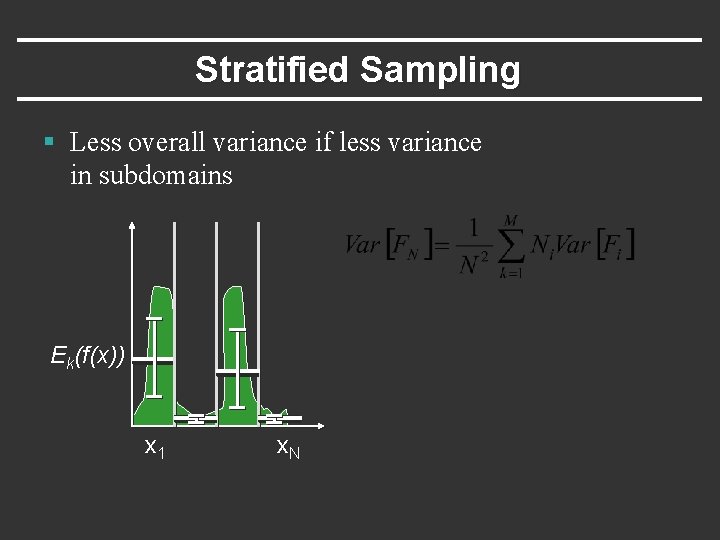
Stratified Sampling § Estimate subdomains separately Arvo Ek(f(x)) x 1 x. N
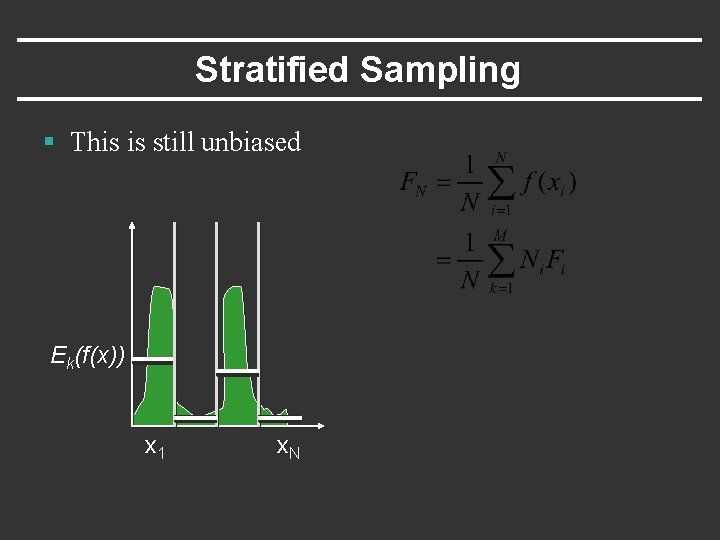
Stratified Sampling § This is still unbiased Ek(f(x)) x 1 x. N
Stratified Sampling § Less overall variance if less variance in subdomains Ek(f(x)) x 1 x. N
More Information § Veach Ph. D thesis chapter (linked to from website) § Course Notes (links from website) § Mathematical Models for Computer Graphics, Stanford, Fall 1997 § State of the Art in Monte Carlo Methods for Realistic Image Synthesis, Course 29, SIGGRAPH 2001