
Advanced Computer Architecture Course Goal Understanding important and
![DLX Loop Unrolling Example • For the loop: for (i=1; i<=1000; i++) x[i] =](https://slidetodoc.com/presentation_image_h2/a220692d9a3689c8a5f649a250b7d2a2/image-67.jpg "DLX Loop Unrolling Example • For the loop: for (i=1; i<=1000; i++) x[i] =")
![LLP Analysis Examples • In the loop: for (i=1; i<=100; i=i+1) { A[i+1] =](https://slidetodoc.com/presentation_image_h2/a220692d9a3689c8a5f649a250b7d2a2/image-73.jpg "LLP Analysis Examples • In the loop: for (i=1; i<=100; i=i+1) { A[i+1] =")
![• In the loop: LLP Analysis Examples for (i=1; i<=100; i=i+1) { A[i]](https://slidetodoc.com/presentation_image_h2/a220692d9a3689c8a5f649a250b7d2a2/image-74.jpg "• In the loop: LLP Analysis Examples for (i=1; i<=100; i=i+1) { A[i]")
- Slides: 138
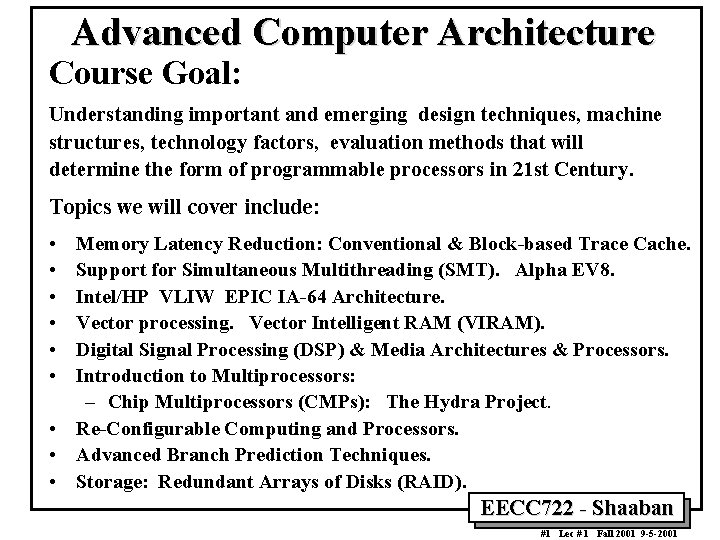
Advanced Computer Architecture Course Goal: Understanding important and emerging design techniques, machine structures, technology factors, evaluation methods that will determine the form of programmable processors in 21 st Century. Topics we will cover include: • • • Memory Latency Reduction: Conventional & Block based Trace Cache. Support for Simultaneous Multithreading (SMT). Alpha EV 8. Intel/HP VLIW EPIC IA 64 Architecture. Vector processing. Vector Intelligent RAM (VIRAM). Digital Signal Processing (DSP) & Media Architectures & Processors. Introduction to Multiprocessors: – Chip Multiprocessors (CMPs): The Hydra Project. • Re Configurable Computing and Processors. • Advanced Branch Prediction Techniques. • Storage: Redundant Arrays of Disks (RAID). EECC 722 Shaaban #1 Lec # 1 Fall 2001 9 5 2001
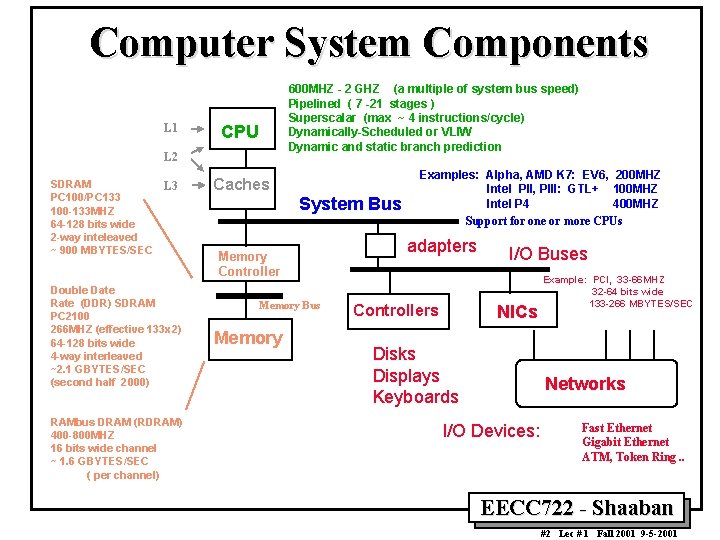
Computer System Components L 1 600 MHZ - 2 GHZ (a multiple of system bus speed) Pipelined ( 7 -21 stages ) Superscalar (max ~ 4 instructions/cycle) Dynamically-Scheduled or VLIW Dynamic and static branch prediction CPU L 2 SDRAM PC 100/PC 133 100 -133 MHZ 64 -128 bits wide 2 -way inteleaved ~ 900 MBYTES/SEC L 3 Double Date Rate (DDR) SDRAM PC 2100 266 MHZ (effective 133 x 2) 64 -128 bits wide 4 -way interleaved ~2. 1 GBYTES/SEC (second half 2000) RAMbus DRAM (RDRAM) 400 -800 MHZ 16 bits wide channel ~ 1. 6 GBYTES/SEC ( per channel) Caches System Bus Memory Controller Memory Bus Memory Examples: Alpha, AMD K 7: EV 6, 200 MHZ Intel PII, PIII: GTL+ 100 MHZ Intel P 4 400 MHZ Support for one or more CPUs adapters I/O Buses NICs Controllers Disks Displays Keyboards Example: PCI, 33 -66 MHZ 32 -64 bits wide 133 -266 MBYTES/SEC Networks I/O Devices: Fast Ethernet Gigabit Ethernet ATM, Token Ring. . EECC 722 Shaaban #2 Lec # 1 Fall 2001 9 5 2001
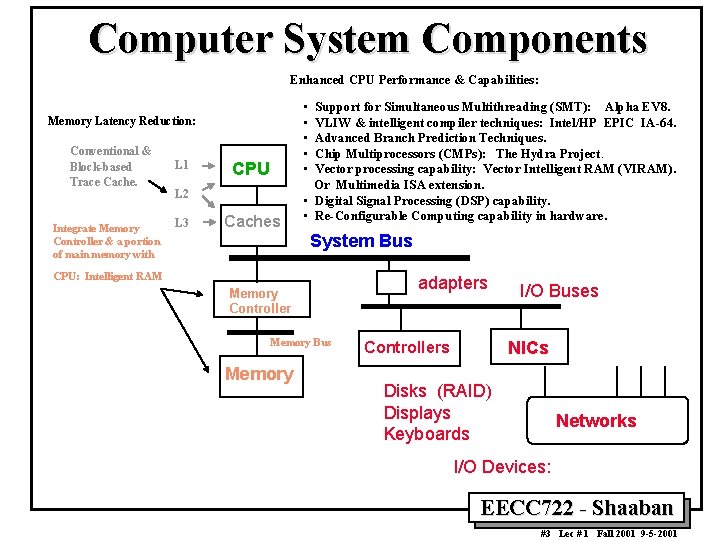
Computer System Components Enhanced CPU Performance & Capabilities: • • • Memory Latency Reduction: Conventional & Block based Trace Cache. Integrate Memory Controller & a portion of main memory with L 1 CPU L 2 L 3 Caches Support for Simultaneous Multithreading (SMT): Alpha EV 8. VLIW & intelligent compiler techniques: Intel/HP EPIC IA 64. Advanced Branch Prediction Techniques. Chip Multiprocessors (CMPs): The Hydra Project. Vector processing capability: Vector Intelligent RAM (VIRAM). Or Multimedia ISA extension. • Digital Signal Processing (DSP) capability. • Re Configurable Computing capability in hardware. System Bus CPU: Intelligent RAM Memory Controller Memory Bus Memory adapters I/O Buses NICs Controllers Disks (RAID) Displays Keyboards Networks I/O Devices: EECC 722 Shaaban #3 Lec # 1 Fall 2001 9 5 2001
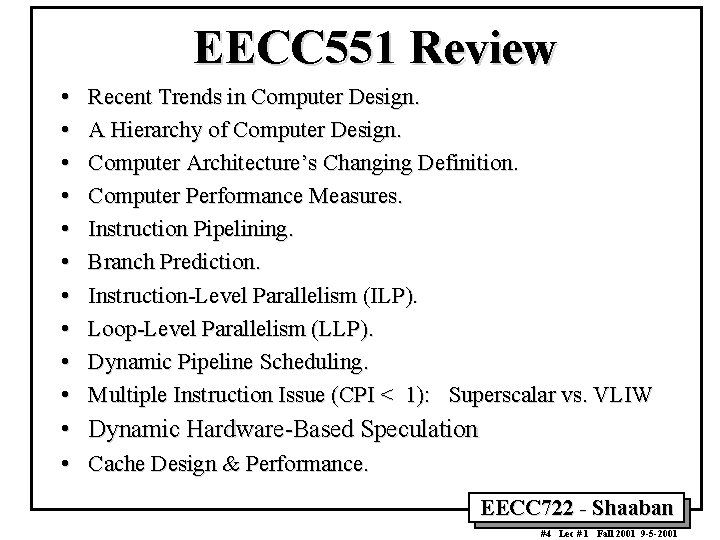
EECC 551 Review • • • Recent Trends in Computer Design. A Hierarchy of Computer Design. Computer Architecture’s Changing Definition. Computer Performance Measures. Instruction Pipelining. Branch Prediction. Instruction-Level Parallelism (ILP). Loop-Level Parallelism (LLP). Dynamic Pipeline Scheduling. Multiple Instruction Issue (CPI < 1): Superscalar vs. VLIW • Dynamic Hardware-Based Speculation • Cache Design & Performance. EECC 722 Shaaban #4 Lec # 1 Fall 2001 9 5 2001
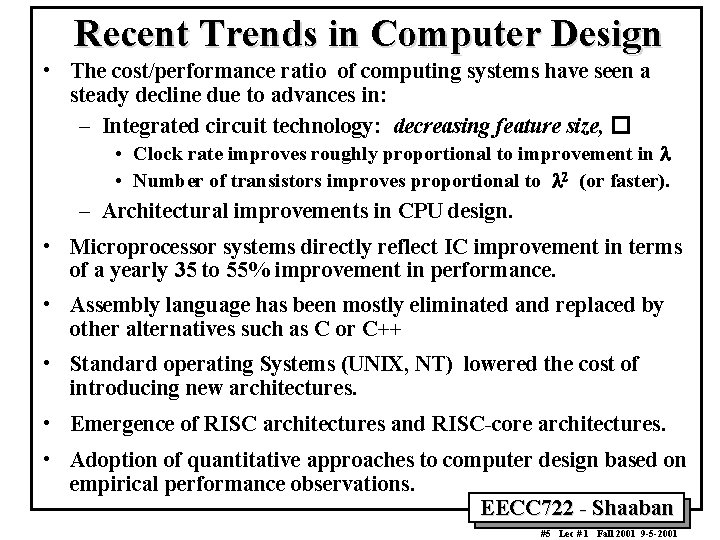
Recent Trends in Computer Design • The cost/performance ratio of computing systems have seen a steady decline due to advances in: – Integrated circuit technology: decreasing feature size, � • Clock rate improves roughly proportional to improvement in • Number of transistors improves proportional to (or faster). – Architectural improvements in CPU design. • Microprocessor systems directly reflect IC improvement in terms of a yearly 35 to 55% improvement in performance. • Assembly language has been mostly eliminated and replaced by other alternatives such as C or C++ • Standard operating Systems (UNIX, NT) lowered the cost of introducing new architectures. • Emergence of RISC architectures and RISC core architectures. • Adoption of quantitative approaches to computer design based on empirical performance observations. EECC 722 Shaaban #5 Lec # 1 Fall 2001 9 5 2001
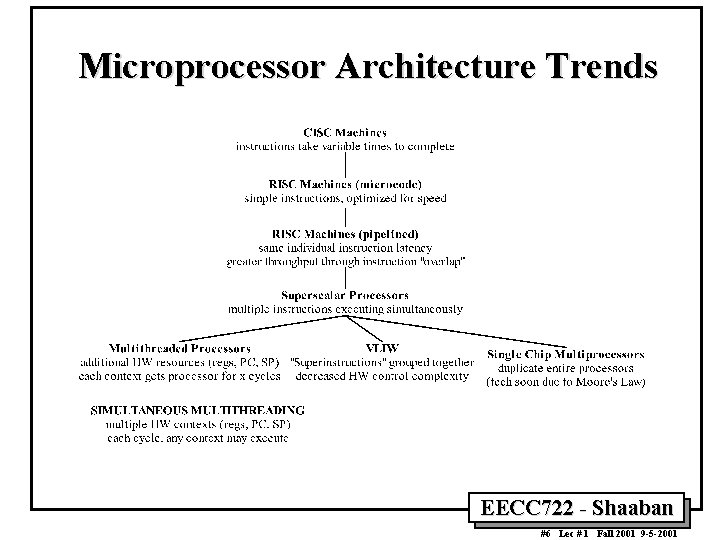
Microprocessor Architecture Trends EECC 722 Shaaban #6 Lec # 1 Fall 2001 9 5 2001
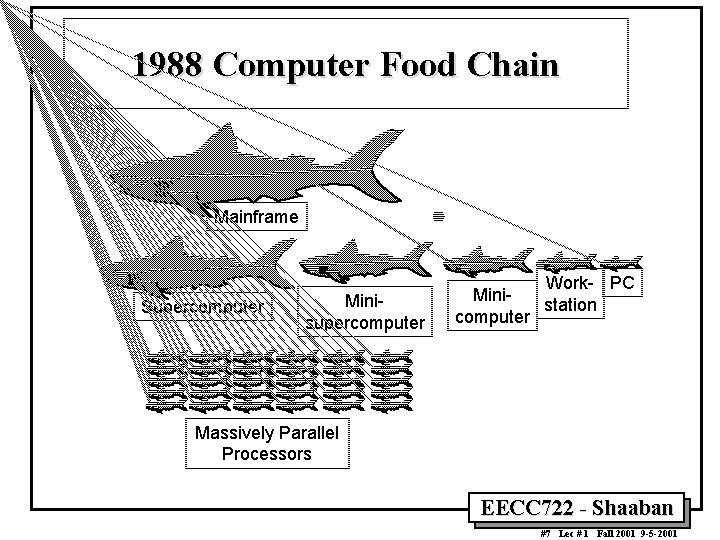
1988 Computer Food Chain Mainframe Supercomputer Minisupercomputer Work- PC Ministation computer Massively Parallel Processors EECC 722 Shaaban #7 Lec # 1 Fall 2001 9 5 2001
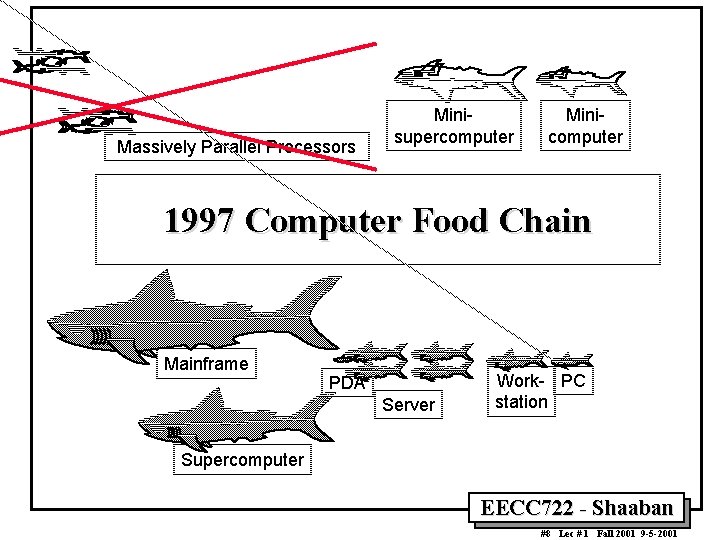
Massively Parallel Processors Minisupercomputer Minicomputer 1997 Computer Food Chain Mainframe PDA Server Work- PC station Supercomputer EECC 722 Shaaban #8 Lec # 1 Fall 2001 9 5 2001
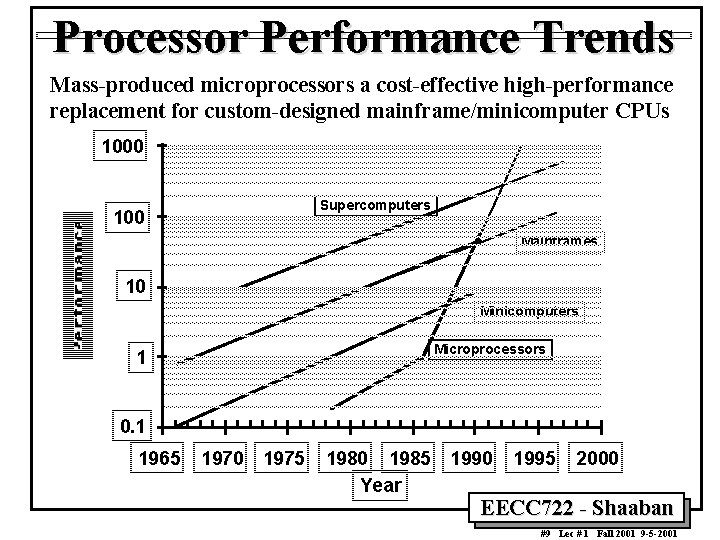
Processor Performance Trends Mass produced microprocessors a cost effective high performance replacement for custom designed mainframe/minicomputer CPUs 1000 Supercomputers 100 Mainframes 10 Minicomputers Microprocessors 1 0. 1 1965 1970 1975 1980 1985 Year 1990 1995 2000 EECC 722 Shaaban #9 Lec # 1 Fall 2001 9 5 2001
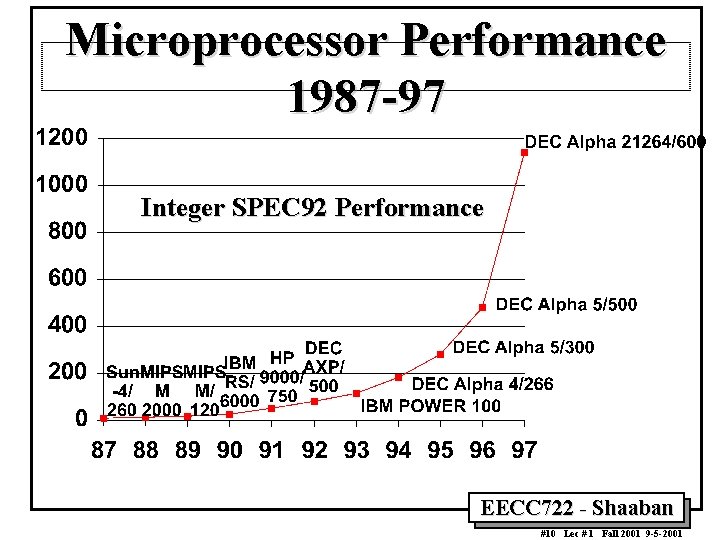
Microprocessor Performance 1987 97 Integer SPEC 92 Performance EECC 722 Shaaban #10 Lec # 1 Fall 2001 9 5 2001
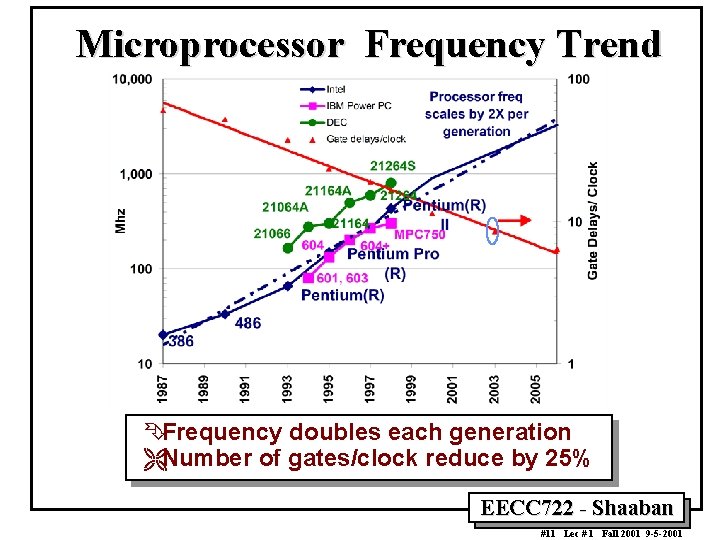
Microprocessor Frequency Trend ÊFrequency doubles each generation ËNumber of gates/clock reduce by 25% EECC 722 Shaaban #11 Lec # 1 Fall 2001 9 5 2001
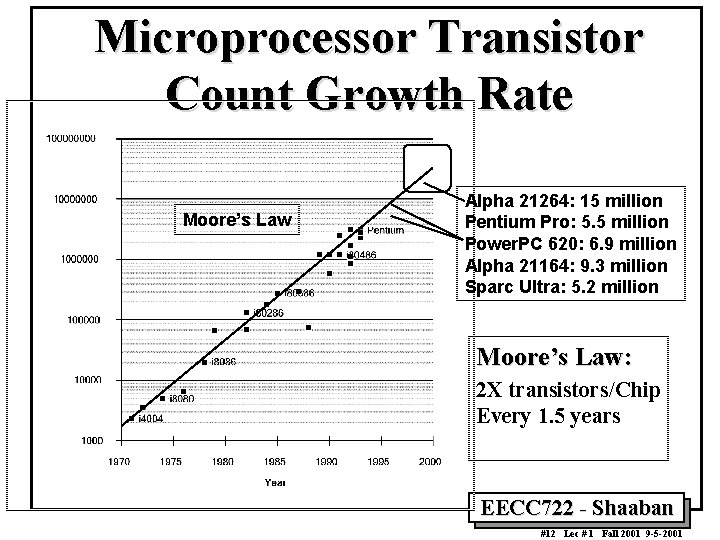
Microprocessor Transistor Count Growth Rate Moore’s Law Alpha 21264: 15 million Pentium Pro: 5. 5 million Power. PC 620: 6. 9 million Alpha 21164: 9. 3 million Sparc Ultra: 5. 2 million Moore’s Law: 2 X transistors/Chip Every 1. 5 years EECC 722 Shaaban #12 Lec # 1 Fall 2001 9 5 2001
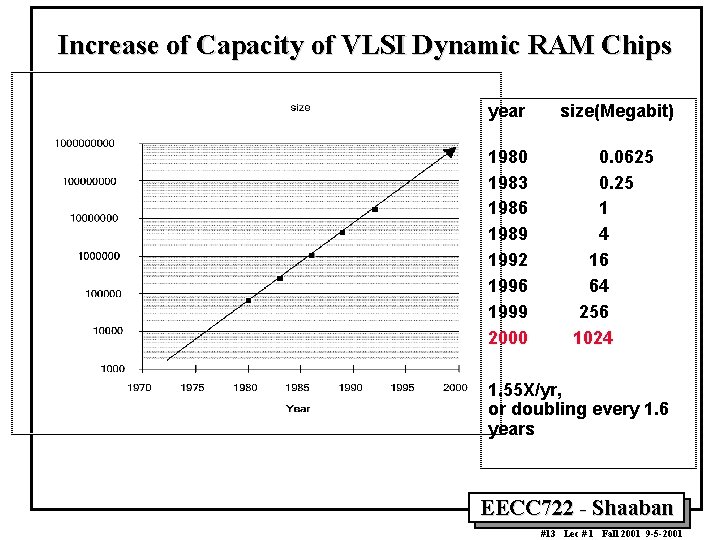
Increase of Capacity of VLSI Dynamic RAM Chips year size(Megabit) 1980 1983 1986 1989 1992 1996 1999 2000 0. 0625 0. 25 1 4 16 64 256 1024 1. 55 X/yr, or doubling every 1. 6 years EECC 722 Shaaban #13 Lec # 1 Fall 2001 9 5 2001
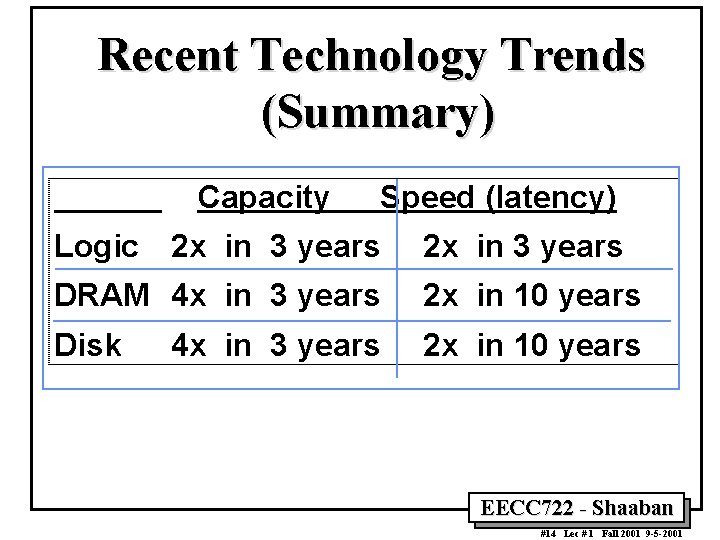
Recent Technology Trends (Summary) Capacity Speed (latency) Logic 2 x in 3 years DRAM 4 x in 3 years 2 x in 10 years Disk 2 x in 10 years 4 x in 3 years EECC 722 Shaaban #14 Lec # 1 Fall 2001 9 5 2001
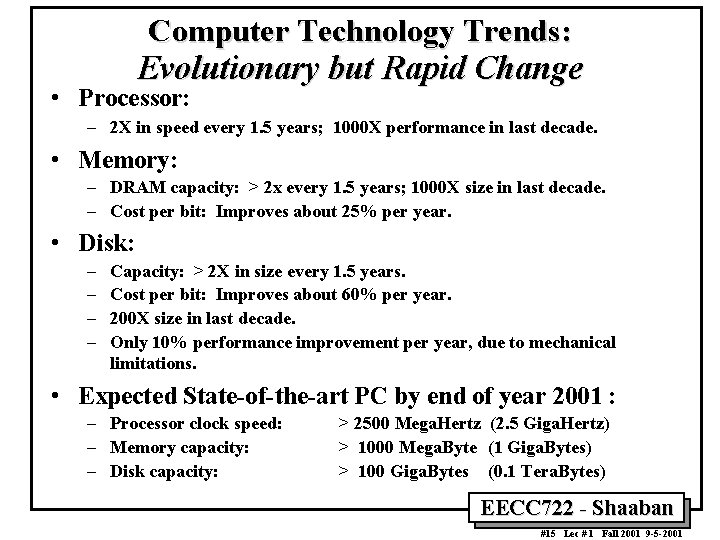
Computer Technology Trends: Evolutionary but Rapid Change • Processor: – 2 X in speed every 1. 5 years; 1000 X performance in last decade. • Memory: – DRAM capacity: > 2 x every 1. 5 years; 1000 X size in last decade. – Cost per bit: Improves about 25% per year. • Disk: – – Capacity: > 2 X in size every 1. 5 years. Cost per bit: Improves about 60% per year. 200 X size in last decade. Only 10% performance improvement per year, due to mechanical limitations. • Expected State of the art PC by end of year 2001 : – Processor clock speed: – Memory capacity: – Disk capacity: > 2500 Mega. Hertz (2. 5 Giga. Hertz) > 1000 Mega. Byte (1 Giga. Bytes) > 100 Giga. Bytes (0. 1 Tera. Bytes) EECC 722 Shaaban #15 Lec # 1 Fall 2001 9 5 2001
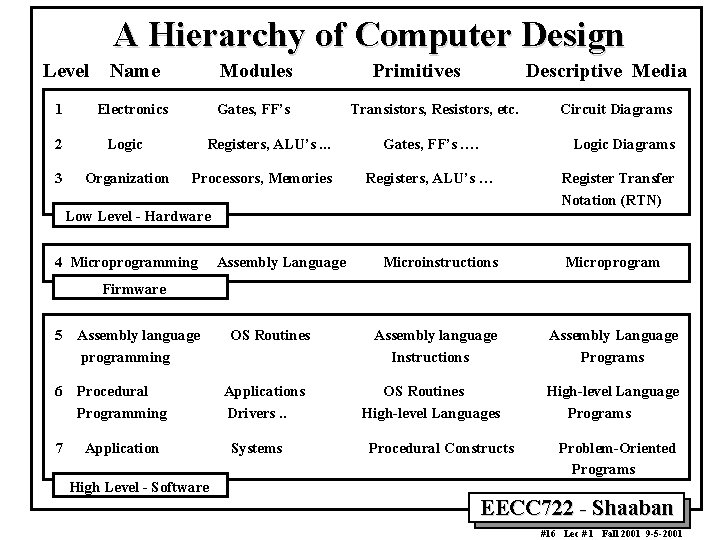
A Hierarchy of Computer Design Level 1 Name Modules Electronics Gates, FF’s 2 Logic 3 Organization Registers, ALU’s. . . Processors, Memories Primitives Descriptive Media Transistors, Resistors, etc. Gates, FF’s …. Logic Diagrams Registers, ALU’s … Low Level Hardware 4 Microprogramming Assembly Language Circuit Diagrams Microinstructions Register Transfer Notation (RTN) Microprogram Firmware 5 Assembly language programming 6 Procedural Programming 7 Application OS Routines Applications Drivers. . Systems Assembly language Instructions Assembly Language Programs OS Routines High level Language Programs Procedural Constructs Problem Oriented Programs High Level Software EECC 722 Shaaban #16 Lec # 1 Fall 2001 9 5 2001
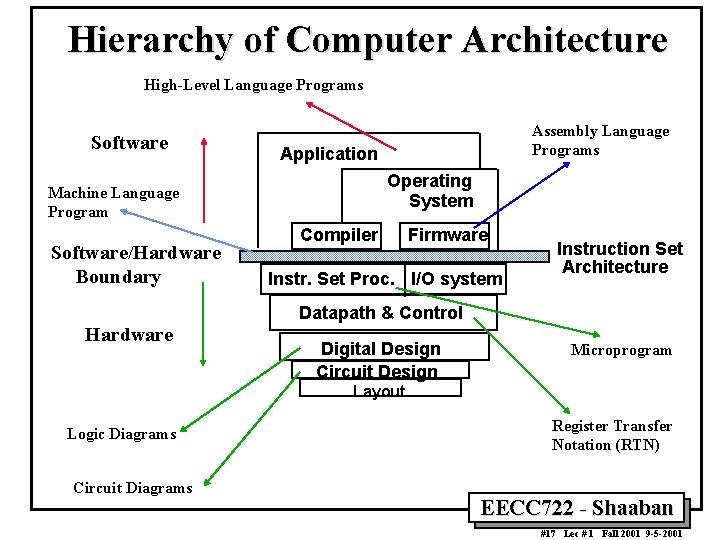
Hierarchy of Computer Architecture High Level Language Programs Software Application Operating System Machine Language Program Software/Hardware Boundary Assembly Language Programs Compiler Firmware Instr. Set Proc. I/O system Instruction Set Architecture Datapath & Control Hardware Digital Design Circuit Design Microprogram Layout Logic Diagrams Circuit Diagrams Register Transfer Notation (RTN) EECC 722 Shaaban #17 Lec # 1 Fall 2001 9 5 2001
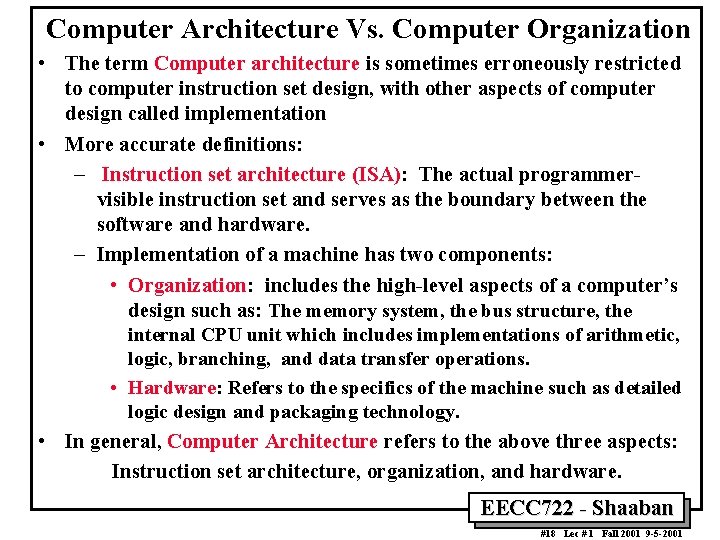
Computer Architecture Vs. Computer Organization • The term Computer architecture is sometimes erroneously restricted to computer instruction set design, with other aspects of computer design called implementation • More accurate definitions: – Instruction set architecture (ISA): The actual programmer visible instruction set and serves as the boundary between the software and hardware. – Implementation of a machine has two components: • Organization: includes the high level aspects of a computer’s design such as: The memory system, the bus structure, the internal CPU unit which includes implementations of arithmetic, logic, branching, and data transfer operations. • Hardware: Refers to the specifics of the machine such as detailed logic design and packaging technology. • In general, Computer Architecture refers to the above three aspects: Instruction set architecture, organization, and hardware. EECC 722 Shaaban #18 Lec # 1 Fall 2001 9 5 2001
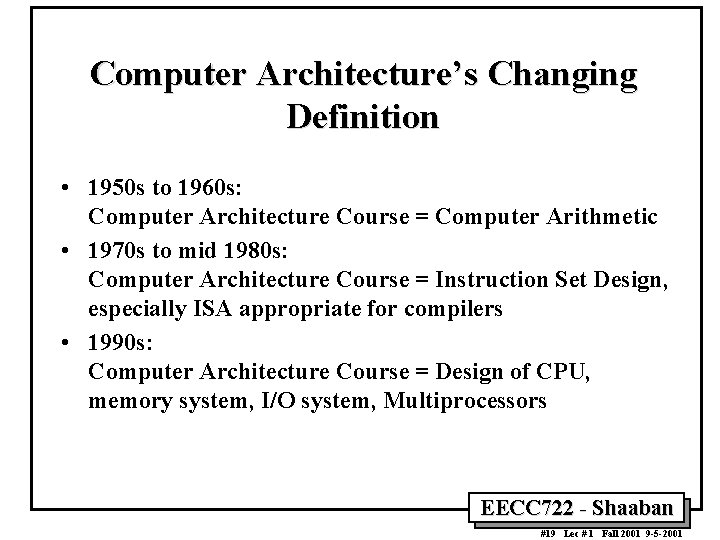
Computer Architecture’s Changing Definition • 1950 s to 1960 s: Computer Architecture Course = Computer Arithmetic • 1970 s to mid 1980 s: Computer Architecture Course = Instruction Set Design, especially ISA appropriate for compilers • 1990 s: Computer Architecture Course = Design of CPU, memory system, I/O system, Multiprocessors EECC 722 Shaaban #19 Lec # 1 Fall 2001 9 5 2001
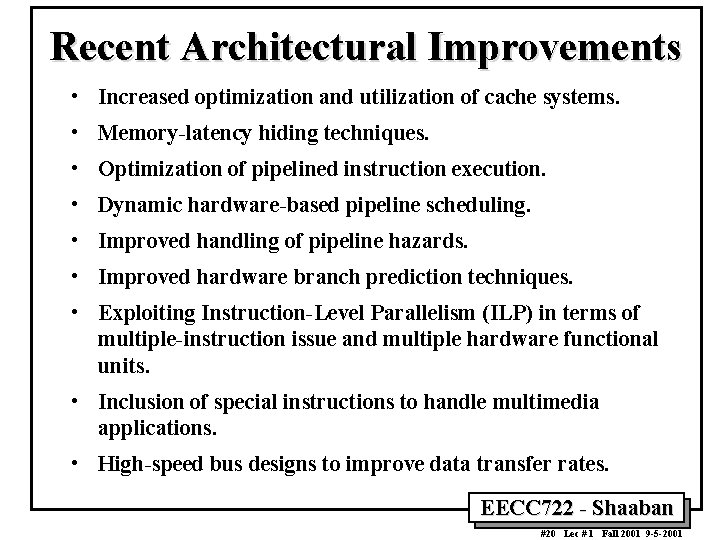
Recent Architectural Improvements • Increased optimization and utilization of cache systems. • Memory latency hiding techniques. • Optimization of pipelined instruction execution. • Dynamic hardware based pipeline scheduling. • Improved handling of pipeline hazards. • Improved hardware branch prediction techniques. • Exploiting Instruction Level Parallelism (ILP) in terms of multiple instruction issue and multiple hardware functional units. • Inclusion of special instructions to handle multimedia applications. • High speed bus designs to improve data transfer rates. EECC 722 Shaaban #20 Lec # 1 Fall 2001 9 5 2001
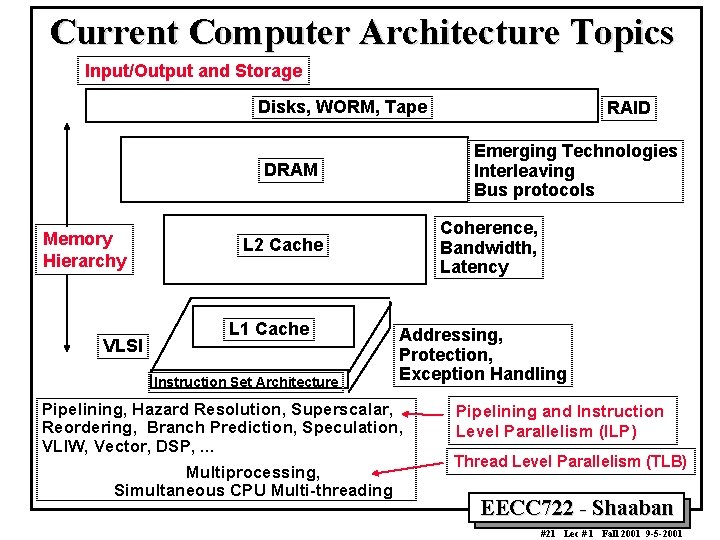
Current Computer Architecture Topics Input/Output and Storage Disks, WORM, Tape Emerging Technologies Interleaving Bus protocols DRAM Memory Hierarchy VLSI Coherence, Bandwidth, Latency L 2 Cache L 1 Cache Instruction Set Architecture Addressing, Protection, Exception Handling Pipelining, Hazard Resolution, Superscalar, Reordering, Branch Prediction, Speculation, VLIW, Vector, DSP, . . . Multiprocessing, Simultaneous CPU Multi-threading RAID Pipelining and Instruction Level Parallelism (ILP) Thread Level Parallelism (TLB) EECC 722 Shaaban #21 Lec # 1 Fall 2001 9 5 2001
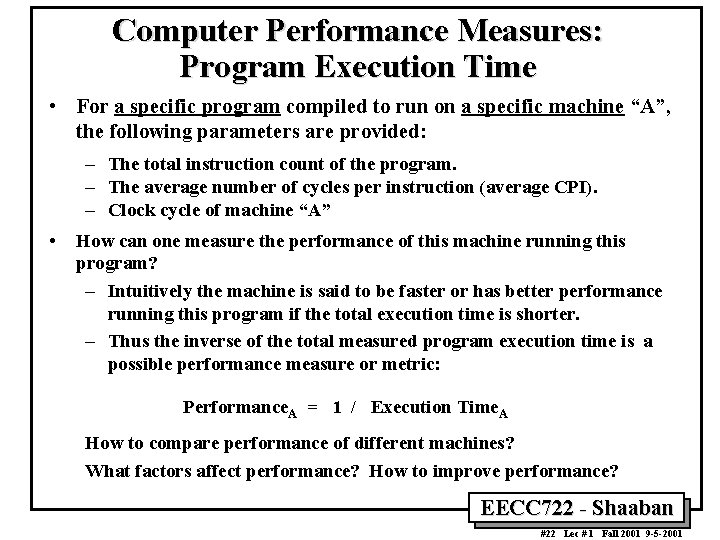
Computer Performance Measures: Program Execution Time • For a specific program compiled to run on a specific machine “A”, the following parameters are provided: – The total instruction count of the program. – The average number of cycles per instruction (average CPI). – Clock cycle of machine “A” • How can one measure the performance of this machine running this program? – Intuitively the machine is said to be faster or has better performance running this program if the total execution time is shorter. – Thus the inverse of the total measured program execution time is a possible performance measure or metric: Performance. A = 1 / Execution Time. A How to compare performance of different machines? What factors affect performance? How to improve performance? EECC 722 Shaaban #22 Lec # 1 Fall 2001 9 5 2001
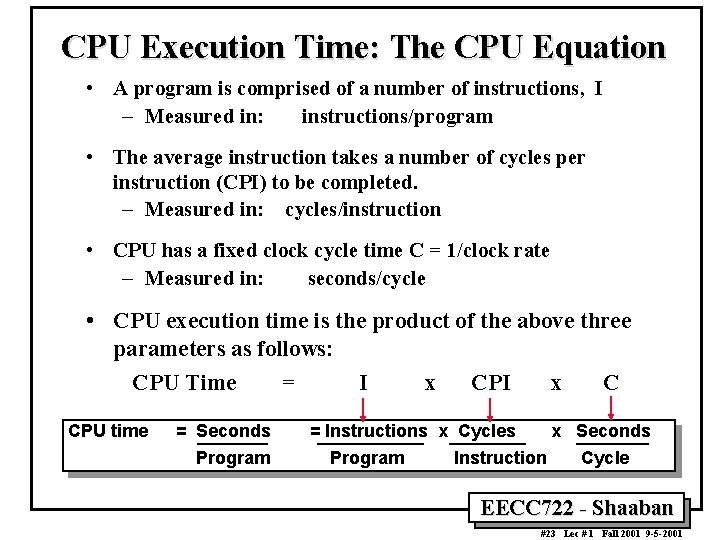
CPU Execution Time: The CPU Equation • A program is comprised of a number of instructions, I – Measured in: instructions/program • The average instruction takes a number of cycles per instruction (CPI) to be completed. – Measured in: cycles/instruction • CPU has a fixed clock cycle time C = 1/clock rate – Measured in: seconds/cycle • CPU execution time is the product of the above three parameters as follows: CPU Time = I x CPI x C CPU time = Seconds Program = Instructions x Cycles Program x Seconds Instruction Cycle EECC 722 Shaaban #23 Lec # 1 Fall 2001 9 5 2001
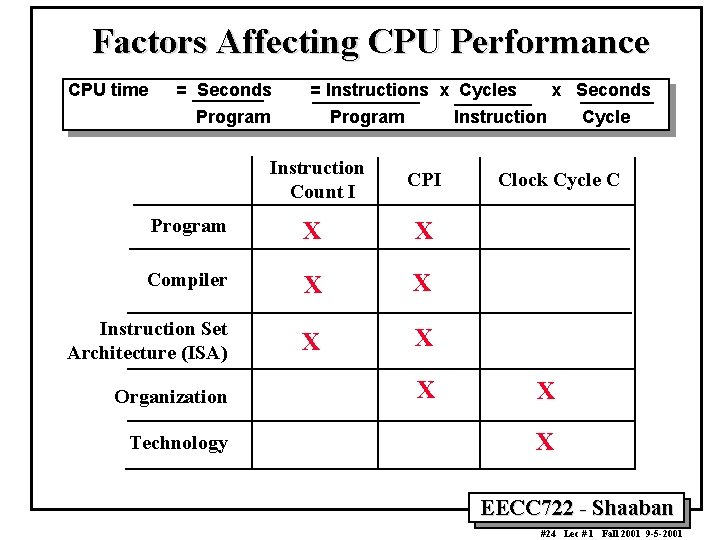
Factors Affecting CPU Performance CPU time = Seconds = Instructions x Cycles Program Instruction Count I CPI Program X X Compiler X X Instruction Set Architecture (ISA) X X Organization Technology x Seconds X Cycle Clock Cycle C X X EECC 722 Shaaban #24 Lec # 1 Fall 2001 9 5 2001
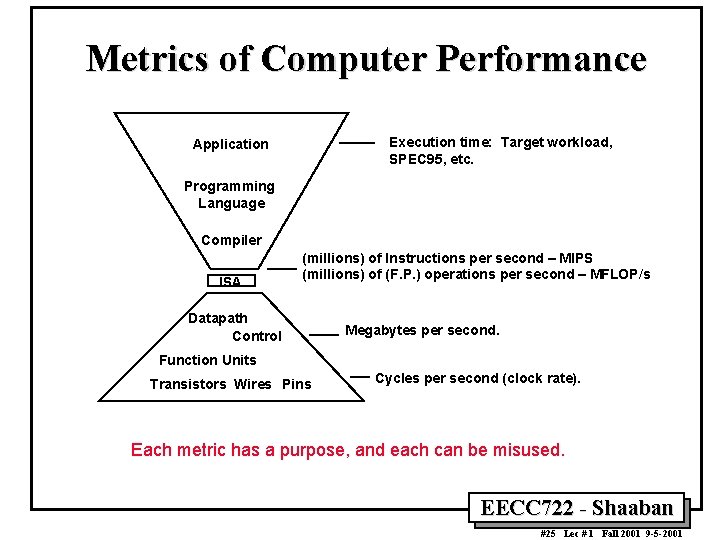
Metrics of Computer Performance Execution time: Target workload, SPEC 95, etc. Application Programming Language Compiler ISA (millions) of Instructions per second – MIPS (millions) of (F. P. ) operations per second – MFLOP/s Datapath Control Megabytes per second. Function Units Transistors Wires Pins Cycles per second (clock rate). Each metric has a purpose, and each can be misused. EECC 722 Shaaban #25 Lec # 1 Fall 2001 9 5 2001
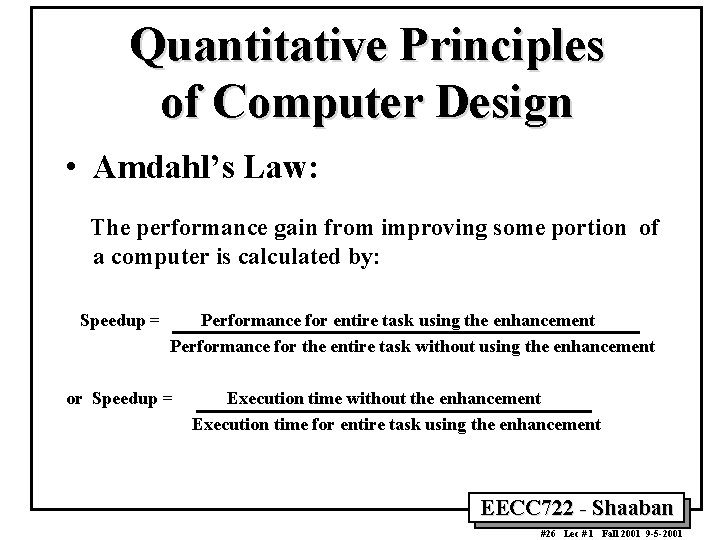
Quantitative Principles of Computer Design • Amdahl’s Law: The performance gain from improving some portion of a computer is calculated by: Speedup = Performance for entire task using the enhancement Performance for the entire task without using the enhancement or Speedup = Execution time without the enhancement Execution time for entire task using the enhancement EECC 722 Shaaban #26 Lec # 1 Fall 2001 9 5 2001
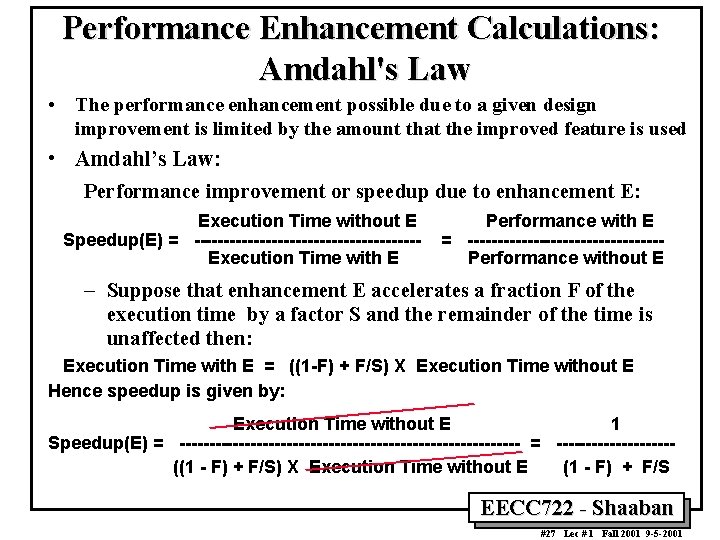
Performance Enhancement Calculations: Amdahl's Law • The performance enhancement possible due to a given design improvement is limited by the amount that the improved feature is used • Amdahl’s Law: Performance improvement or speedup due to enhancement E: Execution Time without E Speedup(E) = -------------------Execution Time with E Performance with E = ----------------Performance without E – Suppose that enhancement E accelerates a fraction F of the execution time by a factor S and the remainder of the time is unaffected then: Execution Time with E = ((1 -F) + F/S) X Execution Time without E Hence speedup is given by: Execution Time without E 1 Speedup(E) = ----------------------------- = ----------((1 - F) + F/S) X Execution Time without E (1 - F) + F/S EECC 722 Shaaban #27 Lec # 1 Fall 2001 9 5 2001
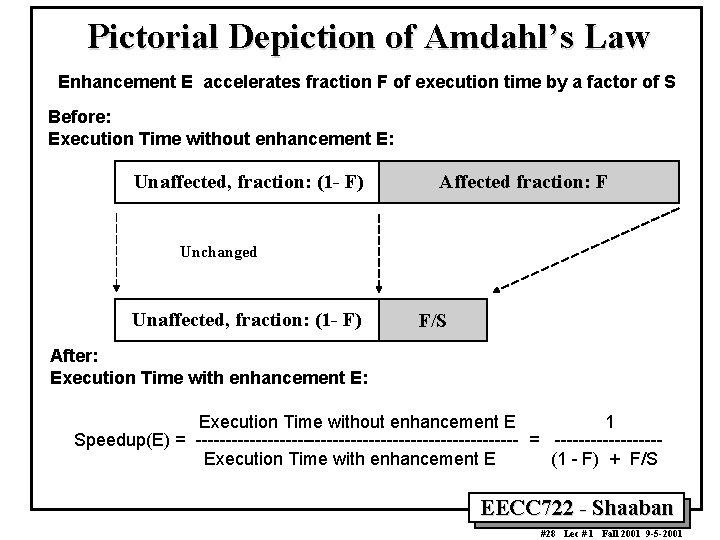
Pictorial Depiction of Amdahl’s Law Enhancement E accelerates fraction F of execution time by a factor of S Before: Execution Time without enhancement E: Unaffected, fraction: (1 F) Affected fraction: F Unchanged Unaffected, fraction: (1 F) F/S After: Execution Time with enhancement E: Execution Time without enhancement E 1 Speedup(E) = --------------------------- = ---------Execution Time with enhancement E (1 - F) + F/S EECC 722 Shaaban #28 Lec # 1 Fall 2001 9 5 2001
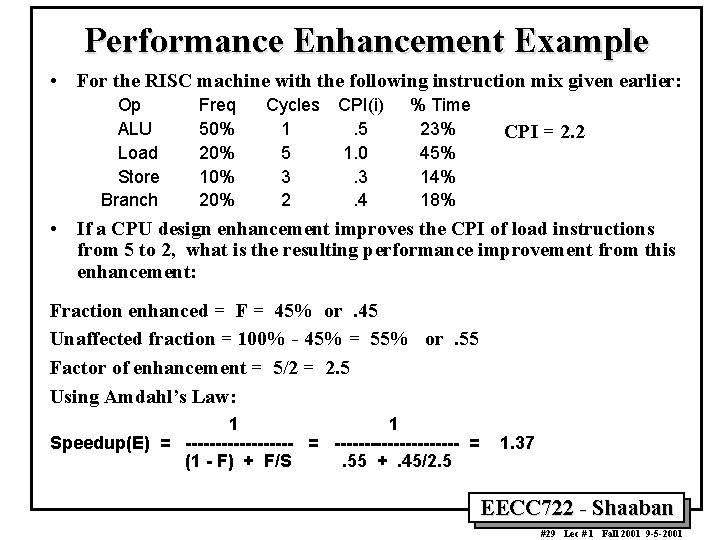
Performance Enhancement Example • For the RISC machine with the following instruction mix given earlier: Op ALU Load Store Branch Freq 50% 20% 10% 20% Cycles 1 5 3 2 CPI(i). 5 1. 0. 3. 4 % Time 23% 45% 14% 18% CPI = 2. 2 • If a CPU design enhancement improves the CPI of load instructions from 5 to 2, what is the resulting performance improvement from this enhancement: Fraction enhanced = F = 45% or. 45 Unaffected fraction = 100% 45% = 55% or. 55 Factor of enhancement = 5/2 = 2. 5 Using Amdahl’s Law: 1 1 Speedup(E) = --------------------- = (1 - F) + F/S. 55 +. 45/2. 5 1. 37 EECC 722 Shaaban #29 Lec # 1 Fall 2001 9 5 2001
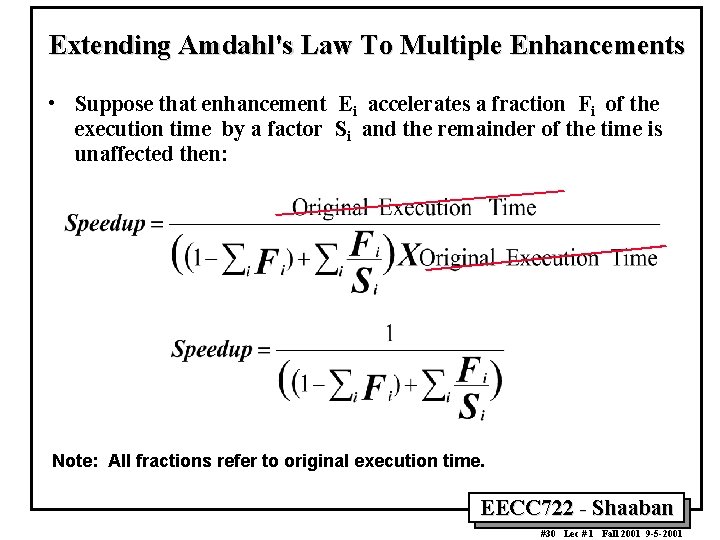
Extending Amdahl's Law To Multiple Enhancements • Suppose that enhancement Ei accelerates a fraction Fi of the execution time by a factor Si and the remainder of the time is unaffected then: Note: All fractions refer to original execution time. EECC 722 Shaaban #30 Lec # 1 Fall 2001 9 5 2001
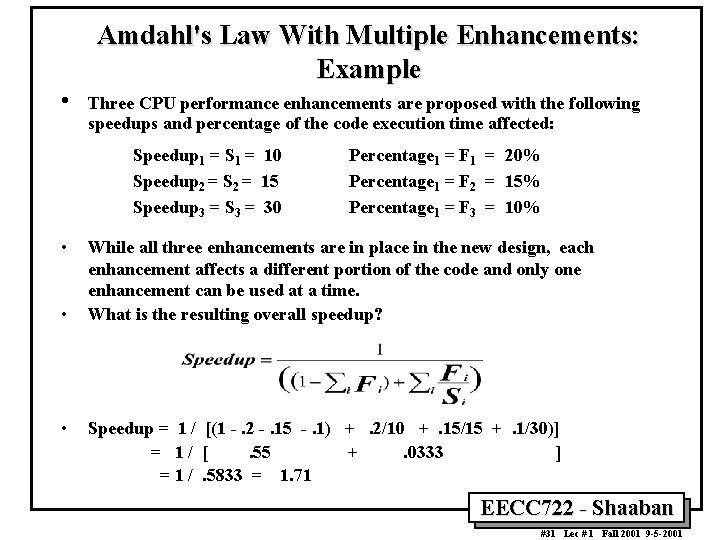
Amdahl's Law With Multiple Enhancements: Example • Three CPU performance enhancements are proposed with the following speedups and percentage of the code execution time affected: Speedup 1 = S 1 = 10 Speedup 2 = S 2 = 15 Speedup 3 = S 3 = 30 • • • Percentage 1 = F 1 = 20% Percentage 1 = F 2 = 15% Percentage 1 = F 3 = 10% While all three enhancements are in place in the new design, each enhancement affects a different portion of the code and only one enhancement can be used at a time. What is the resulting overall speedup? Speedup = 1 / [(1 . 2 . 15 . 1) +. 2/10 +. 15/15 +. 1/30)] = 1/ [. 55 +. 0333 ] = 1 /. 5833 = 1. 71 EECC 722 Shaaban #31 Lec # 1 Fall 2001 9 5 2001
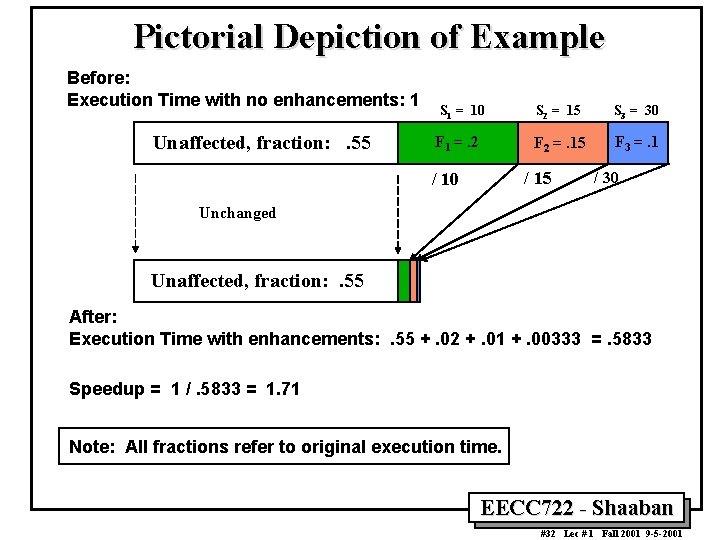
Pictorial Depiction of Example Before: Execution Time with no enhancements: 1 Unaffected, fraction: . 55 S 1 = 10 F 1 =. 2 S 2 = 15 S 3 = 30 F 2 =. 15 F 3 =. 1 / 15 / 10 / 30 Unchanged Unaffected, fraction: . 55 After: Execution Time with enhancements: . 55 +. 02 +. 01 +. 00333 =. 5833 Speedup = 1 /. 5833 = 1. 71 Note: All fractions refer to original execution time. EECC 722 Shaaban #32 Lec # 1 Fall 2001 9 5 2001
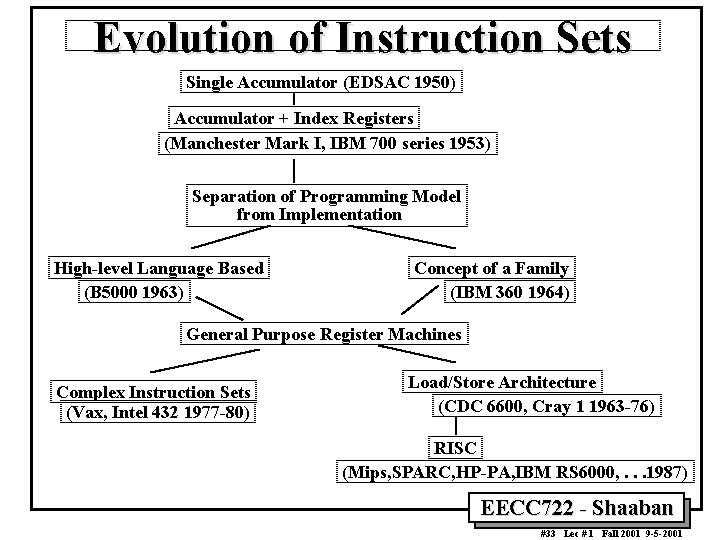
Evolution of Instruction Sets Single Accumulator (EDSAC 1950) Accumulator + Index Registers (Manchester Mark I, IBM 700 series 1953) Separation of Programming Model from Implementation High level Language Based (B 5000 1963) Concept of a Family (IBM 360 1964) General Purpose Register Machines Complex Instruction Sets (Vax, Intel 432 1977 80) Load/Store Architecture (CDC 6600, Cray 1 1963 76) RISC (Mips, SPARC, HP PA, IBM RS 6000, . . . 1987) EECC 722 Shaaban #33 Lec # 1 Fall 2001 9 5 2001
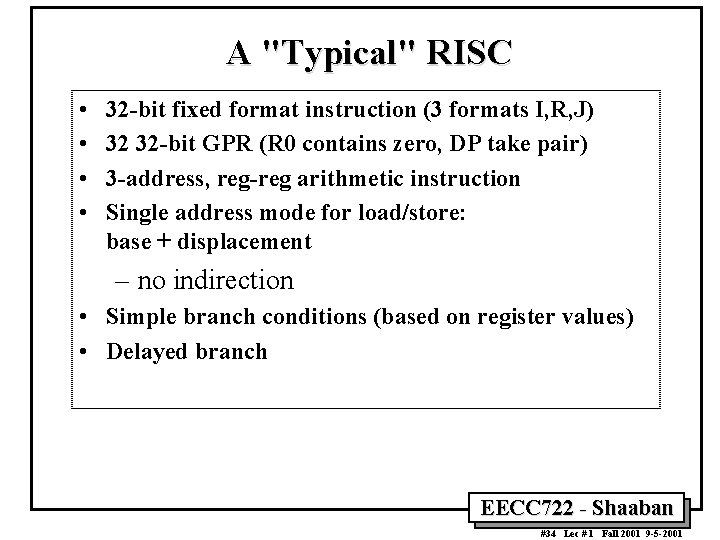
A "Typical" RISC • • 32 bit fixed format instruction (3 formats I, R, J) 32 32 bit GPR (R 0 contains zero, DP take pair) 3 address, reg arithmetic instruction Single address mode for load/store: base + displacement – no indirection • Simple branch conditions (based on register values) • Delayed branch EECC 722 Shaaban #34 Lec # 1 Fall 2001 9 5 2001
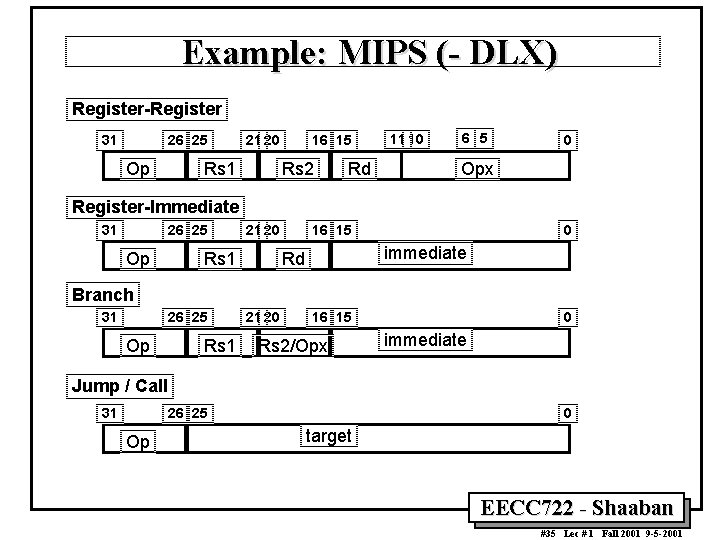
Example: MIPS ( DLX) Register-Register 31 26 25 Op 21 20 Rs 1 16 15 Rs 2 Rd 11 10 6 5 0 Opx Register-Immediate 31 26 25 Op 21 20 Rs 1 16 15 0 immediate Rd Branch 31 26 25 Op Rs 1 21 20 16 15 Rs 2/Opx 0 immediate Jump / Call 31 26 25 Op 0 target EECC 722 Shaaban #35 Lec # 1 Fall 2001 9 5 2001
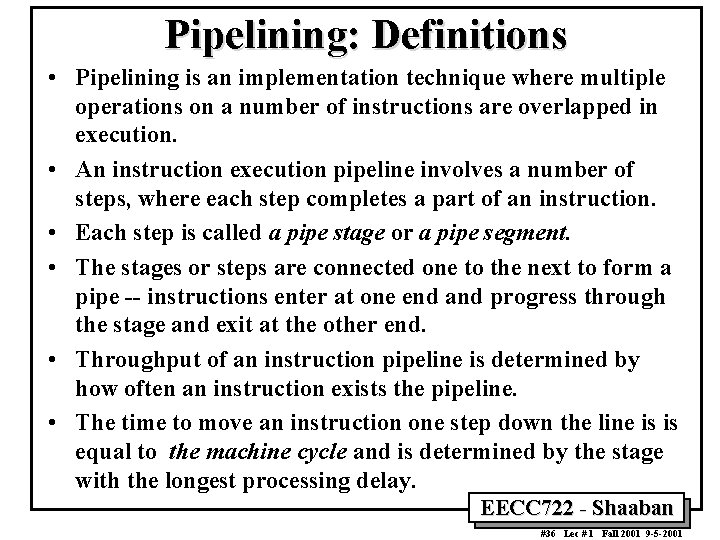
Pipelining: Definitions • Pipelining is an implementation technique where multiple operations on a number of instructions are overlapped in execution. • An instruction execution pipeline involves a number of steps, where each step completes a part of an instruction. • Each step is called a pipe stage or a pipe segment. • The stages or steps are connected one to the next to form a pipe instructions enter at one end and progress through the stage and exit at the other end. • Throughput of an instruction pipeline is determined by how often an instruction exists the pipeline. • The time to move an instruction one step down the line is is equal to the machine cycle and is determined by the stage with the longest processing delay. EECC 722 Shaaban #36 Lec # 1 Fall 2001 9 5 2001
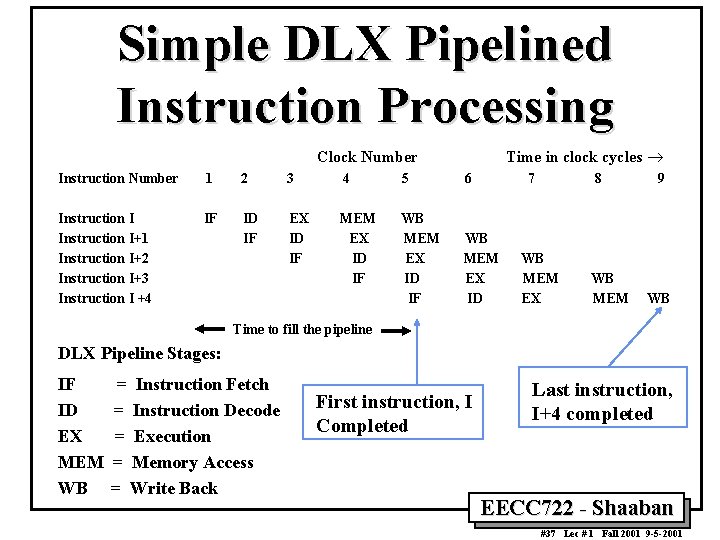
Simple DLX Pipelined Instruction Processing Time in clock cycles ® Clock Number Instruction Number 1 2 3 4 5 6 7 Instruction I+1 Instruction I+2 Instruction I+3 Instruction I +4 IF ID IF EX ID IF MEM EX ID IF WB MEM EX ID 8 WB MEM EX WB MEM 9 WB Time to fill the pipeline DLX Pipeline Stages: IF ID EX MEM WB = Instruction Fetch = Instruction Decode = Execution = Memory Access = Write Back First instruction, I Completed Last instruction, I+4 completed EECC 722 Shaaban #37 Lec # 1 Fall 2001 9 5 2001
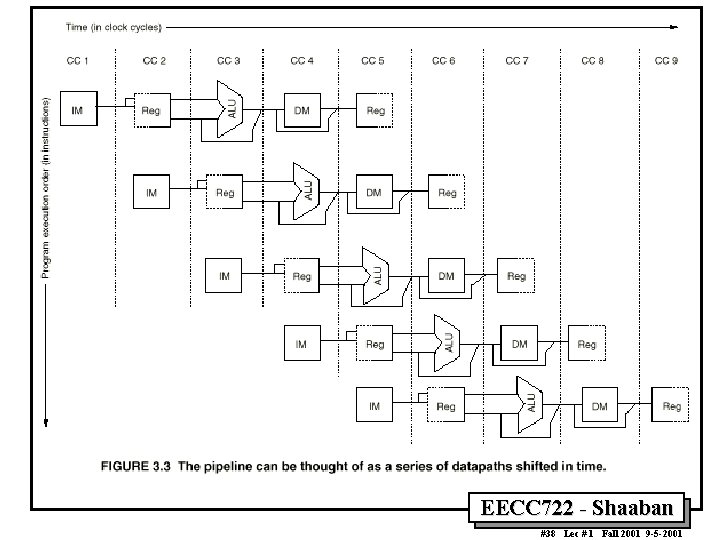
EECC 722 Shaaban #38 Lec # 1 Fall 2001 9 5 2001
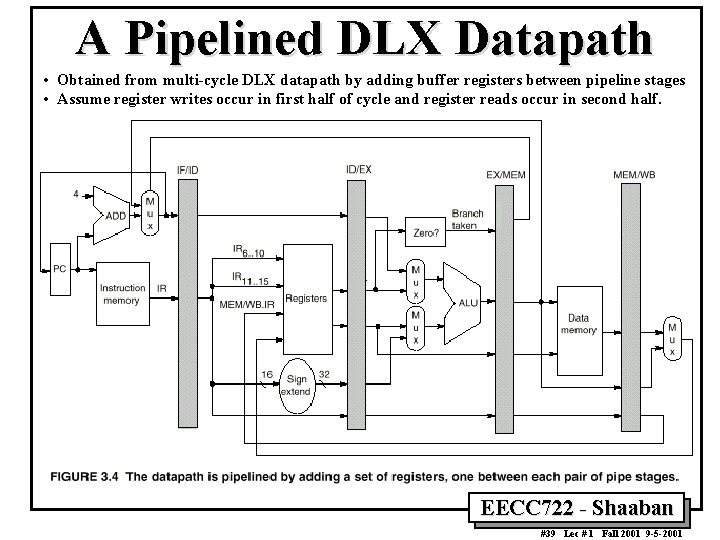
A Pipelined DLX Datapath • Obtained from multi cycle DLX datapath by adding buffer registers between pipeline stages • Assume register writes occur in first half of cycle and register reads occur in second half. EECC 722 Shaaban #39 Lec # 1 Fall 2001 9 5 2001
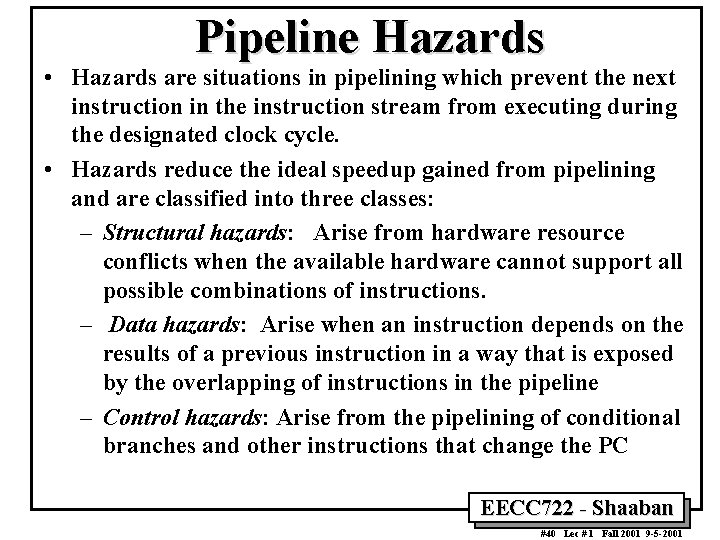
Pipeline Hazards • Hazards are situations in pipelining which prevent the next instruction in the instruction stream from executing during the designated clock cycle. • Hazards reduce the ideal speedup gained from pipelining and are classified into three classes: – Structural hazards: Arise from hardware resource conflicts when the available hardware cannot support all possible combinations of instructions. – Data hazards: Arise when an instruction depends on the results of a previous instruction in a way that is exposed by the overlapping of instructions in the pipeline – Control hazards: Arise from the pipelining of conditional branches and other instructions that change the PC EECC 722 Shaaban #40 Lec # 1 Fall 2001 9 5 2001
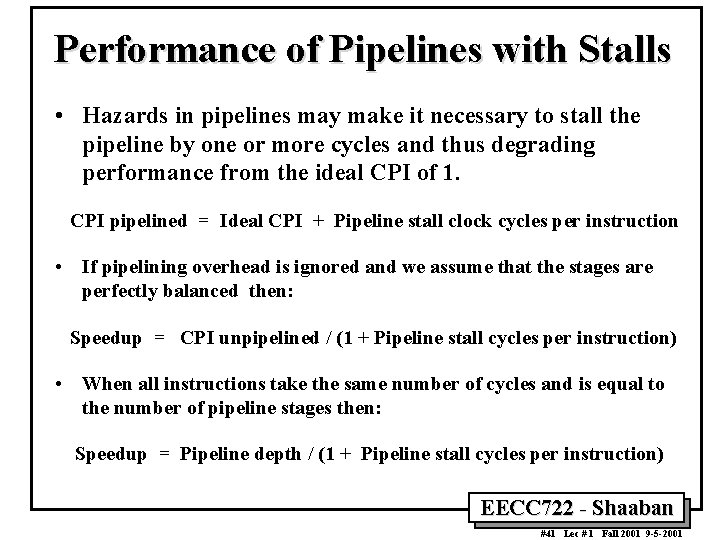
Performance of Pipelines with Stalls • Hazards in pipelines may make it necessary to stall the pipeline by one or more cycles and thus degrading performance from the ideal CPI of 1. CPI pipelined = Ideal CPI + Pipeline stall clock cycles per instruction • If pipelining overhead is ignored and we assume that the stages are perfectly balanced then: Speedup = CPI unpipelined / (1 + Pipeline stall cycles per instruction) • When all instructions take the same number of cycles and is equal to the number of pipeline stages then: Speedup = Pipeline depth / (1 + Pipeline stall cycles per instruction) EECC 722 Shaaban #41 Lec # 1 Fall 2001 9 5 2001
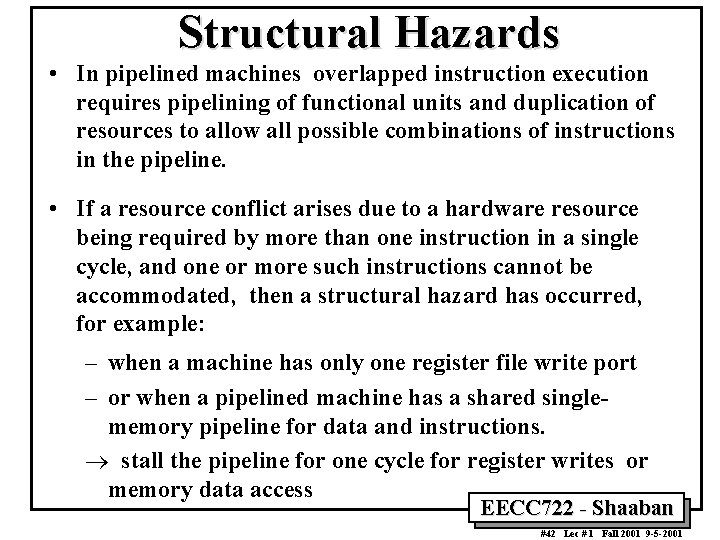
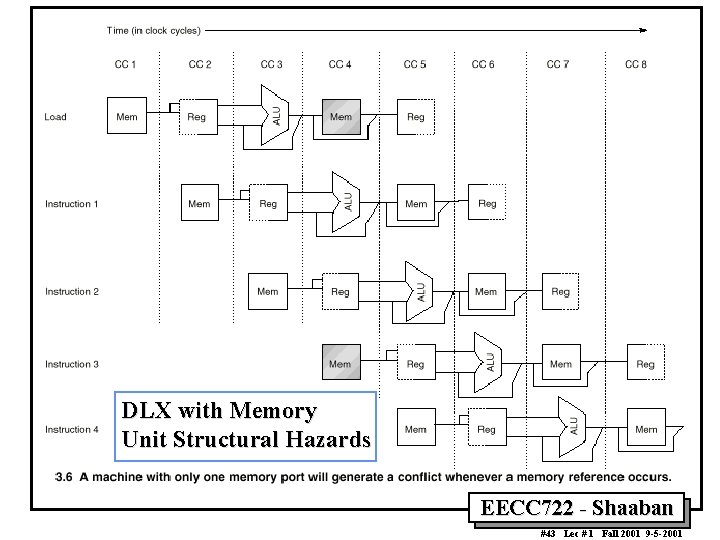
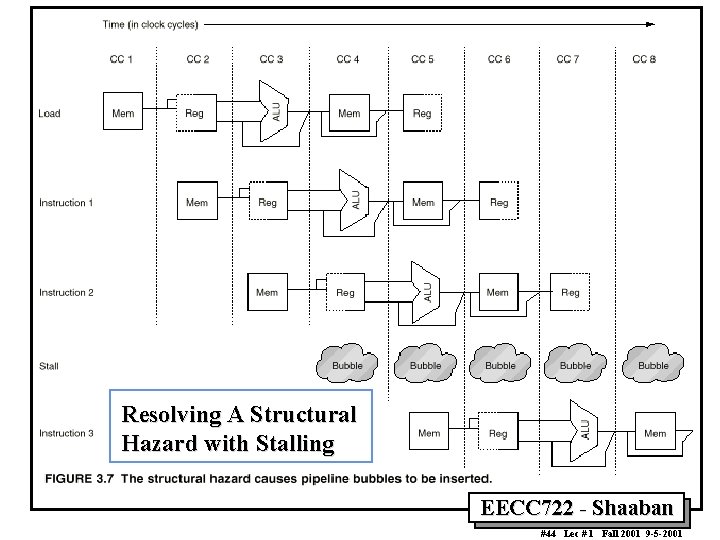
Structural Hazards • In pipelined machines overlapped instruction execution requires pipelining of functional units and duplication of resources to allow all possible combinations of instructions in the pipeline. • If a resource conflict arises due to a hardware resource being required by more than one instruction in a single cycle, and one or more such instructions cannot be accommodated, then a structural hazard has occurred, for example: – when a machine has only one register file write port – or when a pipelined machine has a shared single memory pipeline for data and instructions. ® stall the pipeline for one cycle for register writes or memory data access EECC 722 Shaaban #42 Lec # 1 Fall 2001 9 5 2001
DLX with Memory Unit Structural Hazards EECC 722 Shaaban #43 Lec # 1 Fall 2001 9 5 2001
Resolving A Structural Hazard with Stalling EECC 722 Shaaban #44 Lec # 1 Fall 2001 9 5 2001
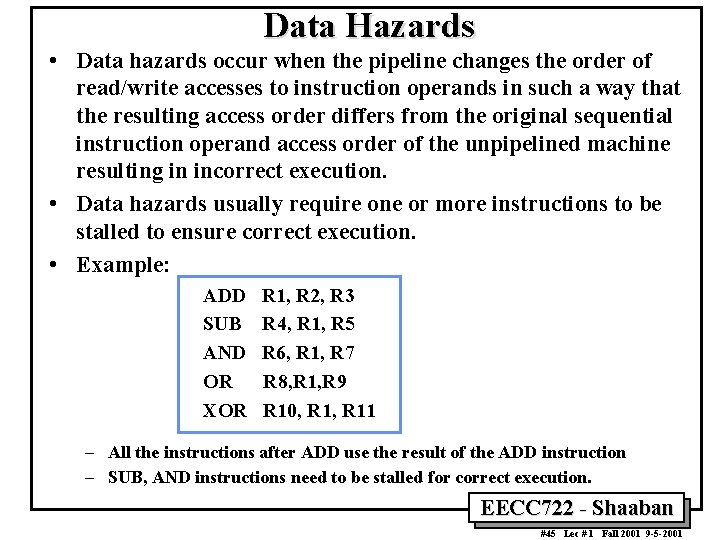
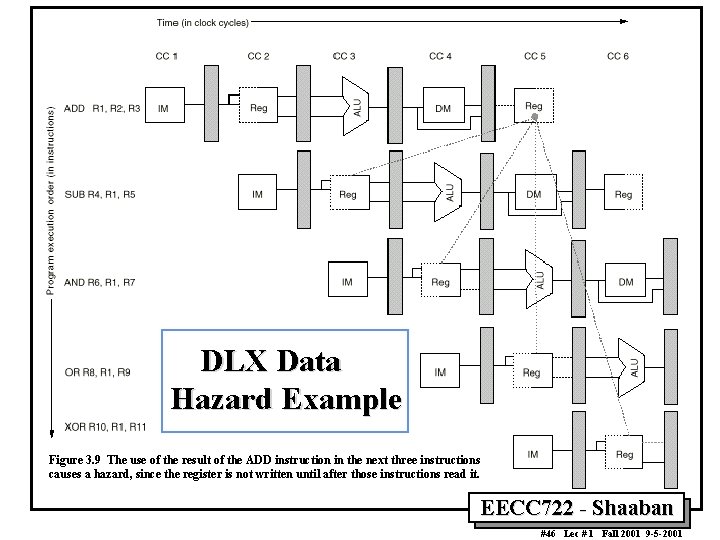
Data Hazards • Data hazards occur when the pipeline changes the order of read/write accesses to instruction operands in such a way that the resulting access order differs from the original sequential instruction operand access order of the unpipelined machine resulting in incorrect execution. • Data hazards usually require one or more instructions to be stalled to ensure correct execution. • Example: ADD SUB AND OR XOR R 1, R 2, R 3 R 4, R 1, R 5 R 6, R 1, R 7 R 8, R 1, R 9 R 10, R 11 – All the instructions after ADD use the result of the ADD instruction – SUB, AND instructions need to be stalled for correct execution. EECC 722 Shaaban #45 Lec # 1 Fall 2001 9 5 2001
DLX Data Hazard Example Figure 3. 9 The use of the result of the ADD instruction in the next three instructions causes a hazard, since the register is not written until after those instructions read it. EECC 722 Shaaban #46 Lec # 1 Fall 2001 9 5 2001
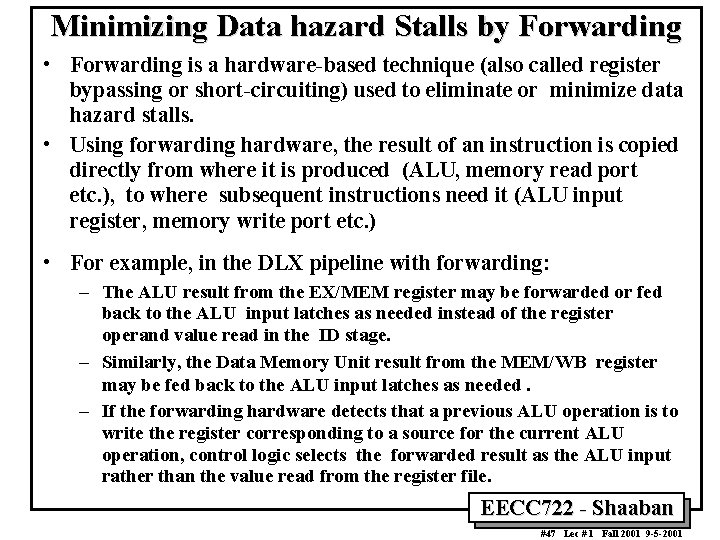
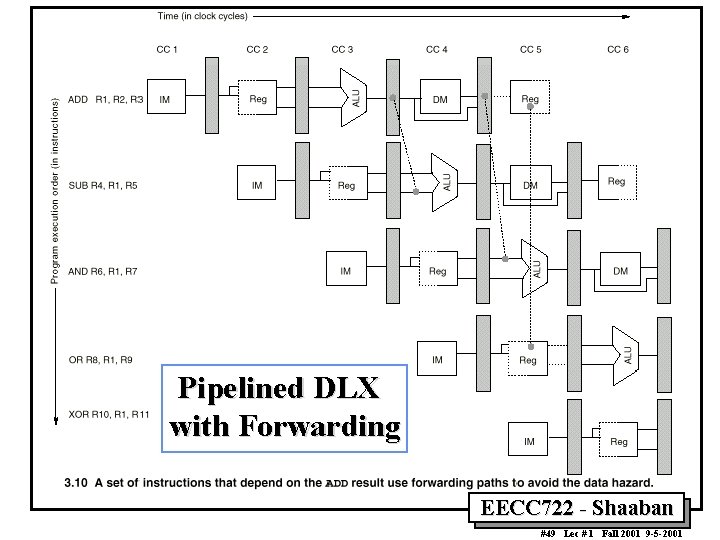
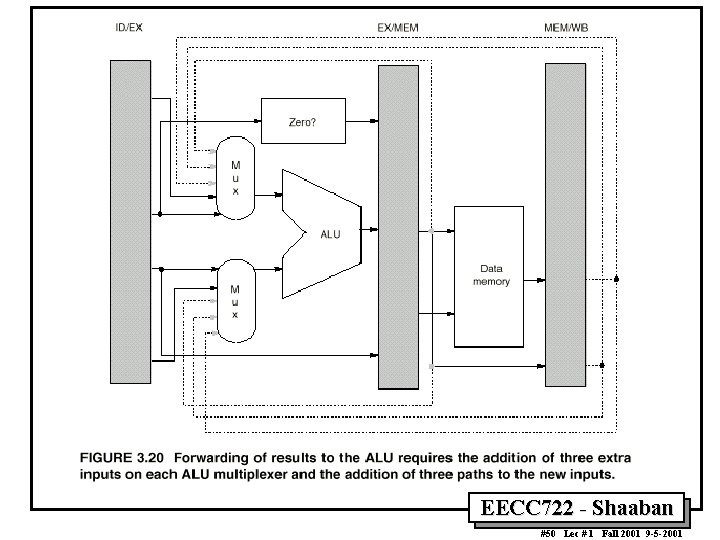
Minimizing Data hazard Stalls by Forwarding • Forwarding is a hardware based technique (also called register bypassing or short circuiting) used to eliminate or minimize data hazard stalls. • Using forwarding hardware, the result of an instruction is copied directly from where it is produced (ALU, memory read port etc. ), to where subsequent instructions need it (ALU input register, memory write port etc. ) • For example, in the DLX pipeline with forwarding: – The ALU result from the EX/MEM register may be forwarded or fed back to the ALU input latches as needed instead of the register operand value read in the ID stage. – Similarly, the Data Memory Unit result from the MEM/WB register may be fed back to the ALU input latches as needed. – If the forwarding hardware detects that a previous ALU operation is to write the register corresponding to a source for the current ALU operation, control logic selects the forwarded result as the ALU input rather than the value read from the register file. EECC 722 Shaaban #47 Lec # 1 Fall 2001 9 5 2001
Minimizing Data hazard Stalls by Forwarding • Forwarding is a hardware based technique (also called register bypassing or short circuiting) used to eliminate or minimize data hazard stalls. • Using forwarding hardware, the result of an instruction is copied directly from where it is produced (ALU, memory read port etc. ), to where subsequent instructions need it (ALU input register, memory write port etc. ) • For example, in the DLX pipeline with forwarding: – The ALU result from the EX/MEM register may be forwarded or fed back to the ALU input latches as needed instead of the register operand value read in the ID stage. – Similarly, the Data Memory Unit result from the MEM/WB register may be fed back to the ALU input latches as needed. – If the forwarding hardware detects that a previous ALU operation is to write the register corresponding to a source for the current ALU operation, control logic selects the forwarded result as the ALU input rather than the value read from the register file. EECC 722 Shaaban #48 Lec # 1 Fall 2001 9 5 2001
Pipelined DLX with Forwarding EECC 722 Shaaban #49 Lec # 1 Fall 2001 9 5 2001
EECC 722 Shaaban #50 Lec # 1 Fall 2001 9 5 2001
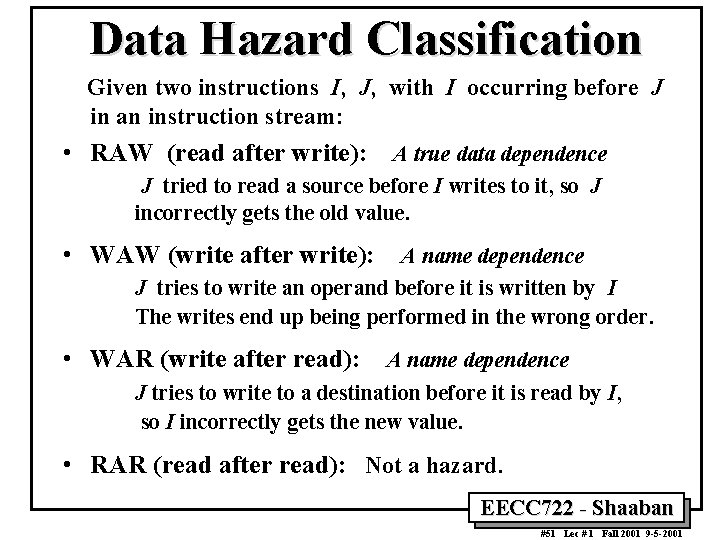
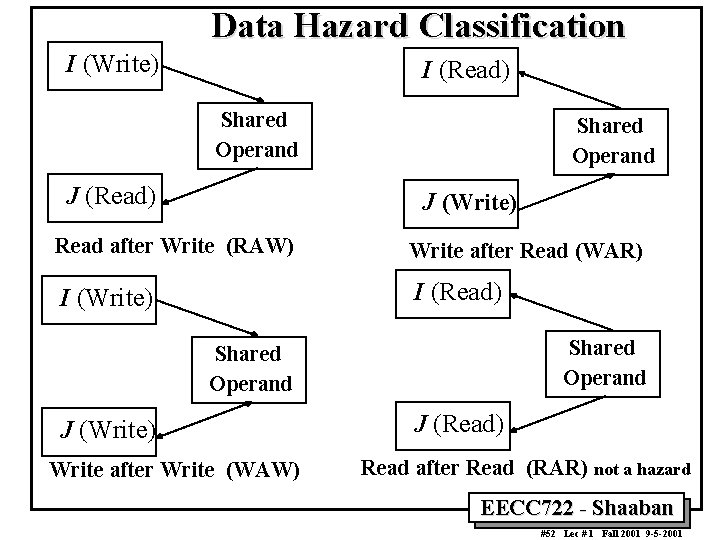
Data Hazard Classification Given two instructions I, J, with I occurring before J in an instruction stream: • RAW (read after write): A true data dependence J tried to read a source before I writes to it, so J incorrectly gets the old value. • WAW (write after write): A name dependence J tries to write an operand before it is written by I The writes end up being performed in the wrong order. • WAR (write after read): A name dependence J tries to write to a destination before it is read by I, so I incorrectly gets the new value. • RAR (read after read): Not a hazard. EECC 722 Shaaban #51 Lec # 1 Fall 2001 9 5 2001
Data Hazard Classification I (Write) I (Read) Shared Operand J (Write) Read after Write (RAW) Write after Read (WAR) I (Write) I (Read) Shared Operand J (Write) Write after Write (WAW) J (Read) Read after Read (RAR) not a hazard EECC 722 Shaaban #52 Lec # 1 Fall 2001 9 5 2001
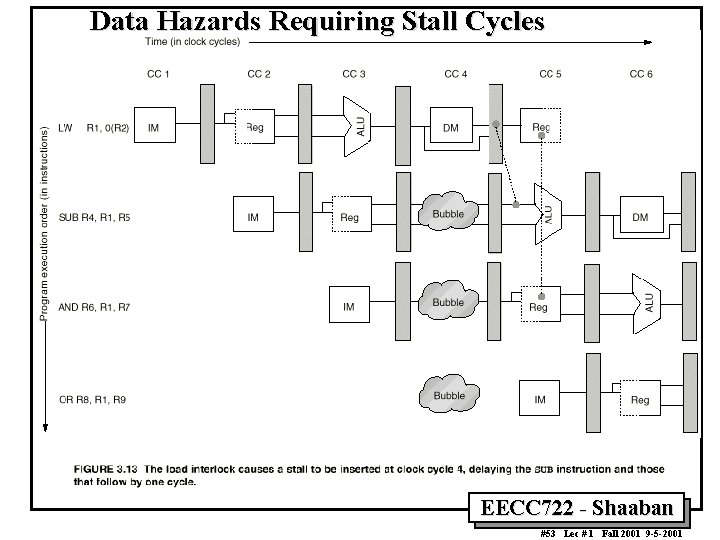
Data Hazards Requiring Stall Cycles EECC 722 Shaaban #53 Lec # 1 Fall 2001 9 5 2001
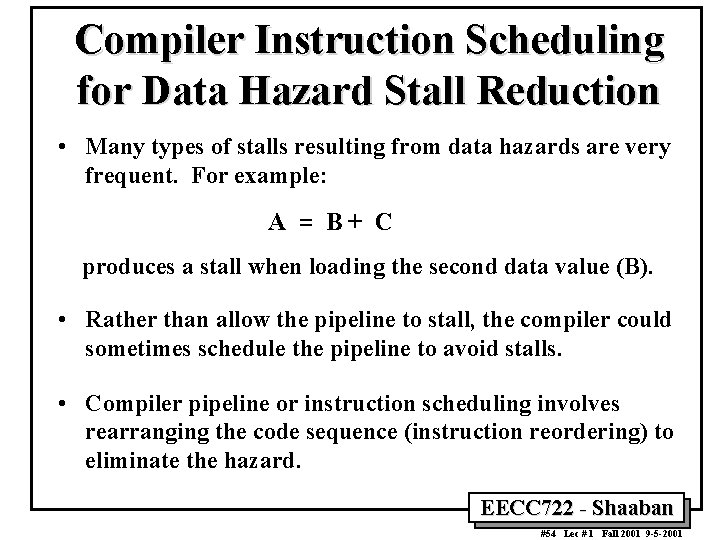
Compiler Instruction Scheduling for Data Hazard Stall Reduction • Many types of stalls resulting from data hazards are very frequent. For example: A = B+ C produces a stall when loading the second data value (B). • Rather than allow the pipeline to stall, the compiler could sometimes schedule the pipeline to avoid stalls. • Compiler pipeline or instruction scheduling involves rearranging the code sequence (instruction reordering) to eliminate the hazard. EECC 722 Shaaban #54 Lec # 1 Fall 2001 9 5 2001
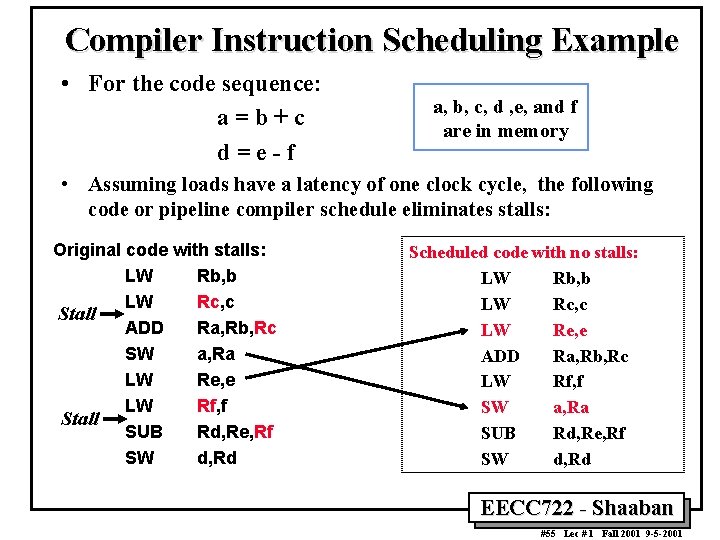
Compiler Instruction Scheduling Example • For the code sequence: a=b+c d=e f a, b, c, d , e, and f are in memory • Assuming loads have a latency of one clock cycle, the following code or pipeline compiler schedule eliminates stalls: Original code with stalls: LW Rb, b LW Rc, c Stall ADD Ra, Rb, Rc SW a, Ra LW Re, e LW Rf, f Stall SUB Rd, Re, Rf SW d, Rd Scheduled code with no stalls: LW Rb, b LW Rc, c LW Re, e ADD Ra, Rb, Rc LW Rf, f SW a, Ra SUB Rd, Re, Rf SW d, Rd EECC 722 Shaaban #55 Lec # 1 Fall 2001 9 5 2001
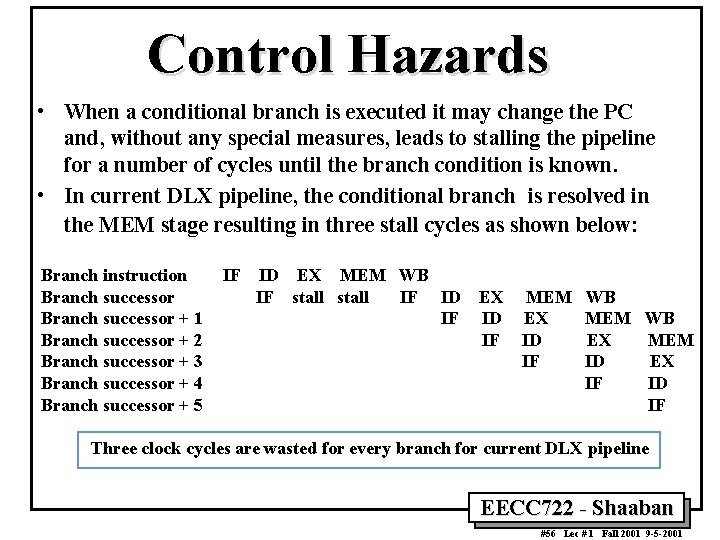
Control Hazards • When a conditional branch is executed it may change the PC and, without any special measures, leads to stalling the pipeline for a number of cycles until the branch condition is known. • In current DLX pipeline, the conditional branch is resolved in the MEM stage resulting in three stall cycles as shown below: Branch instruction Branch successor + 1 Branch successor + 2 Branch successor + 3 Branch successor + 4 Branch successor + 5 IF ID EX MEM WB IF stall IF ID IF EX ID IF MEM EX ID IF WB MEM WB EX MEM ID EX IF ID IF Three clock cycles are wasted for every branch for current DLX pipeline EECC 722 Shaaban #56 Lec # 1 Fall 2001 9 5 2001
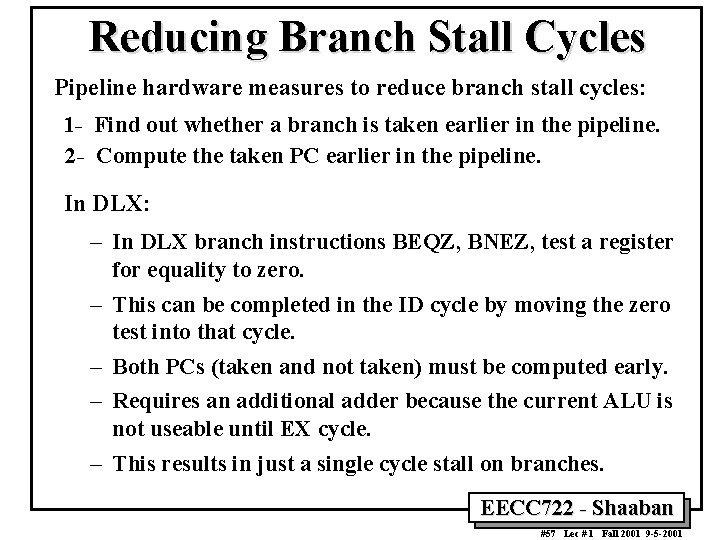
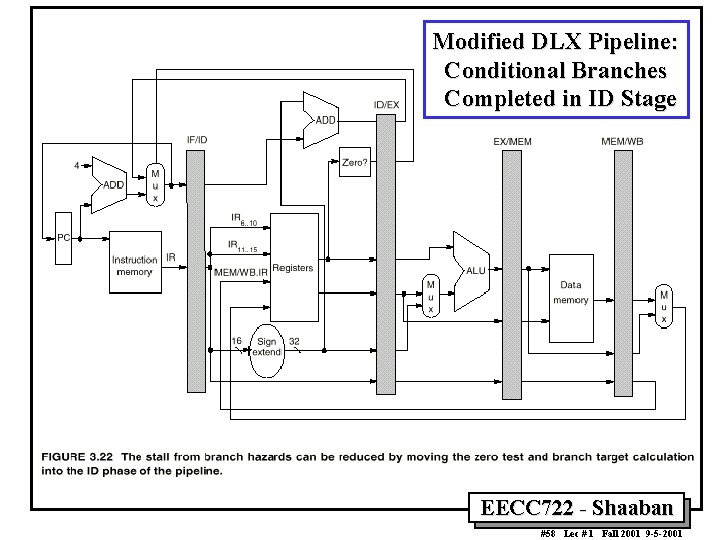
Reducing Branch Stall Cycles Pipeline hardware measures to reduce branch stall cycles: 1 Find out whether a branch is taken earlier in the pipeline. 2 Compute the taken PC earlier in the pipeline. In DLX: – In DLX branch instructions BEQZ, BNEZ, test a register for equality to zero. – This can be completed in the ID cycle by moving the zero test into that cycle. – Both PCs (taken and not taken) must be computed early. – Requires an additional adder because the current ALU is not useable until EX cycle. – This results in just a single cycle stall on branches. EECC 722 Shaaban #57 Lec # 1 Fall 2001 9 5 2001
Modified DLX Pipeline: Conditional Branches Completed in ID Stage EECC 722 Shaaban #58 Lec # 1 Fall 2001 9 5 2001
Static Compiler Branch Prediction Two basic methods exist to statically predict branches at compile time: 1 By examination of program behavior and the use of information collected from earlier runs of the program. – For example, a program profile may show that most forward branches and backward branches (often forming loops) are taken. The simplest scheme in this case is to just predict the branch as taken. 2 To predict branches on the basis of branch direction, choosing backward branches as taken and forward branches as not taken. EECC 722 Shaaban #59 Lec # 1 Fall 2001 9 5 2001
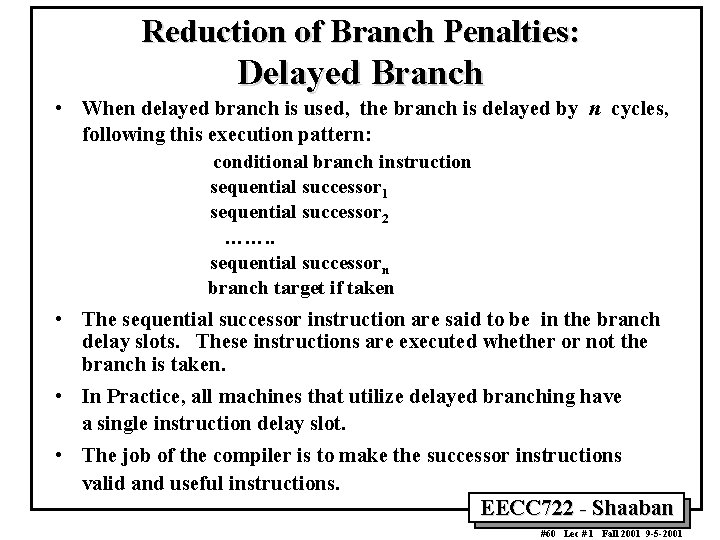
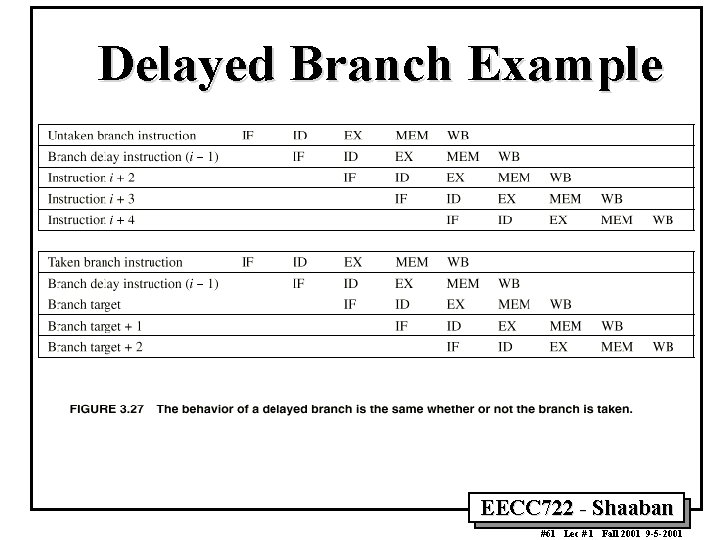
Reduction of Branch Penalties: Delayed Branch • When delayed branch is used, the branch is delayed by n cycles, following this execution pattern: conditional branch instruction sequential successor 1 sequential successor 2 ……. . sequential successorn branch target if taken • The sequential successor instruction are said to be in the branch delay slots. These instructions are executed whether or not the branch is taken. • In Practice, all machines that utilize delayed branching have a single instruction delay slot. • The job of the compiler is to make the successor instructions valid and useful instructions. EECC 722 Shaaban #60 Lec # 1 Fall 2001 9 5 2001
Delayed Branch Example EECC 722 Shaaban #61 Lec # 1 Fall 2001 9 5 2001
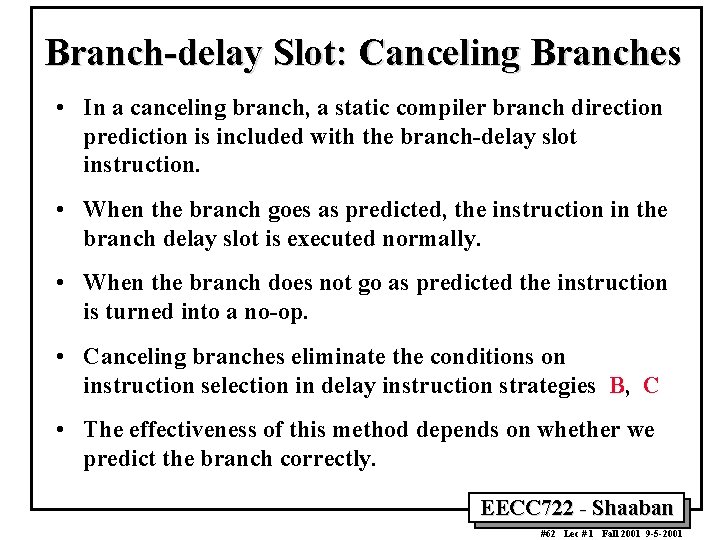
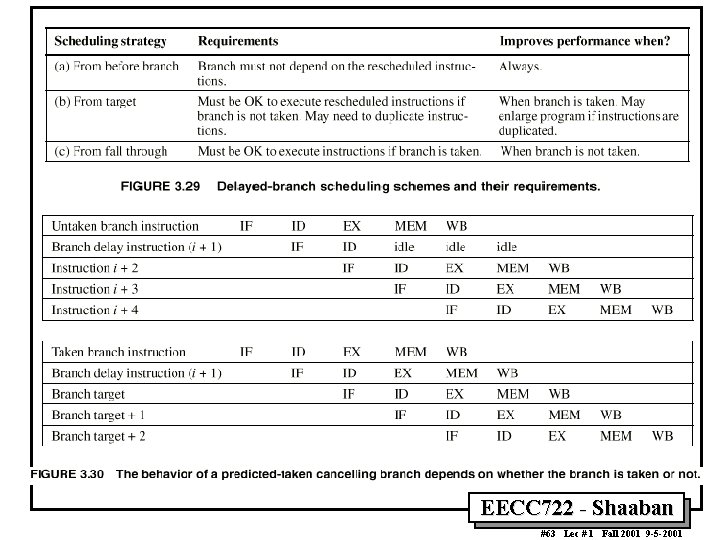
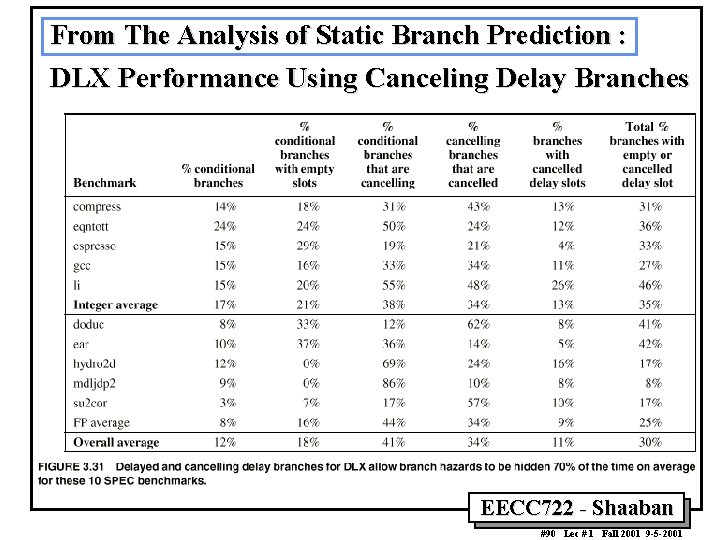
Branch delay Slot: Canceling Branches • In a canceling branch, a static compiler branch direction prediction is included with the branch delay slot instruction. • When the branch goes as predicted, the instruction in the branch delay slot is executed normally. • When the branch does not go as predicted the instruction is turned into a no op. • Canceling branches eliminate the conditions on instruction selection in delay instruction strategies B, C • The effectiveness of this method depends on whether we predict the branch correctly. EECC 722 Shaaban #62 Lec # 1 Fall 2001 9 5 2001
EECC 722 Shaaban #63 Lec # 1 Fall 2001 9 5 2001
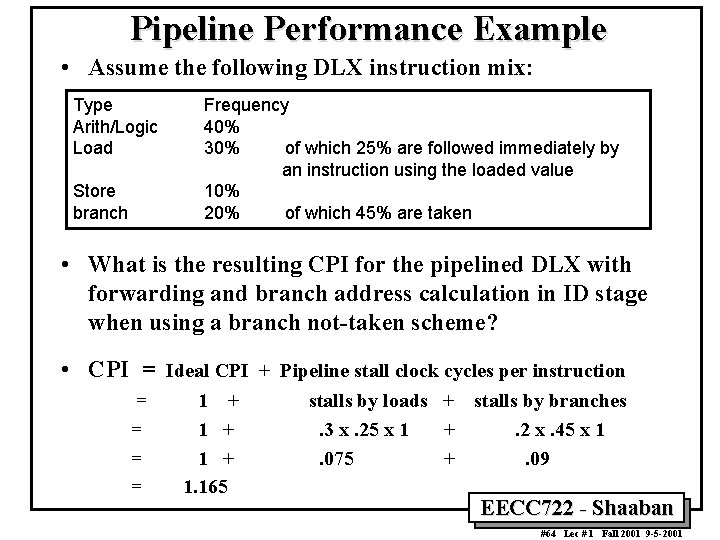
Pipeline Performance Example • Assume the following DLX instruction mix: Type Arith/Logic Load Store branch Frequency 40% 30% of which 25% are followed immediately by an instruction using the loaded value 10% 20% of which 45% are taken • What is the resulting CPI for the pipelined DLX with forwarding and branch address calculation in ID stage when using a branch not taken scheme? • CPI = Ideal CPI + Pipeline stall clock cycles per instruction = = 1 + 1 + 1. 165 stalls by loads + stalls by branches. 3 x. 25 x 1 +. 2 x. 45 x 1. 075 +. 09 EECC 722 Shaaban #64 Lec # 1 Fall 2001 9 5 2001
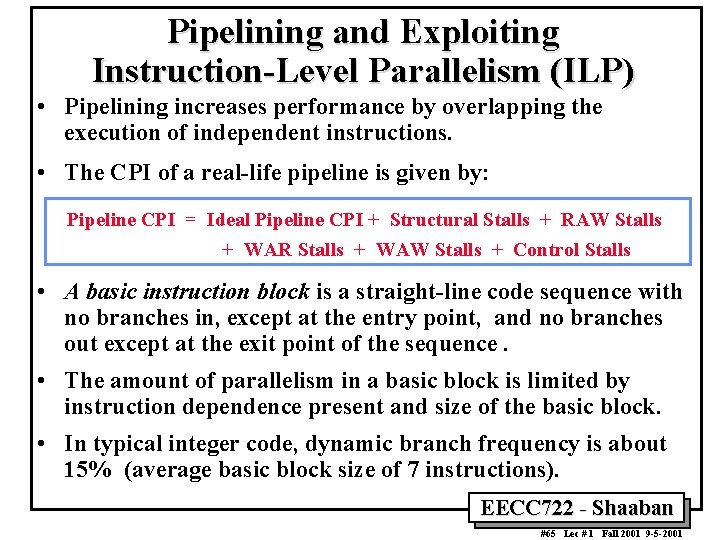
Pipelining and Exploiting Instruction Level Parallelism (ILP) • Pipelining increases performance by overlapping the execution of independent instructions. • The CPI of a real life pipeline is given by: Pipeline CPI = Ideal Pipeline CPI + Structural Stalls + RAW Stalls + WAR Stalls + WAW Stalls + Control Stalls • A basic instruction block is a straight line code sequence with no branches in, except at the entry point, and no branches out except at the exit point of the sequence. • The amount of parallelism in a basic block is limited by instruction dependence present and size of the basic block. • In typical integer code, dynamic branch frequency is about 15% (average basic block size of 7 instructions). EECC 722 Shaaban #65 Lec # 1 Fall 2001 9 5 2001
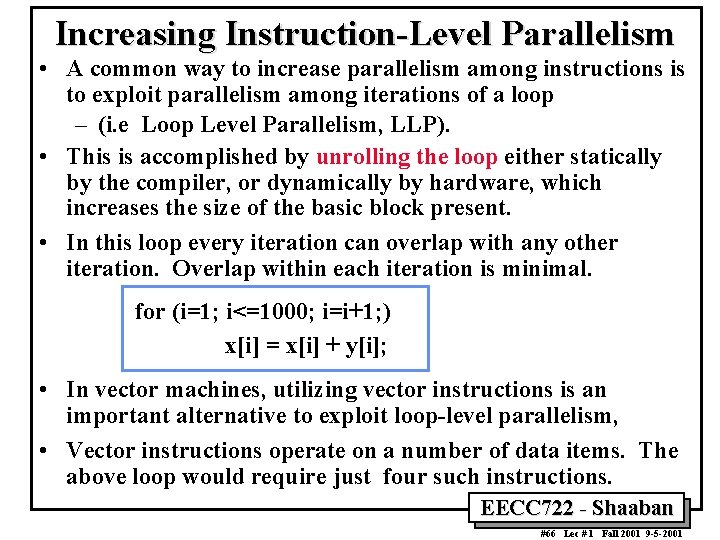
Increasing Instruction Level Parallelism • A common way to increase parallelism among instructions is to exploit parallelism among iterations of a loop – (i. e Loop Level Parallelism, LLP). • This is accomplished by unrolling the loop either statically by the compiler, or dynamically by hardware, which increases the size of the basic block present. • In this loop every iteration can overlap with any other iteration. Overlap within each iteration is minimal. for (i=1; i<=1000; i=i+1; ) x[i] = x[i] + y[i]; • In vector machines, utilizing vector instructions is an important alternative to exploit loop level parallelism, • Vector instructions operate on a number of data items. The above loop would require just four such instructions. EECC 722 Shaaban #66 Lec # 1 Fall 2001 9 5 2001
DLX Loop Unrolling Example • For the loop: for (i=1; i<=1000; i++) x[i] = x[i] + s; The straightforward DLX assembly code is given by: Loop: LD ADDD SD SUBI BENZ F 0, 0 (R 1) F 4, F 0, F 2 0(R 1), F 4 R 1, 8 R 1, Loop ; F 0=array element ; add scalar in F 2 ; store result ; decrement pointer 8 bytes ; branch R 1!=zero EECC 722 Shaaban #67 Lec # 1 Fall 2001 9 5 2001
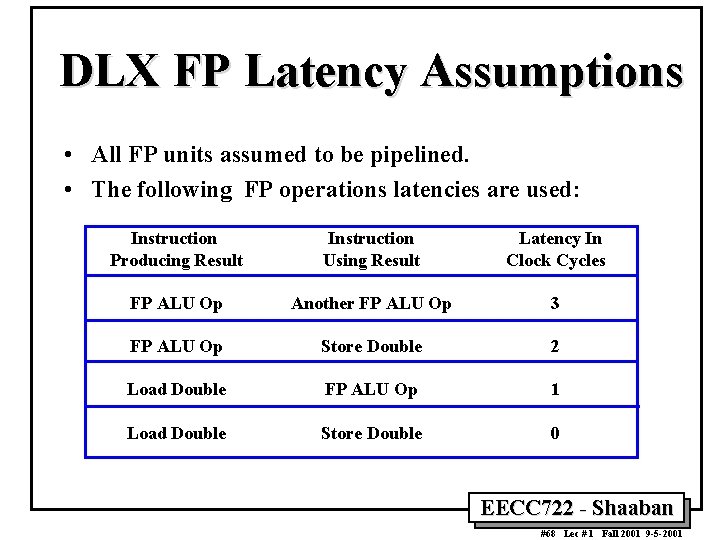
DLX FP Latency Assumptions • All FP units assumed to be pipelined. • The following FP operations latencies are used: Instruction Producing Result Instruction Using Result Latency In Clock Cycles FP ALU Op Another FP ALU Op 3 FP ALU Op Store Double 2 Load Double FP ALU Op 1 Load Double Store Double 0 EECC 722 Shaaban #68 Lec # 1 Fall 2001 9 5 2001
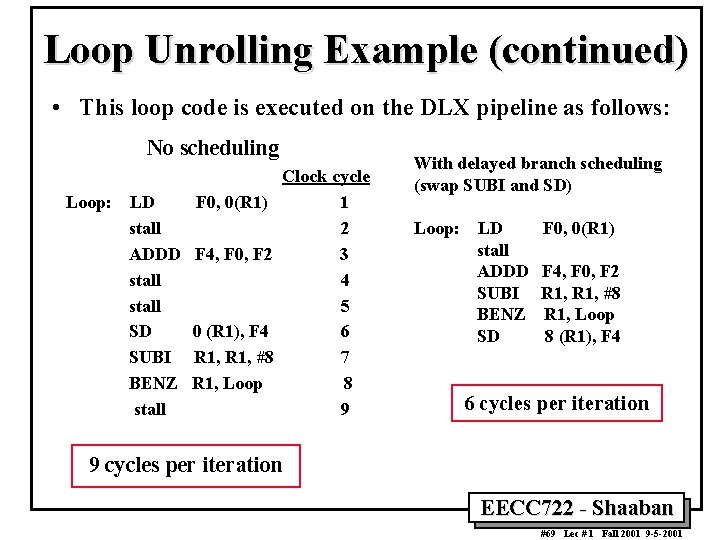
Loop Unrolling Example (continued) • This loop code is executed on the DLX pipeline as follows: No scheduling Loop: LD stall ADDD stall SD SUBI BENZ stall F 0, 0(R 1) F 4, F 0, F 2 0 (R 1), F 4 R 1, #8 R 1, Loop Clock cycle 1 2 3 4 5 6 7 8 9 With delayed branch scheduling (swap SUBI and SD) Loop: LD stall ADDD SUBI BENZ SD F 0, 0(R 1) F 4, F 0, F 2 R 1, #8 R 1, Loop 8 (R 1), F 4 6 cycles per iteration 9 cycles per iteration EECC 722 Shaaban #69 Lec # 1 Fall 2001 9 5 2001
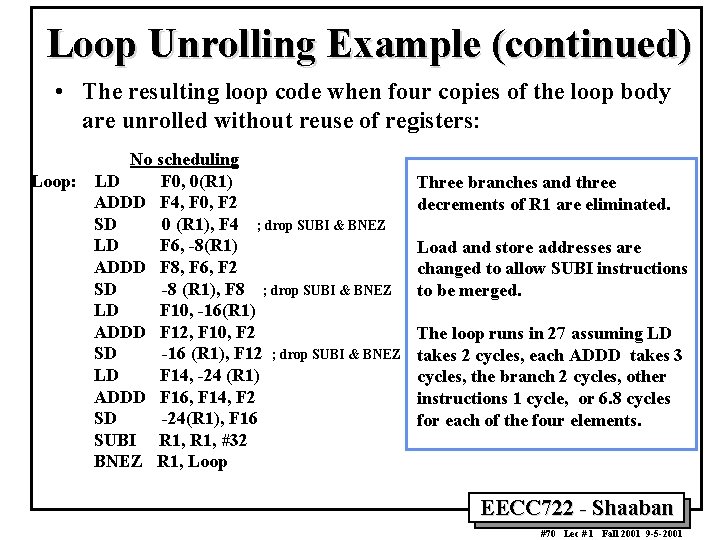
Loop Unrolling Example (continued) • The resulting loop code when four copies of the loop body are unrolled without reuse of registers: No scheduling Loop: LD F 0, 0(R 1) ADDD F 4, F 0, F 2 SD 0 (R 1), F 4 ; drop SUBI & BNEZ LD F 6, 8(R 1) ADDD F 8, F 6, F 2 SD 8 (R 1), F 8 ; drop SUBI & BNEZ LD F 10, 16(R 1) ADDD F 12, F 10, F 2 SD 16 (R 1), F 12 ; drop SUBI & BNEZ LD F 14, 24 (R 1) ADDD F 16, F 14, F 2 SD 24(R 1), F 16 SUBI R 1, #32 BNEZ R 1, Loop Three branches and three decrements of R 1 are eliminated. Load and store addresses are changed to allow SUBI instructions to be merged. The loop runs in 27 assuming LD takes 2 cycles, each ADDD takes 3 cycles, the branch 2 cycles, other instructions 1 cycle, or 6. 8 cycles for each of the four elements. EECC 722 Shaaban #70 Lec # 1 Fall 2001 9 5 2001
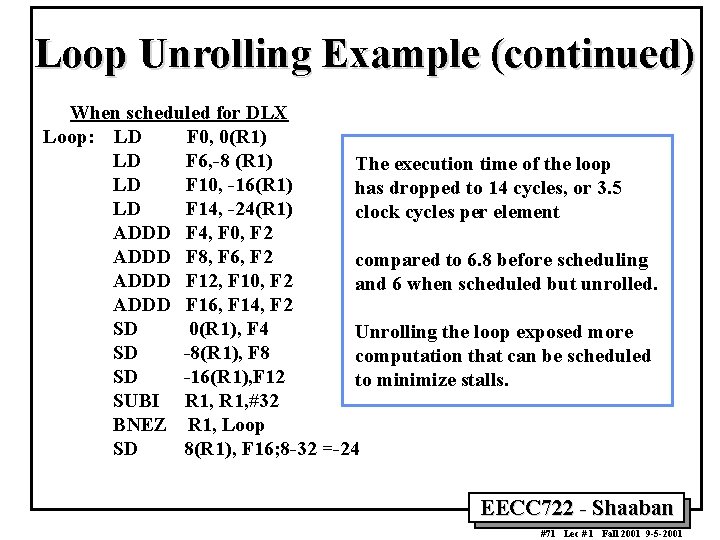
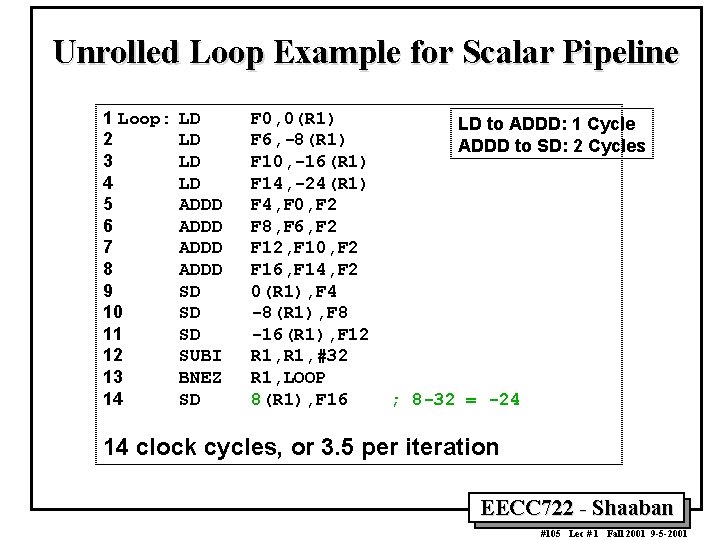
Loop Unrolling Example (continued) When scheduled for DLX Loop: LD F 0, 0(R 1) LD F 6, 8 (R 1) The execution time of the loop LD F 10, 16(R 1) has dropped to 14 cycles, or 3. 5 LD F 14, 24(R 1) clock cycles per element ADDD F 4, F 0, F 2 ADDD F 8, F 6, F 2 compared to 6. 8 before scheduling ADDD F 12, F 10, F 2 and 6 when scheduled but unrolled. ADDD F 16, F 14, F 2 SD 0(R 1), F 4 Unrolling the loop exposed more SD 8(R 1), F 8 computation that can be scheduled SD 16(R 1), F 12 to minimize stalls. SUBI R 1, #32 BNEZ R 1, Loop SD 8(R 1), F 16; 8 32 = 24 EECC 722 Shaaban #71 Lec # 1 Fall 2001 9 5 2001
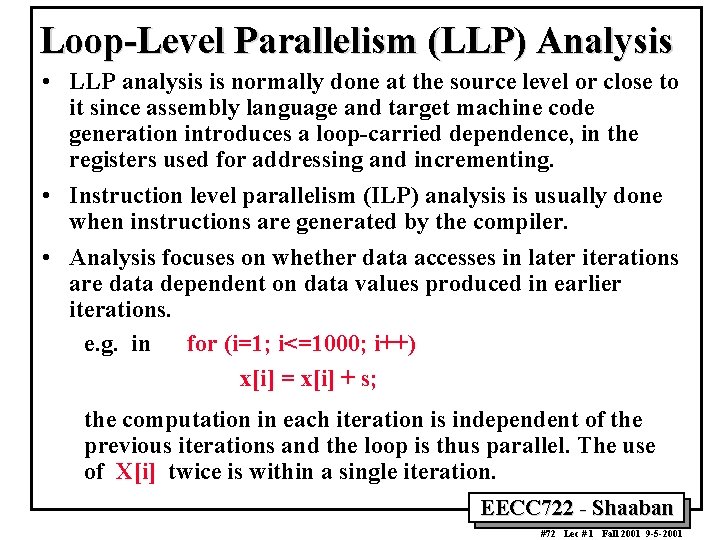
Loop Level Parallelism (LLP) Analysis • LLP analysis is normally done at the source level or close to it since assembly language and target machine code generation introduces a loop carried dependence, in the registers used for addressing and incrementing. • Instruction level parallelism (ILP) analysis is usually done when instructions are generated by the compiler. • Analysis focuses on whether data accesses in later iterations are data dependent on data values produced in earlier iterations. e. g. in for (i=1; i<=1000; i++) x[i] = x[i] + s; the computation in each iteration is independent of the previous iterations and the loop is thus parallel. The use of X[i] twice is within a single iteration. EECC 722 Shaaban #72 Lec # 1 Fall 2001 9 5 2001
LLP Analysis Examples • In the loop: for (i=1; i<=100; i=i+1) { A[i+1] = A[i] + C[i]; /* S 1 */ B[i+1] = B[i] + A[i+1]; } /* S 2 */ } – S 1 uses a value computed in an earlier iteration, since iteration i computes A[i+1] read in iteration i+1 (loop carried dependence, prevents parallelism). – S 2 uses the value A[i+1], computed by S 1 in the same iteration (not loop carried dependence). EECC 722 Shaaban #73 Lec # 1 Fall 2001 9 5 2001
• In the loop: LLP Analysis Examples for (i=1; i<=100; i=i+1) { A[i] = A[i] + B[i]; B[i+1] = C[i] + D[i]; /* S 1 */ /* S 2 */ } – S 1 uses a value computed by S 2 in a previous iteration (loop carried dependence) – This dependence is not circular (neither statement depend on itself; S 1 depends on S 2 but S 2 does not depend on S 1. – Can be made parallel by replacing the code with the following: A[1] = A[1] + B[1]; for (i=1; i<=99; i=i+1) { B[i+1] = C[i] + D[i]; A[i+1] = A[i+1] + B[i+1]; } B[101] = C[100] + D[100]; EECC 722 Shaaban #74 Lec # 1 Fall 2001 9 5 2001
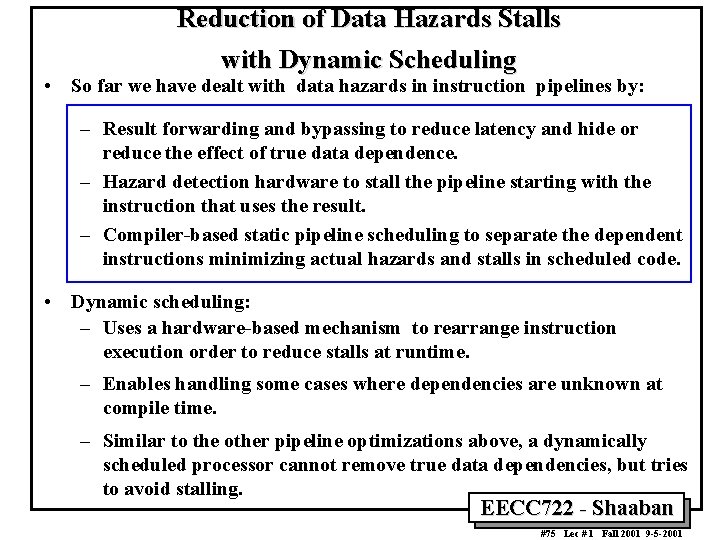
Reduction of Data Hazards Stalls with Dynamic Scheduling • So far we have dealt with data hazards in instruction pipelines by: – Result forwarding and bypassing to reduce latency and hide or reduce the effect of true data dependence. – Hazard detection hardware to stall the pipeline starting with the instruction that uses the result. – Compiler based static pipeline scheduling to separate the dependent instructions minimizing actual hazards and stalls in scheduled code. • Dynamic scheduling: – Uses a hardware based mechanism to rearrange instruction execution order to reduce stalls at runtime. – Enables handling some cases where dependencies are unknown at compile time. – Similar to the other pipeline optimizations above, a dynamically scheduled processor cannot remove true data dependencies, but tries to avoid stalling. EECC 722 Shaaban #75 Lec # 1 Fall 2001 9 5 2001
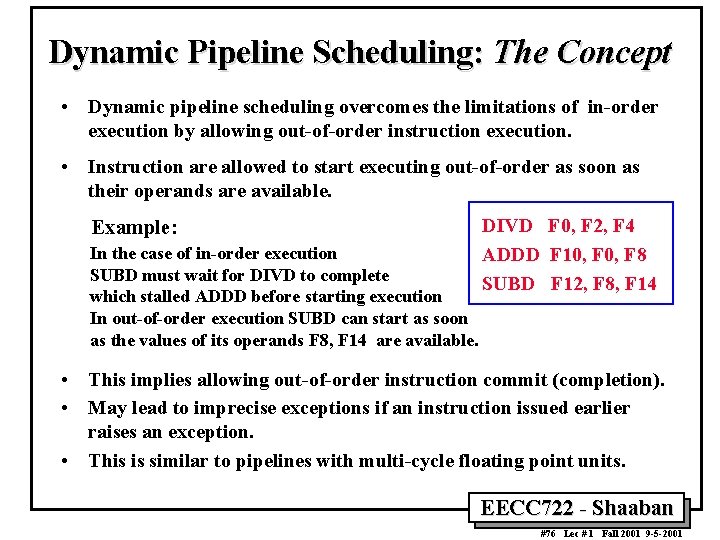
Dynamic Pipeline Scheduling: The Concept • Dynamic pipeline scheduling overcomes the limitations of in order execution by allowing out of order instruction execution. • Instruction are allowed to start executing out of order as soon as their operands are available. Example: In the case of in order execution SUBD must wait for DIVD to complete which stalled ADDD before starting execution In out of order execution SUBD can start as soon as the values of its operands F 8, F 14 are available. DIVD F 0, F 2, F 4 ADDD F 10, F 8 SUBD F 12, F 8, F 14 • This implies allowing out of order instruction commit (completion). • May lead to imprecise exceptions if an instruction issued earlier raises an exception. • This is similar to pipelines with multi cycle floating point units. EECC 722 Shaaban #76 Lec # 1 Fall 2001 9 5 2001
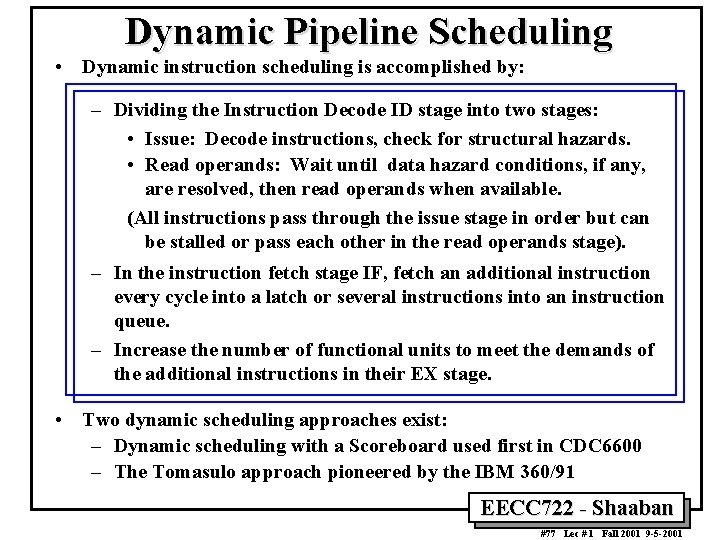
Dynamic Pipeline Scheduling • Dynamic instruction scheduling is accomplished by: – Dividing the Instruction Decode ID stage into two stages: • Issue: Decode instructions, check for structural hazards. • Read operands: Wait until data hazard conditions, if any, are resolved, then read operands when available. (All instructions pass through the issue stage in order but can be stalled or pass each other in the read operands stage). – In the instruction fetch stage IF, fetch an additional instruction every cycle into a latch or several instructions into an instruction queue. – Increase the number of functional units to meet the demands of the additional instructions in their EX stage. • Two dynamic scheduling approaches exist: – Dynamic scheduling with a Scoreboard used first in CDC 6600 – The Tomasulo approach pioneered by the IBM 360/91 EECC 722 Shaaban #77 Lec # 1 Fall 2001 9 5 2001
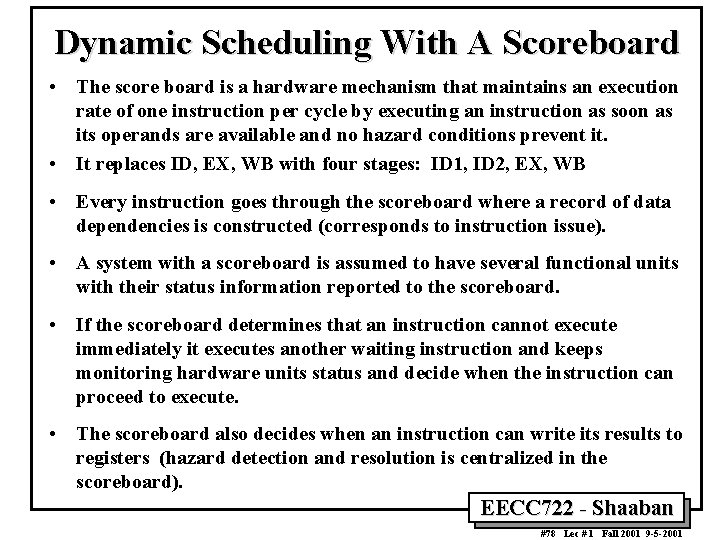
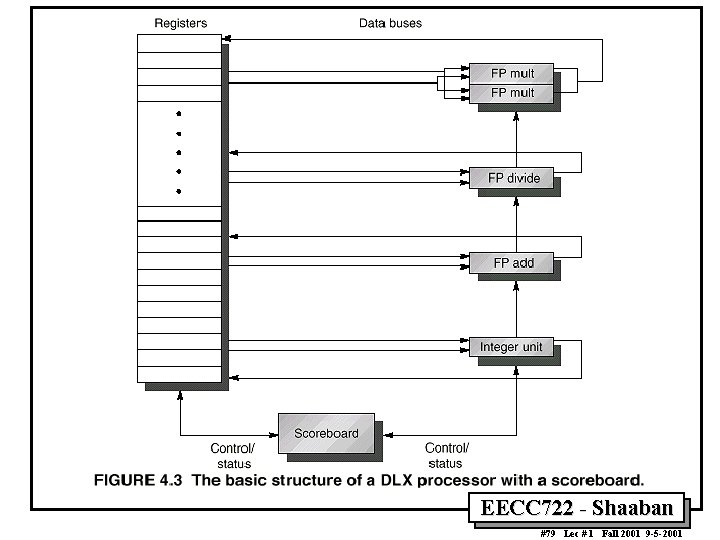
Dynamic Scheduling With A Scoreboard • The score board is a hardware mechanism that maintains an execution rate of one instruction per cycle by executing an instruction as soon as its operands are available and no hazard conditions prevent it. • It replaces ID, EX, WB with four stages: ID 1, ID 2, EX, WB • Every instruction goes through the scoreboard where a record of data dependencies is constructed (corresponds to instruction issue). • A system with a scoreboard is assumed to have several functional units with their status information reported to the scoreboard. • If the scoreboard determines that an instruction cannot execute immediately it executes another waiting instruction and keeps monitoring hardware units status and decide when the instruction can proceed to execute. • The scoreboard also decides when an instruction can write its results to registers (hazard detection and resolution is centralized in the scoreboard). EECC 722 Shaaban #78 Lec # 1 Fall 2001 9 5 2001
EECC 722 Shaaban #79 Lec # 1 Fall 2001 9 5 2001
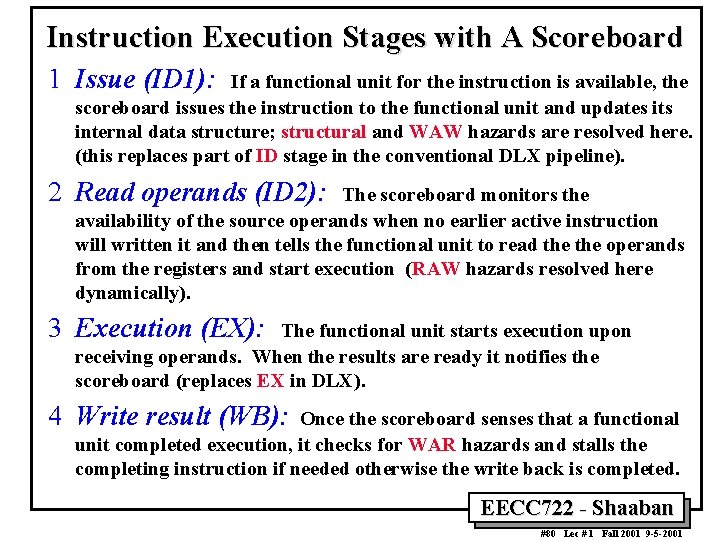
Instruction Execution Stages with A Scoreboard 1 Issue (ID 1): If a functional unit for the instruction is available, the scoreboard issues the instruction to the functional unit and updates its internal data structure; structural and WAW hazards are resolved here. (this replaces part of ID stage in the conventional DLX pipeline). 2 Read operands (ID 2): The scoreboard monitors the availability of the source operands when no earlier active instruction will written it and then tells the functional unit to read the operands from the registers and start execution (RAW hazards resolved here dynamically). 3 Execution (EX): The functional unit starts execution upon receiving operands. When the results are ready it notifies the scoreboard (replaces EX in DLX). 4 Write result (WB): Once the scoreboard senses that a functional unit completed execution, it checks for WAR hazards and stalls the completing instruction if needed otherwise the write back is completed. EECC 722 Shaaban #80 Lec # 1 Fall 2001 9 5 2001
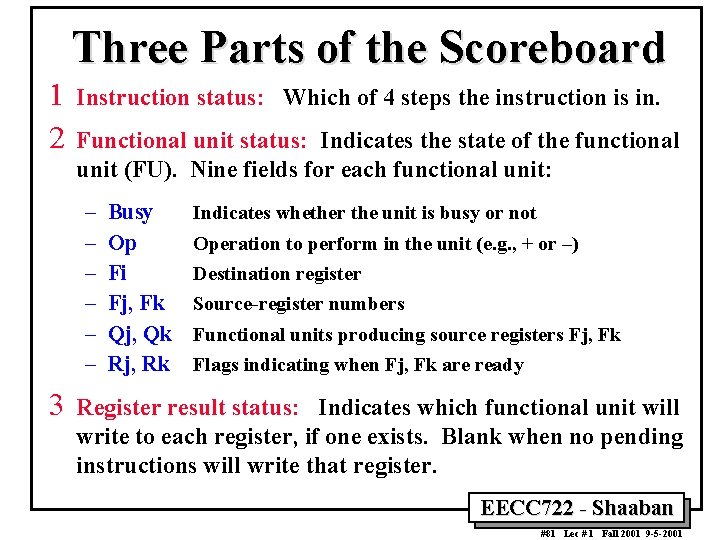
Three Parts of the Scoreboard 1 2 Instruction status: Which of 4 steps the instruction is in. Functional unit status: Indicates the state of the functional unit (FU). Nine fields for each functional unit: – – – 3 Busy Op Fi Fj, Fk Qj, Qk Rj, Rk Indicates whether the unit is busy or not Operation to perform in the unit (e. g. , + or –) Destination register Source register numbers Functional units producing source registers Fj, Fk Flags indicating when Fj, Fk are ready Register result status: Indicates which functional unit will write to each register, if one exists. Blank when no pending instructions will write that register. EECC 722 Shaaban #81 Lec # 1 Fall 2001 9 5 2001
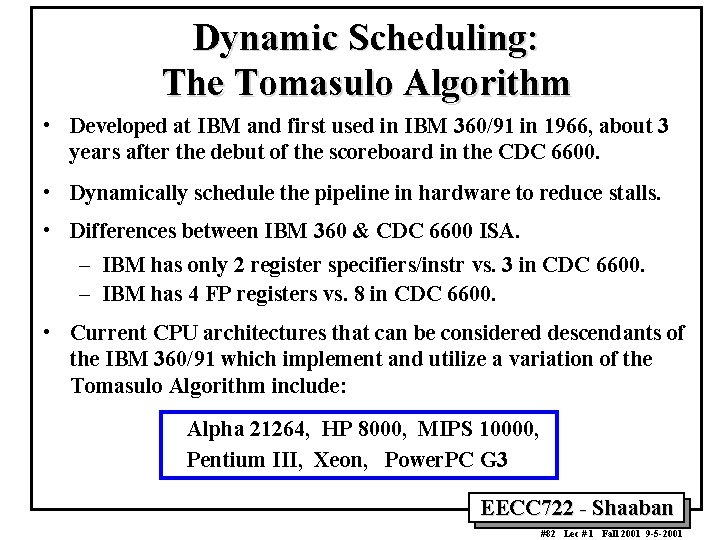
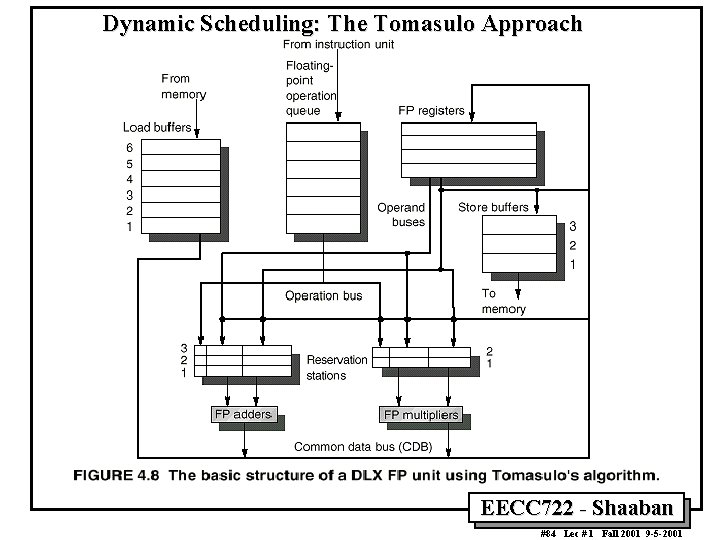
Dynamic Scheduling: The Tomasulo Algorithm • Developed at IBM and first used in IBM 360/91 in 1966, about 3 years after the debut of the scoreboard in the CDC 6600. • Dynamically schedule the pipeline in hardware to reduce stalls. • Differences between IBM 360 & CDC 6600 ISA. – IBM has only 2 register specifiers/instr vs. 3 in CDC 6600. – IBM has 4 FP registers vs. 8 in CDC 6600. • Current CPU architectures that can be considered descendants of the IBM 360/91 which implement and utilize a variation of the Tomasulo Algorithm include: Alpha 21264, HP 8000, MIPS 10000, Pentium III, Xeon, Power. PC G 3 EECC 722 Shaaban #82 Lec # 1 Fall 2001 9 5 2001
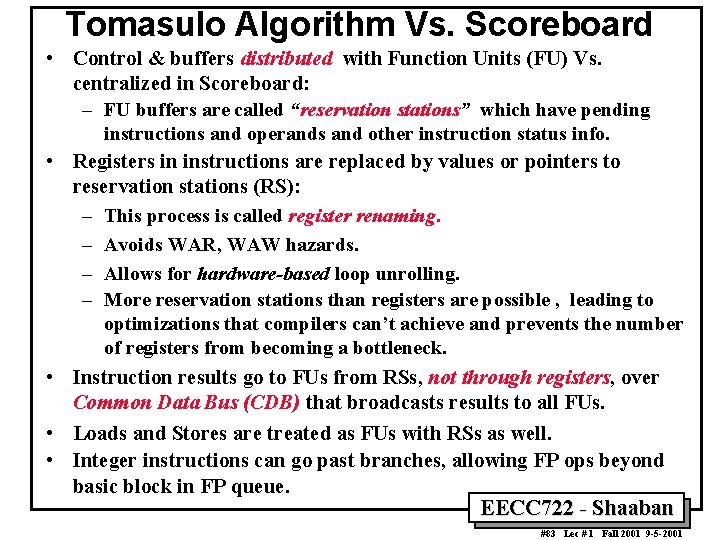
Tomasulo Algorithm Vs. Scoreboard • Control & buffers distributed with Function Units (FU) Vs. centralized in Scoreboard: – FU buffers are called “reservation stations” which have pending instructions and operands and other instruction status info. • Registers in instructions are replaced by values or pointers to reservation stations (RS): – This process is called register renaming. – Avoids WAR, WAW hazards. – Allows for hardware-based loop unrolling. – More reservation stations than registers are possible , leading to optimizations that compilers can’t achieve and prevents the number of registers from becoming a bottleneck. • Instruction results go to FUs from RSs, not through registers, over Common Data Bus (CDB) that broadcasts results to all FUs. • Loads and Stores are treated as FUs with RSs as well. • Integer instructions can go past branches, allowing FP ops beyond basic block in FP queue. EECC 722 Shaaban #83 Lec # 1 Fall 2001 9 5 2001
Dynamic Scheduling: The Tomasulo Approach EECC 722 Shaaban #84 Lec # 1 Fall 2001 9 5 2001
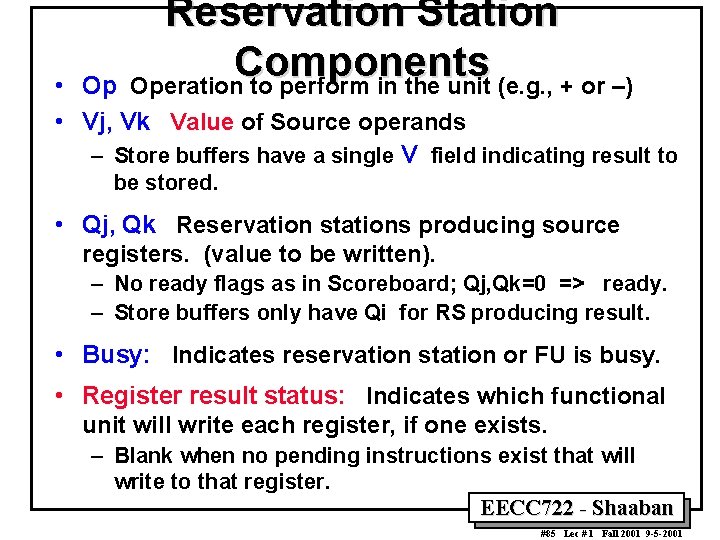
Reservation Station Components Operation to perform in the unit (e. g. , + or –) • Op • Vj, Vk Value of Source operands – Store buffers have a single V field indicating result to be stored. • Qj, Qk Reservation stations producing source registers. (value to be written). – No ready flags as in Scoreboard; Qj, Qk=0 => ready. – Store buffers only have Qi for RS producing result. • Busy: Indicates reservation station or FU is busy. • Register result status: Indicates which functional unit will write each register, if one exists. – Blank when no pending instructions exist that will write to that register. EECC 722 Shaaban #85 Lec # 1 Fall 2001 9 5 2001
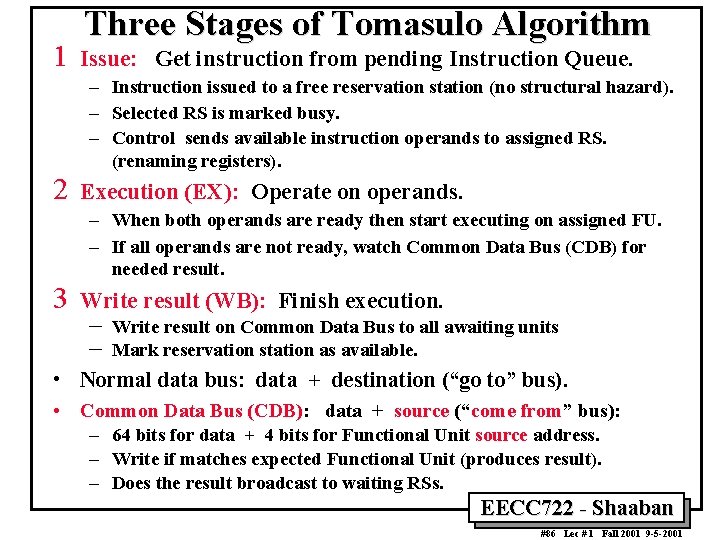
1 Three Stages of Tomasulo Algorithm Issue: Get instruction from pending Instruction Queue. – Instruction issued to a free reservation station (no structural hazard). – Selected RS is marked busy. – Control sends available instruction operands to assigned RS. (renaming registers). 2 Execution (EX): Operate on operands. – When both operands are ready then start executing on assigned FU. – If all operands are not ready, watch Common Data Bus (CDB) for needed result. 3 Write result (WB): Finish execution. – – Write result on Common Data Bus to all awaiting units Mark reservation station as available. • Normal data bus: data + destination (“go to” bus). • Common Data Bus (CDB): data + source (“come from” bus): – 64 bits for data + 4 bits for Functional Unit source address. – Write if matches expected Functional Unit (produces result). – Does the result broadcast to waiting RSs. EECC 722 Shaaban #86 Lec # 1 Fall 2001 9 5 2001
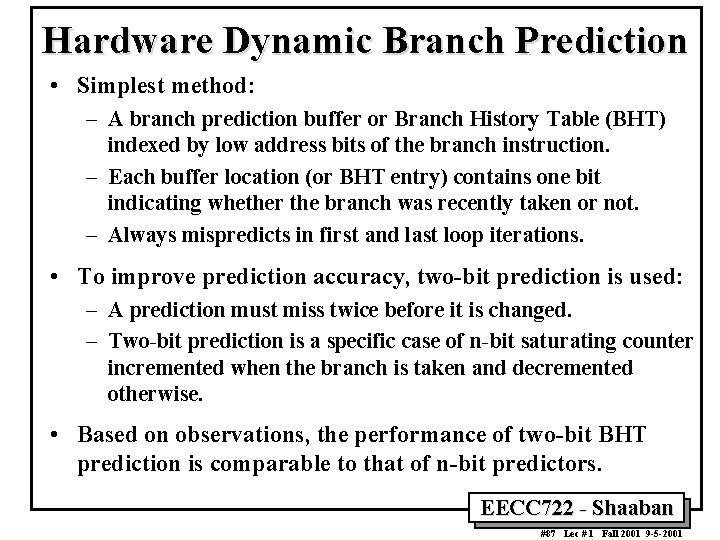
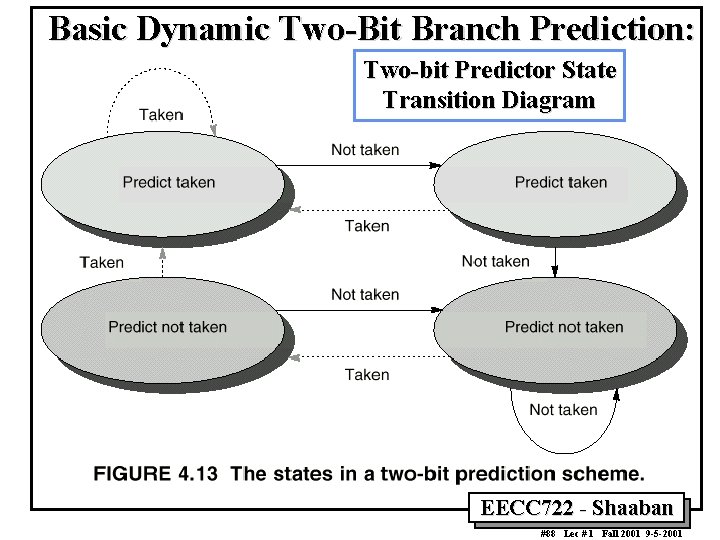
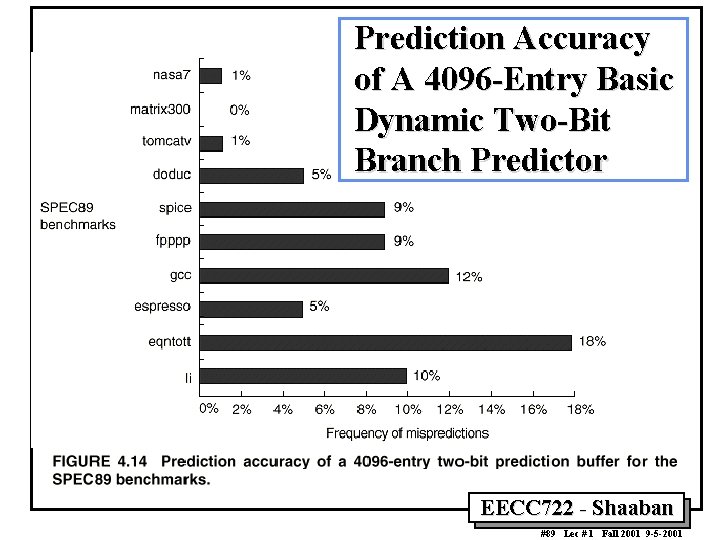
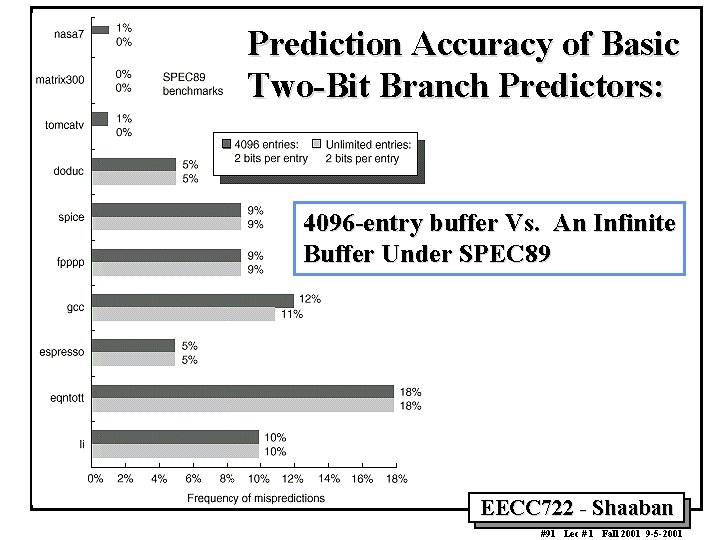
Hardware Dynamic Branch Prediction • Simplest method: – A branch prediction buffer or Branch History Table (BHT) indexed by low address bits of the branch instruction. – Each buffer location (or BHT entry) contains one bit indicating whether the branch was recently taken or not. – Always mispredicts in first and last loop iterations. • To improve prediction accuracy, two bit prediction is used: – A prediction must miss twice before it is changed. – Two bit prediction is a specific case of n bit saturating counter incremented when the branch is taken and decremented otherwise. • Based on observations, the performance of two bit BHT prediction is comparable to that of n bit predictors. EECC 722 Shaaban #87 Lec # 1 Fall 2001 9 5 2001
Basic Dynamic Two Bit Branch Prediction: Two bit Predictor State Transition Diagram EECC 722 Shaaban #88 Lec # 1 Fall 2001 9 5 2001
Prediction Accuracy of A 4096 Entry Basic Dynamic Two Bit Branch Predictor EECC 722 Shaaban #89 Lec # 1 Fall 2001 9 5 2001
From The Analysis of Static Branch Prediction : DLX Performance Using Canceling Delay Branches EECC 722 Shaaban #90 Lec # 1 Fall 2001 9 5 2001
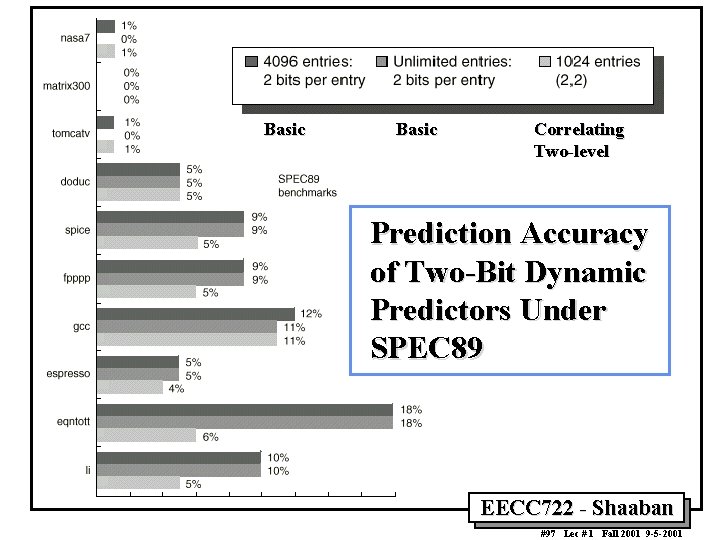
Prediction Accuracy of Basic Two Bit Branch Predictors: 4096 entry buffer Vs. An Infinite Buffer Under SPEC 89 EECC 722 Shaaban #91 Lec # 1 Fall 2001 9 5 2001
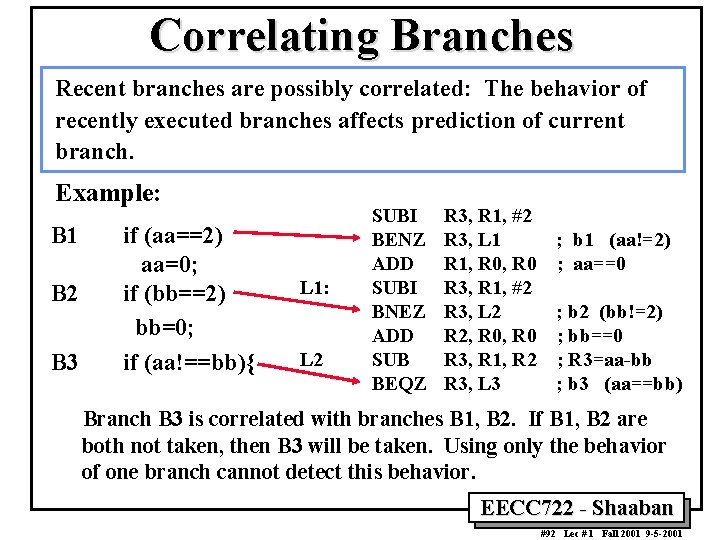
Correlating Branches Recent branches are possibly correlated: The behavior of recently executed branches affects prediction of current branch. Example: B 1 B 2 B 3 if (aa==2) aa=0; if (bb==2) bb=0; if (aa!==bb){ L 1: L 2 SUBI BENZ ADD SUBI BNEZ ADD SUB BEQZ R 3, R 1, #2 R 3, L 1 ; b 1 (aa!=2) R 1, R 0 ; aa==0 R 3, R 1, #2 R 3, L 2 ; b 2 (bb!=2) R 2, R 0 ; bb==0 R 3, R 1, R 2 ; R 3=aa bb R 3, L 3 ; b 3 (aa==bb) Branch B 3 is correlated with branches B 1, B 2. If B 1, B 2 are both not taken, then B 3 will be taken. Using only the behavior of one branch cannot detect this behavior. EECC 722 Shaaban #92 Lec # 1 Fall 2001 9 5 2001
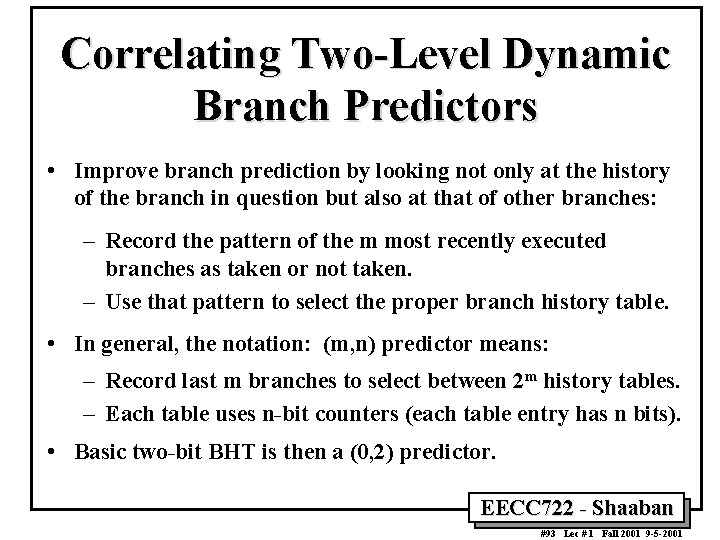
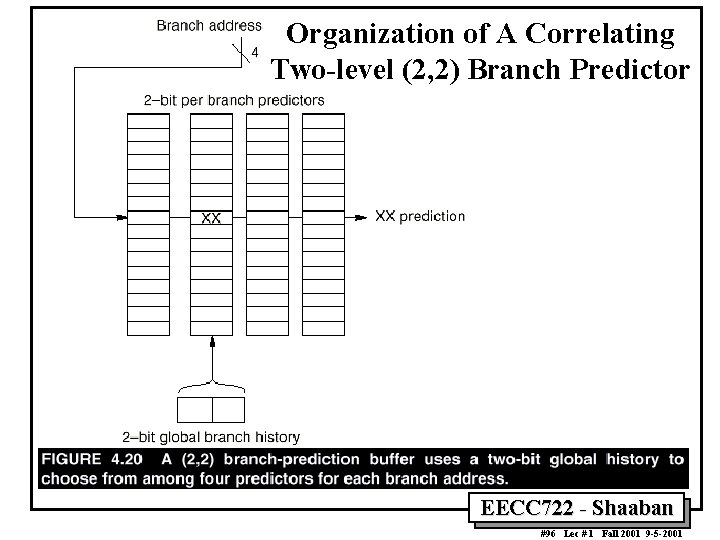
Correlating Two Level Dynamic Branch Predictors • Improve branch prediction by looking not only at the history of the branch in question but also at that of other branches: – Record the pattern of the m most recently executed branches as taken or not taken. – Use that pattern to select the proper branch history table. • In general, the notation: (m, n) predictor means: – Record last m branches to select between 2 m history tables. – Each table uses n bit counters (each table entry has n bits). • Basic two bit BHT is then a (0, 2) predictor. EECC 722 Shaaban #93 Lec # 1 Fall 2001 9 5 2001
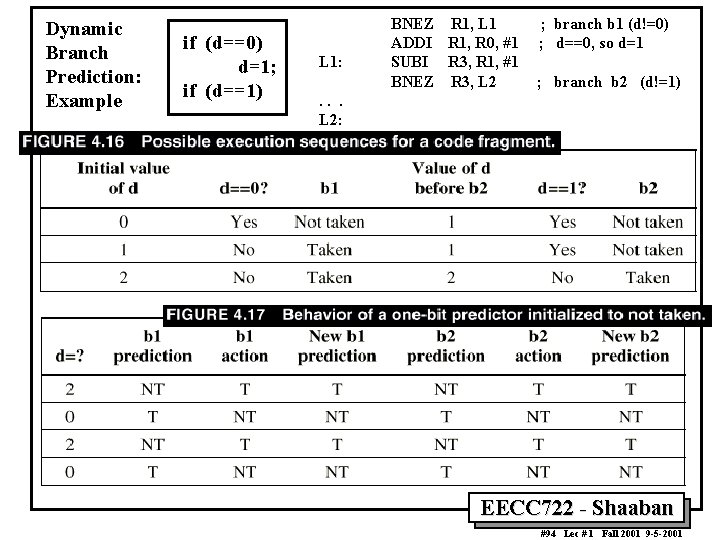
Dynamic Branch Prediction: Example if (d==0) d=1; if (d==1) L 1: BNEZ ADDI SUBI BNEZ R 1, L 1 R 1, R 0, #1 R 3, R 1, #1 R 3, L 2 ; branch b 1 (d!=0) ; d==0, so d=1 ; branch b 2 (d!=1) . . . L 2: EECC 722 Shaaban #94 Lec # 1 Fall 2001 9 5 2001
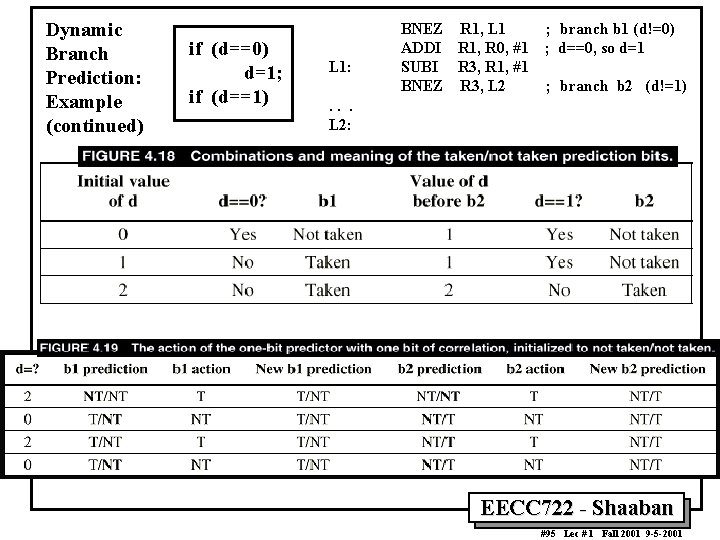
Dynamic Branch Prediction: Example (continued) if (d==0) d=1; if (d==1) L 1: BNEZ ADDI SUBI BNEZ R 1, L 1 ; branch b 1 (d!=0) R 1, R 0, #1 ; d==0, so d=1 R 3, R 1, #1 R 3, L 2 ; branch b 2 (d!=1) . . . L 2: EECC 722 Shaaban #95 Lec # 1 Fall 2001 9 5 2001
Organization of A Correlating Two level (2, 2) Branch Predictor EECC 722 Shaaban #96 Lec # 1 Fall 2001 9 5 2001
Basic Correlating Two level Prediction Accuracy of Two Bit Dynamic Predictors Under SPEC 89 EECC 722 Shaaban #97 Lec # 1 Fall 2001 9 5 2001
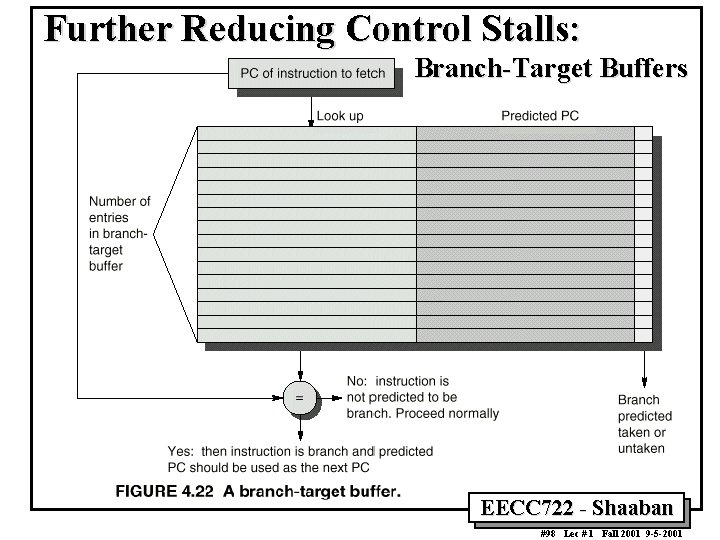
Further Reducing Control Stalls: Branch Target Buffers EECC 722 Shaaban #98 Lec # 1 Fall 2001 9 5 2001
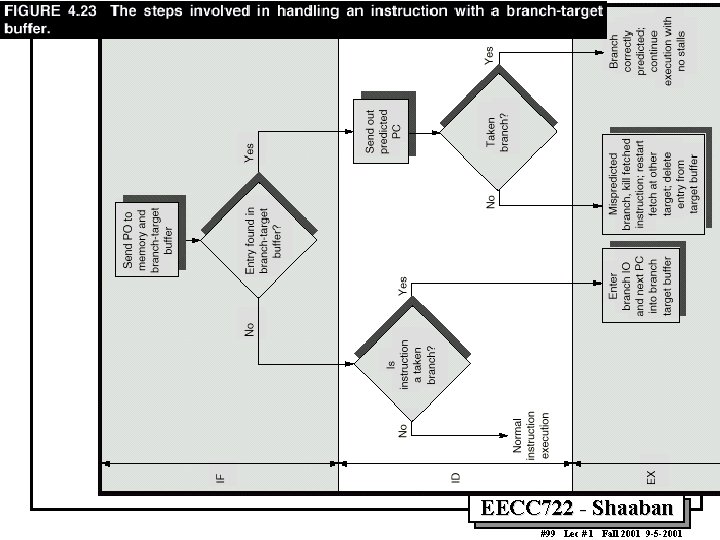
EECC 722 Shaaban #99 Lec # 1 Fall 2001 9 5 2001
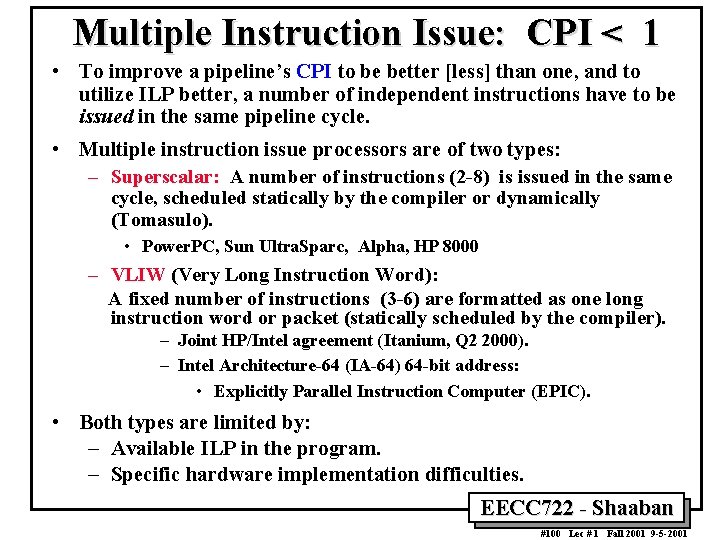
Multiple Instruction Issue: CPI < 1 • To improve a pipeline’s CPI to be better [less] than one, and to utilize ILP better, a number of independent instructions have to be issued in the same pipeline cycle. • Multiple instruction issue processors are of two types: – Superscalar: A number of instructions (2 8) is issued in the same cycle, scheduled statically by the compiler or dynamically (Tomasulo). • Power. PC, Sun Ultra. Sparc, Alpha, HP 8000 – VLIW (Very Long Instruction Word): A fixed number of instructions (3 6) are formatted as one long instruction word or packet (statically scheduled by the compiler). – Joint HP/Intel agreement (Itanium, Q 2 2000). – Intel Architecture 64 (IA 64) 64 bit address: • Explicitly Parallel Instruction Computer (EPIC). • Both types are limited by: – Available ILP in the program. – Specific hardware implementation difficulties. EECC 722 Shaaban #100 Lec # 1 Fall 2001 9 5 2001
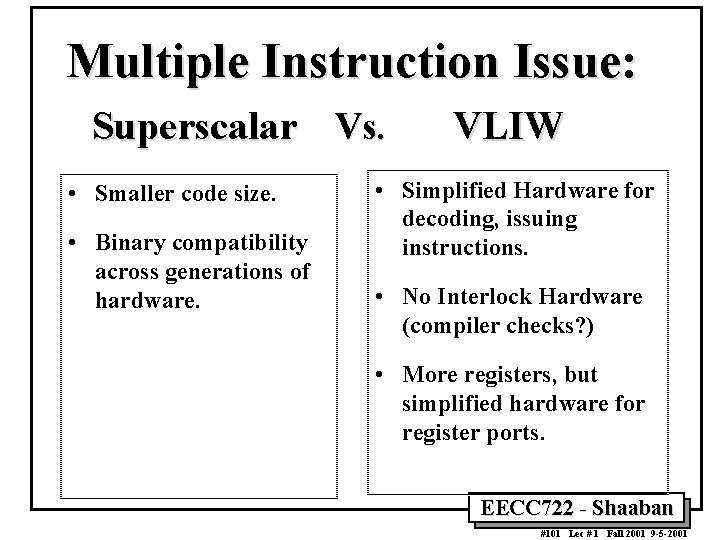
Multiple Instruction Issue: Superscalar Vs. • Smaller code size. • Binary compatibility across generations of hardware. VLIW • Simplified Hardware for decoding, issuing instructions. • No Interlock Hardware (compiler checks? ) • More registers, but simplified hardware for register ports. EECC 722 Shaaban #101 Lec # 1 Fall 2001 9 5 2001
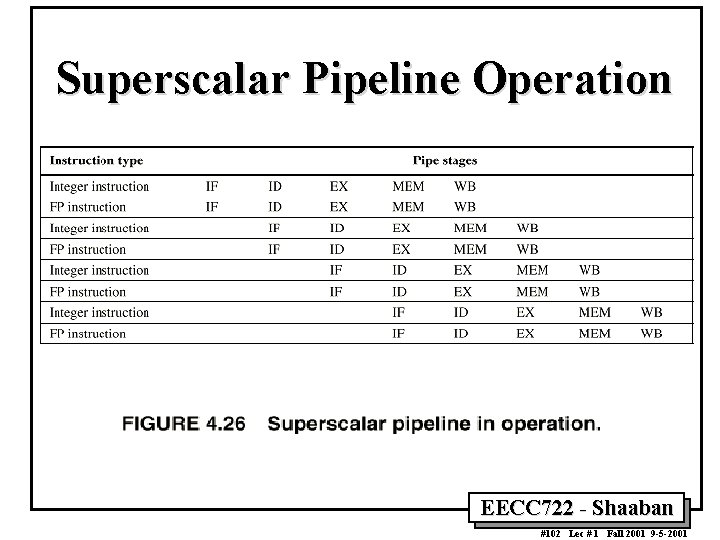
Superscalar Pipeline Operation EECC 722 Shaaban #102 Lec # 1 Fall 2001 9 5 2001
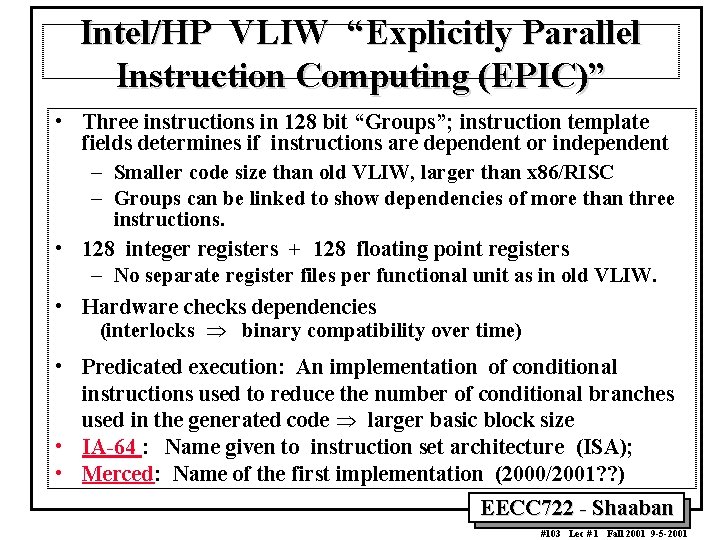
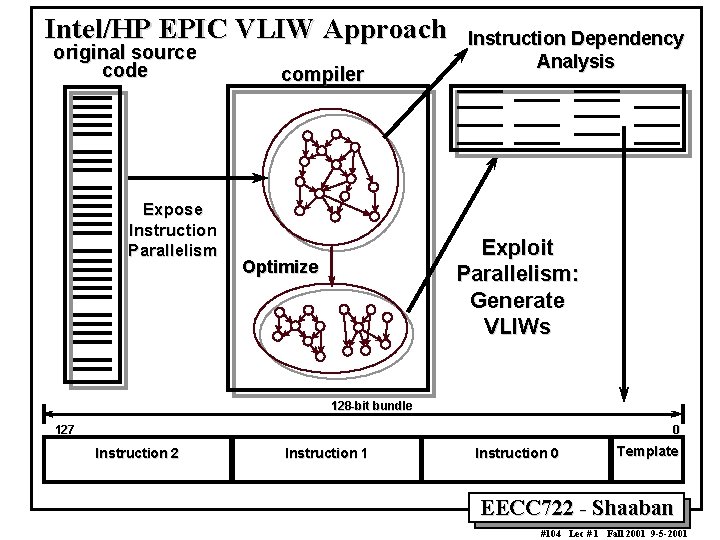
Intel/HP VLIW “Explicitly Parallel Instruction Computing (EPIC)” • Three instructions in 128 bit “Groups”; instruction template fields determines if instructions are dependent or independent – Smaller code size than old VLIW, larger than x 86/RISC – Groups can be linked to show dependencies of more than three instructions. • 128 integer registers + 128 floating point registers – No separate register files per functional unit as in old VLIW. • Hardware checks dependencies (interlocks Þ binary compatibility over time) • Predicated execution: An implementation of conditional instructions used to reduce the number of conditional branches used in the generated code Þ larger basic block size • IA 64 : Name given to instruction set architecture (ISA); • Merced: Name of the first implementation (2000/2001? ? ) EECC 722 Shaaban #103 Lec # 1 Fall 2001 9 5 2001
Intel/HP EPIC VLIW Approach original source code Expose Instruction Parallelism compiler Instruction Dependency Analysis Exploit Parallelism: Generate VLIWs Optimize 128 -bit bundle 127 0 Instruction 2 Instruction 1 Instruction 0 Template EECC 722 Shaaban #104 Lec # 1 Fall 2001 9 5 2001
Unrolled Loop Example for Scalar Pipeline 1 Loop: 2 3 4 5 6 7 8 9 10 11 12 13 14 LD LD ADDD SD SD SD SUBI BNEZ SD F 0, 0(R 1) F 6, -8(R 1) F 10, -16(R 1) F 14, -24(R 1) F 4, F 0, F 2 F 8, F 6, F 2 F 12, F 10, F 2 F 16, F 14, F 2 0(R 1), F 4 -8(R 1), F 8 -16(R 1), F 12 R 1, #32 R 1, LOOP 8(R 1), F 16 LD to ADDD: 1 Cycle ADDD to SD: 2 Cycles ; 8 -32 = -24 14 clock cycles, or 3. 5 per iteration EECC 722 Shaaban #105 Lec # 1 Fall 2001 9 5 2001
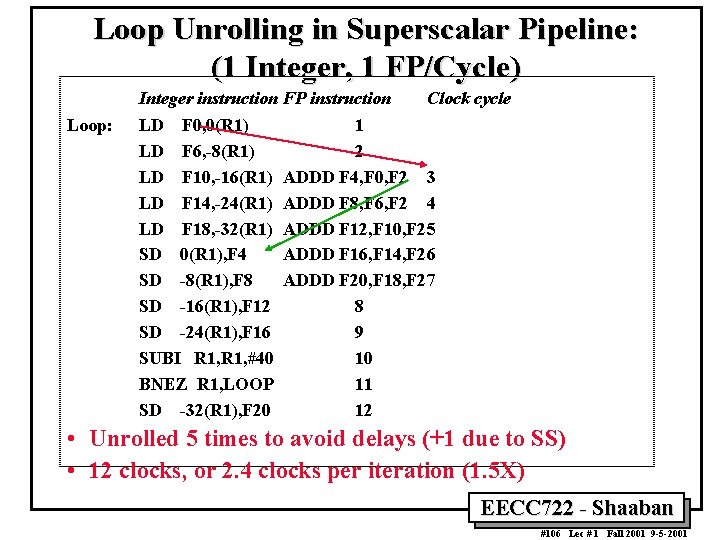
Loop Unrolling in Superscalar Pipeline: (1 Integer, 1 FP/Cycle) Integer instruction FP instruction Loop: LD F 0, 0(R 1) LD F 6, 8(R 1) LD F 10, 16(R 1) LD F 14, 24(R 1) LD F 18, 32(R 1) SD 0(R 1), F 4 SD 8(R 1), F 8 SD 16(R 1), F 12 SD 24(R 1), F 16 SUBI R 1, #40 BNEZ R 1, LOOP SD 32(R 1), F 20 Clock cycle 1 2 ADDD F 4, F 0, F 2 3 ADDD F 8, F 6, F 2 4 ADDD F 12, F 10, F 25 ADDD F 16, F 14, F 26 ADDD F 20, F 18, F 27 8 9 10 11 12 • Unrolled 5 times to avoid delays (+1 due to SS) • 12 clocks, or 2. 4 clocks per iteration (1. 5 X) EECC 722 Shaaban #106 Lec # 1 Fall 2001 9 5 2001
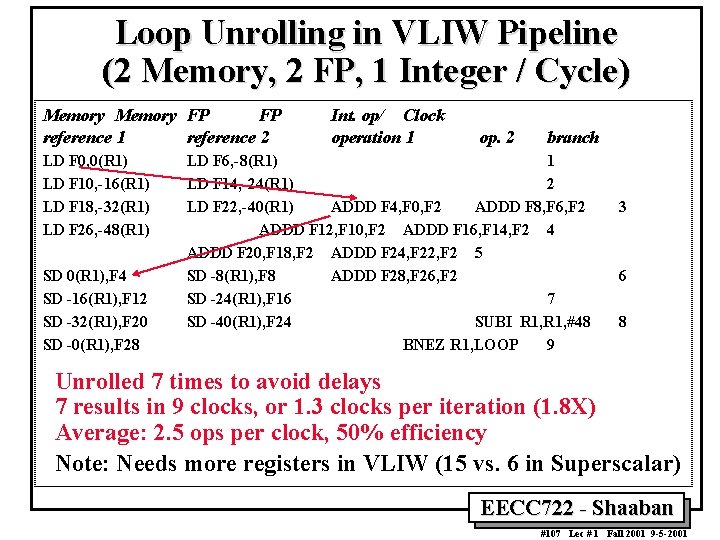
Loop Unrolling in VLIW Pipeline (2 Memory, 2 FP, 1 Integer / Cycle) Memory FP FP reference 1 reference 2 LD F 0, 0(R 1) LD F 10, 16(R 1) LD F 18, 32(R 1) LD F 26, 48(R 1) SD 0(R 1), F 4 SD 16(R 1), F 12 SD 32(R 1), F 20 SD 0(R 1), F 28 Int. op/ Clock operation 1 op. 2 branch LD F 6, 8(R 1) 1 LD F 14, 24(R 1) 2 LD F 22, 40(R 1) ADDD F 4, F 0, F 2 ADDD F 8, F 6, F 2 ADDD F 12, F 10, F 2 ADDD F 16, F 14, F 2 4 ADDD F 20, F 18, F 2 ADDD F 24, F 22, F 2 5 SD 8(R 1), F 8 ADDD F 28, F 26, F 2 SD 24(R 1), F 16 7 SD 40(R 1), F 24 SUBI R 1, #48 BNEZ R 1, LOOP 9 3 6 8 Unrolled 7 times to avoid delays 7 results in 9 clocks, or 1. 3 clocks per iteration (1. 8 X) Average: 2. 5 ops per clock, 50% efficiency Note: Needs more registers in VLIW (15 vs. 6 in Superscalar) EECC 722 Shaaban #107 Lec # 1 Fall 2001 9 5 2001
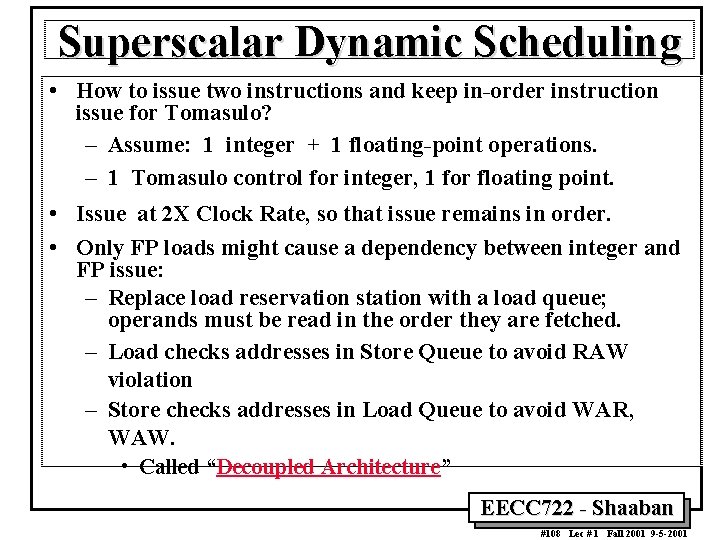
Superscalar Dynamic Scheduling • How to issue two instructions and keep in order instruction issue for Tomasulo? – Assume: 1 integer + 1 floating point operations. – 1 Tomasulo control for integer, 1 for floating point. • Issue at 2 X Clock Rate, so that issue remains in order. • Only FP loads might cause a dependency between integer and FP issue: – Replace load reservation station with a load queue; operands must be read in the order they are fetched. – Load checks addresses in Store Queue to avoid RAW violation – Store checks addresses in Load Queue to avoid WAR, WAW. • Called “Decoupled Architecture” EECC 722 Shaaban #108 Lec # 1 Fall 2001 9 5 2001
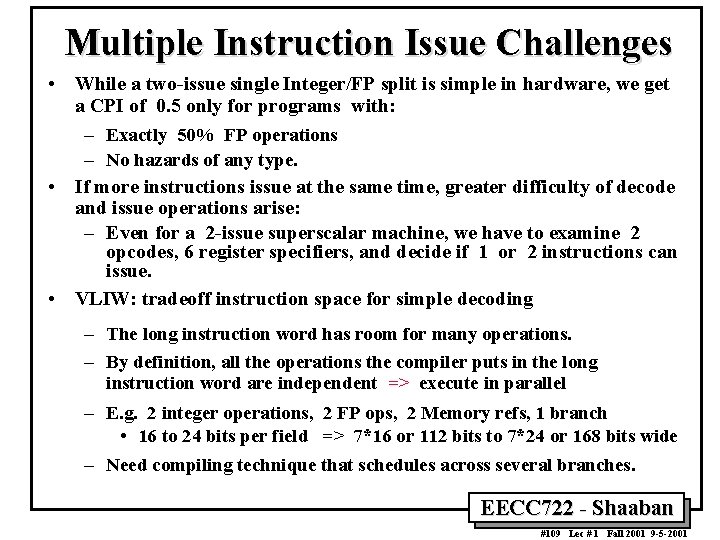
Multiple Instruction Issue Challenges • While a two issue single Integer/FP split is simple in hardware, we get a CPI of 0. 5 only for programs with: – Exactly 50% FP operations – No hazards of any type. • If more instructions issue at the same time, greater difficulty of decode and issue operations arise: – Even for a 2 issue superscalar machine, we have to examine 2 opcodes, 6 register specifiers, and decide if 1 or 2 instructions can issue. • VLIW: tradeoff instruction space for simple decoding – The long instruction word has room for many operations. – By definition, all the operations the compiler puts in the long instruction word are independent => execute in parallel – E. g. 2 integer operations, 2 FP ops, 2 Memory refs, 1 branch • 16 to 24 bits per field => 7*16 or 112 bits to 7*24 or 168 bits wide – Need compiling technique that schedules across several branches. EECC 722 Shaaban #109 Lec # 1 Fall 2001 9 5 2001
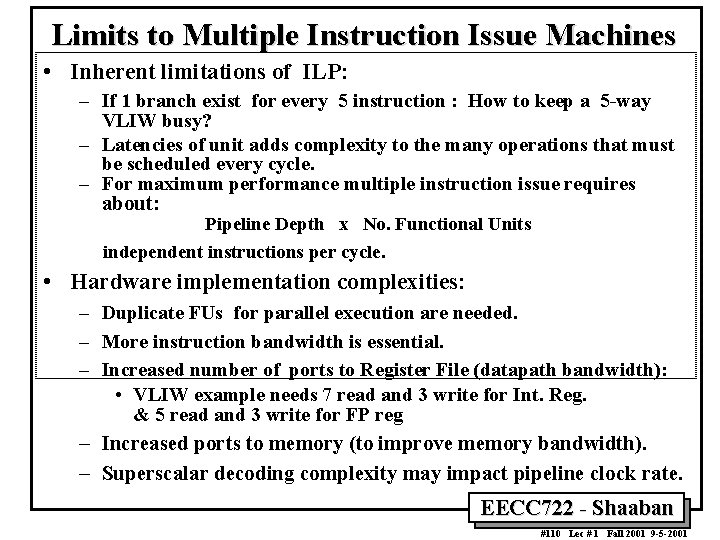
Limits to Multiple Instruction Issue Machines • Inherent limitations of ILP: – If 1 branch exist for every 5 instruction : How to keep a 5 way VLIW busy? – Latencies of unit adds complexity to the many operations that must be scheduled every cycle. – For maximum performance multiple instruction issue requires about: Pipeline Depth x No. Functional Units independent instructions per cycle. • Hardware implementation complexities: – Duplicate FUs for parallel execution are needed. – More instruction bandwidth is essential. – Increased number of ports to Register File (datapath bandwidth): • VLIW example needs 7 read and 3 write for Int. Reg. & 5 read and 3 write for FP reg – Increased ports to memory (to improve memory bandwidth). – Superscalar decoding complexity may impact pipeline clock rate. EECC 722 Shaaban #110 Lec # 1 Fall 2001 9 5 2001
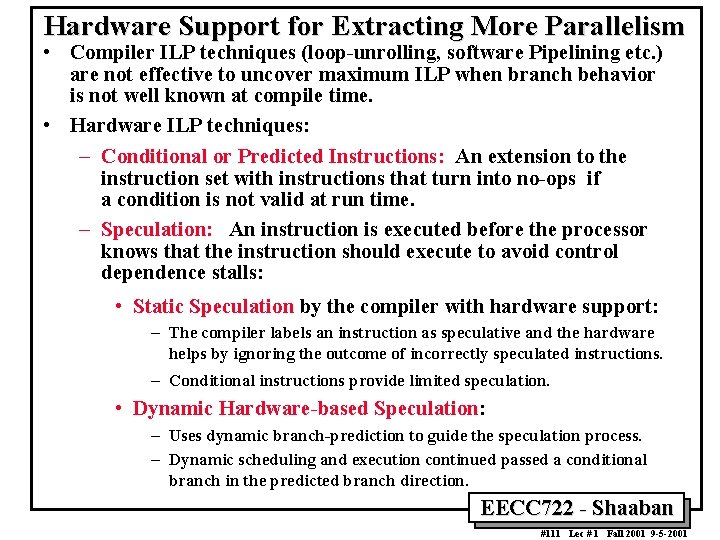
Hardware Support for Extracting More Parallelism • Compiler ILP techniques (loop unrolling, software Pipelining etc. ) are not effective to uncover maximum ILP when branch behavior is not well known at compile time. • Hardware ILP techniques: – Conditional or Predicted Instructions: An extension to the instruction set with instructions that turn into no ops if a condition is not valid at run time. – Speculation: An instruction is executed before the processor knows that the instruction should execute to avoid control dependence stalls: • Static Speculation by the compiler with hardware support: – The compiler labels an instruction as speculative and the hardware helps by ignoring the outcome of incorrectly speculated instructions. – Conditional instructions provide limited speculation. • Dynamic Hardware based Speculation: – Uses dynamic branch prediction to guide the speculation process. – Dynamic scheduling and execution continued passed a conditional branch in the predicted branch direction. EECC 722 Shaaban #111 Lec # 1 Fall 2001 9 5 2001
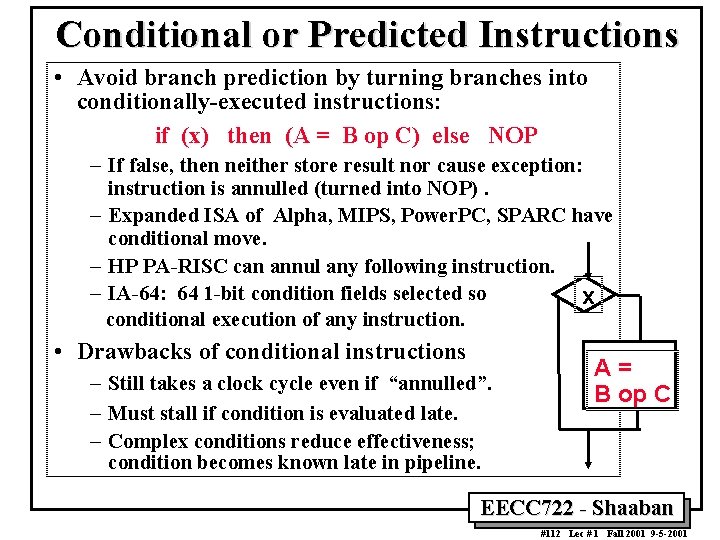
Conditional or Predicted Instructions • Avoid branch prediction by turning branches into conditionally executed instructions: if (x) then (A = B op C) else NOP – If false, then neither store result nor cause exception: instruction is annulled (turned into NOP). – Expanded ISA of Alpha, MIPS, Power. PC, SPARC have conditional move. – HP PA RISC can annul any following instruction. – IA 64: 64 1 bit condition fields selected so x conditional execution of any instruction. • Drawbacks of conditional instructions – Still takes a clock cycle even if “annulled”. – Must stall if condition is evaluated late. – Complex conditions reduce effectiveness; condition becomes known late in pipeline. A= B op C EECC 722 Shaaban #112 Lec # 1 Fall 2001 9 5 2001
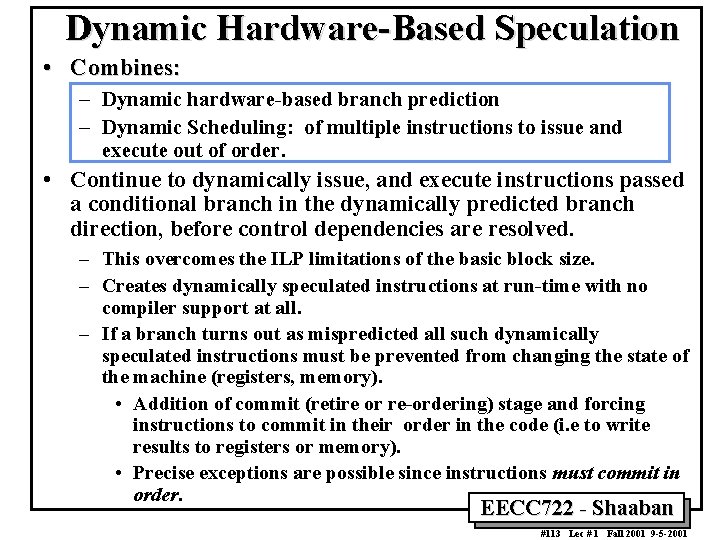
Dynamic Hardware Based Speculation • Combines: – Dynamic hardware based branch prediction – Dynamic Scheduling: of multiple instructions to issue and execute out of order. • Continue to dynamically issue, and execute instructions passed a conditional branch in the dynamically predicted branch direction, before control dependencies are resolved. – This overcomes the ILP limitations of the basic block size. – Creates dynamically speculated instructions at run time with no compiler support at all. – If a branch turns out as mispredicted all such dynamically speculated instructions must be prevented from changing the state of the machine (registers, memory). • Addition of commit (retire ordering) stage and forcing instructions to commit in their order in the code (i. e to write results to registers or memory). • Precise exceptions are possible since instructions must commit in order. EECC 722 Shaaban #113 Lec # 1 Fall 2001 9 5 2001
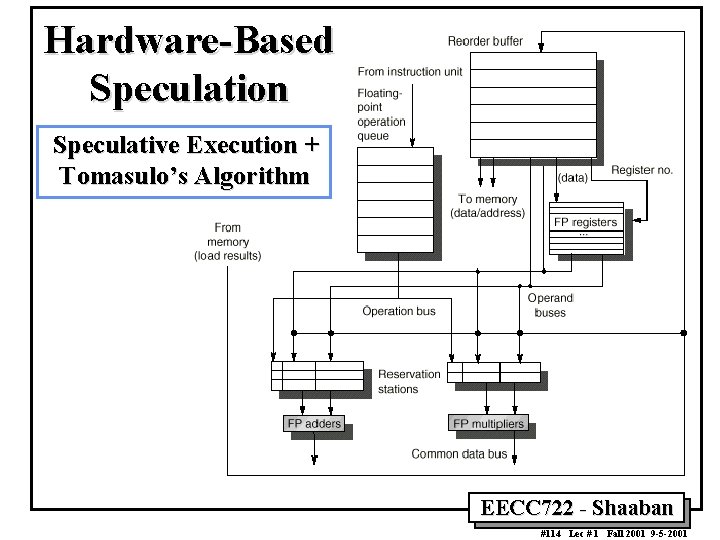
Hardware Based Speculation Speculative Execution + Tomasulo’s Algorithm EECC 722 Shaaban #114 Lec # 1 Fall 2001 9 5 2001
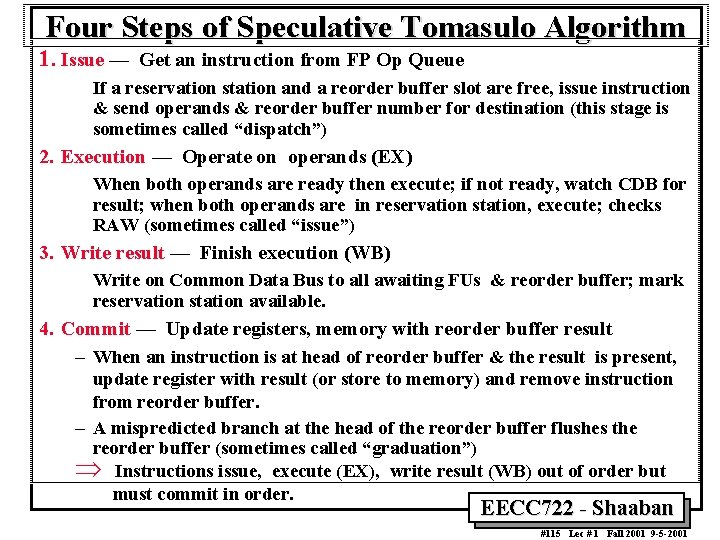
Four Steps of Speculative Tomasulo Algorithm 1. Issue — Get an instruction from FP Op Queue If a reservation station and a reorder buffer slot are free, issue instruction & send operands & reorder buffer number for destination (this stage is sometimes called “dispatch”) 2. Execution — Operate on operands (EX) When both operands are ready then execute; if not ready, watch CDB for result; when both operands are in reservation station, execute; checks RAW (sometimes called “issue”) 3. Write result — Finish execution (WB) Write on Common Data Bus to all awaiting FUs & reorder buffer; mark reservation station available. 4. Commit — Update registers, memory with reorder buffer result – When an instruction is at head of reorder buffer & the result is present, update register with result (or store to memory) and remove instruction from reorder buffer. – A mispredicted branch at the head of the reorder buffer flushes the reorder buffer (sometimes called “graduation”) Þ Instructions issue, execute (EX), write result (WB) out of order but must commit in order. EECC 722 Shaaban #115 Lec # 1 Fall 2001 9 5 2001
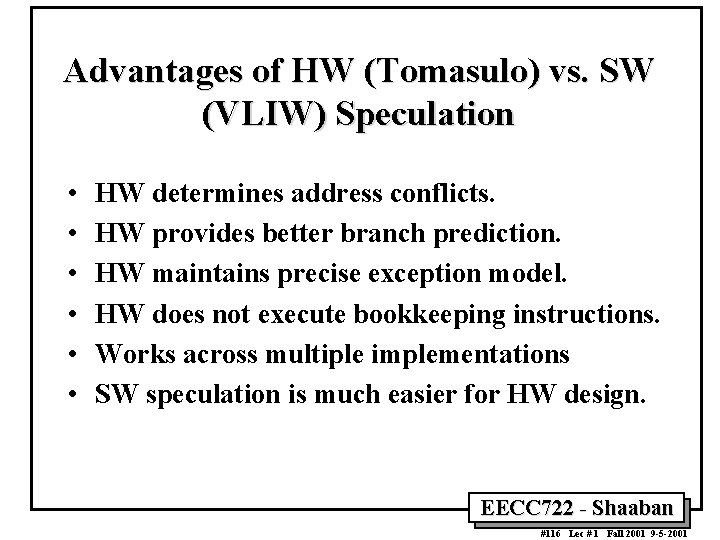
Advantages of HW (Tomasulo) vs. SW (VLIW) Speculation • • • HW determines address conflicts. HW provides better branch prediction. HW maintains precise exception model. HW does not execute bookkeeping instructions. Works across multiple implementations SW speculation is much easier for HW design. EECC 722 Shaaban #116 Lec # 1 Fall 2001 9 5 2001
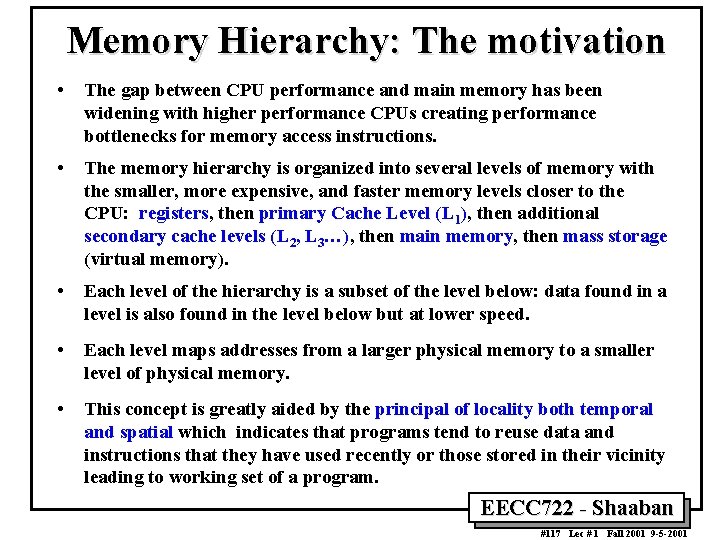
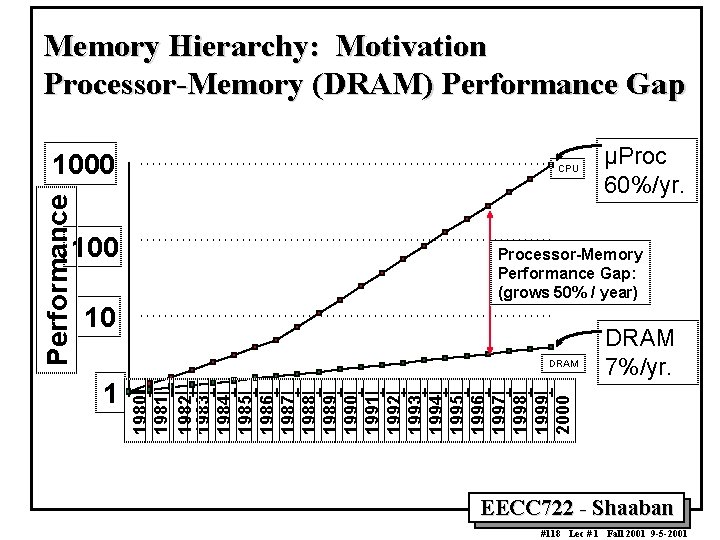
Memory Hierarchy: The motivation • The gap between CPU performance and main memory has been widening with higher performance CPUs creating performance bottlenecks for memory access instructions. • The memory hierarchy is organized into several levels of memory with the smaller, more expensive, and faster memory levels closer to the CPU: registers, then primary Cache Level (L 1), then additional secondary cache levels (L 2, L 3…), then main memory, then mass storage (virtual memory). • Each level of the hierarchy is a subset of the level below: data found in a level is also found in the level below but at lower speed. • Each level maps addresses from a larger physical memory to a smaller level of physical memory. • This concept is greatly aided by the principal of locality both temporal and spatial which indicates that programs tend to reuse data and instructions that they have used recently or those stored in their vicinity leading to working set of a program. EECC 722 Shaaban #117 Lec # 1 Fall 2001 9 5 2001
Memory Hierarchy: Motivation Processor Memory (DRAM) Performance Gap 100 CPU Processor-Memory Performance Gap: (grows 50% / year) 10 DRAM 1 µProc 60%/yr. DRAM 7%/yr. 1980 1981 1982 1983 1984 1985 1986 1987 1988 1989 1990 1991 1992 1993 1994 1995 1996 1997 1998 1999 2000 Performance 1000 EECC 722 Shaaban #118 Lec # 1 Fall 2001 9 5 2001
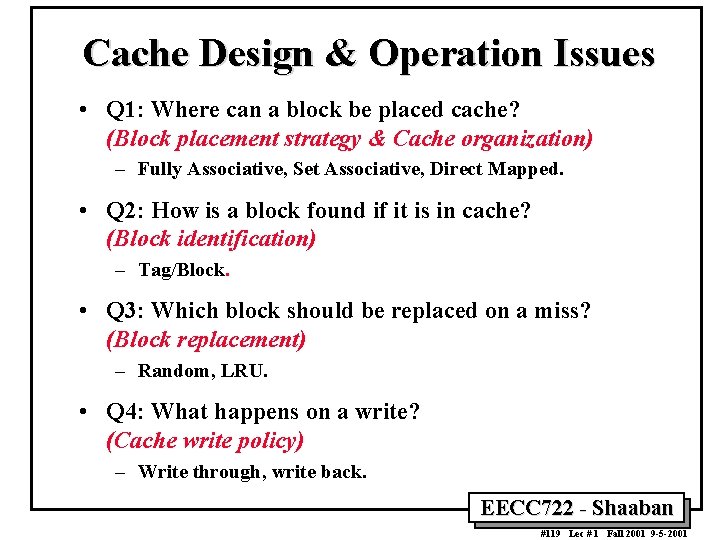
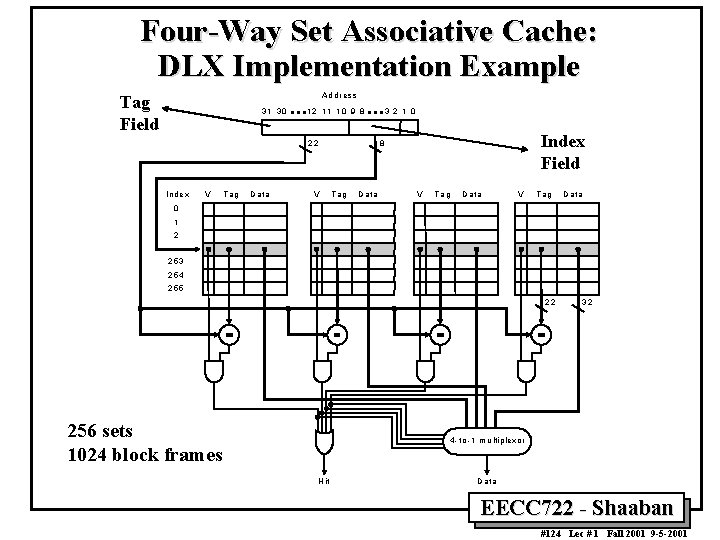
Cache Design & Operation Issues • Q 1: Where can a block be placed cache? (Block placement strategy & Cache organization) – Fully Associative, Set Associative, Direct Mapped. • Q 2: How is a block found if it is in cache? (Block identification) – Tag/Block. • Q 3: Which block should be replaced on a miss? (Block replacement) – Random, LRU. • Q 4: What happens on a write? (Cache write policy) – Write through, write back. EECC 722 Shaaban #119 Lec # 1 Fall 2001 9 5 2001
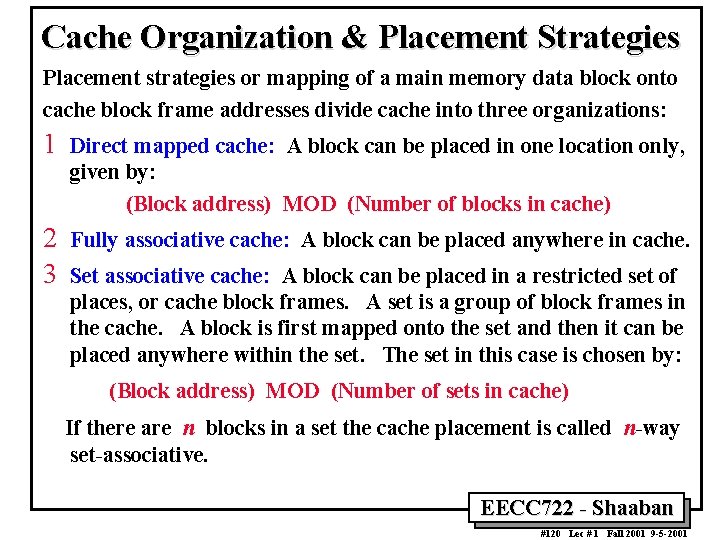
Cache Organization & Placement Strategies Placement strategies or mapping of a main memory data block onto cache block frame addresses divide cache into three organizations: 1 Direct mapped cache: A block can be placed in one location only, given by: (Block address) MOD (Number of blocks in cache) 2 3 Fully associative cache: A block can be placed anywhere in cache. Set associative cache: A block can be placed in a restricted set of places, or cache block frames. A set is a group of block frames in the cache. A block is first mapped onto the set and then it can be placed anywhere within the set. The set in this case is chosen by: (Block address) MOD (Number of sets in cache) If there are n blocks in a set the cache placement is called n way set associative. EECC 722 Shaaban #120 Lec # 1 Fall 2001 9 5 2001
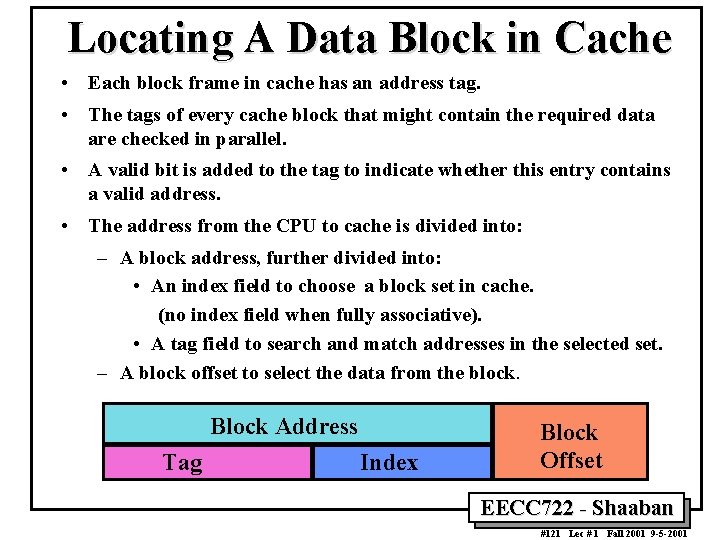
Locating A Data Block in Cache • Each block frame in cache has an address tag. • The tags of every cache block that might contain the required data are checked in parallel. • A valid bit is added to the tag to indicate whether this entry contains a valid address. • The address from the CPU to cache is divided into: – A block address, further divided into: • An index field to choose a block set in cache. (no index field when fully associative). • A tag field to search and match addresses in the selected set. – A block offset to select the data from the block. Block Address Tag Index Block Offset EECC 722 Shaaban #121 Lec # 1 Fall 2001 9 5 2001
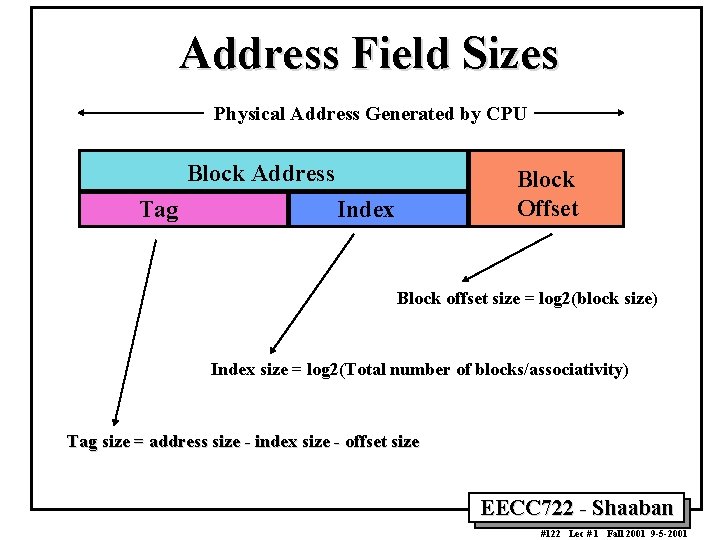
Address Field Sizes Physical Address Generated by CPU Block Address Tag Block Offset Index Block offset size = log 2(block size) Index size = log 2(Total number of blocks/associativity) Tag size = address size index size offset size EECC 722 Shaaban #122 Lec # 1 Fall 2001 9 5 2001
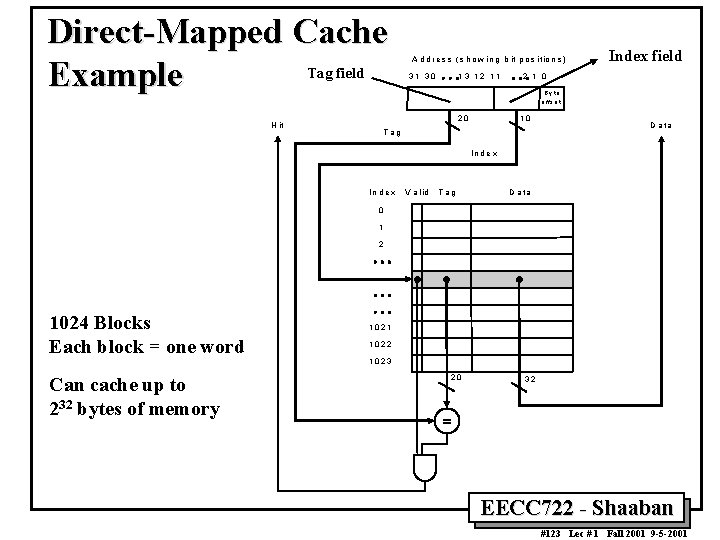
Direct Mapped Cache Tag field Example A d d r e s s ( s h o w i n g b it p o s i tio n s ) 31 30 13 12 11 Index field 2 1 0 B y te o ffs e t H it 10 20 Tag D a ta In d e x V a l id T ag D a ta 0 1 2 1024 Blocks Each block = one word Can cache up to 232 bytes of memory 1021 1022 1023 20 32 EECC 722 Shaaban #123 Lec # 1 Fall 2001 9 5 2001
Four Way Set Associative Cache: DLX Implementation Example A d dre s s Tag Field 31 3 0 12 11 10 9 8 V Tag D a ta Index Field 8 22 In d ex 3 2 1 0 V Tag D a ta V T ag D a ta 0 1 2 253 254 255 22 256 sets 1024 block frames 32 4 - to - 1 m u ltip le xo r H it D a ta EECC 722 Shaaban #124 Lec # 1 Fall 2001 9 5 2001
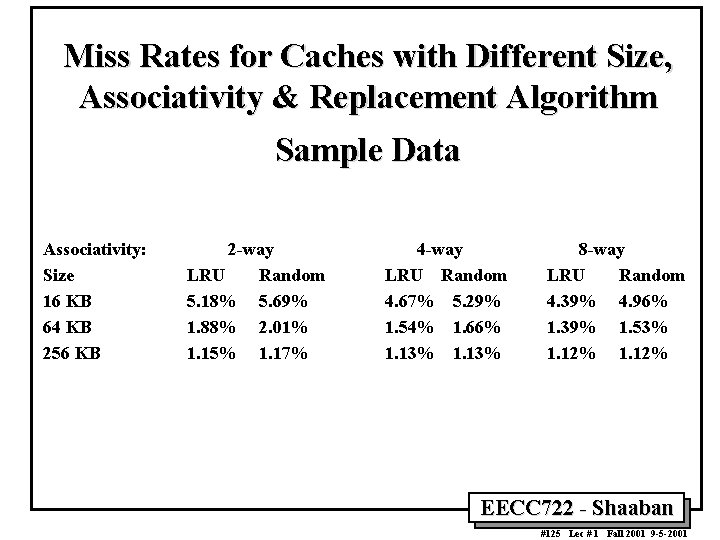
Miss Rates for Caches with Different Size, Associativity & Replacement Algorithm Sample Data Associativity: Size 16 KB 64 KB 256 KB 2 way LRU Random 5. 18% 5. 69% 1. 88% 2. 01% 1. 15% 1. 17% 4 way LRU Random 4. 67% 5. 29% 1. 54% 1. 66% 1. 13% 8 way LRU Random 4. 39% 4. 96% 1. 39% 1. 53% 1. 12% EECC 722 Shaaban #125 Lec # 1 Fall 2001 9 5 2001
Cache Read/Write Operations • Statistical data suggest that reads (including instruction fetches) dominate processor cache accesses (writes account for 25% of data cache traffic). • In cache reads, a block is read at the same time while the tag is being compared with the block address. If the read is a hit the data is passed to the CPU, if a miss it ignores it. • In cache writes, modifying the block cannot begin until the tag is checked to see if the address is a hit. • Thus for cache writes, tag checking cannot take place in parallel, and only the specific data (between 1 and 8 bytes) requested by the CPU can be modified. • Cache is classified according to the write and memory update strategy in place: write through, or write back. EECC 722 Shaaban #126 Lec # 1 Fall 2001 9 5 2001
1 Cache Write Strategies Write Though: Data is written to both the cache block and to a block of main memory. – The lower level always has the most updated data; an important feature for I/O and multiprocessing. – Easier to implement than write back. – A write buffer is often used to reduce CPU write stall while data is written to memory. 2 Write back: Data is written or updated only to the cache block. The modified cache block is written to main memory when it’s being replaced from cache. – Writes occur at the speed of cache – A status bit called a dirty bit, is used to indicate whether the block was modified while in cache; if not the block is not written to main memory. – Uses less memory bandwidth than write through. EECC 722 Shaaban #127 Lec # 1 Fall 2001 9 5 2001
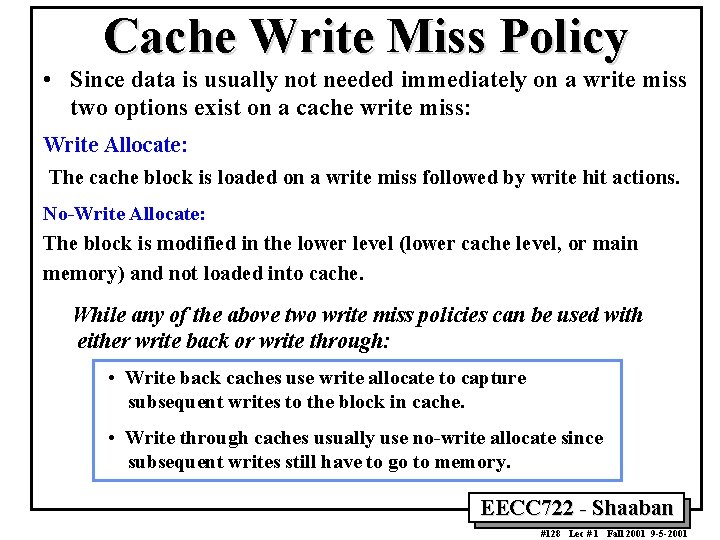
Cache Write Miss Policy • Since data is usually not needed immediately on a write miss two options exist on a cache write miss: Write Allocate: The cache block is loaded on a write miss followed by write hit actions. No Write Allocate: The block is modified in the lower level (lower cache level, or main memory) and not loaded into cache. While any of the above two write miss policies can be used with either write back or write through: • Write back caches use write allocate to capture subsequent writes to the block in cache. • Write through caches usually use no write allocate since subsequent writes still have to go to memory. EECC 722 Shaaban #128 Lec # 1 Fall 2001 9 5 2001
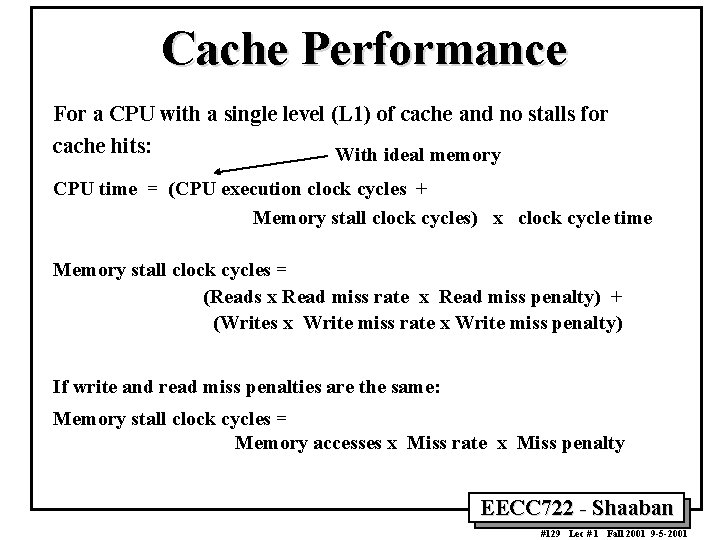
Cache Performance For a CPU with a single level (L 1) of cache and no stalls for cache hits: With ideal memory CPU time = (CPU execution clock cycles + Memory stall clock cycles) x clock cycle time Memory stall clock cycles = (Reads x Read miss rate x Read miss penalty) + (Writes x Write miss rate x Write miss penalty) If write and read miss penalties are the same: Memory stall clock cycles = Memory accesses x Miss rate x Miss penalty EECC 722 Shaaban #129 Lec # 1 Fall 2001 9 5 2001
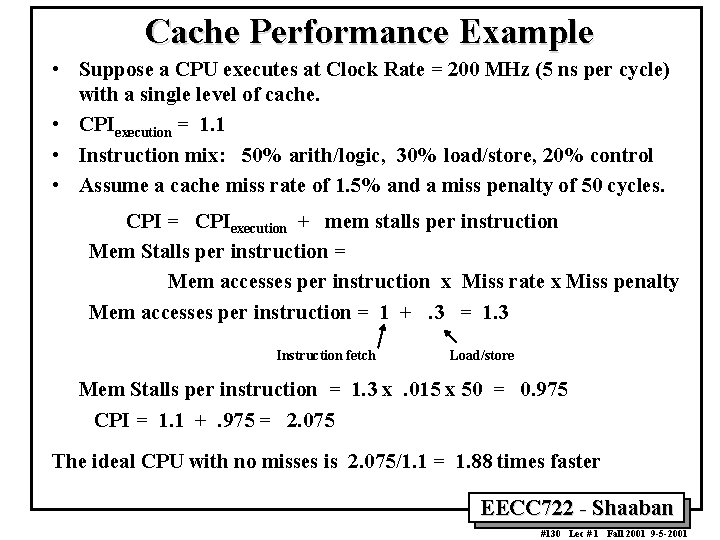
Cache Performance Example • Suppose a CPU executes at Clock Rate = 200 MHz (5 ns per cycle) with a single level of cache. • CPIexecution = 1. 1 • Instruction mix: 50% arith/logic, 30% load/store, 20% control • Assume a cache miss rate of 1. 5% and a miss penalty of 50 cycles. CPI = CPIexecution + mem stalls per instruction Mem Stalls per instruction = Mem accesses per instruction x Miss rate x Miss penalty Mem accesses per instruction = 1 +. 3 = 1. 3 Instruction fetch Load/store Mem Stalls per instruction = 1. 3 x. 015 x 50 = 0. 975 CPI = 1. 1 +. 975 = 2. 075 The ideal CPU with no misses is 2. 075/1. 1 = 1. 88 times faster EECC 722 Shaaban #130 Lec # 1 Fall 2001 9 5 2001
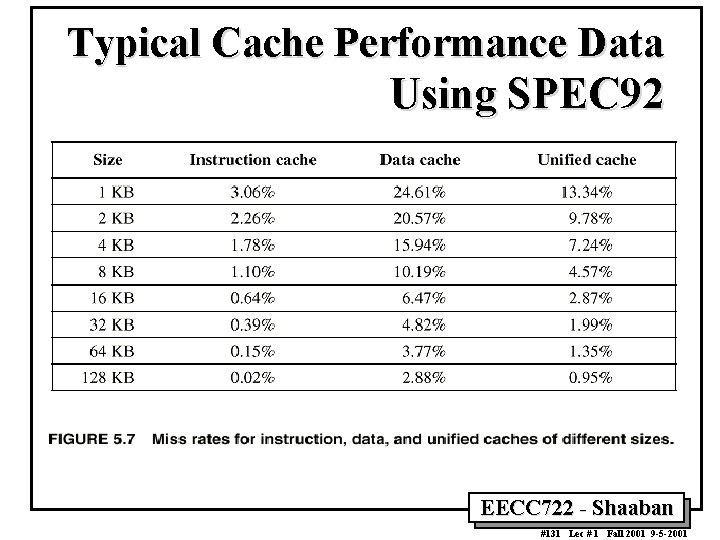
Typical Cache Performance Data Using SPEC 92 EECC 722 Shaaban #131 Lec # 1 Fall 2001 9 5 2001
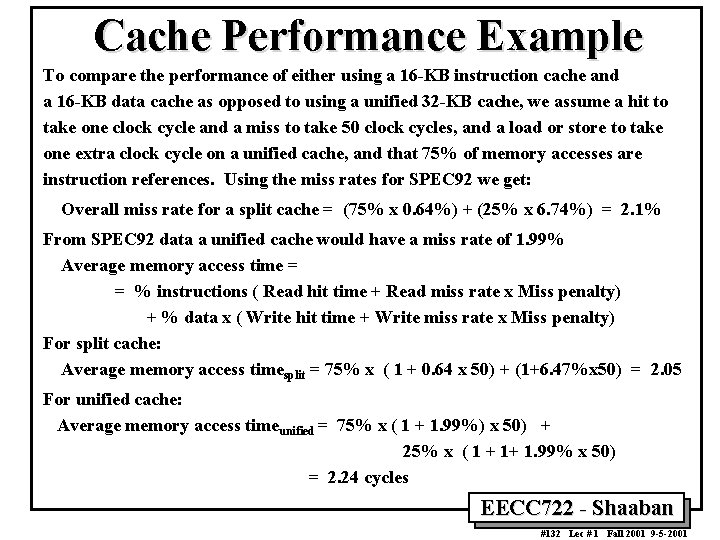
Cache Performance Example To compare the performance of either using a 16 KB instruction cache and a 16 KB data cache as opposed to using a unified 32 KB cache, we assume a hit to take one clock cycle and a miss to take 50 clock cycles, and a load or store to take one extra clock cycle on a unified cache, and that 75% of memory accesses are instruction references. Using the miss rates for SPEC 92 we get: Overall miss rate for a split cache = (75% x 0. 64%) + (25% x 6. 74%) = 2. 1% From SPEC 92 data a unified cache would have a miss rate of 1. 99% Average memory access time = = % instructions ( Read hit time + Read miss rate x Miss penalty) + % data x ( Write hit time + Write miss rate x Miss penalty) For split cache: Average memory access timesplit = 75% x ( 1 + 0. 64 x 50) + (1+6. 47%x 50) = 2. 05 For unified cache: Average memory access timeunified = 75% x ( 1 + 1. 99%) x 50) + 25% x ( 1 + 1+ 1. 99% x 50) = 2. 24 cycles EECC 722 Shaaban #132 Lec # 1 Fall 2001 9 5 2001
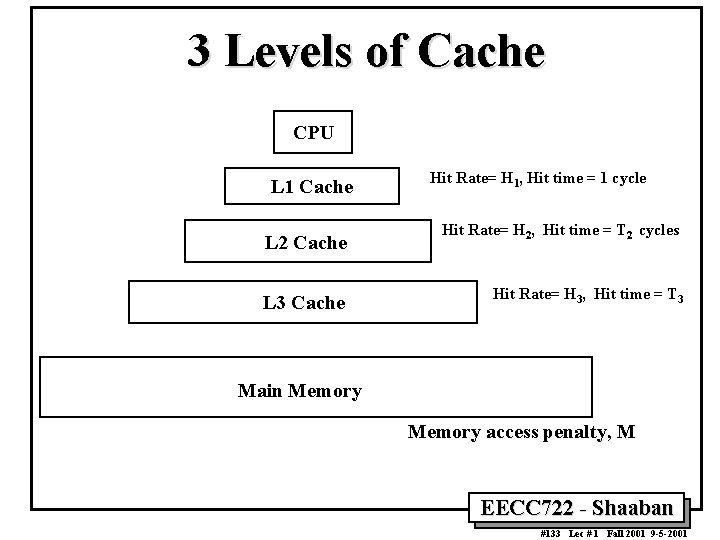
3 Levels of Cache CPU L 1 Cache L 2 Cache L 3 Cache Hit Rate= H 1, Hit time = 1 cycle Hit Rate= H 2, Hit time = T 2 cycles Hit Rate= H 3, Hit time = T 3 Main Memory access penalty, M EECC 722 Shaaban #133 Lec # 1 Fall 2001 9 5 2001
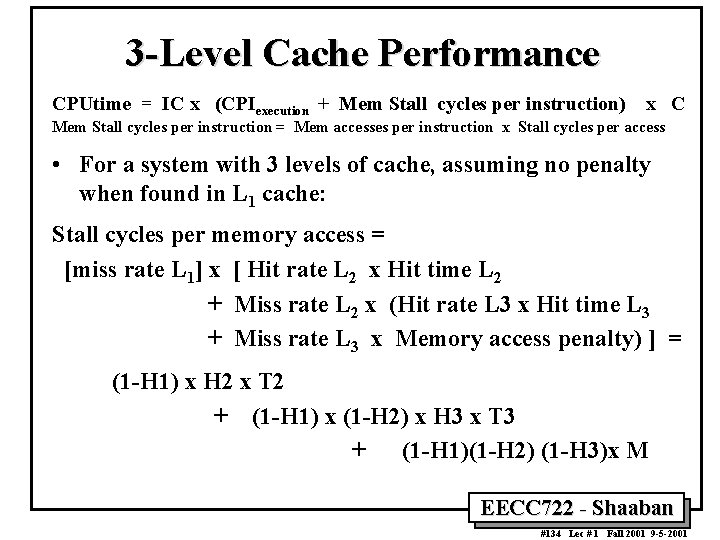
3 Level Cache Performance CPUtime = IC x (CPIexecution + Mem Stall cycles per instruction) x C Mem Stall cycles per instruction = Mem accesses per instruction x Stall cycles per access • For a system with 3 levels of cache, assuming no penalty when found in L 1 cache: Stall cycles per memory access = [miss rate L 1] x [ Hit rate L 2 x Hit time L 2 + Miss rate L 2 x (Hit rate L 3 x Hit time L 3 + Miss rate L 3 x Memory access penalty) ] = (1 H 1) x H 2 x T 2 + (1 H 1) x (1 H 2) x H 3 x T 3 + (1 H 1)(1 H 2) (1 H 3)x M EECC 722 Shaaban #134 Lec # 1 Fall 2001 9 5 2001
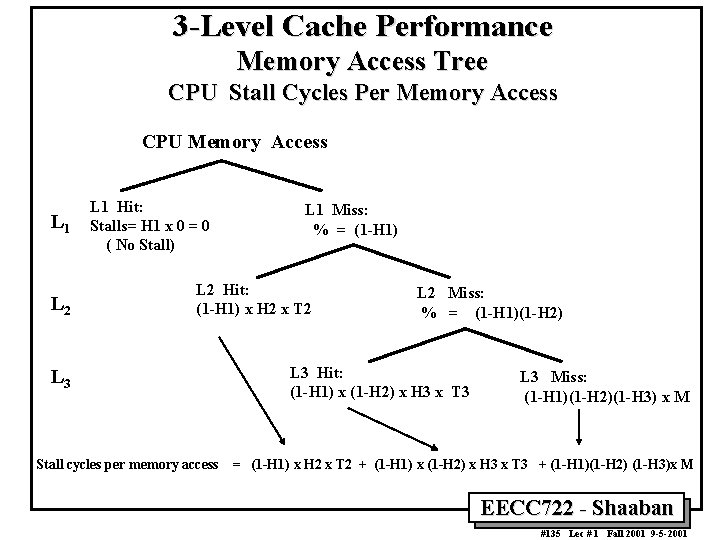
3 Level Cache Performance Memory Access Tree CPU Stall Cycles Per Memory Access CPU Memory Access L 1 L 2 L 1 Hit: Stalls= H 1 x 0 = 0 ( No Stall) L 1 Miss: % = (1 H 1) L 2 Hit: (1 H 1) x H 2 x T 2 L 3 Stall cycles per memory access L 2 Miss: % = (1 H 1)(1 H 2) L 3 Hit: (1 H 1) x (1 H 2) x H 3 x T 3 L 3 Miss: (1 H 1)(1 H 2)(1 H 3) x M = (1 H 1) x H 2 x T 2 + (1 H 1) x (1 H 2) x H 3 x T 3 + (1 H 1)(1 H 2) (1 H 3)x M EECC 722 Shaaban #135 Lec # 1 Fall 2001 9 5 2001
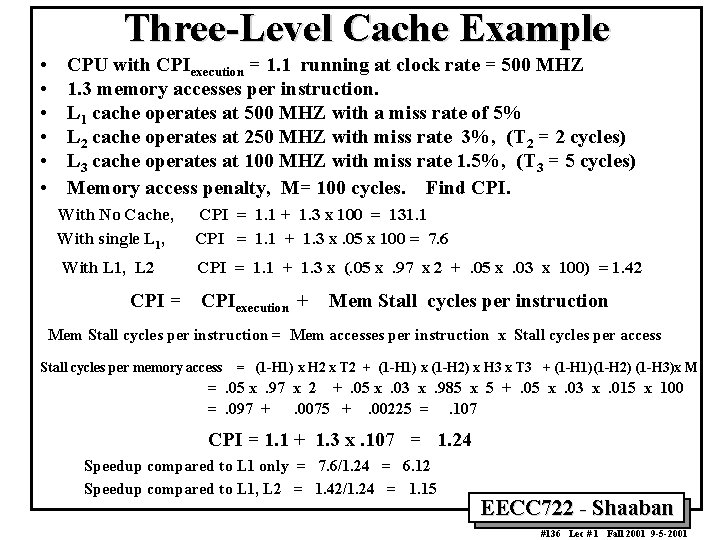
Three Level Cache Example • • • CPU with CPIexecution = 1. 1 running at clock rate = 500 MHZ 1. 3 memory accesses per instruction. L 1 cache operates at 500 MHZ with a miss rate of 5% L 2 cache operates at 250 MHZ with miss rate 3%, (T 2 = 2 cycles) L 3 cache operates at 100 MHZ with miss rate 1. 5%, (T 3 = 5 cycles) Memory access penalty, M= 100 cycles. Find CPI. With No Cache, With single L 1, CPI = 1. 1 + 1. 3 x 100 = 131. 1 CPI = 1. 1 + 1. 3 x. 05 x 100 = 7. 6 With L 1, L 2 CPI = 1. 1 + 1. 3 x (. 05 x. 97 x 2 +. 05 x. 03 x 100) = 1. 42 CPI = CPIexecution + Mem Stall cycles per instruction = Mem accesses per instruction x Stall cycles per access Stall cycles per memory access = (1 H 1) x H 2 x T 2 + (1 H 1) x (1 H 2) x H 3 x T 3 + (1 H 1)(1 H 2) (1 H 3)x M =. 05 x. 97 x 2 +. 05 x. 03 x. 985 x 5 +. 05 x. 03 x. 015 x 100 =. 097 +. 0075 +. 00225 =. 107 CPI = 1. 1 + 1. 3 x. 107 = 1. 24 Speedup compared to L 1 only = 7. 6/1. 24 = 6. 12 Speedup compared to L 1, L 2 = 1. 42/1. 24 = 1. 15 EECC 722 Shaaban #136 Lec # 1 Fall 2001 9 5 2001
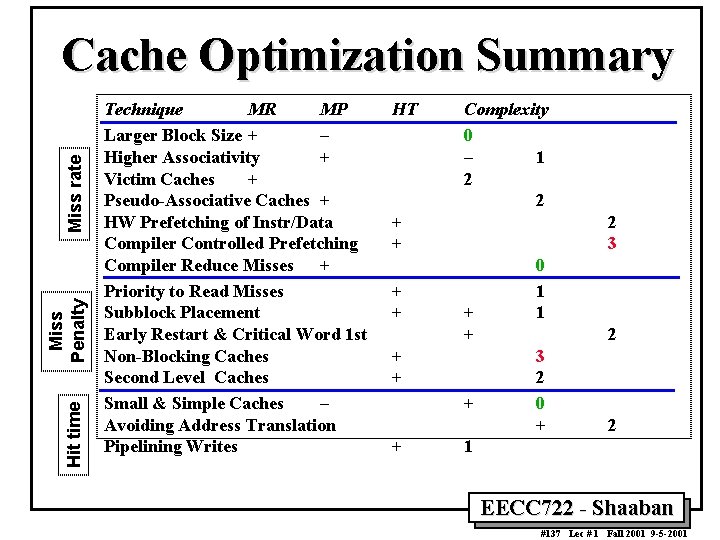
Hit time Miss Penalty Miss rate Cache Optimization Summary Technique MR MP Larger Block Size + – Higher Associativity + Victim Caches + Pseudo Associative Caches + HW Prefetching of Instr/Data Compiler Controlled Prefetching Compiler Reduce Misses + Priority to Read Misses Subblock Placement Early Restart & Critical Word 1 st Non Blocking Caches Second Level Caches Small & Simple Caches – Avoiding Address Translation Pipelining Writes HT Complexity 0 – 1 2 2 + + 2 3 + + + 0 1 1 2 3 2 0 + 2 1 EECC 722 Shaaban #137 Lec # 1 Fall 2001 9 5 2001
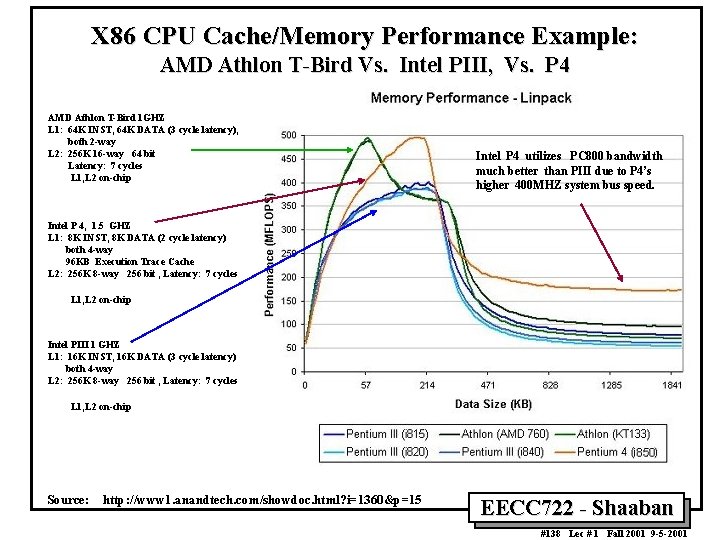
X 86 CPU Cache/Memory Performance Example: AMD Athlon T Bird Vs. Intel PIII, Vs. P 4 AMD Athlon T Bird 1 GHZ L 1: 64 K INST, 64 K DATA (3 cycle latency), both 2 way L 2: 256 K 16 way 64 bit Latency: 7 cycles L 1, L 2 on chip Intel P 4 utilizes PC 800 bandwidth much better than PIII due to P 4’s higher 400 MHZ system bus speed. Intel P 4, 1. 5 GHZ L 1: 8 K INST, 8 K DATA (2 cycle latency) both 4 way 96 KB Execution Trace Cache L 2: 256 K 8 way 256 bit , Latency: 7 cycles L 1, L 2 on chip Intel PIII 1 GHZ L 1: 16 K INST, 16 K DATA (3 cycle latency) both 4 way L 2: 256 K 8 way 256 bit , Latency: 7 cycles L 1, L 2 on chip Source: http: //www 1. anandtech. com/showdoc. html? i=1360&p=15 EECC 722 Shaaban #138 Lec # 1 Fall 2001 9 5 2001