
Advanced Computer Architecture 5 MD 00 5 Z
- Slides: 29
Advanced Computer Architecture 5 MD 00 / 5 Z 032 SMT Simultaneously Multi-Threading Henk Corporaal www. ics. ele. tue. nl/~heco/courses/ h. corporaal@tue. nl TUEindhoven 2007 ACA H. Corporaal
Lecture overview • How to achieve speedup • Simultaneous Multithreading • Examples – Power 4 vs. Power 5 • Head to Head: VLIW vs. Superscalar vs. SMT • Conclusion • Book: sections 3. 4 – 3. 6 10/18/2021 ACA H. Corporaal 2
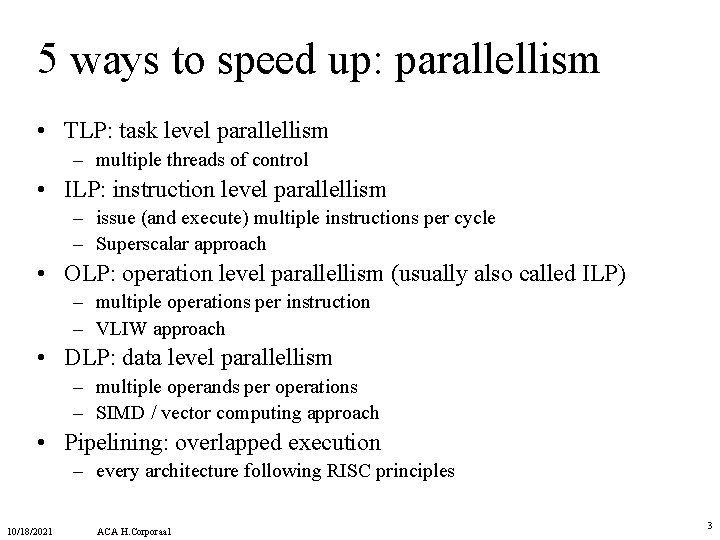
5 ways to speed up: parallellism • TLP: task level parallellism – multiple threads of control • ILP: instruction level parallellism – issue (and execute) multiple instructions per cycle – Superscalar approach • OLP: operation level parallellism (usually also called ILP) – multiple operations per instruction – VLIW approach • DLP: data level parallellism – multiple operands per operations – SIMD / vector computing approach • Pipelining: overlapped execution – every architecture following RISC principles 10/18/2021 ACA H. Corporaal 3
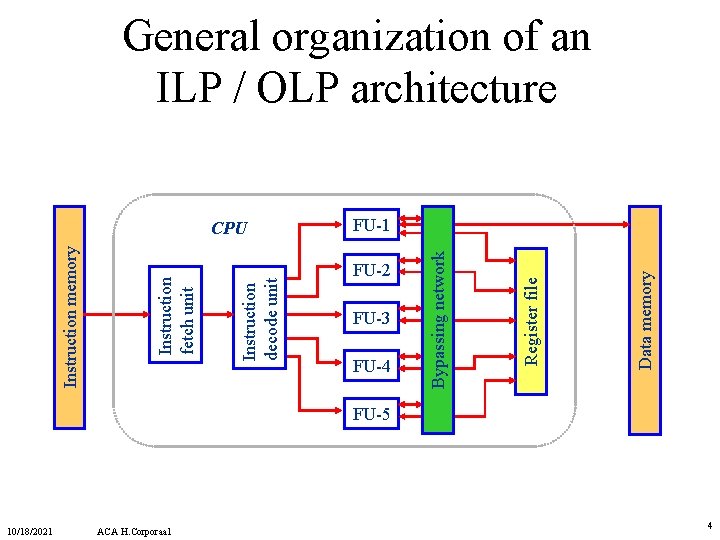
10/18/2021 ACA H. Corporaal Instruction decode unit Instruction fetch unit Instruction memory FU-2 FU-3 FU-4 Data memory Register file CPU Bypassing network General organization of an ILP / OLP architecture FU-1 FU-5 4
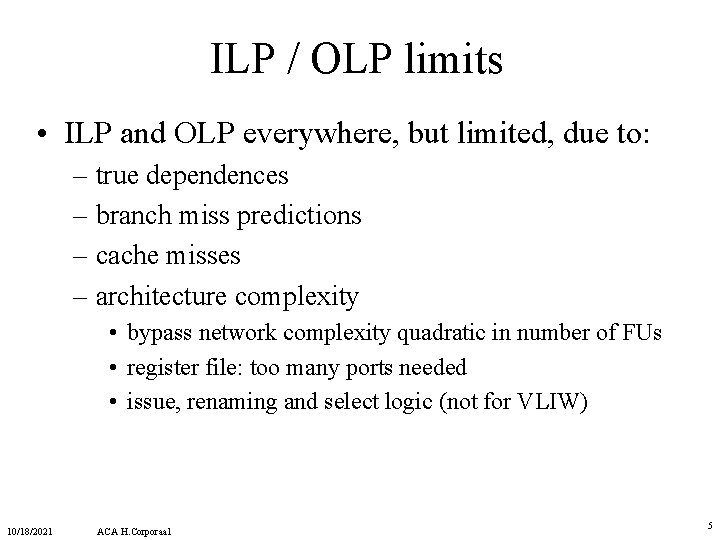
ILP / OLP limits • ILP and OLP everywhere, but limited, due to: – true dependences – branch miss predictions – cache misses – architecture complexity • bypass network complexity quadratic in number of FUs • register file: too many ports needed • issue, renaming and select logic (not for VLIW) 10/18/2021 ACA H. Corporaal 5
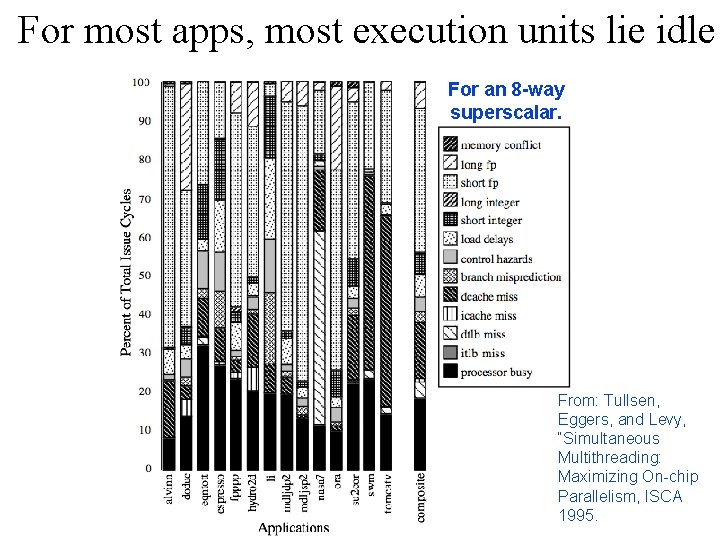
For most apps, most execution units lie idle For an 8 -way superscalar. From: Tullsen, Eggers, and Levy, “Simultaneous Multithreading: Maximizing On-chip Parallelism, ISCA 1995.
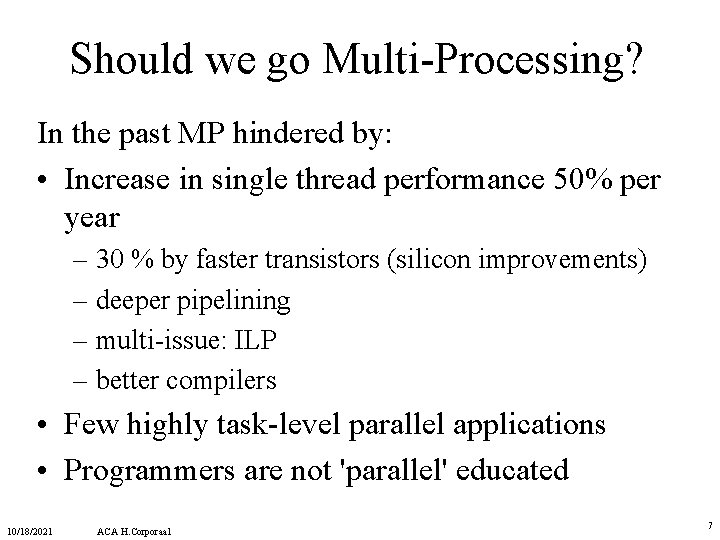
Should we go Multi-Processing? In the past MP hindered by: • Increase in single thread performance 50% per year – 30 % by faster transistors (silicon improvements) – deeper pipelining – multi-issue: ILP – better compilers • Few highly task-level parallel applications • Programmers are not 'parallel' educated 10/18/2021 ACA H. Corporaal 7
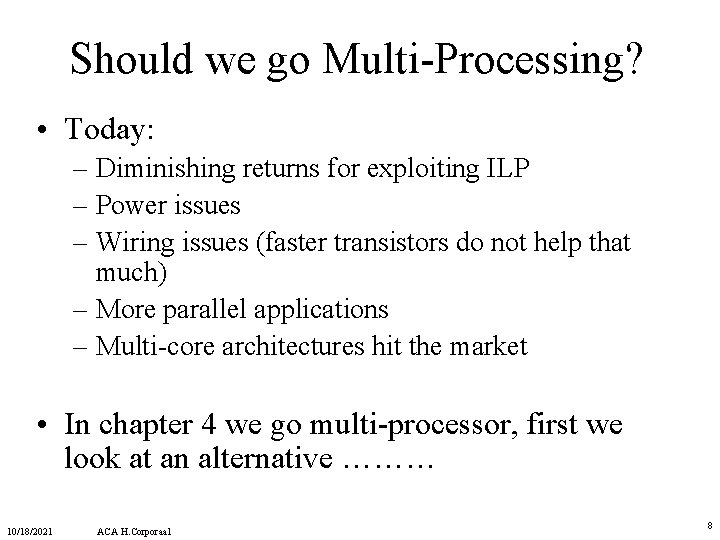
Should we go Multi-Processing? • Today: – Diminishing returns for exploiting ILP – Power issues – Wiring issues (faster transistors do not help that much) – More parallel applications – Multi-core architectures hit the market • In chapter 4 we go multi-processor, first we look at an alternative ……… 10/18/2021 ACA H. Corporaal 8
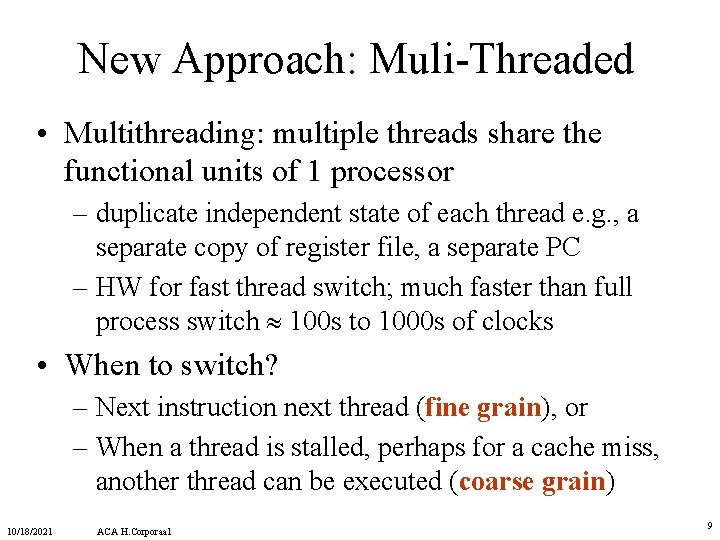
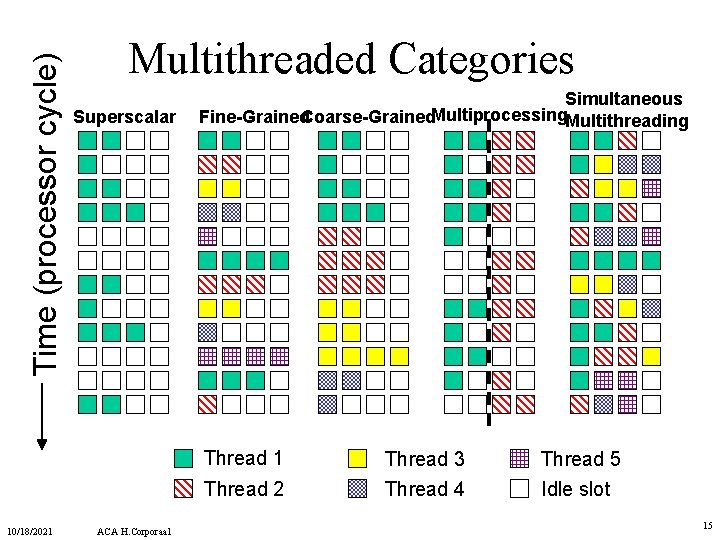
New Approach: Muli-Threaded • Multithreading: multiple threads share the functional units of 1 processor – duplicate independent state of each thread e. g. , a separate copy of register file, a separate PC – HW for fast thread switch; much faster than full process switch 100 s to 1000 s of clocks • When to switch? – Next instruction next thread (fine grain), or – When a thread is stalled, perhaps for a cache miss, another thread can be executed (coarse grain) 10/18/2021 ACA H. Corporaal 9
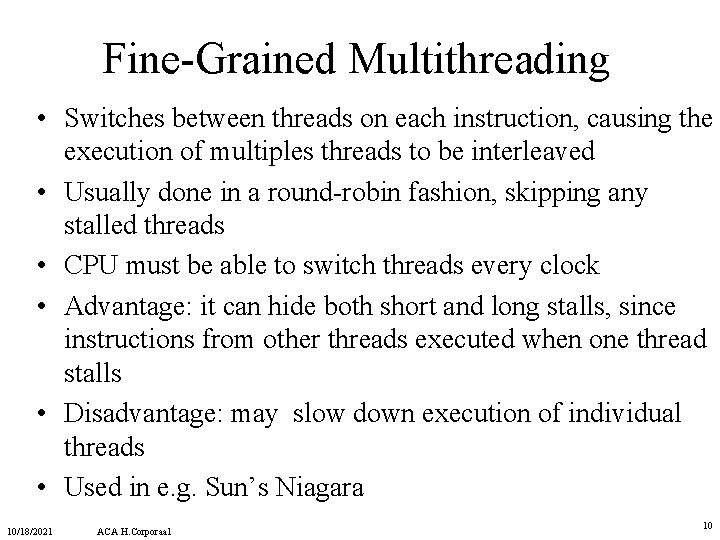
Fine-Grained Multithreading • Switches between threads on each instruction, causing the execution of multiples threads to be interleaved • Usually done in a round-robin fashion, skipping any stalled threads • CPU must be able to switch threads every clock • Advantage: it can hide both short and long stalls, since instructions from other threads executed when one thread stalls • Disadvantage: may slow down execution of individual threads • Used in e. g. Sun’s Niagara 10/18/2021 ACA H. Corporaal 10
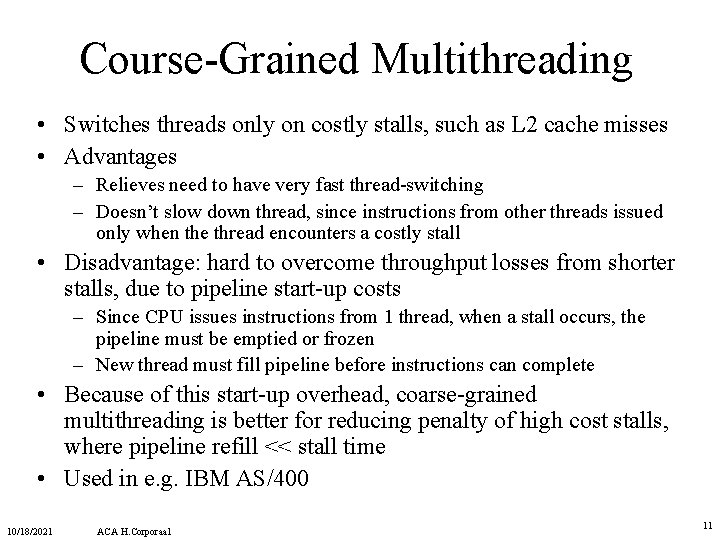
Course-Grained Multithreading • Switches threads only on costly stalls, such as L 2 cache misses • Advantages – Relieves need to have very fast thread-switching – Doesn’t slow down thread, since instructions from other threads issued only when the thread encounters a costly stall • Disadvantage: hard to overcome throughput losses from shorter stalls, due to pipeline start-up costs – Since CPU issues instructions from 1 thread, when a stall occurs, the pipeline must be emptied or frozen – New thread must fill pipeline before instructions can complete • Because of this start-up overhead, coarse-grained multithreading is better for reducing penalty of high cost stalls, where pipeline refill << stall time • Used in e. g. IBM AS/400 10/18/2021 ACA H. Corporaal 11
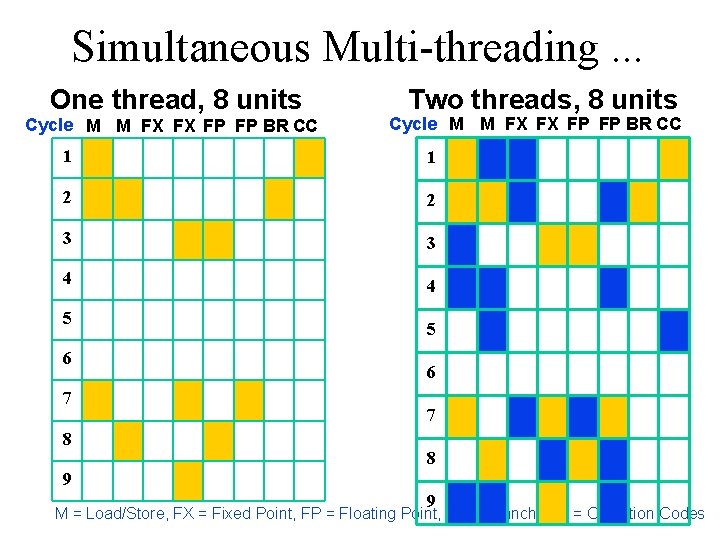
Simultaneous Multi-threading. . . One thread, 8 units Cycle M M FX FX FP FP BR CC Two threads, 8 units Cycle M M FX FX FP FP BR CC 1 1 2 2 3 3 4 4 5 6 7 8 9 9 M = Load/Store, FX = Fixed Point, FP = Floating Point, BR = Branch, CC = Condition Codes
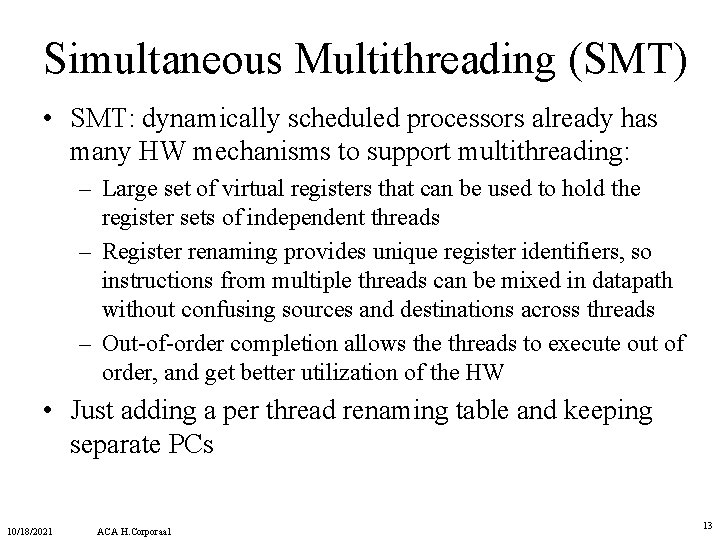
Simultaneous Multithreading (SMT) • SMT: dynamically scheduled processors already has many HW mechanisms to support multithreading: – Large set of virtual registers that can be used to hold the register sets of independent threads – Register renaming provides unique register identifiers, so instructions from multiple threads can be mixed in datapath without confusing sources and destinations across threads – Out-of-order completion allows the threads to execute out of order, and get better utilization of the HW • Just adding a per thread renaming table and keeping separate PCs 10/18/2021 ACA H. Corporaal 13
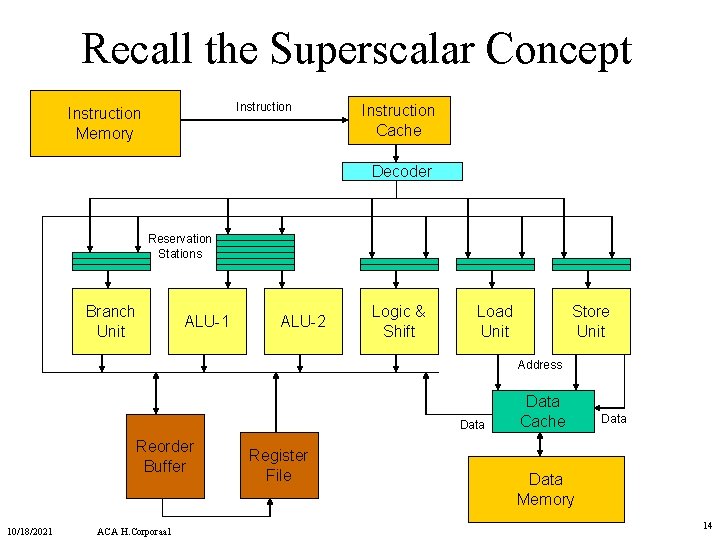
Recall the Superscalar Concept Instruction Memory Instruction Cache Decoder Reservation Stations Branch Unit ALU-1 ALU-2 Logic & Shift Load Unit Store Unit Address Data Reorder Buffer 10/18/2021 ACA H. Corporaal Register File Data Cache Data Memory 14
Time (processor cycle) Multithreaded Categories Superscalar Simultaneous Fine-Grained. Coarse-Grained. Multiprocessing. Multithreading Thread 1 Thread 2 10/18/2021 ACA H. Corporaal Thread 3 Thread 4 Thread 5 Idle slot 15
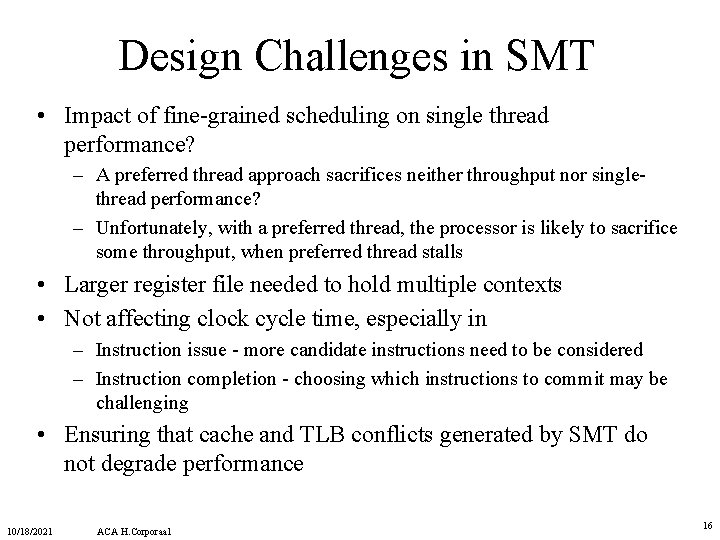
Design Challenges in SMT • Impact of fine-grained scheduling on single thread performance? – A preferred thread approach sacrifices neither throughput nor singlethread performance? – Unfortunately, with a preferred thread, the processor is likely to sacrifice some throughput, when preferred thread stalls • Larger register file needed to hold multiple contexts • Not affecting clock cycle time, especially in – Instruction issue - more candidate instructions need to be considered – Instruction completion - choosing which instructions to commit may be challenging • Ensuring that cache and TLB conflicts generated by SMT do not degrade performance 10/18/2021 ACA H. Corporaal 16
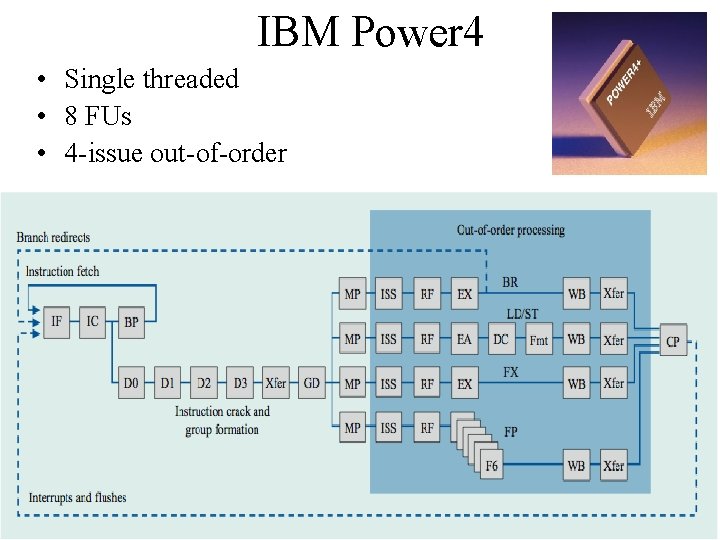
IBM Power 4 • Single threaded • 8 FUs • 4 -issue out-of-order
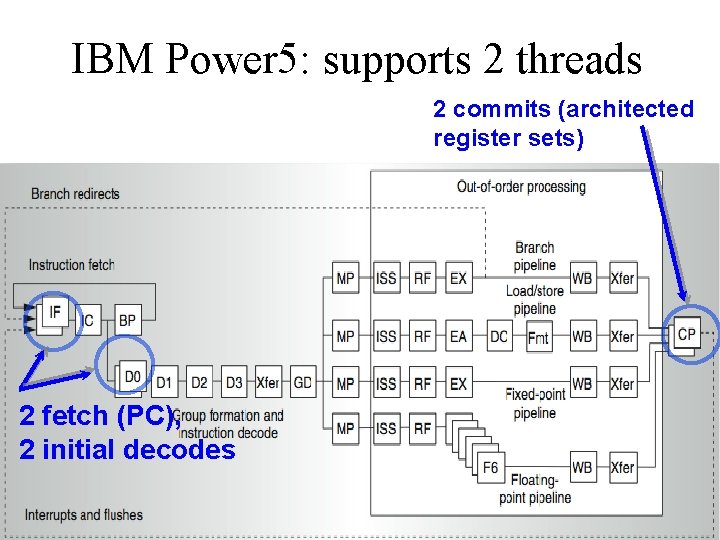
IBM Power 5: supports 2 threads 2 commits (architected register sets) 2 fetch (PC), 2 initial decodes
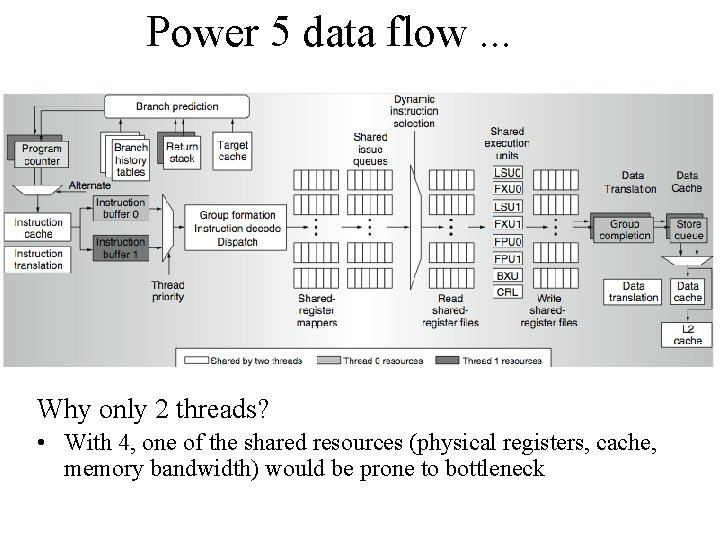
Power 5 data flow. . . Why only 2 threads? • With 4, one of the shared resources (physical registers, cache, memory bandwidth) would be prone to bottleneck
Changes in Power 5 to support SMT • Increased associativity of L 1 instruction cache and the instruction address translation buffers • Added per thread load and store queues • Increased size of the L 2 (1. 92 vs. 1. 44 MB) and L 3 caches • Added separate instruction prefetch and buffering per thread • Increased the number of virtual registers from 152 to 240 • Increased the size of several issue queues • The Power 5 core is about 24% larger than the Power 4 core because of the addition of SMT support 10/18/2021 ACA H. Corporaal 20
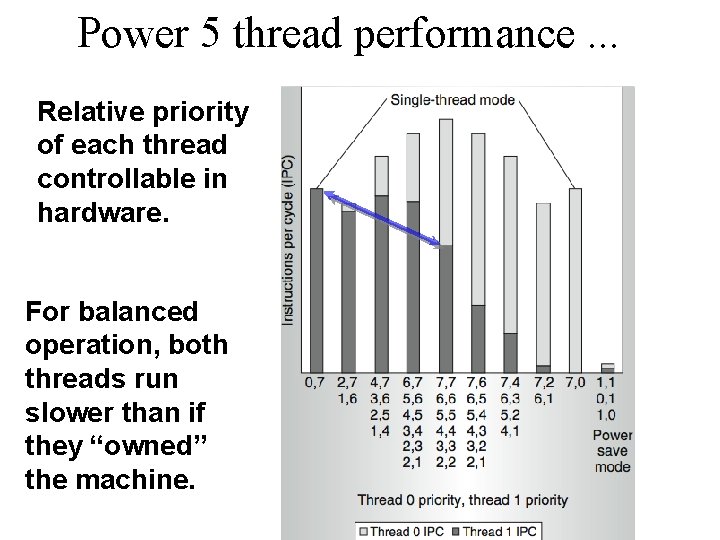
Power 5 thread performance. . . Relative priority of each thread controllable in hardware. For balanced operation, both threads run slower than if they “owned” the machine.
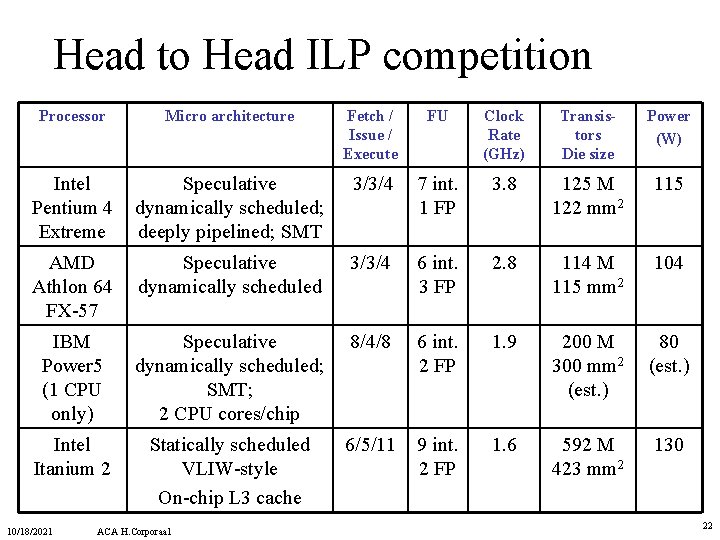
Head to Head ILP competition Processor Micro architecture Fetch / Issue / Execute FU Clock Rate (GHz) Transistors Die size Power (W) Intel Pentium 4 Extreme Speculative dynamically scheduled; deeply pipelined; SMT 3/3/4 7 int. 1 FP 3. 8 125 M 122 mm 2 115 AMD Athlon 64 FX-57 Speculative dynamically scheduled 3/3/4 6 int. 3 FP 2. 8 114 M 115 mm 2 104 IBM Power 5 (1 CPU only) Speculative dynamically scheduled; SMT; 2 CPU cores/chip 8/4/8 6 int. 2 FP 1. 9 200 M 300 mm 2 (est. ) 80 (est. ) Intel Itanium 2 Statically scheduled VLIW-style On-chip L 3 cache 6/5/11 9 int. 2 FP 1. 6 592 M 423 mm 2 130 10/18/2021 ACA H. Corporaal 22
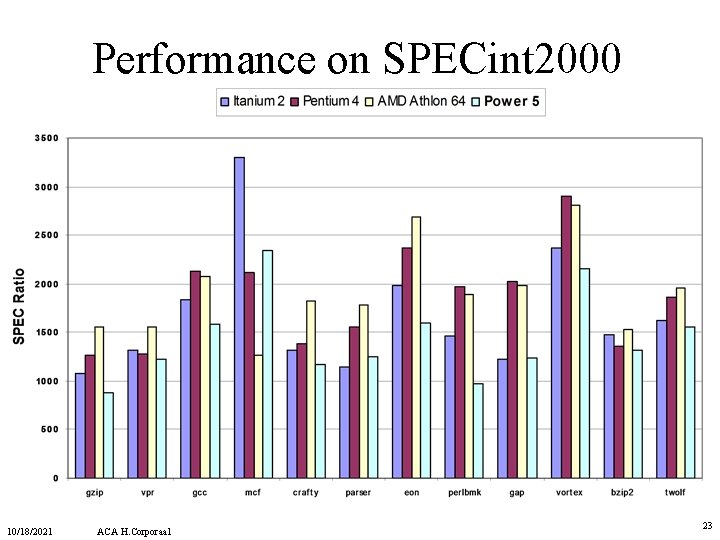
Performance on SPECint 2000 10/18/2021 ACA H. Corporaal 23
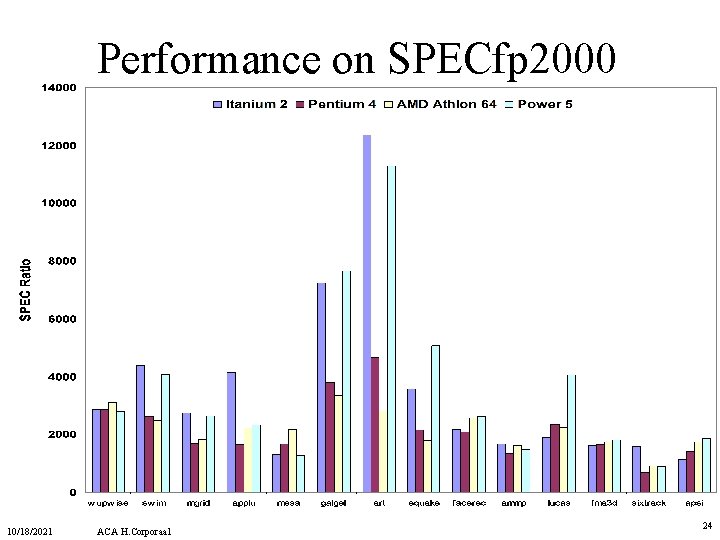
Performance on SPECfp 2000 10/18/2021 ACA H. Corporaal 24
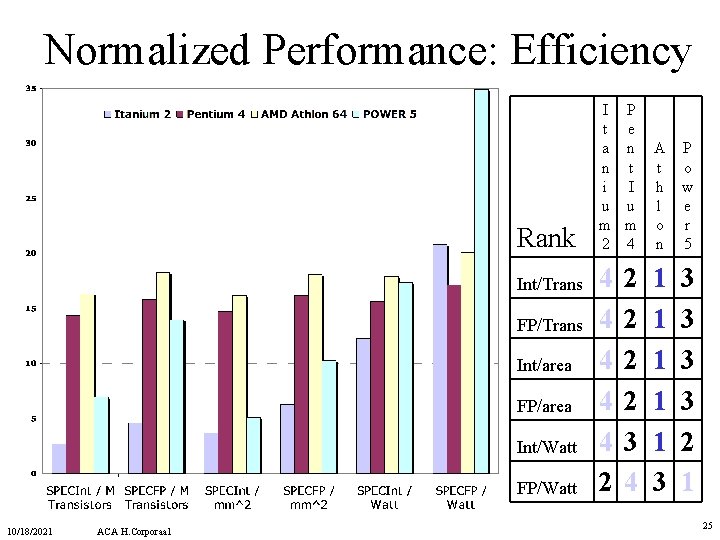
Normalized Performance: Efficiency Rank Int/Trans FP/Trans Int/area FP/area Int/Watt FP/Watt 10/18/2021 ACA H. Corporaal I t a n i u m 2 P e n t I u m 4 A t h l o n P o w e r 5 4 4 4 2 2 2 3 4 1 1 1 3 3 3 2 1 25
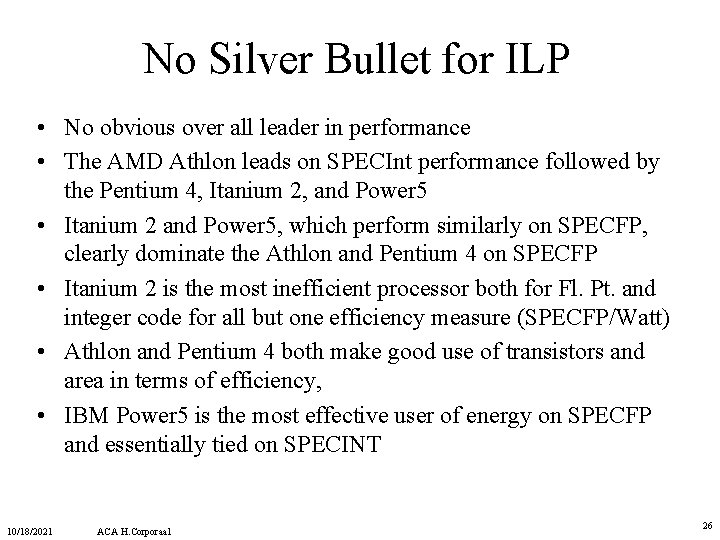
No Silver Bullet for ILP • No obvious over all leader in performance • The AMD Athlon leads on SPECInt performance followed by the Pentium 4, Itanium 2, and Power 5 • Itanium 2 and Power 5, which perform similarly on SPECFP, clearly dominate the Athlon and Pentium 4 on SPECFP • Itanium 2 is the most inefficient processor both for Fl. Pt. and integer code for all but one efficiency measure (SPECFP/Watt) • Athlon and Pentium 4 both make good use of transistors and area in terms of efficiency, • IBM Power 5 is the most effective user of energy on SPECFP and essentially tied on SPECINT 10/18/2021 ACA H. Corporaal 26
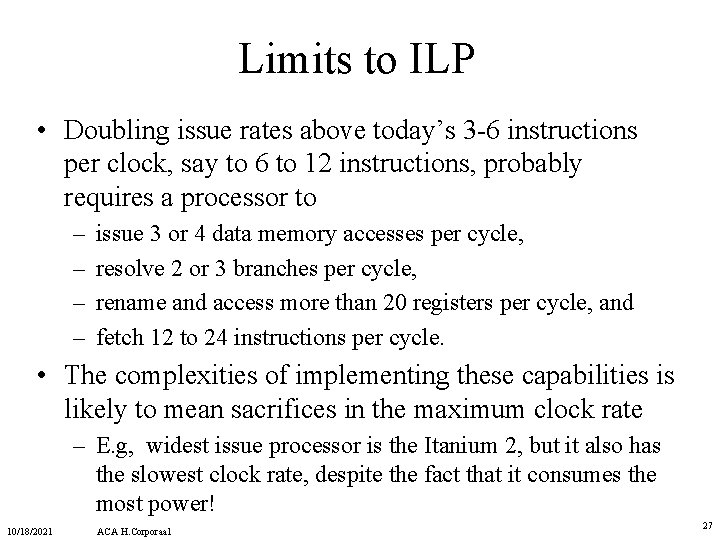
Limits to ILP • Doubling issue rates above today’s 3 -6 instructions per clock, say to 6 to 12 instructions, probably requires a processor to – – issue 3 or 4 data memory accesses per cycle, resolve 2 or 3 branches per cycle, rename and access more than 20 registers per cycle, and fetch 12 to 24 instructions per cycle. • The complexities of implementing these capabilities is likely to mean sacrifices in the maximum clock rate – E. g, widest issue processor is the Itanium 2, but it also has the slowest clock rate, despite the fact that it consumes the most power! 10/18/2021 ACA H. Corporaal 27
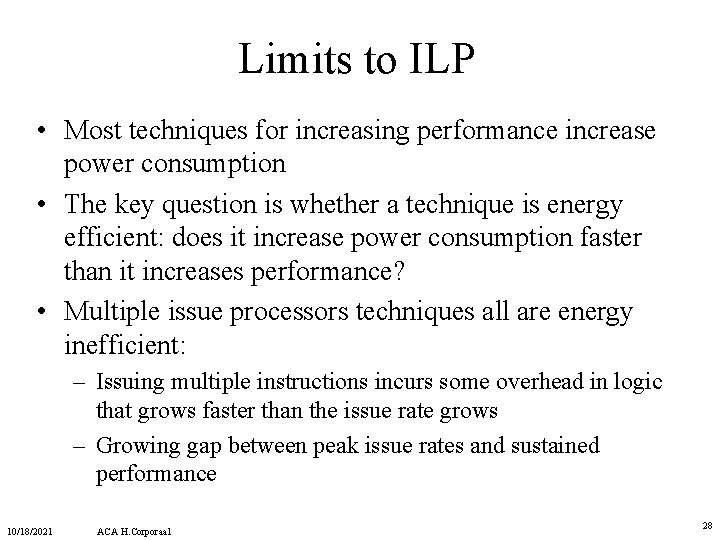
Limits to ILP • Most techniques for increasing performance increase power consumption • The key question is whether a technique is energy efficient: does it increase power consumption faster than it increases performance? • Multiple issue processors techniques all are energy inefficient: – Issuing multiple instructions incurs some overhead in logic that grows faster than the issue rate grows – Growing gap between peak issue rates and sustained performance 10/18/2021 ACA H. Corporaal 28
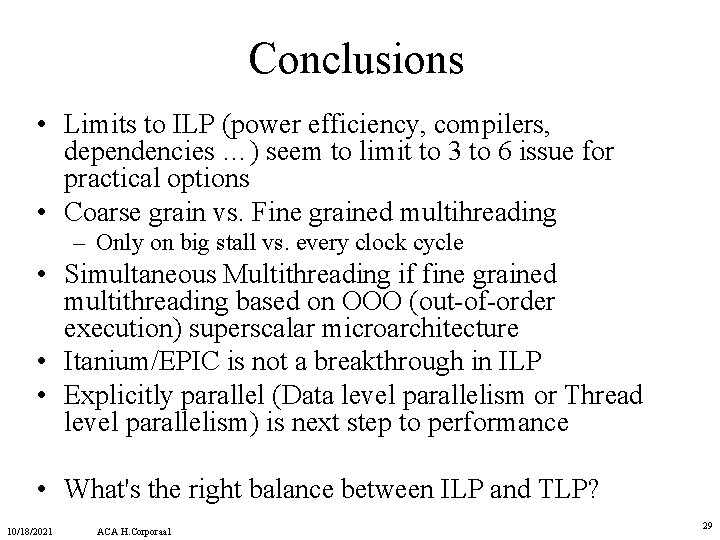
Conclusions • Limits to ILP (power efficiency, compilers, dependencies …) seem to limit to 3 to 6 issue for practical options • Coarse grain vs. Fine grained multihreading – Only on big stall vs. every clock cycle • Simultaneous Multithreading if fine grained multithreading based on OOO (out-of-order execution) superscalar microarchitecture • Itanium/EPIC is not a breakthrough in ILP • Explicitly parallel (Data level parallelism or Thread level parallelism) is next step to performance • What's the right balance between ILP and TLP? 10/18/2021 ACA H. Corporaal 29