
Advanced Composite Types You will learn in this
- Slides: 17
Advanced Composite Types You will learn in this section of notes how to create single and generic instances of non-homogeneous composite types. James Tam
What You Know • How to create composite types (that are composed of other types e. g. , integers, real numbers, strings) which are homogeneous. • Python implementation of this composite type: List • Typical implementation of this composite type in other programming languages (e. g. , ‘C’, “C++”, “Pascal”, “Java”): Array James Tam
What You Will Learn • How to create composite types that aren’t strictly homogeneous (elements are all the same). James Tam
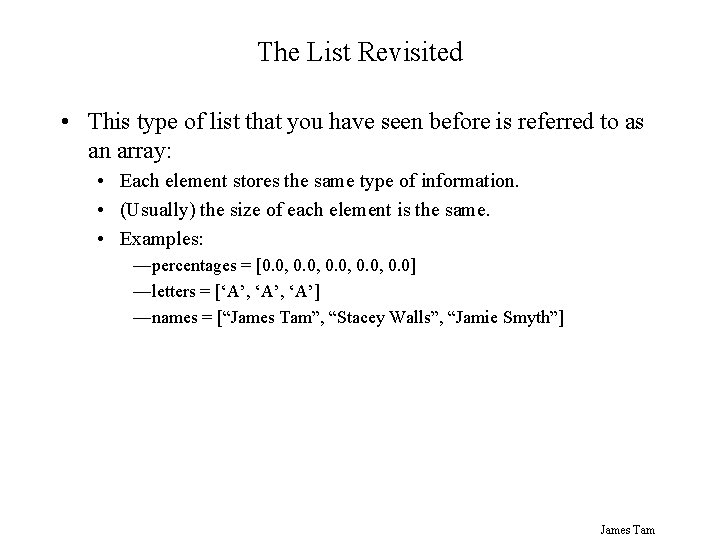
The List Revisited • This type of list that you have seen before is referred to as an array: • Each element stores the same type of information. • (Usually) the size of each element is the same. • Examples: —percentages = [0. 0, 0. 0] —letters = [‘A’, ‘A’] —names = [“James Tam”, “Stacey Walls”, “Jamie Smyth”] James Tam
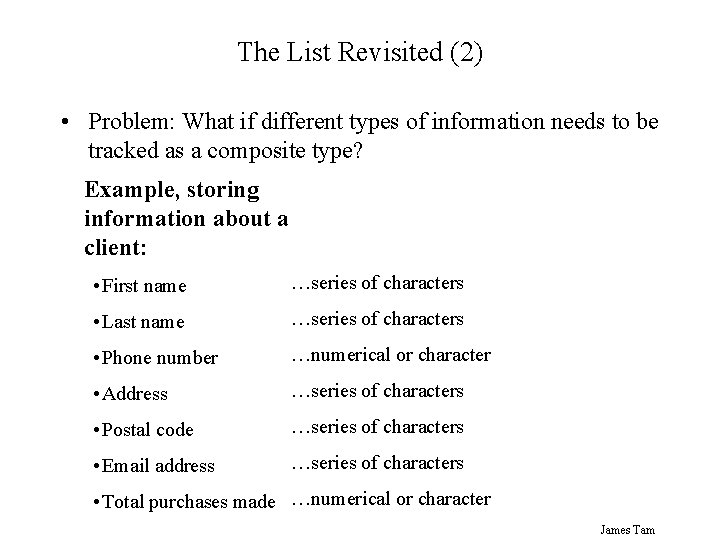
The List Revisited (2) • Problem: What if different types of information needs to be tracked as a composite type? Example, storing information about a client: • First name …series of characters • Last name …series of characters • Phone number …numerical or character • Address …series of characters • Postal code …series of characters • Email address …series of characters • Total purchases made …numerical or character James Tam
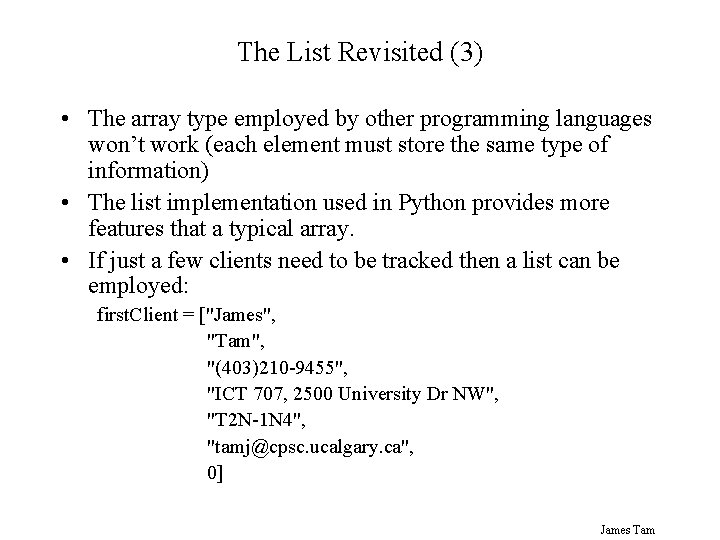
The List Revisited (3) • The array type employed by other programming languages won’t work (each element must store the same type of information) • The list implementation used in Python provides more features that a typical array. • If just a few clients need to be tracked then a list can be employed: first. Client = ["James", "Tam", "(403)210 -9455", "ICT 707, 2500 University Dr NW", "T 2 N-1 N 4", "tamj@cpsc. ucalgary. ca", 0] James Tam
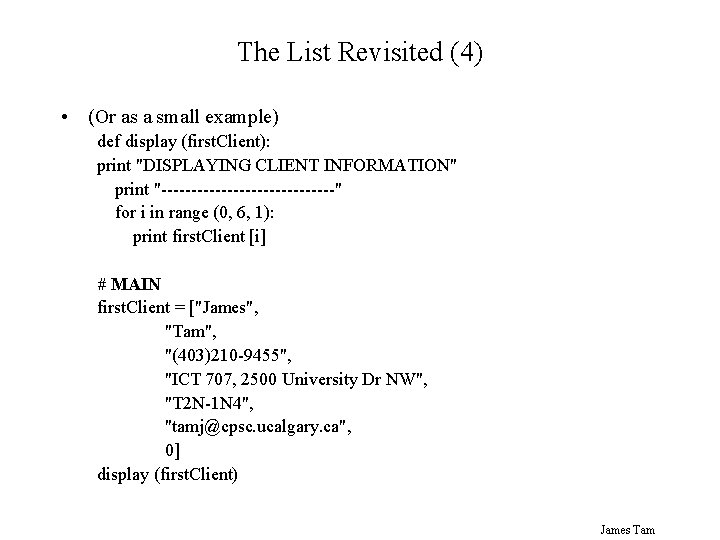
The List Revisited (4) • (Or as a small example) def display (first. Client): print "DISPLAYING CLIENT INFORMATION" print "---------------" for i in range (0, 6, 1): print first. Client [i] # MAIN first. Client = ["James", "Tam", "(403)210 -9455", "ICT 707, 2500 University Dr NW", "T 2 N-1 N 4", "tamj@cpsc. ucalgary. ca", 0] display (first. Client) James Tam
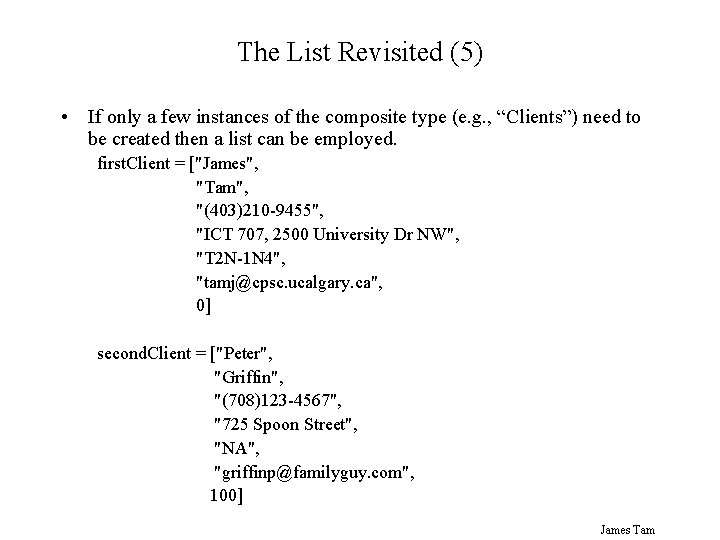
The List Revisited (5) • If only a few instances of the composite type (e. g. , “Clients”) need to be created then a list can be employed. first. Client = ["James", "Tam", "(403)210 -9455", "ICT 707, 2500 University Dr NW", "T 2 N-1 N 4", "tamj@cpsc. ucalgary. ca", 0] second. Client = ["Peter", "Griffin", "(708)123 -4567", "725 Spoon Street", "NA", "griffinp@familyguy. com", 100] James Tam
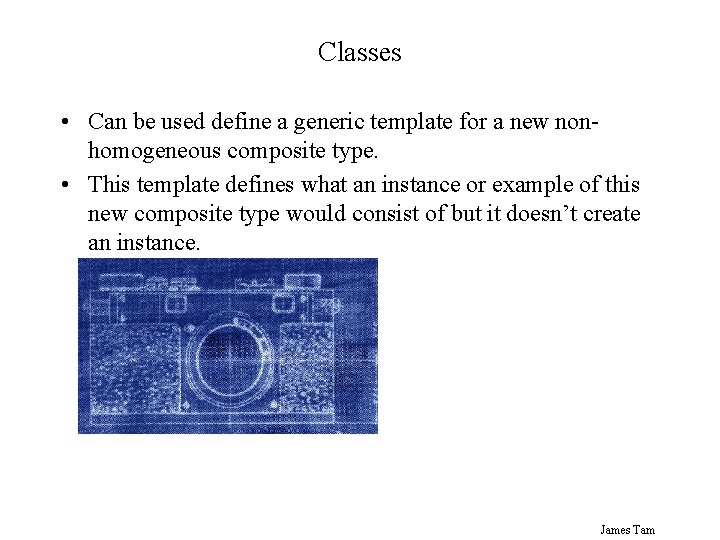
Classes • Can be used define a generic template for a new nonhomogeneous composite type. • This template defines what an instance or example of this new composite type would consist of but it doesn’t create an instance. James Tam
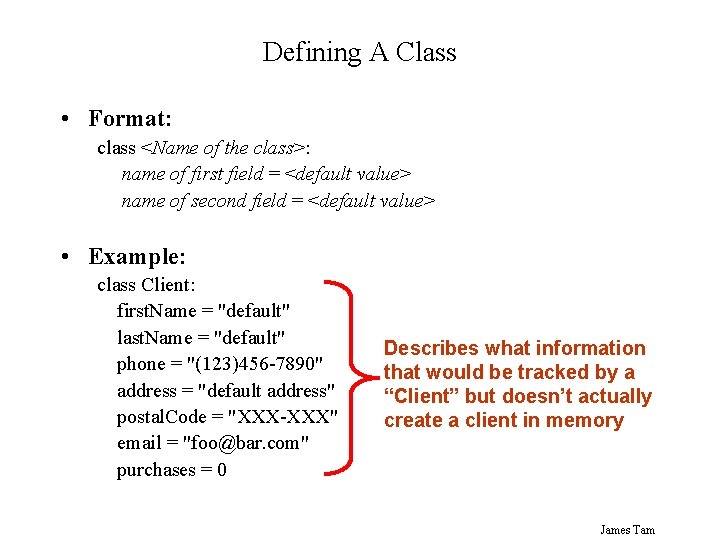
Defining A Class • Format: class <Name of the class>: name of first field = <default value> name of second field = <default value> • Example: class Client: first. Name = "default" last. Name = "default" phone = "(123)456 -7890" address = "default address" postal. Code = "XXX-XXX" email = "foo@bar. com" purchases = 0 Describes what information that would be tracked by a “Client” but doesn’t actually create a client in memory James Tam
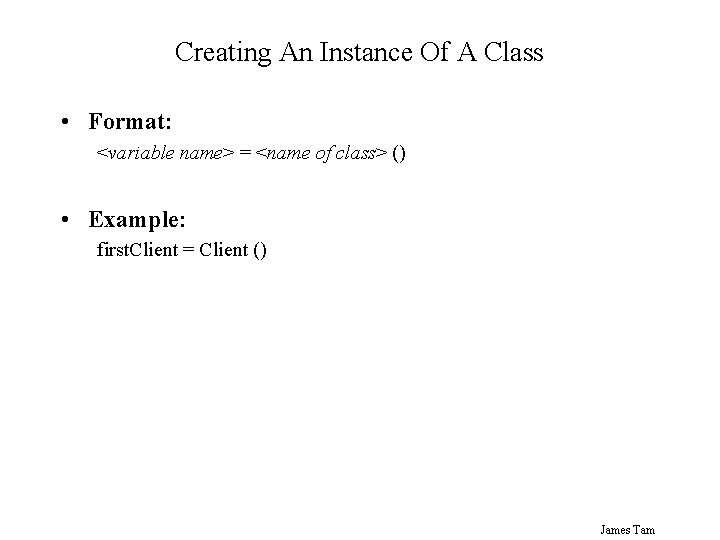
Creating An Instance Of A Class • Format: <variable name> = <name of class> () • Example: first. Client = Client () James Tam
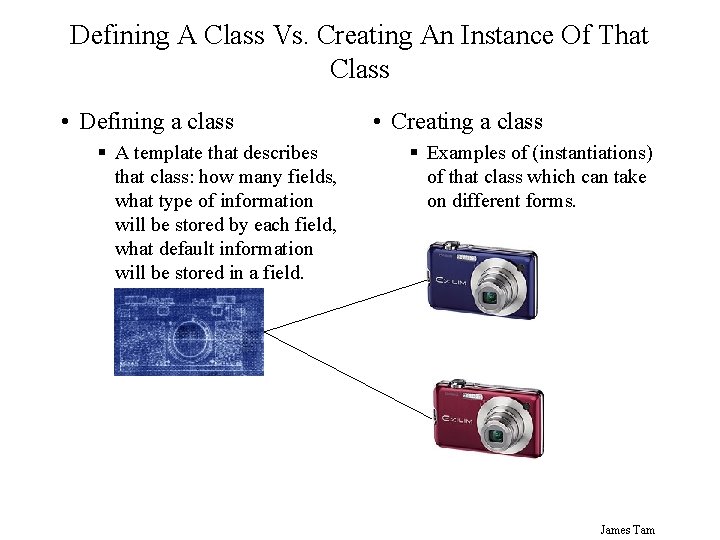
Defining A Class Vs. Creating An Instance Of That Class • Defining a class § A template that describes that class: how many fields, what type of information will be stored by each field, what default information will be stored in a field. • Creating a class § Examples of (instantiations) of that class which can take on different forms. James Tam
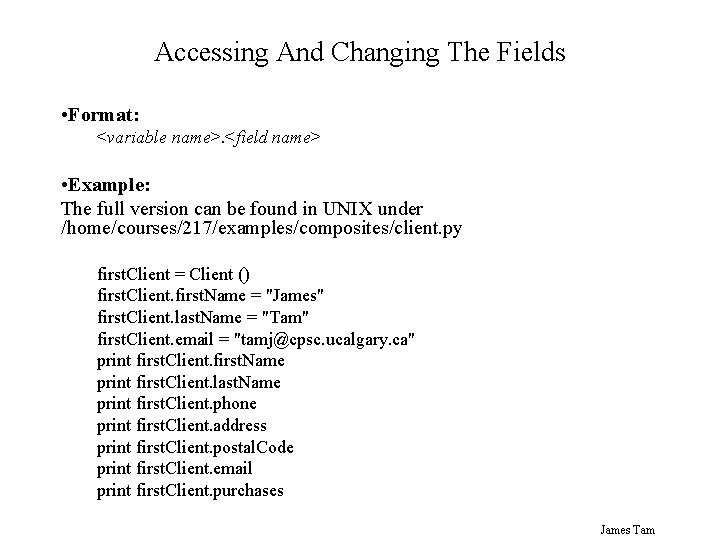
Accessing And Changing The Fields • Format: <variable name>. <field name> • Example: The full version can be found in UNIX under /home/courses/217/examples/composites/client. py first. Client = Client () first. Client. first. Name = "James" first. Client. last. Name = "Tam" first. Client. email = "tamj@cpsc. ucalgary. ca" print first. Client. first. Name print first. Client. last. Name print first. Client. phone print first. Client. address print first. Client. postal. Code print first. Client. email print first. Client. purchases James Tam
What Is The Benefit Of Defining A Class • It allows new types of variables to be declared. • The new type can model information about most any arbitrary entity: • Car • Movie • Your pet • A biological entity in a simulation • A ‘critter’ a video game • An ‘object’ in a video game • Etc. James Tam
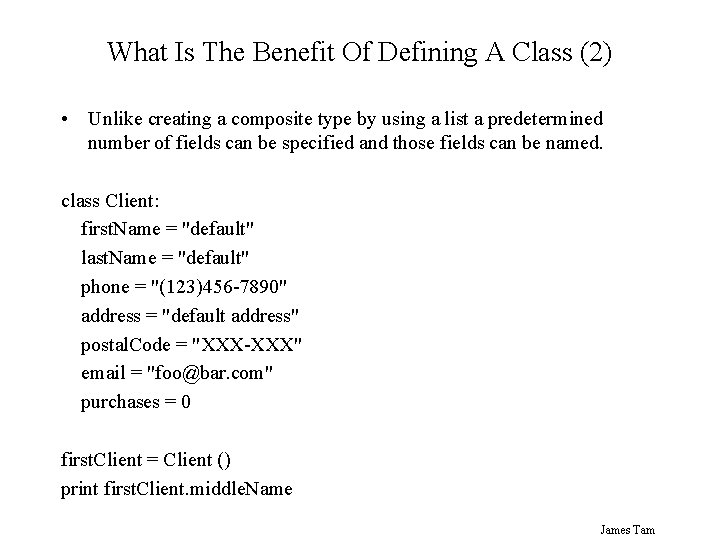
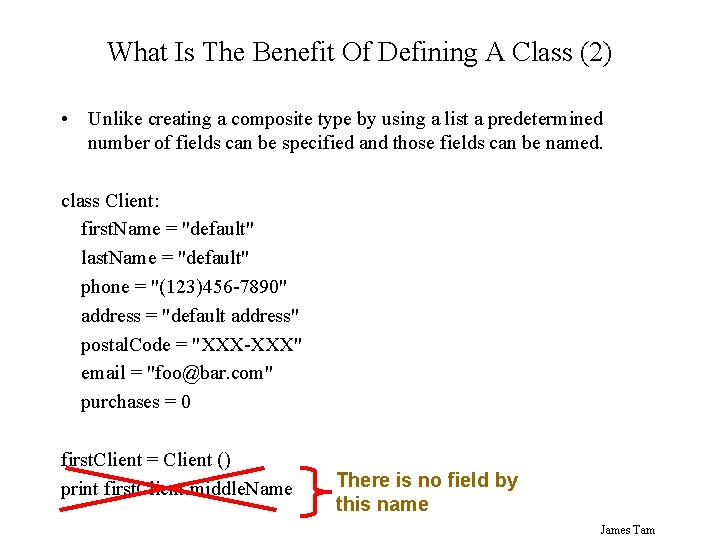
What Is The Benefit Of Defining A Class (2) • Unlike creating a composite type by using a list a predetermined number of fields can be specified and those fields can be named. class Client: first. Name = "default" last. Name = "default" phone = "(123)456 -7890" address = "default address" postal. Code = "XXX-XXX" email = "foo@bar. com" purchases = 0 first. Client = Client () print first. Client. middle. Name James Tam
What Is The Benefit Of Defining A Class (2) • Unlike creating a composite type by using a list a predetermined number of fields can be specified and those fields can be named. class Client: first. Name = "default" last. Name = "default" phone = "(123)456 -7890" address = "default address" postal. Code = "XXX-XXX" email = "foo@bar. com" purchases = 0 first. Client = Client () print first. Client. middle. Name There is no field by this name James Tam
You Should Now Know • How a list can be used to store different types of information (non-homogeneous composite type) • How to define an arbitrary composite type using a class • What are the benefits of defining a composite type by using a class definition over using a list • How to create instances of a class (instantiate) • How to access and change the attributes or fields of a class James Tam