
Advanced Cervical Spine Anatomy and Biomechanics Atlanto Occipital
Advanced Cervical Spine Anatomy and Biomechanics

Atlanto Occipital Ligaments Joint capsule • Thin and loose Anterior atlanto occipital membrane • Connects the anterior part of the foramen magnum to the anterior arch of C 1. Continuation of the ALL. May provide some A-P stability Posterior atlanto occipital membrane • Connects the posterior ring of C 1 to the occiput at the foramen magnum. Broad and thin • The anterior and posterior membranes prevent anterior and vertical displacement of C 1 and C 2.
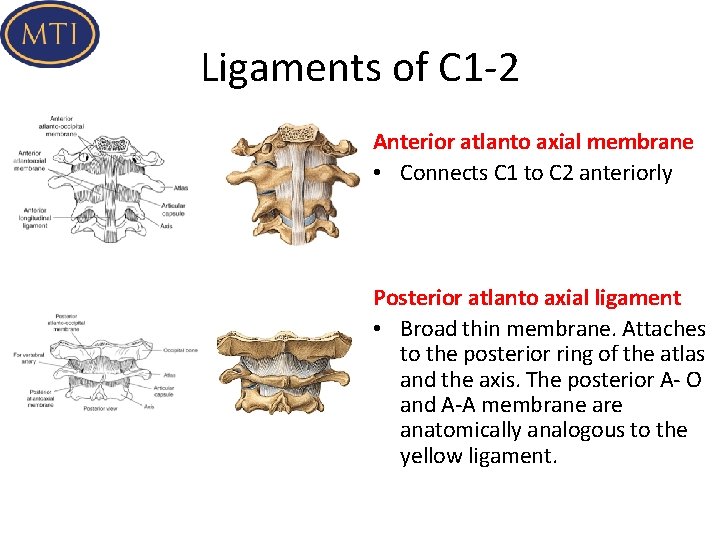
Ligaments of C 1 -2 Anterior atlanto axial membrane • Connects C 1 to C 2 anteriorly Posterior atlanto axial ligament • Broad thin membrane. Attaches to the posterior ring of the atlas and the axis. The posterior A- O and A-A membrane are anatomically analogous to the yellow ligament.
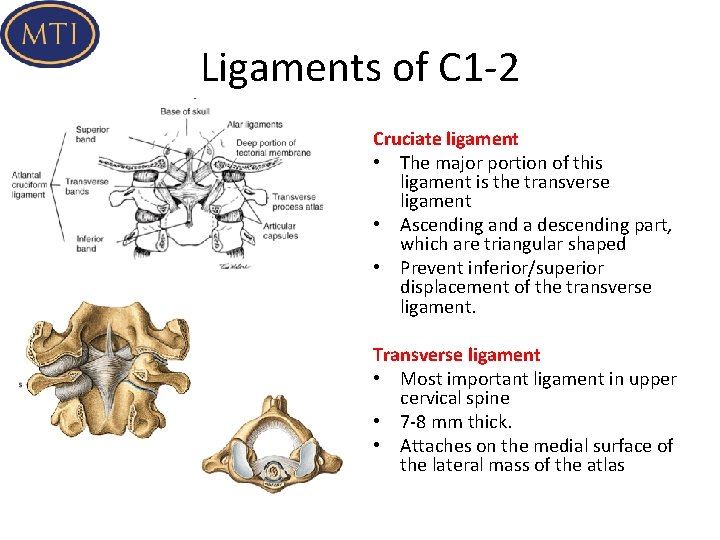
Ligaments of C 1 -2 Cruciate ligament • The major portion of this ligament is the transverse ligament • Ascending and a descending part, which are triangular shaped • Prevent inferior/superior displacement of the transverse ligament. Transverse ligament • Most important ligament in upper cervical spine • 7 -8 mm thick. • Attaches on the medial surface of the lateral mass of the atlas

Ligaments connecting C 2 with Occiput Tectorial membrane • Continuation of PLL • Runs from the body of C 2 up over the posterior portion of the dens and then makes a 45 -degree angle in the anterior direction as it attaches to the anterior edge of the foramen magnum • Limits flexion, extension and vertical translation

Ligaments connecting C 2 with Occiput Apical ligament • Connects the apex of the dens to the anterior edge of the foramen magnum • Contributes little to upper cervical spine stability
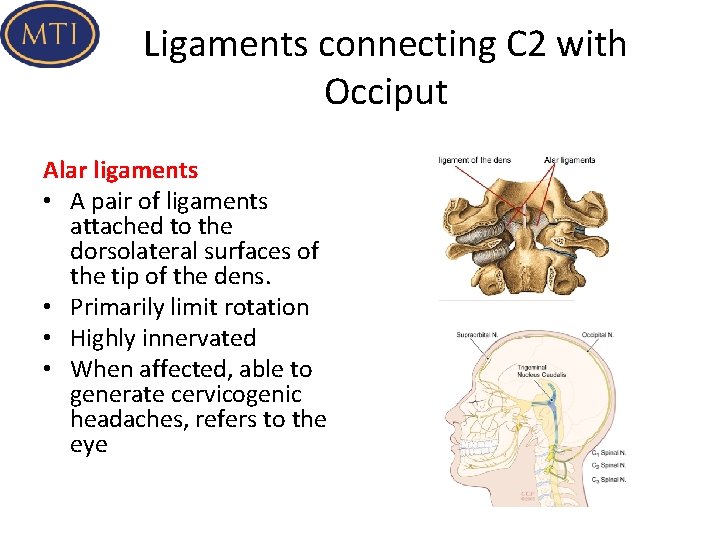
Ligaments connecting C 2 with Occiput Alar ligaments • A pair of ligaments attached to the dorsolateral surfaces of the tip of the dens. • Primarily limit rotation • Highly innervated • When affected, able to generate cervicogenic headaches, refers to the eye

Sub Occipital Musculature • Main function: fine-tuning of position changes of the head. • Oblique capitis inferior also acts as an active stabilizer of C 1 -2. • Bilateral contraction of the sub occipital muscles extends the neck at O-A. • Unilateral contraction of the sub occipital muscles side bends and rotates the upper cervical spine. • Rotation at O-A is conjunct.
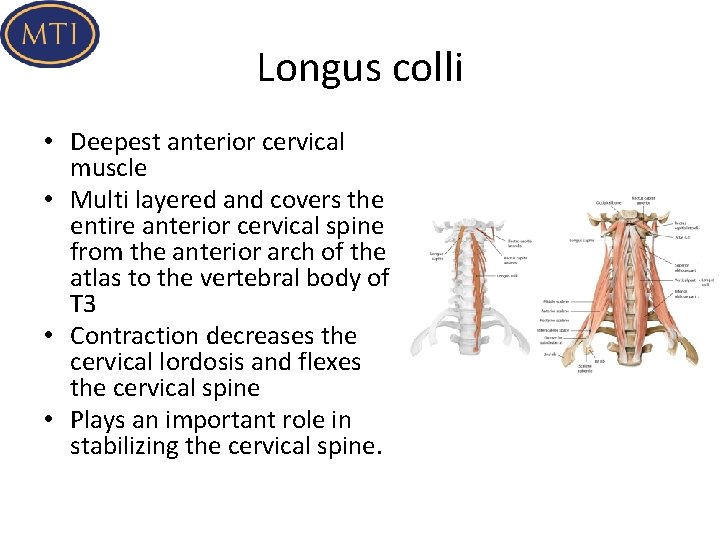
Longus colli • Deepest anterior cervical muscle • Multi layered and covers the entire anterior cervical spine from the anterior arch of the atlas to the vertebral body of T 3 • Contraction decreases the cervical lordosis and flexes the cervical spine • Plays an important role in stabilizing the cervical spine.
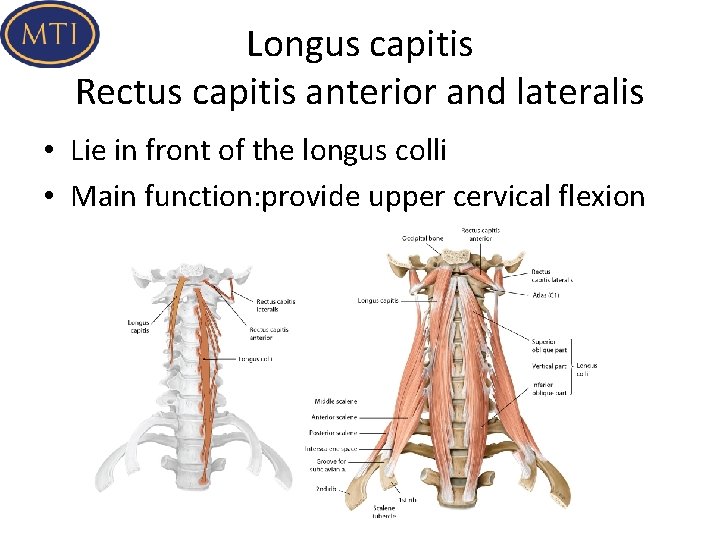
Longus capitis Rectus capitis anterior and lateralis • Lie in front of the longus colli • Main function: provide upper cervical flexion
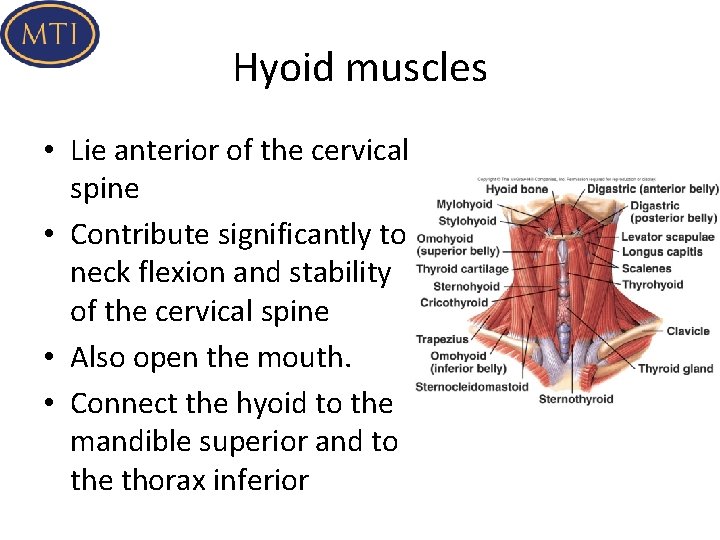
Hyoid muscles • Lie anterior of the cervical spine • Contribute significantly to neck flexion and stability of the cervical spine • Also open the mouth. • Connect the hyoid to the mandible superior and to the thorax inferior

Scalenes • Run on the anterior lateral side of the cervical spine • Connecting the cervical vertebrae with the 1 st and 2 nd rib • Function much like the mainstays on a sailboat. • Consists of 3 muscles • Between the anterior and medial scalenus run the brachial plexus and the subclavian artery

Posterior muscles Intrinsic muscles • On the posterior side of the cervical spine are 4 layers of muscles • The deepest layer consists of the small intrinsic muscles: transversospinal and interspinous muscles

Hyoid • Palpate the mandible left and right with thumb and index finger • Follow the contour of the neck and slide caudally. • The hyoid is then easily palpable. • Horseshoe shaped and moves up and down with swallowing. • Hyoid is at the level of C 3. • Palpate for mobility.
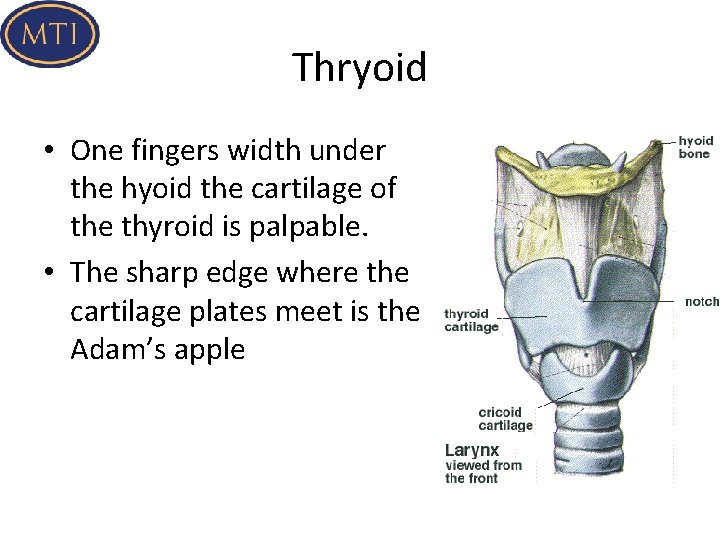
Thryoid • One fingers width under the hyoid the cartilage of the thyroid is palpable. • The sharp edge where the cartilage plates meet is the Adam’s apple

Cricoid • Ring of cartilage caudally of thyroid • Caudally of the cricoid is the trachea • Lies at the level of C 6 • Lateral of the cricoid you can palpate thyroid gland. • Palpate the cricoid between thumb and indexfinger and have the patient swallow • The larynx and thyroid should move up and down. • Size and consistency of the thyroid can then be evaluated
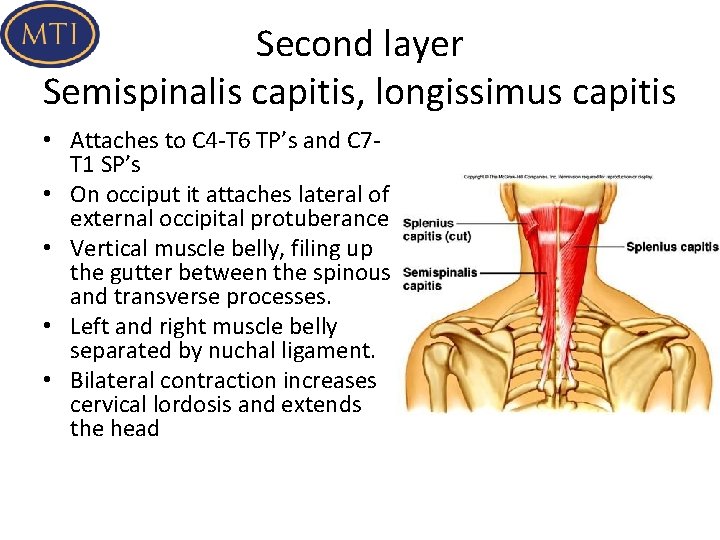
Second layer Semispinalis capitis, longissimus capitis • Attaches to C 4 -T 6 TP’s and C 7 T 1 SP’s • On occiput it attaches lateral of external occipital protuberance • Vertical muscle belly, filing up the gutter between the spinous and transverse processes. • Left and right muscle belly separated by nuchal ligament. • Bilateral contraction increases cervical lordosis and extends the head
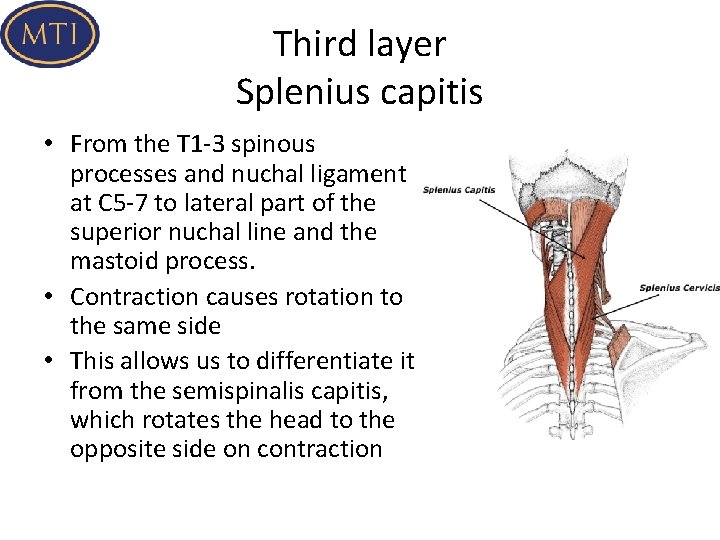
Third layer Splenius capitis • From the T 1 -3 spinous processes and nuchal ligament at C 5 -7 to lateral part of the superior nuchal line and the mastoid process. • Contraction causes rotation to the same side • This allows us to differentiate it from the semispinalis capitis, which rotates the head to the opposite side on contraction
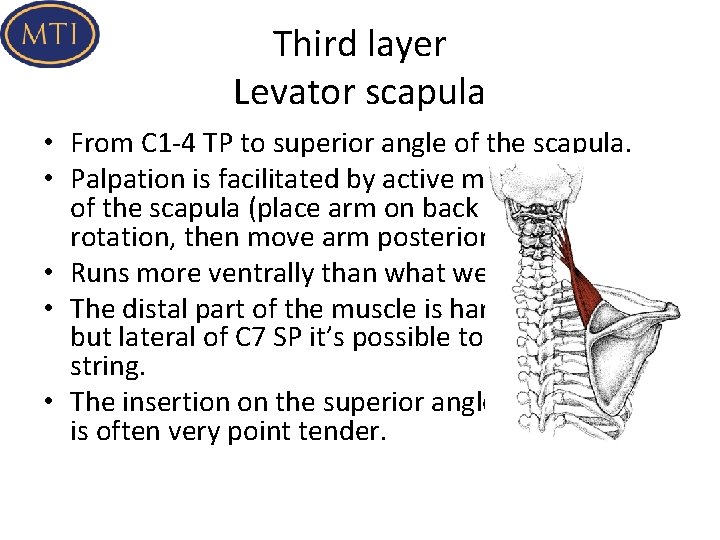
Third layer Levator scapula • From C 1 -4 TP to superior angle of the scapula. • Palpation is facilitated by active medial rotation of the scapula (place arm on back in full internal rotation, then move arm posterior). • Runs more ventrally than what we might expect. • The distal part of the muscle is harder to palpate, but lateral of C 7 SP it’s possible to feel a rolling string. • The insertion on the superior angle of the scapula is often very point tender.

Menisci of Cervical Facet Joints • Three types of intra-articular inclusions are found in the synovial joints: 1. capsular rims, 2. intra-articular fat pads 3. fibro adipose meniscoid structures • At least one type of structure is found in each synovial joint

Intra Articular Fat Pads • Articular fat pads occupy the space between joint capsule and perimeter of the articular cartilage and remain outside the joint space • Composed of adipose tissue. They occur most frequently at O-A, where they are located medial or lateral of the facet of the atlas. At lower levels of the cervical spine their presence is rare and their disposition irregular.
Intra Articular Fat Pads • Function: displaceable space fillers • For this purpose neither synovial fluid nor fibrous tissue would serve as well as fat • Synovial fluid is not designed to fill cavities but rather to act as a lubricant while fibrous tissue would cause the joint to be stiff.

Fibro Adipose Meniscoids • Most commonly found inclusion in joints at all levels of the cervical spine, except at O-A where fat pads predominate. • The fibro-adipose meniscoid has a thick base attached to the joint capsule, which tapers to a thin fibrous end, which protrudes into the joint for 2 -5 mm

Fibro Adipose Meniscoids • Function: protect the exposed cartilage during joint motion by maintaining a film of synovial fluid between themselves and the cartilage
Capsular Rim • Stiff, wedge shaped intrusions of the joint capsule. • Occur around the margin of the articular surface • Do not enter the joint space, occupying the space between joint capsule and the facet margin • Occur mostly at O-A. • They appear to be internal thickenings of the joint capsule • Function: fill the space around the rim thereby helping to distribute forces

Role of Meniscoids • Imaging is difficult as they are so small • Therefore discussion about exact role is mostly speculative: 1. Stiffness of cervical joints could be accounted for by fibrous tissue proliferation and such adhesions. 2. Intra articular inclusion of the fibro adipose meniscus has also been implicated in acute locked necks
Arthrokinematics Flexion Upper Cervical Spine • The convex occipital condyles glide backward on the concave facets of C 1 • The occiput moves upwards and away from the posterior arch of C 1 • C 1 glides forward 2 -3 mm until the transverse ligament checks its motion • The posterior ligaments between occiput and C 1 tighten and pull the posterior arch up while the anterior arch drops 2 -4 mm. • When the slack in the posterior ligaments of C 1 -2 has been taken up, the spinous process of C 2 goes up, and C 2 flexes on C 3
Extension Upper Cervical Spine • The occipital condyles glide forward on C 1 • The occiput moves caudally, approximating the posterior arch of C 1 • C 1 is squeezed backwards 2 -3 mm until its anterior arch butts up against the dens • C 1 tilts 12 degrees on C 2 • The anterior arch of C 1 raises 2 -4 mm while the posterior arch of C 1 drops down • The anterior ligaments at C 1 -2 tighten and pull up on C 2, while the occiput and posterior arch of C 1 push down on C 2, causing the inferior facets of C 2 to glide down and back on the superior facets of C 3
Left Rotation O-A • Rotation of OA is secondary to C 1 -2 rotation • Occiput left rotates on C 1 • As rotation continues, the right alar ligament tightens • The tension in the alar ligament pulls the right occipital condyle to the left, producing right sidebending
Right Sidebend O-A • Right occipital condyle glides , medial, inferior and anterior, the left condyle glides lateral, posterior and superior • The right condyle, by moving anterior, now rests on the lower portion of the surface of C 1, while the left has moved to the higher, posterior portion of C 1. • The inferior movement on the right, coupled with the superior movement on the left produces the sidebending of the occiput • During right sidebending, the left alar ligament will tighten up, causing right rotation of C 2.

Left Rotation C 1 -2 • C 1 osteoligamentous ring moves around the dens in a counter clockwise fashion • This relaxes the left C 1 -2 capsule and stretches the right C 1 -2 capsule • The right lateral mass moves forward and its inferior articular surface drops down on C 2 while the left lateral mass moves posteriorly and drops down on C 2 on the left. • This causes C 1 to move 2 -3 mm caudally. • There is also a momentary rotation of C 2 to the right due to the pressure of C 1 screwing down on it. • As C 1 continues to rotate to the left, motion is taken up at C 1 -2 and C 2 eventually “pulls out” of its momentary right rotation and follows C 1 to the left, producing left rotation at C 2 -3.
- Slides: 31