
Advanced Calculus Lecture for first year by Nguyen

Advanced Calculus Lecture for first year by Nguyen Xuan Hung Index FAQ
Sets Concepts Union of sets Intersections Complementary sets Index FAQ
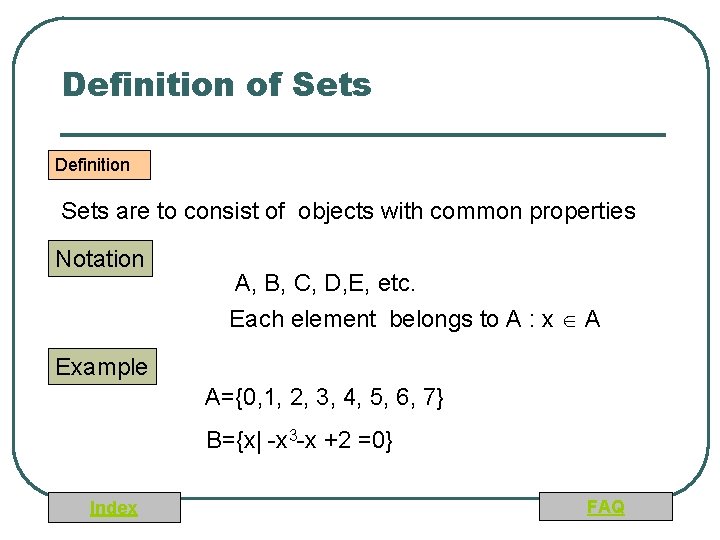
Definition of Sets Definition Sets are to consist of objects with common properties Notation A, B, C, D, E, etc. Each element belongs to A : x A Example A={0, 1, 2, 3, 4, 5, 6, 7} B={x| -x 3 -x +2 =0} Index FAQ
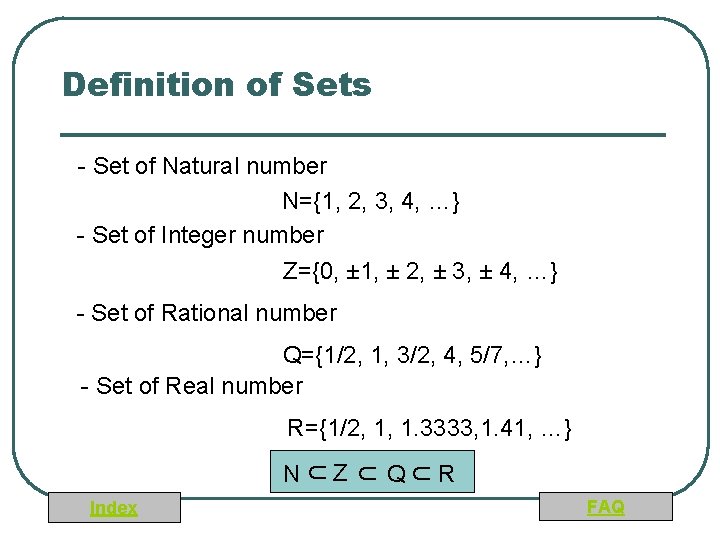
Definition of Sets - Set of Natural number N={1, 2, 3, 4, …} - Set of Integer number Z={0, ± 1, ± 2, ± 3, ± 4, …} - Set of Rational number Q={1/2, 1, 3/2, 4, 5/7, …} - Set of Real number Index Q ∩ Z ∩ N ∩ R={1/2, 1, 1. 3333, 1. 41, …} R FAQ
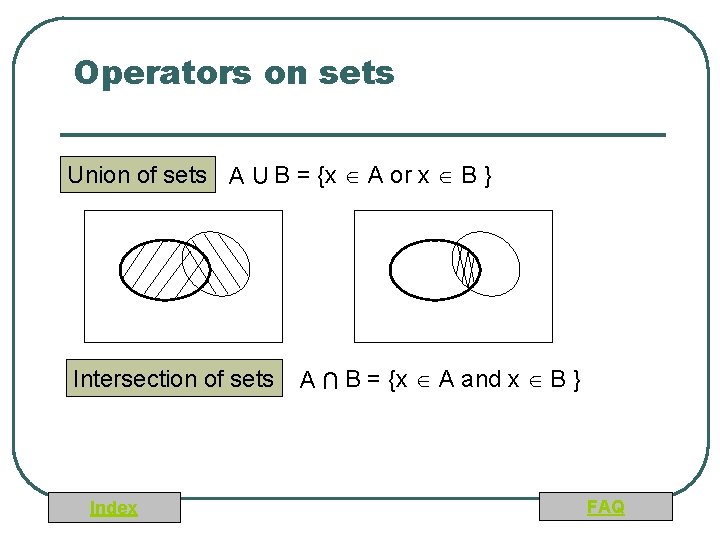
Operators on sets ∩ Union of sets A B = {x A or x B } Intersection of sets Index A ∩ B = {x A and x B } FAQ
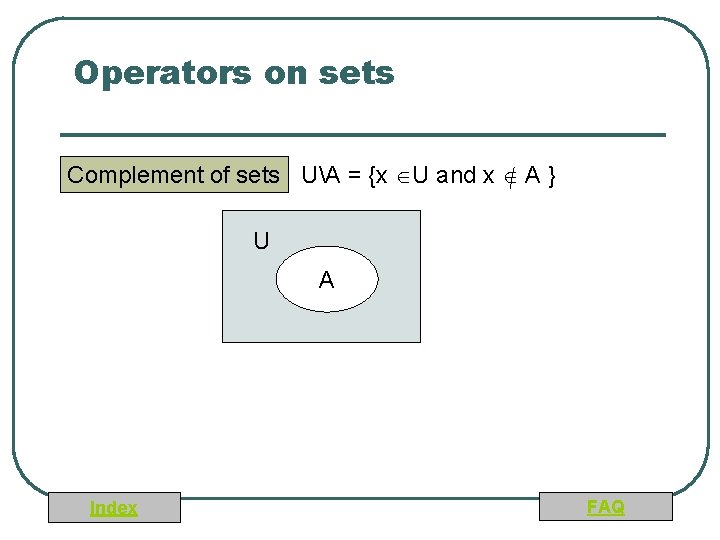
Operators on sets Complement of sets UA = {x U and x A } U A Index FAQ
Functions and their Graphs Injectivity and Surjectivity Index FAQ
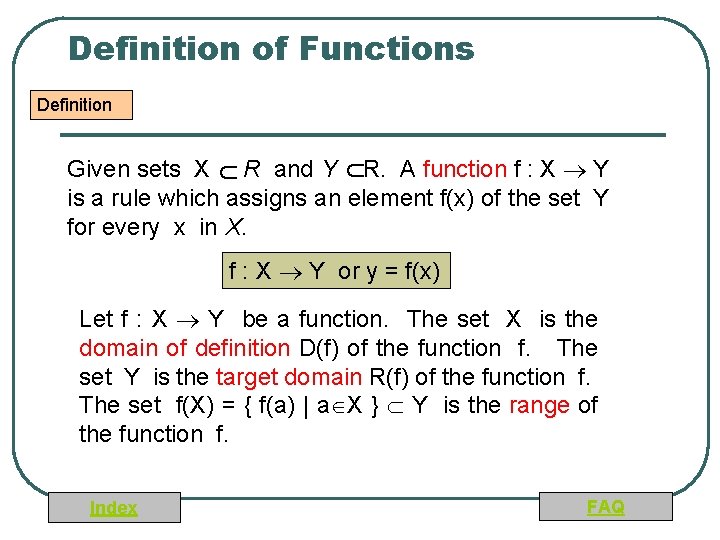
Definition of Functions Definition ∩ ∩ Given sets X R and Y R. A function f : X Y is a rule which assigns an element f(x) of the set Y for every x in X. f : X Y or y = f(x) Let f : X Y be a function. The set X is the domain of definition D(f) of the function f. The set Y is the target domain R(f) of the function f. The set f(X) = { f(a) | a X } Y is the range of the function f. Index FAQ
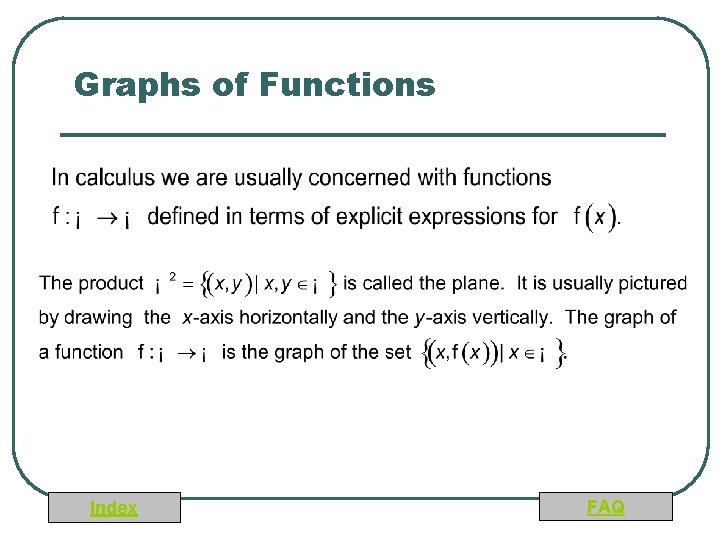
Graphs of Functions Index FAQ
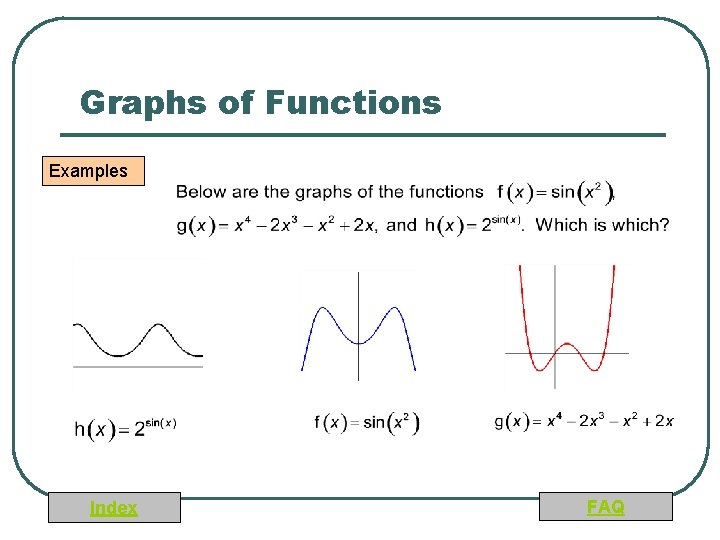
Graphs of Functions Examples Index FAQ
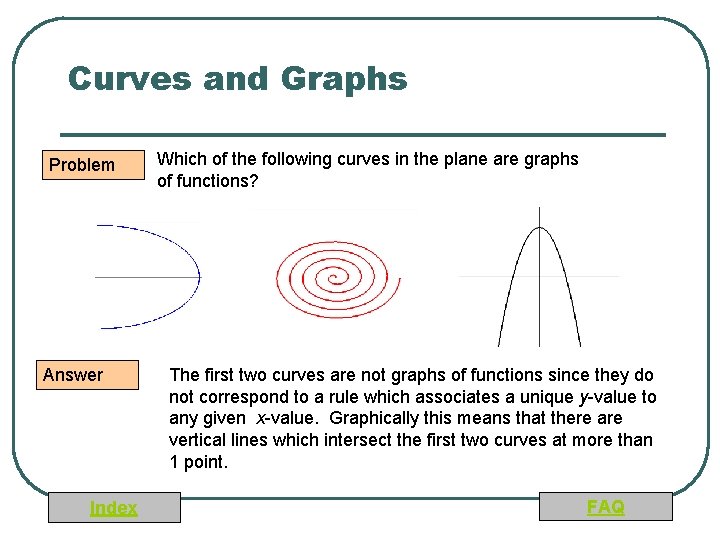
Curves and Graphs Problem Answer Index Which of the following curves in the plane are graphs of functions? The first two curves are not graphs of functions since they do not correspond to a rule which associates a unique y-value to any given x-value. Graphically this means that there are vertical lines which intersect the first two curves at more than 1 point. FAQ
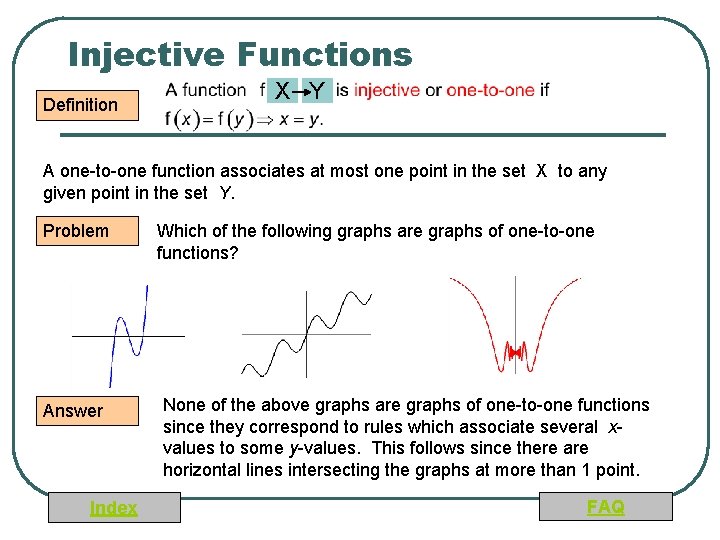
Injective Functions Definition X Y A one-to-one function associates at most one point in the set X to any given point in the set Y. Problem Answer Index Which of the following graphs are graphs of one-to-one functions? None of the above graphs are graphs of one-to-one functions since they correspond to rules which associate several xvalues to some y-values. This follows since there are horizontal lines intersecting the graphs at more than 1 point. FAQ
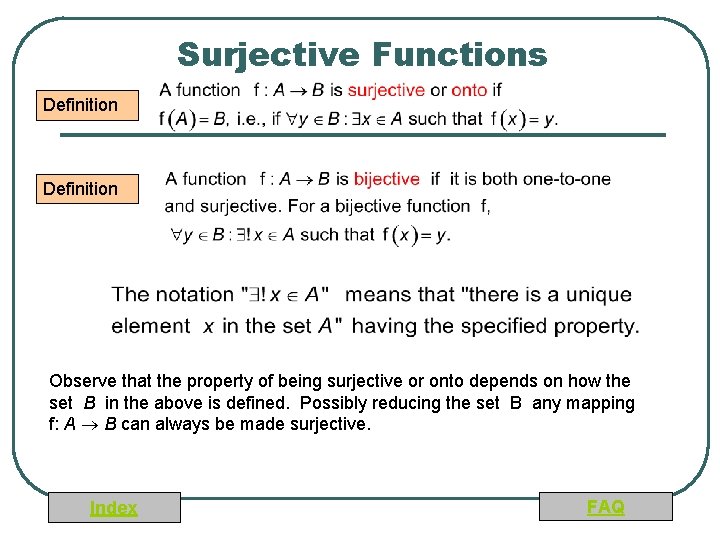
Surjective Functions Definition Observe that the property of being surjective or onto depends on how the set B in the above is defined. Possibly reducing the set B any mapping f: A B can always be made surjective. Index FAQ
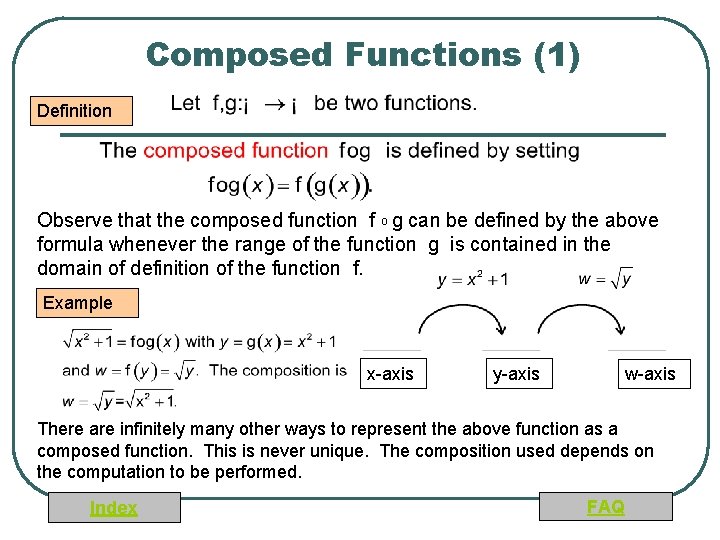
Composed Functions (1) Definition Observe that the composed function f o g can be defined by the above formula whenever the range of the function g is contained in the domain of definition of the function f. Example x-axis y-axis w-axis There are infinitely many other ways to represent the above function as a composed function. This is never unique. The composition used depends on the computation to be performed. Index FAQ
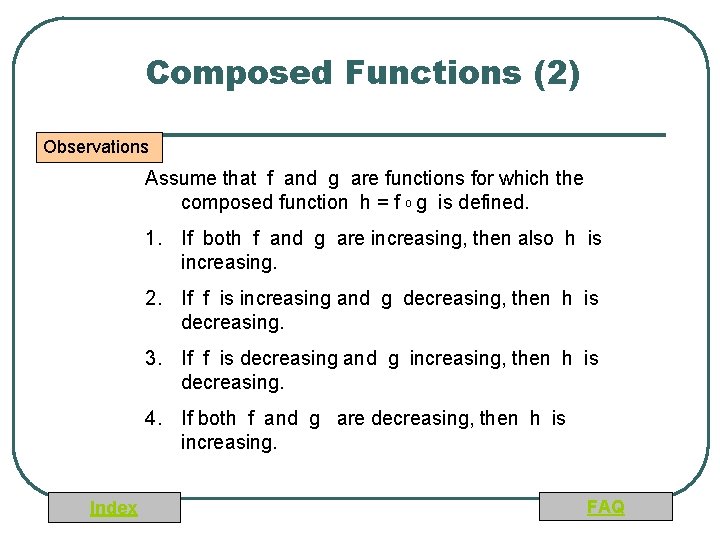
Composed Functions (2) Observations Assume that f and g are functions for which the composed function h = f o g is defined. 1. If both f and g are increasing, then also h is increasing. 2. If f is increasing and g decreasing, then h is decreasing. 3. If f is decreasing and g increasing, then h is decreasing. 4. If both f and g are decreasing, then h is increasing. Index FAQ
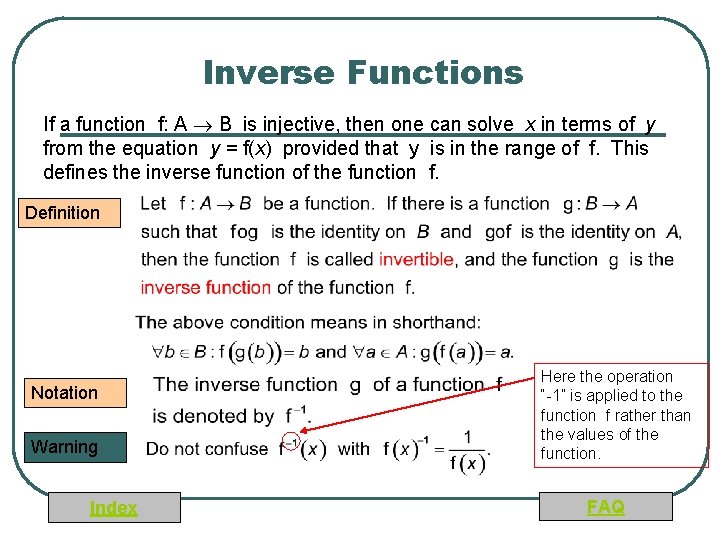
Inverse Functions If a function f: A B is injective, then one can solve x in terms of y from the equation y = f(x) provided that y is in the range of f. This defines the inverse function of the function f. Definition Notation Warning Index Here the operation “-1” is applied to the function f rather than the values of the function. FAQ
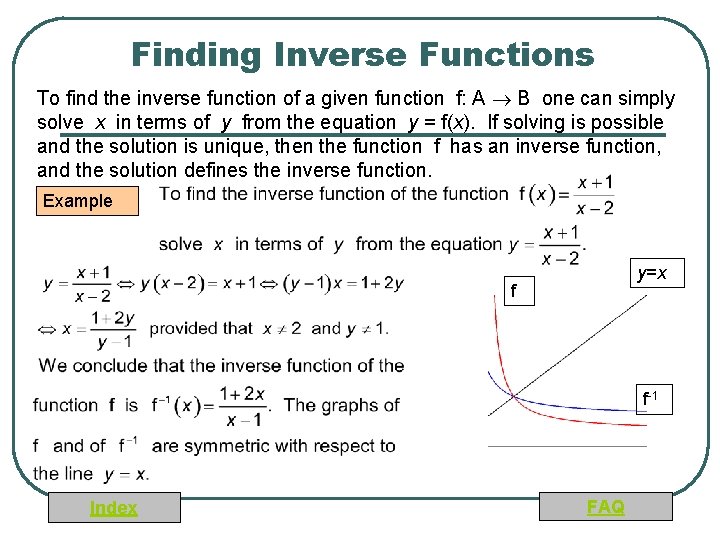
Finding Inverse Functions To find the inverse function of a given function f: A B one can simply solve x in terms of y from the equation y = f(x). If solving is possible and the solution is unique, then the function f has an inverse function, and the solution defines the inverse function. Example y=x f f-1 Index FAQ
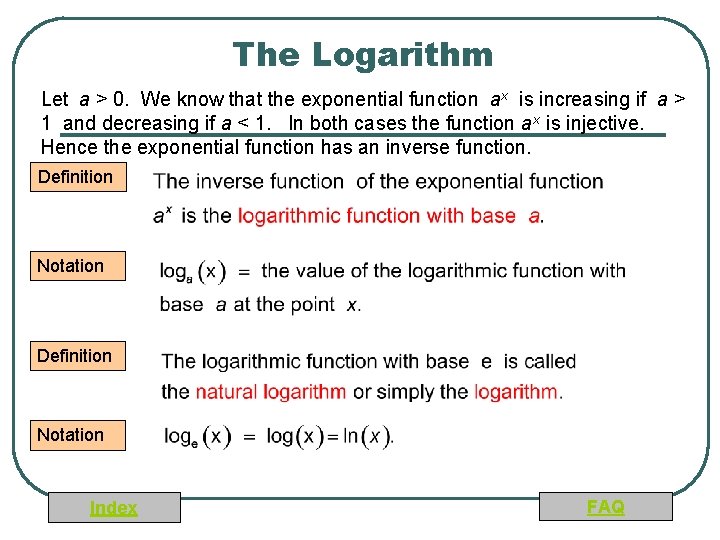
The Logarithm Let a > 0. We know that the exponential function ax is increasing if a > 1 and decreasing if a < 1. In both cases the function ax is injective. Hence the exponential function has an inverse function. Definition Notation Index FAQ
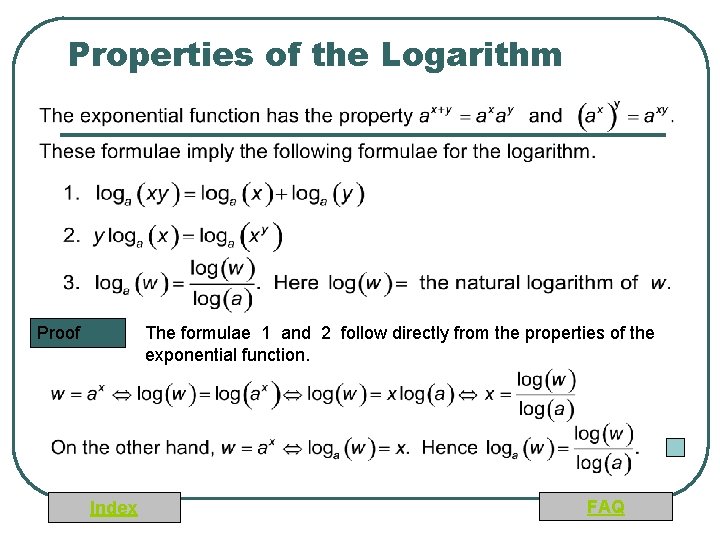
Properties of the Logarithm Proof The formulae 1 and 2 follow directly from the properties of the exponential function. Index FAQ
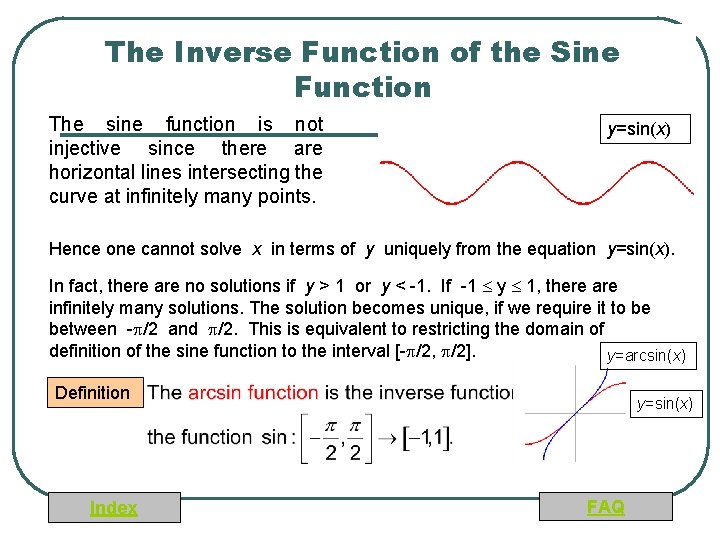
The Inverse Function of the Sine Function The sine function is not injective since there are horizontal lines intersecting the curve at infinitely many points. y=sin(x) Hence one cannot solve x in terms of y uniquely from the equation y=sin(x). In fact, there are no solutions if y > 1 or y < -1. If -1 y 1, there are infinitely many solutions. The solution becomes unique, if we require it to be between - /2 and /2. This is equivalent to restricting the domain of definition of the sine function to the interval [- /2, /2]. y=arcsin(x) Definition Index y=sin(x) FAQ
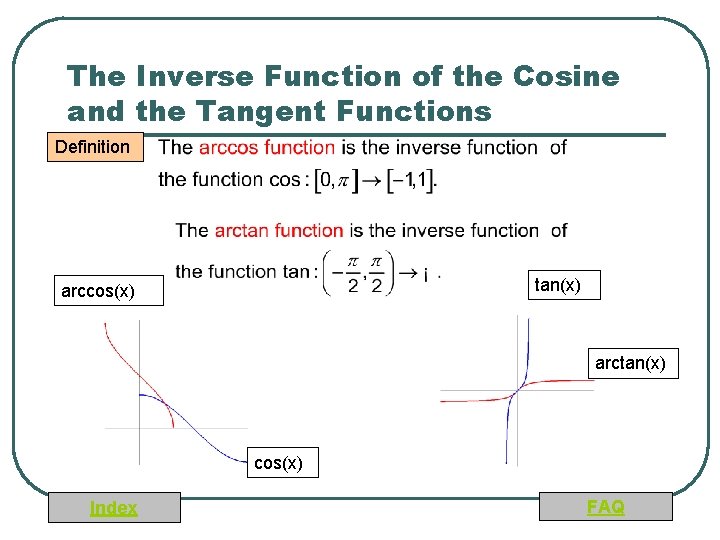
The Inverse Function of the Cosine and the Tangent Functions Definition tan(x) arccos(x) arctan(x) cos(x) Index FAQ
New Functions from Old Piecewise Defined Functions Deformations of Functions Composed Functions Inverses of Exponential Functions Inverses of Trigonometric Functions Index FAQ
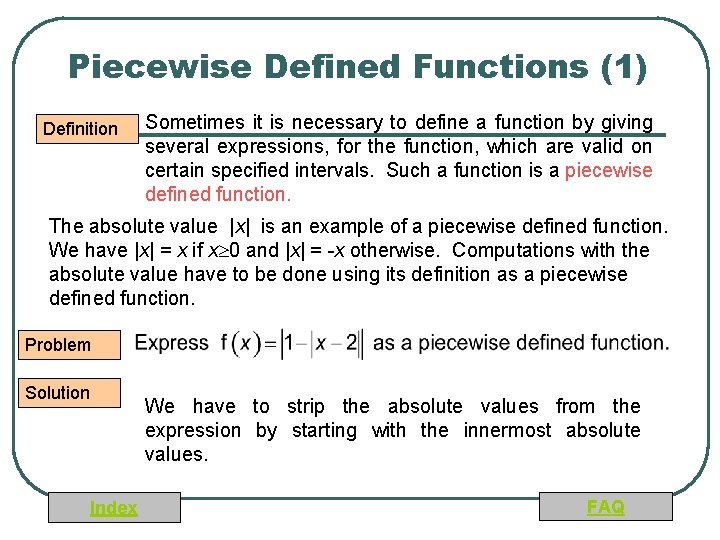
Piecewise Defined Functions (1) Definition Sometimes it is necessary to define a function by giving several expressions, for the function, which are valid on certain specified intervals. Such a function is a piecewise defined function. The absolute value |x| is an example of a piecewise defined function. We have |x| = x if x 0 and |x| = -x otherwise. Computations with the absolute value have to be done using its definition as a piecewise defined function. Problem Solution We have to strip the absolute values from the expression by starting with the innermost absolute values. Index FAQ
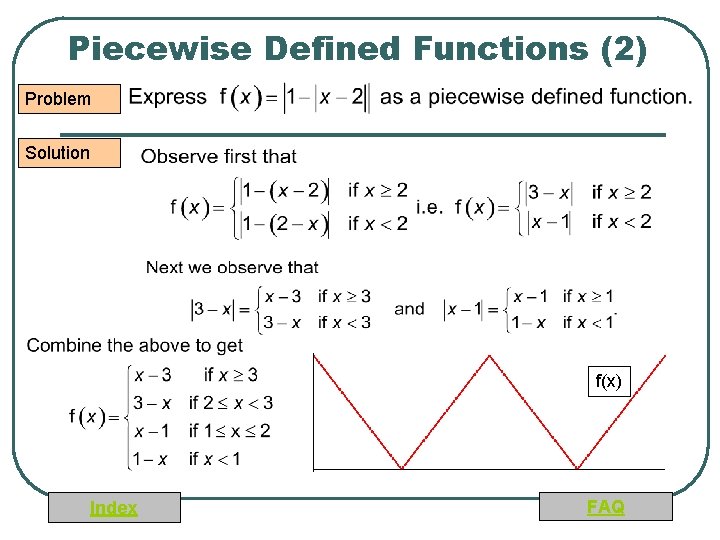
Piecewise Defined Functions (2) Problem Solution f(x) Index FAQ
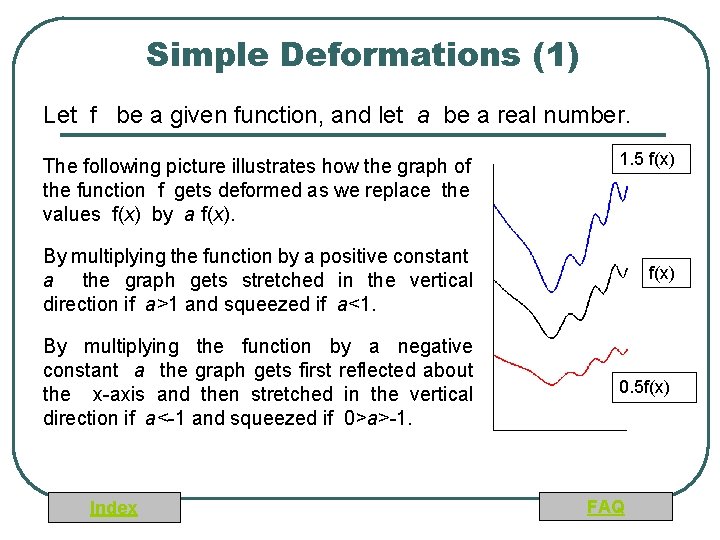
Simple Deformations (1) Let f be a given function, and let a be a real number. The following picture illustrates how the graph of the function f gets deformed as we replace the values f(x) by a f(x). 1. 5 f(x) By multiplying the function by a positive constant a the graph gets stretched in the vertical direction if a>1 and squeezed if a<1. f(x) By multiplying the function by a negative constant a the graph gets first reflected about the x-axis and then stretched in the vertical direction if a<-1 and squeezed if 0>a>-1. 0. 5 f(x) Index FAQ
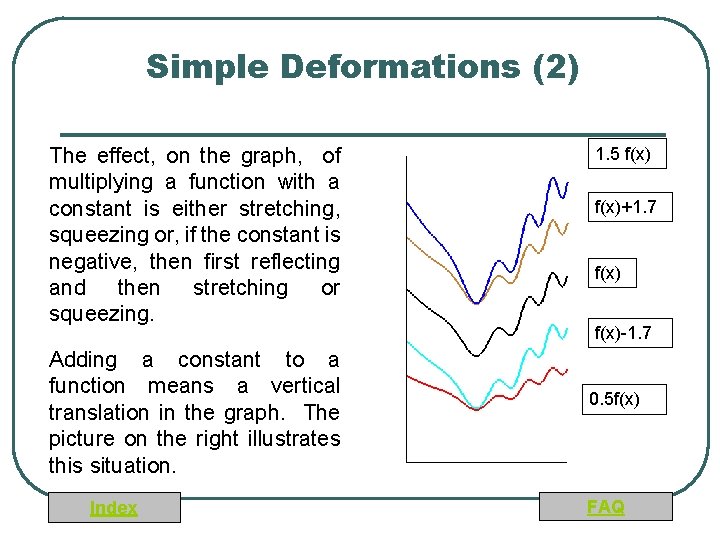
Simple Deformations (2) The effect, on the graph, of multiplying a function with a constant is either stretching, squeezing or, if the constant is negative, then first reflecting and then stretching or squeezing. Adding a constant to a function means a vertical translation in the graph. The picture on the right illustrates this situation. Index 1. 5 f(x)+1. 7 f(x)-1. 7 0. 5 f(x) FAQ
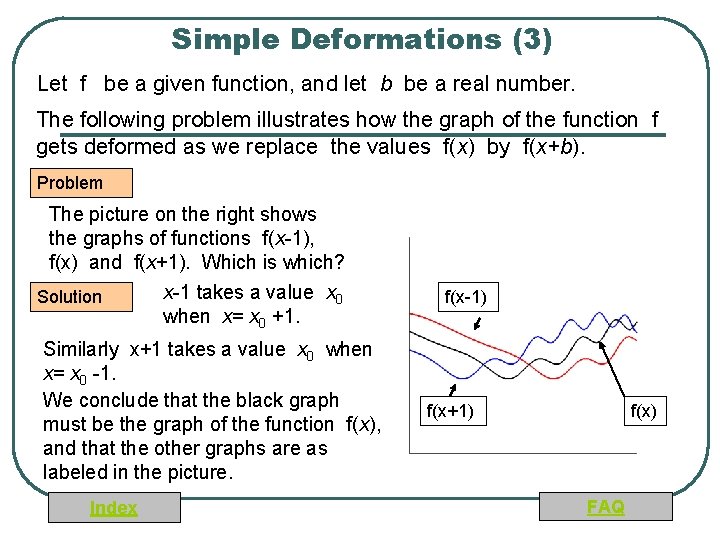
Simple Deformations (3) Let f be a given function, and let b be a real number. The following problem illustrates how the graph of the function f gets deformed as we replace the values f(x) by f(x+b). Problem The picture on the right shows the graphs of functions f(x-1), f(x) and f(x+1). Which is which? x-1 takes a value x 0 Solution when x= x 0 +1. Similarly x+1 takes a value x 0 when x= x 0 -1. We conclude that the black graph must be the graph of the function f(x), and that the other graphs are as labeled in the picture. Index f(x-1) f(x+1) f(x) FAQ
- Slides: 27