
Advanced Biology Review Cell Structure and Function Mr
Advanced Biology Review: Cell Structure and Function Mr. Sechrengost
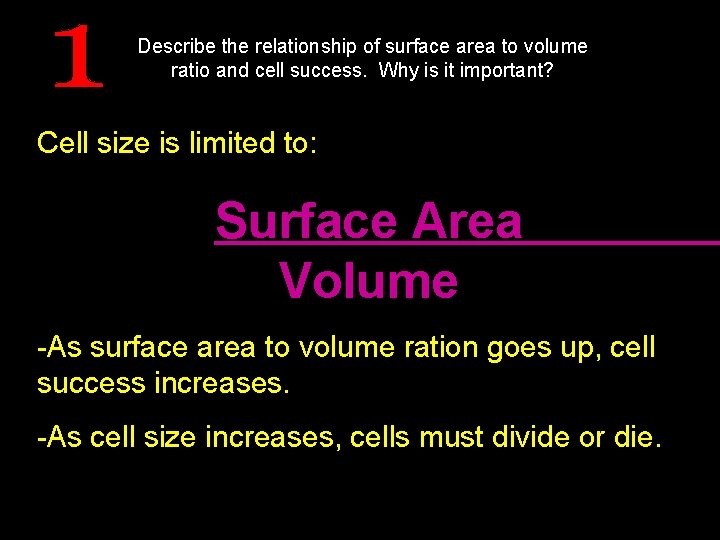
Describe the relationship of surface area to volume ratio and cell success. Why is it important? Cell size is limited to: Surface Area Volume -As surface area to volume ration goes up, cell success increases. -As cell size increases, cells must divide or die.
![Which kind of cells contain mitochondria? [eukaryotic, prokaryotic, animal, plant] All eukaryotic cells contain](http://slidetodoc.com/presentation_image_h2/4dd52fdd896e9b58a63b3774dde3ed31/image-3.jpg "Which kind of cells contain mitochondria? [eukaryotic, prokaryotic, animal, plant] All eukaryotic cells contain")
Which kind of cells contain mitochondria? [eukaryotic, prokaryotic, animal, plant] All eukaryotic cells contain mitochondria.
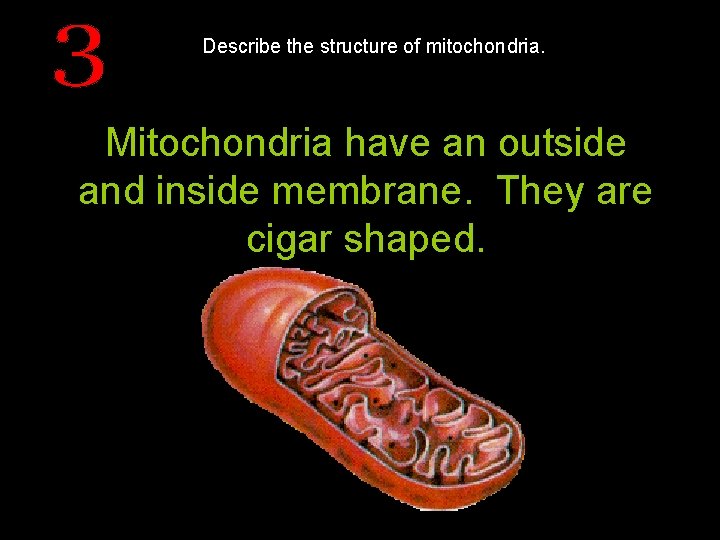
Describe the structure of mitochondria. Mitochondria have an outside and inside membrane. They are cigar shaped.
What are cristae? How is the inner membrane of the mitochondria different from the outer? -Folds in internal membrane of mitochondria where cell respiration takes place. - Inner membrane is folded to increase surface area.
What do you know about the origin of mitochondrion? Describe the Margulis endosymbiotic theory. -Mitochondria originated from bacteria that were able to efficiently use glucose to make energy. -Margulis believed that some bacteria had abilities similar to organelles of today’s eukaryotic cell; those bacteria were engulfed by others and formed an endosymbiotic relationship which could be inherited.
What is the main function of the mitochondria? The main function of mitochondria is to break down glucose in a series of biochemical reactions called Krebs Cycle and ETC to produce 38 molecules of high energy ATP.
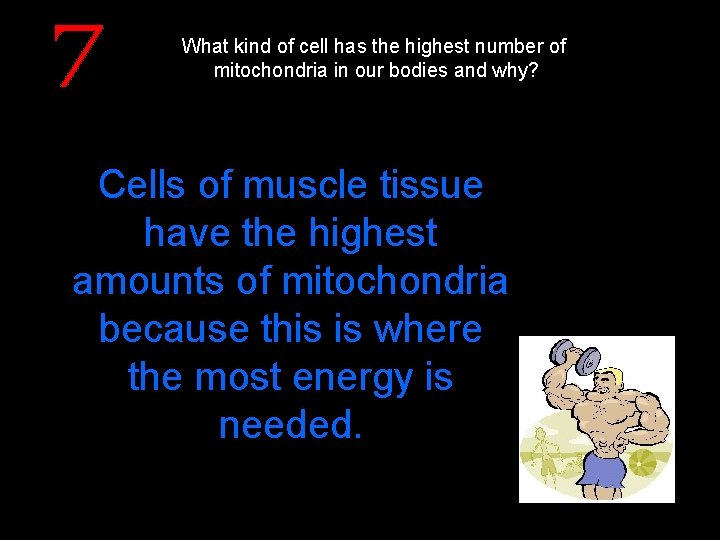
What kind of cell has the highest number of mitochondria in our bodies and why? Cells of muscle tissue have the highest amounts of mitochondria because this is where the most energy is needed.
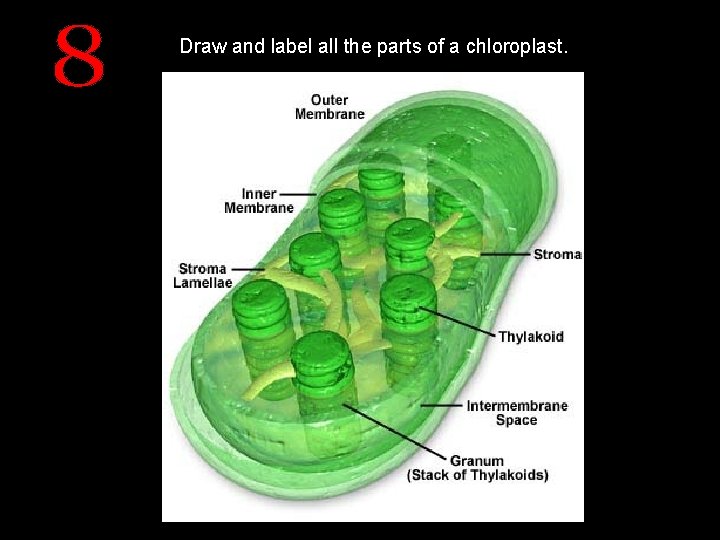
Draw and label all the parts of a chloroplast.
Describe the structure of the chloroplast. A chloroplast is composed of an outer membrane which contains the stroma and an inner membrane of thylakoids.
Why does the chloroplast have a double membrane? The inner membrane consists of flattened sacs which increase the surface area for light to be collected.
What are thylakoid membranes? Thylakoid membranes are membranes shaped like stacks of green pancakes which make up the inner membrane of the chloroplast.
Where exactly is chlorophyll located in the chloroplast? Chlorophyll is located in the lumen fluid inside thylakoids.
What is the function of a chloroplast? The function of a chloroplast is to collect carbon dioxide and light to convert light into ATP, then build sugar with the energy.
![What kinds of cells contain chloroplasts? (eukaryotic, prokaryotic, animal, plant) Plants [eukaryotic], algae [eukaryotic]](http://slidetodoc.com/presentation_image_h2/4dd52fdd896e9b58a63b3774dde3ed31/image-15.jpg "What kinds of cells contain chloroplasts? (eukaryotic, prokaryotic, animal, plant) Plants [eukaryotic], algae [eukaryotic]")
What kinds of cells contain chloroplasts? (eukaryotic, prokaryotic, animal, plant) Plants [eukaryotic], algae [eukaryotic] and some bacteria [prokaryotic] contain chloroplasts.
Name that fluid inside the chloroplast. The fluid inside the chloroplast is called the stroma = protein rich solution where dark reactions take place
Where in the chloroplast is sunlight harvested to make ATP? Thylakoids.
Where in the chloroplast is sugar made? Stroma.
What are the various functions of the cytoskeleton? The cytoskeleton maintains the cell’s shape, keeps the organelles in a relatively constant position, and provides a framework for microtubule extensions known as cilia and flagella.
Name the two kinds of protein that usually make up the cytoskeleton. Microtubules. Microfilaments.
What are cilia and flagella? Where do you find them? -Microtubules used for locomotion - Extending from basal bodies at the cell membrane
What are the microtubules in a dividing cell called? Centrioles.
What is a nucleus? What kind of cells contain a nucleus? (eukaryotic, prokaryotic, animal, plant) -Part of cell which contains genetic information within a membrane. - Eukaryotic – both plant and animal
What is the function of a nucleus? Name the most important molecule housed inside the nucleus. -Since it contains the DNA, it is responsible for control of the cell functions. - DNA Chromatin Chromosomes
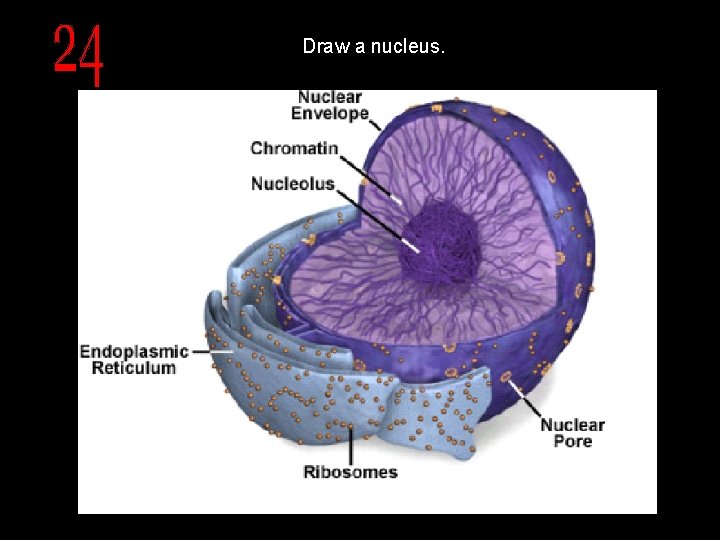
Draw a nucleus.
When are the cells chromosomes best visible? The cell’s chromosomes are best visible during cell division. [The forming of new cells. ]
What is the function of the nucleolus? The function of the nucleolus if to produce ribosomes.
What kind of molecules are found in large numbers within the nucleolus? Proteins are found in large numbers because ribosomes are mostly protein.
Name the intermediate molecule that is made from genes, before it is translated into proteins. RNA
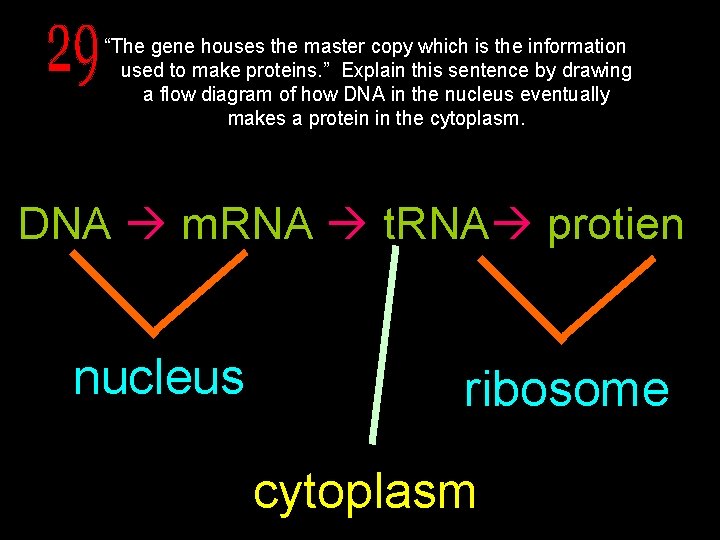
“The gene houses the master copy which is the information used to make proteins. ” Explain this sentence by drawing a flow diagram of how DNA in the nucleus eventually makes a protein in the cytoplasm. DNA m. RNA t. RNA protien nucleus ribosome cytoplasm
Where does energy from photosynthesis come from? sunlight
At the end of respiration, what form is the energy finally converted to? Chemical ATP
At the end of photosynthesis, what form is the energy finally converted to? Structural glucose
Name the two waste products that are formed at the end of photosynthesis. Water O 2
Why do cells need respiration? What can happen to your heart tissue if it cannot respire? -Respiration is needed because cells need energy - You will have a heart attack
Why do plants need photosynthesis? What would happen globally if photosynthesis suddenly stopped on the entire planet? -They don’t eat; have to make sugar - No O 2
What drives the movement of a molecule across a membrane? What drives the movement of water across a membrane? -Diffusion - Osmosis
Differentiate between diffusion and active transport. Diffusion is movement of molecules from high to low concentration [with the gradient] and doesn’t require energy – Active transport moves molecules against a concentration gradient and requires energy.
Explain how each of these move across the membrane: water, oxygen, sodium ion, and glucose molecule - Water and oxygen move through by simple diffusion -Sodium ions are pumped through ion channels - Glucose molecules require a carrier protein = facilitated diffusion
What kind of transport takes place through channels? What are gates channels? How are the gates usually controlled? -Passive - Recognition proteins that allow only certain substances to pass - ion interaction
Name the fastest method of transport across a membrane. Diffusion.
Differentiate between simple and facilitated diffusion using examples. -simple diffusion – pass directly through w/o use of carrier protein -facilitated diffusion – requires the use of carrier proteins but no energy
Differentiate between transport through a channel and a lipid bilayer. Transport through channels involves integral proteins where molecules pass through. Membrane transport involves materials small enough to fit through spaces between lipids.
If I put a drop of purple dye in a beaker of water, what will cause it to diffuse across the solution? Particles will randomly move from high to low concentration w/o adding energy.
If I put a teaspoon of salt on one side of a beaker of water that has been divided into two halves by a semi-permeable membrane, what will happen to the salt molecules? What will happen to the water molecules? What will be notice in the levels of the water on two sides of the partition? -nothing; may dissolve in water. - water will move toward the side with more salt. - salt side level will increase.
What will happen if we put molecule A on one side and molecule B on the other side of the membrane above? Some of A will move to the other side until the concentration is equal [if A is small enough to pass through the membrane] *the same with B*
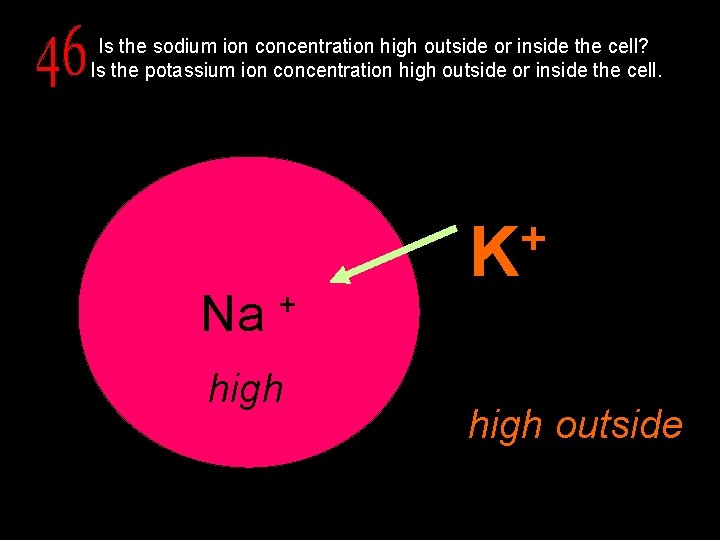
Is the sodium ion concentration high outside or inside the cell? Is the potassium ion concentration high outside or inside the cell. Na + high + K high outside
What will happen to a plant cell when placed in the above solutions? Why? -red blood cell will gain water until cytolysis - nothing - red blood cell will lose water; shrivel up [crenation]
What will happen to a plant cell when placed in the above solutions? Why? -cell membrane will press against the cell wall = high turgidity - nothing -cell membrane will pull away from cell wall = wilt
Define osmosis, hypertonic, hypotonic, isotonic, and osmotic solutes. -osmosis = diffusion of water - hypertonic = concentration of solute is greater outside the cell than inside (syrup egg) - hypotonic = concentration of solute is less outside than inside (water egg) -isotonic = concentration is the same inside and out - osmotic solutes = materials dissolved in solution which lead to gain or loss of water by osmosis
Describe how active transport takes place in a cell using examples. One molecule of ATP is added for each 3 sodium ions pumped out and 2 potassium ions moved in. [Ex. ] nerve impulses
Explain how the sodium-potassium pump functions. Where does the energy for this pump come from? 3 sodium are pumped out for each 2 potassium in. Energy comes from ATP made in mitochondria.
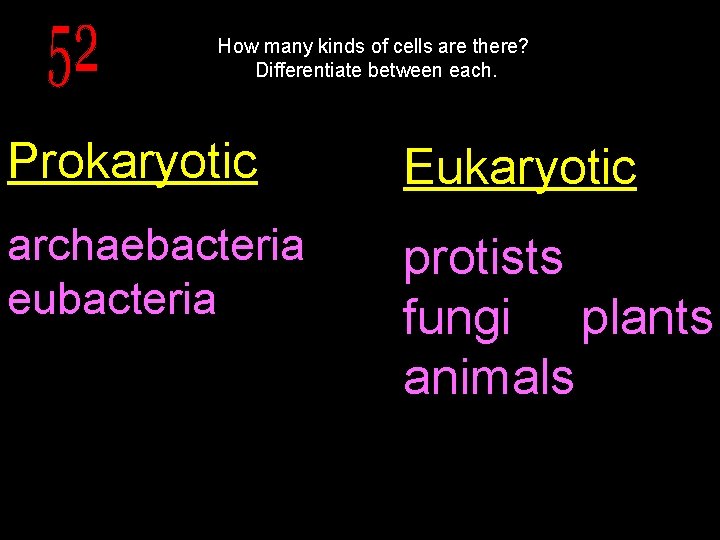
How many kinds of cells are there? Differentiate between each. Prokaryotic Eukaryotic archaebacteria eubacteria protists fungi plants animals
Can all organisms be separated into prokaryotic and eukaryotic types? Yes; bacteria are prokaryotic, all others are eukaryotic.
How are prokaryotic cells different from animals cells? What do they have in common? -Membrane bound organelles and nucleus in eukaryotic cells; none in prokaryotes except ribosomes. -All cells have a cell membrane and cytoplasm. All cells have ribosomes. Both plant cells and bacteria have cell walls.
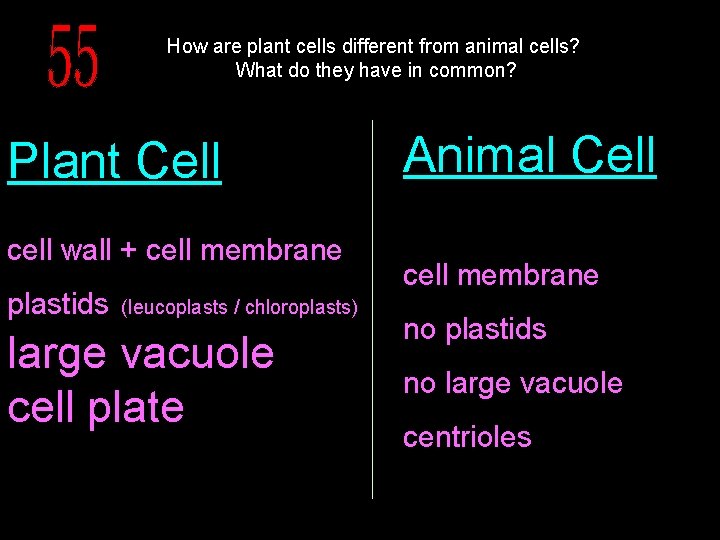
How are plant cells different from animal cells? What do they have in common? Plant Cell cell wall + cell membrane plastids (leucoplasts / chloroplasts) large vacuole cell plate Animal Cell cell membrane no plastids no large vacuole centrioles
List the levels of cellular organization from smallest to largest. Cells Tissue Organ System Organism.
How many kinds of nucleic acids can viruses have? either DNA or RNA
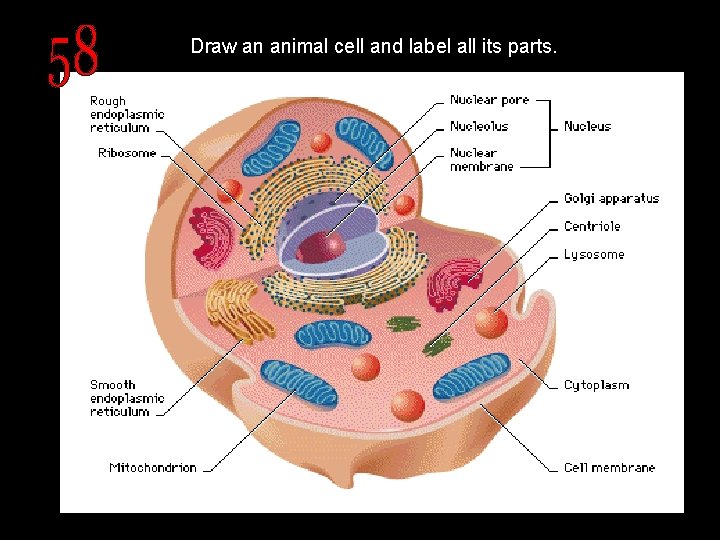
Draw an animal cell and label all its parts.
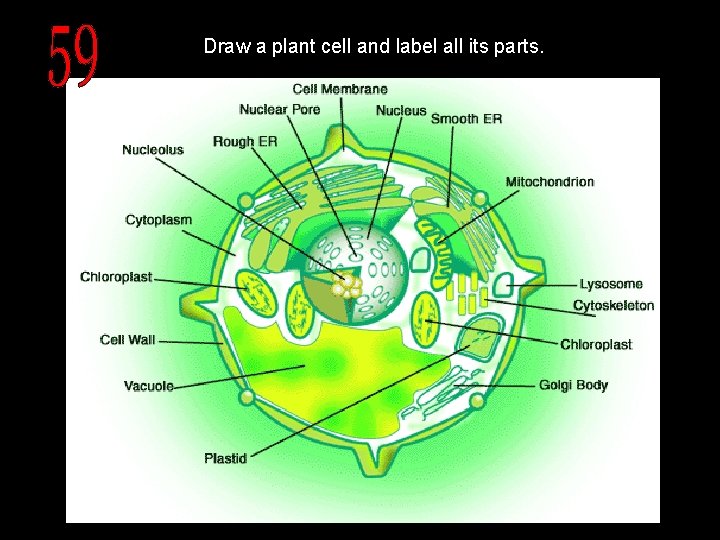
Draw a plant cell and label all its parts.
Distinguish between endocytosis and exocytosis. -Endocytosis = moves material in -Exocytosis = moves material out
Distinguish between pinocytosis and phagocytosis. -pinocytosis = endocytosis of fluid -phagocytosis = endocytosis of solid particles
Distinguish between aerobic cellular respiration and anaerobic cellular respiration. -aerobic = uses oxygen and produces 38 ATP -anaerobic = no oxygen; only 2 ATP
List the nutrients in order of ease with which it can be used to make energy. sugar lipid protien
Describe how each of the following people contributed to our current knowledge of the cell. -Hooke = coined the word “cell” - Schwann = “All animal cells are made of cells” - Virchow = “all cells come from pre-existing cells”
List thee main components of the cell theory. 1. Cells are the basic unit of structure and function in all organisms. 2. All living things are made from cells. 3. All cells come from pre-existing cells.

- Slides: 67