
ADVANCED BEHAVIOR CHANGE THEORY Created by Jordan Weinstein

ADVANCED BEHAVIOR CHANGE THEORY Created by: Jordan Weinstein and Tess Komarek Created on: April 2015 Last updated by: Gwen Stacy Last updated on: March 2016
WHAT IS BEHAVIOR CHANGE?
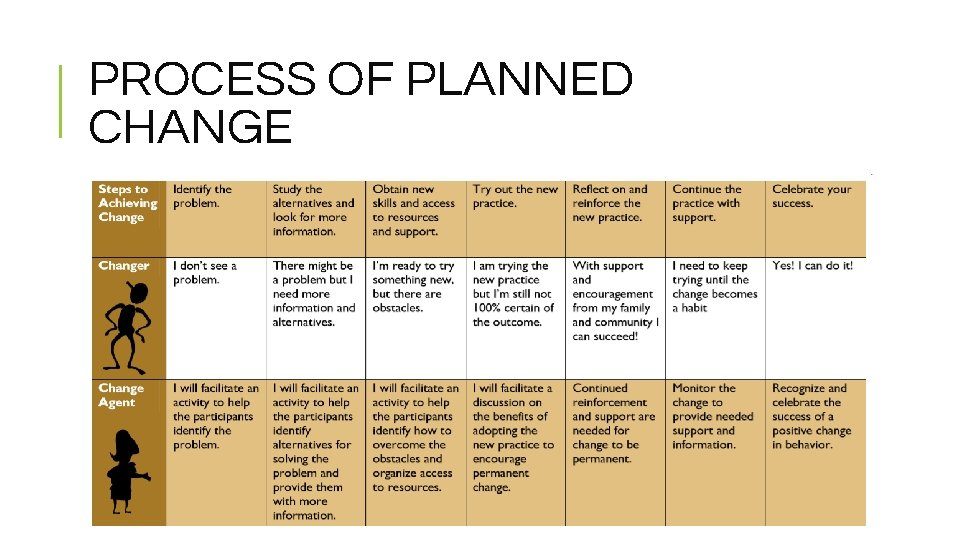
PROCESS OF PLANNED CHANGE
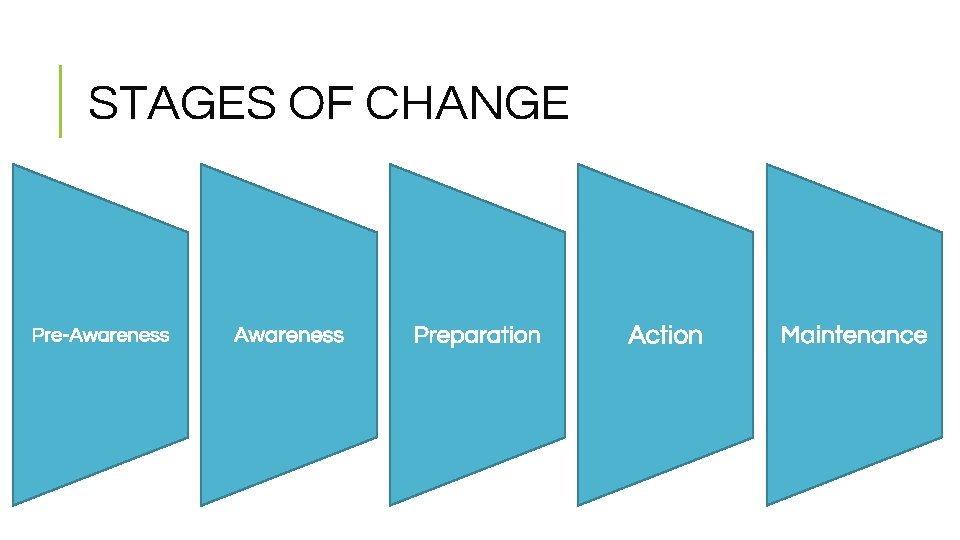
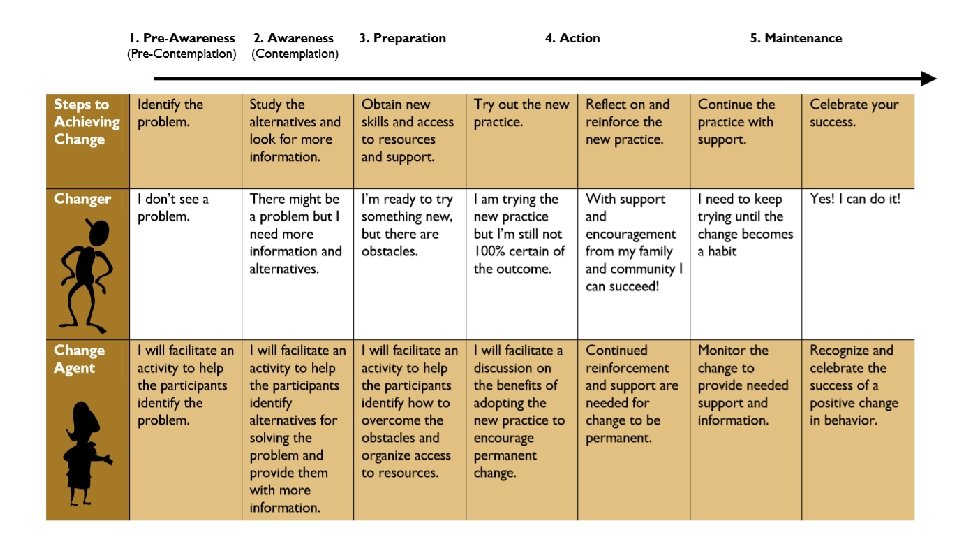
STAGES OF CHANGE Pre-Awareness Preparation Action Maintenance
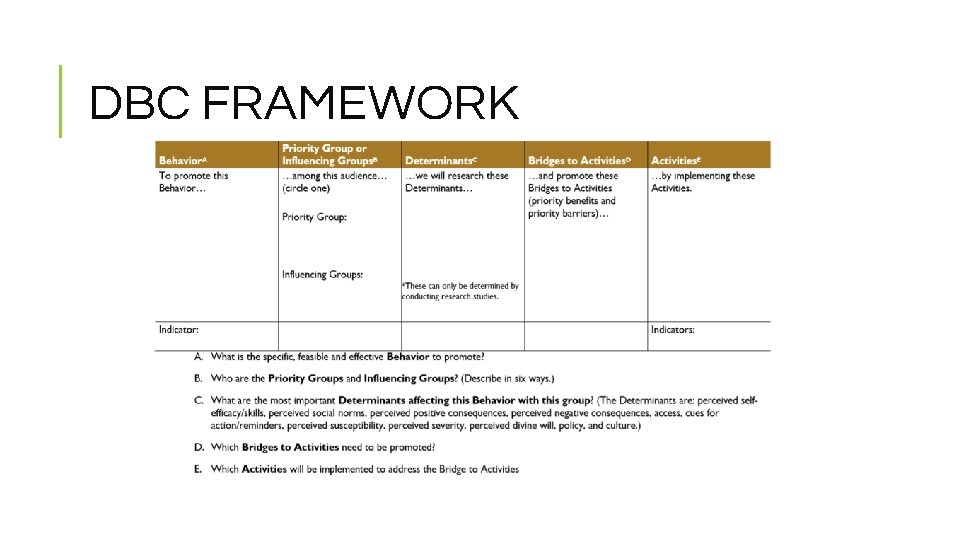
DBC FRAMEWORK
DETERMINANTS Determinant: Determinants represent a person’s feelings, beliefs, or other elements within his or her environment that can support him/her to do a behavior or prevent him/her from doing a behavior 12 Determinants All about perceptions
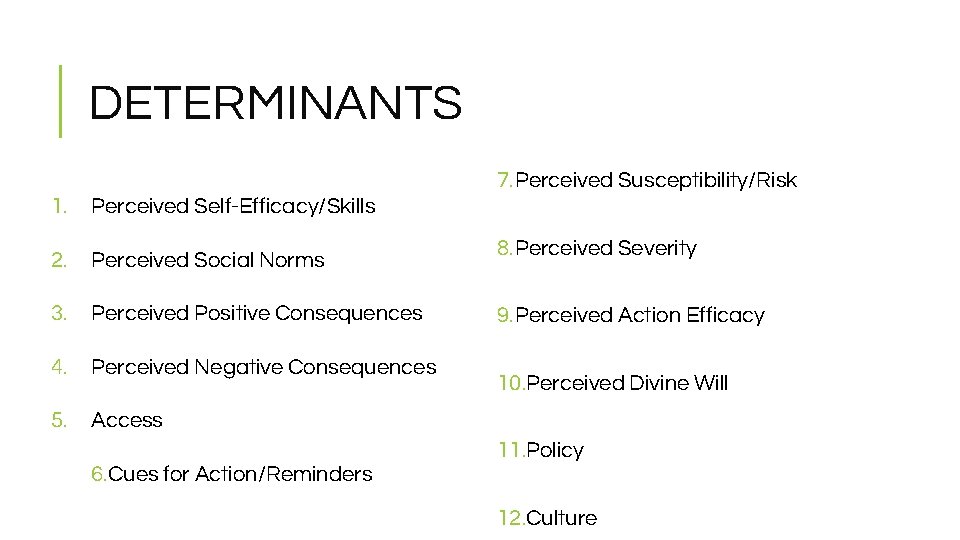
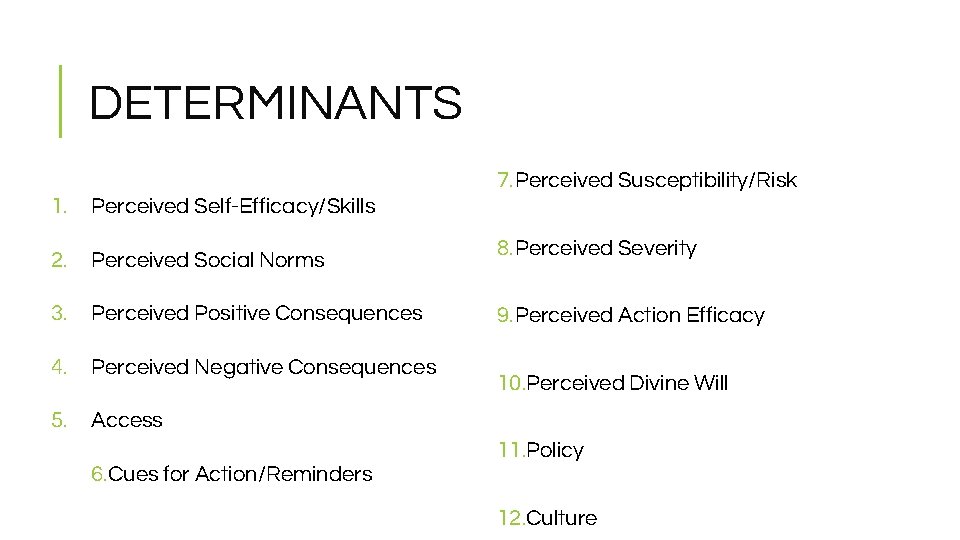
DETERMINANTS 7. Perceived Susceptibility/Risk 1. Perceived Self-Efficacy/Skills 2. Perceived Social Norms 3. Perceived Positive Consequences 4. Perceived Negative Consequences 5. Access 8. Perceived Severity 9. Perceived Action Efficacy 10. Perceived Divine Will 11. Policy 6. Cues for Action/Reminders 12. Culture
PERCEIVED SELFEFFICACY/SKILLS An individual’s belief that he or she can do a particular behavior given his/her current knowledge and skills The set of knowledge, skills, abilities and confidence necessary to perform a particular behavior EXAMPLE: I don’t know how to facilitate a causerie.

PERCEIVED SOCIAL NORMS The perception that people important to an individual think that he or she should do the behavior There are two parts: ●Who matters most to the person on a particular issue ●What he/she perceives those people think he/she should do EXAMPLE: My APCD wants me to do more malaria focused projects.
PERCEIVED POSITIVE CONSEQUENCES What positive things a person thinks will happen as a result of performing a behavior EXAMPLE: I brush my teeth because it gives me minty fresh breath.
PERCEIVED NEGATIVE CONSEQUENCES What negative things a person thinks will happen as a result of performing a behavior EXAMPLE: I don’t want to eat mangoes because I got sick the last time I ate a mango.
ACCESS The degree of availability of the needed products or services required to adopt a given behavior Includes an audience’s comfort in accessing desired types of products or using a service Includes issues related to cost, gender, culture, language, etc. EXAMPLE: I like talking to my APCD about potential products because they are very nice and approachable.
CUES FOR ACTION/REMINDERS The presence of reminders that help a person remember to do a particular behavior or remember the steps involved in doing the behavior EXAMPLE: I was going to get my bike fixed but I forgot when Joe was going on tourney.
PERCEIVED SUSCEPTIBILITY/RISK A person’s perception of how vulnerable they feel to the problem EXAMPLE: I live in the north and there isn’t any malaria there.

PERCEIVED SEVERITY Belief that the problem (which the behavior can prevent) is serious EXAMPLE: If I get malaria, it won’t be that serious.
PERCEIVED ACTION EFFICACY Belief that by practicing the behavior one will avoid the problem, that the behavior is effective in avoiding the problem EXAMPLE: If I don’t swim in the river, I won’t get schisto.
PERCEIVED DIVINE WILL A person’s belief that it is G-d’s will for him/her to have the problem and/or overcome it A person’s belief that G-d is responsible for the problem EXAMPLE: It’s G-d’s will whether or not I make it to Dakar before my appointment; there’s not a lot I can do about it.
POLICY Laws and regulations that affect behaviors and access to products and services EXAMPLE: Peace Corps Staff are supposed to respond to emails within five business days.

CULTURE The set of history, customs, lifestyles, values and practices within a selfdefined group May be associated with ethnicity or lifestyle EXAMPLE: It is our tradition to go to WAIST every February.
DETERMINANTS 7. Perceived Susceptibility/Risk 1. Perceived Self-Efficacy/Skills 2. Perceived Social Norms 3. Perceived Positive Consequences 4. Perceived Negative Consequences 5. Access 8. Perceived Severity 9. Perceived Action Efficacy 10. Perceived Divine Will 11. Policy 6. Cues for Action/Reminders 12. Culture

VOLUNTEER OBSERVATIONS What have you observed in your sites? What health issues does your community face? /What business opportunities are present? How do you think you can address these issues?
- Slides: 22