
Advanced Applications in Medical Practice 2018 PostScottsdale Webinar

Advanced Applications in Medical Practice – 2018 Post-Scottsdale: Webinar - 1 Dr. Paul S. Anderson Curriculum Developer for AAMP July 2018

Post-Scottsdale 2018 AAMP Q&A • As promised this is your chance as an attendee to ask postconference questions. • We appreciate those sent prior to this webinar but will take all (we can fit in) “live” as well. • You can type your questions in to the question box on your “Join. Me” screen. • We will start with a few previously sent questions: (c) PS Anderson 2018 2
Q Is there any problem with giving a iron supplement in cases of low ferritin (15 -35) when there is also chronic infection like EBV, SIBO, or other bugs? (c) PS Anderson 2018 3
Q This is a clarification question I wanted to make sure I understood correctly. In hypoxia /pseudohypoxia is there a down regulation in oxidative phosphorylation and up-regulation in anaerobic energy production? HBOT helps the mitochondria work and shifts energy production back to using oxidative phosphorylation. (c) PS Anderson 2018 4
Q Any specific protocols regarding HBOT/IV/Supplement therapy for Dementia/Alzheimer's as well as Parkinson's (IV Glutathione/Nutrients, etc. )? (c) PS Anderson 2018 5
Q This question is related to content I am attempting to use in the Clinical Notes provided specifically on the area of Magnesium Sensitivity. I have a patient I have been working with for a few months. She is severely jammed in a number of places, however, nothing I do seems to take the pressure off the system. Her symptoms are almost always the same It starts with ear fullness and reduce hearing She gets a runny nose and cough which always includes some phelgm Then she will get headache, tired Then she gets flushed and often anxious/depressed The spasms start and then she takes several days to rebound Her symptoms seem CBS like, so I wanted to treat there but she reacts the worst to Magnesium. She started initially reacting like this to supplements - Magnesium the most which is why I was looking at this information. In the case of magnesium she gets so bad that her muscles tense up completely. We ran the tests suggested: RBC Mg was 2. 18 (ref 1. 65 -2. 52), GGT 7 (ref 12 - 37), Na 142 (ref 135 -145), K 4. 3 (3. 5 -5. 2), Ca (2. 27 - 2. 60). Diet was already strict (she took out gluten, dairy, corn, alcohol, nuts, nightshades, sugar, caffeine), but finds she is now reacting to every food. (c) PS Anderson 2018 6
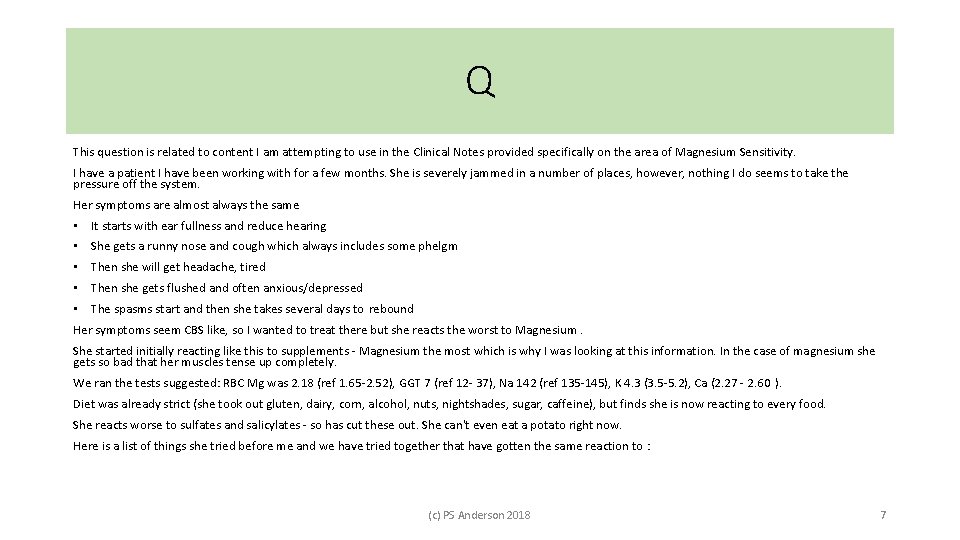
Q This question is related to content I am attempting to use in the Clinical Notes provided specifically on the area of Magnesium Sensitivity. I have a patient I have been working with for a few months. She is severely jammed in a number of places, however, nothing I do seems to take the pressure off the system. Her symptoms are almost always the same • It starts with ear fullness and reduce hearing • She gets a runny nose and cough which always includes some phelgm • Then she will get headache, tired • Then she gets flushed and often anxious/depressed • The spasms start and then she takes several days to rebound Her symptoms seem CBS like, so I wanted to treat there but she reacts the worst to Magnesium. She started initially reacting like this to supplements - Magnesium the most which is why I was looking at this information. In the case of magnesium she gets so bad that her muscles tense up completely. We ran the tests suggested: RBC Mg was 2. 18 (ref 1. 65 -2. 52), GGT 7 (ref 12 - 37), Na 142 (ref 135 -145), K 4. 3 (3. 5 -5. 2), Ca (2. 27 - 2. 60 ). Diet was already strict (she took out gluten, dairy, corn, alcohol, nuts, nightshades, sugar, caffeine), but finds she is now reacting to every food. She reacts worse to sulfates and salicylates - so has cut these out. She can't even eat a potato right now. Here is a list of things she tried before me and we have tried together that have gotten the same reaction to : (c) PS Anderson 2018 7
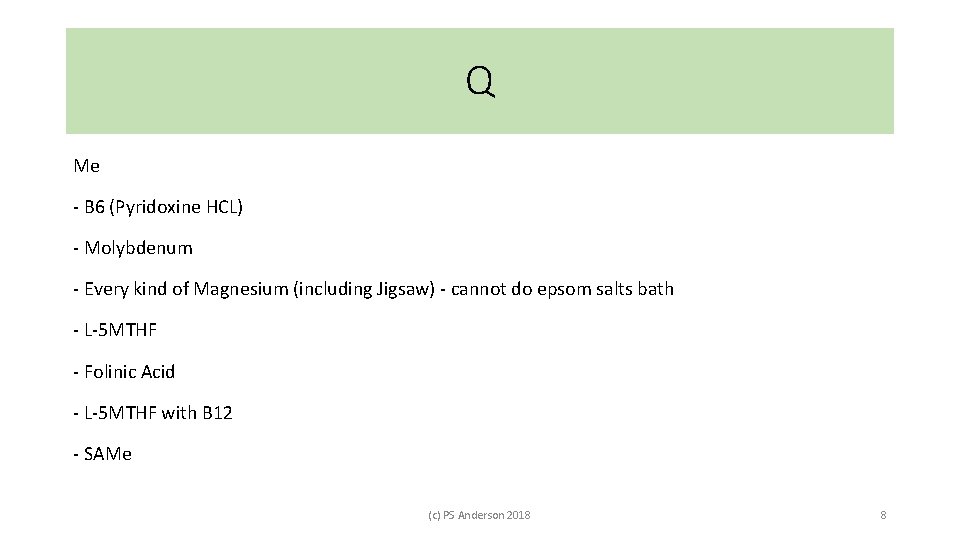
Q Me - B 6 (Pyridoxine HCL) - Molybdenum - Every kind of Magnesium (including Jigsaw) - cannot do epsom salts bath - L-5 MTHF - Folinic Acid - L-5 MTHF with B 12 - SAMe (c) PS Anderson 2018 8
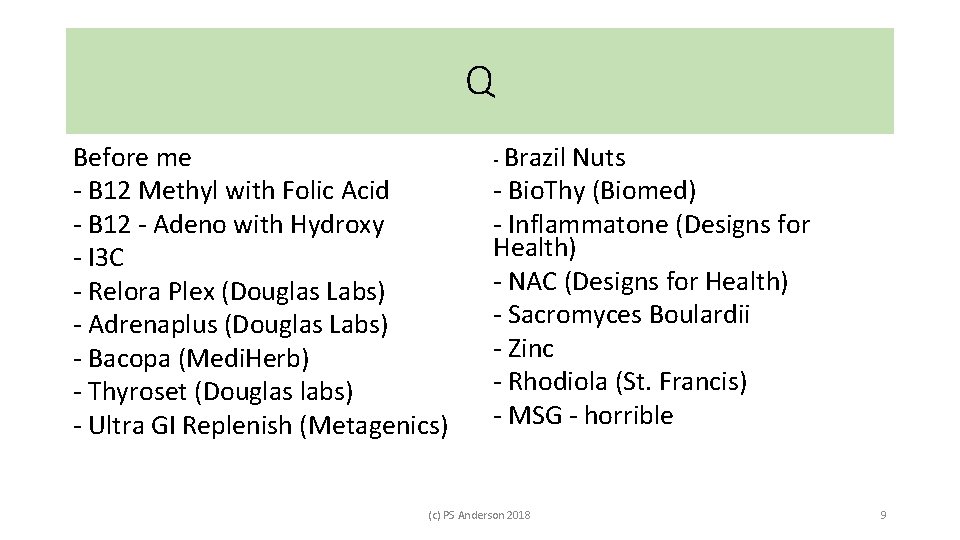
Q Before me - B 12 Methyl with Folic Acid - B 12 - Adeno with Hydroxy - I 3 C - Relora Plex (Douglas Labs) - Adrenaplus (Douglas Labs) - Bacopa (Medi. Herb) - Thyroset (Douglas labs) - Ultra GI Replenish (Metagenics) - Brazil Nuts - Bio. Thy (Biomed) - Inflammatone (Designs for Health) - NAC (Designs for Health) - Sacromyces Boulardii - Zinc - Rhodiola (St. Francis) - MSG - horrible (c) PS Anderson 2018 9
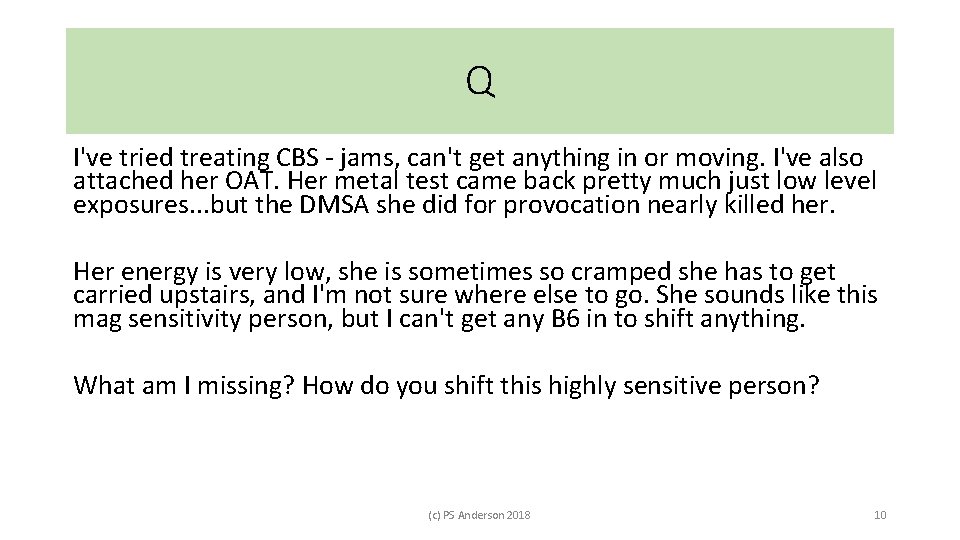
Q I've tried treating CBS - jams, can't get anything in or moving. I've also attached her OAT. Her metal test came back pretty much just low level exposures. . . but the DMSA she did for provocation nearly killed her. Her energy is very low, she is sometimes so cramped she has to get carried upstairs, and I'm not sure where else to go. She sounds like this mag sensitivity person, but I can't get any B 6 in to shift anything. What am I missing? How do you shift this highly sensitive person? (c) PS Anderson 2018 10
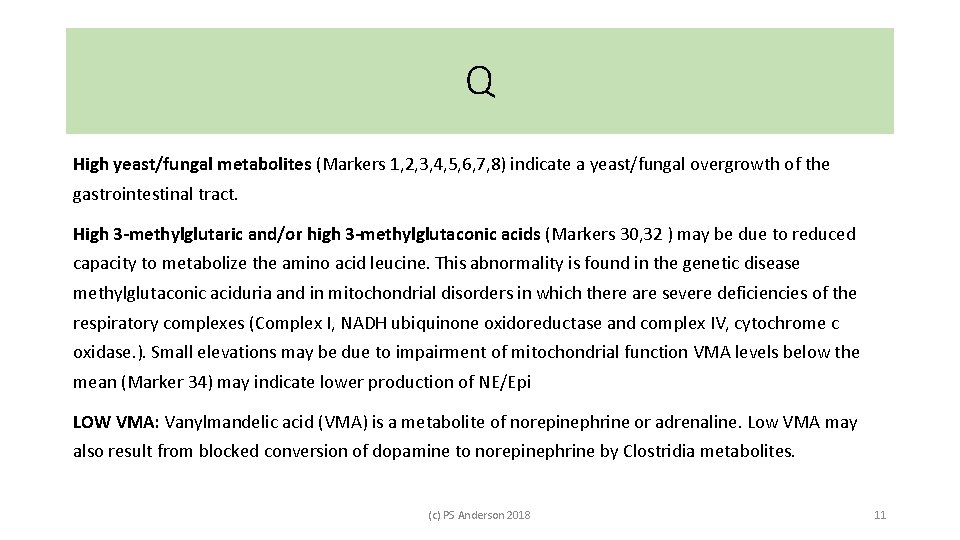
Q High yeast/fungal metabolites (Markers 1, 2, 3, 4, 5, 6, 7, 8) indicate a yeast/fungal overgrowth of the gastrointestinal tract. High 3 -methylglutaric and/or high 3 -methylglutaconic acids (Markers 30, 32 ) may be due to reduced capacity to metabolize the amino acid leucine. This abnormality is found in the genetic disease methylglutaconic aciduria and in mitochondrial disorders in which there are severe deficiencies of the respiratory complexes (Complex I, NADH ubiquinone oxidoreductase and complex IV, cytochrome c oxidase. ). Small elevations may be due to impairment of mitochondrial function VMA levels below the mean (Marker 34) may indicate lower production of NE/Epi LOW VMA: Vanylmandelic acid (VMA) is a metabolite of norepinephrine or adrenaline. Low VMA may also result from blocked conversion of dopamine to norepinephrine by Clostridia metabolites. (c) PS Anderson 2018 11
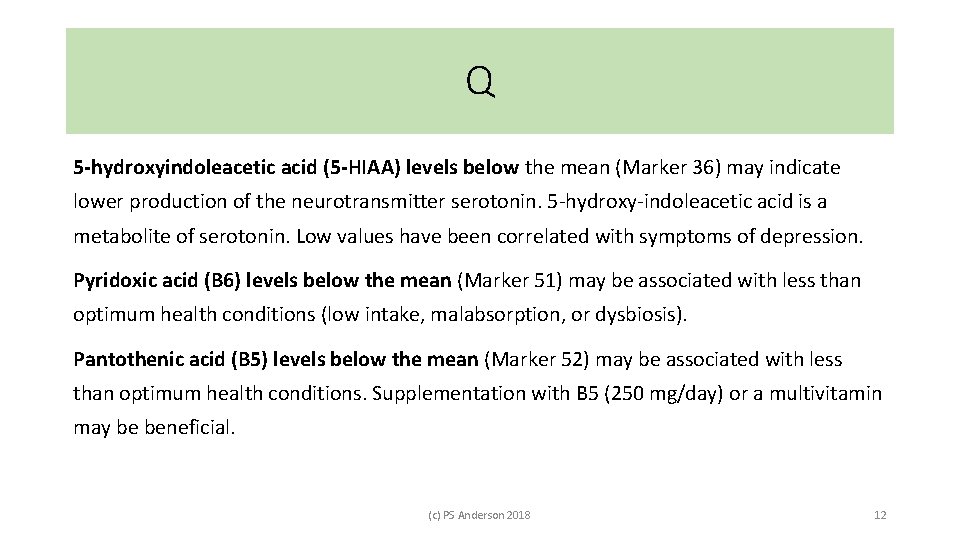
Q 5 -hydroxyindoleacetic acid (5 -HIAA) levels below the mean (Marker 36) may indicate lower production of the neurotransmitter serotonin. 5 -hydroxy-indoleacetic acid is a metabolite of serotonin. Low values have been correlated with symptoms of depression. Pyridoxic acid (B 6) levels below the mean (Marker 51) may be associated with less than optimum health conditions (low intake, malabsorption, or dysbiosis). Pantothenic acid (B 5) levels below the mean (Marker 52) may be associated with less than optimum health conditions. Supplementation with B 5 (250 mg/day) or a multivitamin may be beneficial. (c) PS Anderson 2018 12
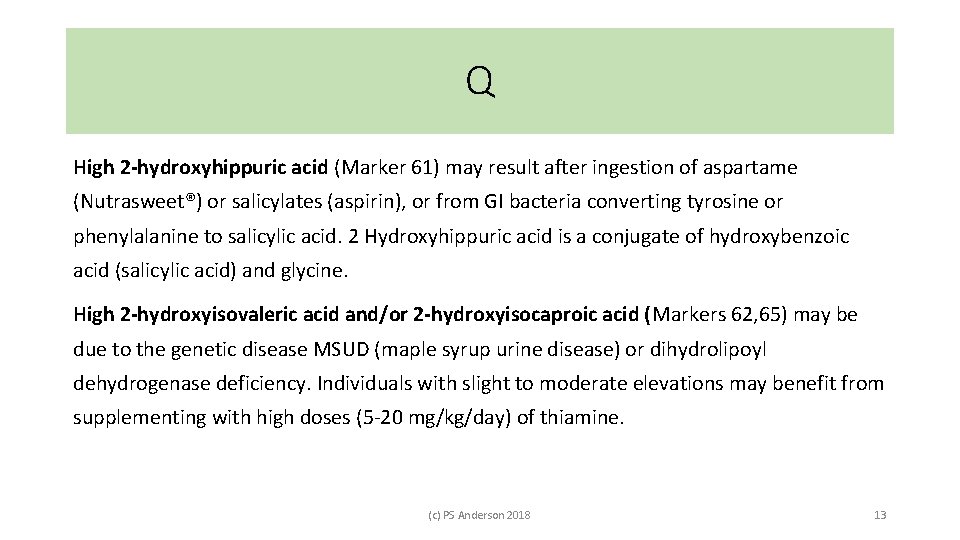
Q High 2 -hydroxyhippuric acid (Marker 61) may result after ingestion of aspartame (Nutrasweet®) or salicylates (aspirin), or from GI bacteria converting tyrosine or phenylalanine to salicylic acid. 2 Hydroxyhippuric acid is a conjugate of hydroxybenzoic acid (salicylic acid) and glycine. High 2 -hydroxyisovaleric acid and/or 2 -hydroxyisocaproic acid (Markers 62, 65) may be due to the genetic disease MSUD (maple syrup urine disease) or dihydrolipoyl dehydrogenase deficiency. Individuals with slight to moderate elevations may benefit from supplementing with high doses (5 -20 mg/kg/day) of thiamine. (c) PS Anderson 2018 13
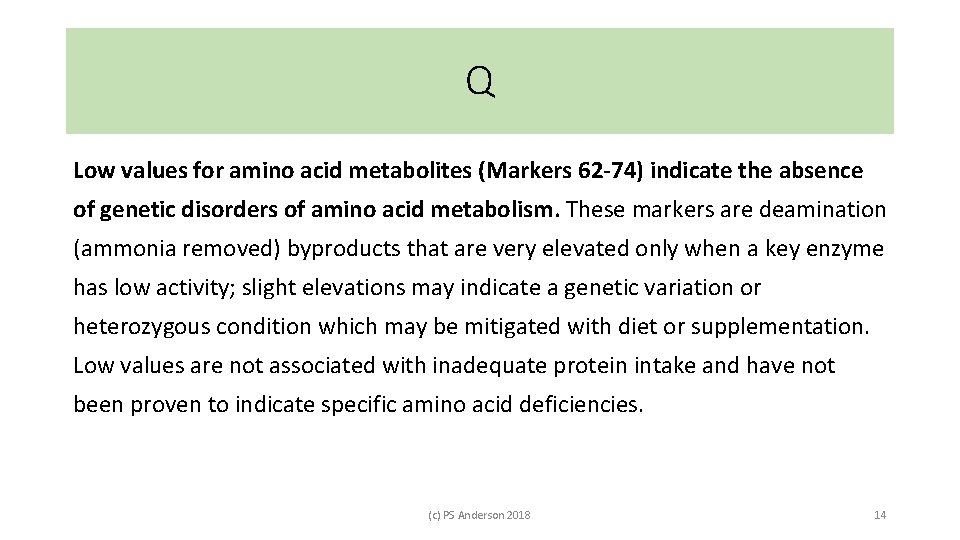
Q Low values for amino acid metabolites (Markers 62 -74) indicate the absence of genetic disorders of amino acid metabolism. These markers are deamination (ammonia removed) byproducts that are very elevated only when a key enzyme has low activity; slight elevations may indicate a genetic variation or heterozygous condition which may be mitigated with diet or supplementation. Low values are not associated with inadequate protein intake and have not been proven to indicate specific amino acid deficiencies. (c) PS Anderson 2018 14

Live Questions (c) PS Anderson 2018 15
More AAMP? (c) PS Anderson 2018 16
AAMP Portland 2018 Complex Chronic Infection Management: More than killing bugs! September 28, 29 and 30 - 2018 (c) PS Anderson 2018 17
AAMP Portland 2018 • Featuring Dr. ’s Paul Anderson, Ann Corson, Dietrich Klinghardt, Cory Tichauer and Jacob Leone • With over 135 years combined experience assessing, treating and managing patients with complex chronic infections this uniquely qualified faculty is set to deliver an incredible advanced conference. The goal is to look at not only the infections and their effects and treatment but MORE IMPORTANTLY why simply “killing an infection” just doesn’t work. How people become chronically ill related to infections and what to do to help them is the goal of the AAMP Portland faculty. (c) PS Anderson 2018 18

Joining me: Ann Corson, MD Dietrich Klinghardt, Ph. D, MD Cory Tichauer, ND and Jacob Leone, ND (c) PS Anderson 2018 19
Concept Areas • • • Proper testing and assessment strategies Non-infectious influences to assess Why the state of the immune system is critical and how to assess that How to eradicate an acute infection so it does not “go chronic” Neuro-psychiatric manifestations of chronic infections and how to manage them Prescription approaches to infections of all types Natural medication approaches to infections of all types Resistance factors in chronic infections Immunotherapies Reassessment strategies And more! (c) PS Anderson 2018 20
Therapy Areas • • • Standard prescription medications Compounded medications / hormones Lab testing: What and when? Herbal and Nutrient interventions Injection and IV therapies Nasal, topical, respiratory and other “non-oral” dosing Low Dose Immunotherapy Hormonal approaches Integration of Heat, Laser and Hyperbaric therapies Other immune modulating approaches And more! (c) PS Anderson 2018 21
AAMP-Post-Conference Scottsdale #2 August 27, 2018 @ 5: 00 pm (c) PS Anderson 2018 22

Thank you! We look forward to seeing you in Portland for the AAMP CME conference series! https: //aampportland. com/ (c) PS Anderson 2018 23
- Slides: 23