
Advanced Algorithms Piyush Kumar Lecture 13 PTAS Using
- Slides: 11
Advanced Algorithms Piyush Kumar (Lecture 13: PTAS Using DP) Welcome to COT 5405 Based on Kevin Wayne’s slides
Today • • • PTAS using DP (Knapsack). – – What we already know: DP for Knapsack. Many other examples of DP Problems. Hardness of approximation: Another example (k-center). – – What we already know: 2 -factor for k-center Hardness of approximation: Reduction from Dominating Set. Note: We will omit 11. 7.
11. 8 Knapsack Problem
Polynomial Time Approximation Scheme • PTAS. (1 + )-approximation algorithm for any constant > 0. – Load balancing. [Hochbaum-Shmoys 1987] – Euclidean TSP. [Arora /Mitchell 90 s] • Consequence. PTAS produces arbitrarily high quality solution, but trades off accuracy for time. • This section. PTAS for knapsack problem via rounding and scaling. 4
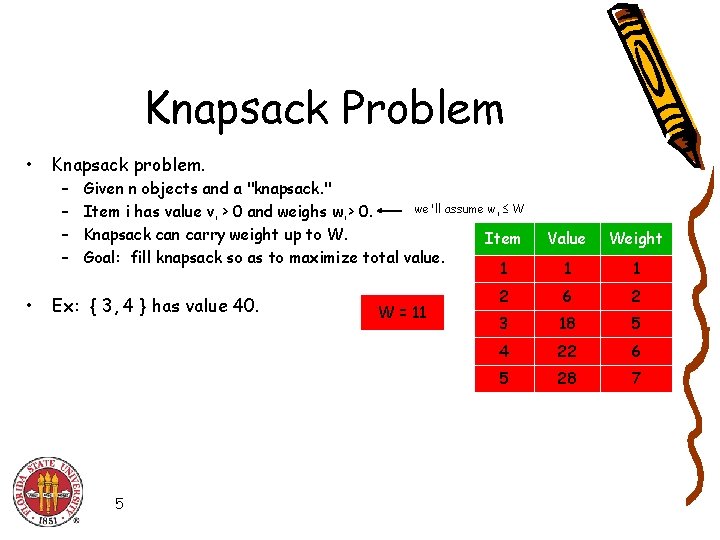
Knapsack Problem • • Knapsack problem. – – Given n objects and a "knapsack. " we'll assume w i W Item i has value vi > 0 and weighs wi > 0. Knapsack can carry weight up to W. Item Goal: fill knapsack so as to maximize total value. 1 Ex: { 3, 4 } has value 40. 5 W = 11 Value Weight 1 1 2 6 2 3 18 5 4 22 6 5 28 7
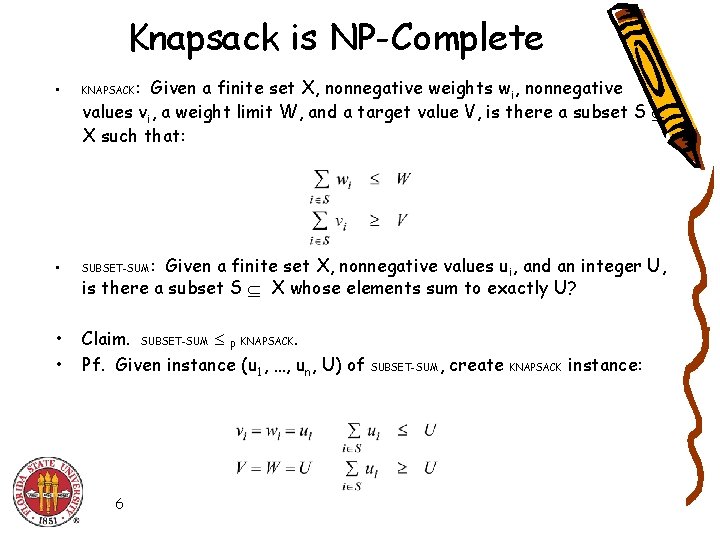
Knapsack is NP-Complete : Given a finite set X, nonnegative weights wi, nonnegative values vi, a weight limit W, and a target value V, is there a subset S X such that: • KNAPSACK • SUBSET-SUM • • Claim. SUBSET-SUM P KNAPSACK. Pf. Given instance (u 1, …, un, U) of : Given a finite set X, nonnegative values ui, and an integer U, is there a subset S X whose elements sum to exactly U? 6 , create SUBSET-SUM KNAPSACK instance:
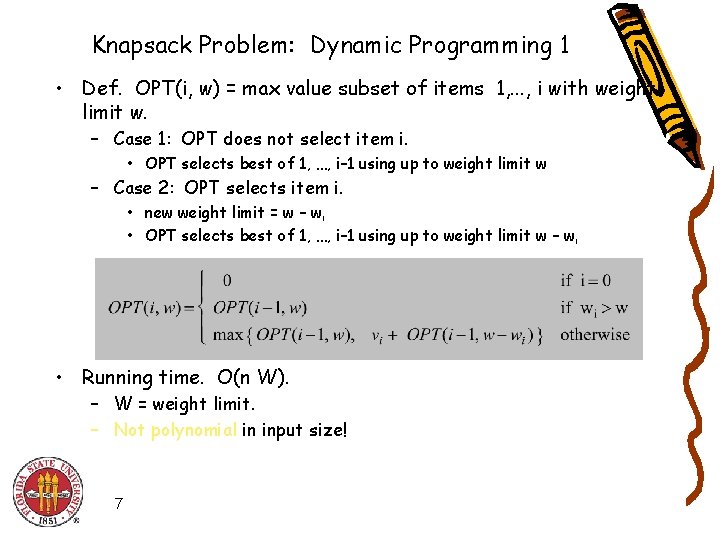
Knapsack Problem: Dynamic Programming 1 • Def. OPT(i, w) = max value subset of items 1, . . . , i with weight limit w. – Case 1: OPT does not select item i. • OPT selects best of 1, …, i– 1 using up to weight limit w – Case 2: OPT selects item i. • new weight limit = w – wi • OPT selects best of 1, …, i– 1 using up to weight limit w – w i • Running time. O(n W). – W = weight limit. – Not polynomial in input size! 7
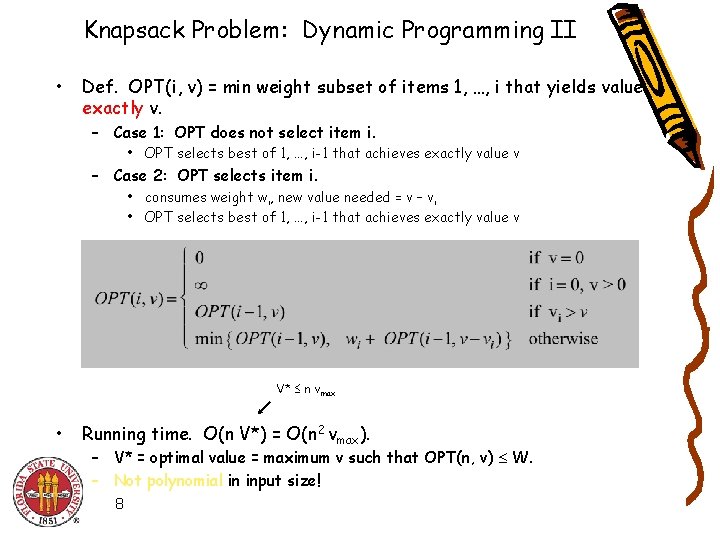
Knapsack Problem: Dynamic Programming II • Def. OPT(i, v) = min weight subset of items 1, …, i that yields value exactly v. – Case 1: OPT does not select item i. • OPT selects best of 1, …, i-1 that achieves exactly value v – Case 2: OPT selects item i. • consumes weight wi, new value needed = v – vi • OPT selects best of 1, …, i-1 that achieves exactly value v V* n vmax • Running time. O(n V*) = O(n 2 vmax). – V* = optimal value = maximum v such that OPT(n, v) W. – Not polynomial in input size! 8
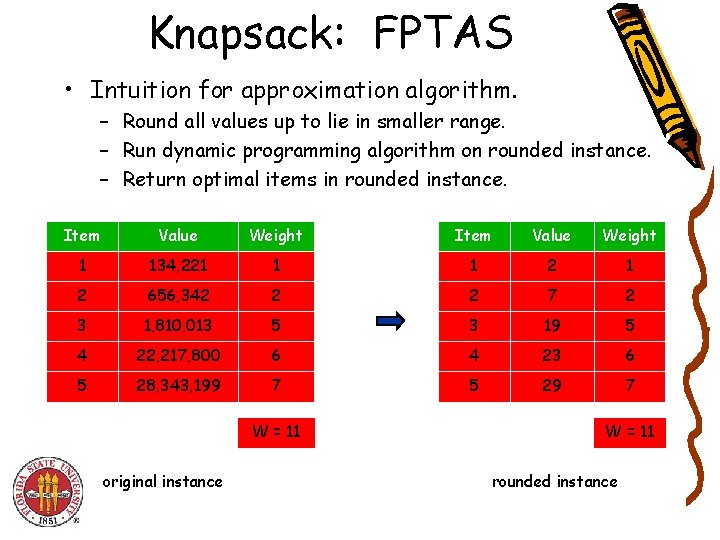
Knapsack: FPTAS • Intuition for approximation algorithm. – Round all values up to lie in smaller range. – Run dynamic programming algorithm on rounded instance. – Return optimal items in rounded instance. Item Value Weight 1 134, 221 1 1 2 656, 342 2 2 7 2 3 1, 810, 013 5 3 19 5 4 22, 217, 800 6 4 23 6 5 28, 343, 199 7 5 29 7 W = 11 original instance W = 11 rounded instance
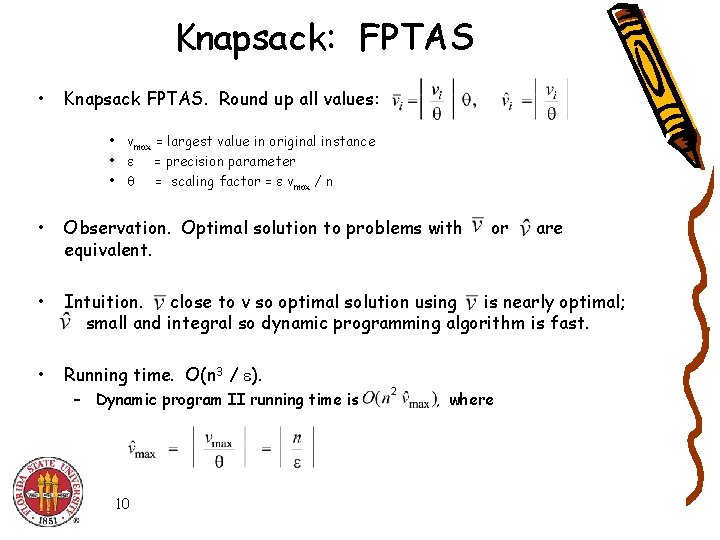
Knapsack: FPTAS • Knapsack FPTAS. Round up all values: • vmax = largest value in original instance • = precision parameter • = scaling factor = vmax / n • Observation. Optimal solution to problems with equivalent. • Intuition. close to v so optimal solution using is nearly optimal; small and integral so dynamic programming algorithm is fast. • Running time. O(n 3 / ). – Dynamic program II running time is 10 or , where are
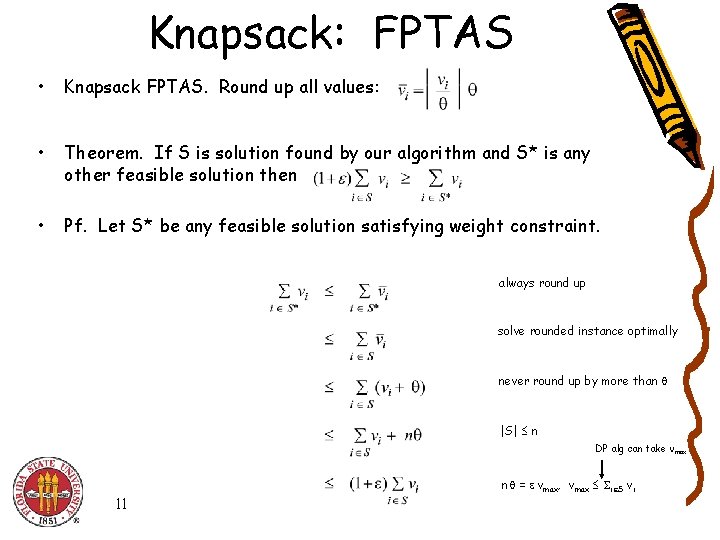
Knapsack: FPTAS • Knapsack FPTAS. Round up all values: • Theorem. If S is solution found by our algorithm and S* is any other feasible solution then • Pf. Let S* be any feasible solution satisfying weight constraint. always round up solve rounded instance optimally never round up by more than |S| n DP alg can take vmax 11 n = vmax, vmax i S vi