
Advanced Algorithms Analysis and Design By Dr Nazir
Advanced Algorithms Analysis and Design By Dr. Nazir Ahmad Zafar Dr Nazir A. Zafar Advanced Algorithms Analysis and Design
Lecture No. 10 Time Complexity of Algorithms (Asymptotic Notations) Dr Nazir A. Zafar Advanced Algorithms Analysis and Design
Today Covered • • Major Factors in Algorithms Design Complexity Analysis Growth of Functions Asymptotic Notations Usefulness of Notations Reflexivity, Symmetry, Transitivity Relations over , , O, and o Relation between , and O Various Examples Explaining each concept Dr Nazir A. Zafar Advanced Algorithms Analysis and Design
What is Complexity? • The level in difficulty in solving mathematically posed problems as measured by – The time (time complexity) – number of steps or arithmetic operations (computational complexity) – memory space required – (space complexity) Dr Nazir A. Zafar Advanced Algorithms Analysis and Design

Major Factors in Algorithms Design 1. Correctness An algorithm is said to be correct if • For every input, it halts with correct output. • An incorrect algorithm might not halt at all OR • It might halt with an answer other than desired one. • Correct algorithm solves a computational problem 2. Algorithm Efficiency Measuring efficiency of an algorithm, • do its analysis i. e. growth rate. • Compare efficiencies of different algorithms for the same problem. Dr Nazir A. Zafar Advanced Algorithms Analysis and Design
Algorithms Growth Rate Algorithm Growth Rates • It measures algorithm efficiency What means by efficient? § If running time is bounded by polynomial in the input Notations for Asymptotic performance • How running time increases with input size • O, Omega, Theta, etc. for asymptotic running time • These notations defined in terms of functions whose domains are natural numbers • convenient for worst case running time • Algorithms, asymptotically efficient best choice Dr Nazir A. Zafar Advanced Algorithms Analysis and Design
Complexity Analysis • Algorithm analysis means predicting resources such as – computational time – memory – computer hardware etc • Worst case analysis – Provides an upper bound on running time – An absolute guarantee • Average case analysis – Provides the expected running time – Very useful, but treat with care: what is “average”? • Random (equally likely) inputs • Real-life inputs Dr Nazir A. Zafar Advanced Algorithms Analysis and Design
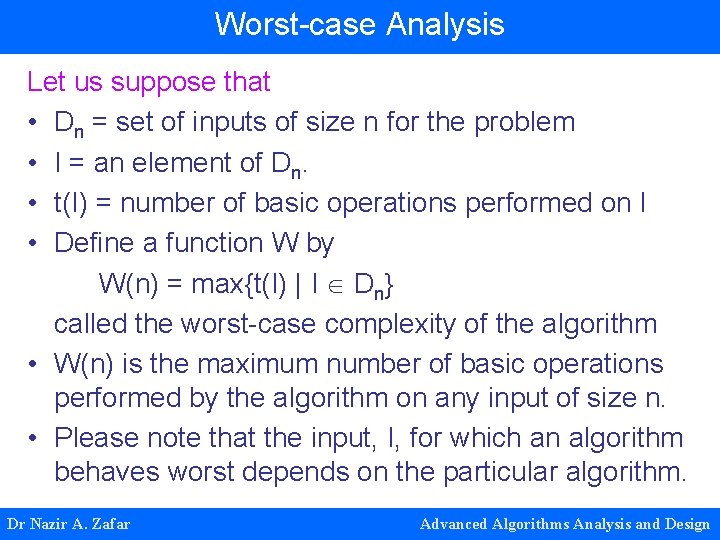
Worst-case Analysis Let us suppose that • Dn = set of inputs of size n for the problem • I = an element of Dn. • t(I) = number of basic operations performed on I • Define a function W by W(n) = max{t(I) | I Dn} called the worst-case complexity of the algorithm • W(n) is the maximum number of basic operations performed by the algorithm on any input of size n. • Please note that the input, I, for which an algorithm behaves worst depends on the particular algorithm. Dr Nazir A. Zafar Advanced Algorithms Analysis and Design
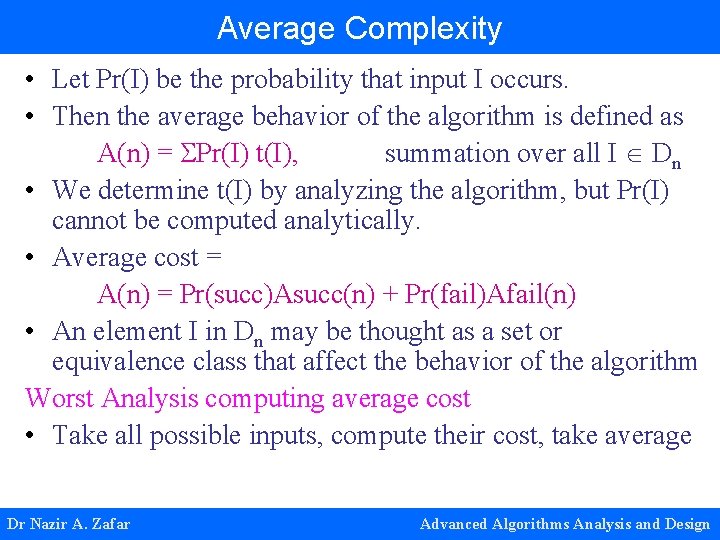
Average Complexity • Let Pr(I) be the probability that input I occurs. • Then the average behavior of the algorithm is defined as A(n) = Pr(I) t(I), summation over all I Dn • We determine t(I) by analyzing the algorithm, but Pr(I) cannot be computed analytically. • Average cost = A(n) = Pr(succ)Asucc(n) + Pr(fail)Afail(n) • An element I in Dn may be thought as a set or equivalence class that affect the behavior of the algorithm Worst Analysis computing average cost • Take all possible inputs, compute their cost, take average Dr Nazir A. Zafar Advanced Algorithms Analysis and Design
Asymptotic Notations Properties • Categorize algorithms based on asymptotic growth rate e. g. linear, quadratic, polynomial, exponential • Ignore small constant and small inputs • Estimate upper bound and lower bound on growth rate of time complexity function • Describe running time of algorithm as n grows to . • Describes behavior of function within the limit. Limitations • not always useful for analysis on fixed-size inputs. • All results are for sufficiently large inputs. Dr Nazir A. Zafar Advanced Algorithms Analysis and Design
Asymptotic Notations , O, , o, § We use to mean “order exactly”, § O to mean “order at most”, § to mean “order at least”, § o to mean “tight upper bound”, • to mean “tight lower bound”, Define a set of functions: which is in practice used to compare two function sizes. Dr Nazir A. Zafar Advanced Algorithms Analysis and Design
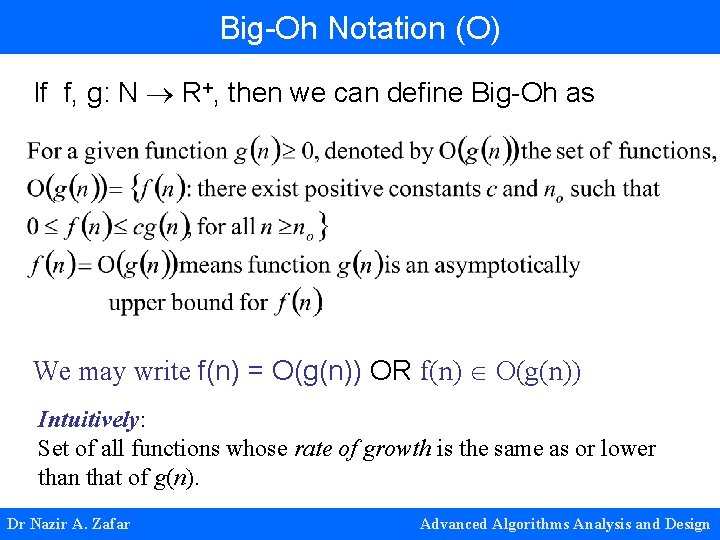
Big-Oh Notation (O) If f, g: N R+, then we can define Big-Oh as We may write f(n) = O(g(n)) OR f(n) O(g(n)) Intuitively: Set of all functions whose rate of growth is the same as or lower than that of g(n). Dr Nazir A. Zafar Advanced Algorithms Analysis and Design
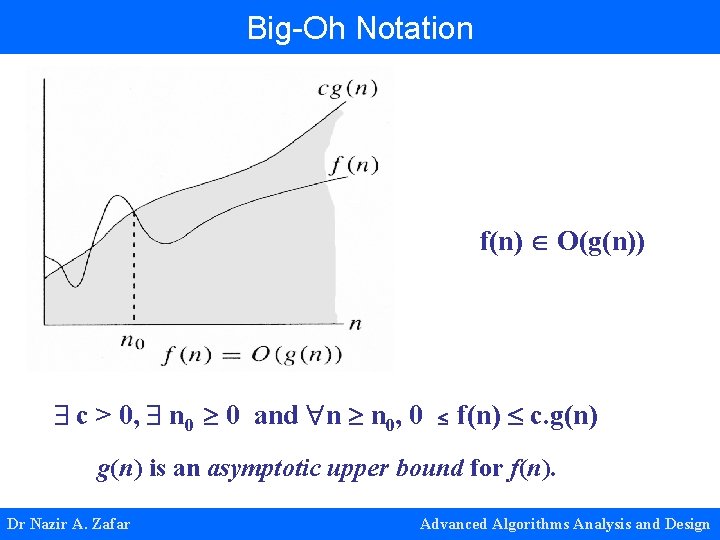
Big-Oh Notation f(n) O(g(n)) c > 0, n 0 0 and n n 0, 0 f(n) c. g(n) is an asymptotic upper bound for f(n). Dr Nazir A. Zafar Advanced Algorithms Analysis and Design
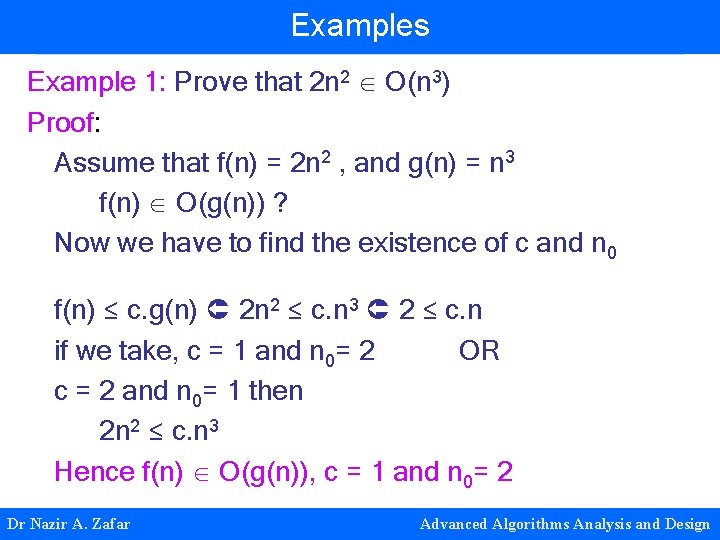
Examples Example 1: Prove that 2 n 2 O(n 3) Proof: Assume that f(n) = 2 n 2 , and g(n) = n 3 f(n) O(g(n)) ? Now we have to find the existence of c and n 0 f(n) ≤ c. g(n) 2 n 2 ≤ c. n 3 2 ≤ c. n if we take, c = 1 and n 0= 2 OR c = 2 and n 0= 1 then 2 n 2 ≤ c. n 3 Hence f(n) O(g(n)), c = 1 and n 0= 2 Dr Nazir A. Zafar Advanced Algorithms Analysis and Design
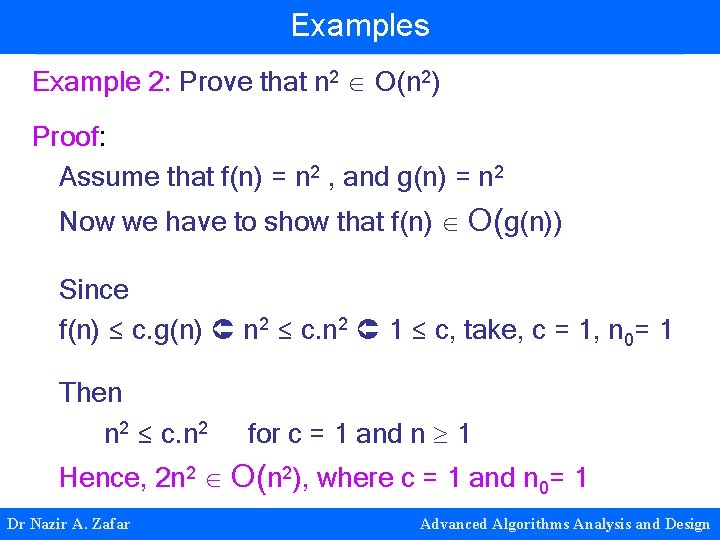
Examples Example 2: Prove that n 2 O(n 2) Proof: Assume that f(n) = n 2 , and g(n) = n 2 Now we have to show that f(n) O(g(n)) Since f(n) ≤ c. g(n) n 2 ≤ c. n 2 1 ≤ c, take, c = 1, n 0= 1 Then n 2 ≤ c. n 2 for c = 1 and n 1 Hence, 2 n 2 O(n 2), where c = 1 and n 0= 1 Dr Nazir A. Zafar Advanced Algorithms Analysis and Design
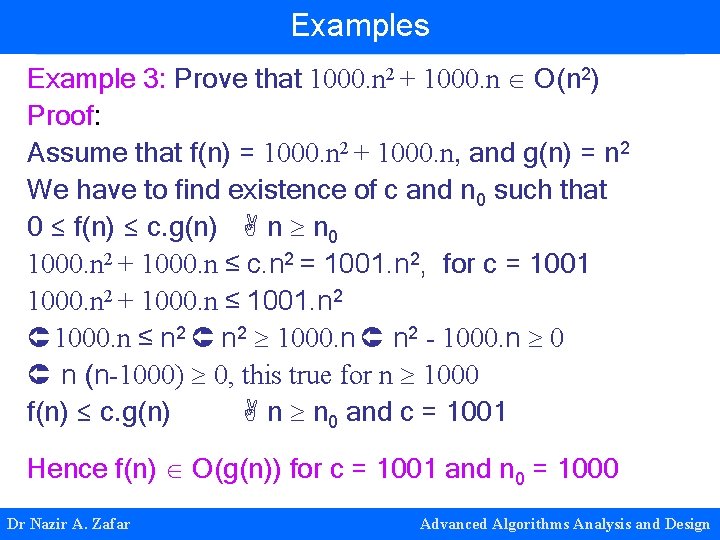
Examples Example 3: Prove that 1000. n 2 + 1000. n O(n 2) Proof: Assume that f(n) = 1000. n 2 + 1000. n, and g(n) = n 2 We have to find existence of c and n 0 such that 0 ≤ f(n) ≤ c. g(n) n n 0 1000. n 2 + 1000. n ≤ c. n 2 = 1001. n 2, for c = 1001 1000. n 2 + 1000. n ≤ 1001. n 2 1000. n ≤ n 2 1000. n n 2 - 1000. n 0 n (n-1000) 0, this true for n 1000 f(n) ≤ c. g(n) n n 0 and c = 1001 Hence f(n) O(g(n)) for c = 1001 and n 0 = 1000 Dr Nazir A. Zafar Advanced Algorithms Analysis and Design
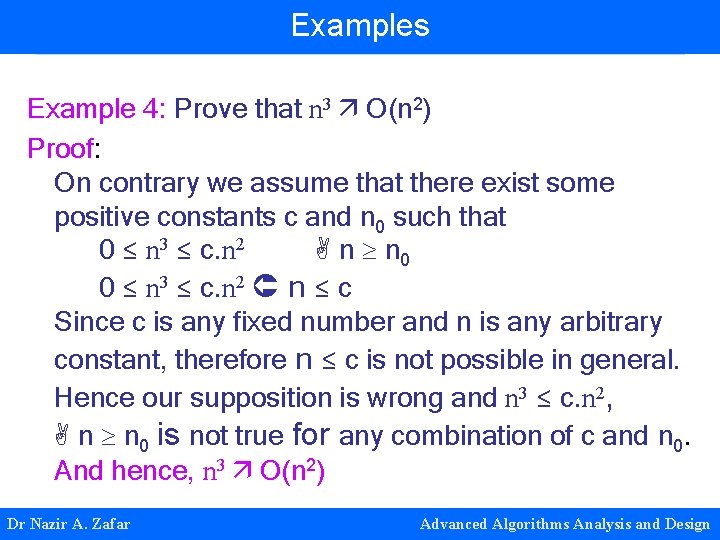
Examples Example 4: Prove that n 3 O(n 2) Proof: On contrary we assume that there exist some positive constants c and n 0 such that 0 ≤ n 3 ≤ c. n 2 n n 0 0 ≤ n 3 ≤ c. n 2 n ≤ c Since c is any fixed number and n is any arbitrary constant, therefore n ≤ c is not possible in general. Hence our supposition is wrong and n 3 ≤ c. n 2, n n 0 is not true for any combination of c and n 0. And hence, n 3 O(n 2) Dr Nazir A. Zafar Advanced Algorithms Analysis and Design
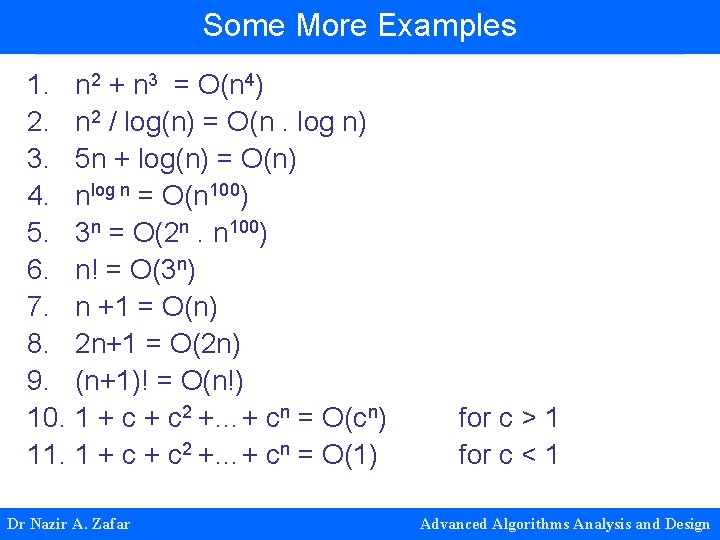
Some. Examples More Examples 1. n 2 + n 3 = O(n 4) 2. n 2 / log(n) = O(n. log n) 3. 5 n + log(n) = O(n) 4. nlog n = O(n 100) 5. 3 n = O(2 n. n 100) 6. n! = O(3 n) 7. n +1 = O(n) 8. 2 n+1 = O(2 n) 9. (n+1)! = O(n!) 10. 1 + c 2 +…+ cn = O(cn) 11. 1 + c 2 +…+ cn = O(1) Dr Nazir A. Zafar for c > 1 for c < 1 Advanced Algorithms Analysis and Design
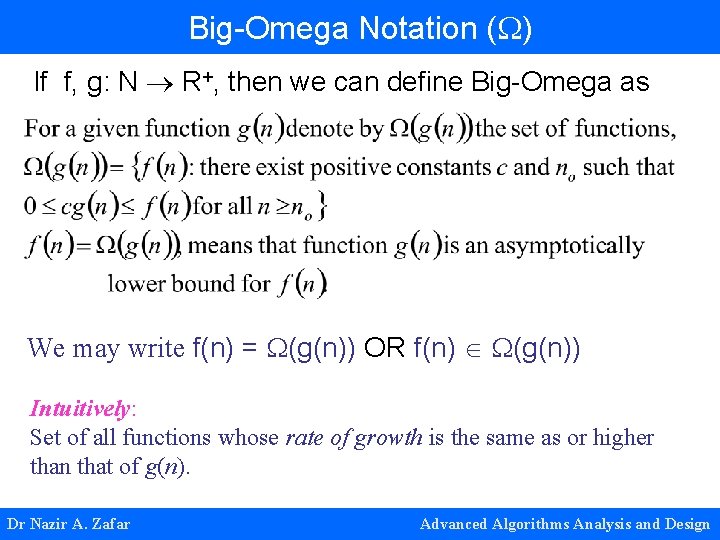
Big-Omega Notation ( ) If f, g: N R+, then we can define Big-Omega as We may write f(n) = (g(n)) OR f(n) (g(n)) Intuitively: Set of all functions whose rate of growth is the same as or higher than that of g(n). Dr Nazir A. Zafar Advanced Algorithms Analysis and Design
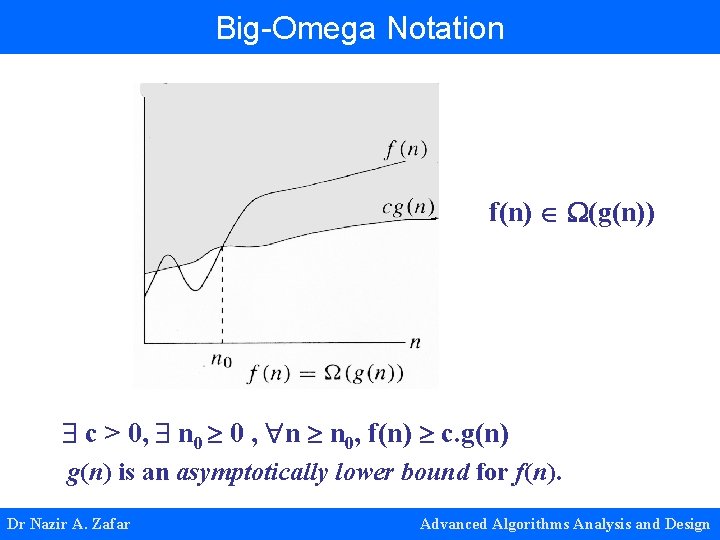
Big-Omega Notation f(n) (g(n)) c > 0, n 0 0 , n n 0, f(n) c. g(n) is an asymptotically lower bound for f(n). Dr Nazir A. Zafar Advanced Algorithms Analysis and Design

Examples Example 1: Prove that 5. n 2 (n) Proof: Assume that f(n) = 5. n 2 , and g(n) = n f(n) (g(n)) ? We have to find the existence of c and n 0 s. t. c. g(n) ≤ f(n) n n 0 c. n ≤ 5. n 2 c ≤ 5. n if we take, c = 5 and n 0= 1 then c. n ≤ 5. n 2 n n 0 And hence f(n) (g(n)), for c = 5 and n 0= 1 Dr Nazir A. Zafar Advanced Algorithms Analysis and Design
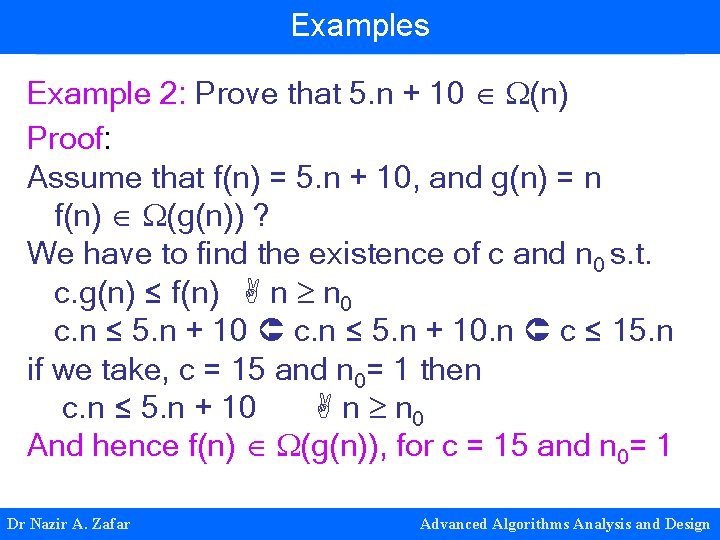
Examples Example 2: Prove that 5. n + 10 (n) Proof: Assume that f(n) = 5. n + 10, and g(n) = n f(n) (g(n)) ? We have to find the existence of c and n 0 s. t. c. g(n) ≤ f(n) n n 0 c. n ≤ 5. n + 10. n c ≤ 15. n if we take, c = 15 and n 0= 1 then c. n ≤ 5. n + 10 n n 0 And hence f(n) (g(n)), for c = 15 and n 0= 1 Dr Nazir A. Zafar Advanced Algorithms Analysis and Design
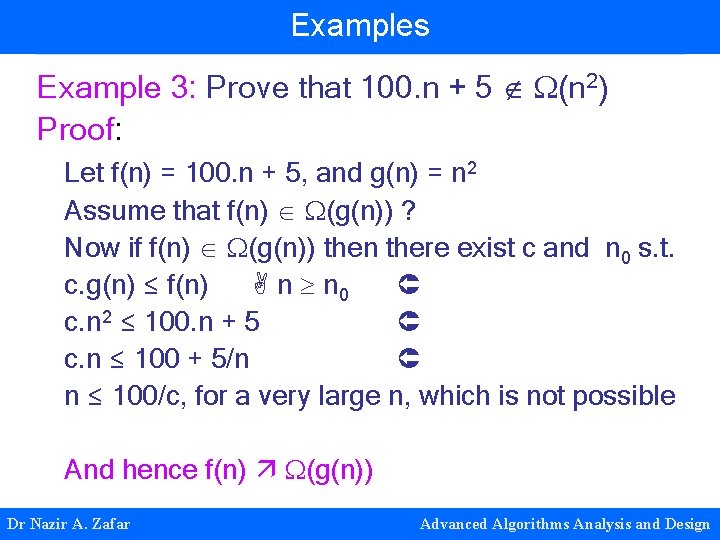
Examples Example 3: Prove that 100. n + 5 (n 2) Proof: Let f(n) = 100. n + 5, and g(n) = n 2 Assume that f(n) (g(n)) ? Now if f(n) (g(n)) then there exist c and n 0 s. t. c. g(n) ≤ f(n) n n 0 c. n 2 ≤ 100. n + 5 c. n ≤ 100 + 5/n n ≤ 100/c, for a very large n, which is not possible And hence f(n) (g(n)) Dr Nazir A. Zafar Advanced Algorithms Analysis and Design
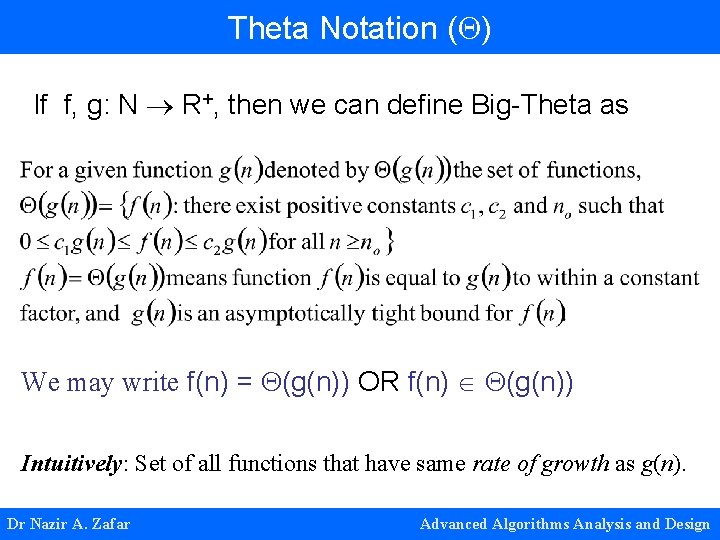
Theta Notation ( ) If f, g: N R+, then we can define Big-Theta as We may write f(n) = (g(n)) OR f(n) (g(n)) Intuitively: Set of all functions that have same rate of growth as g(n). Dr Nazir A. Zafar Advanced Algorithms Analysis and Design
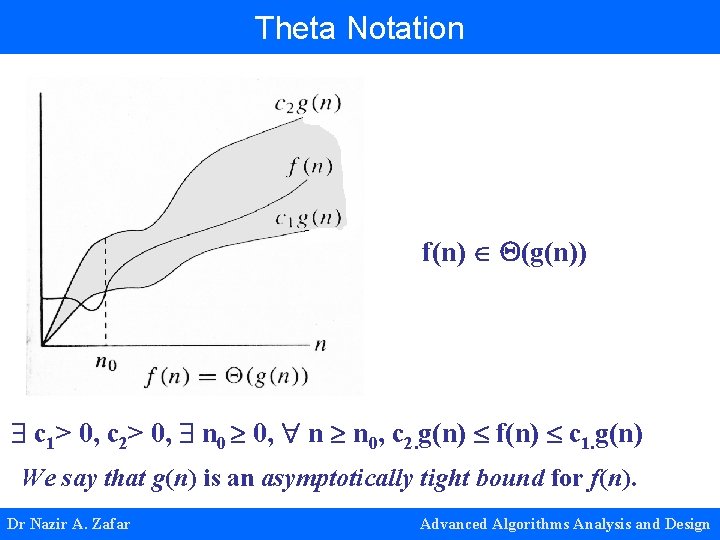
Theta Notation f(n) (g(n)) c 1> 0, c 2> 0, n 0 0, n n 0, c 2. g(n) f(n) c 1. g(n) We say that g(n) is an asymptotically tight bound for f(n). Dr Nazir A. Zafar Advanced Algorithms Analysis and Design
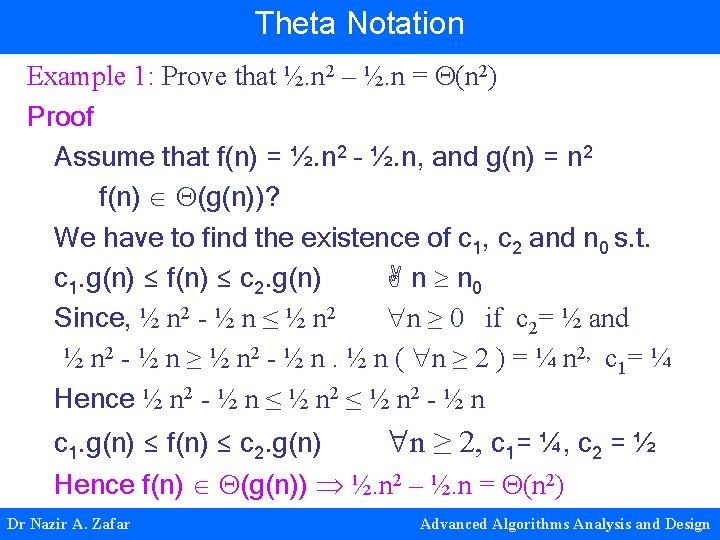
Theta Notation Example 1: Prove that ½. n 2 – ½. n = (n 2) Proof Assume that f(n) = ½. n 2 – ½. n, and g(n) = n 2 f(n) (g(n))? We have to find the existence of c 1, c 2 and n 0 s. t. c 1. g(n) ≤ f(n) ≤ c 2. g(n) n n 0 Since, ½ n 2 - ½ n ≤ ½ n 2 n ≥ 0 if c 2= ½ and ½ n 2 - ½ n ≥ ½ n 2 - ½ n ( n ≥ 2 ) = ¼ n 2, c 1= ¼ Hence ½ n 2 - ½ n ≤ ½ n 2 - ½ n c 1. g(n) ≤ f(n) ≤ c 2. g(n) n ≥ 2, c 1= ¼, c 2 = ½ Hence f(n) (g(n)) ½. n 2 – ½. n = (n 2) Dr Nazir A. Zafar Advanced Algorithms Analysis and Design
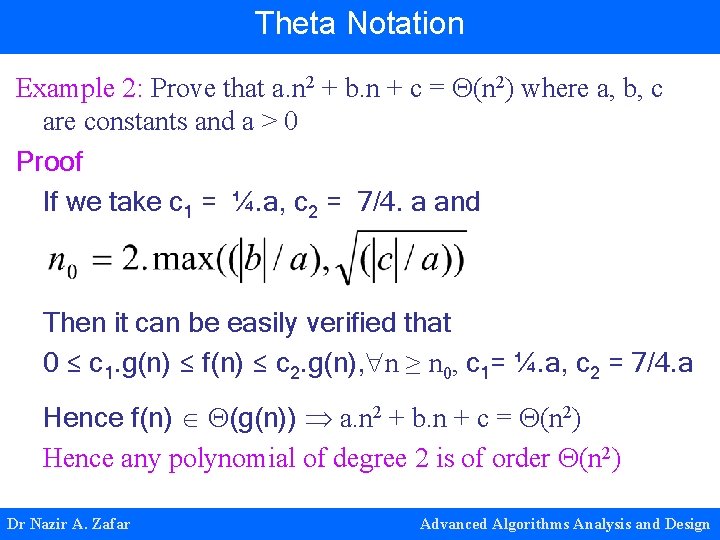
Theta Notation Example 2: Prove that a. n 2 + b. n + c = (n 2) where a, b, c are constants and a > 0 Proof If we take c 1 = ¼. a, c 2 = 7/4. a and Then it can be easily verified that 0 ≤ c 1. g(n) ≤ f(n) ≤ c 2. g(n), n ≥ n 0, c 1= ¼. a, c 2 = 7/4. a Hence f(n) (g(n)) a. n 2 + b. n + c = (n 2) Hence any polynomial of degree 2 is of order (n 2) Dr Nazir A. Zafar Advanced Algorithms Analysis and Design
Theta Notation Example 1: Prove that 2. n 2 + 3. n + 6 (n 3) Proof: Let f(n) = 2. n 2 + 3. n + 6, and g(n) = n 3 we have to show that f(n) (g(n)) On contrary assume that f(n) (g(n)) i. e. there exist some positive constants c 1, c 2 and n 0 such that: c 1. g(n) ≤ f(n) ≤ c 2. g(n) c 1. n 3 ≤ 2. n 2 + 3. n + 6 ≤ c 2. n 3 c 1. n ≤ 2 + 3/n + 6/n 2 ≤ c 2. n c 1. n ≤ 2 ≤ c 2. n, for large n n ≤ 2/c 1 ≤ c 2/c 1. n which is not possible Hence f(n) (g(n)) 2. n 2 + 3. n + 6 (n 3) Dr Nazir A. Zafar Advanced Algorithms Analysis and Design
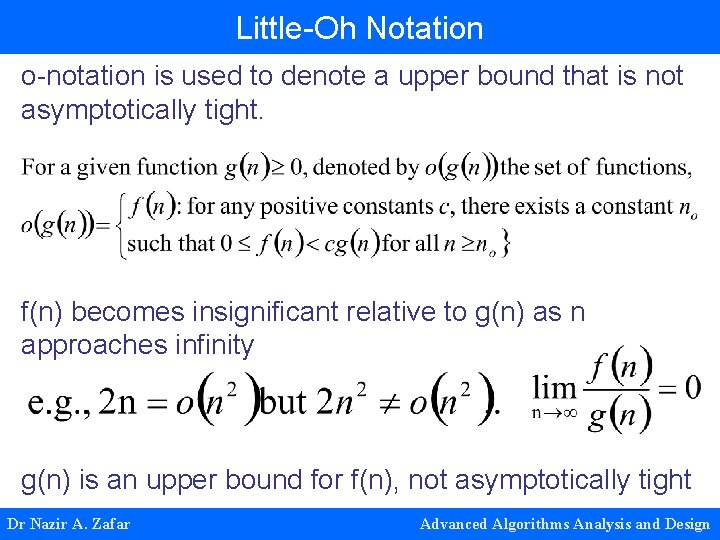
Little-Oh Notation o-notation is used to denote a upper bound that is not asymptotically tight. f(n) becomes insignificant relative to g(n) as n approaches infinity g(n) is an upper bound for f(n), not asymptotically tight Dr Nazir A. Zafar Advanced Algorithms Analysis and Design
Examples Example 1: Prove that 2 n 2 o(n 3) Proof: Assume that f(n) = 2 n 2 , and g(n) = n 3 f(n) o(g(n)) ? Now we have to find the existence n 0 for any c f(n) < c. g(n) this is true 2 n 2 < c. n 3 2 < c. n This is true for any c, because for any arbitrary c we can choose n 0 such that the above inequality holds. Hence f(n) o(g(n)) Dr Nazir A. Zafar Advanced Algorithms Analysis and Design
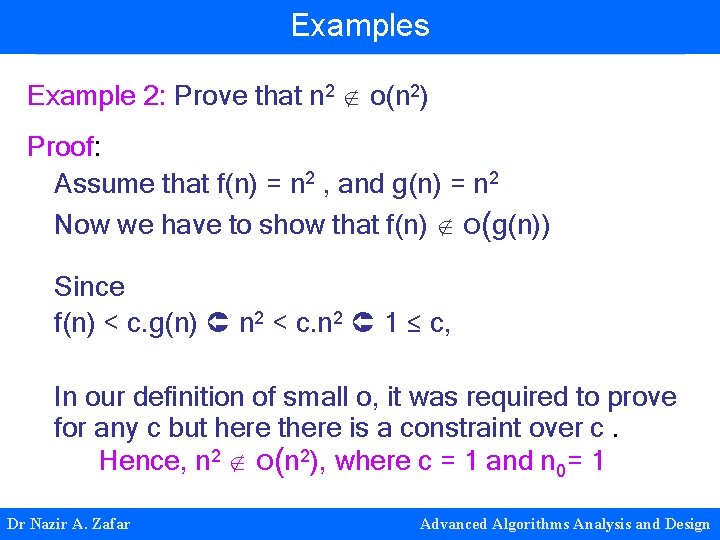
Examples Example 2: Prove that n 2 o(n 2) Proof: Assume that f(n) = n 2 , and g(n) = n 2 Now we have to show that f(n) o(g(n)) Since f(n) < c. g(n) n 2 < c. n 2 1 ≤ c, In our definition of small o, it was required to prove for any c but here there is a constraint over c. Hence, n 2 o(n 2), where c = 1 and n 0= 1 Dr Nazir A. Zafar Advanced Algorithms Analysis and Design
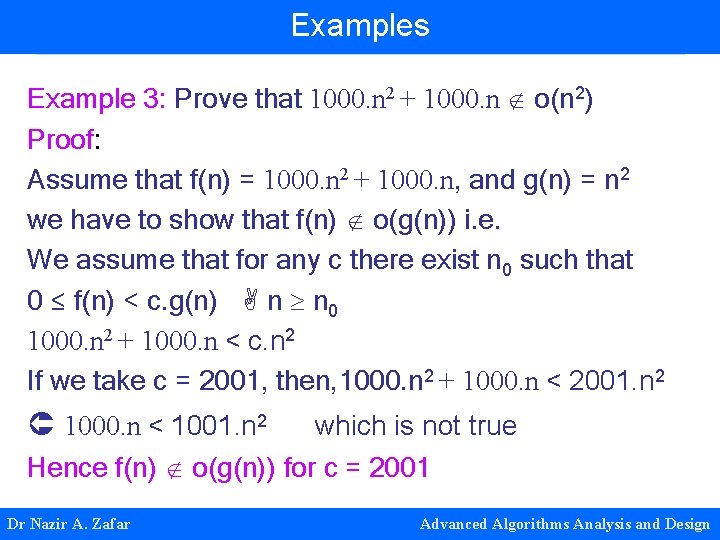
Examples Example 3: Prove that 1000. n 2 + 1000. n o(n 2) Proof: Assume that f(n) = 1000. n 2 + 1000. n, and g(n) = n 2 we have to show that f(n) o(g(n)) i. e. We assume that for any c there exist n 0 such that 0 ≤ f(n) < c. g(n) n n 0 1000. n 2 + 1000. n < c. n 2 If we take c = 2001, then, 1000. n 2 + 1000. n < 2001. n 2 1000. n < 1001. n 2 which is not true Hence f(n) o(g(n)) for c = 2001 Dr Nazir A. Zafar Advanced Algorithms Analysis and Design
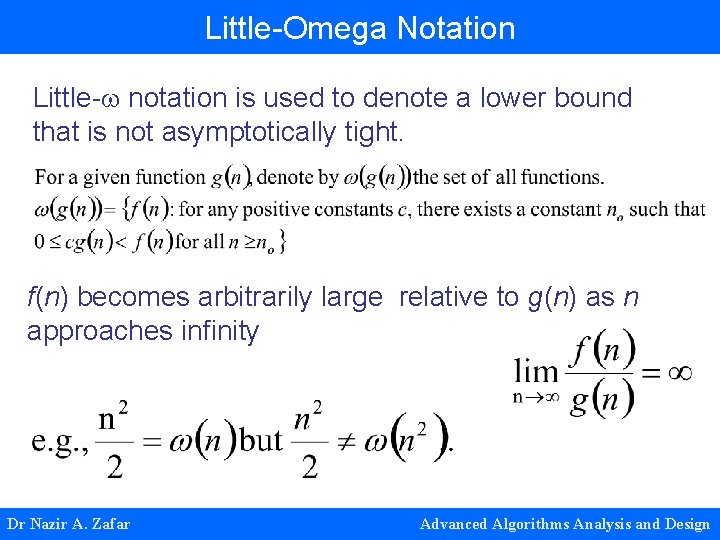
Little-Omega Notation Little- notation is used to denote a lower bound that is not asymptotically tight. f(n) becomes arbitrarily large relative to g(n) as n approaches infinity Dr Nazir A. Zafar Advanced Algorithms Analysis and Design
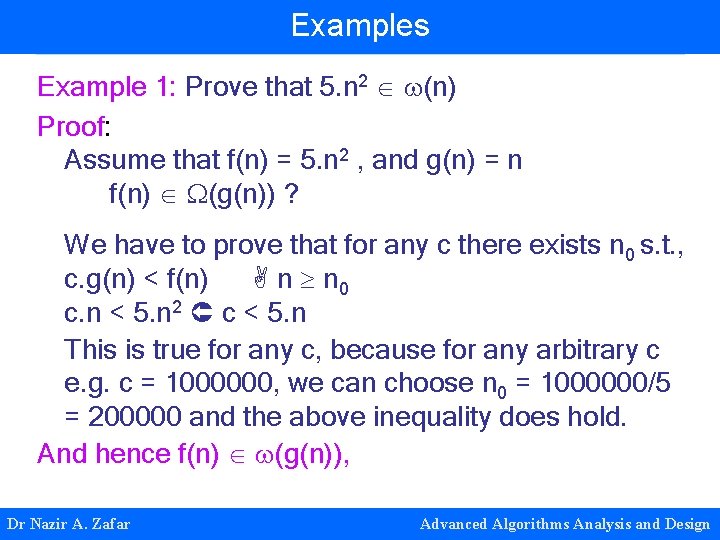
Examples Example 1: Prove that 5. n 2 (n) Proof: Assume that f(n) = 5. n 2 , and g(n) = n f(n) (g(n)) ? We have to prove that for any c there exists n 0 s. t. , c. g(n) < f(n) n n 0 c. n < 5. n 2 c < 5. n This is true for any c, because for any arbitrary c e. g. c = 1000000, we can choose n 0 = 1000000/5 = 200000 and the above inequality does hold. And hence f(n) (g(n)), Dr Nazir A. Zafar Advanced Algorithms Analysis and Design
Examples Example 2: Prove that 5. n + 10 (n) Proof: Assume that f(n) = 5. n + 10, and g(n) = n f(n) (g(n)) ? We have to find the existence n 0 for any c, s. t. c. g(n) < f(n) n n 0 c. n < 5. n + 10, if we take c = 16 then 16. n < 5. n + 10 11. n < 10 is not true for any positive integer. Hence f(n) (g(n)) Dr Nazir A. Zafar Advanced Algorithms Analysis and Design
Examples Example 3: Prove that 100. n (n 2) Proof: Let f(n) = 100. n, and g(n) = n 2 Assume that f(n) (g(n)) Now if f(n) (g(n)) then there n 0 for any c s. t. c. g(n) < f(n) n n 0 this is true c. n 2 < 100. n c. n < 100 If we take c = 100, n < 1, not possible Hence f(n) (g(n)) i. e. 100. n (n 2) Dr Nazir A. Zafar Advanced Algorithms Analysis and Design
Usefulness of Notations • It is not always possible to determine behaviour of an algorithm using Θ-notation. • For example, given a problem with n inputs, we may have an algorithm to solve it in a. n 2 time when n is even and c. n time when n is odd. OR • We may prove that an algorithm never uses more than e. n 2 time and never less than f. n time. • In either case we can neither claim (n) nor (n 2) to be the order of the time usage of the algorithm. • Big O and notation will allow us to give at least partial information Dr Nazir A. Zafar Advanced Algorithms Analysis and Design
- Slides: 37