
Advanced Algorithm Design and Analysis Lecture 9 SW
- Slides: 29
Advanced Algorithm Design and Analysis (Lecture 9) SW 5 fall 2004 Simonas Šaltenis E 1 -215 b simas@cs. aau. dk AALG, lecture 9, © Simonas Šaltenis, 2004
Computational geometry n Main goals of the lecture: n n n to understand how the basic geometric operations are performed; to understand the basic idea of the sweeping algorithm design technique; to understand be able to analyze the Graham's scan and the sweeping-line algorithm to determine whether any pair of line segments intersect. . AALG, lecture 9, © Simonas Šaltenis, 2004 2
Computational geometry n Computational geometry: n Algorithmic basis for many scientific and engineering disciplines: • • • n n Geographic Information Systems (GIS) Robotics Computer graphics Computer vision Computer Aided Design/Manufacturing (CAD/CAM), VLSI design, etc. The term first appeared in the 70’s. We will deal with points and line segments in 2 D space. AALG, lecture 9, © Simonas Šaltenis, 2004 3
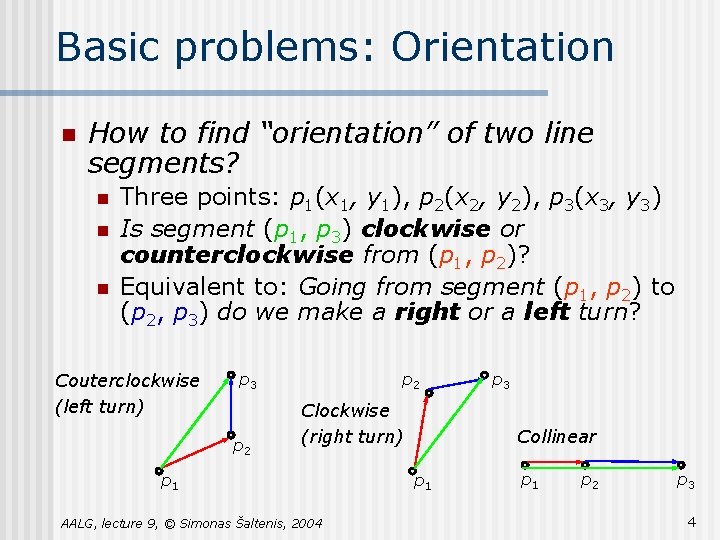
Basic problems: Orientation n How to find “orientation” of two line segments? n n n Three points: p 1(x 1, y 1), p 2(x 2, y 2), p 3(x 3, y 3) Is segment (p 1, p 3) clockwise or counterclockwise from (p 1, p 2)? Equivalent to: Going from segment (p 1, p 2) to (p 2, p 3) do we make a right or a left turn? Couterclockwise (left turn) p 3 p 2 Clockwise (right turn) p 1 AALG, lecture 9, © Simonas Šaltenis, 2004 p 3 Collinear p 1 p 2 p 3 4
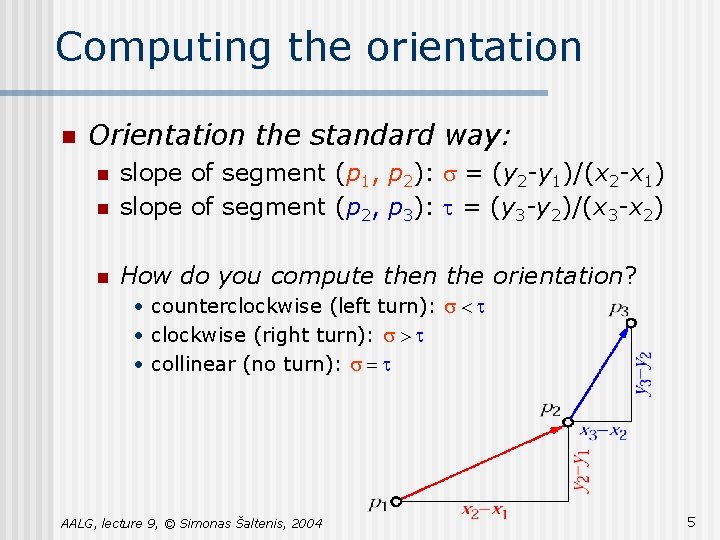
Computing the orientation n Orientation the standard way: n slope of segment (p 1, p 2): s = (y 2 -y 1)/(x 2 -x 1) slope of segment (p 2, p 3): t = (y 3 -y 2)/(x 3 -x 2) n How do you compute then the orientation? n • counterclockwise (left turn): s < t • clockwise (right turn): s > t • collinear (no turn): s = t AALG, lecture 9, © Simonas Šaltenis, 2004 5
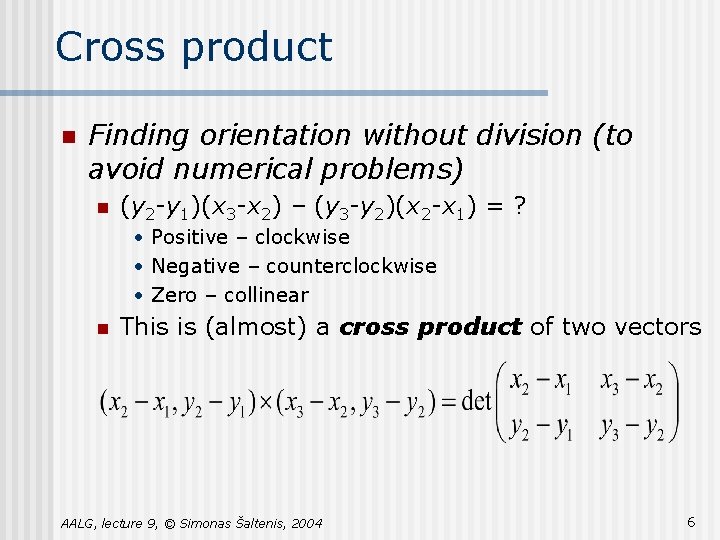
Cross product n Finding orientation without division (to avoid numerical problems) n (y 2 -y 1)(x 3 -x 2) – (y 3 -y 2)(x 2 -x 1) = ? • Positive – clockwise • Negative – counterclockwise • Zero – collinear n This is (almost) a cross product of two vectors AALG, lecture 9, © Simonas Šaltenis, 2004 6
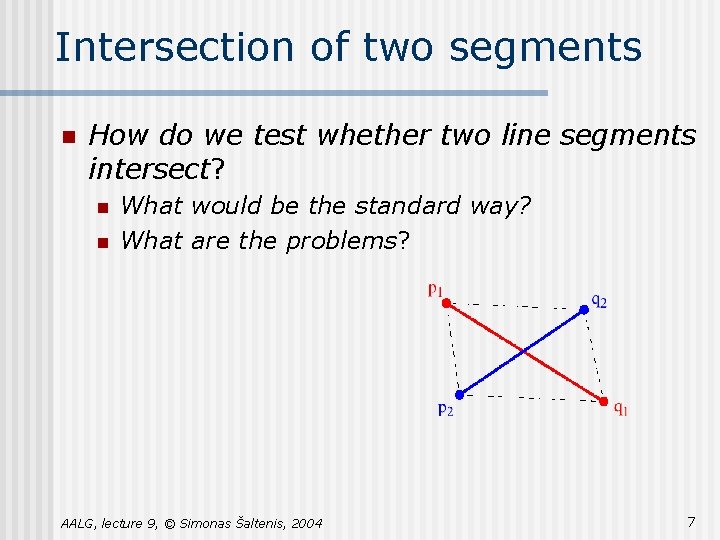
Intersection of two segments n How do we test whether two line segments intersect? n n What would be the standard way? What are the problems? AALG, lecture 9, © Simonas Šaltenis, 2004 7
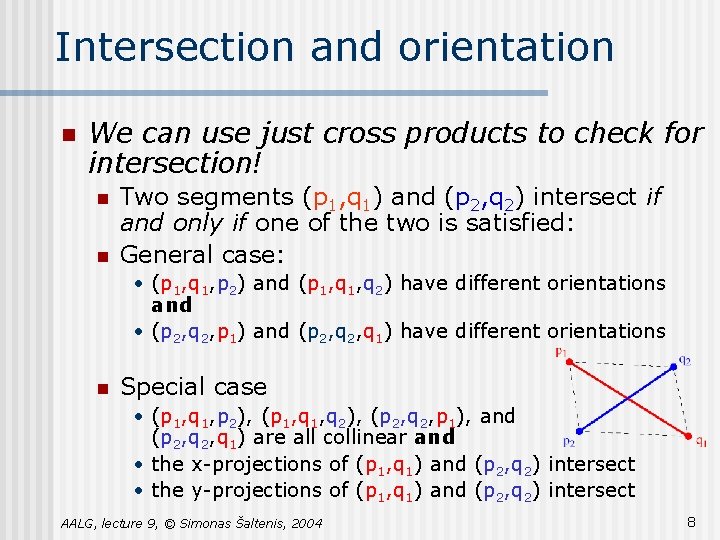
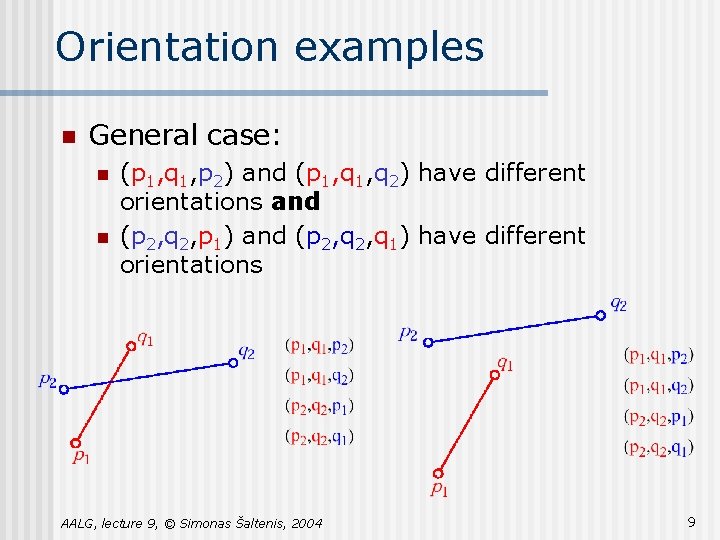
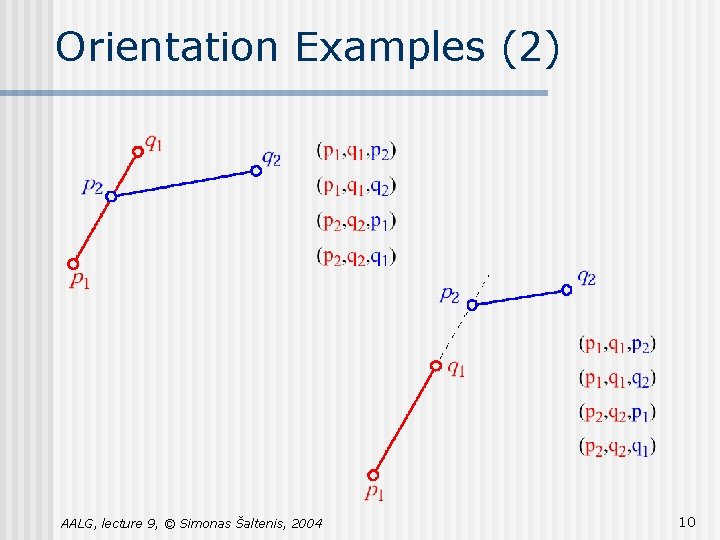
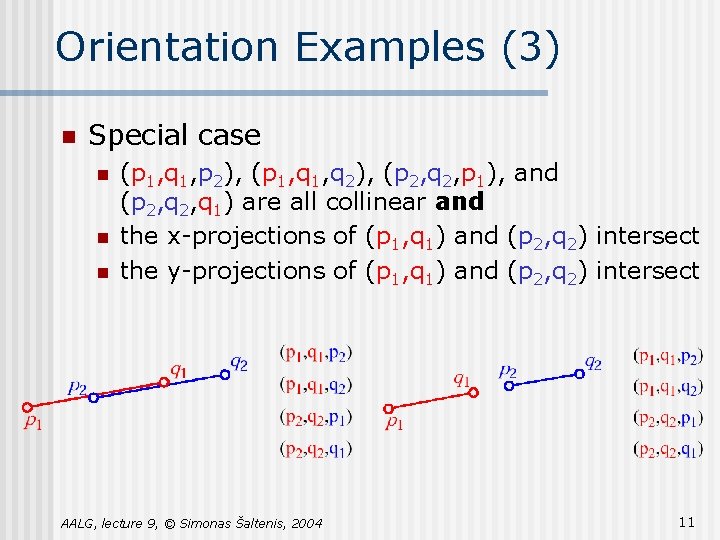
Intersection and orientation n We can use just cross products to check for intersection! n n Two segments (p 1, q 1) and (p 2, q 2) intersect if and only if one of the two is satisfied: General case: • (p 1, q 1, p 2) and (p 1, q 2) have different orientations and • (p 2, q 2, p 1) and (p 2, q 1) have different orientations n Special case • (p 1, q 1, p 2), (p 1, q 2), (p 2, q 2, p 1), and (p 2, q 1) are all collinear and • the x-projections of (p 1, q 1) and (p 2, q 2) intersect • the y-projections of (p 1, q 1) and (p 2, q 2) intersect AALG, lecture 9, © Simonas Šaltenis, 2004 8
Orientation examples n General case: n n (p 1, q 1, p 2) and (p 1, q 2) have different orientations and (p 2, q 2, p 1) and (p 2, q 1) have different orientations AALG, lecture 9, © Simonas Šaltenis, 2004 9
Orientation Examples (2) AALG, lecture 9, © Simonas Šaltenis, 2004 10
Orientation Examples (3) n Special case n n n (p 1, q 1, p 2), (p 1, q 2), (p 2, q 2, p 1), and (p 2, q 1) are all collinear and the x-projections of (p 1, q 1) and (p 2, q 2) intersect the y-projections of (p 1, q 1) and (p 2, q 2) intersect AALG, lecture 9, © Simonas Šaltenis, 2004 11
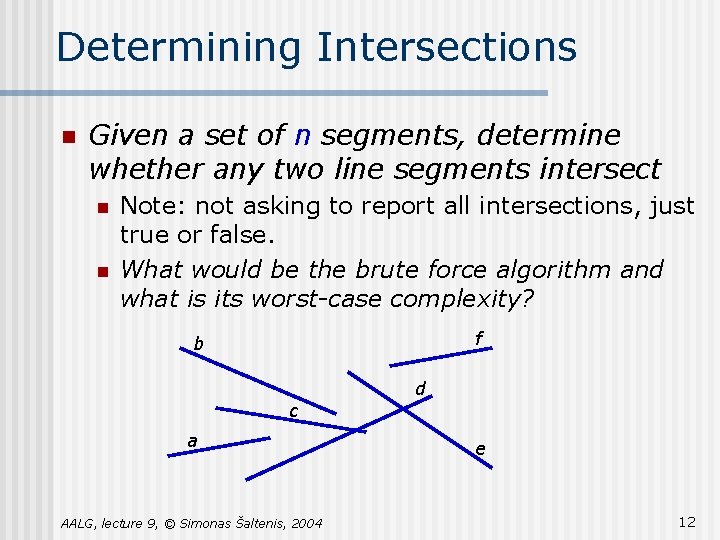
Determining Intersections n Given a set of n segments, determine whether any two line segments intersect n n Note: not asking to report all intersections, just true or false. What would be the brute force algorithm and what is its worst-case complexity? f b d c a AALG, lecture 9, © Simonas Šaltenis, 2004 e 12
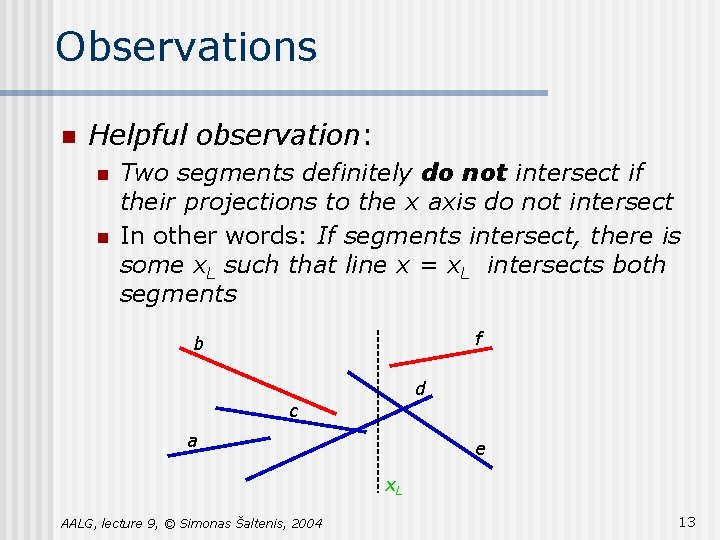
Observations n Helpful observation: n n Two segments definitely do not intersect if their projections to the x axis do not intersect In other words: If segments intersect, there is some x. L such that line x = x. L intersects both segments f b d c a e x. L AALG, lecture 9, © Simonas Šaltenis, 2004 13
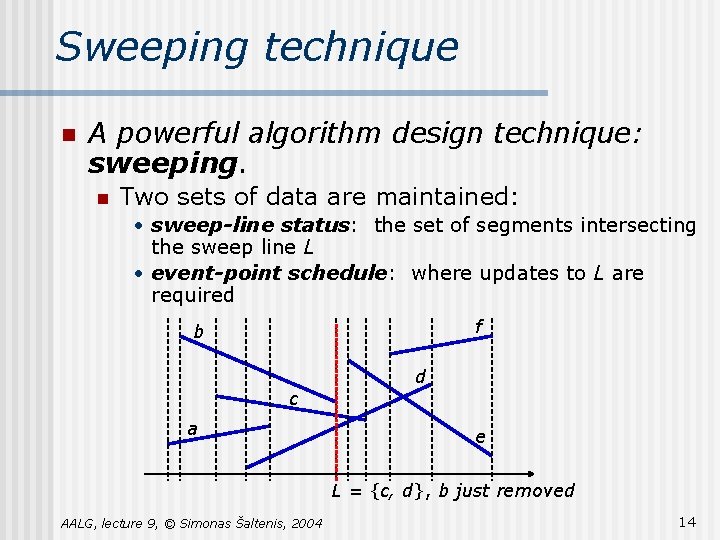
Sweeping technique n A powerful algorithm design technique: sweeping. n Two sets of data are maintained: • sweep-line status: the set of segments intersecting the sweep line L • event-point schedule: where updates to L are required f b d c a e L = {c, d}, b just removed AALG, lecture 9, © Simonas Šaltenis, 2004 14
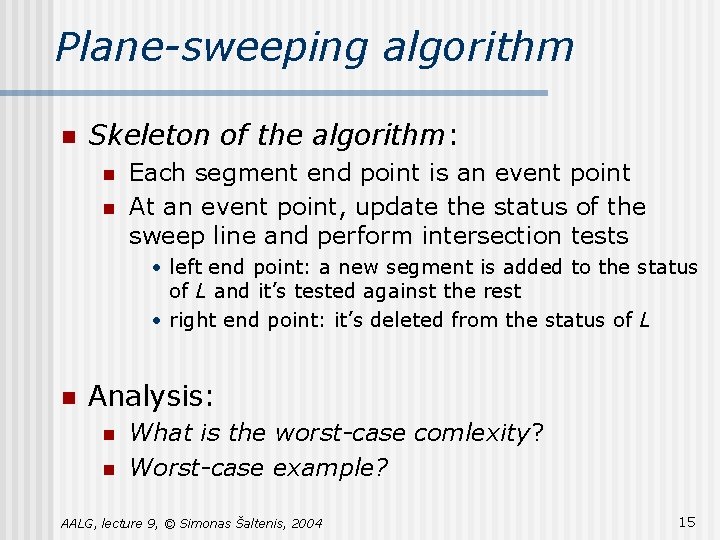
Plane-sweeping algorithm n Skeleton of the algorithm: n n Each segment end point is an event point At an event point, update the status of the sweep line and perform intersection tests • left end point: a new segment is added to the status of L and it’s tested against the rest • right end point: it’s deleted from the status of L n Analysis: n n What is the worst-case comlexity? Worst-case example? AALG, lecture 9, © Simonas Šaltenis, 2004 15
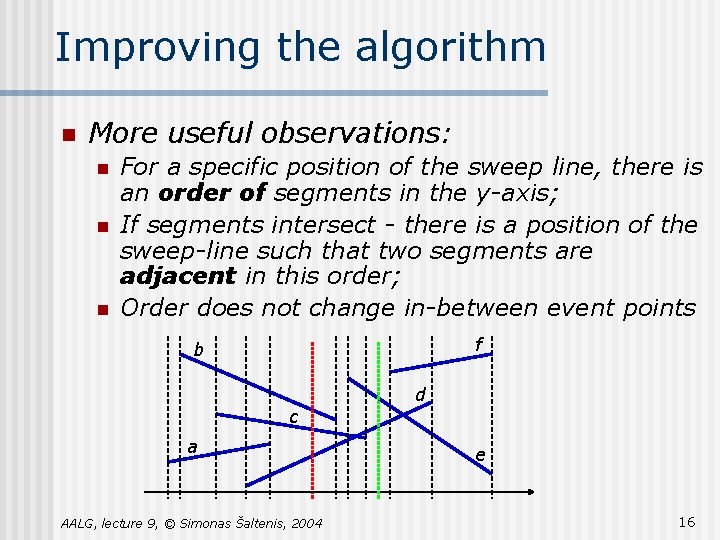
Improving the algorithm n More useful observations: n n n For a specific position of the sweep line, there is an order of segments in the y-axis; If segments intersect - there is a position of the sweep-line such that two segments are adjacent in this order; Order does not change in-between event points f b d c a AALG, lecture 9, © Simonas Šaltenis, 2004 e 16
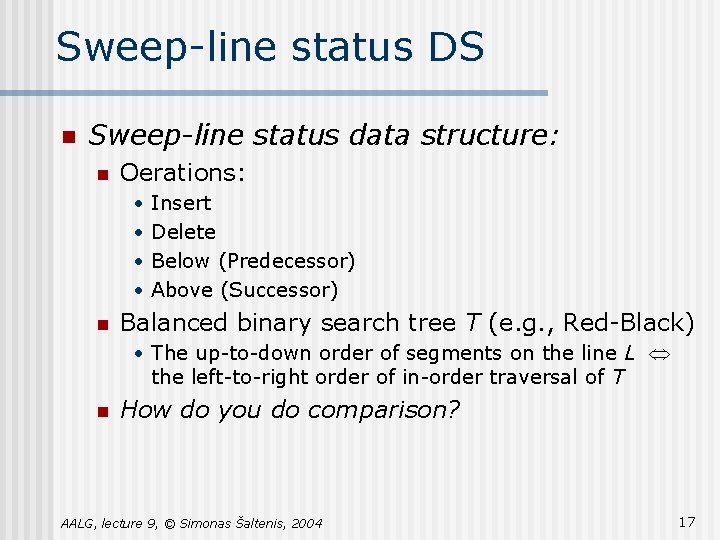
Sweep-line status DS n Sweep-line status data structure: n Oerations: • • n Insert Delete Below (Predecessor) Above (Successor) Balanced binary search tree T (e. g. , Red-Black) • The up-to-down order of segments on the line L Û the left-to-right order of in-order traversal of T n How do you do comparison? AALG, lecture 9, © Simonas Šaltenis, 2004 17
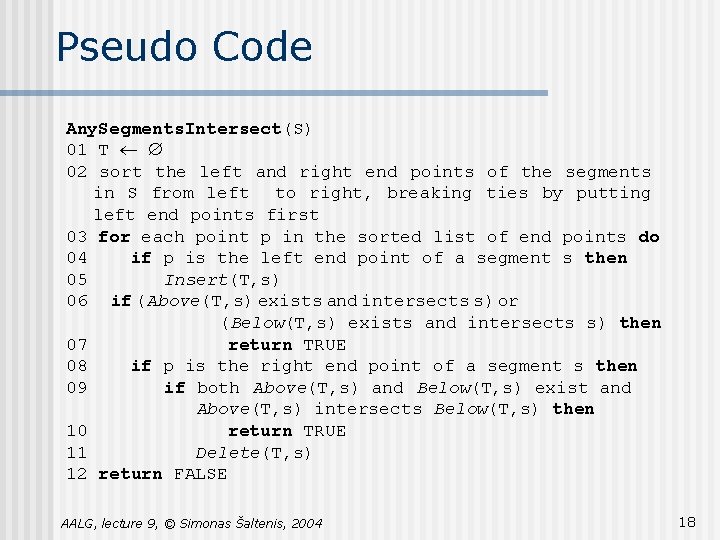
Pseudo Code Any. Segments. Intersect(S) 01 T ¬ Æ 02 sort the left and right end points of the segments in S from left to right, breaking ties by putting left end points first 03 for each point p in the sorted list of end points do 04 if p is the left end point of a segment s then 05 Insert(T, s) 06 if (Above(T, s) exists and intersects s) or (Below(T, s) exists and intersects s) then 07 return TRUE 08 if p is the right end point of a segment s then 09 if both Above(T, s) and Below(T, s) exist and Above(T, s) intersects Below(T, s) then 10 return TRUE 11 Delete(T, s) 12 return FALSE AALG, lecture 9, © Simonas Šaltenis, 2004 18
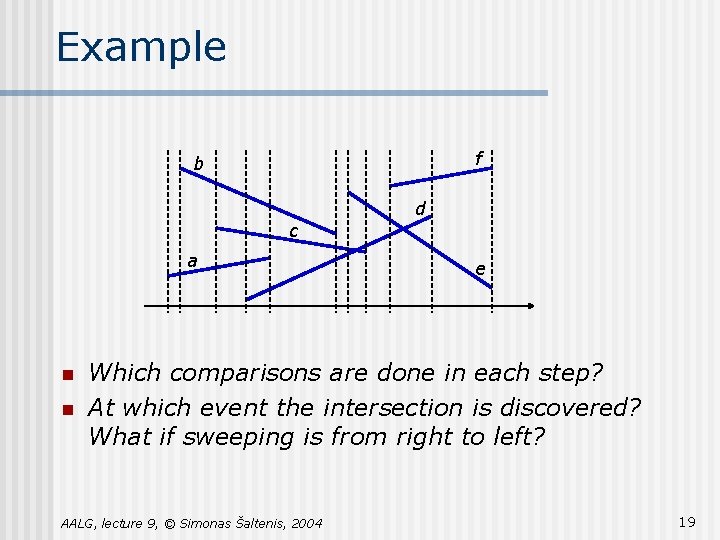
Example f b d c a n n e Which comparisons are done in each step? At which event the intersection is discovered? What if sweeping is from right to left? AALG, lecture 9, © Simonas Šaltenis, 2004 19
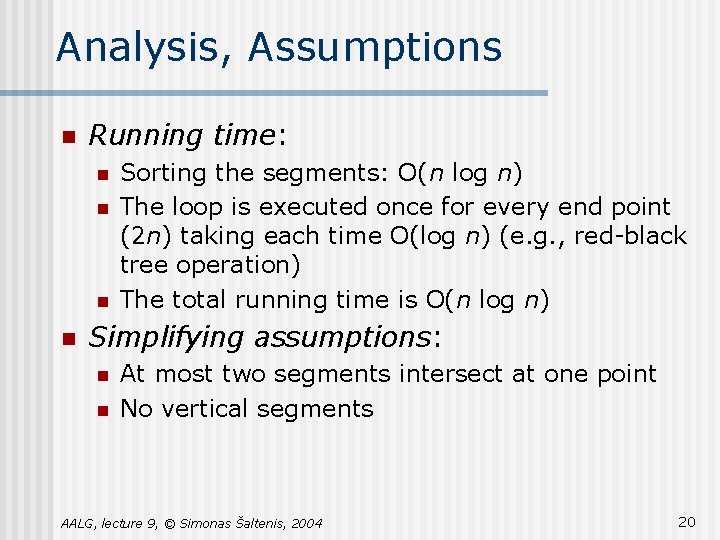
Analysis, Assumptions n Running time: n n Sorting the segments: O(n log n) The loop is executed once for every end point (2 n) taking each time O(log n) (e. g. , red-black tree operation) The total running time is O(n log n) Simplifying assumptions: n n At most two segments intersect at one point No vertical segments AALG, lecture 9, © Simonas Šaltenis, 2004 20
Sweeping technique principles n Principles of sweeping technique: n n n Define events and their order If all the events can be determined in advance – sort the events Else use the priority queue to manage the events See which operations have to be performed with the sweep-line status at each event point Choose a data-structure for the sweep-line status to efficiently support those operations AALG, lecture 9, © Simonas Šaltenis, 2004 21
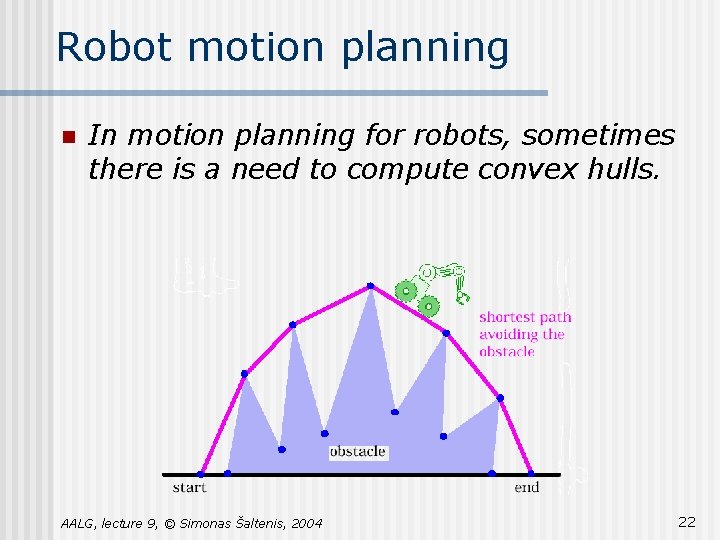
Robot motion planning n In motion planning for robots, sometimes there is a need to compute convex hulls. AALG, lecture 9, © Simonas Šaltenis, 2004 22
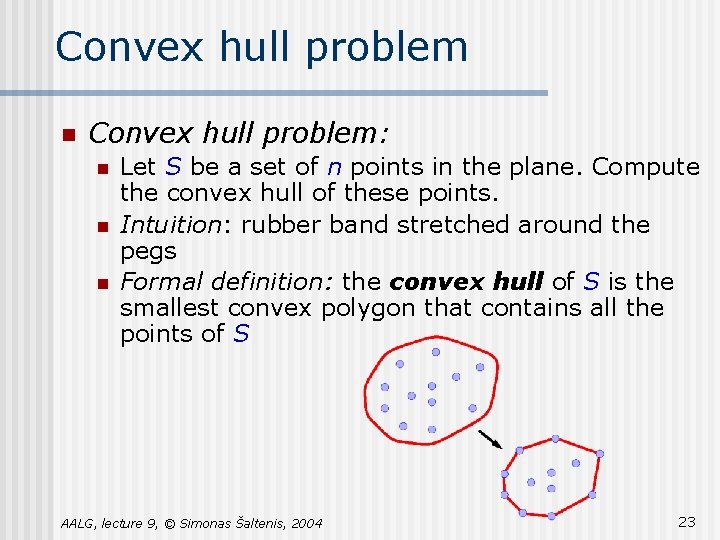
Convex hull problem n Convex hull problem: n n n Let S be a set of n points in the plane. Compute the convex hull of these points. Intuition: rubber band stretched around the pegs Formal definition: the convex hull of S is the smallest convex polygon that contains all the points of S AALG, lecture 9, © Simonas Šaltenis, 2004 23
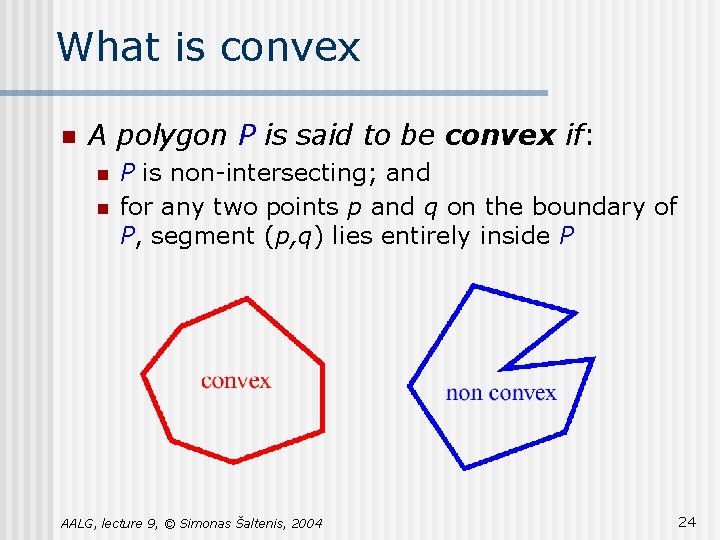
What is convex n A polygon P is said to be convex if: n n P is non-intersecting; and for any two points p and q on the boundary of P, segment (p, q) lies entirely inside P AALG, lecture 9, © Simonas Šaltenis, 2004 24
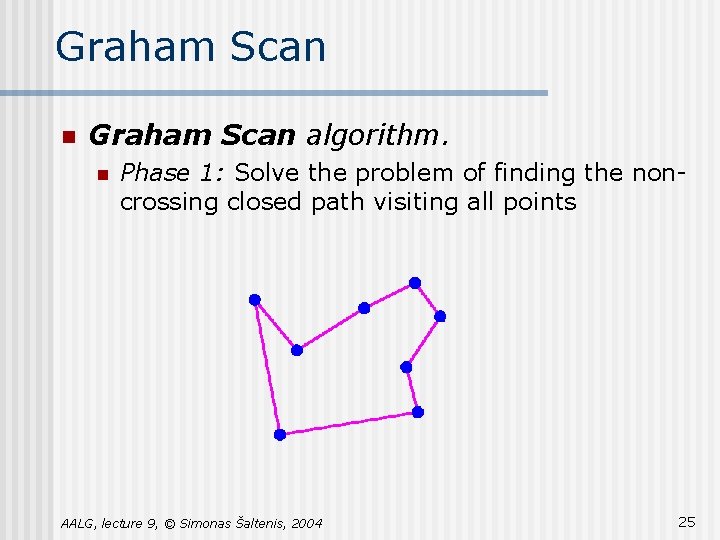
Graham Scan n Graham Scan algorithm. n Phase 1: Solve the problem of finding the noncrossing closed path visiting all points AALG, lecture 9, © Simonas Šaltenis, 2004 25
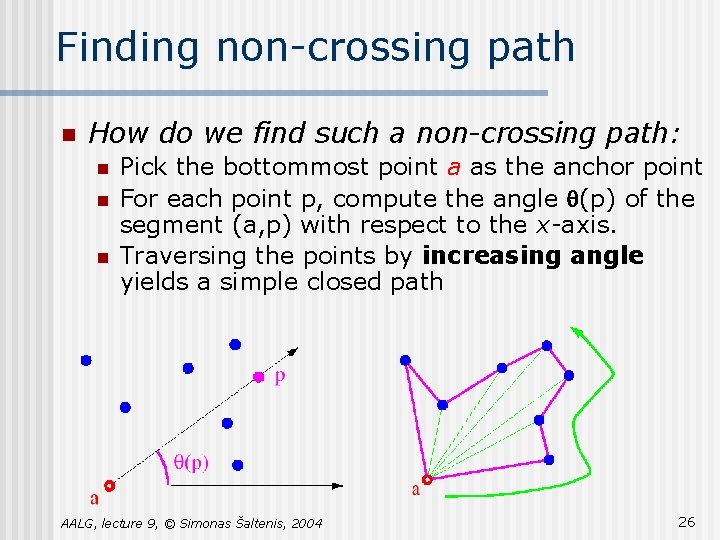
Finding non-crossing path n How do we find such a non-crossing path: n n n Pick the bottommost point a as the anchor point For each point p, compute the angle q(p) of the segment (a, p) with respect to the x-axis. Traversing the points by increasing angle yields a simple closed path AALG, lecture 9, © Simonas Šaltenis, 2004 26
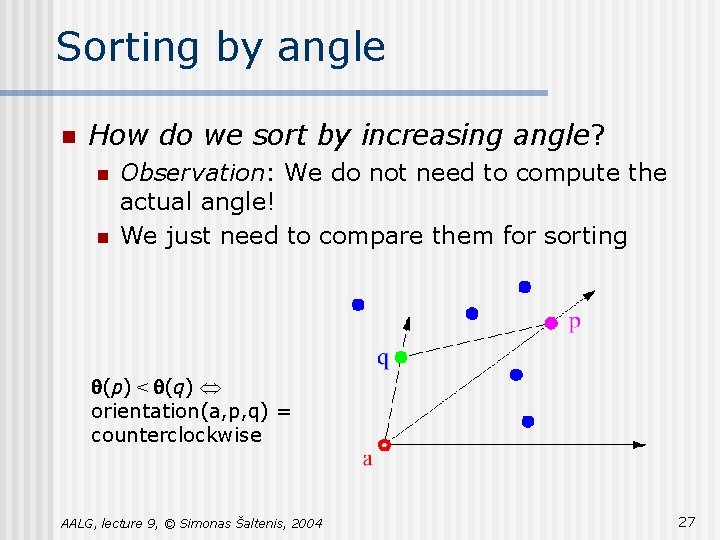
Sorting by angle n How do we sort by increasing angle? n n Observation: We do not need to compute the actual angle! We just need to compare them for sorting q(p) < q(q) Û orientation(a, p, q) = counterclockwise AALG, lecture 9, © Simonas Šaltenis, 2004 27
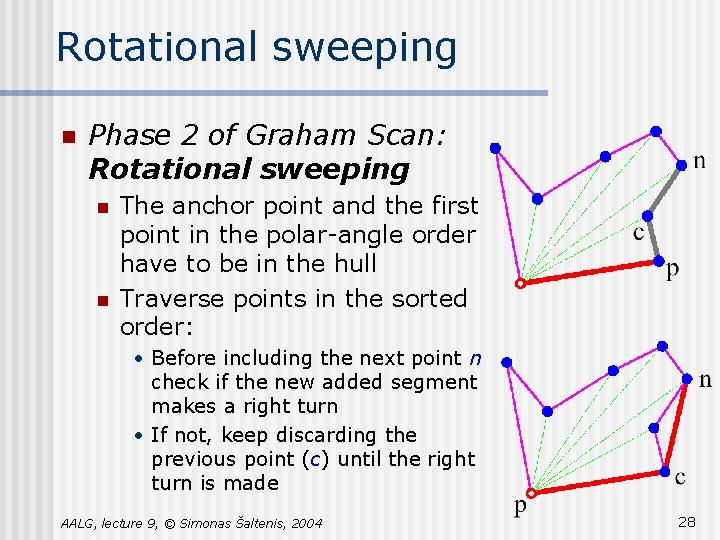
Rotational sweeping n Phase 2 of Graham Scan: Rotational sweeping n n The anchor point and the first point in the polar-angle order have to be in the hull Traverse points in the sorted order: • Before including the next point n check if the new added segment makes a right turn • If not, keep discarding the previous point (c) until the right turn is made AALG, lecture 9, © Simonas Šaltenis, 2004 28
Implementation and analysis n Implementation: n n Stack to store vertices of the convex hull Analysis: n Phase 1: O(n log n) • points are sorted by angle around the anchor n Phase 2: O(n) • each point is pushed into the stack once • each point is removed from the stack at most once n Total time complexity O(n log n) AALG, lecture 9, © Simonas Šaltenis, 2004 29