
ADVANCE SOFTWARE TECHNOLOGIES LINQ PART 1 Topics to

![Where/ Restricted Clause int[] numbers = { 5, 4, 1, 3, 9, 8, 6,](https://slidetodoc.com/presentation_image_h2/0e1c1c1466fc6513bc4c99da063fc36f/image-8.jpg "Where/ Restricted Clause int[] numbers = { 5, 4, 1, 3, 9, 8, 6,")
![Simple Select Clause int[] numbers = { 5, 4, 1, 3, 9, 8, 6,](https://slidetodoc.com/presentation_image_h2/0e1c1c1466fc6513bc4c99da063fc36f/image-9.jpg "Simple Select Clause int[] numbers = { 5, 4, 1, 3, 9, 8, 6,")
![Portioning Operator int[] numbers = { 5, 4, 1, 3, 90, 98, 976, 99,](https://slidetodoc.com/presentation_image_h2/0e1c1c1466fc6513bc4c99da063fc36f/image-10.jpg "Portioning Operator int[] numbers = { 5, 4, 1, 3, 90, 98, 976, 99,")
![Orderby Operator string[] words = { "cherry", "apple", "blueberry" }; var sorted. Words =](https://slidetodoc.com/presentation_image_h2/0e1c1c1466fc6513bc4c99da063fc36f/image-11.jpg "Orderby Operator string[] words = { \"cherry\", \"apple\", \"blueberry\" }; var sorted. Words =")
![Arrays Sorting double[] doubles = { 1. 7, 2. 3, 1. 9, 4. 1,](https://slidetodoc.com/presentation_image_h2/0e1c1c1466fc6513bc4c99da063fc36f/image-13.jpg "Arrays Sorting double[] doubles = { 1. 7, 2. 3, 1. 9, 4. 1,")
![Set Operator int[] factors. Of 300 = { 2, 2, 3, 5, 5 };](https://slidetodoc.com/presentation_image_h2/0e1c1c1466fc6513bc4c99da063fc36f/image-14.jpg "Set Operator int[] factors. Of 300 = { 2, 2, 3, 5, 5 };")
![Grouping Operator int[] numbers = { 5, 4, 1, 3, 9, 8, 6, 7,](https://slidetodoc.com/presentation_image_h2/0e1c1c1466fc6513bc4c99da063fc36f/image-15.jpg "Grouping Operator int[] numbers = { 5, 4, 1, 3, 9, 8, 6, 7,")
![Count Operator int[] factors. Of 300 = { 2, 2, 3, 5, 5 };](https://slidetodoc.com/presentation_image_h2/0e1c1c1466fc6513bc4c99da063fc36f/image-16.jpg "Count Operator int[] factors. Of 300 = { 2, 2, 3, 5, 5 };")
![Sum Operator int[] numbers = { 5, 4, 1, 3, 9, 8, 6, 7,](https://slidetodoc.com/presentation_image_h2/0e1c1c1466fc6513bc4c99da063fc36f/image-17.jpg "Sum Operator int[] numbers = { 5, 4, 1, 3, 9, 8, 6, 7,")
![Min Operator int[] numbers = { 5, 4, 1, 3, 9, 8, 6, 7,](https://slidetodoc.com/presentation_image_h2/0e1c1c1466fc6513bc4c99da063fc36f/image-18.jpg "Min Operator int[] numbers = { 5, 4, 1, 3, 9, 8, 6, 7,")
![Concat Function int[] numbers. A = { 0, 2, 4, 5, 6, 8, 9](https://slidetodoc.com/presentation_image_h2/0e1c1c1466fc6513bc4c99da063fc36f/image-19.jpg "Concat Function int[] numbers. A = { 0, 2, 4, 5, 6, 8, 9")
![Sequence Matching var words. A = new string[] { "cherry", "apple", "blueberry" }; var](https://slidetodoc.com/presentation_image_h2/0e1c1c1466fc6513bc4c99da063fc36f/image-20.jpg "Sequence Matching var words. A = new string[] { \"cherry\", \"apple\", \"blueberry\" }; var")

- Slides: 21
ADVANCE SOFTWARE TECHNOLOGIES LINQ PART 1
Topics to be Covered v v v What is LINQ? LINQ Architecture? Simple LINQ Queries? v v v Where Clause Select Partitioning Operator Order by Generation Arrays Set Count Sum Min Concat
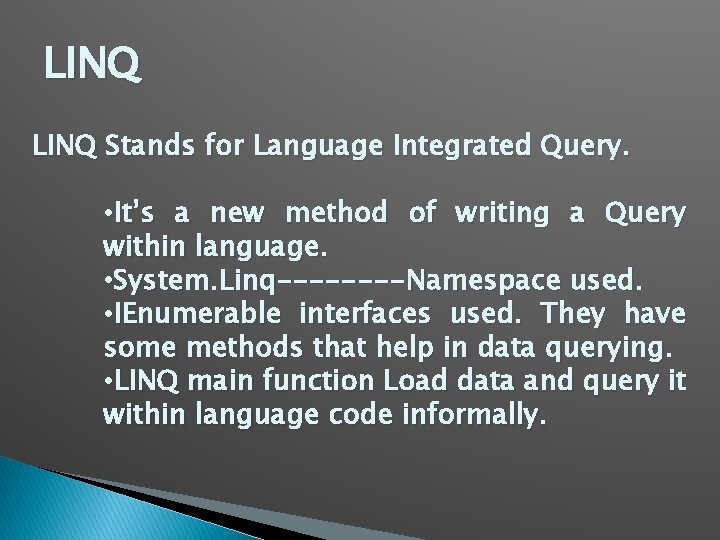
LINQ Stands for Language Integrated Query. • It’s a new method of writing a Query within language. • System. Linq----Namespace used. • IEnumerable interfaces used. They have some methods that help in data querying. • LINQ main function Load data and query it within language code informally.
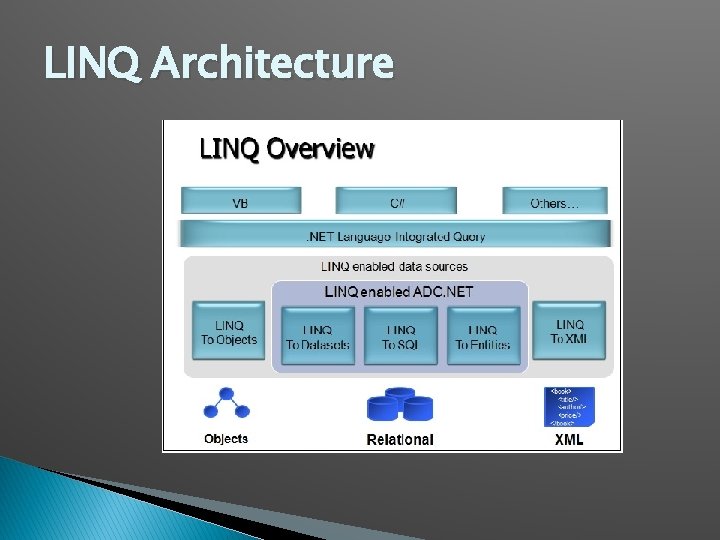
LINQ Architecture
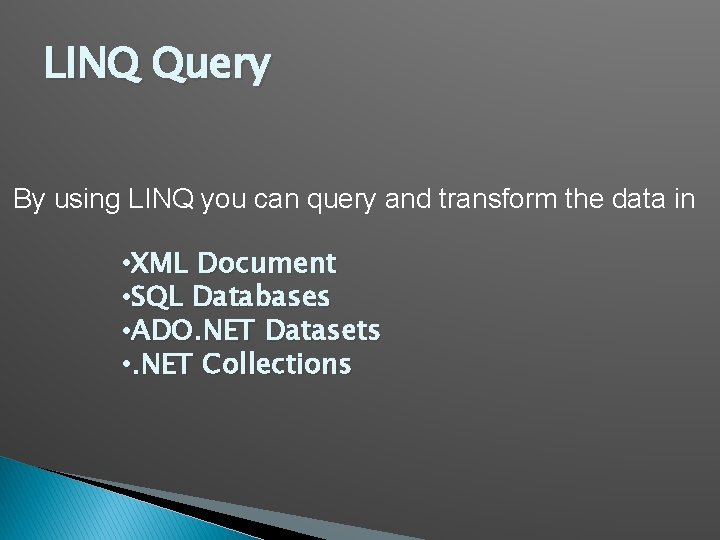
LINQ Query By using LINQ you can query and transform the data in • XML Document • SQL Databases • ADO. NET Datasets • . NET Collections
LINQ Query Operates LINQ Query operation contains three parts 1. Obtain the data source. 2. Create the Query. 3. Execute the Query Lets have example of it
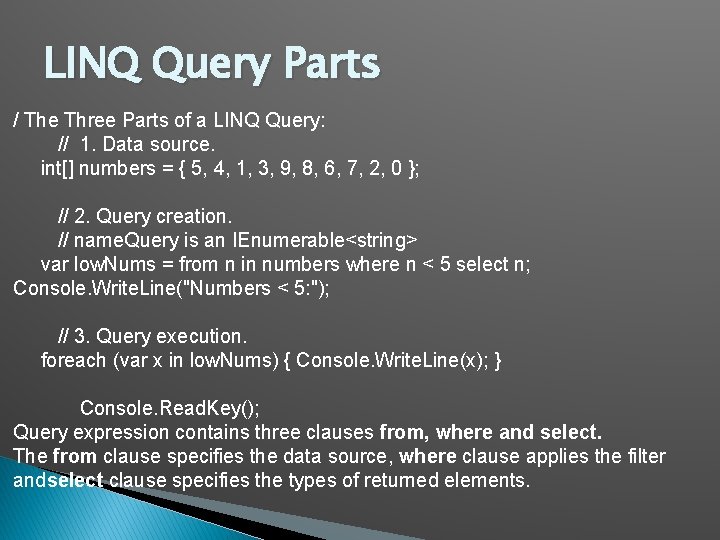
LINQ Query Parts / The Three Parts of a LINQ Query: // 1. Data source. int[] numbers = { 5, 4, 1, 3, 9, 8, 6, 7, 2, 0 }; // 2. Query creation. // name. Query is an IEnumerable<string> var low. Nums = from n in numbers where n < 5 select n; Console. Write. Line("Numbers < 5: "); // 3. Query execution. foreach (var x in low. Nums) { Console. Write. Line(x); } Console. Read. Key(); Query expression contains three clauses from, where and select. The from clause specifies the data source, where clause applies the filter andselect clause specifies the types of returned elements.
Where/ Restricted Clause int[] numbers = { 5, 4, 1, 3, 9, 8, 6, 7, 2, 0 }; var low. Nums = from n in numbers where n < 5 select n; Console. Write. Line("Numbers < 5: "); foreach (var x in low. Nums) { Console. Write. Line(x); }
Simple Select Clause int[] numbers = { 5, 4, 1, 3, 9, 8, 6, 7, 2, 0 }; var nums. Plus. One = from n in numbers select n + 1; Console. Write. Line("Numbers + 1: "); foreach (var i in nums. Plus. One) { Console. Write. Line(i); } Note: this will add 1 in the given above array
Portioning Operator int[] numbers = { 5, 4, 1, 3, 90, 98, 976, 99, 9, 8, 6, 7, 2, 0, 100 }; var first 3 Numbers = numbers. Take(8); Console. Write. Line("First 8 numbers: "); foreach (var n in first 3 Numbers) { Console. Write. Line(n); } Note: take() IEnumerable type and send contiguous number of elements from start
Orderby Operator string[] words = { "cherry", "apple", "blueberry" }; var sorted. Words = from w in words orderby w select w; Console. Write. Line("The sorted list of words: "); foreach (var w in sorted. Words) { Console. Write. Line(w); } Note: here orderby alphabetically
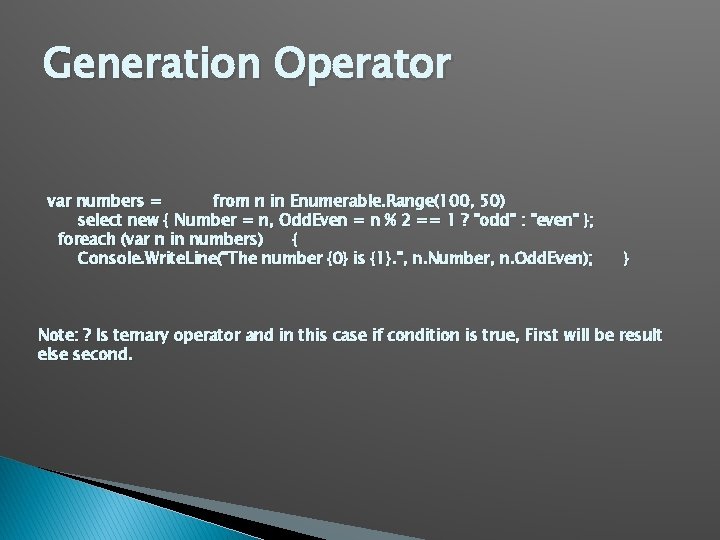
Generation Operator var numbers = from n in Enumerable. Range(100, 50) select new { Number = n, Odd. Even = n % 2 == 1 ? "odd" : "even" }; foreach (var n in numbers) { Console. Write. Line("The number {0} is {1}. ", n. Number, n. Odd. Even); } Note: ? Is ternary operator and in this case if condition is true, First will be result else second.
Arrays Sorting double[] doubles = { 1. 7, 2. 3, 1. 9, 4. 1, 2. 9 }; var sorted. Doubles = from d in doubles orderby d descending select d; var doubles. Array = sorted. Doubles. To. Array(); Console. Write. Line("Every other double from highest to lowest: "); for (int d = 0; d < doubles. Array. Length; d += 2) { Console. Write. Line(doubles. Array[d]); } Note: ? Toarray function is used. Sorts highest to lowest with decrement of 2
Set Operator int[] factors. Of 300 = { 2, 2, 3, 5, 5 }; var unique. Factors = factors. Of 300. Distinct(); Console. Write. Line("Prime factors of 300: "); foreach (var f in unique. Factors) { Console. Write. Line(f); } Note: ? Distinct() method is used for sorting distinct values
Grouping Operator int[] numbers = { 5, 4, 1, 3, 9, 8, 6, 7, 2, 0 }; var number. Groups = from n in numbers group n by n % 5 into g select new { Remainder = g. Key, Numbers = g }; foreach (var g in number. Groups) { Console. Write. Line("Numbers with a remainder of {0} when divided by 5: ", g. Rema inder); foreach (var n in g. Numbers) { Console. Write. Line(n); } }
Count Operator int[] factors. Of 300 = { 2, 2, 3, 5, 5 }; int unique. Factors = factors. Of 300. Distinct(). Count(); Console. Write. Line("There are {0} unique factors of 300. ", unique. Factors); Program 2 int[] numbers = { 5, 4, 1, 3, 9, 8, 6, 7, 2, 0 }; int odd. Numbers = numbers. Count(n => n % 2 == 1); Console. Write. Line("There are {0} odd numbers in the list. ", odd. Numbers);
Sum Operator int[] numbers = { 5, 4, 1, 3, 9, 8, 6, 7, 2, 0 }; double num. Sum = numbers. Sum(); Console. Write. Line("The sum of the numbers is {0}. ", num. Sum);
Min Operator int[] numbers = { 5, 4, 1, 3, 9, 8, 6, 7, 2, 0 }; double num. Sum = numbers. Sum(); Console. Write. Line("The sum of the numbers is {0}. ", num. Sum);
Concat Function int[] numbers. A = { 0, 2, 4, 5, 6, 8, 9 }; int[] numbers. B = { 1, 3, 5, 7, 8 }; var all. Numbers = numbers. A. Concat(numbers. B); Console. Write. Line("All numbers from both arrays: "); foreach (var n in all. Numbers) { Console. Write. Line(n); } Note: Concat() function used in which first variable is Sorce which is to Concatenated with Destination second variable
Sequence Matching var words. A = new string[] { "cherry", "apple", "blueberry" }; var words. B = new string[] { "cherry", "apple", "blueberry" }; bool match = words. A. Sequence. Equal(words. B); Console. Write. Line("The sequences match: {0}", match); Note: Matches sequences of array and outputs true for yes and false for no