
Advance Planning for People with Dementia and their



- Slides: 60
Advance Planning for People with Dementia and their Families Administration for Community Living Erin Long Office of Supportive and Caregiver Services Administration on Aging National Alzheimer’s and Dementia Resource Center sponsored by the Administration for Community Living.
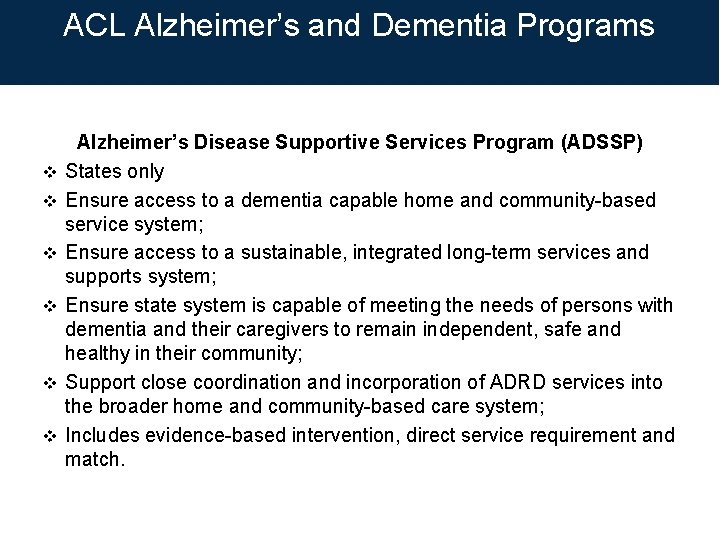
ACL Alzheimer’s and Dementia Programs v v v Alzheimer’s Disease Supportive Services Program (ADSSP) States only Ensure access to a dementia capable home and community-based service system; Ensure access to a sustainable, integrated long-term services and supports system; Ensure state system is capable of meeting the needs of persons with dementia and their caregivers to remain independent, safe and healthy in their community; Support close coordination and incorporation of ADRD services into the broader home and community-based care system; Includes evidence-based intervention, direct service requirement and match.
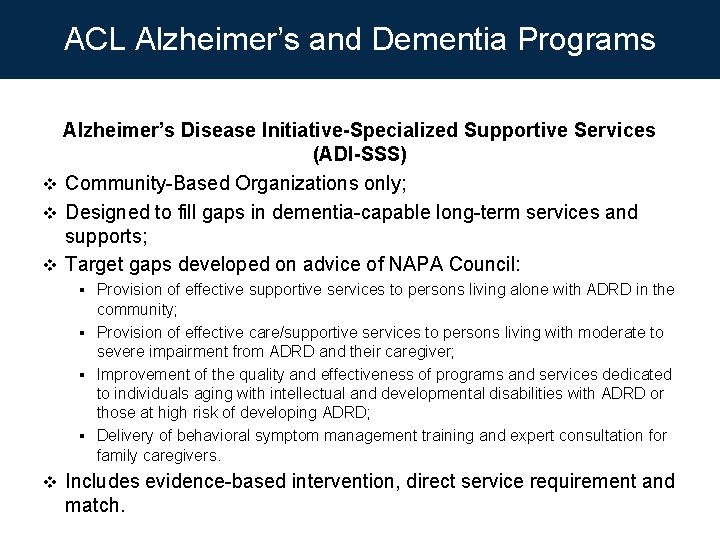
ACL Alzheimer’s and Dementia Programs Alzheimer’s Disease Initiative-Specialized Supportive Services (ADI-SSS) v Community-Based Organizations only; v Designed to fill gaps in dementia-capable long-term services and supports; v Target gaps developed on advice of NAPA Council: Provision of effective supportive services to persons living alone with ADRD in the community; § Provision of effective care/supportive services to persons living with moderate to severe impairment from ADRD and their caregiver; § Improvement of the quality and effectiveness of programs and services dedicated to individuals aging with intellectual and developmental disabilities with ADRD or those at high risk of developing ADRD; § Delivery of behavioral symptom management training and expert consultation for family caregivers. § v Includes evidence-based intervention, direct service requirement and match.
Core Program Components ADSSP and ADI-SSS v Comprehensive person-centered services Access to information to aide with informed choices and service management. Ø Access to information and entry to long-term service and support programs. v Single Point of Entry/No Wrong Door access to Dementia Capable Services Ø Dementia Capable Information, Referral and Access Ø Dementia Capable care transitions Ø v Focus on direct services Direct Service requirement linked to $$$ resources Ø Evidence-based/Evidence-informed interventions Ø ü Ø Designed to assist persons with dementia and their caregivers to maintain health and independence and remain in their community. Target underserved populations Those with the most need; ü Limited English proficiency; ü Those living in rural areas. ü
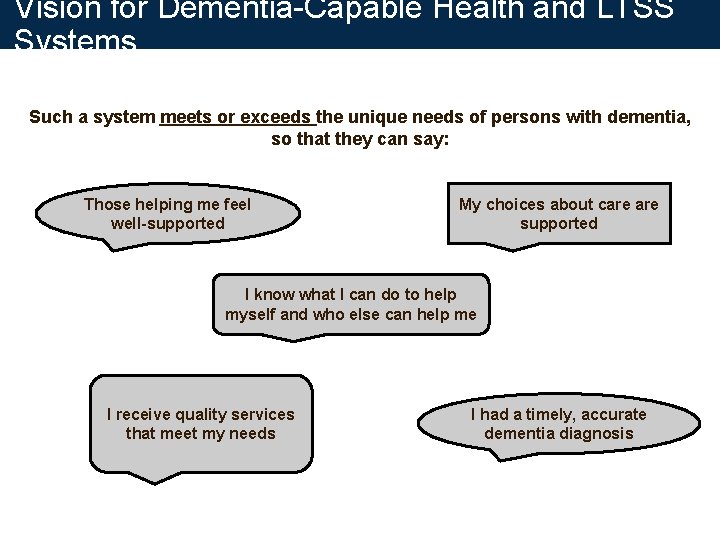
Vision for Dementia-Capable Health and LTSS Systems Such a system meets or exceeds the unique needs of persons with dementia, so that they can say: Those helping me feel well-supported My choices about care supported I know what I can do to help myself and who else can help me I receive quality services that meet my needs I had a timely, accurate dementia diagnosis
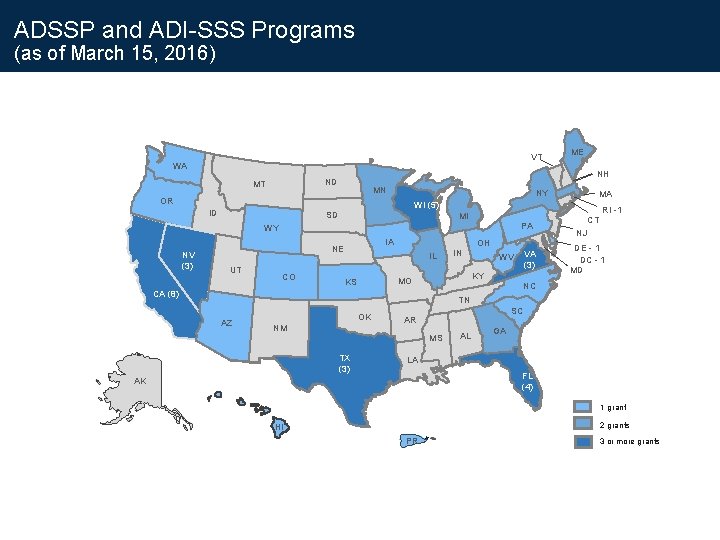
ADSSP and ADI-SSS Programs (as of March 15, 2016) VT WA W A NH ND ND MT MT MN MN OR OR ID ID NV NV (3) UT UT IL IL KS KS CA (8) AZ AZ OK OK NM NM PA PA OH OH IN IN KY KY MO M O VA WV W VA (3) V (3) CT RI -1 NJ DE - 1 DC - 1 MD SC SC AR AR AL AL MA NC NC TN TN MS MS TX TX (3) MI MI IA IA NE NE CO CO NY NY WI (5) SD SD WY W Y ME ME GA GA LA LA FL FL (4) AK 1 grant 2 grants HI PR 3 or more grants
Contact Erin Long, MSW Office of Supportive and Caregiver Services Administration on Aging/Administration for Community Living U. S. Department of Health and Human Services Erin. long@acl. hhs. gov
The Importance of Advance Planning Charles P. Sabatino, JD Commission on Law and Aging American Bar Association National Alzheimer’s and Dementia Resource Center sponsored by the Administration for Community Living. 8
Overview § Financial Planning Tools – Pros and cons § Health Care Planning – Importance – Trends – What constitutes effective planning – Capacity – New tools (POLST) – What happens when no plans are in place? 9
Financial Planning Tools § Joint Accounts § Trusts § Representative Payee § Daily Money Managers/Geriatric Care Managers § Financial Durable Power of Attorney 10
Financial Durable Power of Attorney (DPA) Strengths Very flexible, low cost (about 17 states have statutory form DPAs) § Avoids the negative features of ownership § Agent has a fiduciary standard of care § Can be as broad or narrow as one wants § Can provide for successor or co-agents § Can be immediate or springing §
Financial DPA Weaknesses Increasing incidence of financial abuse § Not automatically monitored § Banks & others sometimes resist § Family member agents commonly don’t understand the responsibility § Generally need lawyer to draft § Springing powers can have difficulty springing § No powers after death §
Financial DPA Make ‘em work better… Educate agents and choose well § Require reporting/accountings to 3 rd party § Require co-signature for extraordinary transactions § Avoid springing powers (or consider immediate + escrow) §
What happens when no plans are made? Spouses – what they can and can’t do § Guardianship § Other options §
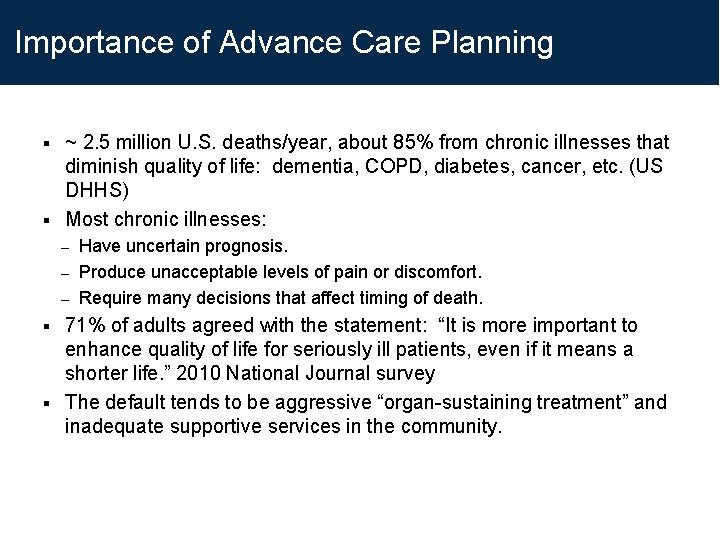
Importance of Advance Care Planning ~ 2. 5 million U. S. deaths/year, about 85% from chronic illnesses that diminish quality of life: dementia, COPD, diabetes, cancer, etc. (US DHHS) § Most chronic illnesses: § Have uncertain prognosis. – Produce unacceptable levels of pain or discomfort. – Require many decisions that affect timing of death. – 71% of adults agreed with the statement: “It is more important to enhance quality of life for seriously ill patients, even if it means a shorter life. ” 2010 National Journal survey § The default tends to be aggressive “organ-sustaining treatment” and inadequate supportive services in the community. §
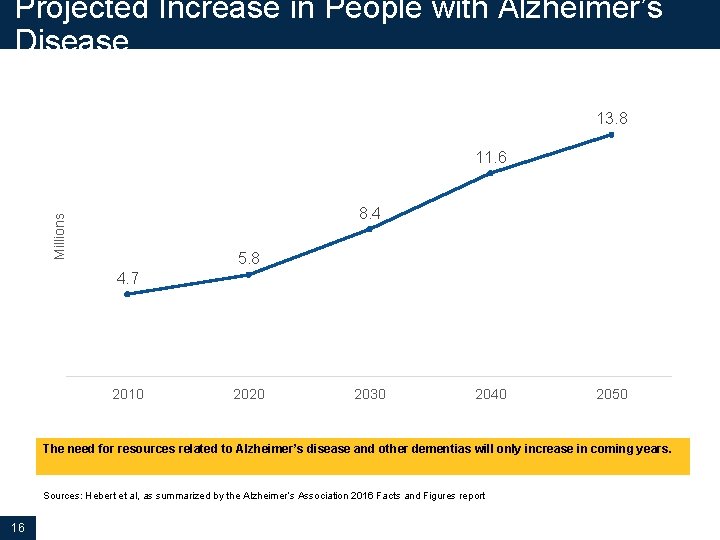
Projected Increase in People with Alzheimer’s Disease 13. 8 11. 6 Millions 8. 4 5. 8 4. 7 2010 2020 2030 2040 2050 The need for resources related to Alzheimer’s disease and other dementias will only increase in coming years. Sources: Hebert et al, as summarized by the Alzheimer’s Association 2016 Facts and Figures report 16
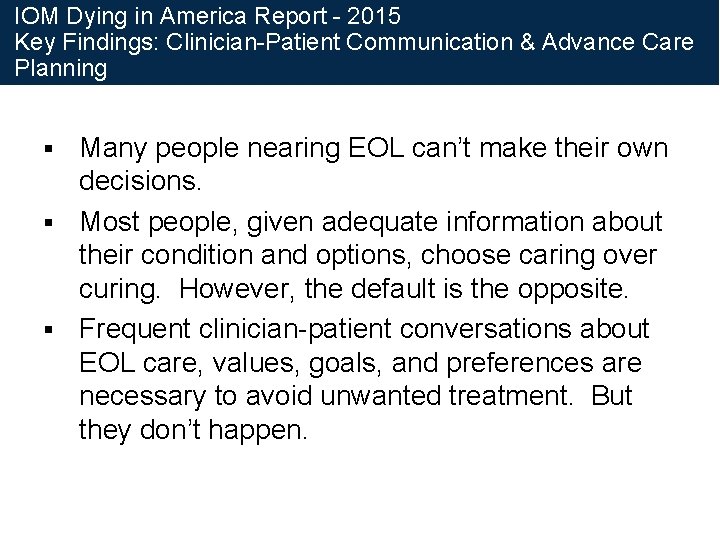
IOM Dying in America Report - 2015 Key Findings: Clinician-Patient Communication & Advance Care Planning Many people nearing EOL can’t make their own decisions. § Most people, given adequate information about their condition and options, choose caring over curing. However, the default is the opposite. § Frequent clinician-patient conversations about EOL care, values, goals, and preferences are necessary to avoid unwanted treatment. But they don’t happen. §
Definitions Health Care Advance Directive – Any document or recording addressing one’s future health care. Includes: • Living Will -- Spells out one’s goals, wishes, or preferences about end-of life care • Health Care Power of Attorney -- Names someone to make medical decisions, should you be unable to make them yourself. May be called a health care proxy, medical power of attorney, durable power of attorney for health care, appointment of a representative, or other name. Most people combine the two types of documents into one Health Care Advance Directive.
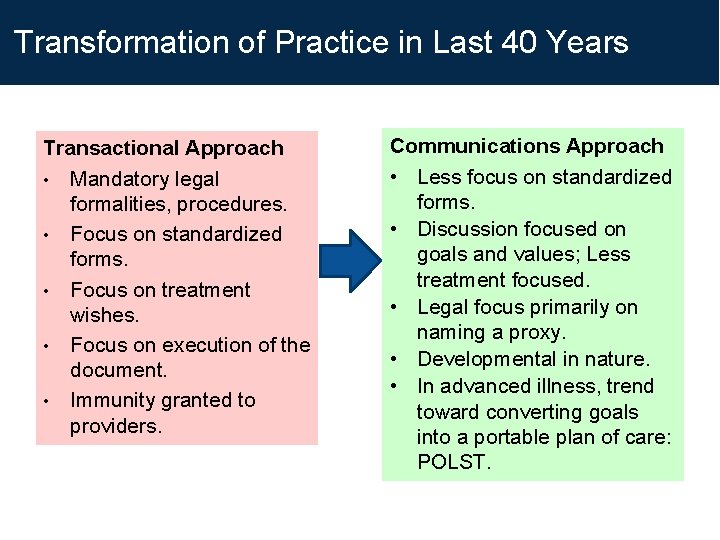
Transformation of Practice in Last 40 Years Transactional Approach • Mandatory legal formalities, procedures. • Focus on standardized forms. • Focus on treatment wishes. • Focus on execution of the document. • Immunity granted to providers. Communications Approach • Less focus on standardized forms. • Discussion focused on goals and values; Less treatment focused. • Legal focus primarily on naming a proxy. • Developmental in nature. • In advanced illness, trend toward converting goals into a portable plan of care: POLST.
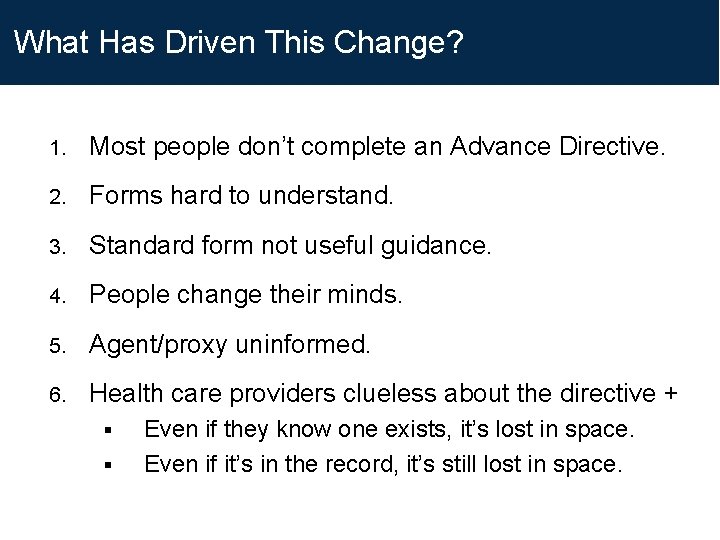
What Has Driven This Change? 1. Most people don’t complete an Advance Directive. 2. Forms hard to understand. 3. Standard form not useful guidance. 4. People change their minds. 5. Agent/proxy uninformed. 6. Health care providers clueless about the directive + § § Even if they know one exists, it’s lost in space. Even if it’s in the record, it’s still lost in space.
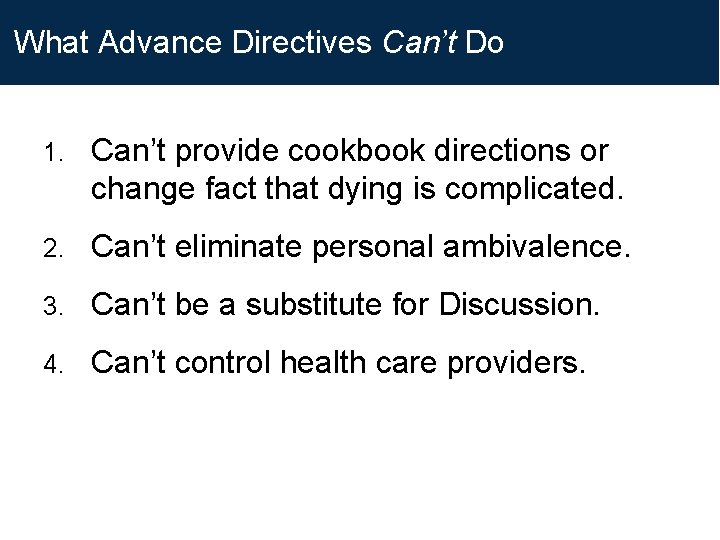
What Advance Directives Can’t Do 1. Can’t provide cookbook directions or change fact that dying is complicated. 2. Can’t eliminate personal ambivalence. 3. Can’t be a substitute for Discussion. 4. Can’t control health care providers.
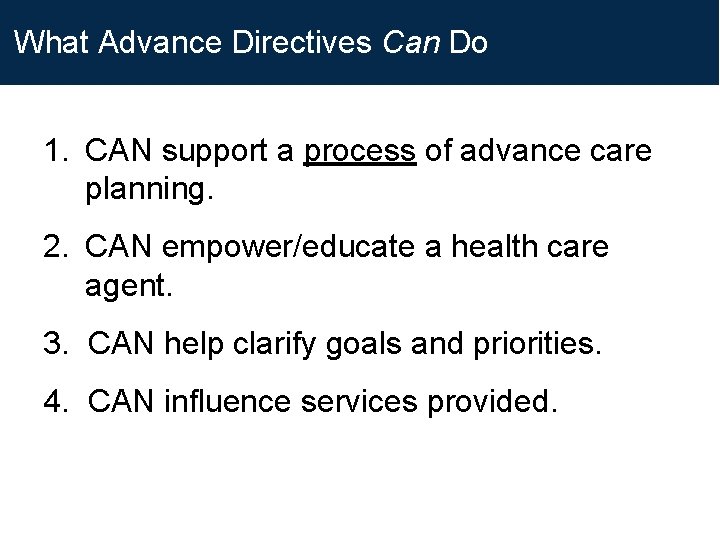
What Advance Directives Can Do 1. CAN support a process of advance care planning. 2. CAN empower/educate a health care agent. 3. CAN help clarify goals and priorities. 4. CAN influence services provided.
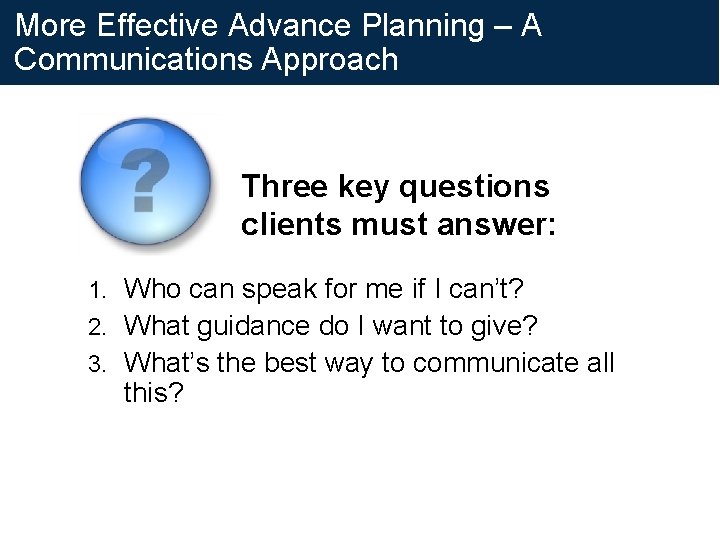
More Effective Advance Planning – A Communications Approach Three key questions clients must answer: Who can speak for me if I can’t? 2. What guidance do I want to give? 3. What’s the best way to communicate all this? 1.
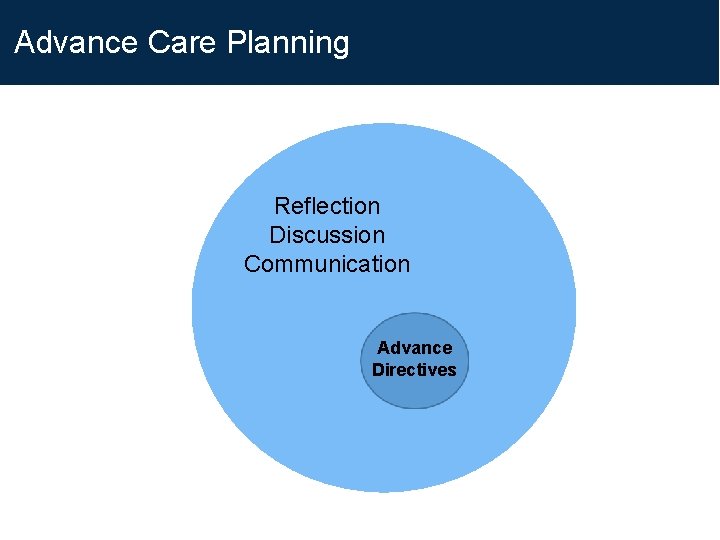
Advance Care Planning Reflection Discussion Communication Advance Directives
Threshold matter… What is capacity to make an advance directive? No well-established legal definition, but…
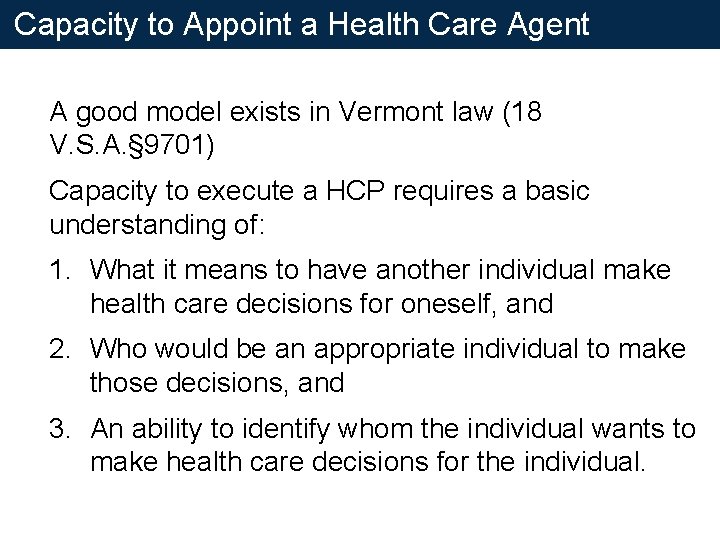
Capacity to Appoint a Health Care Agent A good model exists in Vermont law (18 V. S. A. § 9701) Capacity to execute a HCP requires a basic understanding of: 1. What it means to have another individual make health care decisions for oneself, and 2. Who would be an appropriate individual to make those decisions, and 3. An ability to identify whom the individual wants to make health care decisions for the individual.
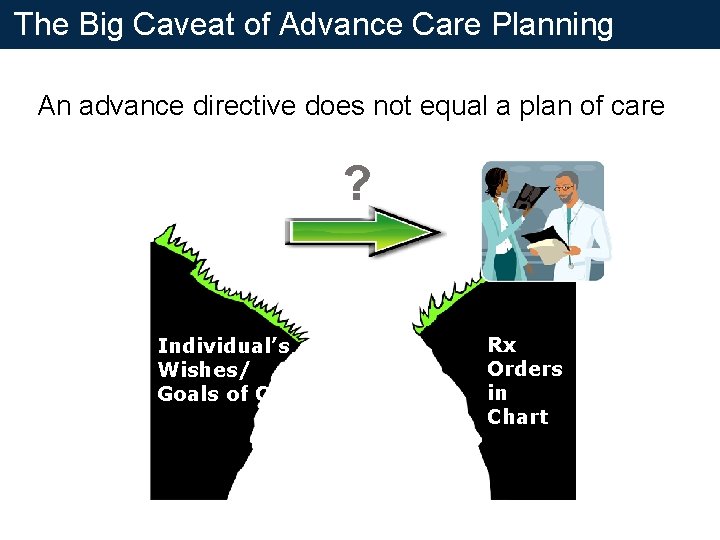
The Big Caveat of Advance Care Planning An advance directive does not equal a plan of care ? Individual’s Wishes/ Goals of Care Rx Orders in Chart
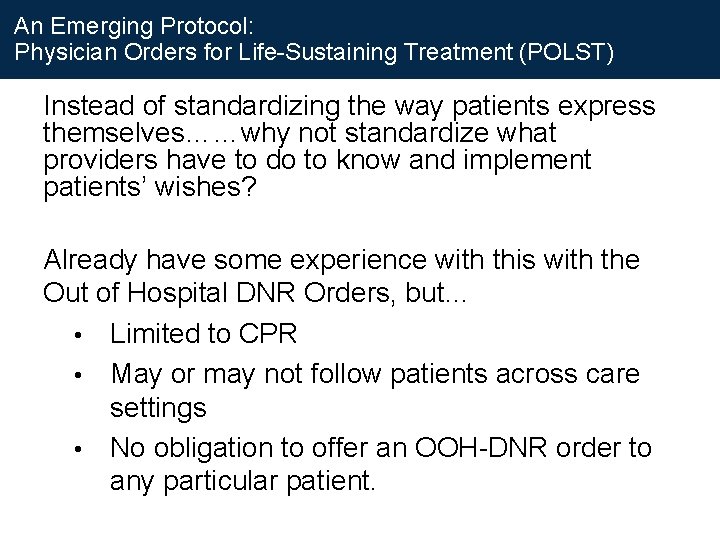
An Emerging Protocol: Physician Orders for Life-Sustaining Treatment (POLST) Instead of standardizing the way patients express themselves……why not standardize what providers have to do to know and implement patients’ wishes? Already have some experience with this with the Out of Hospital DNR Orders, but… • Limited to CPR • May or may not follow patients across care settings • No obligation to offer an OOH-DNR order to any particular patient.
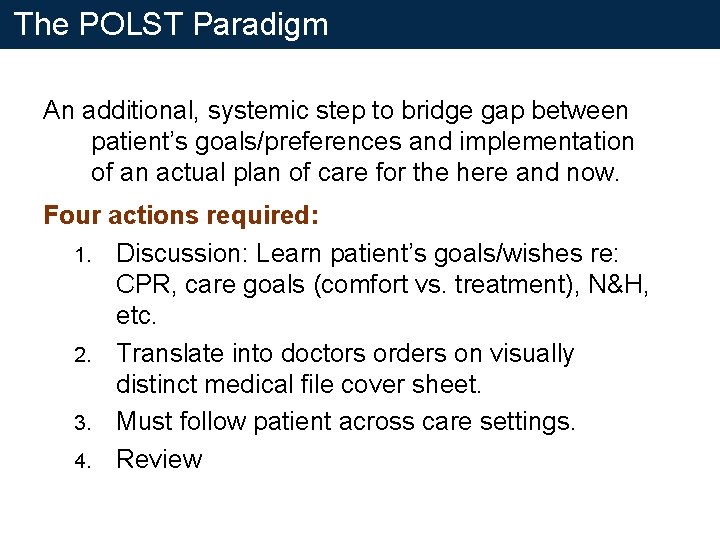
The POLST Paradigm An additional, systemic step to bridge gap between patient’s goals/preferences and implementation of an actual plan of care for the here and now. Four actions required: 1. Discussion: Learn patient’s goals/wishes re: CPR, care goals (comfort vs. treatment), N&H, etc. 2. Translate into doctors orders on visually distinct medical file cover sheet. 3. Must follow patient across care settings. 4. Review
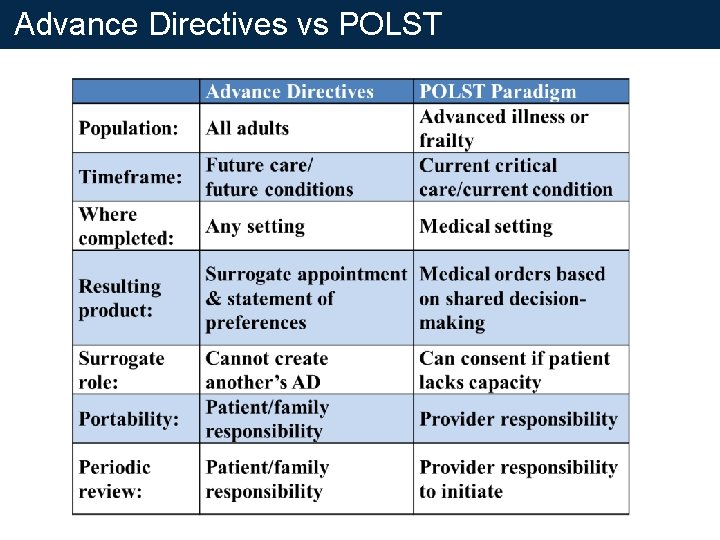
Advance Directives vs POLST
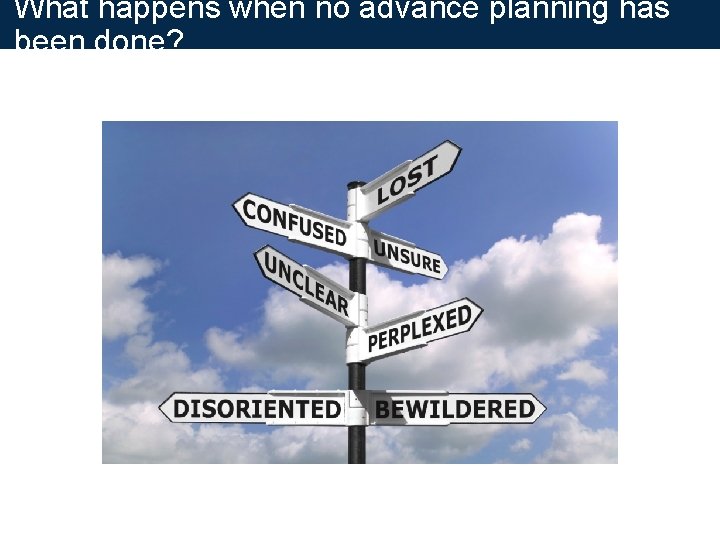
What happens when no advance planning has been done?
Default Surrogate Laws None exists in MA, MN, MO, NE, RI, & WI § Laws in CA, KS, NJ, OK limited to certain decisions § Vary by: § Range/Priority of Surrogates § Scope of Decision Making Authority § Triggers/Pre-conditions § How Disagreements are Handled § Rarely address Isolated Patients
Reasons Not to Rely on Default Surrogate Laws 1. 2. 3. 4. 5. 6. Varying limitations on who can be surrogate Varying limitations on surrogate authority Disagreement among surrogates of the same level can block decision-making Default surrogates more likely to lack guidance on your goals & wishes Next of kin ranking of surrogacy authority may not reflect connectedness to the patient. Isolated elders may have no one
Advance Planning Guides for People with Dementia and Their Families Stephanie Hughes, MPP Research Public Health Analyst RTI, International National Alzheimer’s and Dementia Resource Center sponsored by the Administration for Community Living.
Consumer Guides for People with Dementia Lack of dementia-specific advance planning resources § Dementia-related content § Accessible to people with dementia (language and design) 35
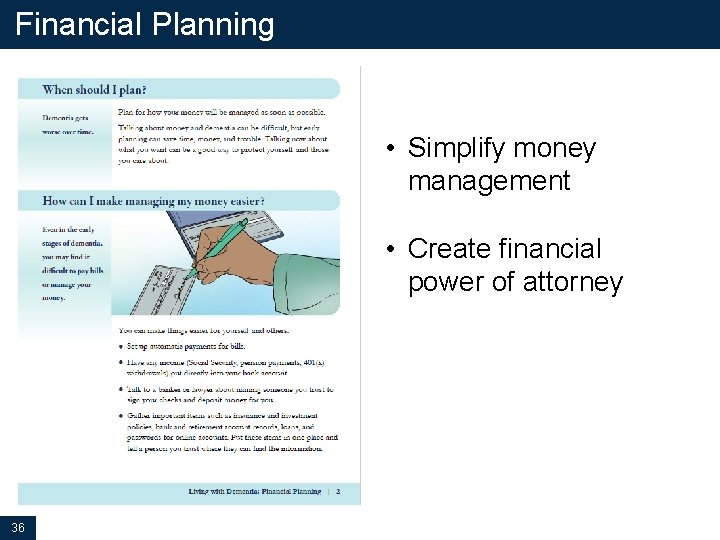
Financial Planning • Simplify money management • Create financial power of attorney 36
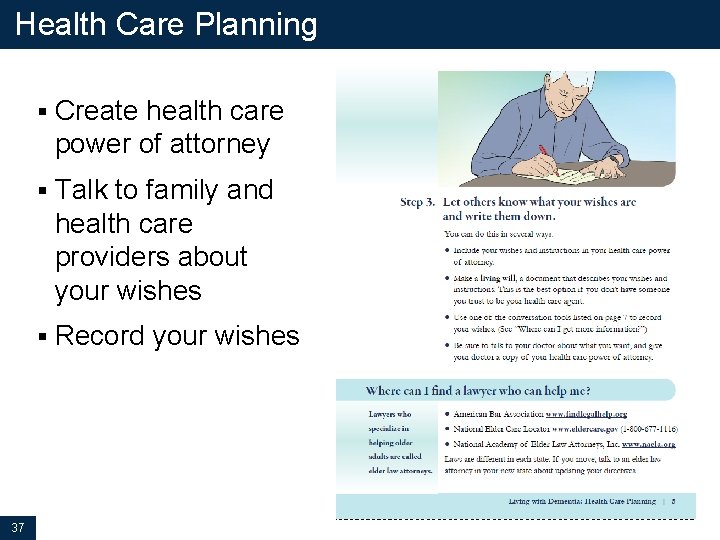
Health Care Planning 37 § Create health care power of attorney § Talk to family and health care providers about your wishes § Record your wishes
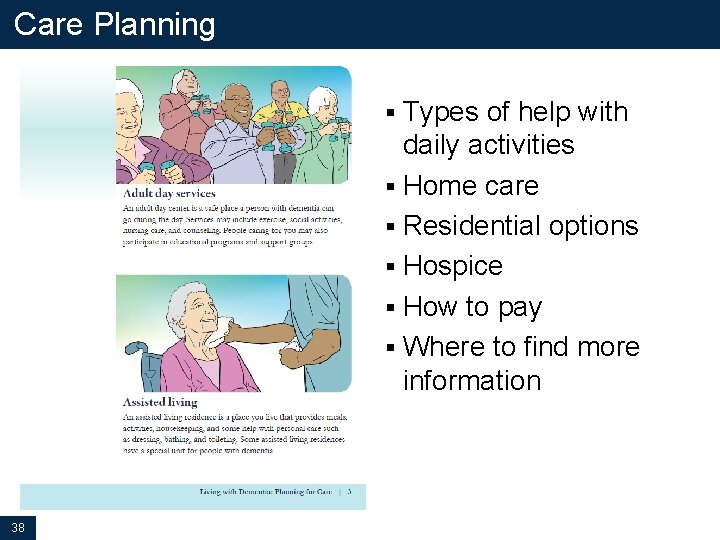
Care Planning Types of help with daily activities § Home care § Residential options § Hospice § How to pay § Where to find more information § 38
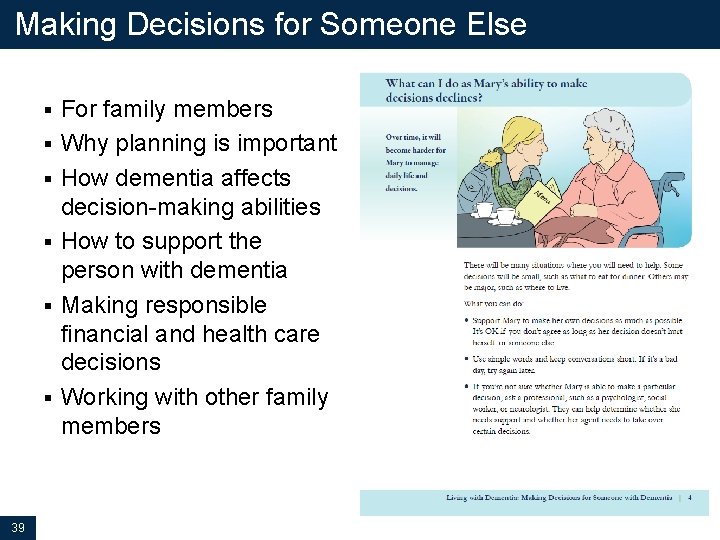
Making Decisions for Someone Else § § § 39 For family members Why planning is important How dementia affects decision-making abilities How to support the person with dementia Making responsible financial and health care decisions Working with other family members
Accessible to People with Dementia Plain language: – Key points – Word choice – Active voice – Simple sentence structure – 7 th-8 th grade reading level 40
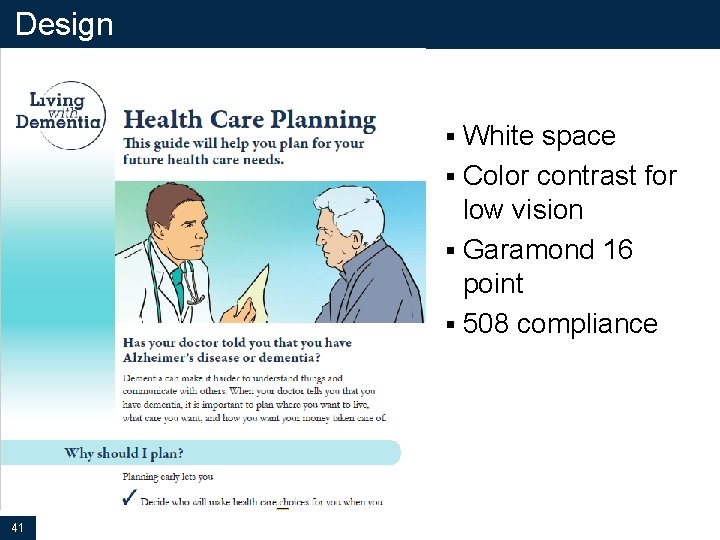
Design White space § Color contrast for low vision § Garamond 16 point § 508 compliance § 41
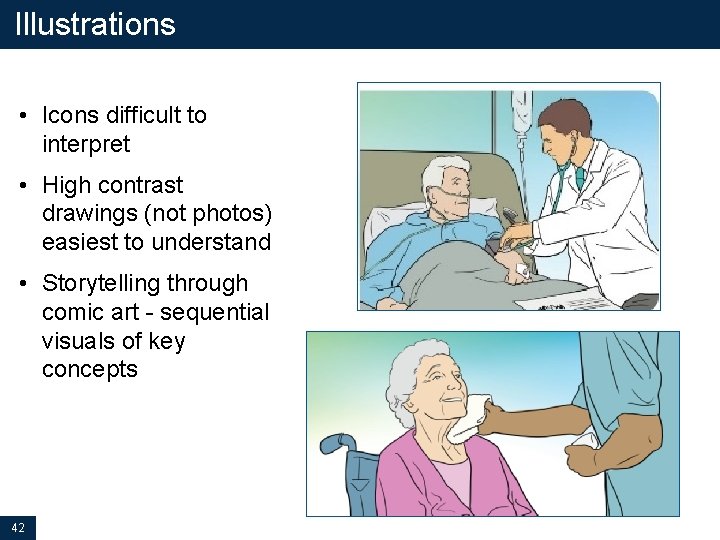
Illustrations • Icons difficult to interpret • High contrast drawings (not photos) easiest to understand • Storytelling through comic art - sequential visuals of key concepts 42
Use and Dissemination § https: //nadrc. acl. gov/node/96 – PDF files – print or electronic use – Links to additional resources § Dissemination through: – ACL website – ADI-SSS and ADSSP grantees – Community partners – Free for use and distribution 43
More information Stephanie Hughes Research Public Health Analyst, RTI International 312 -777 -5238 shughes@rti. org
Supporting Individuals with Advanced Dementia in Hawaii Christy Nishita, Ph. D. Researcher, Center on Aging University of Hawaii National Alzheimer’s and Dementia Resource Center sponsored by the Administration for Community Living.
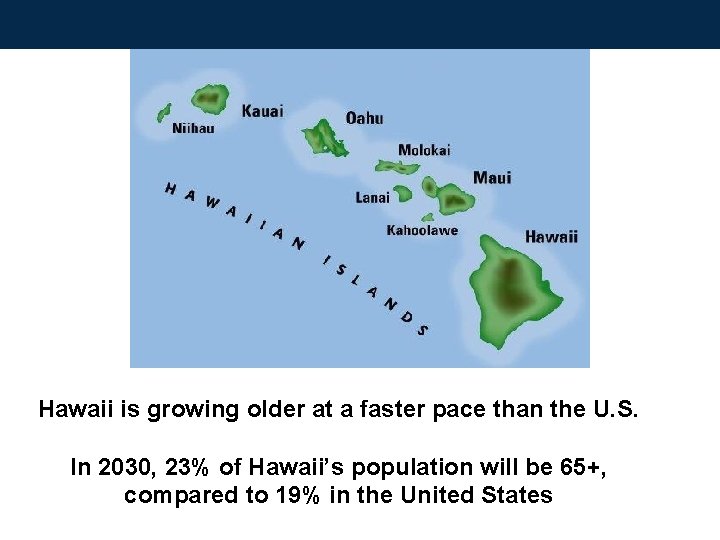
Hawaii is growing older at a faster pace than the U. S. In 2030, 23% of Hawaii’s population will be 65+, compared to 19% in the United States
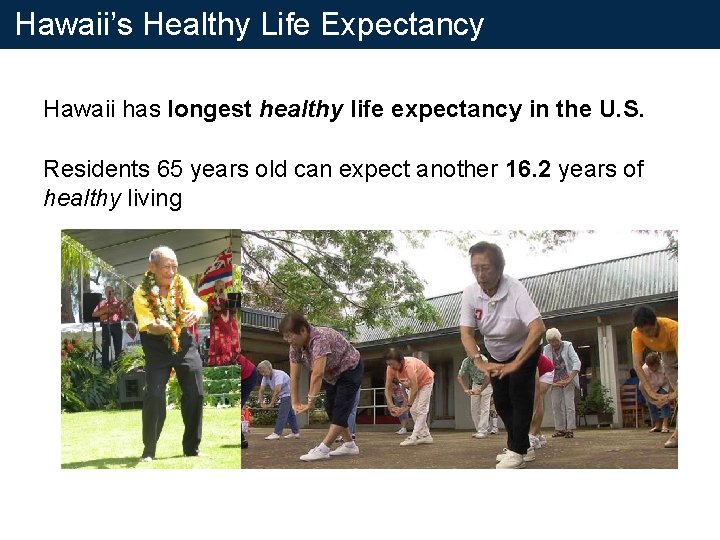
Hawaii’s Healthy Life Expectancy Hawaii has longest healthy life expectancy in the U. S. Residents 65 years old can expect another 16. 2 years of healthy living
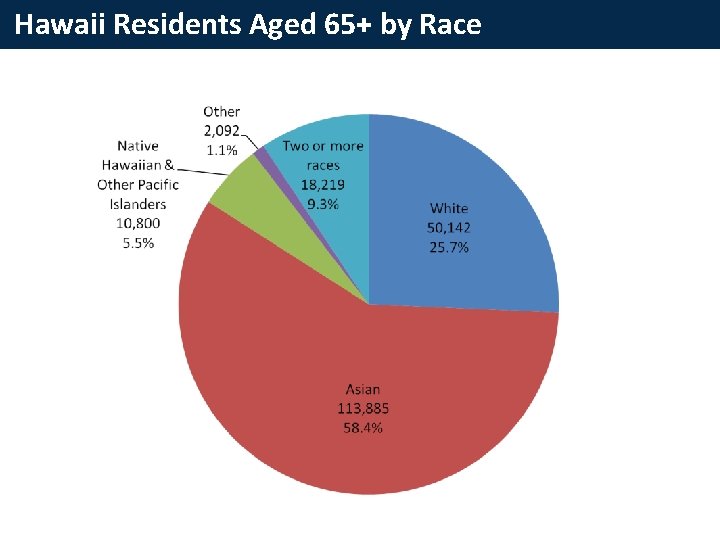
Hawaii Residents Aged 65+ by Race
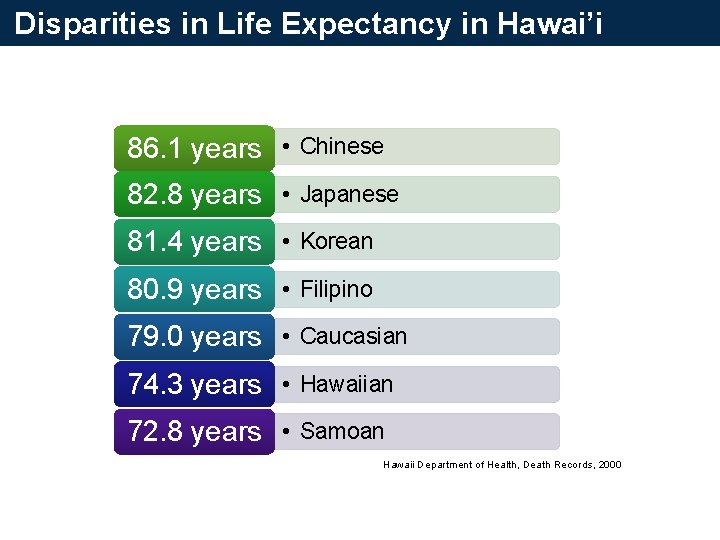
Disparities in Life Expectancy in Hawai’i 86. 1 years • Chinese 82. 8 years • Japanese 81. 4 years • Korean 80. 9 years • Filipino 79. 0 years • Caucasian 74. 3 years • Hawaiian 72. 8 years • Samoan Hawaii Department of Health, Death Records, 2000
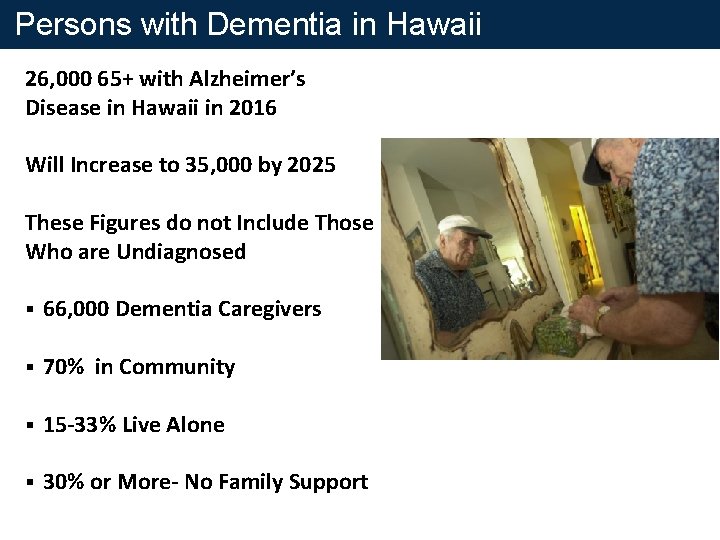
Persons with Dementia in Hawaii 26, 000 65+ with Alzheimer’s Disease in Hawaii in 2016 Will Increase to 35, 000 by 2025 These Figures do not Include Those Who are Undiagnosed § 66, 000 Dementia Caregivers § 70% in Community § 15 -33% Live Alone § 30% or More- No Family Support
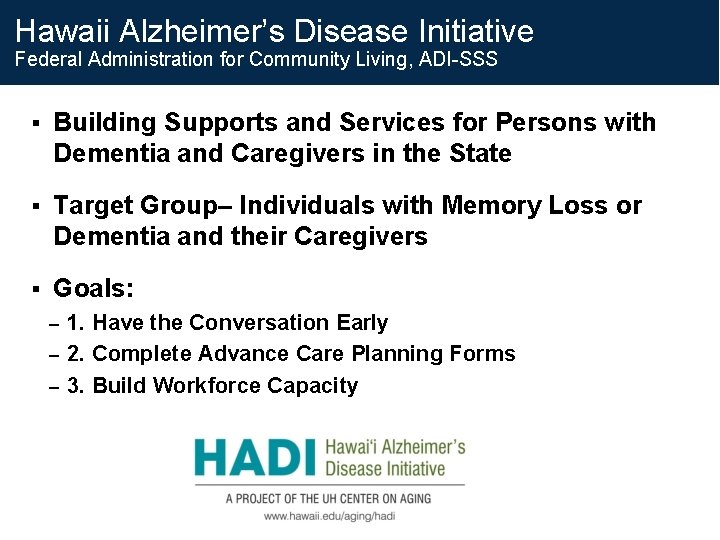
Hawaii Alzheimer’s Disease Initiative Federal Administration for Community Living, ADI-SSS § Building Supports and Services for Persons with Dementia and Caregivers in the State § Target Group– Individuals with Memory Loss or Dementia and their Caregivers § Goals: 1. Have the Conversation Early – 2. Complete Advance Care Planning Forms – 3. Build Workforce Capacity –
Critical Partnership § Statewide Hospice and Palliative Care Organization § 17 yrs- Coalition to Non-Profit § Promoting Excellence Though: – Education – Advocacy – Collaboration
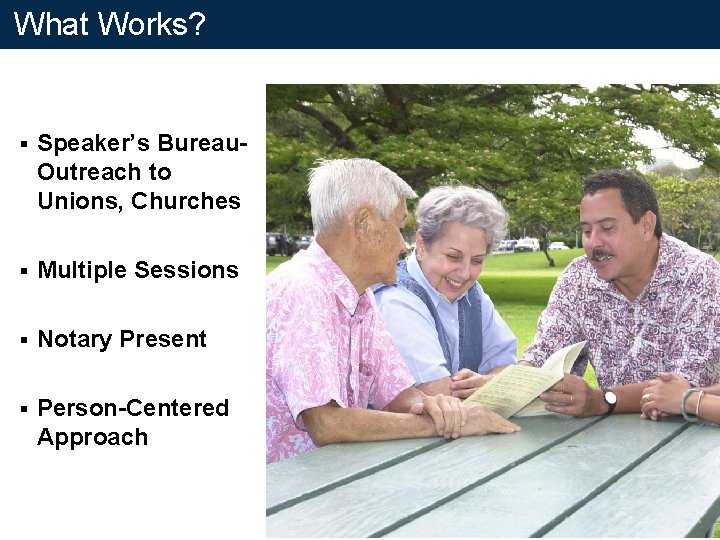
What Works? § Speaker’s Bureau. Outreach to Unions, Churches § Multiple Sessions § Notary Present § Person-Centered Approach
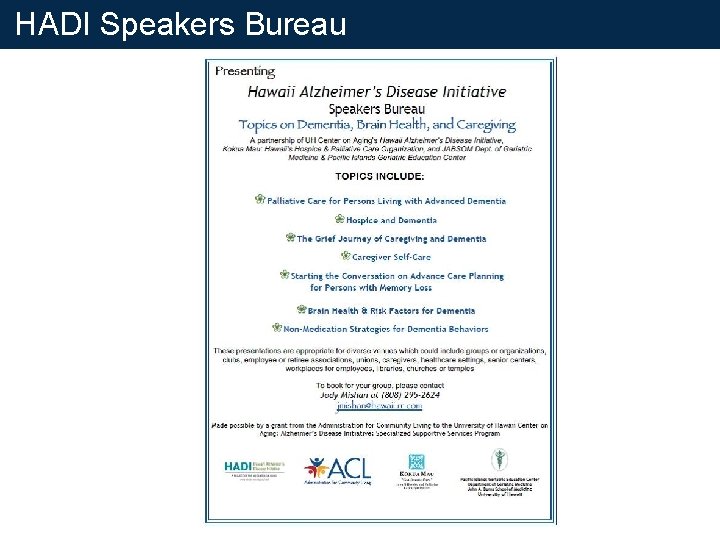
HADI Speakers Bureau
Cultural Competence in Hawaii Working with Families: § Race/ethnic Differences? § Ask Questions and Listen § Establish Trust and Rapport § No Assumptions § What is the Dynamics/Culture of the Family or this Person? § Identify Individual’s Own Way of Approaching/ Viewing Issues
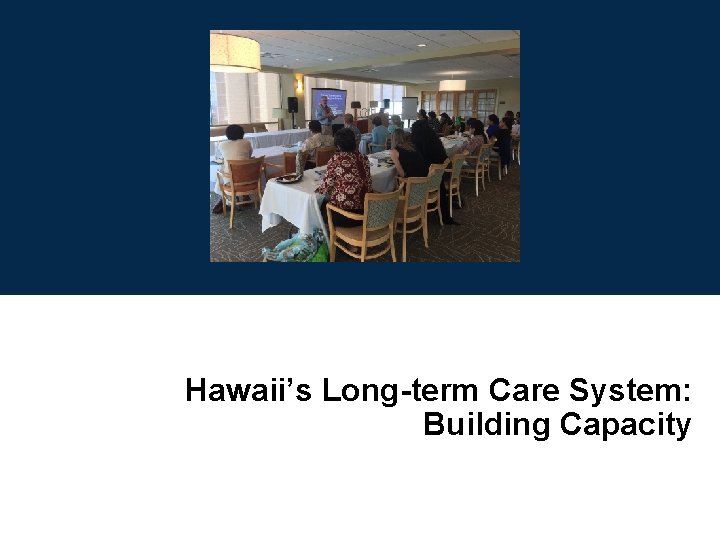
Hawaii’s Long-term Care System: Building Capacity
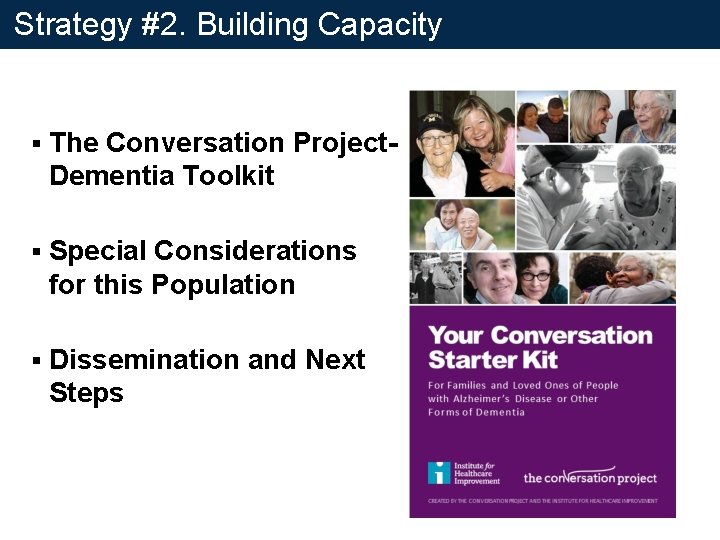
Strategy #2. Building Capacity § The Conversation Project. Dementia Toolkit § Special Considerations for this Population § Dissemination and Next Steps
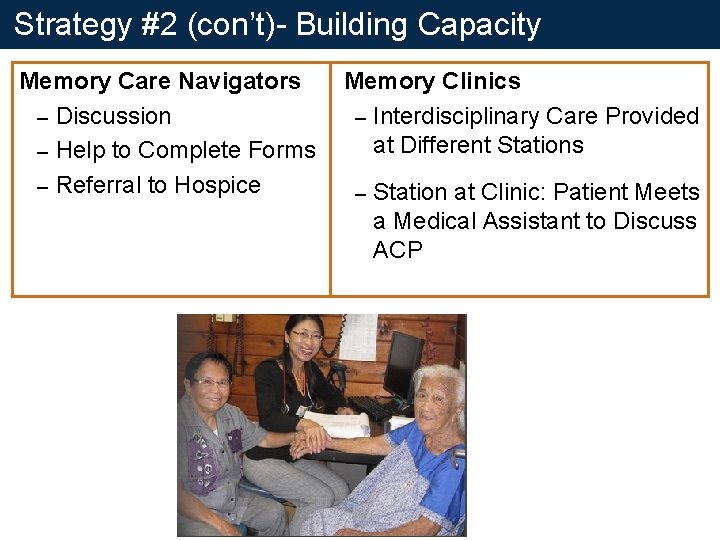
Strategy #2 (con’t)- Building Capacity Memory Care Navigators – Discussion – Help to Complete Forms – Referral to Hospice Memory Clinics – Interdisciplinary Care Provided at Different Stations – Station at Clinic: Patient Meets a Medical Assistant to Discuss ACP
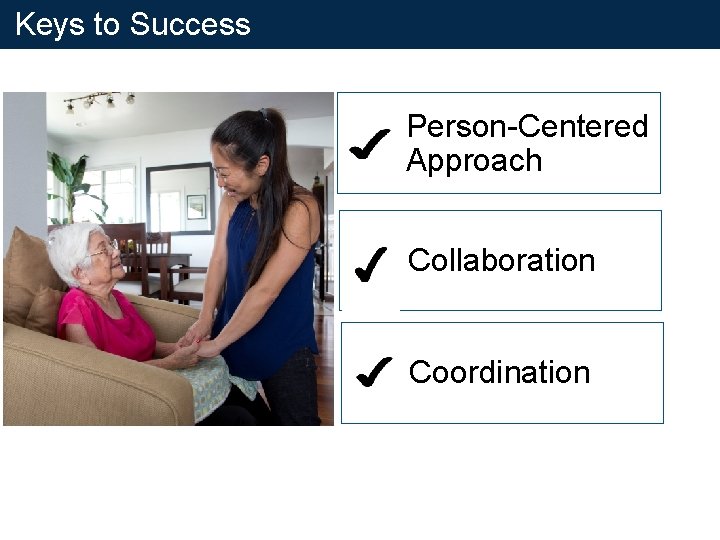
Keys to Success Person-Centered Approach Collaboration Coordination
Thank you! Christy Nishita, Ph. D. Researcher Center on Aging University of Hawaii 808. 956. 5001 cnishita@hawaii. edu