
Advance LED and LASER Structures Including Quantum Well
- Slides: 20
Advance LED and LASER Structures Including Quantum Well Structures By Karin Larson 4/25/16 Abstract: This presentation introduces the difference between LED and LASER diodes, their four main structures, and basic emissions.
Outline � LED vs LASER � Homostructure � Single Heterostructure � Double Heterostructure � Quantum Wells � Edge and Surface Emissions
LED and LASER � Electroluminescence � Reliable and long lifespan due to small size � Mass produced at low cost � Release a photon by an electron moving from a high state to a lower one
LED � Light Emitting Diode � Mostly Monochromatic � Light from spontaneous emission � Significantly divergent � Incoherent light
LASER � Light Amplification by Stimulation of Emitted Radiation � Single wavelength � Light by stimulated emission � Little divergence � Coherent light
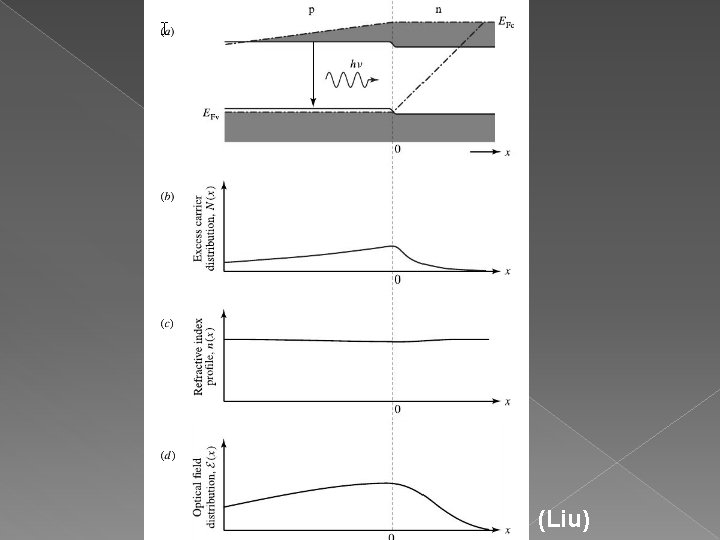
Homostructure � p-n homojuction � Both p and n are heavily doped � Excess carriers are spread by diffusion � Thickness of the active region is generally a few micrometers � Impractical for LASER diodes
(Liu)
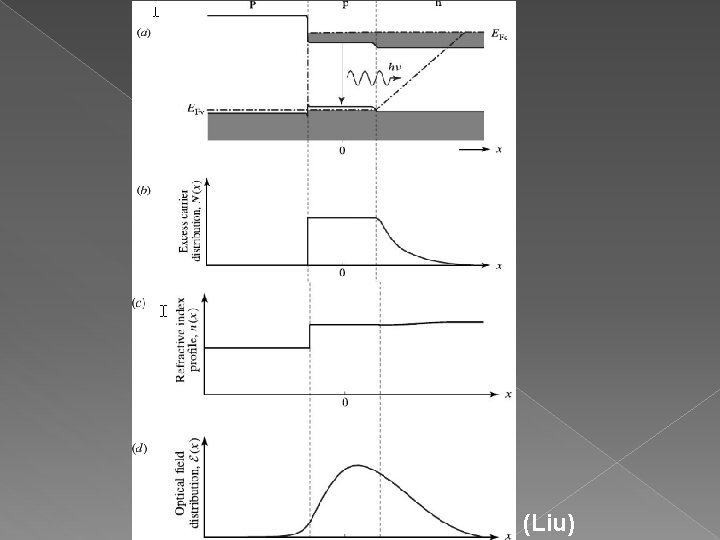
Single Heterostructure � Replace p region with a P-p heterojunction to restrict diffusion � Creates a P-p-n diode � Causes a defined active layer in p region
(Liu)
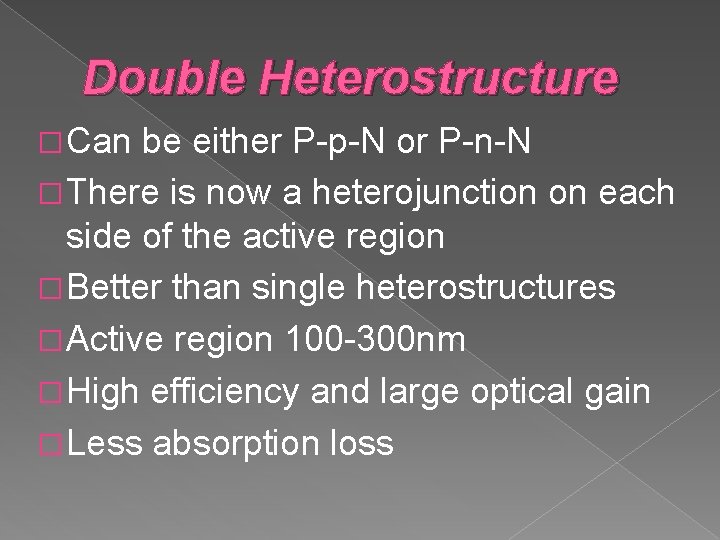
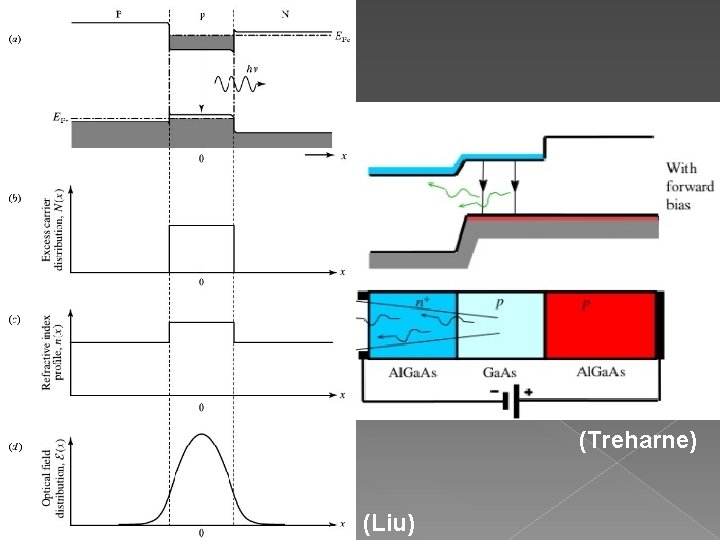
Double Heterostructure � Can be either P-p-N or P-n-N � There is now a heterojunction on each side of the active region � Better than single heterostructures � Active region 100 -300 nm � High efficiency and large optical gain � Less absorption loss
(Treharne) (Liu)
("Crédits Des Ressources. ")
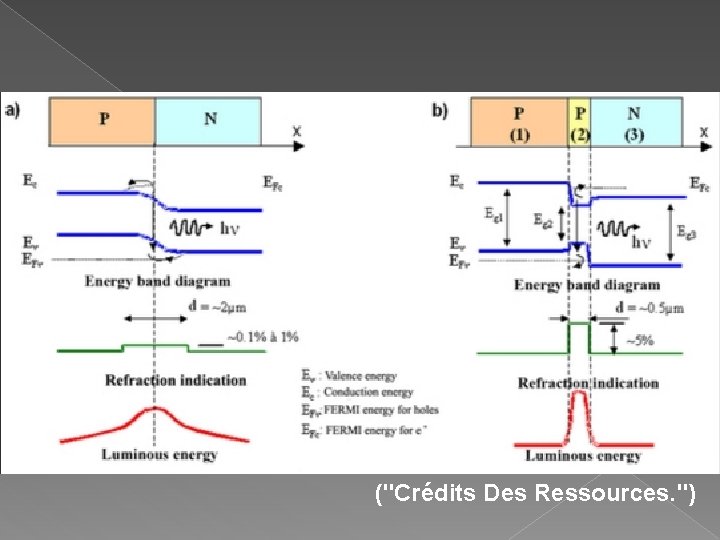
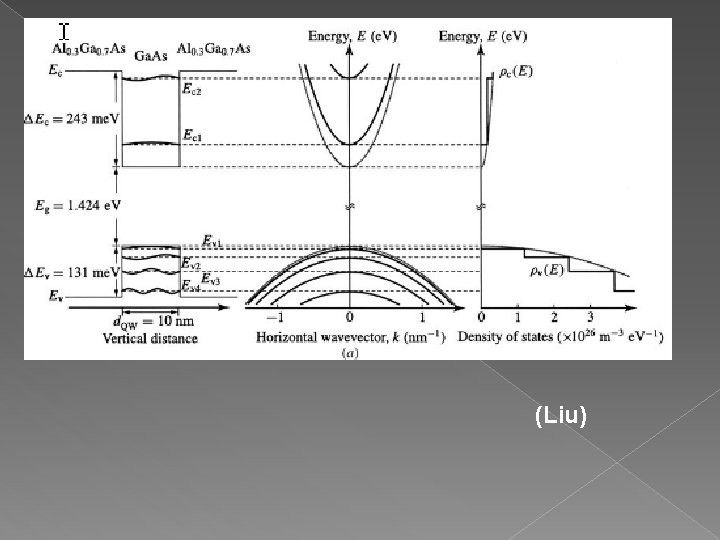
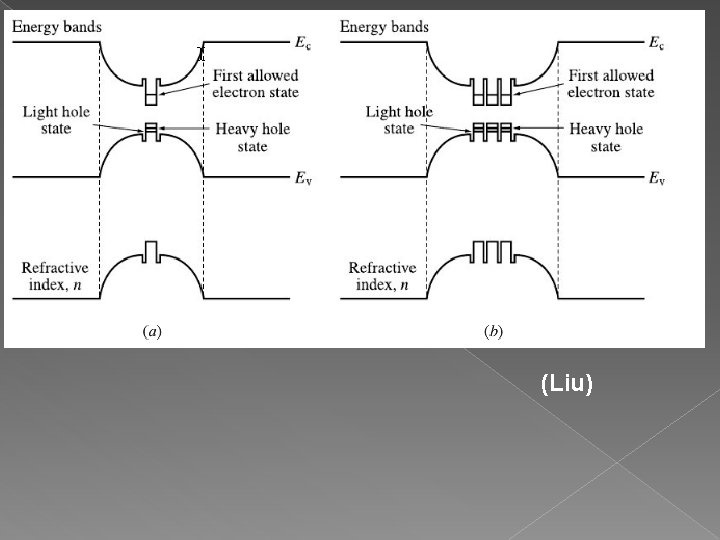
Quantum Well � Double heterostructure when the active region is much smaller � Splits conduction and valence bands into sub -bands � The required injection current density is required than of a DH � Much higher gain � Gain bandwidth is typically 20 -40 THz
(Liu)
(Liu)
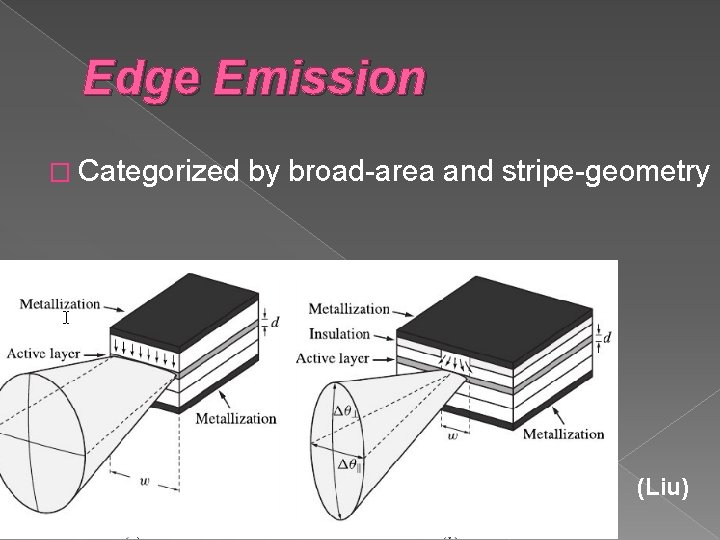
Edge Emission � Categorized by broad-area and stripe-geometry (Liu)
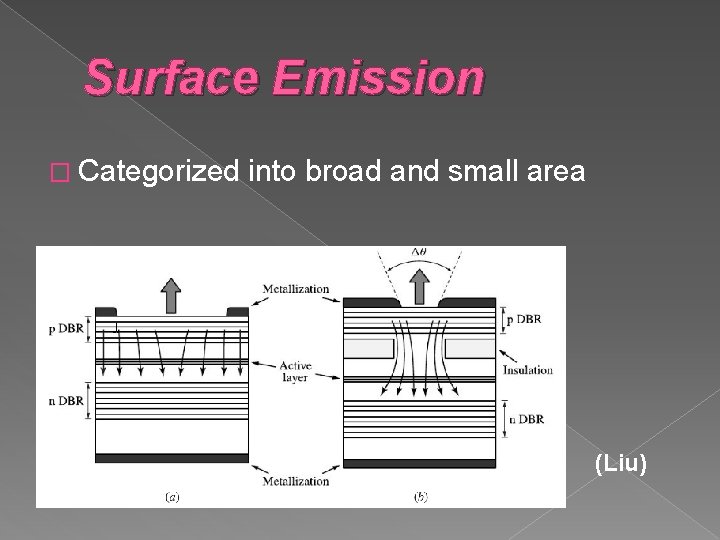
Surface Emission � Categorized into broad and small area (Liu)
Conclusion � In general LEDs and LASER diodes have a lot of similarities with a few defining differences � Adding in heterojunctions leads to more control over the active region and refining the refractive index � Quantum wells are DH structures with a reduced active region and are much better � Light emissions can either be from the edge or the surface of the diode
References � � � � "Crédits Des Ressources. " Specific Applications of Sensors for Photonic and Imaging. N. p. , n. d. Web. 20 Apr. 2016. <http: //www. optiqueingenieur. org/en/courses/OPI_ang_M 05_C 04/co/OPI_ang_M 05_C 04_web_2. html>. Farrell, Gerald. "Laser Structures. " Optical Communications Systems: Semiconductor Laser Diodes (n. d. ): n. pag. Laser Structures. Dublin Institute of Technology, 2002. Web. 20 Apr. 2016. <http: //www. electronics. dit. ie/staff/gfarrell/Laser. Photodiodes/4 Laserdiodestruct. pdf>. Larsen, Adrien P. "LASER vs. LED: What’s the Difference? " Acupuncture Technology News. N. p. , 11 Feb. 2014. Web. 20 Apr. 2016. <https: //www. miridiatech. com/news/2014/02/laser-vs-led-whats-the-difference/>. Liu, Jia-Ming. "Semiconductor Lasers and Light Emitting Diodes. " Photonic Devices. Cambridge: Cambridge, 2005. N. pag. Knovel. Web. 20 Apr. 2016. "Potential Well. " Wikipedia. Wikimedia Foundation, n. d. Web. 20 Apr. 2016. <https: //en. wikipedia. org/wiki/Potential_well>. Treharne, Robert. "Lecture 5: Junctions. " Lecture 5: Junctions. Slide Share, 6 Nov. 2014. Web. 20 Apr. 2016. <http: //www. slideshare. net/Robert. Treharne/lecture-5 junctions>. "Quantum Well Laser. " Wikipedia. Wikimedia Foundation, n. d. Web. 20 Apr. 2016. <https: //en. wikipedia. org/wiki/Quantum_well_laser>.
5 Key Points The main differences between LED and LASER diodes are emission, divergence and coherence � The 4 structures are homostructure, single and double heterostructures, and quantum wells � Quantum wells are DH’s with a smaller active region � Light emissions are either from the edge of the diode or the surface � In general LEDS have a broader emission configuration while LASER uses smaller �