
Adults Health Care Integrated Reablement Service Stephen Cameron

Adults Health & Care Integrated Reablement Service Stephen Cameron Head of Reablement January 2017
What is reablement? • Reablement is the active process of an individual regaining the skills, confidence and independence to enable them to do things for themselves, rather than having things done for them. • It helps people learn or re-learn the skills necessary for daily living, also known as Activities of Daily Living (ADL). These skills may have been lost through deterioration in health and / or through a change in circumstances.
What is the integrated reablement service in HCC? • A bringing together of four distinct service functions, each of which support reablement – Occupational Therapy – Community Response Teams (CRT) – Sensory Services – Equipment Services
Why integrate? Background context: • National austerity measures & subsequent Central Government funding reductions. Local Authority services need to change to meet these challenges. • A sustainable service is needed that is able to respond to the ever-changing challenges that the sector faces, including delivering cost-effective services within the resources available. • Continue to be focused on outcomes for service users; this means that we have to support service users & staff in positive risk taking. Strength Based Approach
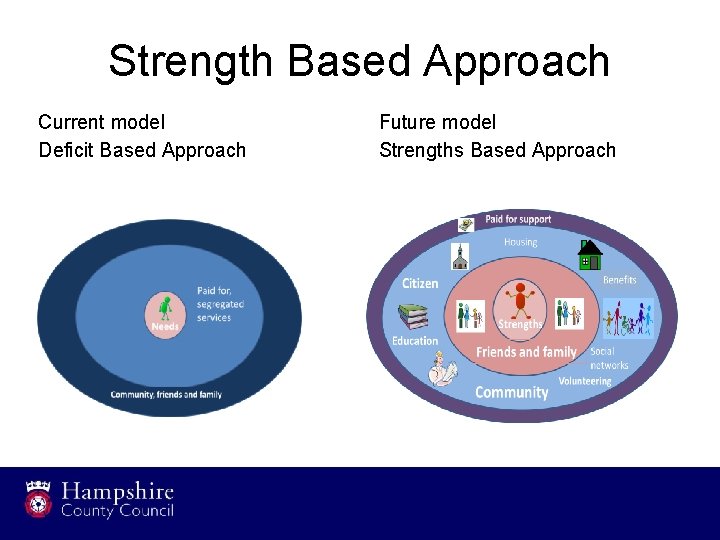
Strength Based Approach Current model Deficit Based Approach Future model Strengths Based Approach
Service principles • The principle behind the delivery of service is to establish an OT governed framework, using established therapy techniques and access to a qualified practitioner when appropriate, as identified as best practice in national research. • The operational integration of services offers rapid access to professional practitioners through effective triage of workflow to better manage demand & improve support planning & service user outcomes built around strength based methodologies.
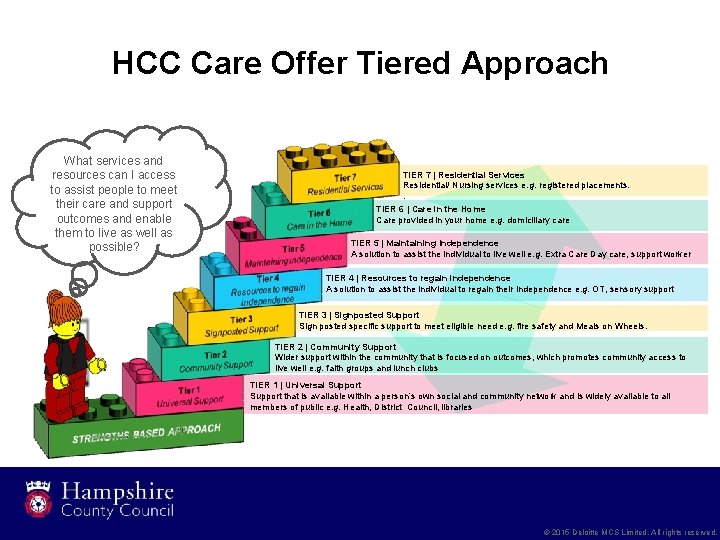
HCC Care Offer Tiered Approach What services and resources can I access to assist people to meet their care and support outcomes and enable them to live as well as possible? TIER 7 | Residential Services Residential/ Nursing services e. g. registered placements. . TIER 6 | Care in the Home Care provided in your home e. g. domiciliary care TIER 5 | Maintaining Independence A solution to assist the individual to live well e. g. Extra Care Day care, support worker TIER 4 | Resources to regain independence A solution to assist the individual to regain their independence e. g. OT, sensory support TIER 3 | Signposted Support Sign posted specific support to meet eligible need e. g. fire safety and Meals on Wheels. TIER 2 | Community Support Wider support within the community that is focused on outcomes, which promotes community access to live well e. g. faith groups and lunch clubs TIER 1 | Universal Support that is available within a person’s own social and community network and is widely available to all members of public e. g. Health, District Council, libraries © 2015 Deloitte MCS Limited. All rights reserved.
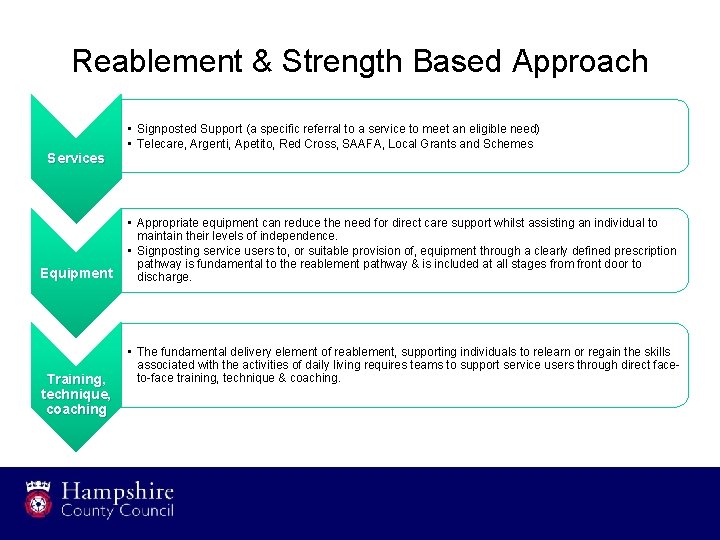
Reablement & Strength Based Approach • Signposted Support (a specific referral to a service to meet an eligible need) • Telecare, Argenti, Apetito, Red Cross, SAAFA, Local Grants and Schemes Services Equipment Training, technique, coaching • Appropriate equipment can reduce the need for direct care support whilst assisting an individual to maintain their levels of independence. • Signposting service users to, or suitable provision of, equipment through a clearly defined prescription pathway is fundamental to the reablement pathway & is included at all stages from front door to discharge. • The fundamental delivery element of reablement, supporting individuals to relearn or regain the skills associated with the activities of daily living requires teams to support service users through direct faceto-face training, technique & coaching.
Reablement – short-term, long term or both? Short term model • This element of reablement service forms part of Hampshire County Council’s non-chargeable care offer and is based on The Care and Support (Charging and Assessment of Resources) Regulations 2014, which includes – Up to 6–week reablement services under intermediate care funding – support people to use prescribed equipment or adaptations – support for safe moving and handling transfers to achieve social care outcomes OT / Sensory • Due to different legislation and guidance there are specific responsibilities that are carried out by Occupational Therapists and Sensory Officers due to their specific skill/qualification set, that fall outside of the short term 6 week model and charging policy but will still be considered as reablement.
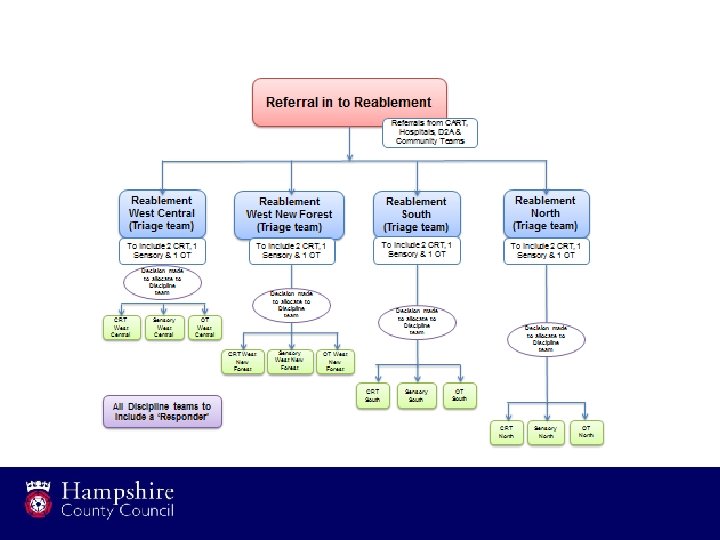
Getting from A to B! • • • Multiple teams Multiple localities Multiple referrals Different functions Different ways of working Different ways of thinking
Getting from A to B! • Seek solutions from operations • Involve those doing the do from the outset • Where were the overlaps? – Common functions • Where was the duplication? – Same or similar being delivered by many • Where was the skill base/gaps? – Who could do what? – What knowledge did we need?
Better Care Fund/Health Education Wessex Workforce development • Underpin transformation in the workforce across health & social care through the Better Care Fund • OT Leadership and governance, • Moving and handling competencies, dementia pathway and tools, standardised equipment pathway and competencies, • Development of long term condition social care competencies and development of occupational therapy mobilising skills.
Benefits? • • • Single service approach Timely & effective decisions Capacity & demand management Acknowledge & appreciate multi-disciplines Person centred, strength based principles Reduce, delay or avoid need for funded long term support • Home first
Forward plan Year 1: • • • Consolidation of new integrated structure Building new pathways with operating model Continued development of governance structure Consolidation of T 17 savings and efficiencies Identification of future reablement efficiencies and contributions Continued development of BCF goals and health integration Year 2 – 3: • • • Escalation of reablement connection to health integration and BCF goals Development of therapeutic and 3 R integration Enhancement of reablement connection in HCC long term care model
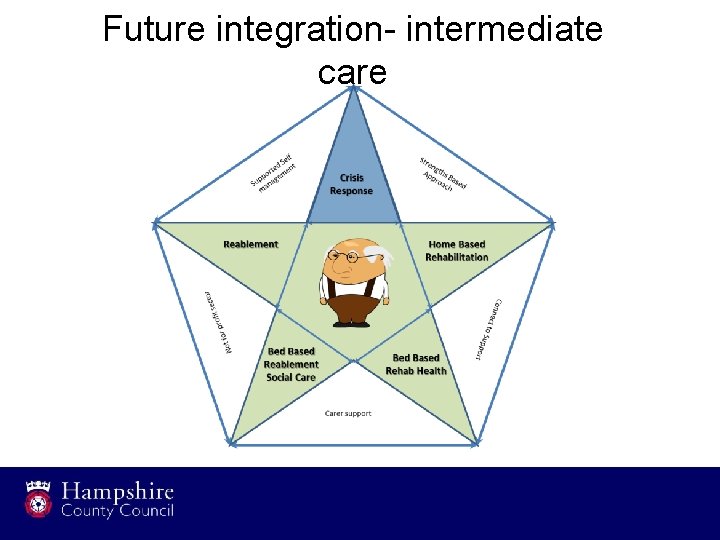
Future integration- intermediate care

Questions?
- Slides: 18