
Adult Protective Services Core Module Case Planning Written











- Slides: 64
Adult Protective Services Core Module: Case Planning Written by NAPSA Adapted by IHS for OHSTS (Revised October 2018)
Learning Objectives Discuss the importance of case plans, case plan essentials, and Ohio’s case plan requirements Discuss the steps in developing a voluntary and involuntary case plan and factors to consider Define involuntary interventions and understand how to determine when an involuntary intervention may be indicated Explore legal and ethical issues in the decision to use involuntary interventions Understand how to gather evidence and document the need for an involuntary intervention
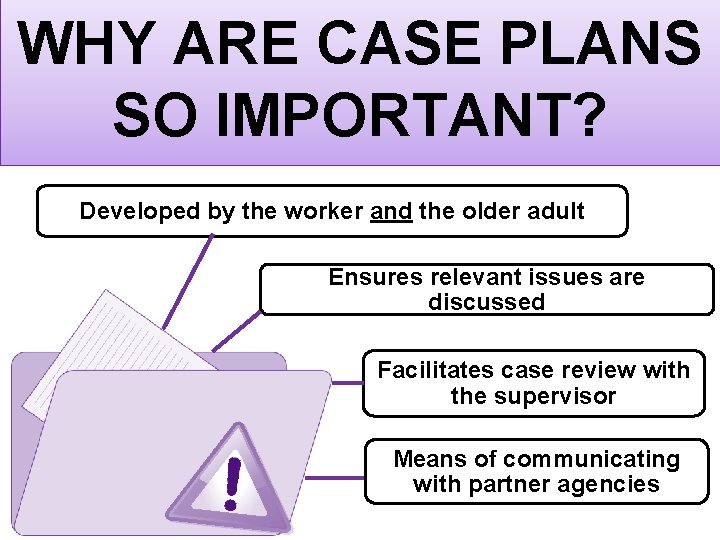
WHY ARE CASE PLANS SO IMPORTANT? Developed by the worker and the older adult Ensures relevant issues are discussed Facilitates case review with the supervisor Means of communicating with partner agencies
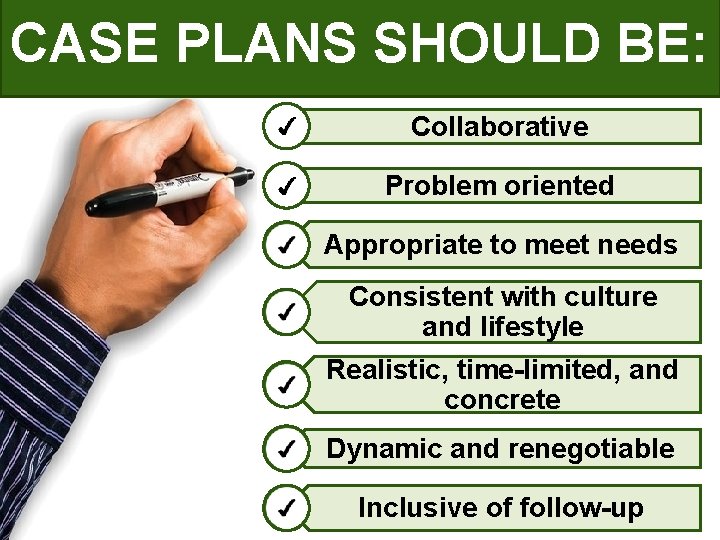
CASE PLANS SHOULD BE: Collaborative Problem oriented Appropriate to meet needs Consistent with culture and lifestyle Realistic, time-limited, and concrete Dynamic and renegotiable Inclusive of follow-up
Ohio Administrative Code 5101: 2 -20 -16 Provisions for Adult Protective Services
Critical Aspects in Case Planning
A case plan shall be developed by the CDJFS or its designated agency no later than 30 calendar days after whichever of the following occurs first: • The case decision indicates the need for services and the older adult agrees to the provision of protective services. • The adult requests services and the CDJFS or its designated agency determines that the requested services are needed and can be provided.
Each case plan shall include, but is not limited to, the following: • The identified concerns • The protective services objectives • The services that will be provided and the service provider(s) • Effective dates of the protective services case plan • Signature of the older adult. If the older adult refuses to sign the plan, the worker shall document the reason in the case record or petition the court pursuant to paragraph (H)(1) of this rule.
In the development of the case plan, the CDJFS or its designated agency must involve the older adult and significant other(s) which may include relatives, friends, caregivers, and neighbors to the extent possible.
The case plan shall be based upon the least restrictive services available to meet the needs of the older adult.
The CDJFS or its designated agency shall be responsible for the delivery of services or may arrange service delivery through the use of referrals, contracts or written agreements. , or
The CDJFS or its designated agency shall make face-to-face contact with the older adult at a minimum of one time per calendar month in order to monitor progress on the case plan objectives.
The caseworker shall document the following in the case record after each contact: (1) Date caseworker met with the older adult (2) Status of services currently in place, indicating whether the services are addressing the concern (3) Any new services that are needed due to the older adult's current level of risk
If the initial attempt to complete a face-to-face contact is unsuccessful, the CDJFS or its designated agency shall make a minimum of 2 additional attempts to complete the face-toface contact within the calendar month. These attempts shall be documented in the case record. No later than 90 days after services have been put in place, the CDJFS or its designated agency shall reassess the need to continue providing protective services. The caseworker shall determine if services should be maintained, amended or terminated. If the older adult continues to be in need of protective services, the CDJFS or its designated agency shall continue the case plan for the next 90 days and every 90 days thereafter until the case can be closed.
The CDJFS or its designated agency shall amend the case plan within 5 working days if there is a change in any of the following: Ø The concerns warranting the need for protective services Ø Principals of the case Ø Services being provided
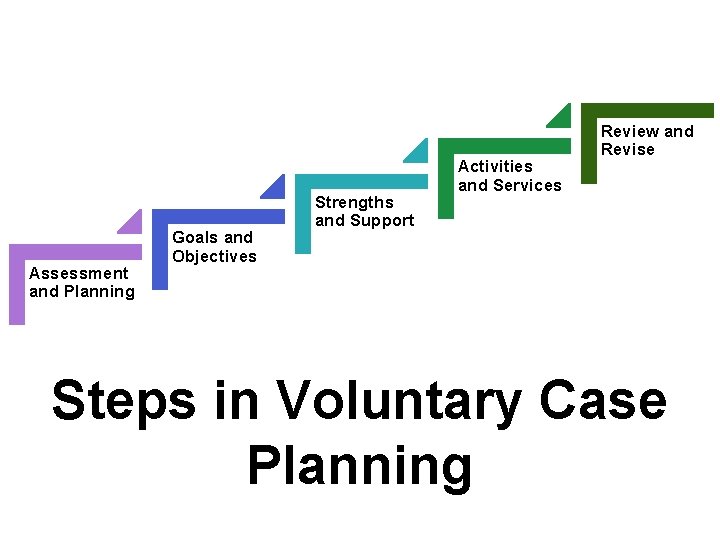
Assessment and Planning Goals and Objectives Strengths and Support Activities and Services Review and Revise Steps in Voluntary Case Planning
EVA’S STORY
Form small groups Select best answer Response Cards Raise response card
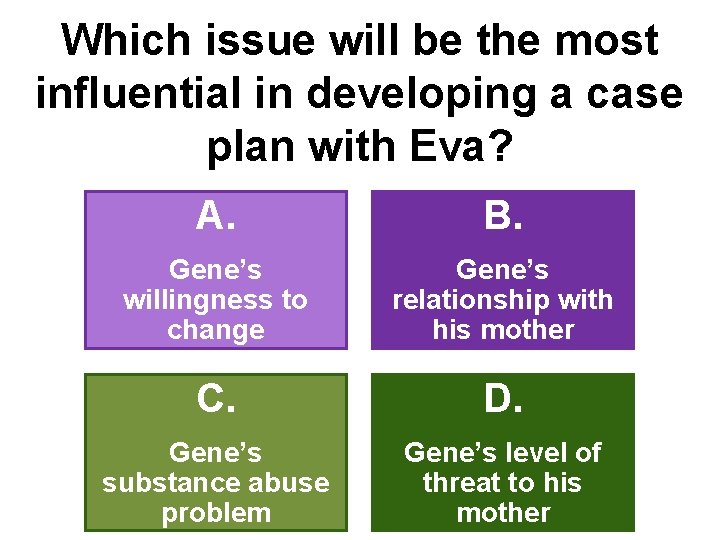
Which issue will be the most influential in developing a case plan with Eva? A. B. Gene’s willingness to change Gene’s relationship with his mother C. D. Gene’s substance abuse problem Gene’s level of threat to his mother
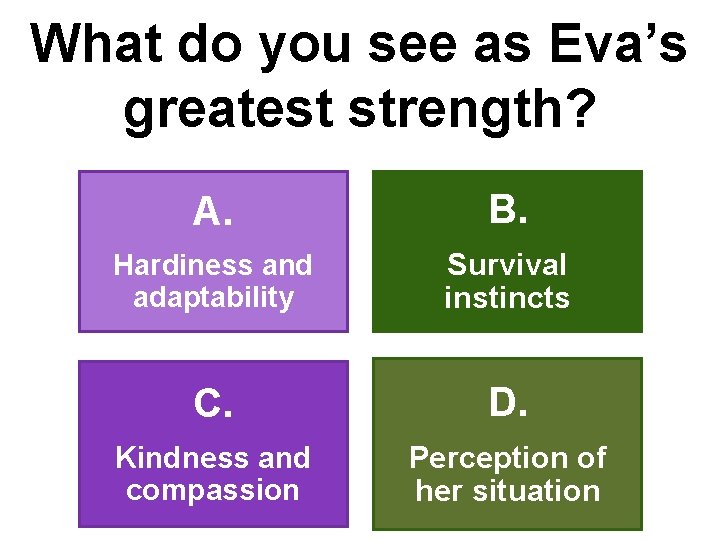
What do you see as Eva’s greatest strength? A. B. Hardiness and adaptability Survival instincts C. D. Kindness and compassion Perception of her situation
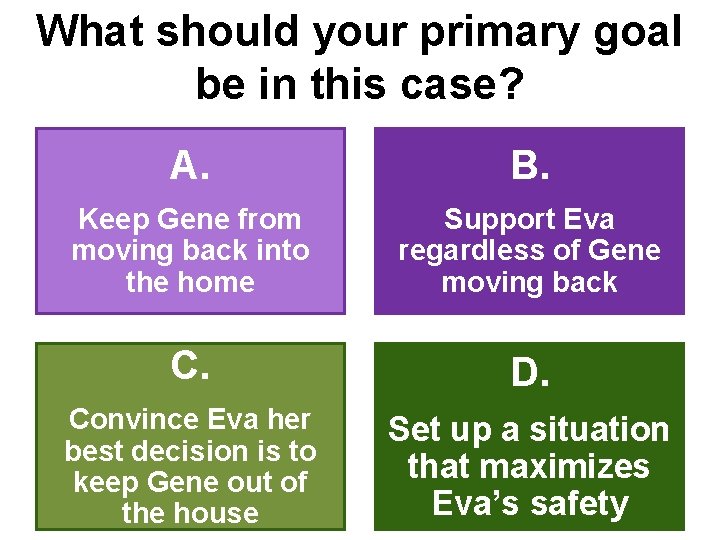
What should your primary goal be in this case? A. B. Keep Gene from moving back into the home Support Eva regardless of Gene moving back C. D. Convince Eva her best decision is to keep Gene out of the house Set up a situation that maximizes Eva’s safety
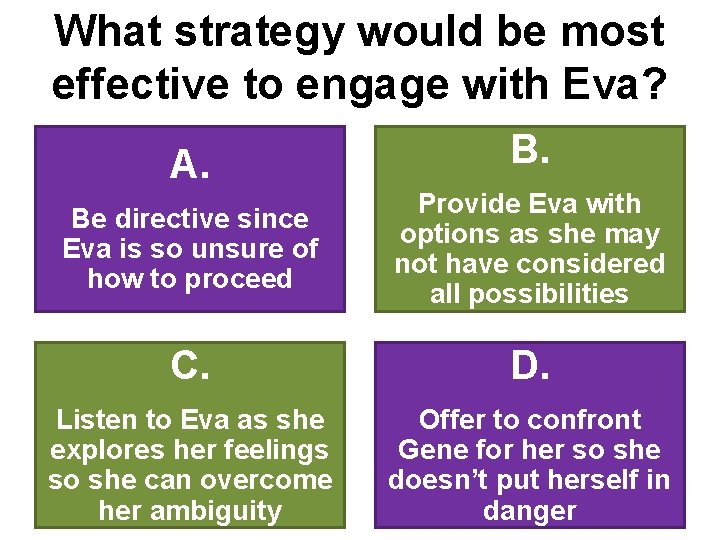
What strategy would be most effective to engage with Eva? A. Be directive since Eva is so unsure of how to proceed Provide Eva with options as she may not have considered all possibilities C. D. Listen to Eva as she explores her feelings so she can overcome her ambiguity Offer to confront Gene for her so she doesn’t put herself in danger
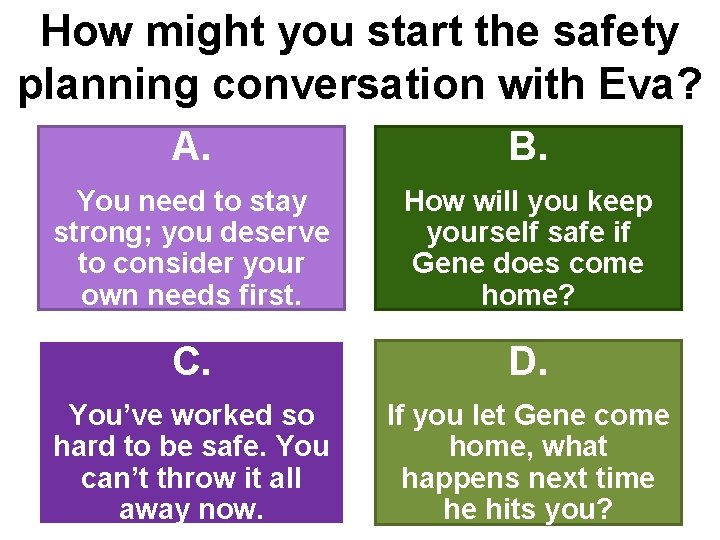
How might you start the safety planning conversation with Eva? A. B. You need to stay strong; you deserve to consider your own needs first. How will you keep yourself safe if Gene does come home? C. D. You’ve worked so hard to be safe. You can’t throw it all away now. If you let Gene come home, what happens next time he hits you?
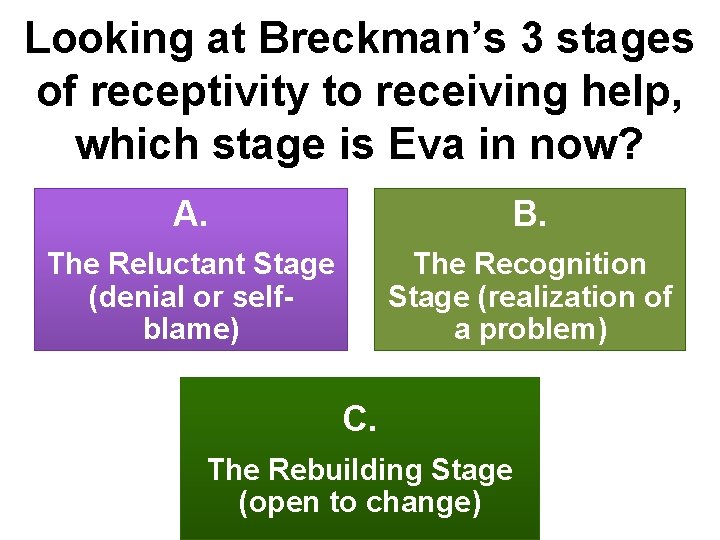
Looking at Breckman’s 3 stages of receptivity to receiving help, which stage is Eva in now? A. B. The Reluctant Stage (denial or selfblame) The Recognition Stage (realization of a problem) C. The Rebuilding Stage (open to change)
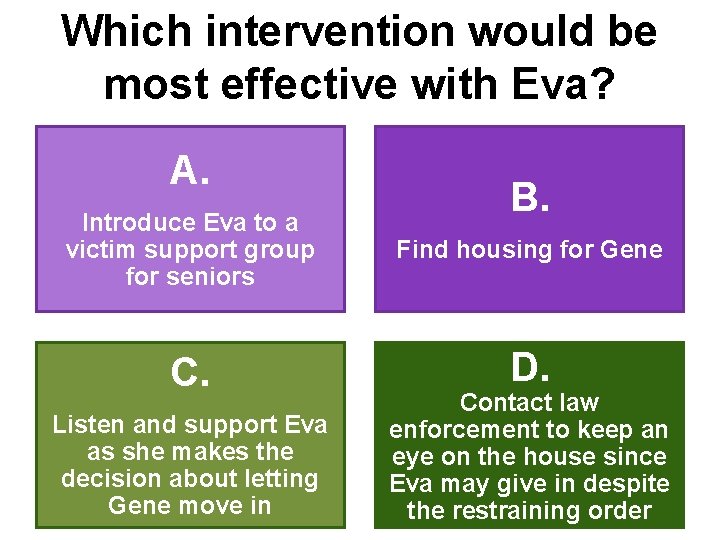
Which intervention would be most effective with Eva? A. B. Introduce Eva to a victim support group for seniors Find housing for Gene C. D. Listen and support Eva as she makes the decision about letting Gene move in Contact law enforcement to keep an eye on the house since Eva may give in despite the restraining order
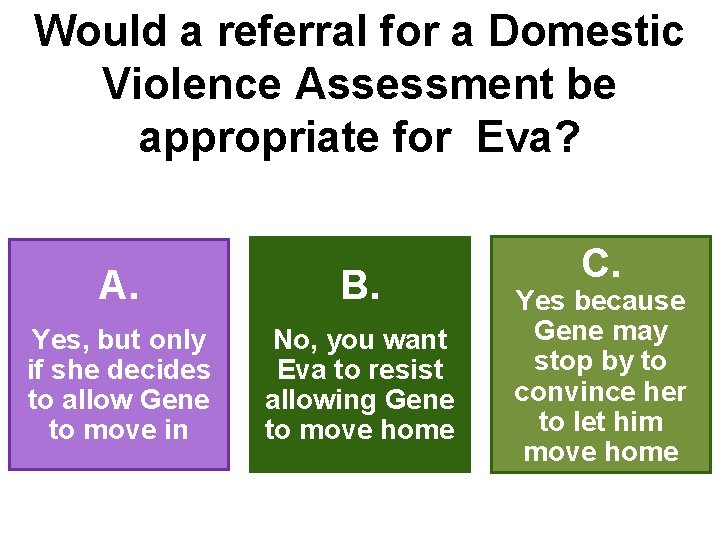
Would a referral for a Domestic Violence Assessment be appropriate for Eva? A. B. Yes, but only if she decides to allow Gene to move in No, you want Eva to resist allowing Gene to move home C. Yes because Gene may stop by to convince her to let him move home
Mildred Jackson What would you need to find out about in order to do an effective assessment of Mildred’s needs, desires, and risk factors? What steps would you take to determine the issues within the six (6) topic areas?
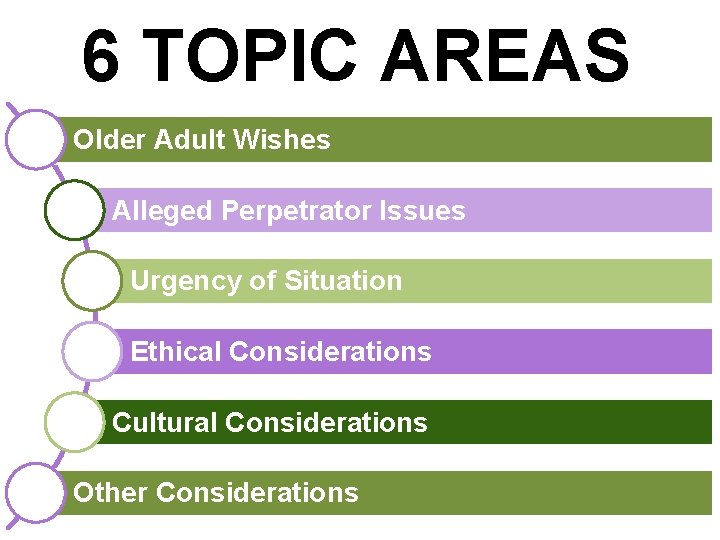
6 TOPIC AREAS Older Adult Wishes Alleged Perpetrator Issues Urgency of Situation Ethical Considerations Cultural Considerations Other Considerations
Remain in small groups Select best answer Response Cards Raise response card
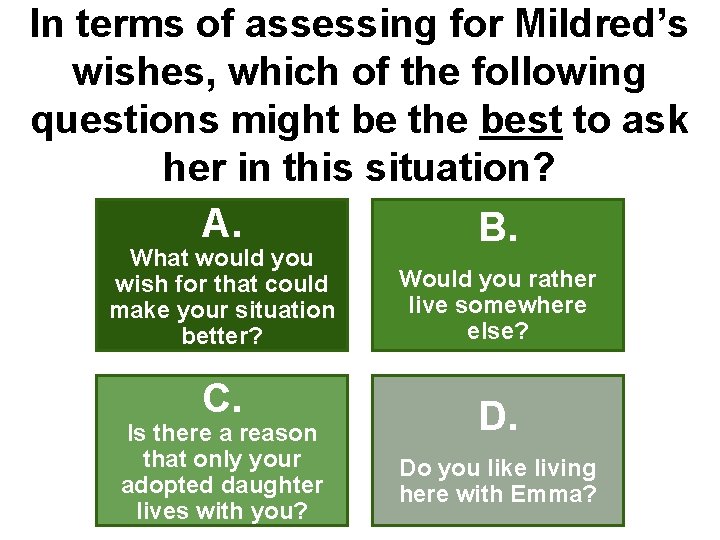
In terms of assessing for Mildred’s wishes, which of the following questions might be the best to ask her in this situation? A. B. What would you wish for that could make your situation better? C. Is there a reason that only your adopted daughter lives with you? Would you rather live somewhere else? D. Do you like living here with Emma?
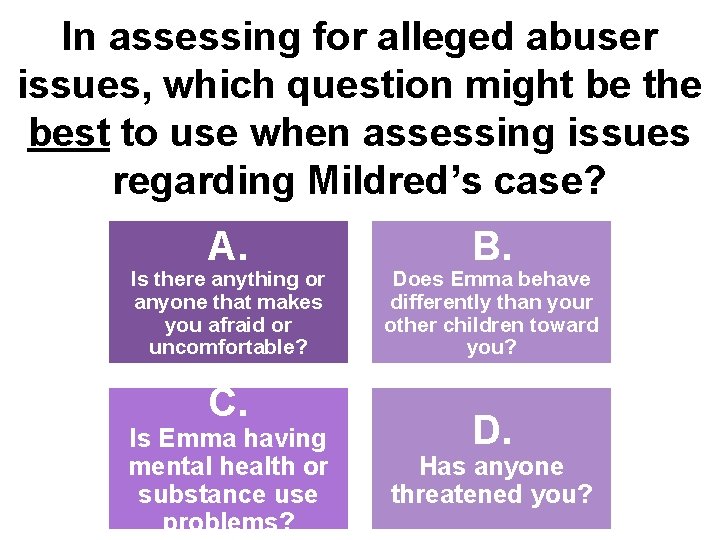
In assessing for alleged abuser issues, which question might be the best to use when assessing issues regarding Mildred’s case? A. Is there anything or anyone that makes you afraid or uncomfortable? C. Is Emma having mental health or substance use problems? B. Does Emma behave differently than your other children toward you? D. Has anyone threatened you?
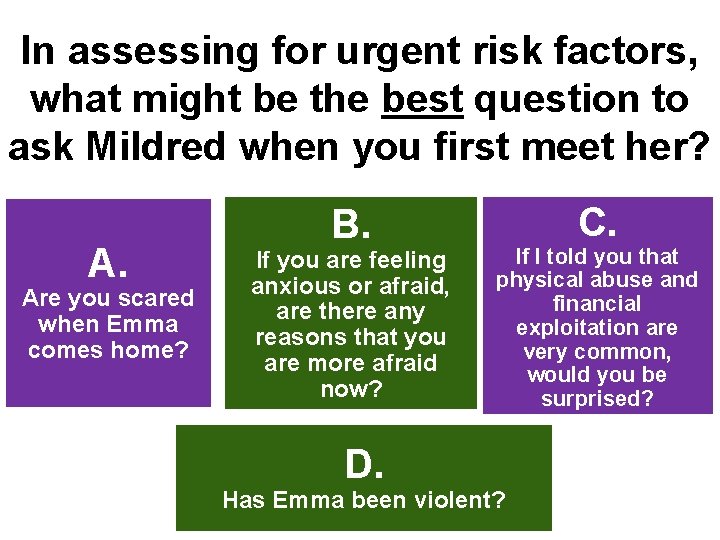
In assessing for urgent risk factors, what might be the best question to ask Mildred when you first meet her? A. Are you scared when Emma comes home? B. If you are feeling anxious or afraid, are there any reasons that you are more afraid now? D. C. If I told you that physical abuse and financial exploitation are very common, would you be surprised? Has Emma been violent?
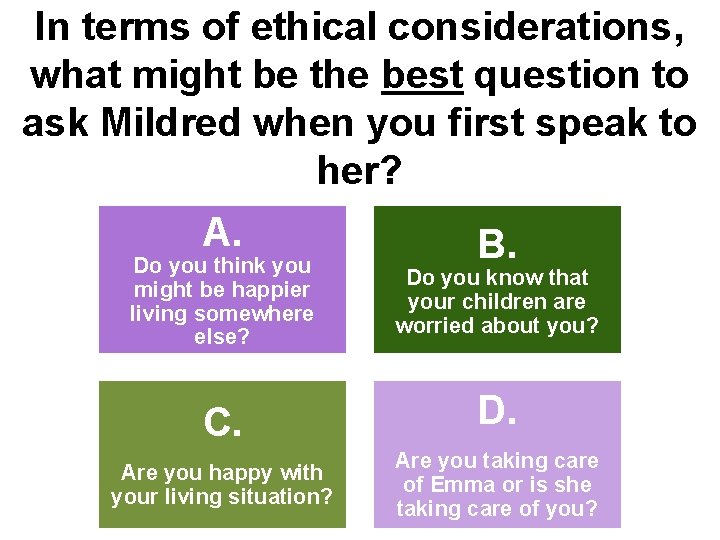
In terms of ethical considerations, what might be the best question to ask Mildred when you first speak to her? A. Do you think you might be happier living somewhere else? C. Are you happy with your living situation? B. Do you know that your children are worried about you? D. Are you taking care of Emma or is she taking care of you?
What would the best question be to begin assessing Mildred’s cultural considerations? A. When you grew up, was family life very different than your life with your family now? C. What kind of food and drink did you grow up with? B. In your family, were family members who were physically or mentally ill cared for at home? D. Were your parents immigrants?
CASE PLAN ACTIVITY
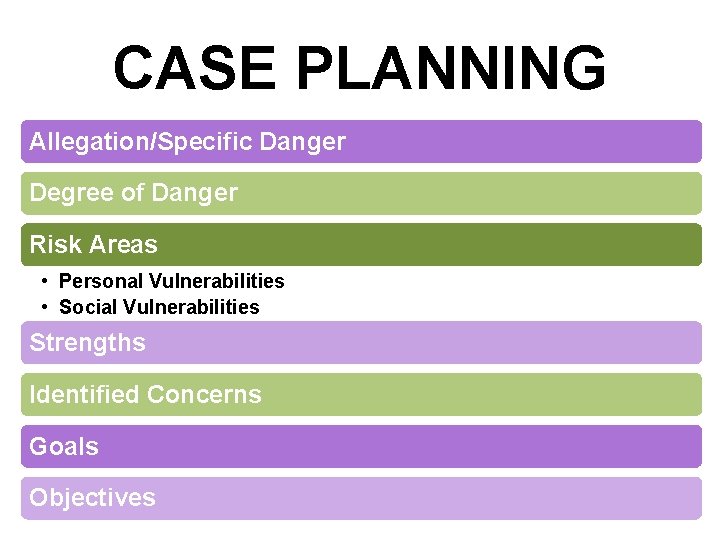
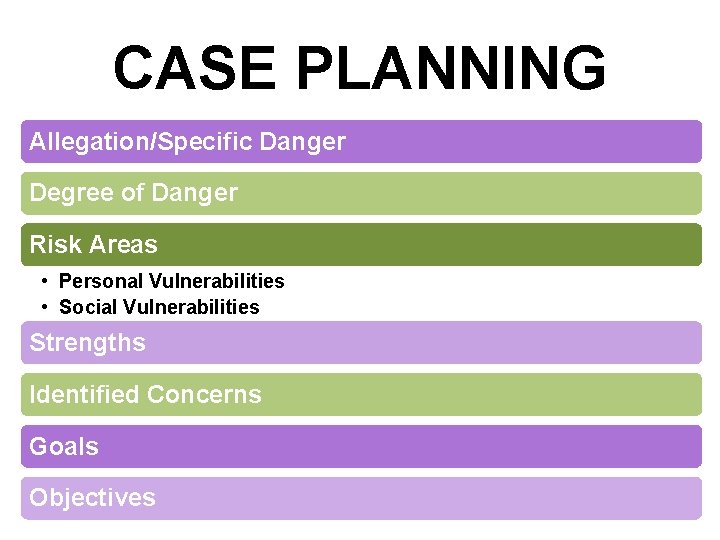
CASE PLANNING Allegation/Specific Danger Degree of Danger Risk Areas • Personal Vulnerabilities • Social Vulnerabilities Strengths Identified Concerns Goals Objectives
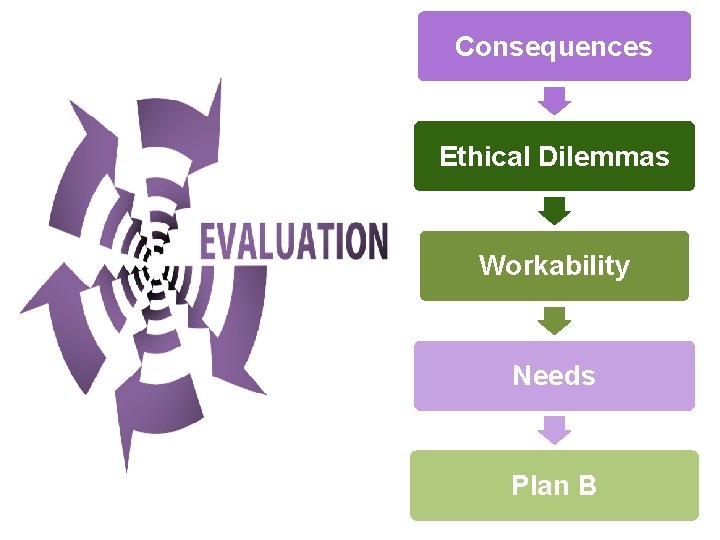
Consequences Ethical Dilemmas Workability Needs Plan B
Can You Name Some Involuntary Interventions?
When should you use involuntary interventions?
When is safety more important than selfdetermination?
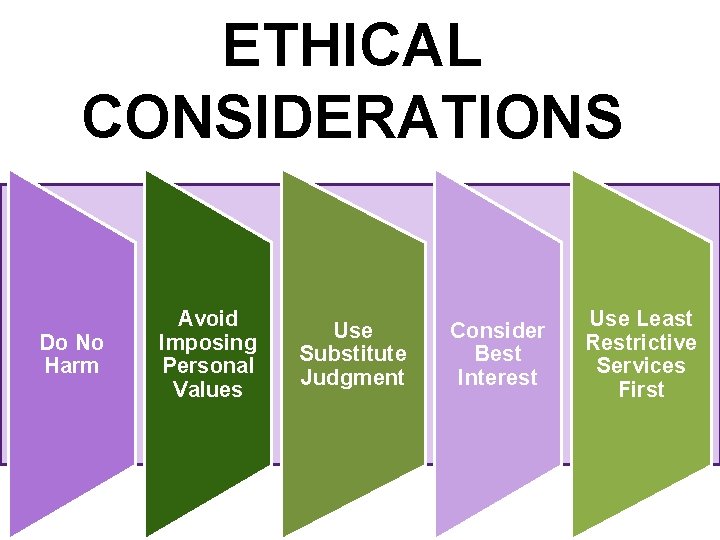
What are some ethical principles you should use when determining whether to employ an involuntary intervention?
Why are case reviews important?
What questions might your supervisor ask you when you want to employ an involuntary case plan?
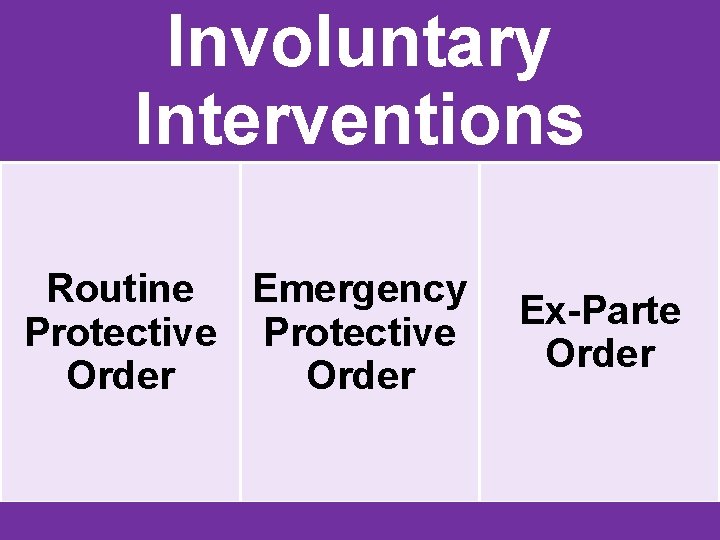
Involuntary Interventions Routine Emergency Protective Order Ex-Parte Order
TOO FAR OR NOT FAR ENOUGH?
This older adult lives in an apartment which is full of clutter and collectables. There is a path from the bedroom to the kitchen. He is frail and has fallen a few times. He says all the items in the apartment have sentimental value and he does not want to throw anything out. You call the local mental health agency and ask to have him evaluated.
This older adult is bedbound and dependent on her daughter for care. Her daughter has a substance abuse problem and has not been providing supervision and meals. The older adult is losing weight and seems a little fearful of her daughter, but she doesn’t want to do anything about the situation. You leave and close the case, since it appears the she has capacity.
This older adult is an 89 -year-old man who has been a widower for 25 years. He recently met a 32 -year-old woman and has fallen in love. He informs his adult children that he will marry this woman. He has changed his will, leaving all his substantial assets to her. The children make a report to APS and the worker puts a freeze on the older adult’s bank account.
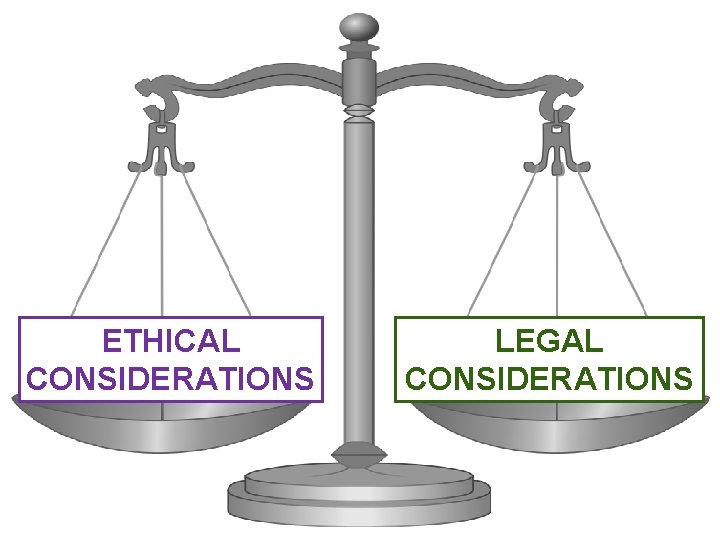
ETHICAL CONSIDERATIONS LEGAL CONSIDERATIONS
ETHICAL CONSIDERATIONS Do No Harm Avoid Imposing Personal Values Use Substitute Judgment Consider Best Interest Use Least Restrictive Services First
CASE STUDY How would you intervene? Would you pursue an involuntary intervention in this situation? If so, which intervention?
Ø What is your experience in collaborating with partner agencies? Ø What worked? Ø What did not work?
Who are your partners? Who can help you reach your goal? Respond to the challenges Learn their language
COLLABORATION TIPS
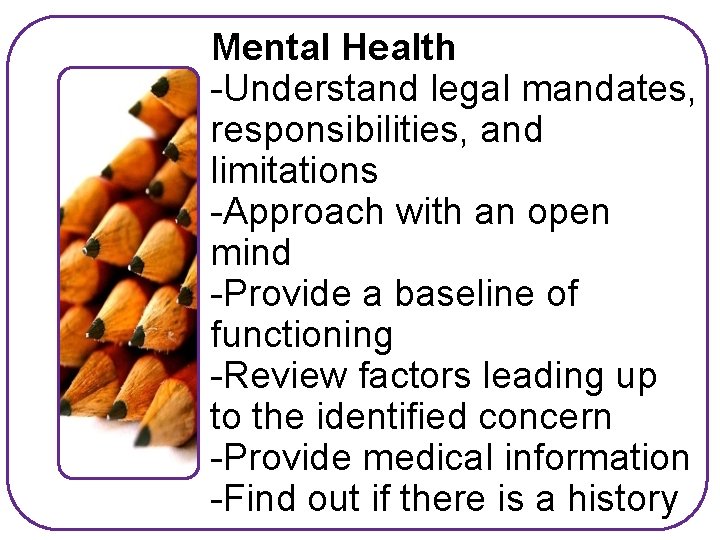
Mental Health -Understand legal mandates, responsibilities, and limitations -Approach with an open mind -Provide a baseline of functioning -Review factors leading up to the identified concern -Provide medical information -Find out if there is a history
Law Enforcement -Understand civil and criminal laws and what the officer is mandated to do, or cannot do -Focus on the facts, avoid gray areas -Gather documentation which would support the case -Discuss crimes and penal code violations, not social problems, refer to criminal codes
Emergency Medical Technician (EMT) -Provide all medical and medication history that is available to you -If older adult is resistant or fearful of hospitalization, try to determine the underlying reason(s). Financial Institution -Understand state statutes regarding fraud and financial exploitation -Provide the institution with your suspicions and reason for investigation -Provide documentation if available
Gather the Evidence Focus on observable facts Collateral information Dates
Ohio Administrative Code OAC 5101: 2 -20 -04 Adult Protective Services Case Records
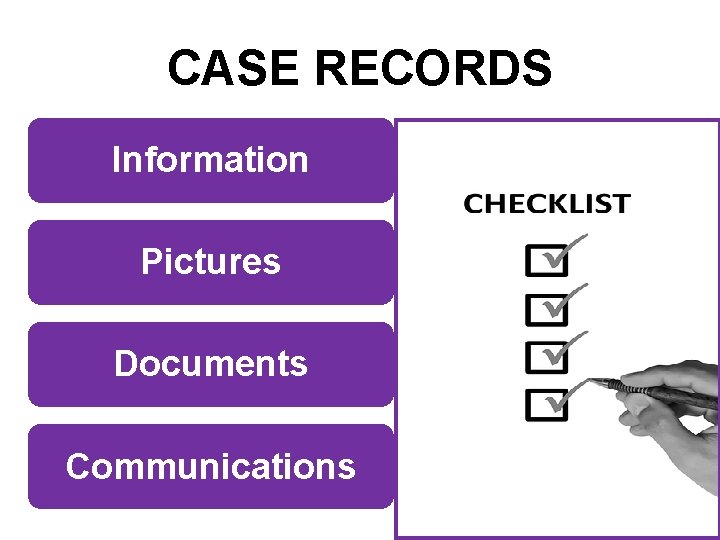
CASE RECORDS Information Pictures Documents Communications
CASE PLAN ACTIVITY
CASE PLANNING Allegation/Specific Danger Degree of Danger Risk Areas • Personal Vulnerabilities • Social Vulnerabilities Strengths Identified Concerns Goals Objectives
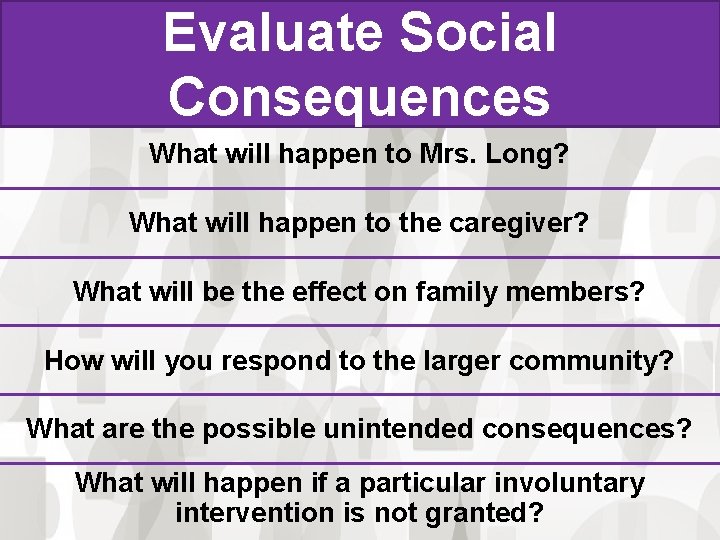
Evaluate Social Consequences What will happen to Mrs. Long? What will happen to the caregiver? What will be the effect on family members? How will you respond to the larger community? What are the possible unintended consequences? What will happen if a particular involuntary intervention is not granted?
Transfer of