
Adult Immunization The Big 5 Sandra Adamson Fryhofer
Adult Immunization : The Big 5 Sandra Adamson Fryhofer, MD, MACP Practicing General Internist, Atlanta, GA Adjunct Associate Professor of Medicine, Emory University School of Medicine Past President, American College of Physicians ACP Liaison to ACIP
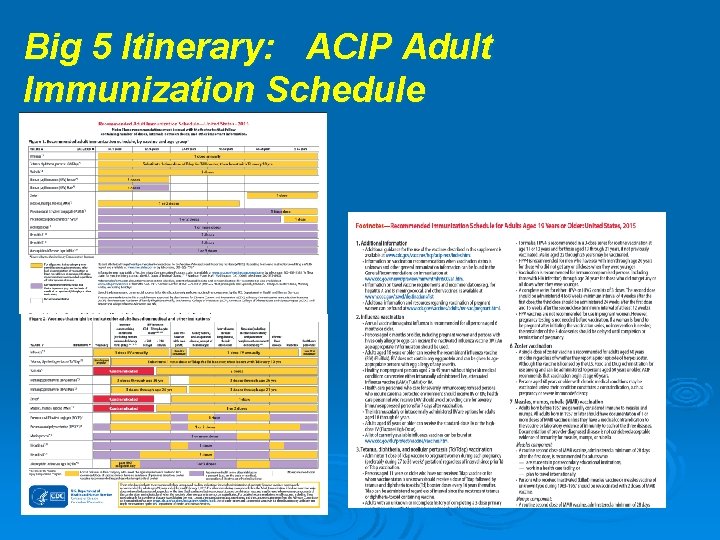
Big 5 Itinerary: ACIP Adult Immunization Schedule
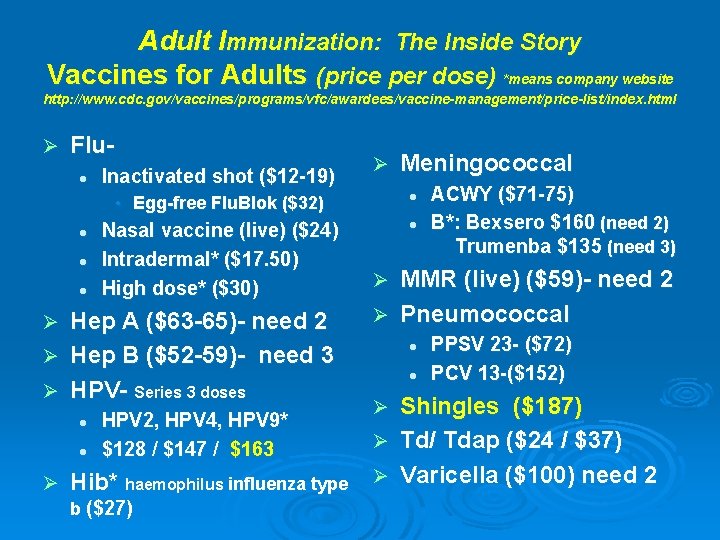
Adult Immunization: The Inside Story Vaccines for Adults (price per dose) *means company website http: //www. cdc. gov/vaccines/programs/vfc/awardees/vaccine-management/price-list/index. html Ø Flul l Inactivated shot ($12 -19) l Nasal vaccine (live) ($24) Intradermal* ($17. 50) High dose* ($30) l Hep A ($63 -65)- need 2 Ø Hep B ($52 -59)- need 3 Ø HPV- Series 3 doses l Ø Meningococcal • Egg-free Flu. Blok ($32) Ø l Ø HPV 2, HPV 4, HPV 9* $128 / $147 / $163 Hib* haemophilus influenza type b ($27) ACWY ($71 -75) B*: Bexsero $160 (need 2) Trumenba $135 (need 3) MMR (live) ($59)- need 2 Ø Pneumococcal Ø l l PPSV 23 - ($72) PCV 13 -($152) Shingles ($187) Ø Td/ Tdap ($24 / $37) Ø Varicella ($100) need 2 Ø

ACIP – Evidence Based Approach Ø October 2010, adopted an evidence- based process -GRADE (Grading of Recommendations, Assessment, Development and Evaluation). Ø evaluates l l quality of evidence benefits/harms values and preferences of affected populations economic impact
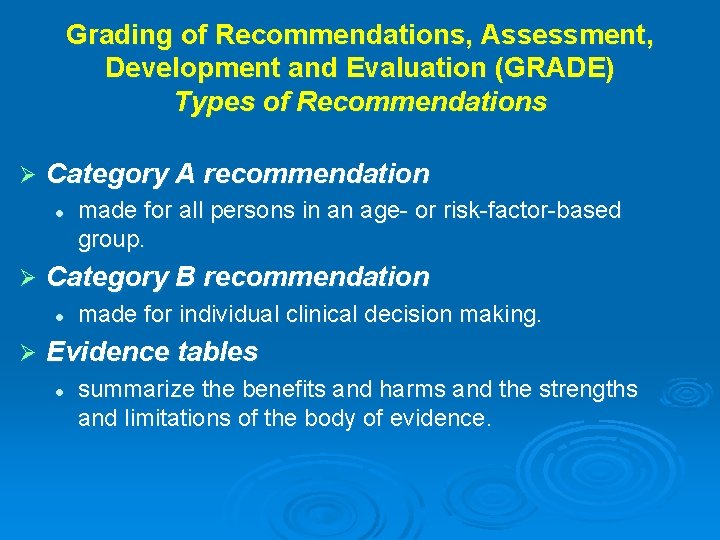
Grading of Recommendations, Assessment, Development and Evaluation (GRADE) Types of Recommendations Ø Category A recommendation l Ø Category B recommendation l Ø made for all persons in an age- or risk-factor-based group. made for individual clinical decision making. Evidence tables l summarize the benefits and harms and the strengths and limitations of the body of evidence.

Vaccine Information Statements (VIS) http: //www. cdc. gov/vaccines/pubs/vis/default. htm
ACIP coverage clout under new ACA plans Ø New health plans will be required to cover new ACIP recommendations made after September 2009 without cost-sharing in the next plan year that occurs one year after the date of the recommendation. Ø Does not apply to Medicare.
FDA versus ACIP Ø ACIP recommendations are not always consistent with FDA licensing. FDA (Food and Drug Administration) licensing l ACIP (Advisory Committee on Immunization Practices) l • ACA: ACIP recommendation coverage clout l New health plans: ACA requirement coverage without cost sharing one year after recommendation is made. l Does not apply to Medicare.
FDA Licensing Process Ø IND: Investigational New Drug Application l Ø Includes protocol for human studies Preclinical licensure trials: l l l Phase 1 studies (small study) Phase 2 Studies (larger study- hundreds of patients) Phase 3 Studies (vaccine effectiveness and safety- thousands of patients) BLA: Biologics License Application request Ø Accelerated Approval Pathway (fast track) Ø l l based on early evidence of effectiveness May not satisfy comprehensive ACIP GRADE evidence assessment
The Big 5: Flu FLU FACTS http: //www. cdc. gov/flu/about/qa/disease. htm On average each year: Ø Up to 20% of US get flu Ø More than 200, 000 hospitalized Ø Up to 49, 000 die
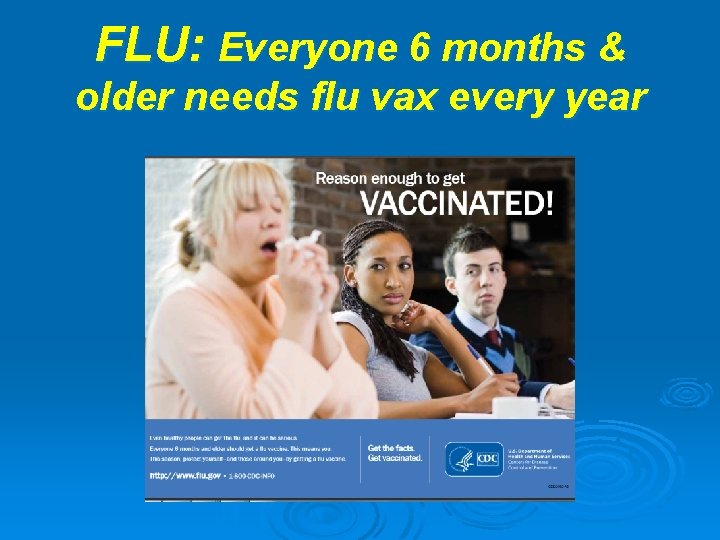
FLU: Everyone 6 months & older needs flu vax every year
Flu Prevention: Which flu vaccine to give? Ø Inactivated flu shot Ø High dose Ø Intradermal Ø Needleless Ø Nasal flu vaccine
Flu Vaccination 2015 -2016 : Standard Shot (IIV 3 and IIV 4) Ø IIV 3: Trivalent vaccines will contain: l A/California/7/2009 (H 1 N 1)pdm 09 -like virus; (same as 2014 -2015) l A/Switzerland/9715293/2013 (H 3 N 2)-like virus; (NEW) l B/Phuket/3073/2013 -like virus. (NEW) Ø IIV 4: Quadrivalent vaccines: the above + l B/Brisbane/60/2008 -like virus (same as 2014 -2015)

High dose flu shot (for Seniors): Fluzone High Dose For seniors 65 and older Ø Inactivated vaccine Ø l l Ø Downsides l l Ø Contains four times more hemaglutinin per dose than standard flu vaccine Designed to improve immune response. More injection site reactions Cost (almost double the price) Covered by Medicare B : CPT code 90662, admin code 90471

Intradermal Flu Vaccine: Fluzone Intradermal: age 18 -64
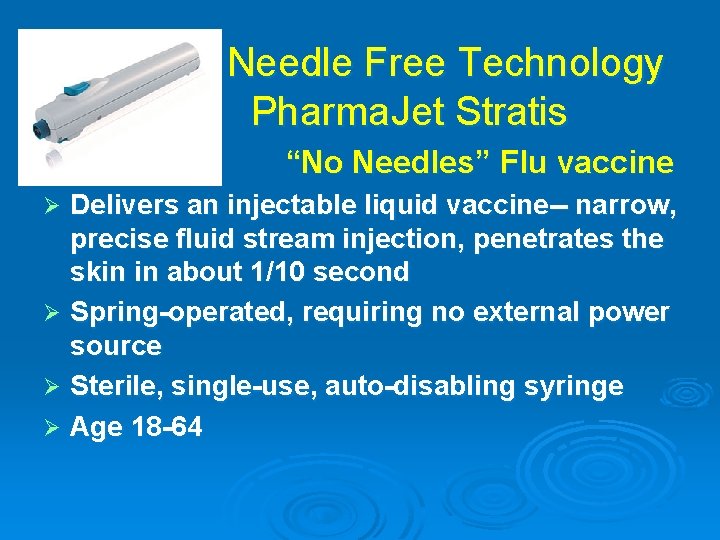
Needle Free Technology Pharma. Jet Stratis Ø No. Flu “No Needles” Flu vaccine Delivers an injectable liquid vaccine-- narrow, precise fluid stream injection, penetrates the skin in about 1/10 second Ø Spring-operated, requiring no external power source Ø Sterile, single-use, auto-disabling syringe Ø Age 18 -64 Ø
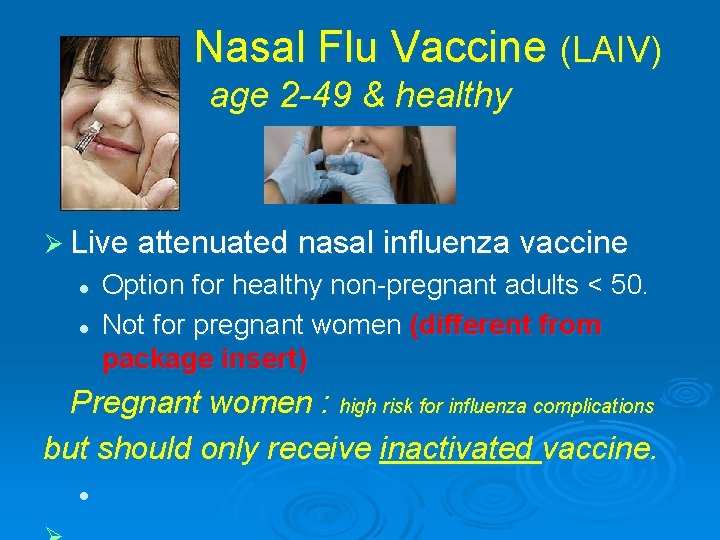
Nasal Flu Vaccine (LAIV) age 2 -49 & healthy Ø Live attenuated nasal influenza vaccine l l Option for healthy non-pregnant adults < 50. Not for pregnant women (different from package insert) Pregnant women : high risk for influenza complications but should only receive inactivated vaccine. l
Mild (hives only) Egg Allergy Ø Can get the inactivated flu shot. l l That’s what’s been studied. They can’t get the nasal flu vaccine. Ø Person giving the vaccine should l Be familiar with “egg allergy” Ø Observe patient for at least 30 minutes
Recombinant Influenza Vaccine (RIV 3) Trivalent Ø Brand name – Flu. Blok Ø For 18 and older Ø Ø Totally egg free Ø Can be given to age appropriate with egg allergy of any severity
Babies and FLU Ø Babies under six months old: too young to get flu shot l too young for anti-virals l little ones are most at risk l more likely to be hospitalized l more likely to die if they get the flu Ø Family members and care givers of babies need flu vaccination. l
Tdap : A Family Affair (tetanus/diptheria/pertussis) Ø Pertussis = whooping cough Ø Last 10 years- surge in pertussis related deaths in infants Ø Cocoon babies in circle of protection Ø Household members are to blame for up to 83% of transmission
Who needs Tdap? Ø Adolescents need Tdap booster Unvaccinated dads need one time Tdap booster Ø Grandparents need one time Tdap booster Ø Pregnant women need Tdap in each pregnancy (in late 3 rd trimester between 27 -36 weeks) Ø
February 2012 ACIP Tdap for Adults : Universal Recs Ø Adults age 65 & + had higher rates of hospitalization than those age 19 -64 Ø Expand Tdap booster to ALL adults age 65 and older – not just those with close contact with infants Ø Universal Tdap booster for ALL adults!
ACIP guidance statement MMWR , June 29, 2012 / 61(25); 468 -470 http: //www. cdc. gov/mmwr/preview/mmwrhtml/mm 6125 a 4. htm Ø Currently, only a single booster dose of Tdap is recommended October 2012: Pregnant women need Tdap in EACH pregnancy. (Multiple Tdap boosters is off -label use )
The Big 5: Hep B FACTS Ø Chronic Infection l l l 800, 000 to 1. 4 million people suffer from it 3000 cases of acute Hepatitis B each year Can lead to liver cancer
The Big 5: Hepatitis B Ø Transmitted by exposure to infected blood or body fluid Ø Who needs Hep B vax ? Ø Hepatitis B series (3 dose) : l l l All health care workers; All diabetics < 60; > 1 sex partner over last 6 months
The Big 5: Shingles FACTS Ø Ø Ø If had chickenpox…… at risk for shingles More that 90% of all adults in the United States infected with varicella zoster virus One million cases/ year Lifetime risk: 30% Risk increases with age (starting at age 50)
Key HZ symptom: Pain Ø Pain prior to rash onset: 84% of cases § Starts as abnormal skin sensation, itching or tingling § Precedes rash by 1 -5 days but occasionally weeks or more § Diagnostic dilemmas & work-ups (e. g. , cardiac, gallbladder) Ø Pain once rash develops: 89% of cases
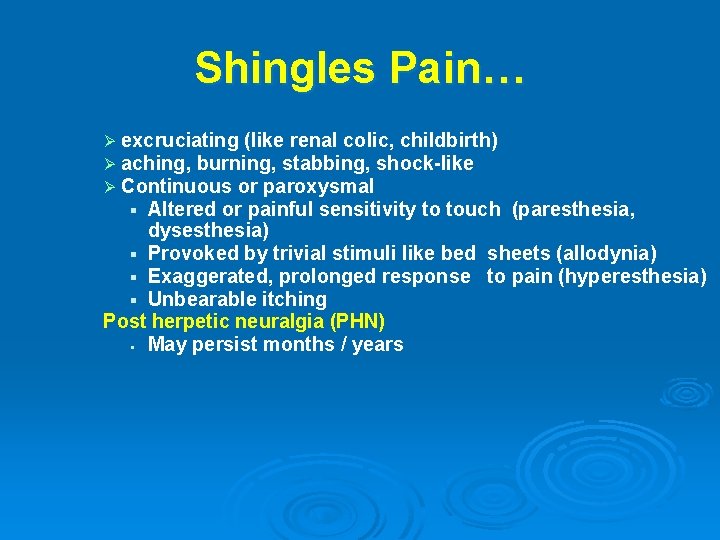
Shingles Pain… Ø excruciating (like renal colic, childbirth) Ø aching, burning, stabbing, shock-like Ø Continuous or paroxysmal § Altered or painful sensitivity to touch (paresthesia, dysesthesia) § Provoked by trivial stimuli like bed sheets (allodynia) § Exaggerated, prolonged response to pain (hyperesthesia) § Unbearable itching Post herpetic neuralgia (PHN) § May persist months / years
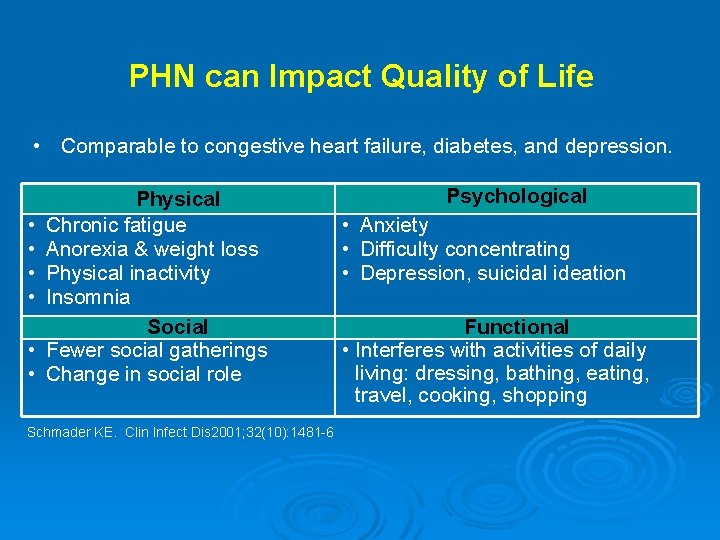
PHN can Impact Quality of Life • Comparable to congestive heart failure, diabetes, and depression. • • • Physical Chronic fatigue Anorexia & weight loss Physical inactivity Insomnia Social Fewer social gatherings Change in social role Schmader KE. Clin Infect Dis 2001; 32(10): 1481 -6 Psychological • Anxiety • Difficulty concentrating • Depression, suicidal ideation Functional • Interferes with activities of daily living: dressing, bathing, eating, travel, cooking, shopping
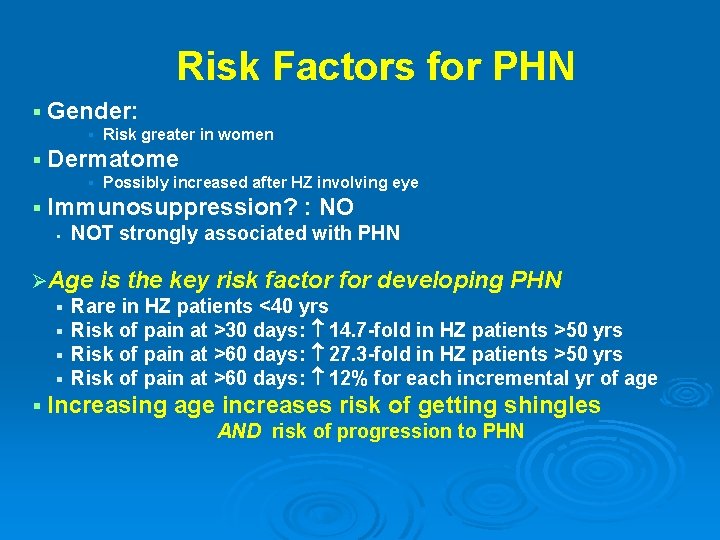
Risk Factors for PHN § Gender: § § Dermatome § § Risk greater in women Possibly increased after HZ involving eye Immunosuppression? : NO § NOT strongly associated with PHN ØAge is the key risk factor for developing PHN § Rare in HZ patients <40 yrs § Risk of pain at >30 days: 14. 7 -fold in HZ patients >50 yrs § Risk of pain at >60 days: 27. 3 -fold in HZ patients >50 yrs § Risk of pain at >60 days: 12% for each incremental yr of age § Increasing age increases risk of getting shingles AND risk of progression to PHN
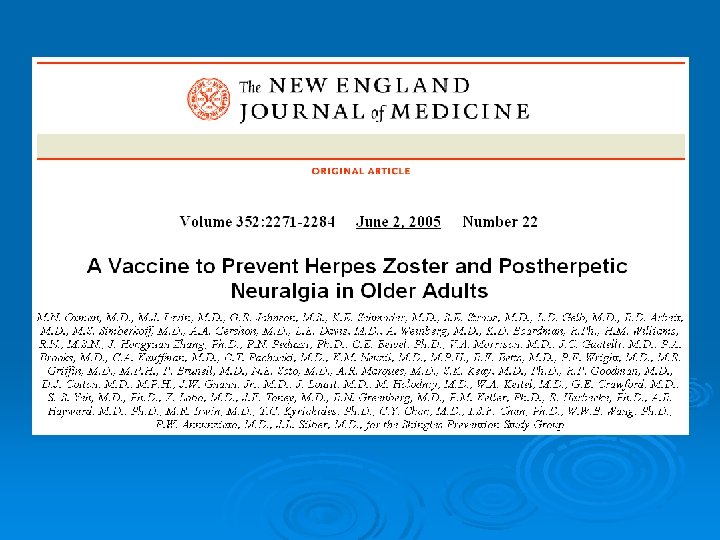
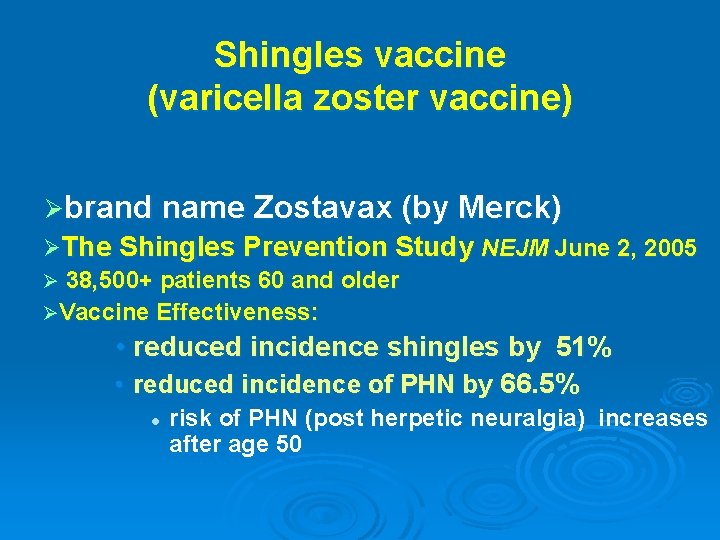
Shingles vaccine (varicella zoster vaccine) Øbrand name Zostavax (by Merck) ØThe Shingles Prevention Study NEJM June 2, 2005 Ø 38, 500+ patients 60 and older ØVaccine Effectiveness: • reduced incidence shingles by 51% • reduced incidence of PHN by 66. 5% l risk of PHN (post herpetic neuralgia) increases after age 50
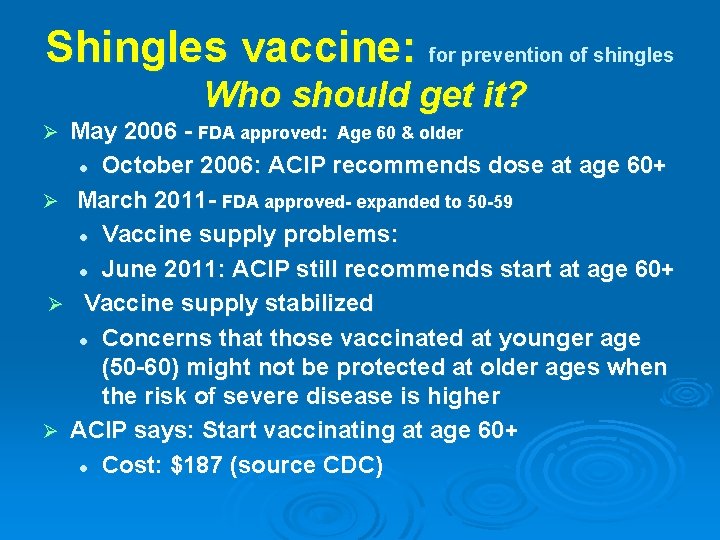
Shingles vaccine: for prevention of shingles Who should get it? May 2006 - FDA approved: Age 60 & older l October 2006: ACIP recommends dose at age 60+ Ø March 2011 - FDA approved- expanded to 50 -59 l Vaccine supply problems: l June 2011: ACIP still recommends start at age 60+ Ø Vaccine supply stabilized l Concerns that those vaccinated at younger age (50 -60) might not be protected at older ages when the risk of severe disease is higher Ø ACIP says: Start vaccinating at age 60+ l Cost: $187 (source CDC) Ø
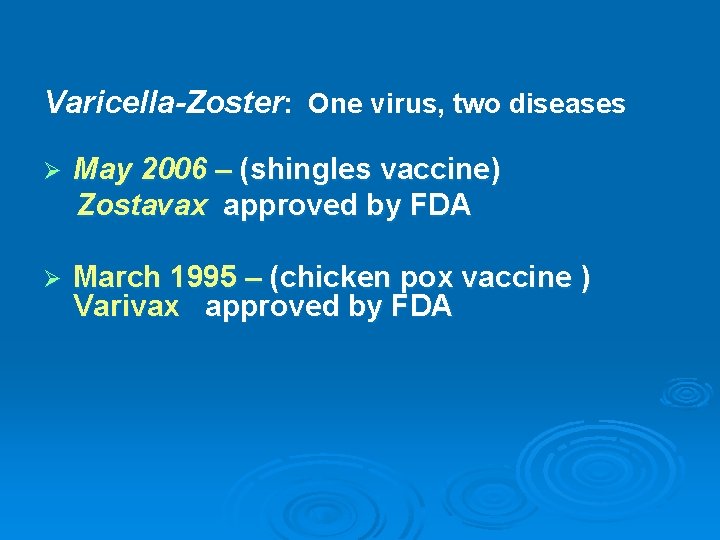
Varicella-Zoster: One virus, two diseases Ø May 2006 – (shingles vaccine) Zostavax approved by FDA Ø March 1995 – (chicken pox vaccine ) Varivax approved by FDA
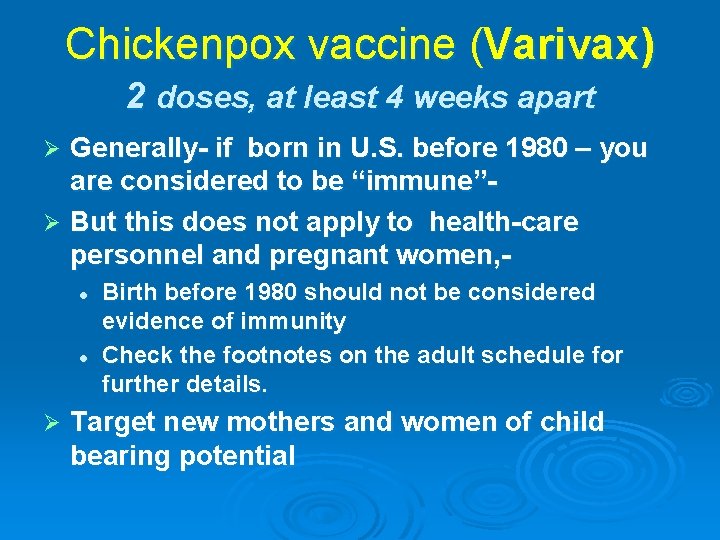
Chickenpox vaccine (Varivax) 2 doses, at least 4 weeks apart Generally- if born in U. S. before 1980 – you are considered to be “immune”Ø But this does not apply to health-care personnel and pregnant women, Ø l l Ø Birth before 1980 should not be considered evidence of immunity Check the footnotes on the adult schedule for further details. Target new mothers and women of child bearing potential
Shingles Vaccine: ACIP Recommendations Ø You don’t have to check varicella history or titers before administering HZV l l l Just about everyone ≥ 60 has serologic evidence of prior varicella, even if they do not recall having the illness No evidence that giving Shingles vaccine to someone without prior varicella raises safety concerns Determining varicella history: a major and unnecessary barrier to vaccination
Shingles (Herpes Zoster) Vaccine : Storage & Handling Ø Must be stored frozen l l Ø Need dedicated freezer only: combined fridge/freezer models may not work l Ø Must be stored at freezer temperature (≤ 5º F) HZV is the ONLY freezer-requiring vaccine for adults Can reduce fridge temps below freezing and ruin refrigerated vaccines Unused HZV must be discarded 30 min after reconstitution
The Big 5: Pneumococcal Vaccine FACTS about Streptococcus pneumonia (aka the pneumococcus) Kills 4000 in US each year (mostly adults) Ø Leading cause of serious illness: Ø bacteremia, meningitis, pneumonia Ø Source: MMWR Oct 12, 2012 , 816 -819
Two Pneumococcal vaccines- FDA approved for adults Ø Pneumococcal Polysaccharide vaccine (PPSV 23 - Pneumovax 23 by Merck) l Licensed for routine use in adults 50 & older and age 2– 49 with certain risk factors • Private sector cost: $ 72 (source CDC) Ø Pneumococcal Conjugate vaccine (PCV 13 - Prevnar by Pfizer) l FDA approved for use in adults age 50 and older in December 2011 NOTE: Prevnar 13 is NOT FDA approved for age 18 to 49! • Private sector cost: $152 (source CDC)
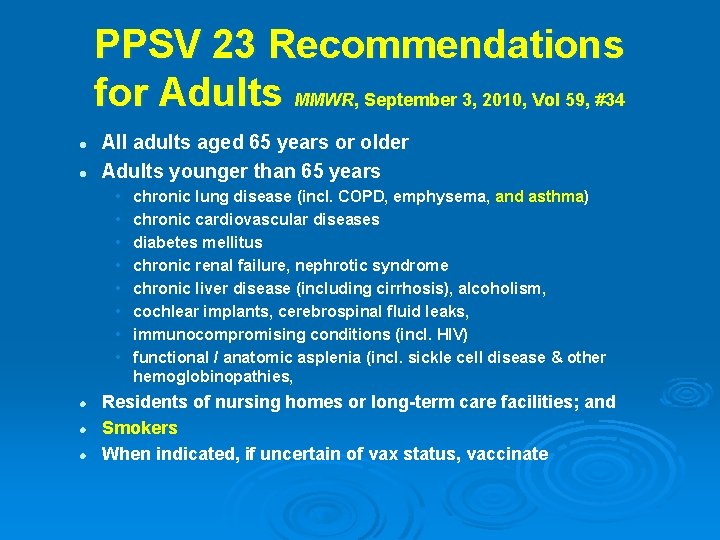
PPSV 23 Recommendations for Adults MMWR, September 3, 2010, Vol 59, #34 l l All adults aged 65 years or older Adults younger than 65 years • • l l l chronic lung disease (incl. COPD, emphysema, and asthma) chronic cardiovascular diseases diabetes mellitus chronic renal failure, nephrotic syndrome chronic liver disease (including cirrhosis), alcoholism, cochlear implants, cerebrospinal fluid leaks, immunocompromising conditions (incl. HIV) functional / anatomic asplenia (incl. sickle cell disease & other hemoglobinopathies, Residents of nursing homes or long-term care facilities; and Smokers When indicated, if uncertain of vax status, vaccinate
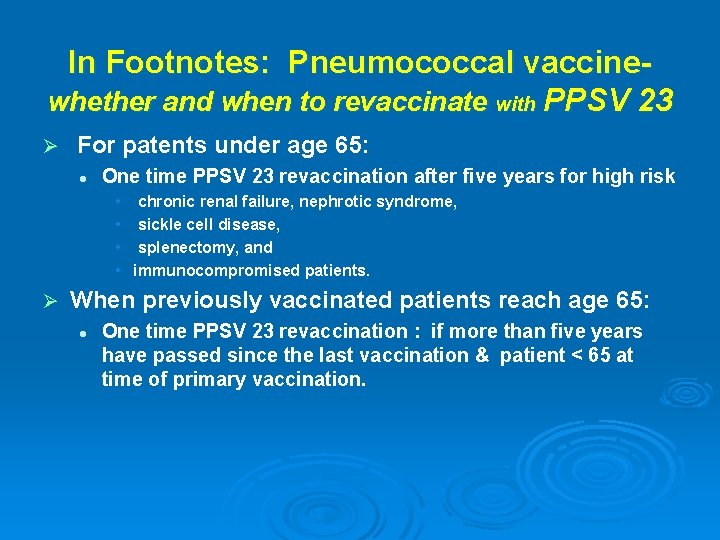
In Footnotes: Pneumococcal vaccine- whether and when to revaccinate with PPSV 23 Ø For patents under age 65: l One time PPSV 23 revaccination after five years for high risk • • Ø chronic renal failure, nephrotic syndrome, sickle cell disease, splenectomy, and immunocompromised patients. When previously vaccinated patients reach age 65: l One time PPSV 23 revaccination : if more than five years have passed since the last vaccination & patient < 65 at time of primary vaccination.
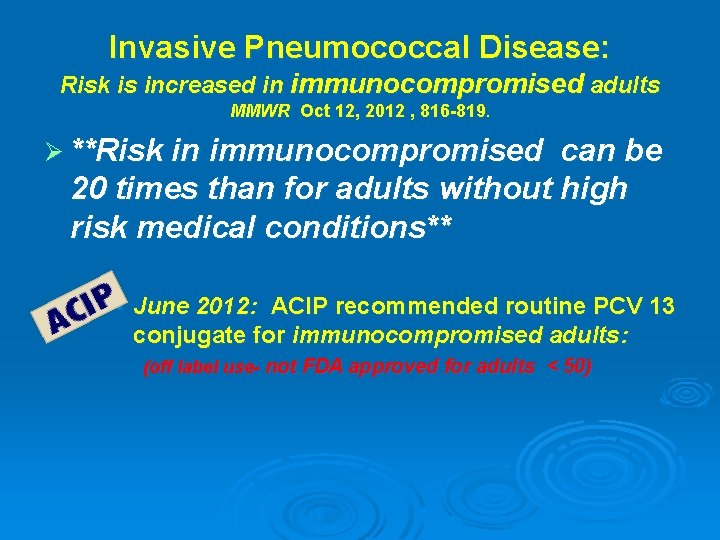
Invasive Pneumococcal Disease: Risk is increased in immunocompromised adults MMWR Oct 12, 2012 , 816 -819. Ø **Risk in immunocompromised can be 20 times than for adults without high risk medical conditions** • June 2012: ACIP recommended routine PCV 13 conjugate for immunocompromised adults: (off label use- not FDA approved for adults < 50)
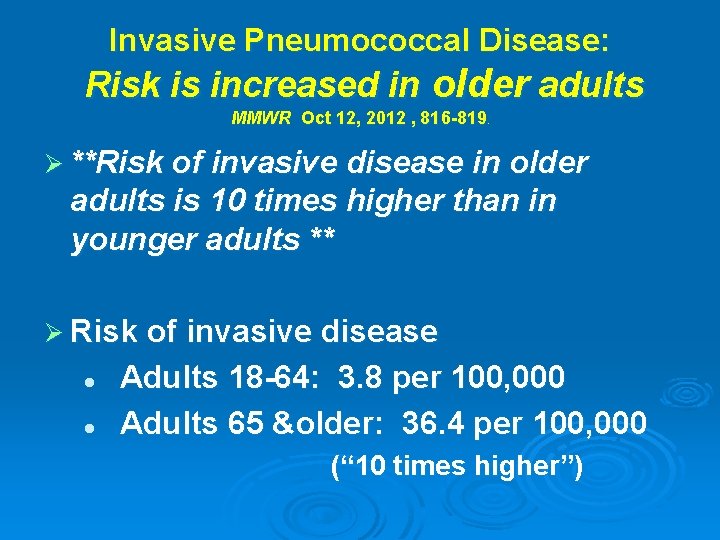
Invasive Pneumococcal Disease: Risk is increased in older adults MMWR Oct 12, 2012 , 816 -819. Ø **Risk of invasive disease in older adults is 10 times higher than in younger adults ** Ø Risk of invasive disease l l Adults 18 -64: 3. 8 per 100, 000 Adults 65 &older: 36. 4 per 100, 000 (“ 10 times higher”)
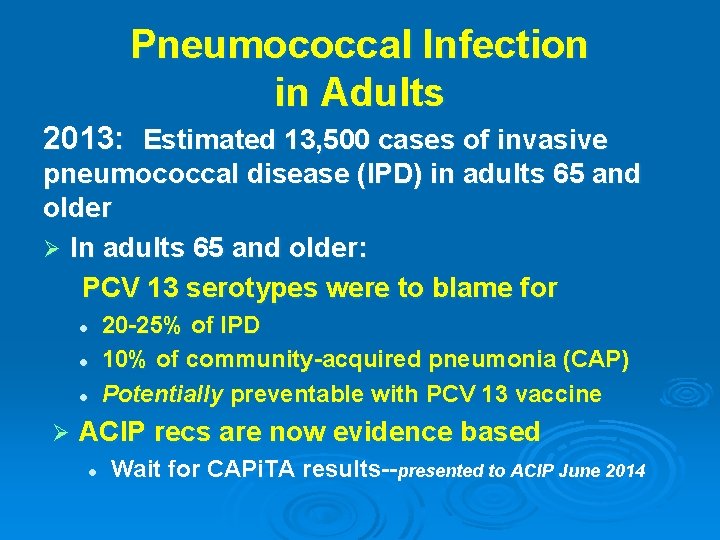
Pneumococcal Infection in Adults 2013: Estimated 13, 500 cases of invasive pneumococcal disease (IPD) in adults 65 and older Ø In adults 65 and older: PCV 13 serotypes were to blame for l l l Ø 20 -25% of IPD 10% of community-acquired pneumonia (CAP) Potentially preventable with PCV 13 vaccine ACIP recs are now evidence based l Wait for CAPi. TA results--presented to ACIP June 2014
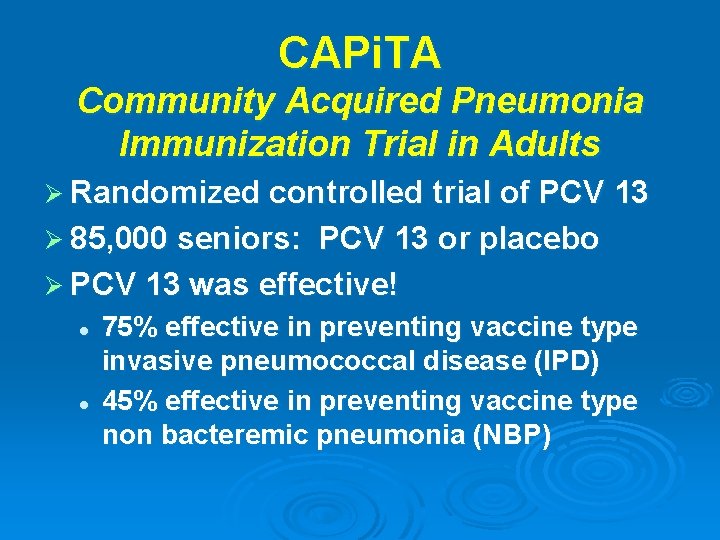
CAPi. TA Community Acquired Pneumonia Immunization Trial in Adults Ø Randomized controlled trial of PCV 13 Ø 85, 000 seniors: PCV 13 or placebo Ø PCV 13 was effective! l l 75% effective in preventing vaccine type invasive pneumococcal disease (IPD) 45% effective in preventing vaccine type non bacteremic pneumonia (NBP)
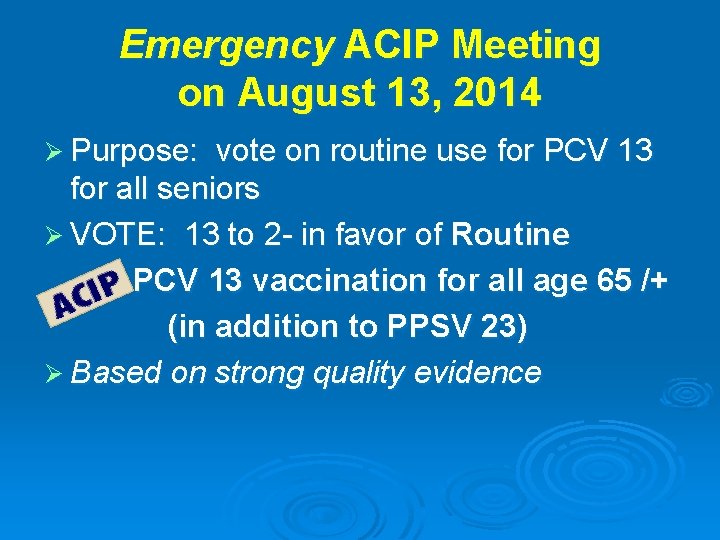
Emergency ACIP Meeting on August 13, 2014 Ø Purpose: vote on routine use for PCV 13 for all seniors Ø VOTE: 13 to 2 - in favor of Routine PCV 13 vaccination for all age 65 /+ (in addition to PPSV 23) Ø Based on strong quality evidence
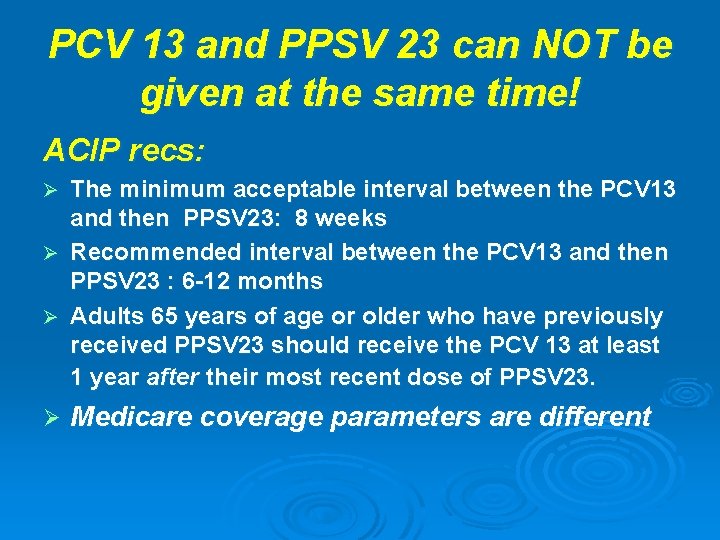
PCV 13 and PPSV 23 can NOT be given at the same time! ACIP recs: The minimum acceptable interval between the PCV 13 and then PPSV 23: 8 weeks Ø Recommended interval between the PCV 13 and then PPSV 23 : 6 -12 months Ø Adults 65 years of age or older who have previously received PPSV 23 should receive the PCV 13 at least 1 year after their most recent dose of PPSV 23. Ø Ø Medicare coverage parameters are different
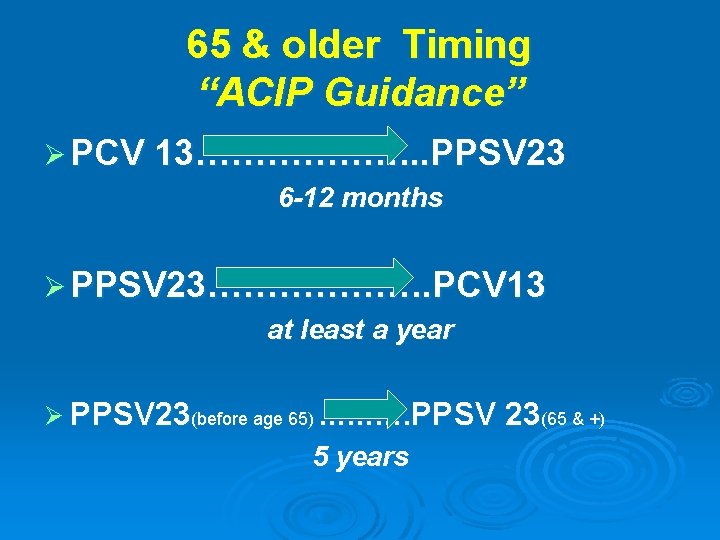
65 & older Timing “ACIP Guidance” Ø PCV 13………………. . PPSV 23 6 -12 months Ø PPSV 23………………. PCV 13 at least a year Ø PPSV 23(before age 65) ………. PPSV 23(65 & +) 5 years
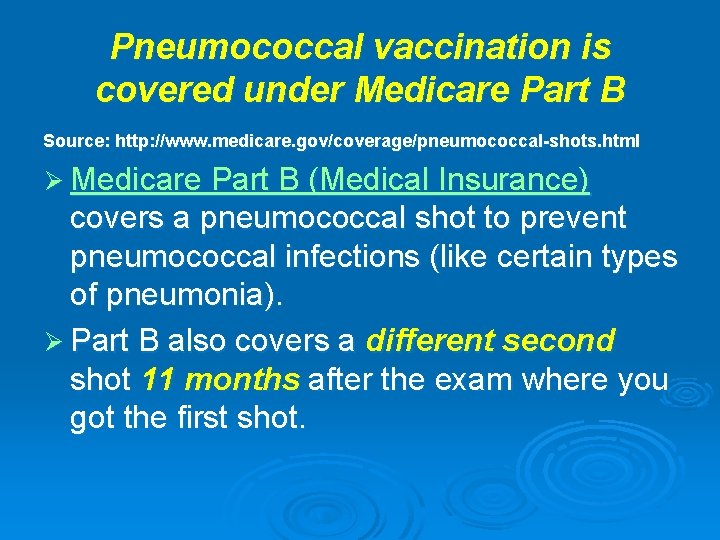
Pneumococcal vaccination is covered under Medicare Part B Source: http: //www. medicare. gov/coverage/pneumococcal-shots. html Ø Medicare Part B (Medical Insurance) covers a pneumococcal shot to prevent pneumococcal infections (like certain types of pneumonia). Ø Part B also covers a different second shot 11 months after the exam where you got the first shot.
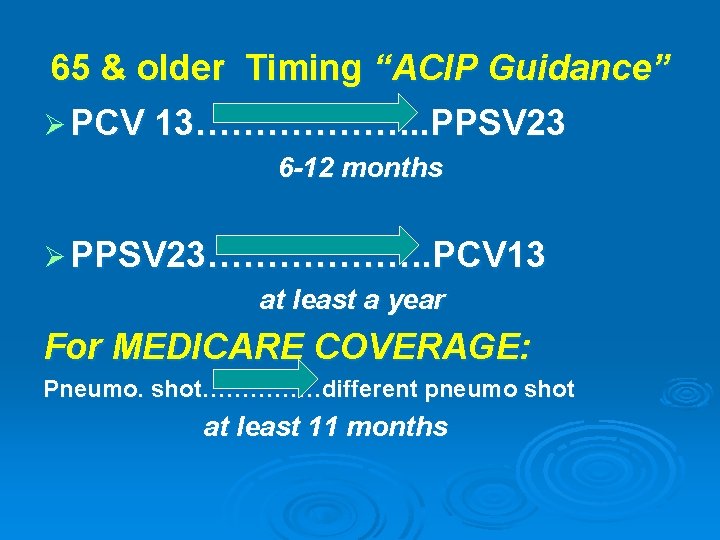
65 & older Timing “ACIP Guidance” Ø PCV 13………………. . PPSV 23 6 -12 months Ø PPSV 23………………. PCV 13 at least a year For MEDICARE COVERAGE: Pneumo. shot……………different pneumo shot at least 11 months
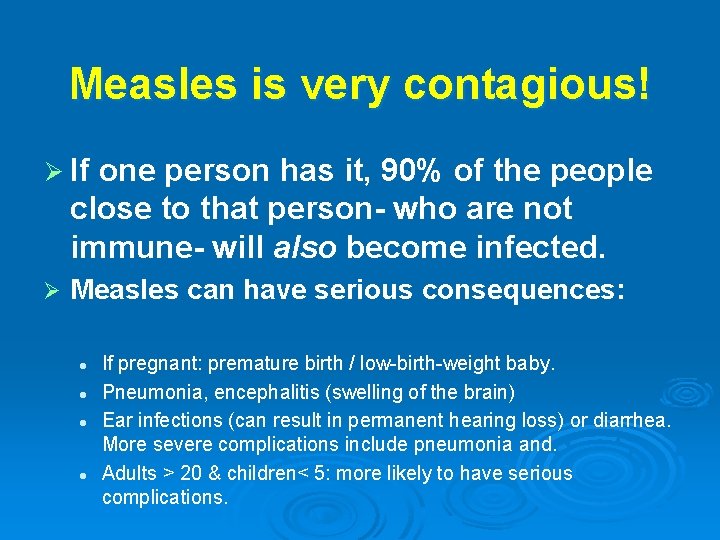
Measles is very contagious! Ø If one person has it, 90% of the people close to that person- who are not immune- will also become infected. Ø Measles can have serious consequences: l l If pregnant: premature birth / low-birth-weight baby. Pneumonia, encephalitis (swelling of the brain) Ear infections (can result in permanent hearing loss) or diarrhea. More severe complications include pneumonia and. Adults > 20 & children< 5: more likely to have serious complications.
Mumps can have serious consequences (after puberty): Ø inflammation of the testicles (orchitis) l Can (rarely) lead to sterility inflammation of the brain/spinal cord covering (encephalitis / meningitis) Ø inflammation of the ovaries (oophoritis) and/or breasts (mastitis) Ø can cause deafness (temporary or permanent) Ø
MMR Vaccine ØMeasles ØMumps ØRubella Ø If unsure if you’re immune : l l get antibody titers checked or get the shot!
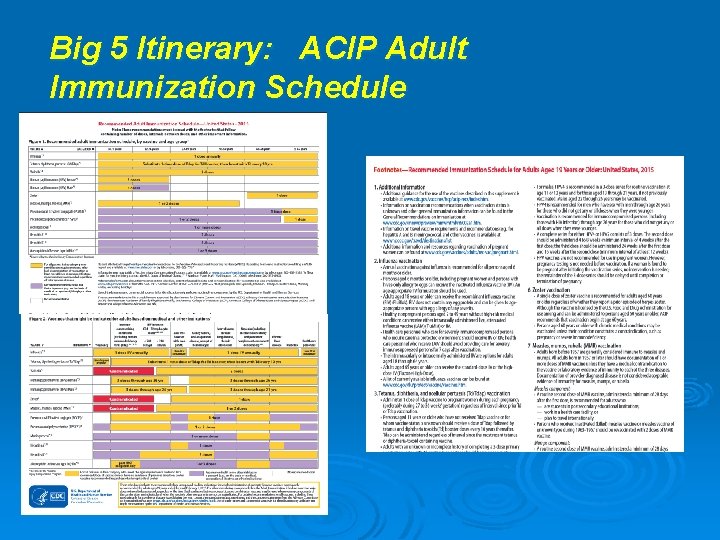
Big 5 Itinerary: ACIP Adult Immunization Schedule
Travel Immunizations www. CDC. gov/travel Country specific travel immunization & health recommendations Ø Yellow fever Ø Typhoid Ø Hepatitis A Ø Japanese encephalitis Ø Malaria prophylaxis (medication - there is not a vaccine) Ø Meds in case get Traveler's diarrhea Ø Insect repellant (DEET)
Final Thoughts “Vaccines are not just for kids…… Adults need them, too. ”
- Slides: 57