
Adult Education and Social Change A Practitioners Guide
- Slides: 11
Adult Education and Social Change: A Practitioners Guide Module 1 © 2013 PRIA International Academy | Appreciation Courses
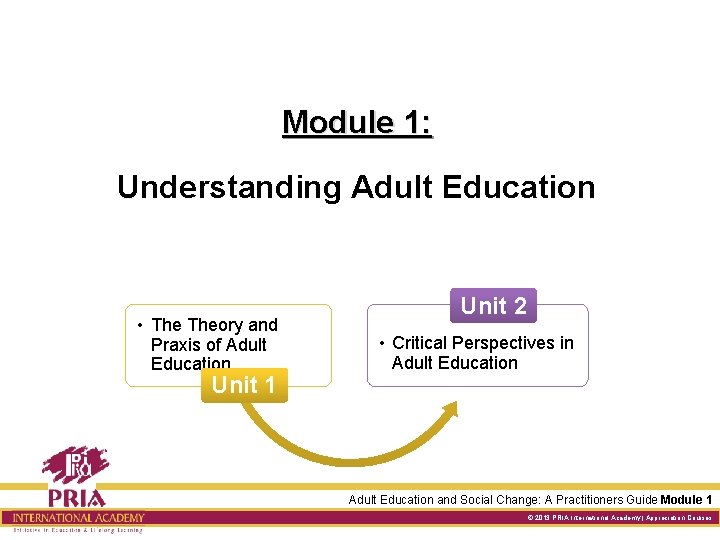
Module 1: Understanding Adult Education • Theory and Praxis of Adult Education Unit 1 Unit 2 • Critical Perspectives in Adult Education and Social Change: A Practitioners Guide Module 1 © 2013 PRIA International Academy | Appreciation Courses
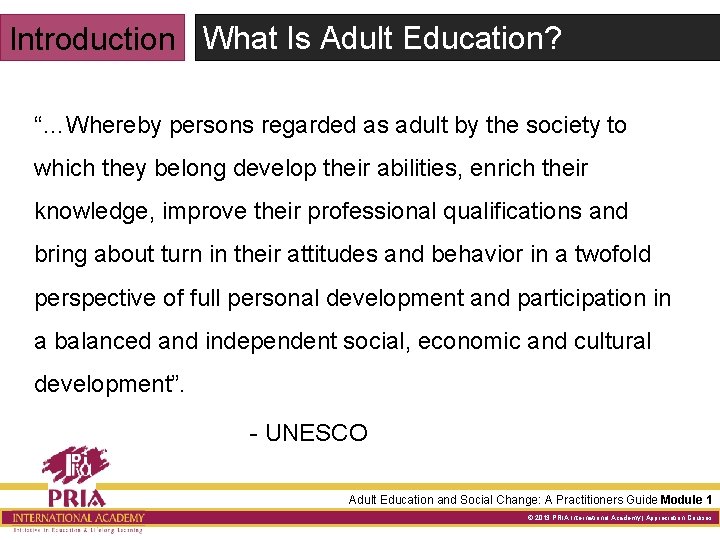
Introduction What Is Adult Education? “…Whereby persons regarded as adult by the society to which they belong develop their abilities, enrich their knowledge, improve their professional qualifications and bring about turn in their attitudes and behavior in a twofold perspective of full personal development and participation in a balanced and independent social, economic and cultural development”. - UNESCO Adult Education and Social Change: A Practitioners Guide Module 1 © 2013 PRIA International Academy | Appreciation Courses
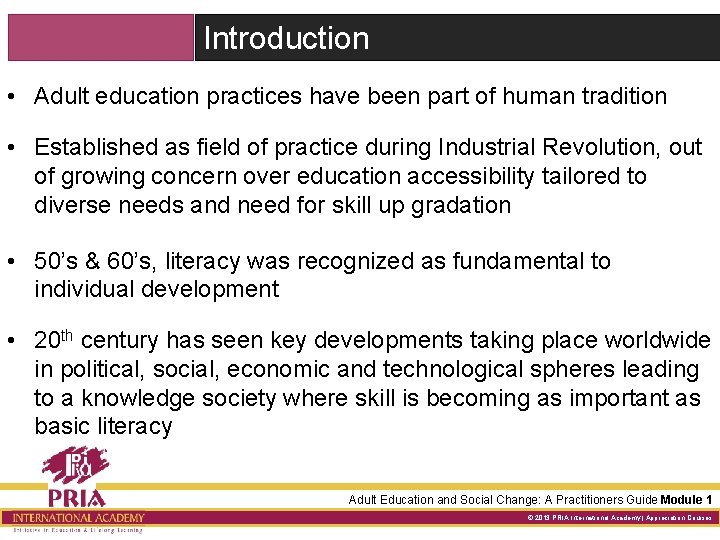
Introduction • Adult education practices have been part of human tradition • Established as field of practice during Industrial Revolution, out of growing concern over education accessibility tailored to diverse needs and need for skill up gradation • 50’s & 60’s, literacy was recognized as fundamental to individual development • 20 th century has seen key developments taking place worldwide in political, social, economic and technological spheres leading to a knowledge society where skill is becoming as important as basic literacy Adult Education and Social Change: A Practitioners Guide Module 1 © 2013 PRIA International Academy | Appreciation Courses
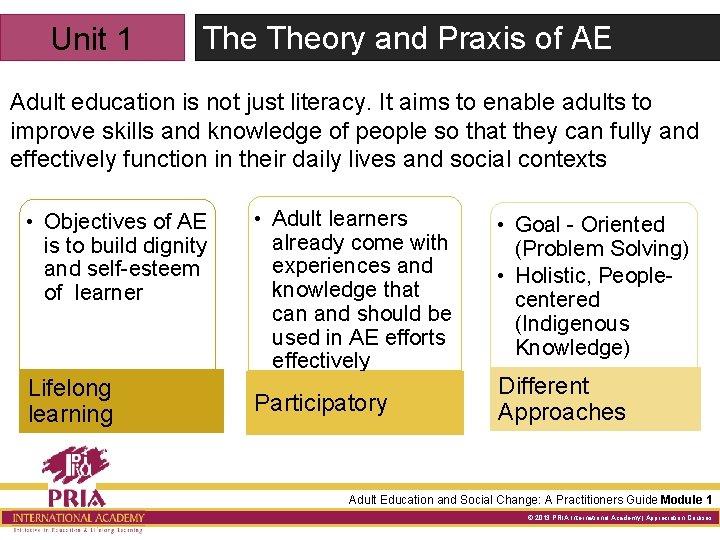
Unit 1 Theory and Praxis of AE Adult education is not just literacy. It aims to enable adults to improve skills and knowledge of people so that they can fully and effectively function in their daily lives and social contexts • Objectives of AE is to build dignity and self-esteem of learner Lifelong learning • Adult learners already come with experiences and knowledge that can and should be used in AE efforts effectively Participatory • Goal - Oriented (Problem Solving) • Holistic, Peoplecentered (Indigenous Knowledge) Different Approaches Adult Education and Social Change: A Practitioners Guide Module 1 © 2013 PRIA International Academy | Appreciation Courses
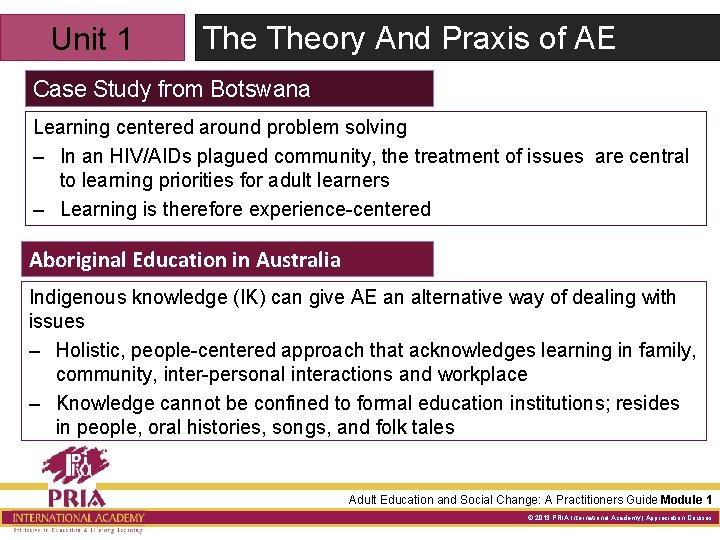
Unit 1 Theory And Praxis of AE Case Study from Botswana Learning centered around problem solving – In an HIV/AIDs plagued community, the treatment of issues are central to learning priorities for adult learners – Learning is therefore experience-centered Aboriginal Education in Australia Indigenous knowledge (IK) can give AE an alternative way of dealing with issues – Holistic, people-centered approach that acknowledges learning in family, community, inter-personal interactions and workplace – Knowledge cannot be confined to formal education institutions; resides in people, oral histories, songs, and folk tales Adult Education and Social Change: A Practitioners Guide Module 1 © 2013 PRIA International Academy | Appreciation Courses
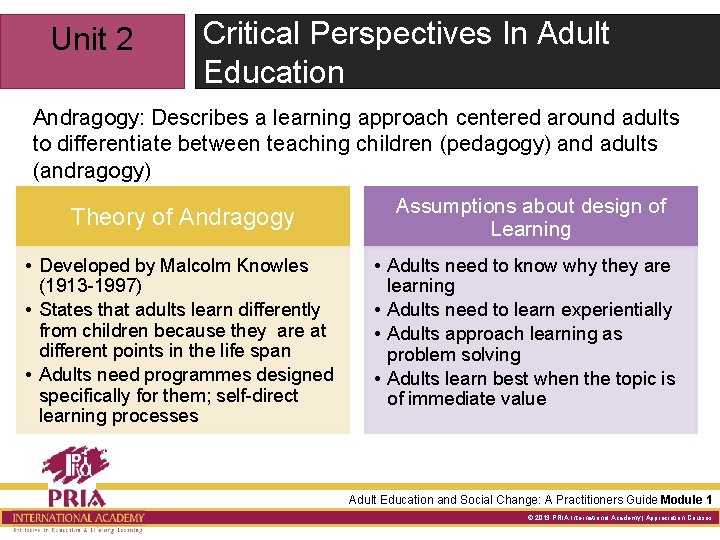
Unit 2 Critical Perspectives In Adult Education Andragogy: Describes a learning approach centered around adults to differentiate between teaching children (pedagogy) and adults (andragogy) Theory of Andragogy • Developed by Malcolm Knowles (1913 -1997) • States that adults learn differently from children because they are at different points in the life span • Adults need programmes designed specifically for them; self-direct learning processes Assumptions about design of Learning • Adults need to know why they are learning • Adults need to learn experientially • Adults approach learning as problem solving • Adults learn best when the topic is of immediate value Adult Education and Social Change: A Practitioners Guide Module 1 © 2013 PRIA International Academy | Appreciation Courses
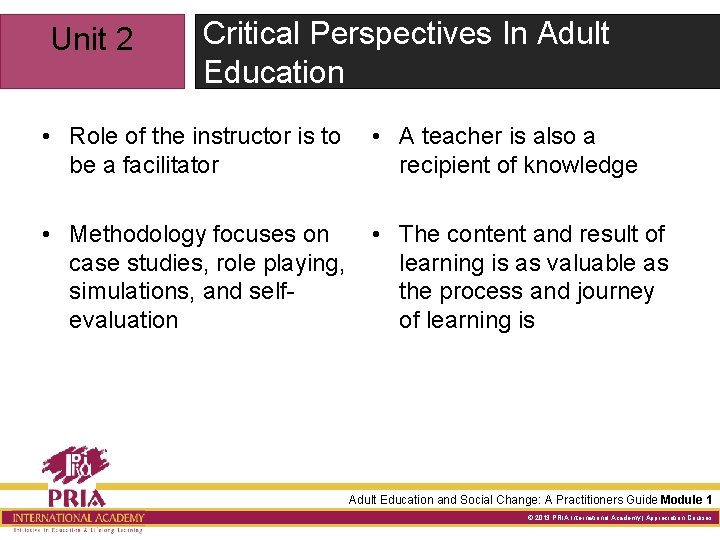
Unit 2 Critical Perspectives In Adult Education • Role of the instructor is to be a facilitator • A teacher is also a recipient of knowledge • Methodology focuses on case studies, role playing, simulations, and selfevaluation • The content and result of learning is as valuable as the process and journey of learning is Adult Education and Social Change: A Practitioners Guide Module 1 © 2013 PRIA International Academy | Appreciation Courses
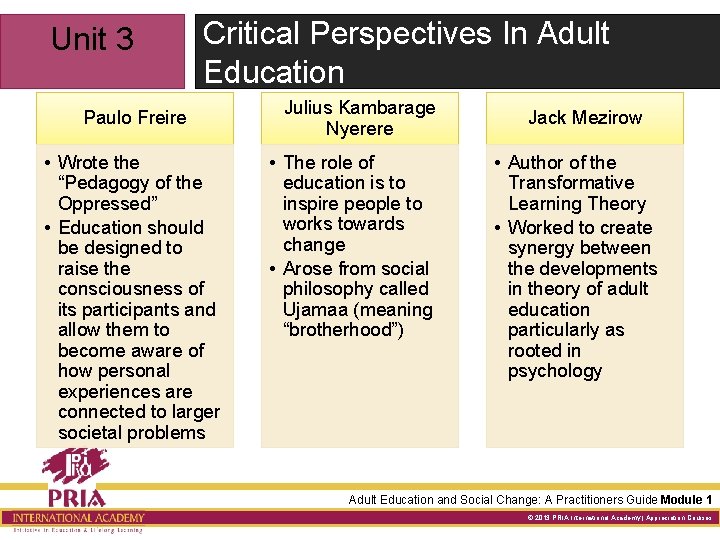
Unit 3 Critical Perspectives In Adult Education Paulo Freire • Wrote the “Pedagogy of the Oppressed” • Education should be designed to raise the consciousness of its participants and allow them to become aware of how personal experiences are connected to larger societal problems Julius Kambarage Nyerere • The role of education is to inspire people to works towards change • Arose from social philosophy called Ujamaa (meaning “brotherhood”) Jack Mezirow • Author of the Transformative Learning Theory • Worked to create synergy between the developments in theory of adult education particularly as rooted in psychology Adult Education and Social Change: A Practitioners Guide Module 1 © 2013 PRIA International Academy | Appreciation Courses
Unit 2 Critical Perspectives In Adult Education Why use Adult Education for Social Change? AE allows for collective and conscious learning leading to a more just society Example: Feminist Movement During mid-1980’s, feminist movement fought for recognition of women’s knowledge and goal to achieve representation in public sphere Adult Education and Social Change: A Practitioners Guide Module 1 © 2013 PRIA International Academy | Appreciation Courses
Summary Key Points to Remember • Adult Education (AE) emerged in mid-nineteenth century but its momentum came after WWII • Andragogy has been reinterpreted and redefined to reflect various learning needs of adults • There remain challenges and resistance because adults are comfortable with routines and want to know why a change is needed in their lifestyles • Must be based on idea of lifelong learning i. e. to create multiple options for adults to learn throughout life Adult Education and Social Change: A Practitioners Guide Module 1 © 2013 PRIA International Academy | Appreciation Courses