
Adult CTAS First Order Modifiers CEDIS and CTAS
- Slides: 1
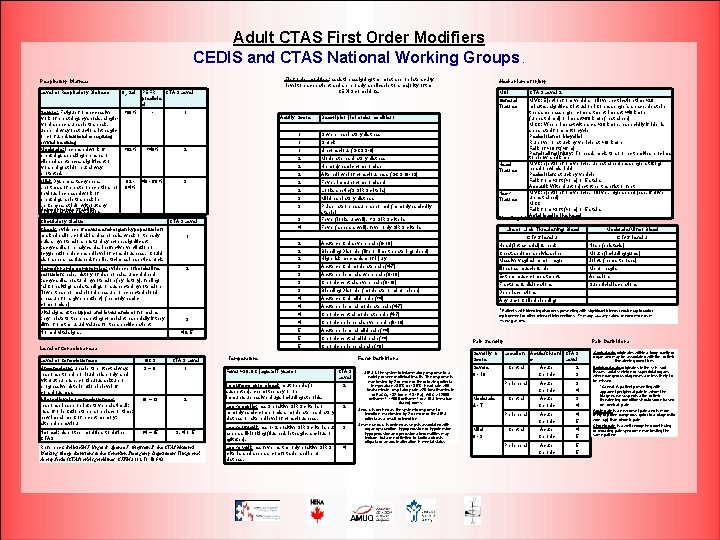
Adult CTAS First Order Modifiers CEDIS and CTAS National Working Groups. First order modifiers: assist in assigning the most appropriate acuity level to each patient and are broadly applicable to a majority of the CEDIS complaints. Respiratory Distress Level of Respiratory Distress Severe: Fatigue from excessive work of breathing, cyanosis, singleword speech, unable to speak, upper airway obstruction, lethargic or confused, intubated or requiring assisted breathing. Moderate: Increased work of breathing, speaking phrases or clipped sentences, significant or worsening stridor but airway protected. Mild: Dyspnea, tachypnea, shortness of breath on exertion, no obvious increased work of breathing, able to speak in sentences, stridor without any Hemodynamic Stability obvious airway obstruction. O 2 Sat <90% PEFR CTAS Level predicte d 1 92 94% <40% 40 - 60% Circulatory Status 2 3 CTAS Level Shock: evidence of severe end-organ hypoperfusion: marked pallor, cool skin, diaphoresis, weak or thready pulse, hypotension, postural syncope, significant tachycardia or bradycardia, ineffective ventilation or oxygenation, decreased level of consciousness. Could also appear as flushed, febrile, toxic, as in septic shock. Hemodynamic compromise: evidence of borderline perfusion; pale, history of diaphoresis, unexplained tachycardia, postural hypotension (by history), feeling faint on sitting and standing, or suspected hypotension (lower than normal blood pressure or expected blood pressure for a given patient) (hemodynamic compromise) Vital signs at the upper and lower ends of normal as they relate to the presenting complaint, especially if they differ from the usual values for the specific patient Normal vital signs. 3 Level of Consciousness GCS CTAS Level Unconscious: unable to protect airway, response to pain or loud noise only and without purpose, continuous seizure or progressive deterioration in level of consciousness Altered level of consciousness: response inappropriate to verbal stimuli; loss of orientation to person place or time; new impairment of recent memory; altered behaviour 3– 9 1 Normal: Use other modifiers to define CTAS 14 – 15 Descriptor (1 st order modifier) 1 Severe respiratory distress 1 Shock 1 Unconscious (GCS 3 -9) 2 Moderate respiratory distress 2 Hemodynamic compromise 2 Altered level of consciousness (GCS 10 -13) 2 Fever, immunocompromised 2 Looks septic (3 SIRS criteria) 3 Mild respiratory distress 3 3 Pulse rate / pressure abnormal (hemodynamically stable) Fever (looks unwell), < 3 SIRS criteria 4 Fever (appears well), fever only SIRS criteria Life or Limb Threatening Bleed 2 3, 4 or 5 Reference: Bullard MJ, Unger B, Spence J, Grafstein E, the CTAS National Working Group. Revisions to the Canadian Emergency Department Triage and Acuity Scale (CTAS) adult guidelines. CJEM 2008; 10: 136 -42 Moderate/Minor Bleed CTAS level 2 2 Level of Consciousness CTAS Level 2 MVC: Ejection from vehicle, rollover, extrication time>20 minutes, significant intrusion into passenger’s space, death in the same passenger compartment, impact >40 km/h (unrestrained) or impact>60 km/h (restrained) MCC: Where impact with a car>30 km/hr, especially if rider is separated from motorcycle Pedestrian or bicyclist Run over or struck by vehicle at >10 km/h Fall: of >18 ft (>6 m) Penetrating injury: To head, neck, torso or extremities proximal to elbow and knee MVC: ejection from vehicle, unrestrained passenger striking Head head on windshield Trauma Pedestrian: struck by vehicle Fall: from >3 ft (>1 m) or 5 stairs Assault: With blunt object other than fist or feet MVC: ejection from vehicle, rollover, high speed (esp. if driver Neck unrestrained) Trauma MCC Fall: from >3 ft (>1 m) or 5 stairs Axial load to the head Bleeding Disorder 1 4&5 10 – 13 MOI General Trauma Acuity Score <92% Mechanism of Injury CTAS level 3 2 Acute central severe pain (8 -10) Head (intracranial) & neck Nose (epistaxis) 2 Bleeding Disorder (life or limb threatening bleed) Chest, abdomen, pelvis, spine Mouth (including gums) 2 High risk mechanism of injury Massive vaginal hemorrhage Joints (hemarthroses) 3 Acute central moderate pain (4 -7) Iliopsoas muscle & hip Menorrhagia 3 Acute peripheral severe pain (8 -10) Extrem musc compartments Abrasions 3 Chronic central severe pain (8 -10) Fractures & dislocations Superficial lacerations 3 Bleeding Disorder (moderate or minor bleed) Deep lacerations 4 Acute central mild pain (<4) Any uncontrolled bleeding 4 Acute peripheral moderate pain (4 -7) 4 Chronic central moderate pain (4 -7) 4 Chronic peripheral severe pain (8 -10) 5 Acute peripheral mild pain (<4) 5 Chronic central mild pain (<4) 5 Chronic peripheral pain (<8) Temperature Fever >38. 0 C (age ≥ 17 years) Fever Definitions CTAS Level Immunocompromised: neutropenia (or suspected), chemotherapy or on immunosupressive drugs including steroids. 2 Looks septic: has 3 positive SIRS criteria or hemodynamic compromise, moderate respiratory distress or altered level of consciousness. 2 Looks unwell: has 1 - 2 positive SIRS criteria but appears ill-looking (flushed, lethargic, anxious or agitated). 3 Looks well: has fever as the only positive SIRS criteria and appears comfortable and in no distress. 4 SIRS is the systemic inflammatory response to a variety of severe clinical insults. The response is manifested by 2 or more of the following criteria: temperature >38°C or <36°C; heart rate >90 beats/minute; respiratory rate >20 breaths/minute or Pa. CO 2 <32 torr (<4. 3 k. Pa); WBC >12000 cells/mm 3, <4000 cells/mm 3 or >10% immature (band) forms. Sepsis is defined as the systemic response to infection, manifested by 2 or more of the SIRS criteria as a result of infection. Severe sepsis is defined as sepsis associated with organ dysfunction, hypoperfusion or hypotension; hypoperfusion and perfusion abnormalities may include, but are not limited to, lactic acidosis, oliguria or an acute alteration in mental status. *Patients with bleeding disorders presenting with significant bleeds require rapid factor replacement or other relevant interventions. Therapy usually takes precedence over investigations. Pain Severity & Score Severe 8 - 10 Moderate 4 -7 Mild 0 -3 Pain Definitions Location Acute/Chroni CTAS c Level Central Acute Chronic 2 3 Peripheral Acute Chronic 3 4 Central Acute Chronic 3 4 Peripheral Acute Chronic 4 5 Central Acute Chronic 4 5 Peripheral Acute Chronic 5 5 Central pain originates within a body cavity or organ and may be associated with life- or limb -threatening conditions. Peripheral pain originates in the skin, soft tissues, axial skeleton or superficial organs where dangerous diagnoses are less likely to be missed. *Caveat: A patient presenting with apparent peripheral pain in whom the triage nurse suspects a life or limb threatening condition should score based on “central” pain. Acute pain is a new onset pain and is more likely to prove dangerous (prior to a diagnostic work-up) than chronic pain. Chronic pain is a well-recognized continuing or recurring pain syndrome manifesting the same pattern.