
ADTs and vectors towards linked lists l tvector



- Slides: 20
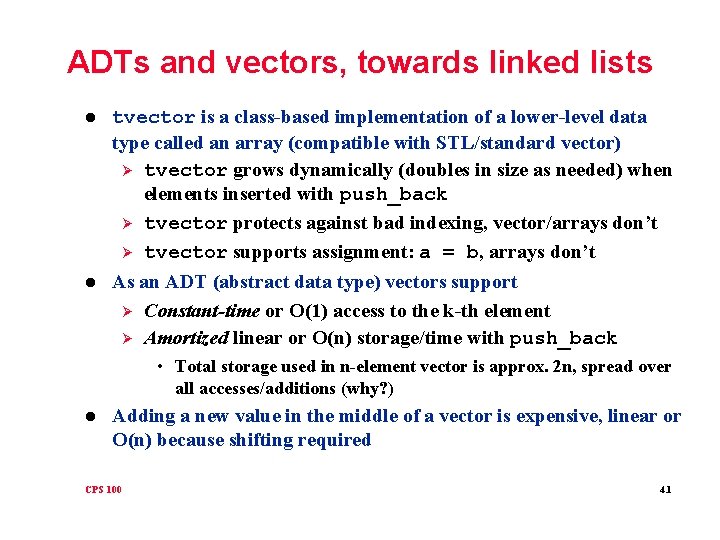
ADTs and vectors, towards linked lists l tvector is a class-based implementation of a lower-level data type called an array (compatible with STL/standard vector) Ø tvector grows dynamically (doubles in size as needed) when elements inserted with push_back Ø tvector protects against bad indexing, vector/arrays don’t Ø tvector supports assignment: a = b, arrays don’t l As an ADT (abstract data type) vectors support Ø Constant-time or O(1) access to the k-th element Ø Amortized linear or O(n) storage/time with push_back • Total storage used in n-element vector is approx. 2 n, spread over all accesses/additions (why? ) l Adding a new value in the middle of a vector is expensive, linear or O(n) because shifting required CPS 100 4. 1
What is big-Oh about? (preview) l Intuition: avoid details when they don’t matter, and they don’t matter when input size (N) is big enough Ø For polynomials, use only leading term, ignore coefficients y = 3 x y = x 2 l y = 6 x-2 y = x 2 -6 x+9 y = 15 x + 44 y = 3 x 2+4 x The first family is O(n), the second is O(n 2) Ø Intuition: family of curves, generally the same shape Ø More formally: O(f(n)) is an upper-bound, when n is large enough the expression cf(n) is larger Ø Intuition: linear function: double input, double time, quadratic function: double input, quadruple the time CPS 100 4. 2
More on O-notation, big-Oh l Big-Oh hides/obscures some empirical analysis, but is good for general description of algorithm Ø Allows us to compare algorithms in the limit • 20 N hours vs N 2 microseconds: which is better? l O-notation is an upper-bound, this means that N is O(N), but it is also O(N 2); we try to provide tight bounds. Formally: Ø A function g(N) is, by definition, O(f(N)) if there exist constants c and n such that g(N) < cf(N) for all N > n cf(N) g(N) x = n CPS 100 4. 3
Big-Oh calculations from code l Add a new element at front of vector by shifting, complexity? Ø Only count vector assignments in code below, don’t account for vector growing a. push_back(new. Element); // make room for it for(int k=a. size()-1; k >=0; k--) { a[k+1] = a[k]; // shift right }; a[0] = new. Element; If we call the code above N times on an initially empty vector, what’s the complexity using big-Oh? Now, what about complexity of growing a vector after N insertions Ø If vector doubles in size? If vector increases by one? Ø l CPS 100 4. 4
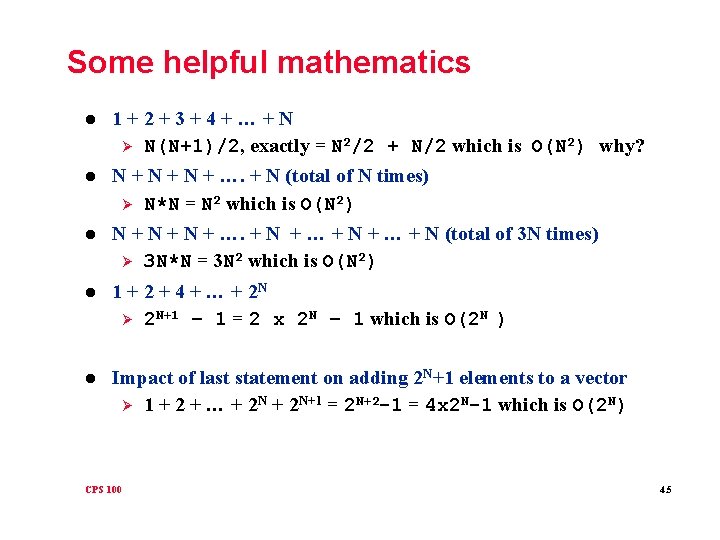
Some helpful mathematics l 1+2+3+4+…+N Ø N(N+1)/2, exactly = N 2/2 + N/2 which is O(N 2) why? l N + N + …. + N (total of N times) Ø N*N = N 2 which is O(N 2) l N + N + … + N (total of 3 N times) Ø 3 N*N = 3 N 2 which is O(N 2) l 1 + 2 + 4 + … + 2 N Ø 2 N+1 – 1 = 2 x 2 N – 1 which is O(2 N ) l Impact of last statement on adding 2 N+1 elements to a vector Ø 1 + 2 + … + 2 N+1 = 2 N+2 -1 = 4 x 2 N-1 which is O(2 N) CPS 100 4. 5
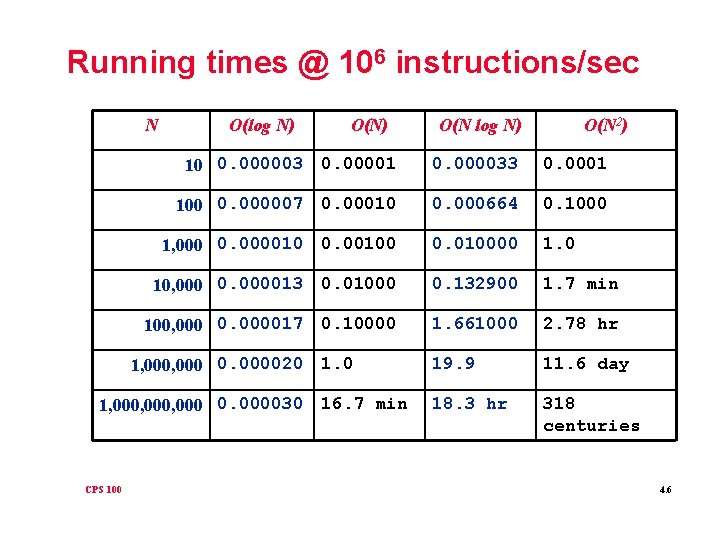
Running times @ 106 instructions/sec N O(log N) O(N 2) 10 0. 000003 0. 00001 0. 000033 0. 0001 100 0. 000007 0. 00010 0. 000664 0. 1000 1, 000 0. 000010 0. 00100 0. 010000 1. 0 10, 000 0. 000013 0. 01000 0. 132900 1. 7 min 100, 000 0. 000017 0. 10000 1. 661000 2. 78 hr 19. 9 11. 6 day 18. 3 hr 318 centuries 1, 000 0. 000020 1. 0 1, 000, 000 0. 000030 16. 7 min CPS 100 O(N log N) 4. 6
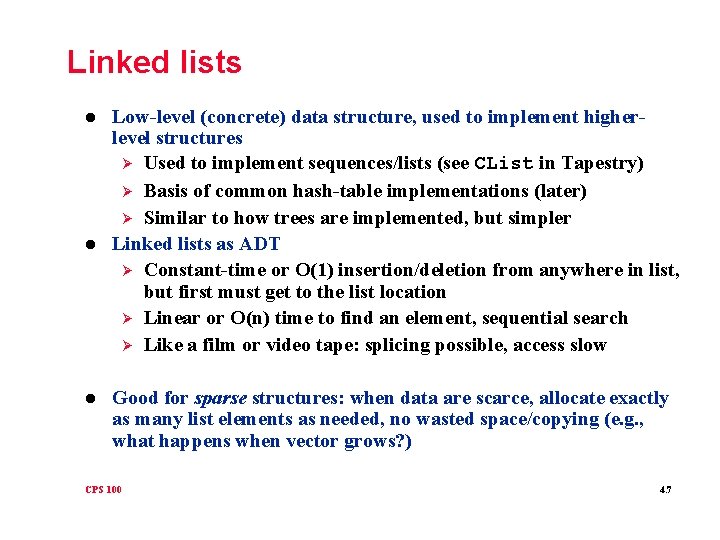
Linked lists l l l Low-level (concrete) data structure, used to implement higherlevel structures Ø Used to implement sequences/lists (see CList in Tapestry) Ø Basis of common hash-table implementations (later) Ø Similar to how trees are implemented, but simpler Linked lists as ADT Ø Constant-time or O(1) insertion/deletion from anywhere in list, but first must get to the list location Ø Linear or O(n) time to find an element, sequential search Ø Like a film or video tape: splicing possible, access slow Good for sparse structures: when data are scarce, allocate exactly as many list elements as needed, no wasted space/copying (e. g. , what happens when vector grows? ) CPS 100 4. 7
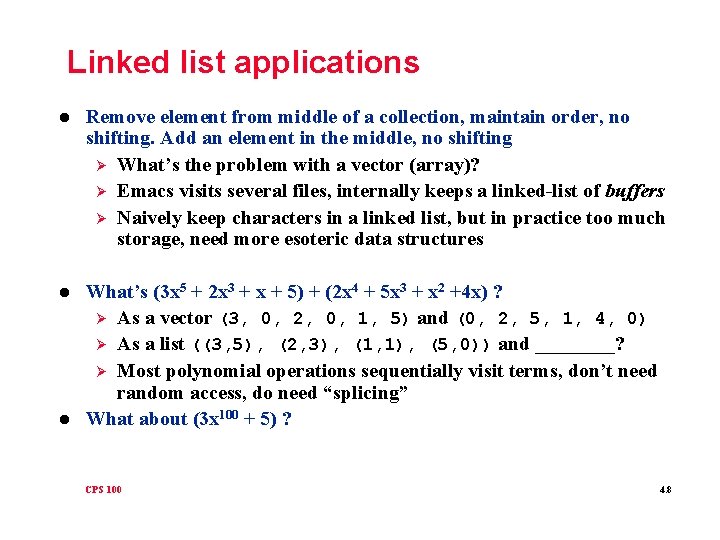
Linked list applications l Remove element from middle of a collection, maintain order, no shifting. Add an element in the middle, no shifting Ø What’s the problem with a vector (array)? Ø Emacs visits several files, internally keeps a linked-list of buffers Ø Naively keep characters in a linked list, but in practice too much storage, need more esoteric data structures l What’s (3 x 5 + 2 x 3 + x + 5) + (2 x 4 + 5 x 3 + x 2 +4 x) ? Ø As a vector (3, 0, 2, 0, 1, 5) and (0, 2, 5, 1, 4, 0) Ø As a list ((3, 5), (2, 3), (1, 1), (5, 0)) and ____? Ø Most polynomial operations sequentially visit terms, don’t need random access, do need “splicing” What about (3 x 100 + 5) ? l CPS 100 4. 8
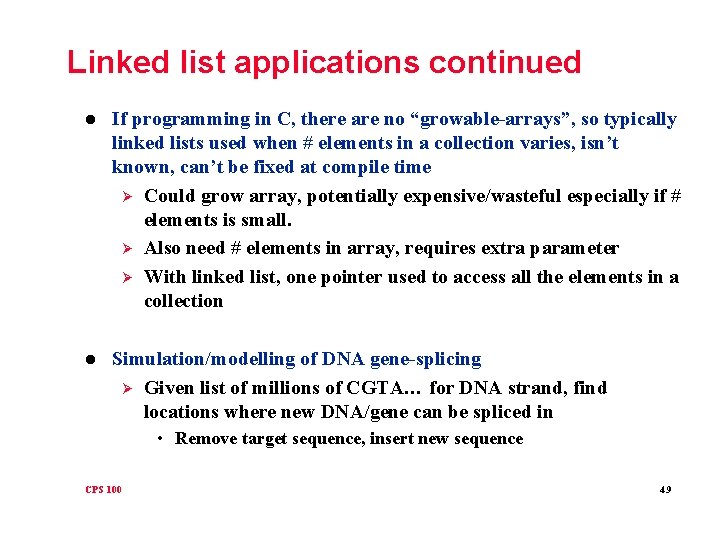
Linked list applications continued l If programming in C, there are no “growable-arrays”, so typically linked lists used when # elements in a collection varies, isn’t known, can’t be fixed at compile time Ø Could grow array, potentially expensive/wasteful especially if # elements is small. Ø Also need # elements in array, requires extra parameter Ø With linked list, one pointer used to access all the elements in a collection l Simulation/modelling of DNA gene-splicing Ø Given list of millions of CGTA… for DNA strand, find locations where new DNA/gene can be spliced in • Remove target sequence, insert new sequence CPS 100 4. 9
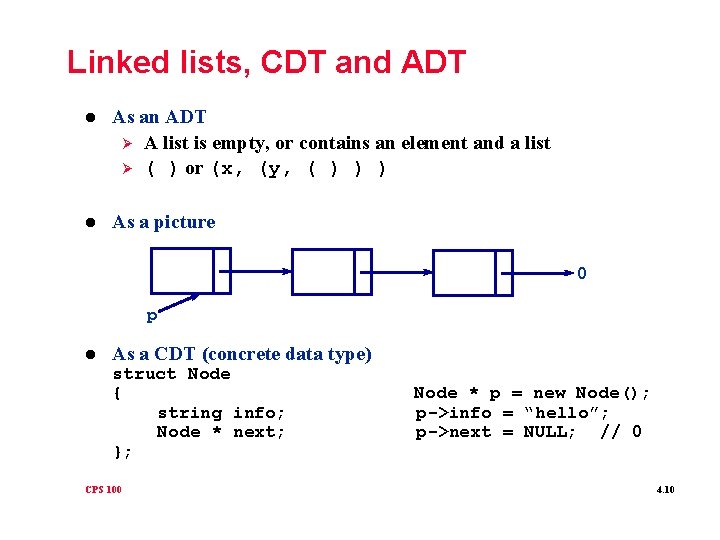
Linked lists, CDT and ADT l As an ADT Ø A list is empty, or contains an element and a list Ø ( ) or (x, (y, ( ) ) ) l As a picture 0 p l As a CDT (concrete data type) struct Node { string info; Node * next; }; CPS 100 Node * p = new Node(); p->info = “hello”; p->next = NULL; // 0 4. 10
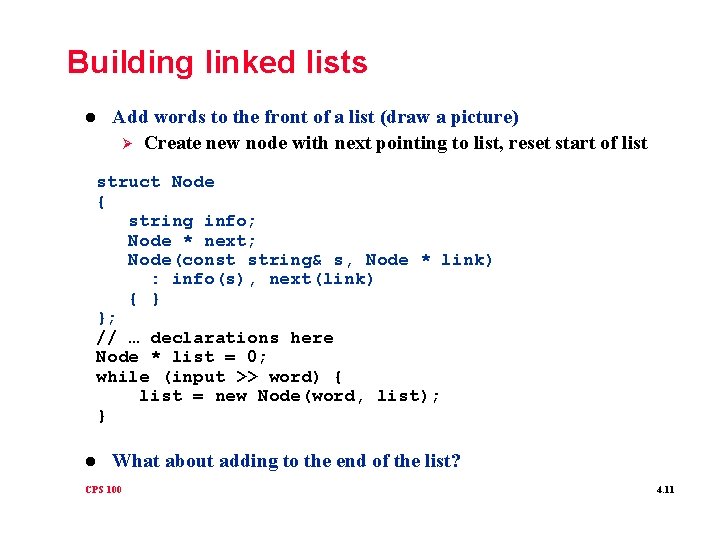
Building linked lists l Add words to the front of a list (draw a picture) Ø Create new node with next pointing to list, reset start of list struct Node { string info; Node * next; Node(const string& s, Node * link) : info(s), next(link) { } }; // … declarations here Node * list = 0; while (input >> word) { list = new Node(word, list); } l What about adding to the end of the list? CPS 100 4. 11
Dissection of add-to-front l l List initially empty First node has first word list A list = new Node(word, list); Node(const string& s, Node * link) : info(s), next(link) { } B l l Each new word causes new node to be created Ø New node added to front Rhs of operator = completely evaluated before assignment CPS 100 4. 12
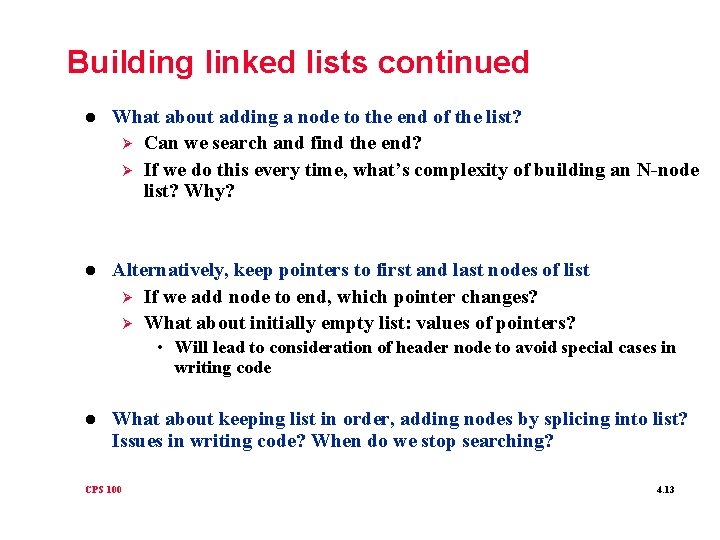
Building linked lists continued l What about adding a node to the end of the list? Ø Can we search and find the end? Ø If we do this every time, what’s complexity of building an N-node list? Why? l Alternatively, keep pointers to first and last nodes of list Ø If we add node to end, which pointer changes? Ø What about initially empty list: values of pointers? • Will lead to consideration of header node to avoid special cases in writing code l What about keeping list in order, adding nodes by splicing into list? Issues in writing code? When do we stop searching? CPS 100 4. 13
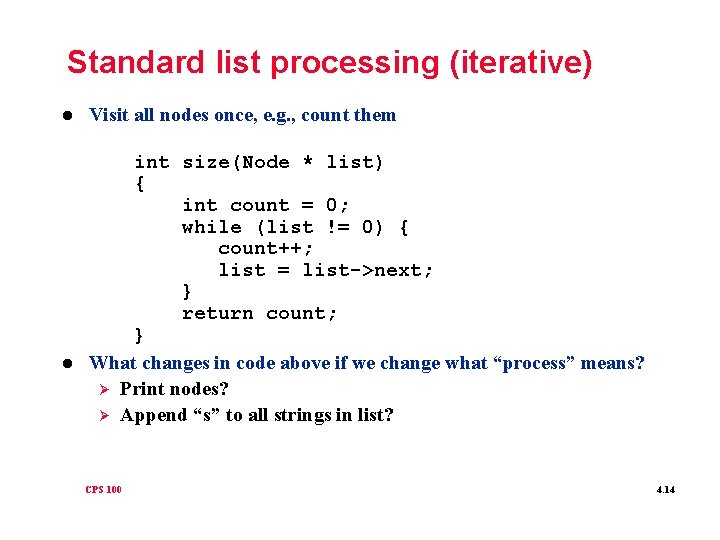
Standard list processing (iterative) l l Visit all nodes once, e. g. , count them int size(Node * list) { int count = 0; while (list != 0) { count++; list = list->next; } return count; } What changes in code above if we change what “process” means? Ø Print nodes? Ø Append “s” to all strings in list? CPS 100 4. 14
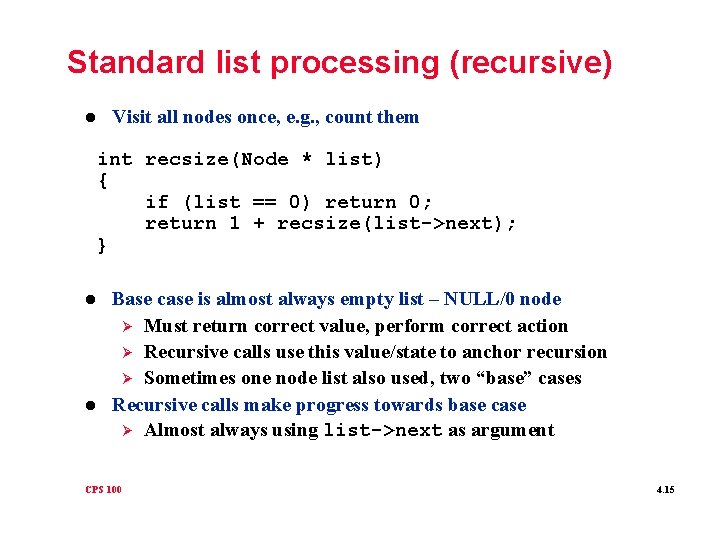
Standard list processing (recursive) l Visit all nodes once, e. g. , count them int recsize(Node * list) { if (list == 0) return 0; return 1 + recsize(list->next); } l l Base case is almost always empty list – NULL/0 node Ø Must return correct value, perform correct action Ø Recursive calls use this value/state to anchor recursion Ø Sometimes one node list also used, two “base” cases Recursive calls make progress towards base case Ø Almost always using list->next as argument CPS 100 4. 15
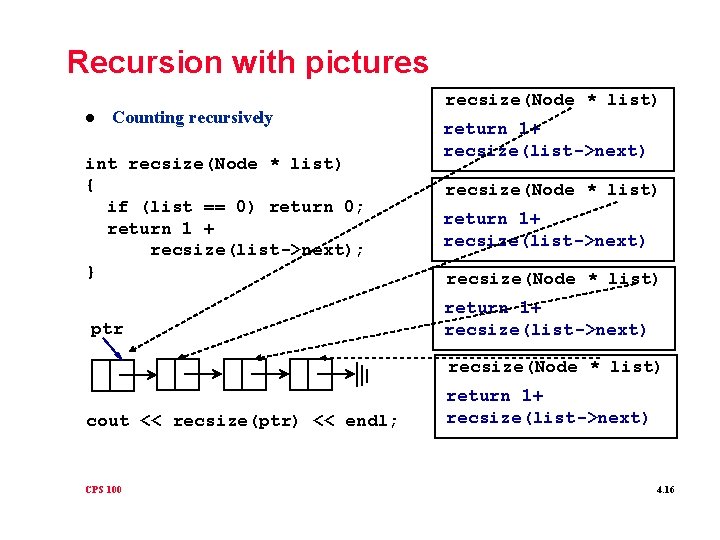
Recursion with pictures l Counting recursively int recsize(Node * list) { if (list == 0) return 0; return 1 + recsize(list->next); } ptr recsize(Node * list) return 1+ recsize(list->next) recsize(Node * list) cout << recsize(ptr) << endl; CPS 100 return 1+ recsize(list->next) 4. 16
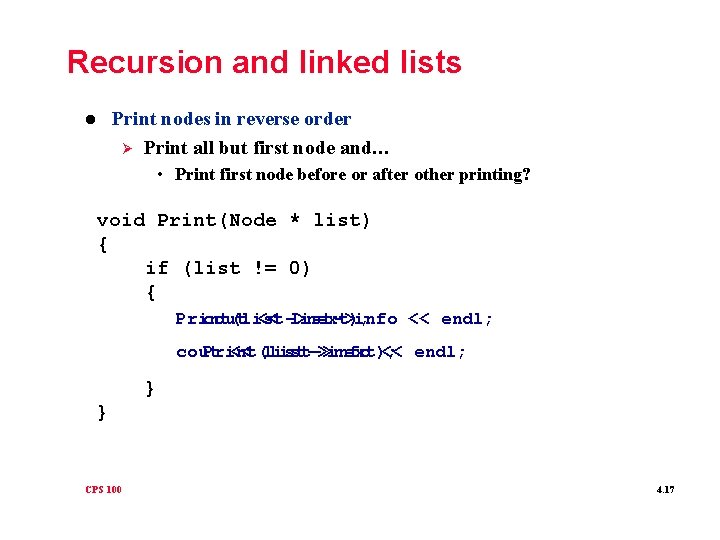
Recursion and linked lists Print nodes in reverse order Ø Print all but first node and… l • Print first node before or after other printing? void Print(Node * list) { if (list != 0) { Print(list->next); cout << list->info << endl; cout Print(list->next); << list->info << endl; } } CPS 100 4. 17
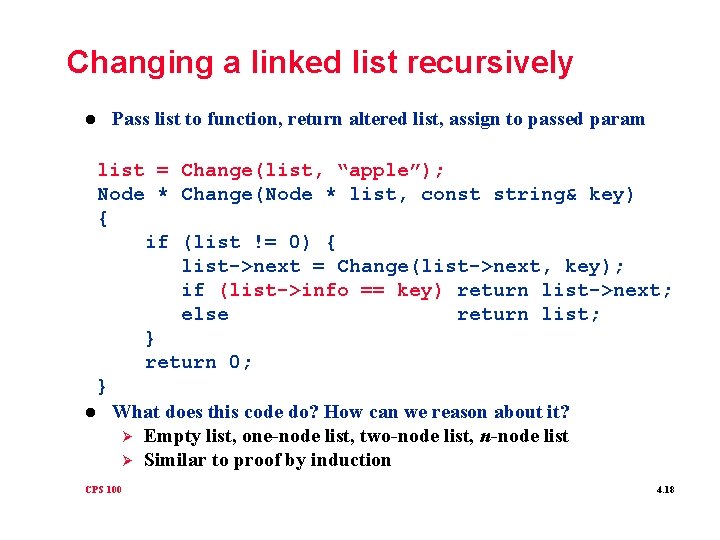
Changing a linked list recursively l Pass list to function, return altered list, assign to passed param list = Change(list, “apple”); Node * Change(Node * list, const string& key) { if (list != 0) { list->next = Change(list->next, key); if (list->info == key) return list->next; else return list; } return 0; } l What does this code do? How can we reason about it? Ø Empty list, one-node list, two-node list, n-node list Ø Similar to proof by induction CPS 100 4. 18
Header (aka dummy) nodes l Special cases in code lead to problems Ø Permeate the code, hard to reason about correctness Ø Avoid special cases when trade-offs permit • Space, time trade-offs l In linked lists it is useful to have a header node, the empty list is not NULL/0, but a single “blank” node Ø Every node has a node before it, avoid special code for empty lists Ø Header node is skipped by some functions, e. g. , count the values in a list Ø What about a special “trailing” node? Ø What value is stored in the header node? CPS 100 4. 19
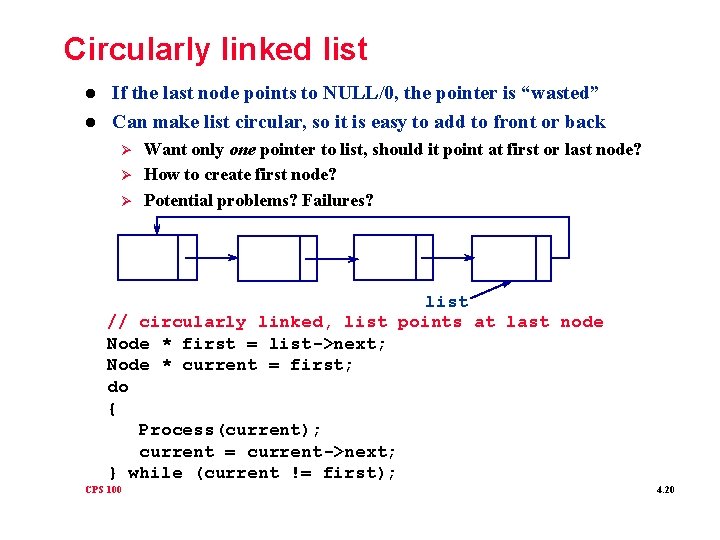
Circularly linked list l l If the last node points to NULL/0, the pointer is “wasted” Can make list circular, so it is easy to add to front or back Ø Ø Ø Want only one pointer to list, should it point at first or last node? How to create first node? Potential problems? Failures? list // circularly linked, list points at last node Node * first = list->next; Node * current = first; do { Process(current); current = current->next; } while (current != first); CPS 100 4. 20