
ADT 2010 Introduction to XML XPath XQuery Chapter





- Slides: 14
ADT 2010 Introduction to (XML, XPath &) XQuery Chapter 10 in Silberschatz, Korth, Sudarshan “Database System Concepts” Stefan Manegold Stefan. Manegold@cwi. nl http: //www. cwi. nl/~manegold/
XML Databases why • Motivation & The Big Picture: XML, DTD, XML Schema, XPath WHAT • Crash Course XQuery who • XML files Saxon, Galax, GNU Qexo • XML DBMS e. Xist, Berkeley. DB, Monet. DB, X-Hive, Tamino, Xyleme • XML RDBMS Oracle 10 g, SQLserver 2005, DB 2 how • Under The Hood of Monet. DB/XQuery • Some Benchmarks Stefan. Manegold@CWI. nl Introduction to XML, XPath & XQuery ADT 2010
XQuery A full-fledged XQuery implementation is available: ⊳ Monet. DB/XQuery: http: //monetdb-xquery. org/ Stefan. Manegold@CWI. nl Introduction to XML, XPath & XQuery ADT 2010
XQuery Stefan. Manegold@CWI. nl Introduction to XML, XPath & XQuery ADT 2010
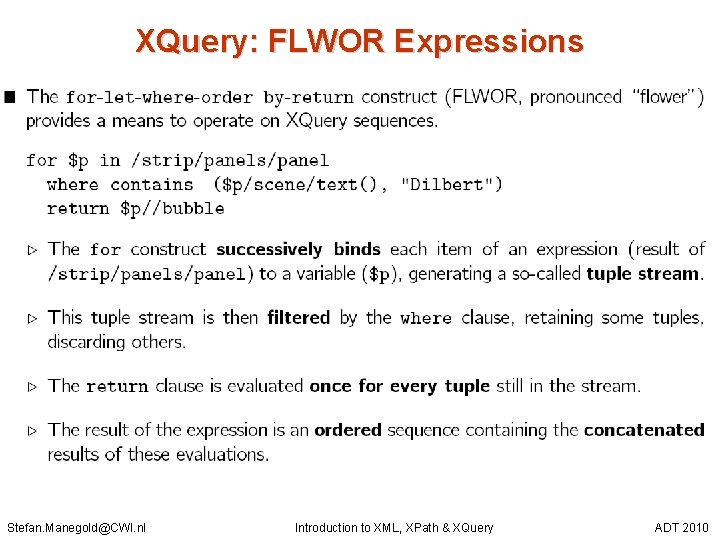
XQuery: FLWOR Expressions Stefan. Manegold@CWI. nl Introduction to XML, XPath & XQuery ADT 2010
XQuery Example Stefan. Manegold@CWI. nl Introduction to XML, XPath & XQuery ADT 2010
XQuery Example (1, 10) (1, 20) (2, 10) (2, 20) (3, 10) (3, 20) Stefan. Manegold@CWI. nl Introduction to XML, XPath & XQuery ADT 2010
XQuery: FLWOR Expressions event Stefan. Manegold@CWI. nl Introduction to XML, XPath & XQuery ADT 2010
XQuery: Element Construction Stefan. Manegold@CWI. nl Introduction to XML, XPath & XQuery ADT 2010
Joins are specified in a manner very similar to SQL for $a in /bank/account, $c in /bank/customer, $d in /bank/depositor where $a/account_number = $d/account_number and $c/customer_name = $d/customer_name return <cust_acct> { $c $a } </cust_acct> The same query can be expressed with the selections specified as XPath selections: for $a in /bank/account $c in /bank/customer $d in /bank/depositor[ account_number = $a/account_number and customer_name = $c/customer_name] return <cust_acct> { $c $a } </cust_acct> Stefan. Manegold@CWI. nl Introduction to XML, XPath & XQuery ADT 2010
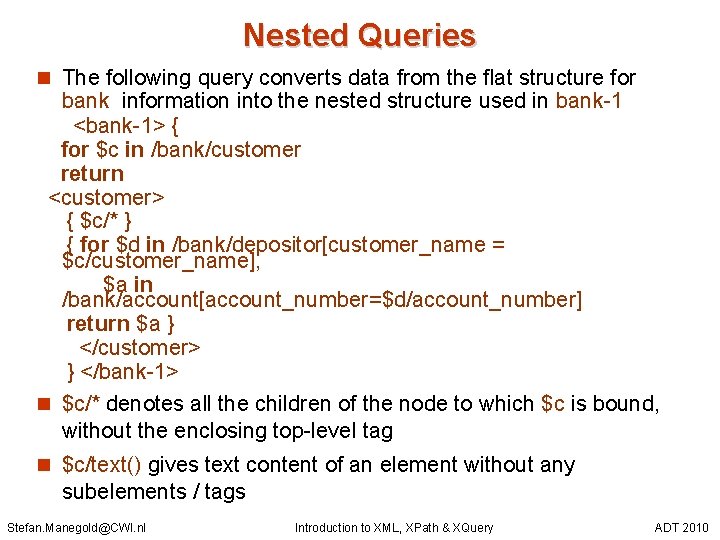
Nested Queries The following query converts data from the flat structure for bank information into the nested structure used in bank-1 <bank-1> { for $c in /bank/customer return <customer> { $c/* } { for $d in /bank/depositor[customer_name = $c/customer_name], $a in /bank/account[account_number=$d/account_number] return $a } </customer> } </bank-1> $c/* denotes all the children of the node to which $c is bound, without the enclosing top-level tag $c/text() gives text content of an element without any subelements / tags Stefan. Manegold@CWI. nl Introduction to XML, XPath & XQuery ADT 2010
Sorting in XQuery The order by clause can be used at the end of any expression. to return customers sorted by name E. g. for $c in /bank/customer order by $c/customer_name return <customer> { $c/* } </customer> Use order by $c/customer_name to sort in descending order Can sort at multiple levels of nesting (sort by customer_name, and by account_number within each customer) <bank-1> { for $c in /bank/customer order by $c/customer_name return <customer> { $c/* } { for $d in /bank/depositor[customer_name=$c/customer_name], $a in /bank/account[account_number=$d/account_number] order by $a/account_number return <account> { $a/* } </account> } </customer> } </bank-1> Stefan. Manegold@CWI. nl Introduction to XML, XPath & XQuery ADT 2010
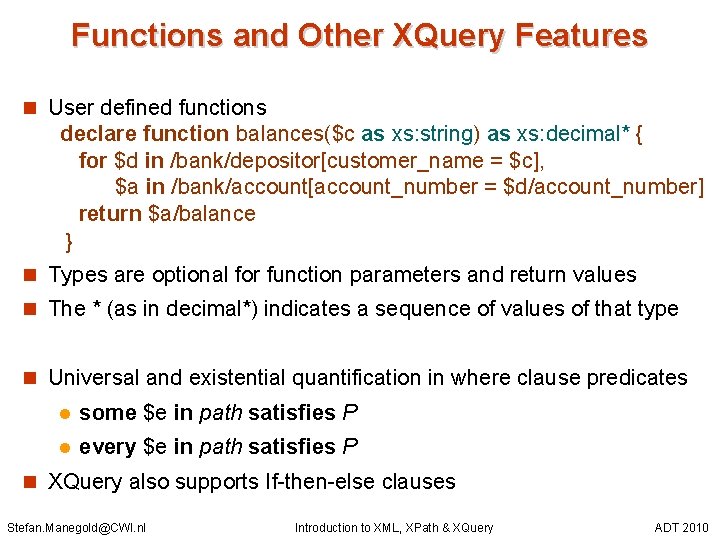
Functions and Other XQuery Features User defined functions declare function balances($c as xs: string) as xs: decimal* { for $d in /bank/depositor[customer_name = $c], $a in /bank/account[account_number = $d/account_number] return $a/balance } Types are optional for function parameters and return values The * (as in decimal*) indicates a sequence of values of that type Universal and existential quantification in where clause predicates some $e in path satisfies P every $e in path satisfies P XQuery also supports If-then-else clauses Stefan. Manegold@CWI. nl Introduction to XML, XPath & XQuery ADT 2010
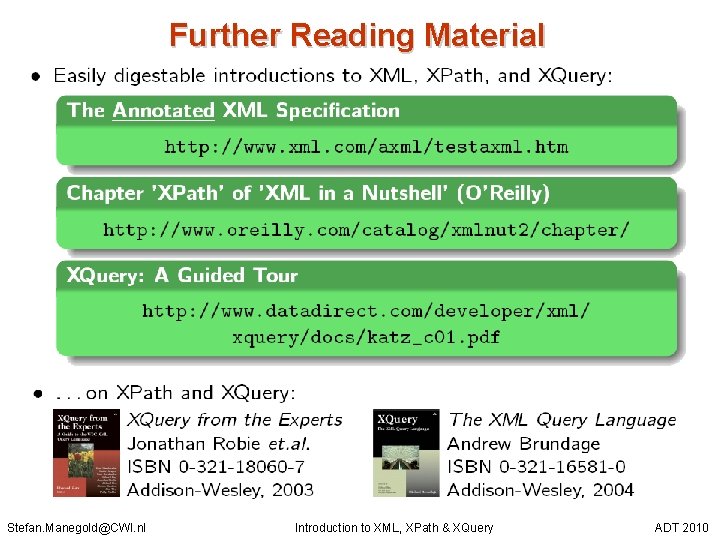
Further Reading Material Stefan. Manegold@CWI. nl Introduction to XML, XPath & XQuery ADT 2010