
Adsorption Equilibrium Adsorption vs Absorption Adsorption is accumulation
Adsorption Equilibrium • Adsorption vs. Absorption – Adsorption is accumulation of molecules on a surface (a surface layer of molecules) in contact with an air or water phase – Absorption is dissolution of molecules within a phase, e. g. , within an organic phase in contact with an air or water phase

Adsorption PHASE I ‘PHASE’ 2 Absorption (“partitioning”) PHASE I PHASE 2 Henry’s Law

The Jargon of Adsorption

Causes of Adsorption • Dislike of Water Phase – ‘Hydrophobicity’ • Attraction to the Sorbent Surface – van der Waals forces: physical attraction – electrostatic forces (surface charge interaction) – chemical forces (e. g. , - and hydrogen bonding)

Adsorbents in Natural & Engineered Systems • Natural Systems – Sediments – Soils • Engineered Systems – Activated carbon – Metal oxides (iron and aluminum as coagulants) – Ion exchange resins – Biosolids
Engineered Systems - Removal Objectives • Activated carbon (chemical functional groups) – Adsorption of organics (esp. hydrophobic) – Chemical reduction of oxidants • Metal oxides (surface charge depends on p. H) – Adsorption of natural organic matter (NOM) – Adsorption of inorganics (both cations & anions) • Ion exchange resins – Cations and anions – Hardness removal (Ca 2+, Mg 2+) – Arsenic (various negatively charged species), NO 3 -, Ba 2+ removal
Steps in Preparation of Activated Carbon • Pyrolysis – heat in absence of oxygen to form graphitic char • Activation – expose to air or steam; partial oxidation forms oxygen-containing surface groups and lots of tiny pores
Factors Affecting Activated Carbon Properties • Starting materials (e. g. , coal vs. wood based) and activation • Pores and pore size distributions • Internal surface area • Surface chemistry (esp. polarity) • Apparent density • Particle Size: Granular vs. Powdered (GAC vs. PAC)
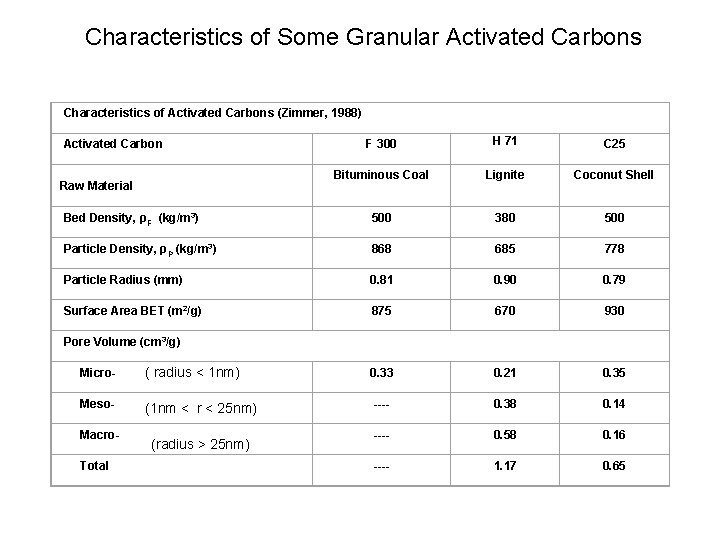
Characteristics of Some Granular Activated Carbons Characteristics of Activated Carbons (Zimmer, 1988) F 300 H 71 C 25 Bituminous Coal Lignite Coconut Shell Bed Density, ρF (kg/m 3) 500 380 500 Particle Density, ρP (kg/m 3) 868 685 778 Particle Radius (mm) 0. 81 0. 90 0. 79 Surface Area BET (m 2/g) 875 670 930 0. 33 0. 21 0. 35 ---- 0. 38 0. 14 ---- 0. 58 0. 16 ---- 1. 17 0. 65 Activated Carbon Raw Material Pore Volume (cm 3/g) Micro- ( radius < 1 nm) Meso- (1 nm < r < 25 nm) Macro. Total (radius > 25 nm)
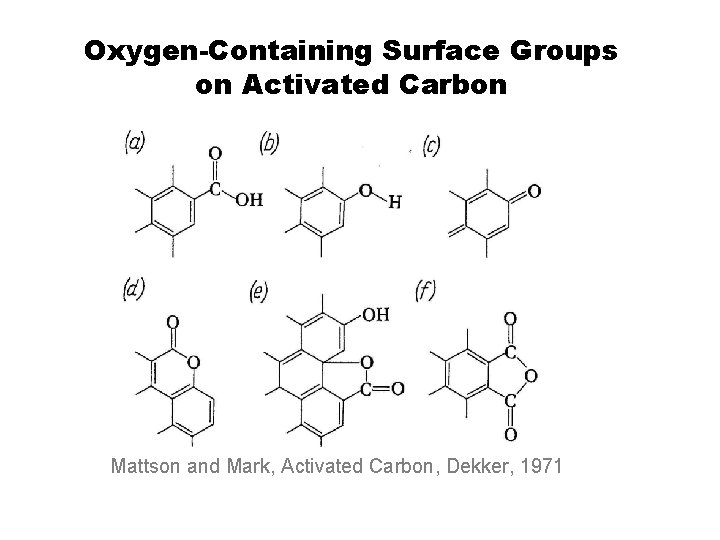
Oxygen-Containing Surface Groups on Activated Carbon Mattson and Mark, Activated Carbon, Dekker, 1971
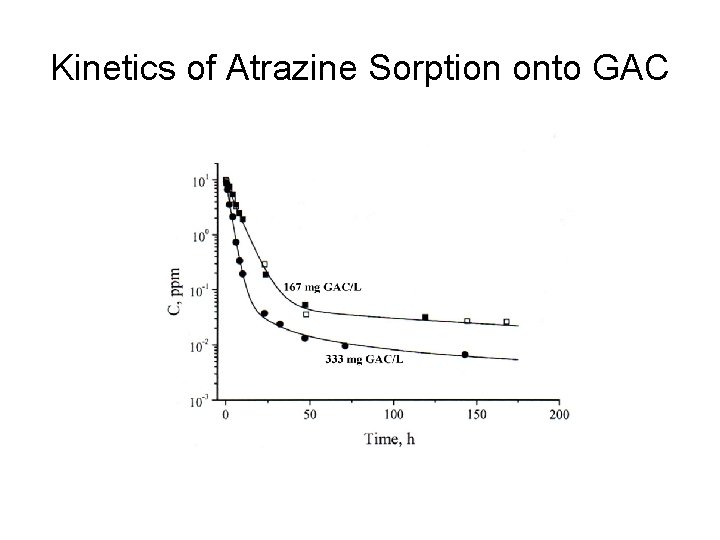
Kinetics of Atrazine Sorption onto GAC
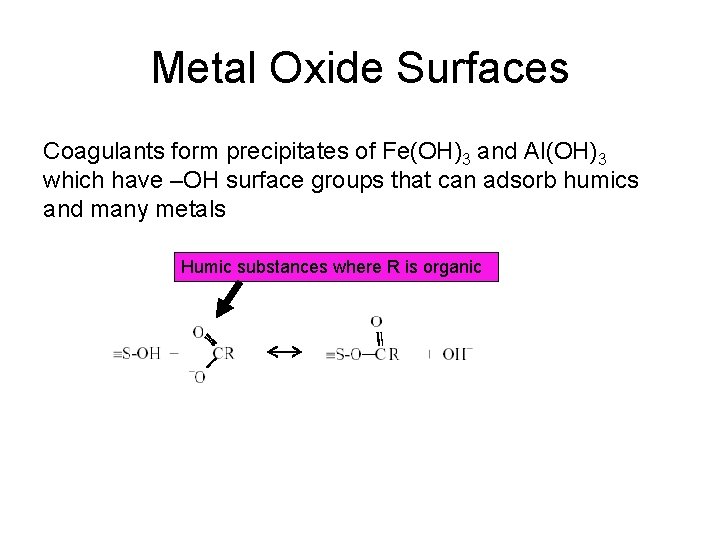
Metal Oxide Surfaces Coagulants form precipitates of Fe(OH)3 and Al(OH)3 which have –OH surface groups that can adsorb humics and many metals Humic substances where R is organic
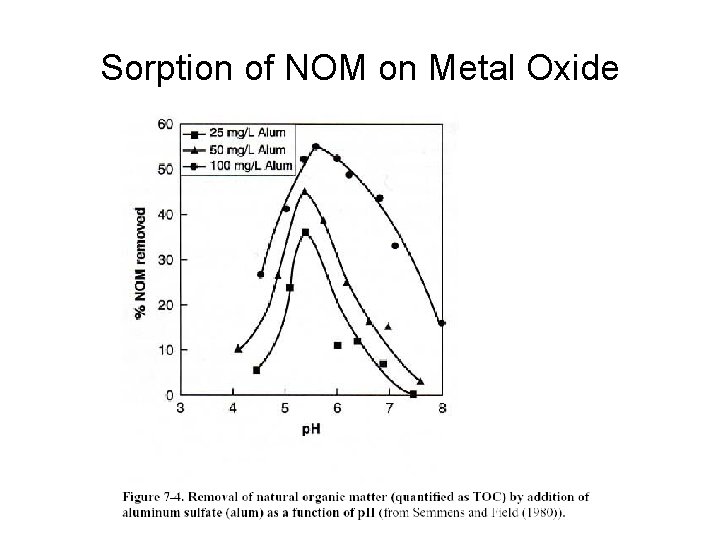
Sorption of NOM on Metal Oxide
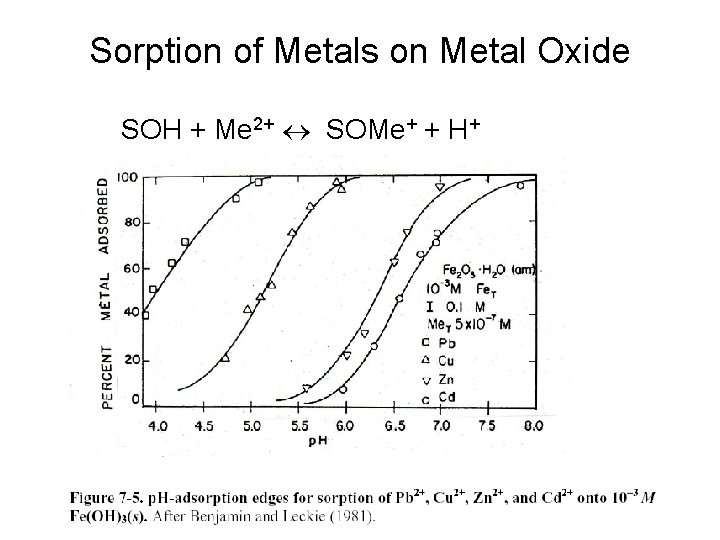
Sorption of Metals on Metal Oxide SOH + Me 2+ SOMe+ + H+
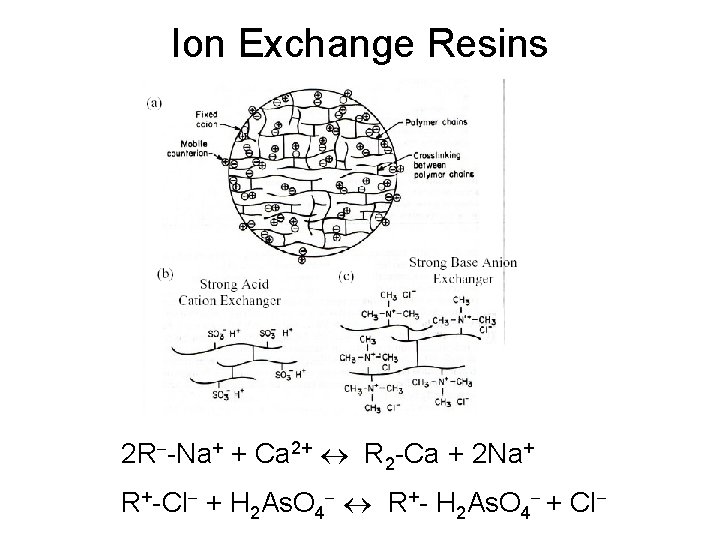
Ion Exchange Resins 2 R--Na+ + Ca 2+ R 2 -Ca + 2 Na+ R+-Cl- + H 2 As. O 4 - R+- H 2 As. O 4 - + Cl-

Adsorptive Equilibration in a Porous Adsorbent Pore Early Later Laminar Boundary Layer GAC Particle Adsorbed Molecule Diffusing Molecule Equilibrium

Adsorption Isotherms Add Same Initial Target Chemical Concentration, Cinit, in each Control Different activated carbon dosage, Csolid, in each An adsorption ‘isotherm’ is a q vs. c relationship at equilibrium


Assuming mineral surface started with q = 0: If mineral surface started with q >0:
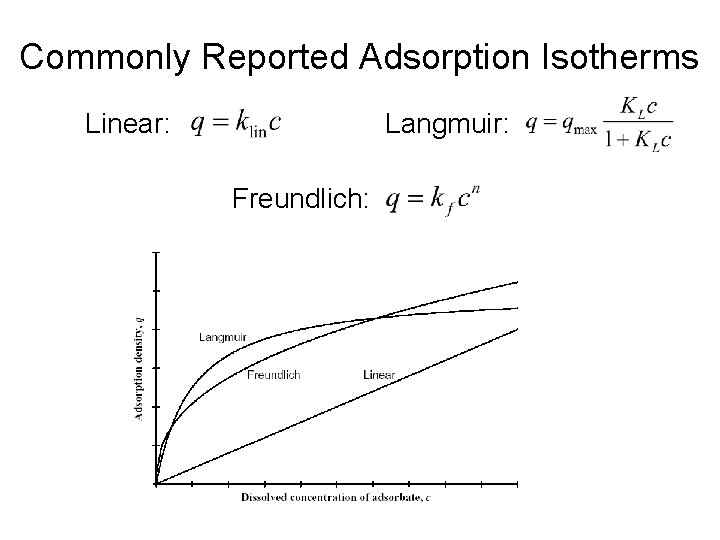
Commonly Reported Adsorption Isotherms Linear: Langmuir: Freundlich:
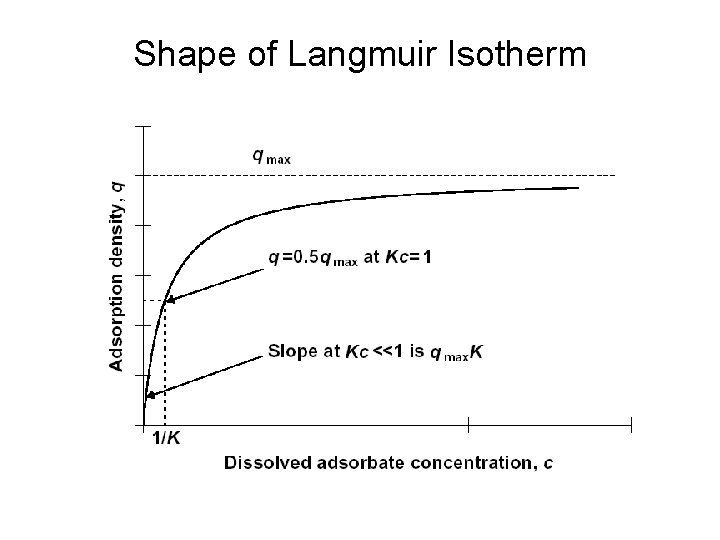
Shape of Langmuir Isotherm
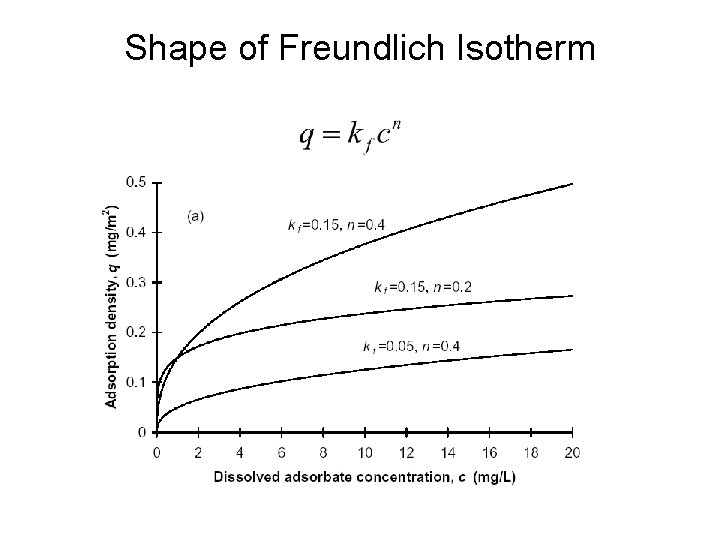
Shape of Freundlich Isotherm
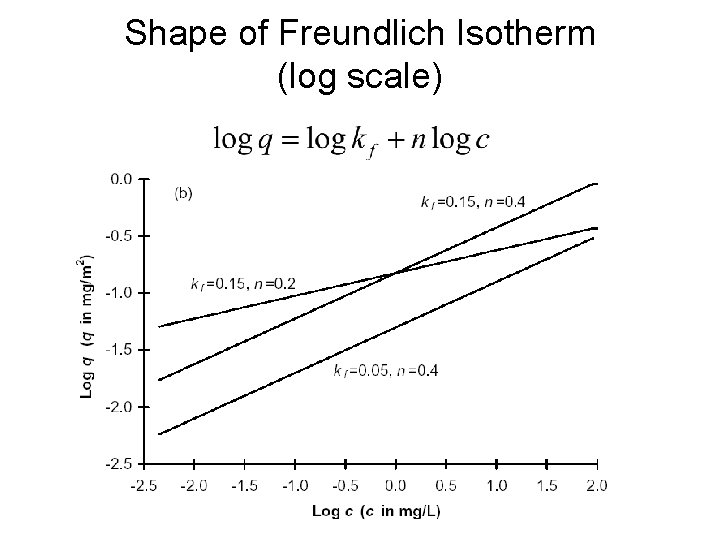
Shape of Freundlich Isotherm (log scale)
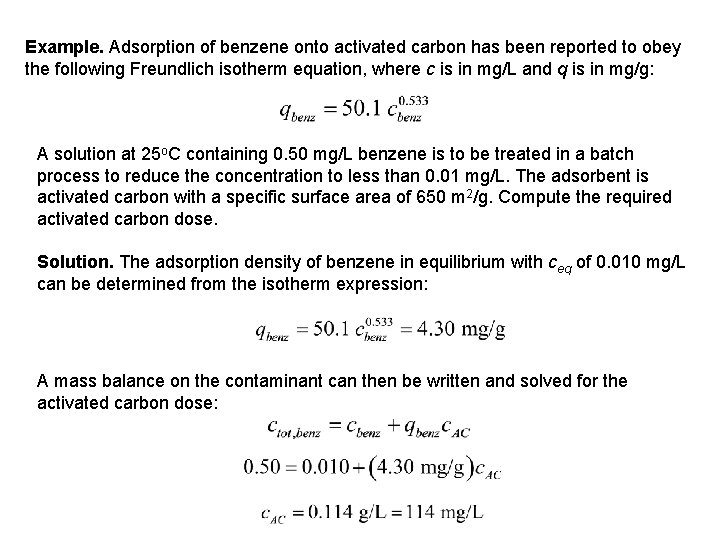
Example. Adsorption of benzene onto activated carbon has been reported to obey the following Freundlich isotherm equation, where c is in mg/L and q is in mg/g: A solution at 25 o. C containing 0. 50 mg/L benzene is to be treated in a batch process to reduce the concentration to less than 0. 01 mg/L. The adsorbent is activated carbon with a specific surface area of 650 m 2/g. Compute the required activated carbon dose. Solution. The adsorption density of benzene in equilibrium with ceq of 0. 010 mg/L can be determined from the isotherm expression: A mass balance on the contaminant can then be written and solved for the activated carbon dose:

Example If the same adsorbent dose is used to treat a solution containing 0. 500 mg/L toluene, what will the equilibrium concentration and adsorption density be? The adsorption isotherm for toluene is: Solution. The mass balance on toluene is:
General Process Design Features • Contactors provide large surface area • Types of contactors – Continuous flow, slurry reactors – Batch slurry reactors (infrequently) – Continuous flow, packed bed reactors • Product water concentration may be – Steady state or – Unsteady state
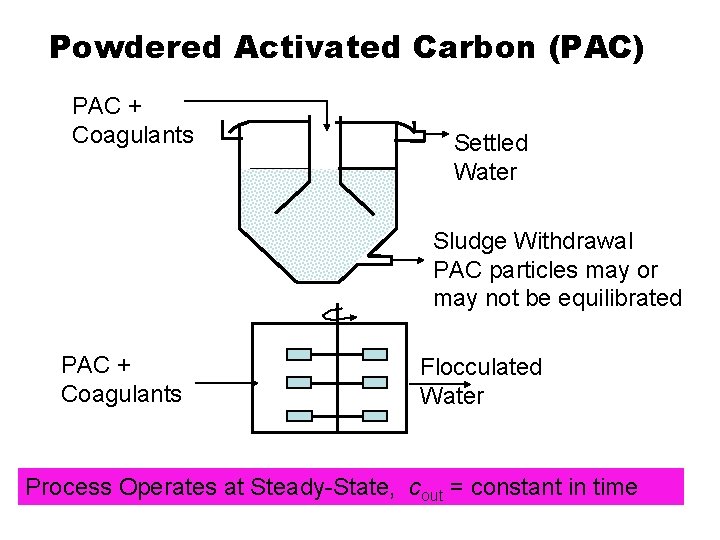
Powdered Activated Carbon (PAC) PAC + Coagulants Settled Water Sludge Withdrawal PAC particles may or may not be equilibrated PAC + Coagulants Flocculated Water Process Operates at Steady-State, cout = constant in time
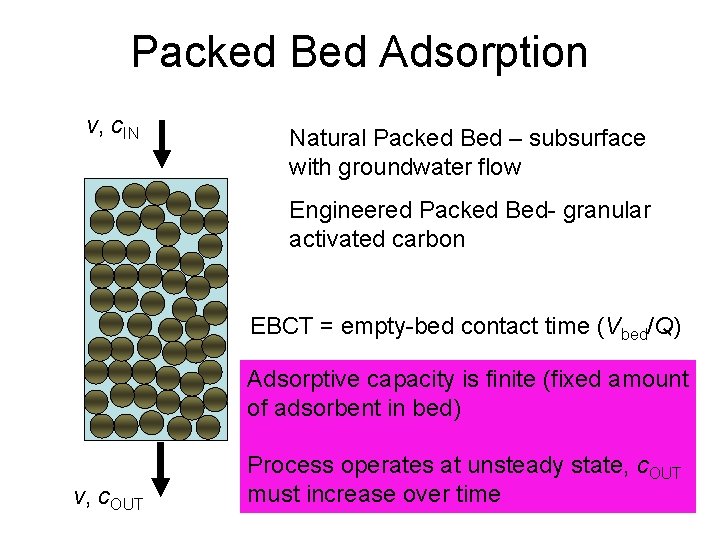
Packed Bed Adsorption v, c. IN Natural Packed Bed – subsurface with groundwater flow Engineered Packed Bed- granular activated carbon EBCT = empty-bed contact time (Vbed/Q) Adsorptive capacity is finite (fixed amount of adsorbent in bed) v, c. OUT Process operates at unsteady state, c. OUT must increase over time
- Slides: 28