
ADSORPTION CHROMATOGRAPHY It is a method of separation
- Slides: 10
ADSORPTION CHROMATOGRAPHY It is a method of separation, purification and identification of the active constituents This type of chromatography called ( solid – liquid chromatography ) The stationary phase: - is solid ( like : - silica gel , ALUMINA ) The mobile phase: - is liquid ( single or mixture solvent)
T HIN- L AYER- C HROMATOGRAPHY (T. L. C ) � � The stationary phase in TLC is a solid stationary phase, used as a thin film and we can use plastic or glass sheath as an inert support for coating material which does not involve in the separation technique. We can use silica gel GF (G =Gypsum and F= fluorescence). The mobile phase in TLC is a liquid and it could a mixture of liquids or a single liquid. We have different types of silica gel depending on the number of free hydroxyl groups. By the addition of water to silica gel we block the active sites of silica gel (deactivation). if the silica gel have a large content of water, the water content is considered as a stationary phase and the mechanism of separation is partition.
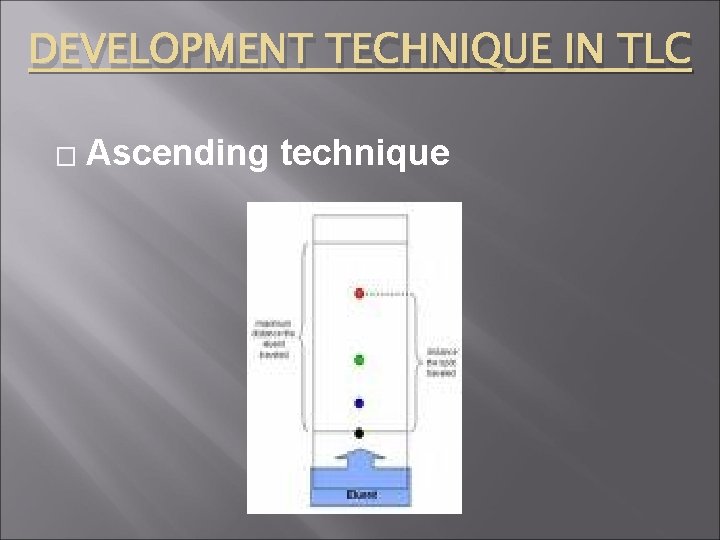
DEVELOPMENT TECHNIQUE IN TLC � Ascending technique
DETECTION METHODS IN TLC � � � The detection methods in TLC is the same in PC, these are: 1) Physical detection: we use UV light with certain wavelength. 2) Chemical detection: we use a chemical reagent either by spraying or dipping in both methods the chemical reagent will react with separated compound and give a color. 3) Biological detection: by using certain microorganisms to detect the separated compounds. 4) Radioactive detection: if the compound being separated have radioactivity, such compound can be detected by using special instrument.
ADVANTAGES OF TLC OVER PC � � � 1) Fractionations can be effected more rapidly with smaller quantities of a mixture. 2) The separated spots are usually more compact and clearly identified from one anther. 3) The nature of the film is often such that drastic reagents such as H 2 SO 4 which would destroy a paper chromatogram can be used for the location of separated substances.
TLC ON MICROSCOPE SLIDES � � 1) Preparation of slides for TLC. Thin layer slides are prepared from slurry of the adsorbent which after separating and drying forms a powder film over the surface of glass slide. The slurry is prepared by mixing 35 g of silica gel G with 100 ml of acetone in ajar. two clean slides are prepared by dipping in the slurry (make sure that the jar containing the slurry is well shaken before each dipping process to ensure homogenous coating of the slurry).
2) Drying of TLC slides. 3) Application of test mixture. Measure 1 cm from the bottom of the slide. This is the base line of the chromatogram. Place the Spot of the sample of mixture by a clean capillary tube to the base line at 1 cm from the edge of the slide. Repeat the same spotting procedure on slide
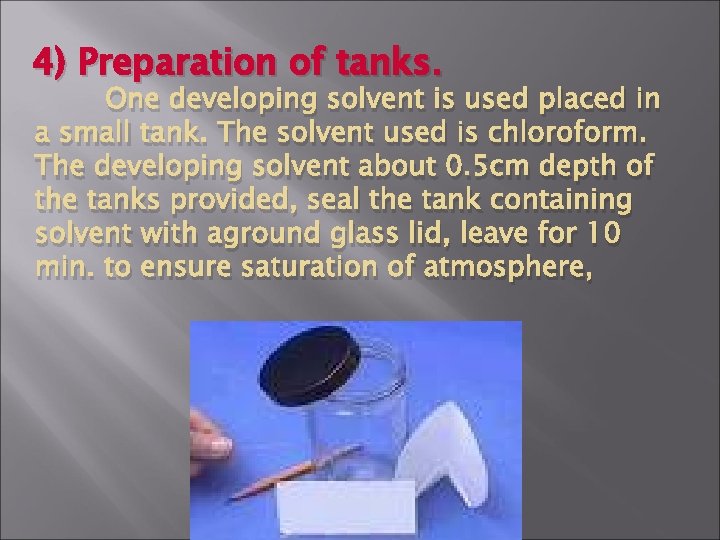
4) Preparation of tanks. One developing solvent is used placed in a small tank. The solvent used is chloroform. The developing solvent about 0. 5 cm depth of the tanks provided, seal the tank containing solvent with aground glass lid, leave for 10 min. to ensure saturation of atmosphere,
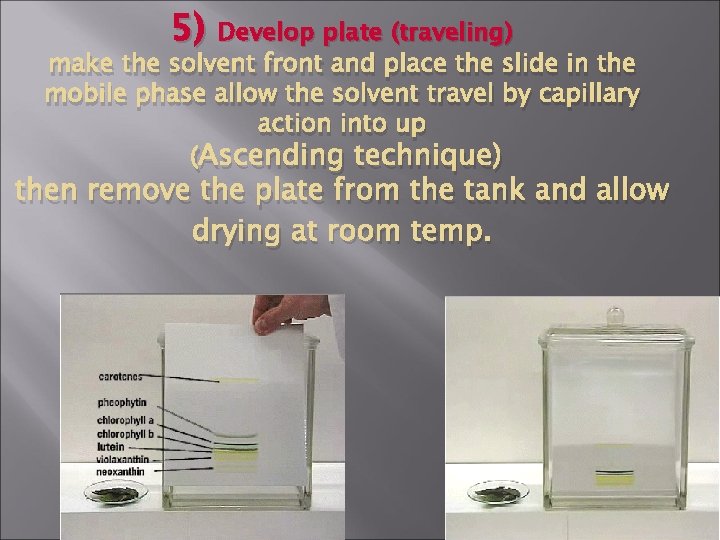
5) Develop plate (traveling) make the solvent front and place the slide in the mobile phase allow the solvent travel by capillary action into up (Ascending technique) then remove the plate from the tank and allow drying at room temp.
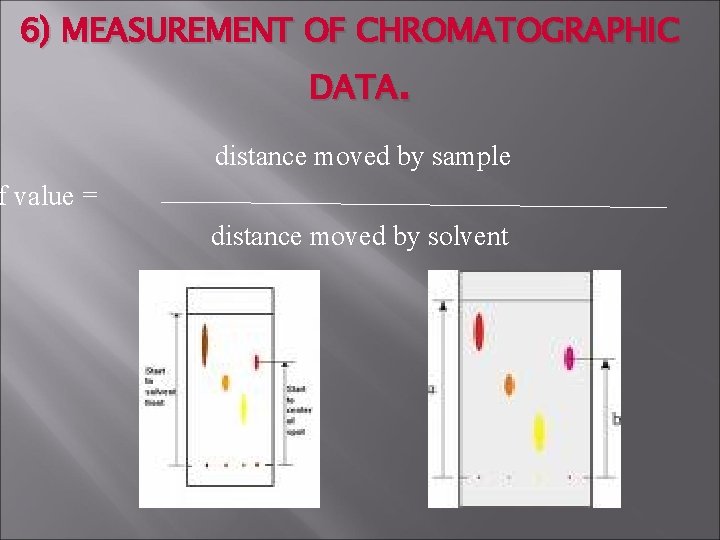
6) MEASUREMENT OF CHROMATOGRAPHIC DATA. distance moved by sample f value = distance moved by solvent