
ADSORPTIO N by Pranoy Pratik Raul 1 Content
ADSORPTIO N by Pranoy Pratik Raul 1
Content ØDefinition ØCause ØClassification ØIsotherms ØApplications v Only 12 slides 2
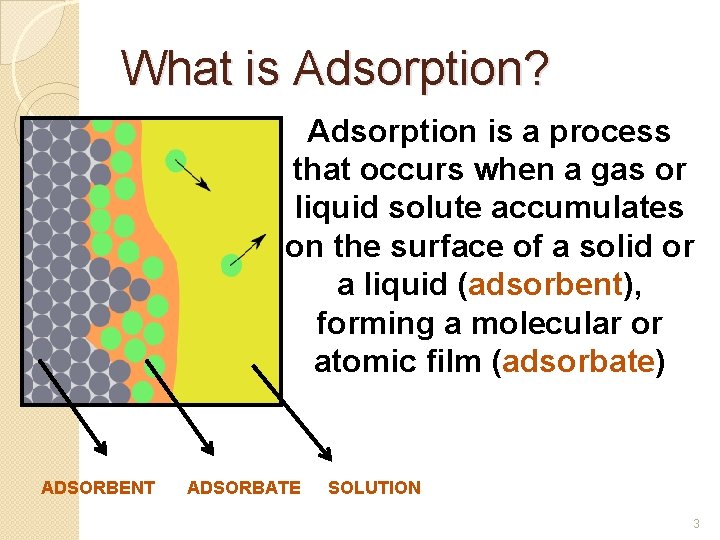
What is Adsorption? Adsorption is a process that occurs when a gas or liquid solute accumulates on the surface of a solid or a liquid (adsorbent), forming a molecular or atomic film (adsorbate) ADSORBENT ADSORBATE SOLUTION 3
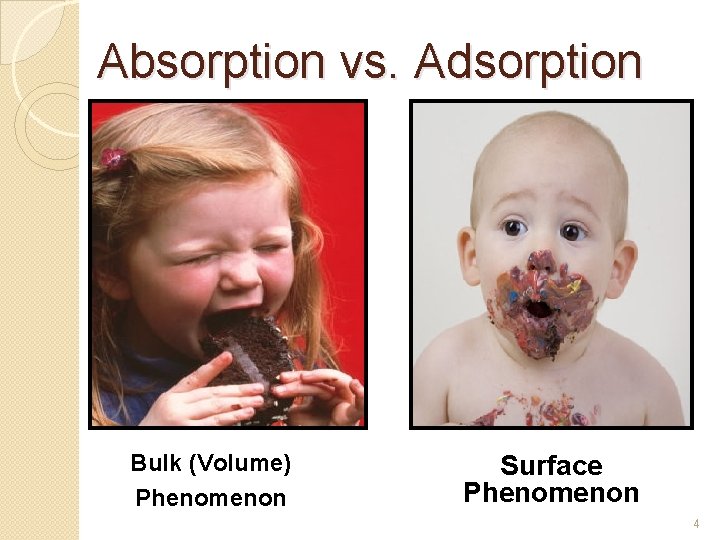
Absorption vs. Adsorption Bulk (Volume) Phenomenon Surface Phenomenon 4
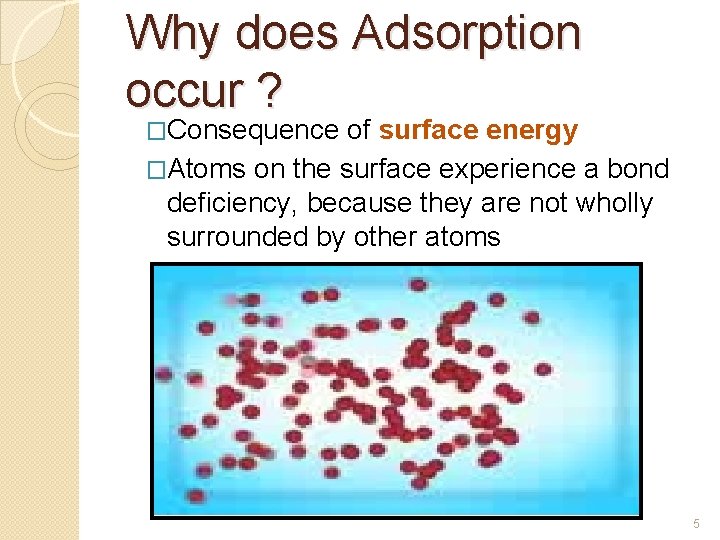
Why does Adsorption occur ? �Consequence of surface energy �Atoms on the surface experience a bond deficiency, because they are not wholly surrounded by other atoms 5
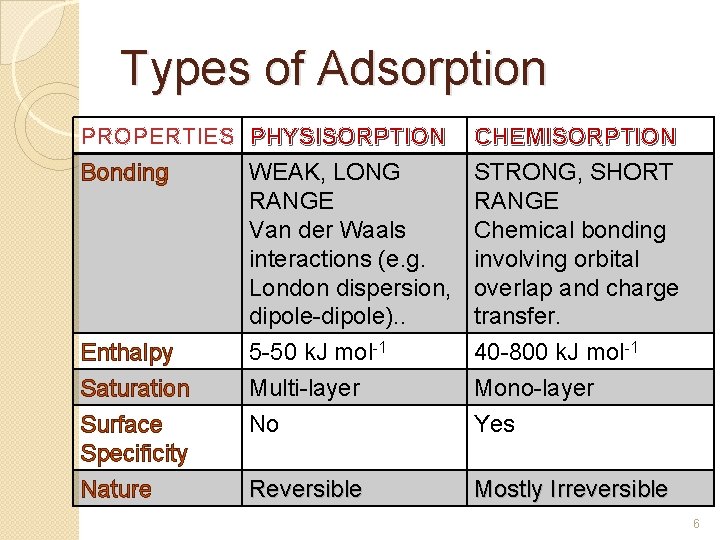
Types of Adsorption PROPERTIES PHYSISORPTION Bonding WEAK, LONG RANGE Van der Waals interactions (e. g. London dispersion, dipole-dipole). . CHEMISORPTION STRONG, SHORT RANGE Chemical bonding involving orbital overlap and charge transfer. Enthalpy Saturation Surface Specificity Nature 5 -50 k. J mol-1 Multi-layer No 40 -800 k. J mol-1 Mono-layer Yes Reversible Mostly Irreversible 6
Adsorption Isotherms �Plot of the amount of adsorbate on the adsorbent as a function of its pressure (if gas) or concentration (if liquid) at constant temperature. �Langmuir isotherm (adsorbed layer one molecule thick) �Freundlich isotherm (Heterogeneous adsorbent surface with different adsorption sites) �Brunauer, Emmett and Teller (BET) isotherm (molecules can be adsorbed more than one layer thick) 7
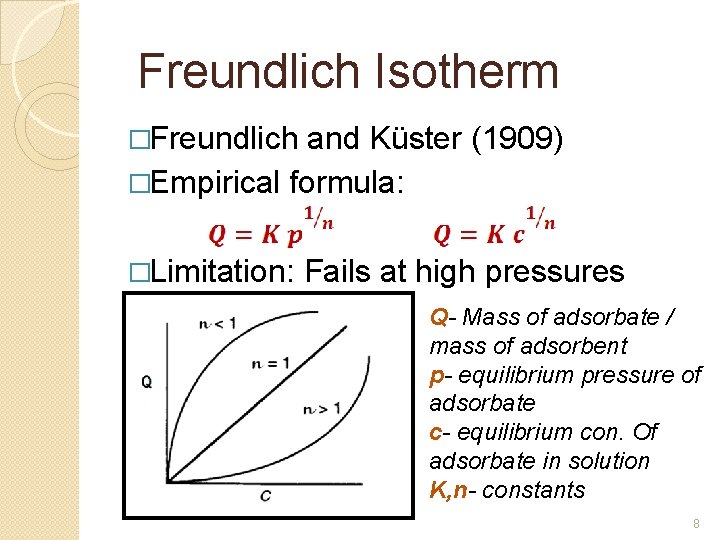
Freundlich Isotherm �Freundlich and Küster (1909) �Empirical formula: �Limitation: Fails at high pressures Q- Mass of adsorbate / mass of adsorbent p- equilibrium pressure of adsorbate c- equilibrium con. Of adsorbate in solution K, n- constants 8
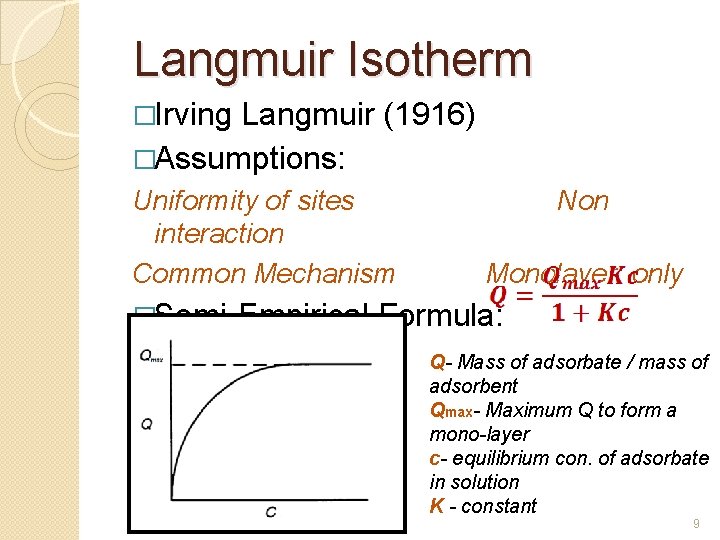
Langmuir Isotherm �Irving Langmuir (1916) �Assumptions: Uniformity of sites interaction Common Mechanism Non Monolayer only �Semi-Empirical Formula: Q- Mass of adsorbate / mass of adsorbent Qmax- Maximum Q to form a mono-layer c- equilibrium con. of adsorbate in solution K - constant 9
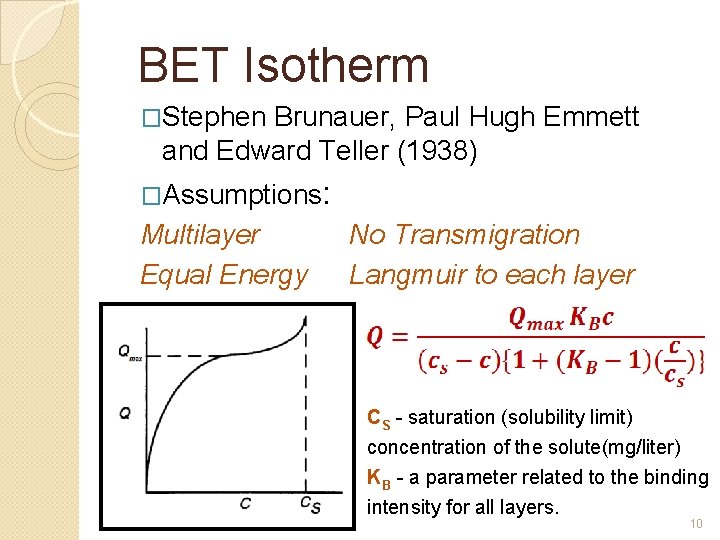
BET Isotherm �Stephen Brunauer, Paul Hugh Emmett and Edward Teller (1938) �Assumptions: Multilayer Equal Energy No Transmigration Langmuir to each layer CS - saturation (solubility limit) concentration of the solute(mg/liter) KB - a parameter related to the binding intensity for all layers. 10
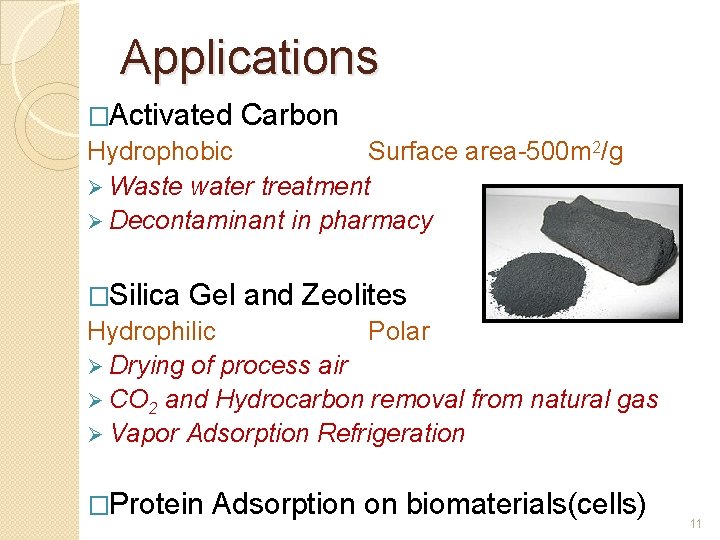
Applications �Activated Carbon Hydrophobic Surface area-500 m 2/g Ø Waste water treatment Ø Decontaminant in pharmacy �Silica Gel and Zeolites Hydrophilic Polar Ø Drying of process air Ø CO 2 and Hydrocarbon removal from natural gas Ø Vapor Adsorption Refrigeration �Protein Adsorption on biomaterials(cells) 11

12
- Slides: 12