
ADS determination of with BKDK BhhDK and BK
ADS determination of γ with B→(Kπ)DK, B→(hh)DK and B→(K 3π)DK Jim Libby (University of Oxford) 25/9/2007 LHCb UK meeting 1
Outline n n Overview of ADS technique and current sensitivity with B→(Kπ)DK and B→(hh)DK at LHCb Extension to B→(K 3π)DK – Introducing the coherence factor – How to measure it at CLEO-c n n Outlook Acknowledgements: Mitesh Patel, Andrew Powell and Guy Wilkinson 25/9/2007 LHCb UK meeting 2
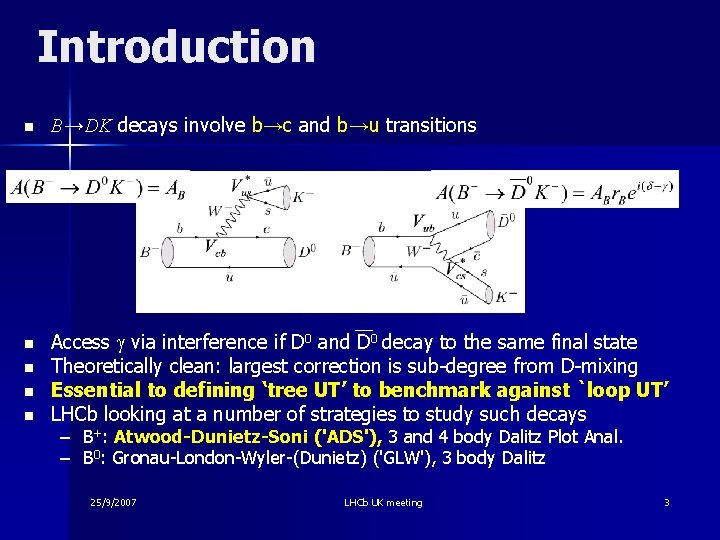
Introduction n B→DK decays involve b→c and b→u transitions n Access g via interference if D 0 and D 0 decay to the same final state Theoretically clean: largest correction is sub-degree from D-mixing Essential to defining ‘tree UT’ to benchmark against `loop UT’ LHCb looking at a number of strategies to study such decays n n n – B+: Atwood-Dunietz-Soni ('ADS'), 3 and 4 body Dalitz Plot Anal. – B 0: Gronau-London-Wyler-(Dunietz) ('GLW'), 3 body Dalitz 25/9/2007 LHCb UK meeting 3
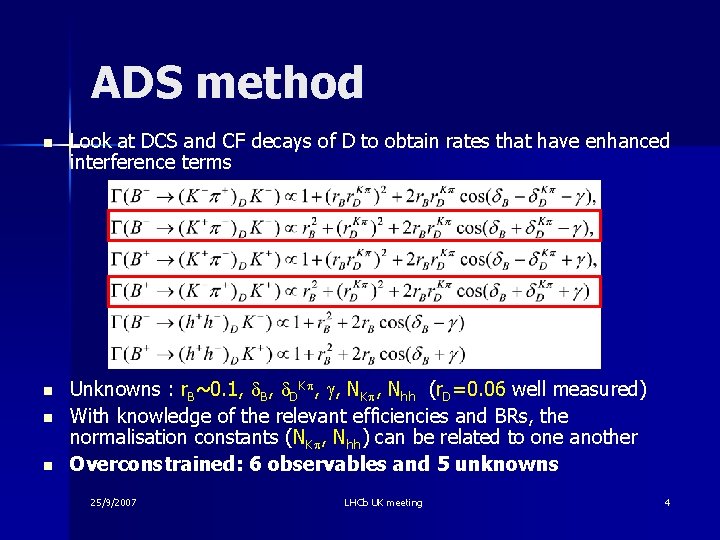
ADS method n Look at DCS and CF decays of D to obtain rates that have enhanced interference terms n Unknowns : r. B~0. 1, d. B, d. DK , g, NK , Nhh (r. D=0. 06 well measured) With knowledge of the relevant efficiencies and BRs, the normalisation constants (NK , Nhh) can be related to one another Overconstrained: 6 observables and 5 unknowns n n 25/9/2007 LHCb UK meeting 4
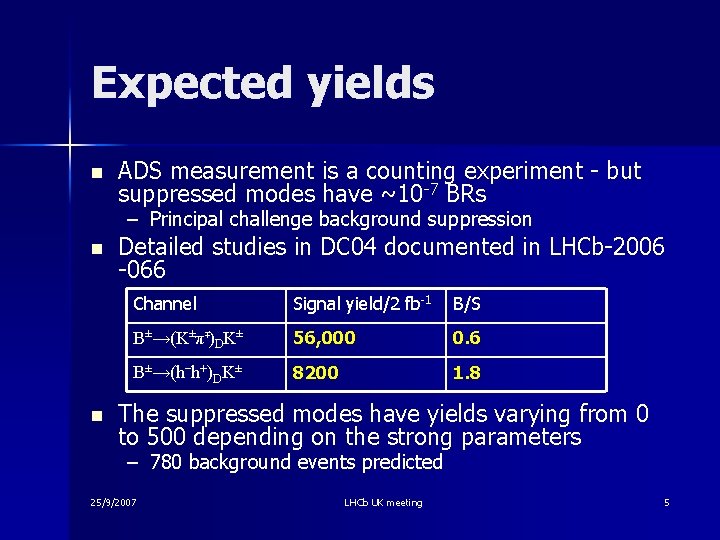
Expected yields n ADS measurement is a counting experiment - but suppressed modes have ~10 -7 BRs – Principal challenge background suppression n Detailed studies in DC 04 documented in LHCb-2006 -066 Channel Signal yield/2 fb-1 B/S B±→(K±π )DK± 56, 000 0. 6 B±→(h−h+)DK± 8200 1. 8 ± n The suppressed modes have yields varying from 0 to 500 depending on the strong parameters – 780 background events predicted 25/9/2007 LHCb UK meeting 5
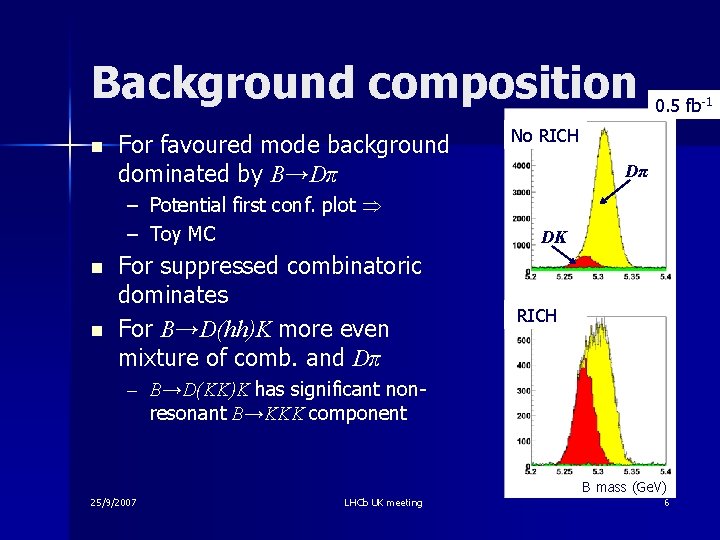
Background composition n For favoured mode background dominated by B→Dπ – Potential first conf. plot – Toy MC n n For suppressed combinatoric dominates For B→D(hh)K more even mixture of comb. and Dπ 0. 5 fb-1 No RICH Dπ DK RICH – B→D(KK)K has significant nonresonant B→KKK component B mass (Ge. V) 25/9/2007 LHCb UK meeting 6
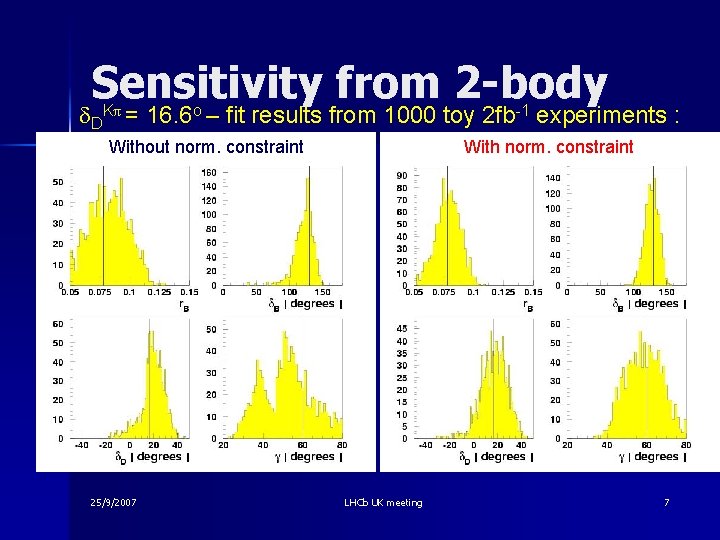
Sensitivity from 2 -body d. DKπ = 16. 6 o – fit results from 1000 toy 2 fb-1 experiments : Without norm. constraint 25/9/2007 With norm. constraint LHCb UK meeting 7
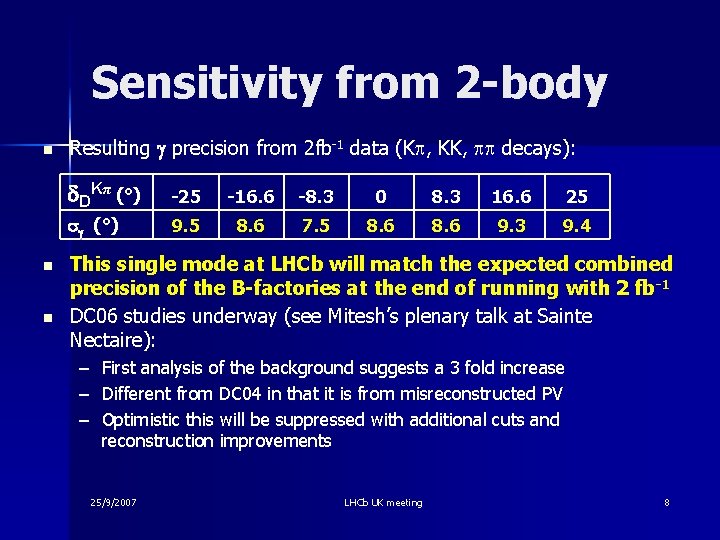
Sensitivity from 2 -body n n n Resulting precision from 2 fb-1 data (K , KK, decays): d. DKπ (°) -25 -16. 6 -8. 3 0 8. 3 16. 6 25 s (°) 9. 5 8. 6 7. 5 8. 6 9. 3 9. 4 This single mode at LHCb will match the expected combined precision of the B-factories at the end of running with 2 fb -1 DC 06 studies underway (see Mitesh’s plenary talk at Sainte Nectaire): – – – First analysis of the background suggests a 3 fold increase Different from DC 04 in that it is from misreconstructed PV Optimistic this will be suppressed with additional cuts and reconstruction improvements 25/9/2007 LHCb UK meeting 8
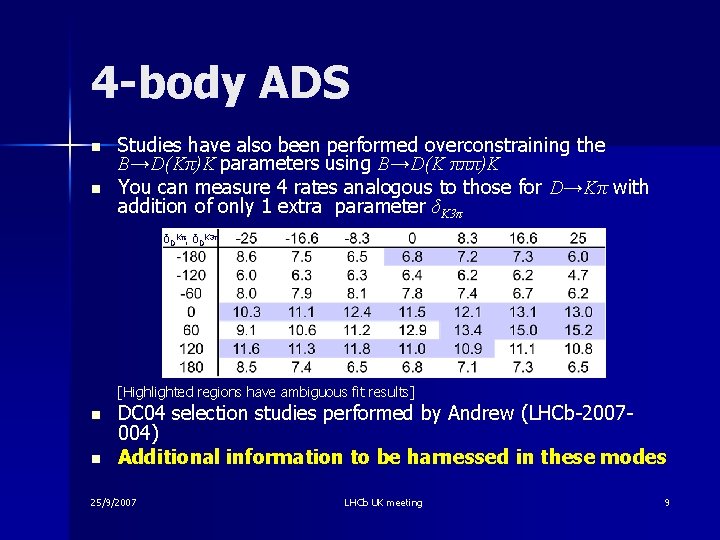
4 -body ADS n n Studies have also been performed overconstraining the B→D(Kπ)K parameters using B→D(K πππ)K You can measure 4 rates analogous to those for D→Kπ with addition of only 1 extra parameter δK 3π δDK , δDK 3 [Highlighted regions have ambiguous fit results] n n DC 04 selection studies performed by Andrew (LHCb-2007004) Additional information to be harnessed in these modes 25/9/2007 LHCb UK meeting 9
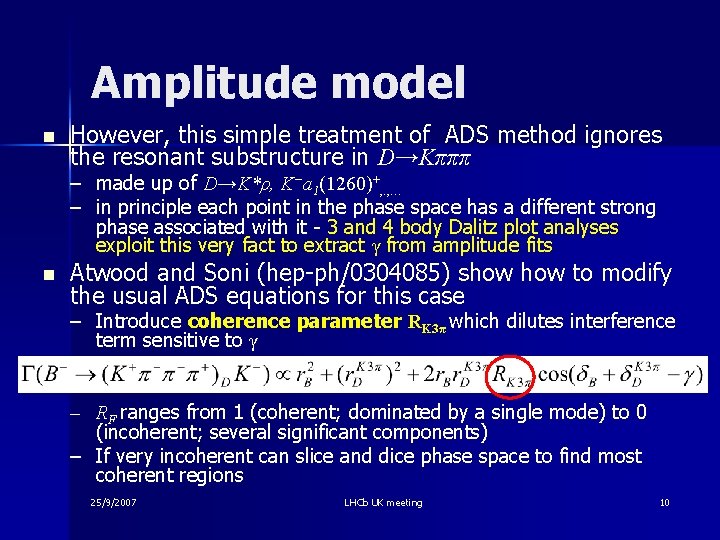
Amplitude model n However, this simple treatment of ADS method ignores the resonant substructure in D→Kπππ – made up of D→K*ρ, K−a 1(1260)+, . , … – in principle each point in the phase space has a different strong phase associated with it - 3 and 4 body Dalitz plot analyses exploit this very fact to extract γ from amplitude fits n Atwood and Soni (hep-ph/0304085) show to modify the usual ADS equations for this case – Introduce coherence parameter RK 3π which dilutes interference term sensitive to γ – RF ranges from 1 (coherent; dominated by a single mode) to 0 (incoherent; several significant components) – If very incoherent can slice and dice phase space to find most coherent regions 25/9/2007 LHCb UK meeting 10
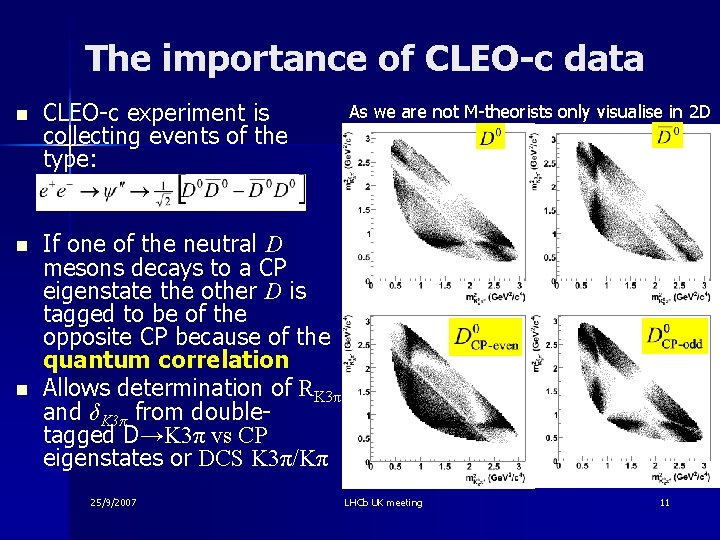
The importance of CLEO-c data n CLEO-c experiment is collecting events of the type: n If one of the neutral D mesons decays to a CP eigenstate the other D is tagged to be of the opposite CP because of the quantum correlation Allows determination of RK 3π and δK 3π from doubletagged D→K 3π vs CP eigenstates or DCS K 3π/Kπ n 25/9/2007 As we are not M-theorists only visualise in 2 D LHCb UK meeting 11
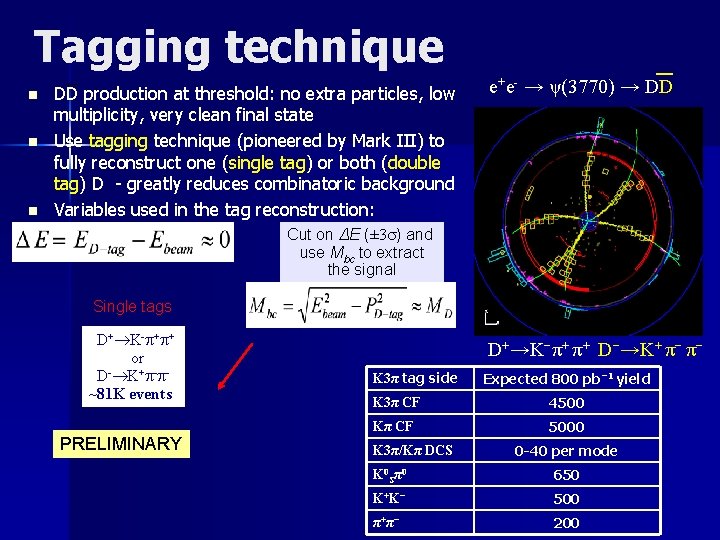
Tagging technique n n n DD production at threshold: no extra particles, low multiplicity, very clean final state Use tagging technique (pioneered by Mark III) to fully reconstruct one (single tag) or both (double tag) D - greatly reduces combinatoric background Variables used in the tag reconstruction: e+e- → ψ(3770) → DD Cut on ΔE (± 3 ) and use Mbc to extract the signal Single tags D+ K- + + or D- K+ - ~81 K events PRELIMINARY D+→K−π+ π+ D−→K+ π− π− K 3π tag side Expected 800 pb− 1 yield K 3π CF 4500 Kπ CF 5000 K 3π/Kπ DCS 0 -40 per mode K 0 Sπ0 650 K+K− 500 π+π− 200
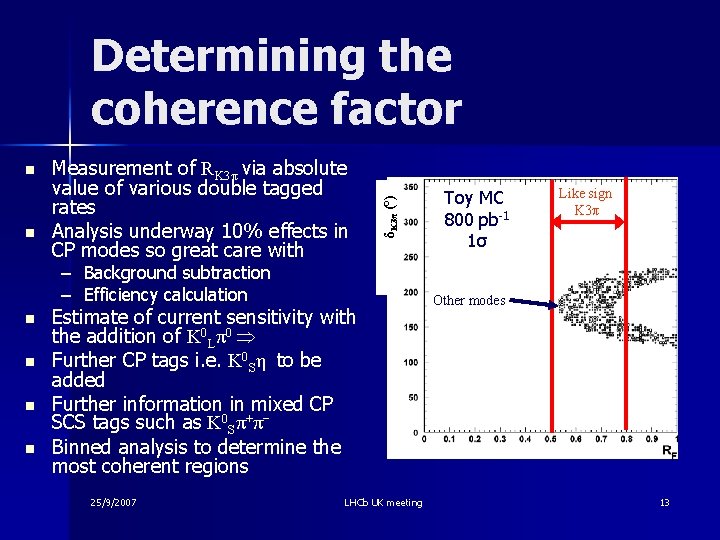
n n Measurement of RK 3π via absolute value of various double tagged rates Analysis underway 10% effects in CP modes so great care with δK 3π (°) Determining the coherence factor – Background subtraction – Efficiency calculation n n Estimate of current sensitivity with the addition of K 0 Lπ0 Further CP tags i. e. K 0 Sη to be added Further information in mixed CP SCS tags such as K 0 Sπ+π− Binned analysis to determine the most coherent regions 25/9/2007 LHCb UK meeting Toy MC 800 pb-1 1σ Like sign K 3π Other modes 13
Outlook n 2 -body ADS is well developed – Counting experiment therefore likely to be first B→DK measurement of γ – Precision of ~8° expected with 2 fb− 1 n Additional information in 4 -body B→D(K 3π)K – Model free determination requires measurement of coherence parameter of the D→K 3π final state – Work at CLEO-c has begun to do this and will be complete before first ADS analysis n Combine with 3 -body decays and all neutral modes for ultimate γ sensitivity in the `tree UT’ 25/9/2007 LHCb UK meeting 14

Additional slides 25/9/2007 LHCb UK meeting 15
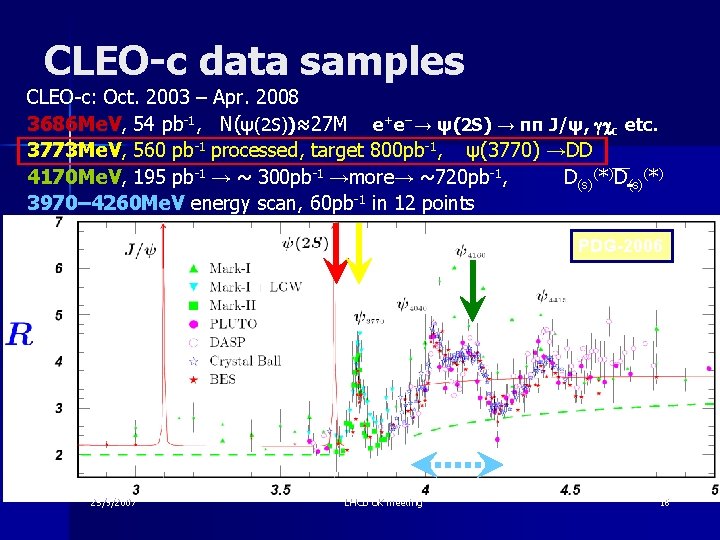
CLEO-c data samples CLEO-c: Oct. 2003 – Apr. 2008 3686 Me. V, 54 pb-1, N(ψ(2 S))≈27 M e+e−→ ψ(2 S) → ππ J/ψ, c etc. 3773 Me. V, 560 pb-1 processed, target 800 pb-1, ψ(3770) →DD 4170 Me. V, 195 pb-1 → ~ 300 pb-1 →more→ ~720 pb-1, D(s)(*) 3970– 4260 Me. V energy scan, 60 pb-1 in 12 points PDG-2006 25/9/2007 LHCb UK meeting 16
- Slides: 16