
Adrenergic Neurotransmission Dr Nirbhay Kumar Asstt Professor Head
Adrenergic Neurotransmission Dr. Nirbhay Kumar Asstt. Professor & Head Deptt. of Veterinary Pharmacology & Toxicology Bihar Veterinary College, Bihar Animal Sciences University, Patna
t Adrenergic Transmission The impulse transmission that is mediated by norepinephrine (post-ganglionic sympathetic nerve terminals and CNS), dopamine (CNS) and epinephrine (adrenal medulla) is in general called as adrenergic transmission. All these transmitters are also called as catecholamines. CATECHOLAMINES: Norepinephrine: neuroeffector junctions and in the CNS. Epinephrine : It is the major hormone released from adrenal medulla. Dopamine It is believed to transmit impulse information in specific areas within the CNS (basal ganglia, limbic system, CTZ, anterior pituitary etc. ). :

Synthesis of Catecholamines Step I: Step II: Phenylalanine → Tyrosine → DOPA (Rate Limiting Step) Step III: DOPA Step IV: Dopamine Step V: → Dopamine → Norepinephrine → Epinephrine
Storage of Catecholamines ü Catecholamines are taken up from the cytoplasm into vesicles or granules by an active transport system which is ATP and Mg 2+ dependent. ü Storage within the granular vesicles is accomplished by complexation of the catecholamines with ATP (in molecular ratio of 4: 1) which is adsorbed on a protein, chromogranin. This complexation renders the amine inactive until their release. ü The intra-granular pool of NE is the principal source of neurotransmitter released upon nerve stimulation. ü The cytoplasmic pool of catecholamines is kept low by the enzyme monoamine oxidase (MAO) present in neuronal mitochondria. [NB: Reserpine is a drug which depletes catecholamine stores by inhibiting monoamine transport into vesicles].
Release & Termination of action of Catecholamines Release of Catecholamines: ü The nerve impulse coupled release of catecholamines from adrenergic nerve terminals takes place by exocytosis and is dependent upon an inward movement of Ca 2+. ü Released norepinephrine migrates across the synaptic cleft and interacts with specific adrenergic receptor sites on the post-junctional membrane. ü Bretylium inhibits norepinephrine release. Termination of Catecholamines action: Uptake of Catecholamines: ü There is a very efficient mechanism by which norepinephrine released from the nerve terminal is recaptured. Exogenously administered norepinephrine and epinephrine are taken up into sympathetic nerve endings by this uptake process. ü Conservation of catecholamine neurotransmitters by reuptake is one of the first examples of recycling used products.
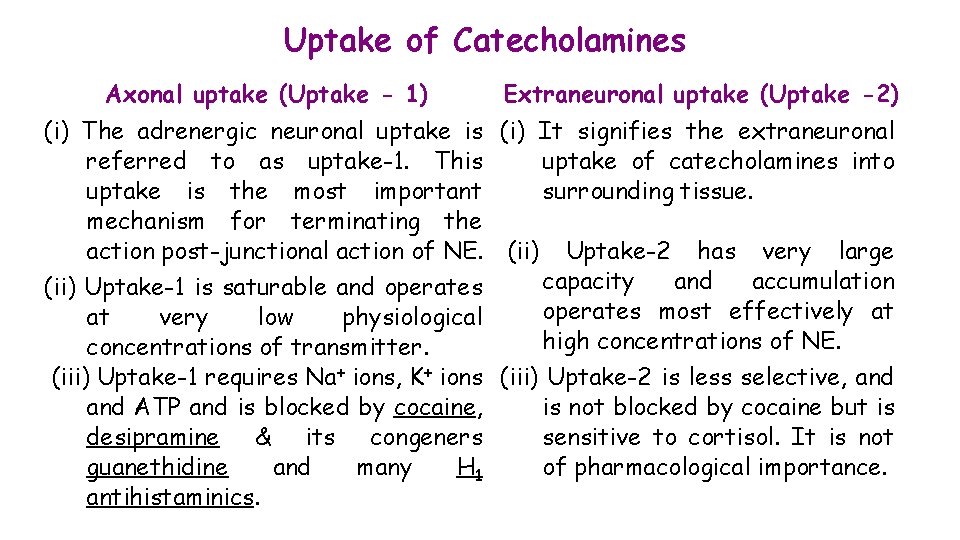
Uptake of Catecholamines Axonal uptake (Uptake - 1) Extraneuronal uptake (Uptake -2) (i) The adrenergic neuronal uptake is referred to as uptake-1. This uptake is the most important mechanism for terminating the action post-junctional action of NE. (ii) Uptake-1 is saturable and operates at very low physiological concentrations of transmitter. (iii) Uptake-1 requires Na+ ions, K+ ions and ATP and is blocked by cocaine, desipramine & its congeners guanethidine and many H 1 antihistaminics. (i) It signifies the extraneuronal uptake of catecholamines into surrounding tissue. (ii) Uptake-2 has very large capacity and accumulation operates most effectively at high concentrations of NE. (iii) Uptake-2 is less selective, and is not blocked by cocaine but is sensitive to cortisol. It is not of pharmacological importance.
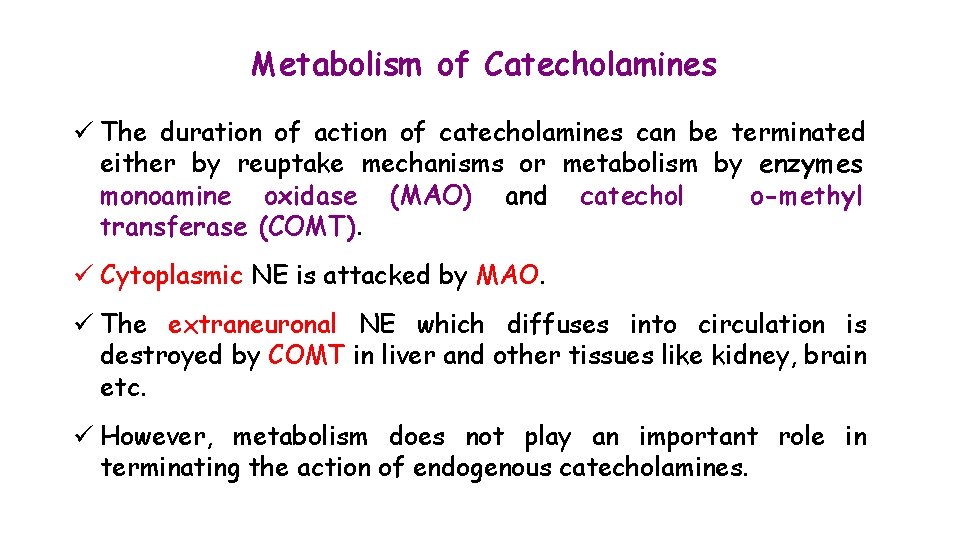
Metabolism of Catecholamines ü The duration of action of catecholamines can be terminated either by reuptake mechanisms or metabolism by enzymes monoamine oxidase (MAO) and catechol o-methyl transferase (COMT). ü Cytoplasmic NE is attacked by MAO. ü The extraneuronal NE which diffuses into circulation is destroyed by COMT in liver and other tissues like kidney, brain etc. ü However, metabolism does not play an important role in terminating the action of endogenous catecholamines.
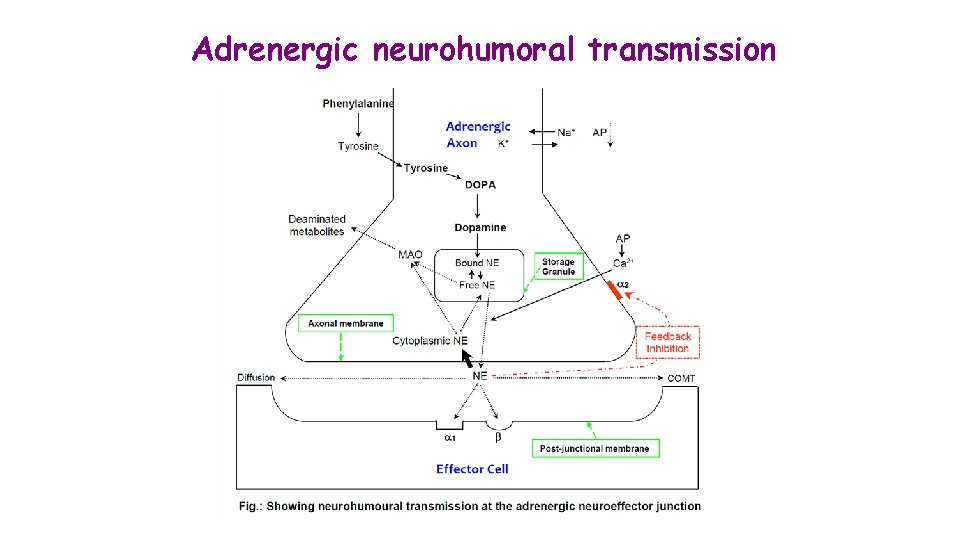
Adrenergic neurohumoral transmission

Adrenergic Receptors ü Adrenergic receptors have been classified into two types based on rank order of potencies of adrenergic agonists – α and β receptors. ü Catecholamines produce excitatory (except GIT) and inhibitory (except CVS) responses on smooth muscles upon activation of α and β receptors, respectively. ü α receptors have been further classified into two subtypes – α 1 and α 2. Molecular cloning have further identified three subtypes of α 1 (α 1 A, α 1 B & α 1 D) and three subtypes of α 2 (α 2 A, α 2 B & α 2 C) receptors. ü β receptors can be classified in three subtypes – β 1, β 2 and β 3 based on relative organ specificity of selective agonists and antagonists.
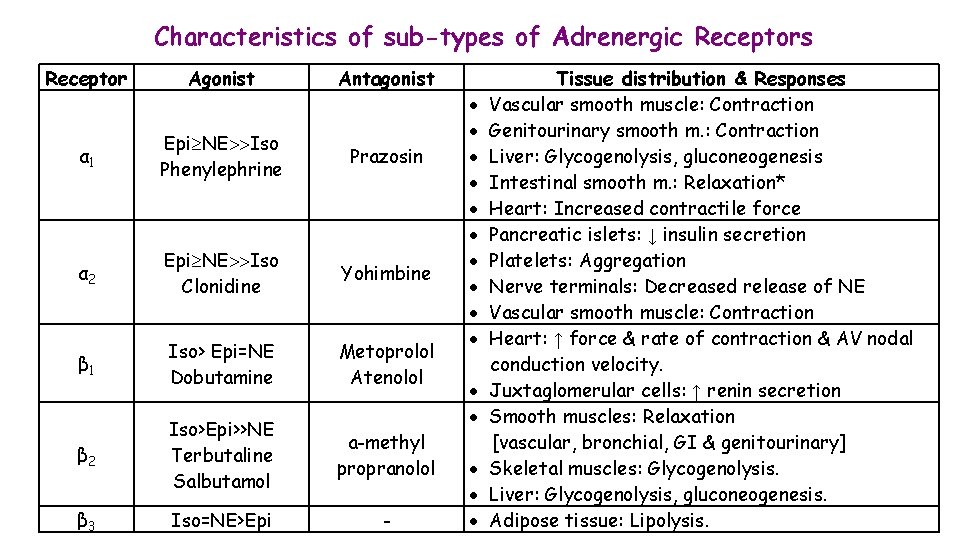
Characteristics of sub-types of Adrenergic Receptors Receptor Agonist Antagonist α 1 Epi NE Iso Phenylephrine Prazosin α 2 Epi NE Iso Clonidine Yohimbine β 1 Iso> Epi=NE Dobutamine Metoprolol Atenolol β 2 Iso>Epi>>NE Terbutaline Salbutamol a-methyl propranolol β 3 Iso=NE>Epi - Tissue distribution & Responses Vascular smooth muscle: Contraction Genitourinary smooth m. : Contraction Liver: Glycogenolysis, gluconeogenesis Intestinal smooth m. : Relaxation* Heart: Increased contractile force Pancreatic islets: ↓ insulin secretion Platelets: Aggregation Nerve terminals: Decreased release of NE Vascular smooth muscle: Contraction Heart: ↑ force & rate of contraction & AV nodal conduction velocity. Juxtaglomerular cells: ↑ renin secretion Smooth muscles: Relaxation [vascular, bronchial, GI & genitourinary] Skeletal muscles: Glycogenolysis. Liver: Glycogenolysis, gluconeogenesis. Adipose tissue: Lipolysis.
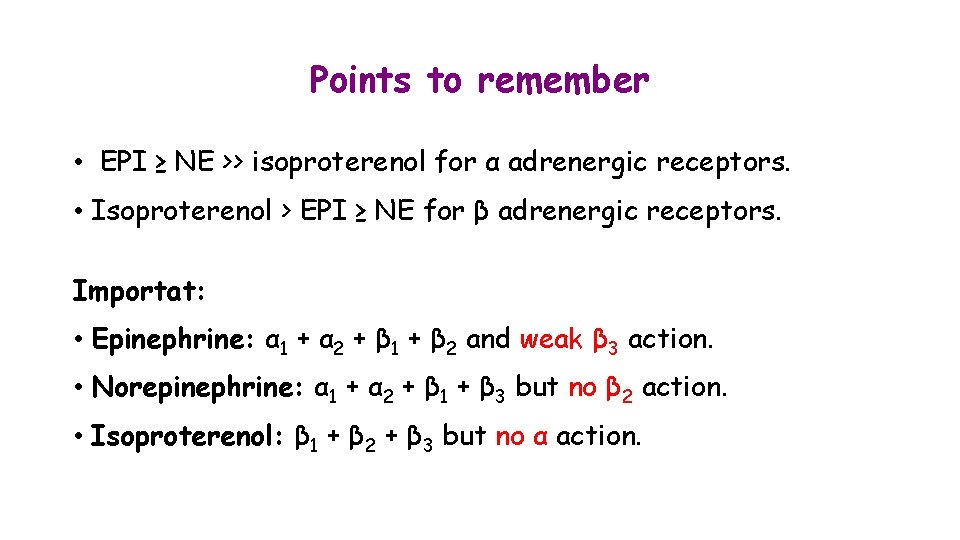
Points to remember • EPI ≥ NE >> isoproterenol for α adrenergic receptors. • Isoproterenol > EPI ≥ NE for β adrenergic receptors. Importat: • Epinephrine: α 1 + α 2 + β 1 + β 2 and weak β 3 action. • Norepinephrine: α 1 + α 2 + β 1 + β 3 but no β 2 action. • Isoproterenol: β 1 + β 2 + β 3 but no α action.
Thank You
- Slides: 12