
Adrenergic agonists DR FATIMAH ALMAHASNEH DEPARTMENT OF BASIC
Adrenergic agonists DR. FATIMAH ALMAHASNEH DEPARTMENT OF BASIC MEDICAL SCIENCES FACULTY OF MEDICINE – YARMOUK UNIVERSITY
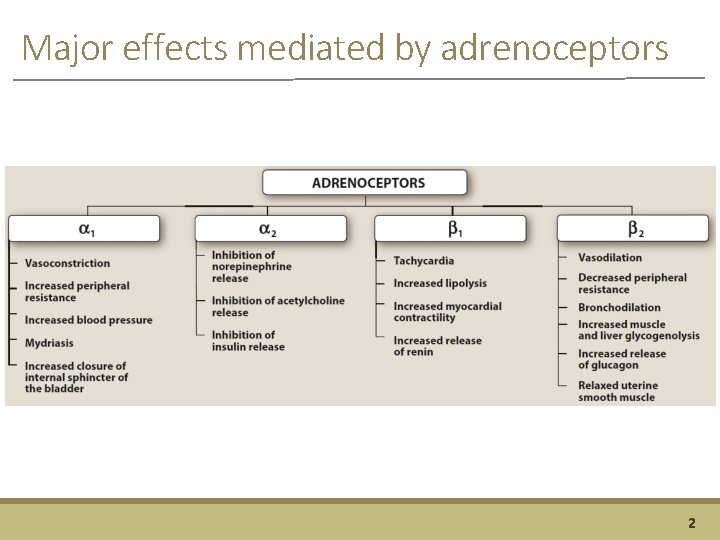
Major effects mediated by adrenoceptors 2
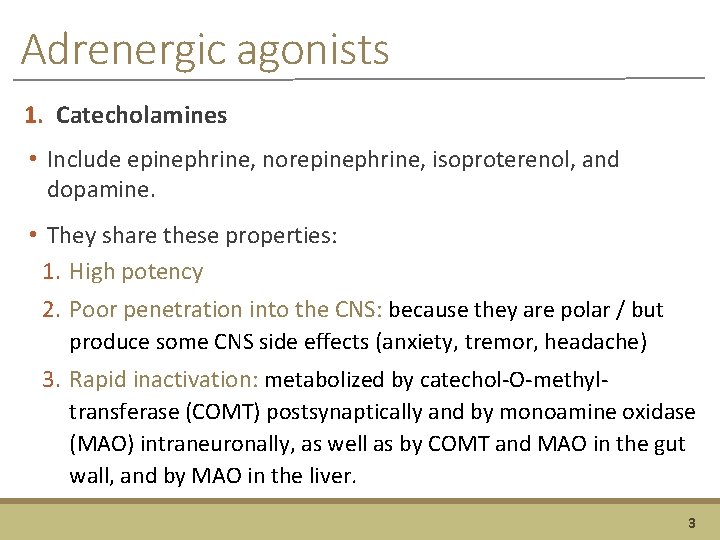
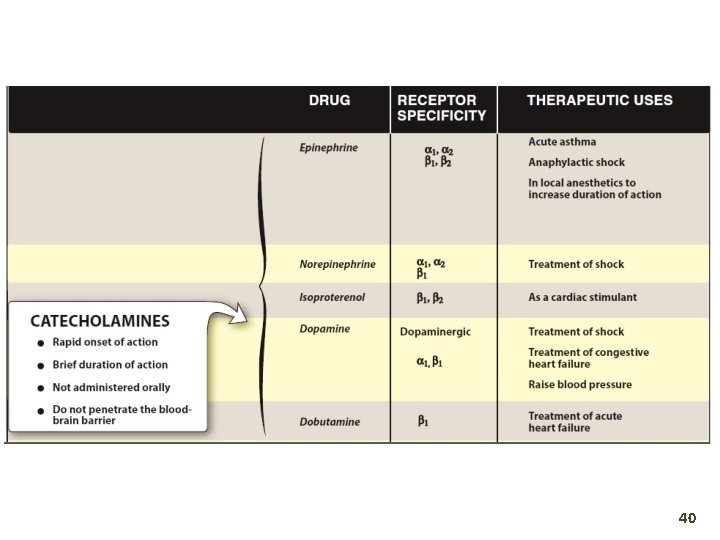
Adrenergic agonists 1. Catecholamines • Include epinephrine, norepinephrine, isoproterenol, and dopamine. • They share these properties: 1. High potency 2. Poor penetration into the CNS: because they are polar / but produce some CNS side effects (anxiety, tremor, headache) 3. Rapid inactivation: metabolized by catechol-O-methyltransferase (COMT) postsynaptically and by monoamine oxidase (MAO) intraneuronally, as well as by COMT and MAO in the gut wall, and by MAO in the liver. 3
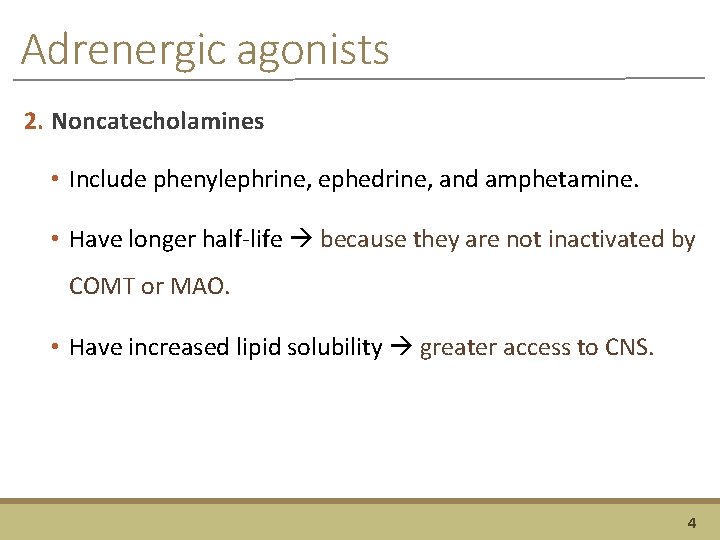
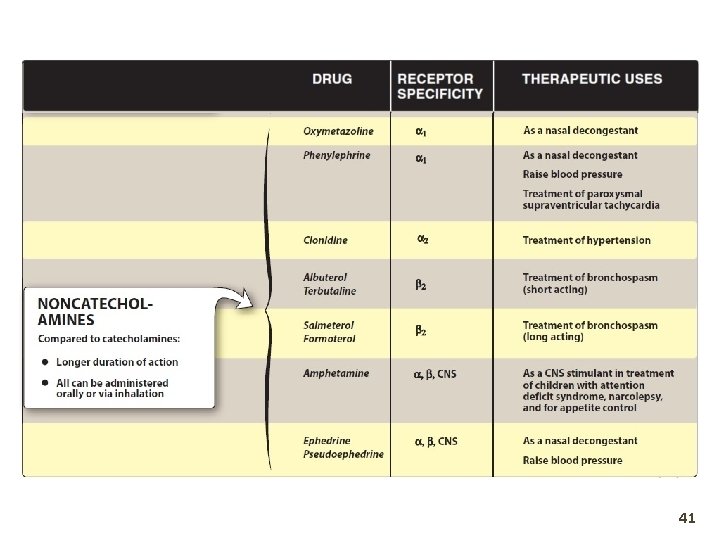
Adrenergic agonists 2. Noncatecholamines • Include phenylephrine, ephedrine, and amphetamine. • Have longer half-life because they are not inactivated by COMT or MAO. • Have increased lipid solubility greater access to CNS. 4
Adrenergic agonists - MOA 1. Direct-acting agonists • Act directly on α or β receptors, producing effects similar to those that occur following stimulation of sympathetic nerves or release of epinephrine from the adrenal medulla. • Include: epinephrine, norepinephrine, isoproterenol, and phenylephrine. 5
Adrenergic agonists - MOA 2. Indirect-acting agonists • These agents block the reuptake of norepinephrine or cause the release of norepinephrine from the adrenergic neuron norepinephrine then traverses the synapse and binds to α or β receptors. • Examples of reuptake inhibitors and agents that cause norepinephrine release include cocaine and amphetamines, respectively. 6
Adrenergic agonists - MOA 3. Mixed-action agonists • Ephedrine and its stereoisomer, pseudoephedrine, both stimulate adrenoceptors directly and release norepinephrine from the adrenergic neuron. 7
Direct-acting adrenergic agonists 8
Epinephrine • It is one of the four catecholamines (epinephrine, norepinephrine, dopamine, and dobutamine) commonly used in therapy. • The first three are naturally occurring neurotransmitters, and the latter is a synthetic compound. • Epinephrine interacts with both α and β receptors. • At low doses, β effects (vasodilation) on the vascular system predominate, whereas at high doses, α effects (vasoconstriction) are the strongest. 9
Epinephrine - Actions 1. Cardiovascular • Positive inotropic and chronotropic effect (β 1 action) ↑ CO ↑ oxygen demands on the myocardium. • Epinephrine activates β 1 receptors on the kidney renin release. • Epinephrine: • constricts arterioles in the skin, mucous membranes, and viscera α effects • dilates vessels going to the liver and skeletal muscle β 2 effects 10
Epinephrine - Actions 1. Cardiovascular • Epinephrine also decreases renal blood flow. • The cumulative effect of epinephrine is: • increase in systolic blood pressure, coupled with a slight decrease in diastolic pressure due to β 2 receptor–mediated vasodilation in the skeletal muscle vascular bed. 11
Epinephrine - Actions 2. Respiratory • Epinephrine causes powerful bronchodilation by activation of β 2 receptors on bronchial smooth muscles. • It also inhibits the release of allergy mediators such as histamine from mast cells. 12
Epinephrine - Actions 3. Hyperglycemia • Epinephrine has a significant hyperglycemic effect because of: ◦ increased glycogenesis in the liver (β 2 effect) ◦ increased release of glucagon (β 2 effect) ◦ decreased release of insulin (α 2 effect). 4. Lipolysis ◦ through agonist activity on the β receptors of adipose tissue increased levels of c. AMP stimulate a hormone-sensitive lipase hydrolyzes triglycerides to free fatty acids and glycerol. 13
Epinephrine - Therapeutic uses 1. Drug of choice for the treatment of anaphylactic shock and type I hypersensitivity. 2. To restore cardiac rhythm in patients with cardiac arrest. 3. Adjuvant to local anesthetics to produce vasoconstriction increased duration of action. 14
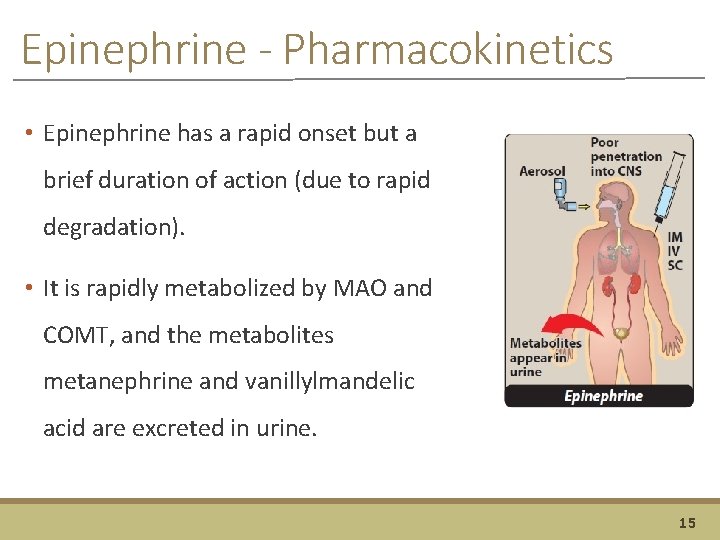
Epinephrine - Pharmacokinetics • Epinephrine has a rapid onset but a brief duration of action (due to rapid degradation). • It is rapidly metabolized by MAO and COMT, and the metabolites metanephrine and vanillylmandelic acid are excreted in urine. 15
Epinephrine – Adverse effects • Anxiety, fear, tension, headache, and tremor • Cardiac arrhythmias (especially with digoxin) • Pulmonary edema • Nonselective β-blockers prevent vasodilatory effects of epinephrine on β 2 receptors, leaving α receptor stimulation unopposed increased peripheral resistance and increased blood pressure. 16
Norepinephrine (NE) • When administered in therapeutic doses, NE mostly affects the α-adrenergic receptors. Norepinephrine actions 1. Vasoconstriction: NE causes intense vasoconstriction of most vascular bed, including the kidney (α 1 effect) ↑ peripheral resistance ↑ both systolic and diastolic BP. • NE causes greater vasoconstriction than epinephrine, because it does not induce compensatory vasodilation via β 2 receptors on blood vessels supplying skeletal muscles. 17
Norepinephrine (NE) 2. Baroreceptor reflex • NE increases blood pressure stimulates the baroreceptors rise in vagal activity reflex bradycardia counteract the local actions of norepinephrine on the heart. Therapeutic uses • Treatment of shock 18
Norepinephrine - Pharmacokinetics • Norepinephrine is given IV for rapid onset of action. • The duration of action is 1 to 2 minutes, following the end of the infusion. • It is rapidly metabolized by MAO and COMT, and inactive metabolites are excreted in the urine. 19
Norepinephrine – Adverse effects • Similar to epinephrine • May cause blanching and sloughing of the skin along the injected vein. • If extravasation occurs, it can cause tissue necrosis. 20
Isoproterenol • It is a direct-acting synthetic catecholamine that stimulates both β 1 - and β 2 -adrenergic receptors. • Rarely used therapeutically. • Isoproterenol produces intense stimulation of the heart increase heart rate, contractility, and cardiac output. • It dilates the arterioles of skeletal muscle (β 2 effect) decreased peripheral resistance. • It is a potent bronchodilator 21
Isoproterenol – Therapeutic uses Treatment of: • bradycardia and resulting cardiogenic shock. • short QT-syndrome and ventricular tachycardia/ventricular fibrillation storm. • torsades de pointes. 22
Dopamine • It is the immediate metabolic precursor of norepinephrine. • It occurs naturally in the CNS in the basal ganglia, where it functions as a neurotransmitter, as well as in the adrenal medulla. • Dopamine can activate α- and β-adrenergic receptors. ◦ At higher doses it causes vasoconstriction by activating α 1 receptors ◦ At lower doses, it stimulates β 1 cardiac receptors. • Binding of dopamine to dopaminergic receptors in the peripheral mesenteric and renal vascular beds produces vasodilation. • Activation of D 2 receptors on presynaptic adrenergic neurons interferes with norepinephrine release. 23
Dopamine - Actions • Stimulatory effect on the β 1 receptors of the heart positive inotropic and chronotropic effects. • At very high doses, dopamine activates α 1 receptors on the vasculature vasoconstriction. • Dopamine dilates renal and splanchnic arterioles by activating dopaminergic receptors increases blood flow to the kidneys and other viscera. 24
Dopamine – Therapeutic uses • Treatment of cardiogenic and septic shock. • It raises blood pressure by stimulating ◦ β 1 receptors on the heart to increase cardiac output ◦ α 1 receptors on blood vessels to increase total peripheral resistance. • In addition, it enhances perfusion to the kidney and splanchnic areas ↑ GFR diuresis. ◦ Note: NE diminishes blood supply to the kidney and may cause renal shutdown. 25
Dopamine – Adverse effects • An overdose of dopamine produces the same effects as sympathetic stimulation. • Dopamine is rapidly metabolized by MAO or COMT, and its adverse effects (nausea, hypertension, and arrhythmias) are, therefore, short-lived. 26
Fenoldopam • It is an agonist of peripheral dopamine D 1 receptors. • It is used as a rapid-acting vasodilator to treat severe hypertension in hospitalized patients, acting on coronary arteries, kidney arterioles, and mesenteric arteries. 27
Dobutamine • It is a synthetic, direct-acting catecholamine that is a β 1 receptor agonist. • It increases cardiac rate and output with few vascular effects. • Dobutamine is used to increase cardiac output in acute heart failure and for inotropic support after cardiac surgery. 28
Oxymetazoline • It is a direct-acting synthetic adrenergic agonist that stimulates both α 1 - and α 2 -adrenergic receptors. • It is found in many over-the-counter short-term nasal spray decongestants, as well as in ophthalmic drops for the relief of redness of the eyes. • Oxymetazoline directly stimulates α receptors on blood vessels supplying the nasal mucosa and conjunctiva, thereby producing vasoconstriction and decreasing congestion. • Rebound congestion and dependence are observed with longterm use. 29
Phenylephrine • It is a direct-acting, synthetic adrenergic drug that binds primarily to α 1 receptors. • Phenylephrine is a vasoconstrictor that raises both systolic and diastolic blood pressures. • It has no effect on the heart itself but, rather, induces reflex bradycardia when given parenterally. • The drug is used to treat hypotension in hospitalized or surgical patients (especially those with tachycardia). • Phenylephrine acts as a nasal decongestant when applied topically or taken orally. • Phenylephrine is also used in ophthalmic solutions for mydriasis. 30
Clonidine • It is an α 2 agonist that is used for the treatment of hypertension. • Clonidine acts centrally on presynaptic α 2 receptors inhibition of sympathetic vasomotor centers decreased sympathetic outflow to the periphery. • Methyldopa is also an α 2 agonist used to treat hypertension. 31
Mirabegron • It is a β 3 agonist that relaxes the detrusor smooth muscle during the urine storage phase increases bladder capacity. • It is used for patients with overactive bladder. 32
Indirect-acting adrenergic agonists 33
Amphetamine • It has marked central stimulatory action drug of abuse. • It has neurologic and clinical effects similar to cocaine. • It significantly increases blood pressure by α 1 agonist action on the vasculature, as well as β 1 -stimulatory effects on the heart. • Its actions are mediated primarily through an increase in nonvesicular (intracellular) release of catecholamines such as dopamine and norepinephrine from nerve terminals. 34
Amphetamine • This group of agents includes: ◦ Dextroamphetamine (major compound) ◦ Methamphetamine (also known as speed) ◦ 3, 4 -Methylenedioxymethamphetamine (also known as MDMA, or Ecstasy) stimulant and hallucinogenic properties. • Effects: Increases alertness, decreased fatigue, depressed appetite, and insomnia. • Therapeutic uses ◦ Attention deficit hyperactivity disorder (ADHD) ◦ Narcolepsy ◦ Appetite suppression 35
Cocaine • It is a local anesthetics that blocks the (Na+/Cl-)-dependent norepinephrine transporter required for cellular uptake of NE into the adrenergic neuron NE accumulates in the synaptic space enhanced sympathetic activity. • It can increase blood pressure by α 1 agonist actions and β stimulatory effects. 36
Mixed-action adrenergic agonists 37
Ephedrine and pseudoephedrine • Release stored onorepinephrine from nerve endings and also directly stimulate both α and β receptors actions similar to epinephrine but less potent. • Ephedrine and pseudoephedrine are not catechols and are poor substrates for COMT and MAO long duration of action. • Ephedrine raises systolic and diastolic BP by vasoconstriction and cardiac stimulation be used to treat hypotension. • It also produces mild stimulation f the CNS. 38
Ephedrine and pseudoephedrine • Pseudoephedrine is primarily used orally to treat nasal and sinus congestion. • Pseudoephedrine has been illegally used to produce methamphetamine. 39
40
41

Thank you for your attention 42
- Slides: 42