
Adoption 101 Heartland for Childrens Trauma Informed Relationship

- Slides: 15
Adoption 101 Heartland for Children’s Trauma Informed, Relationship Focused Adoption Training Class Four
Welcome To Adoption 101, Class Four! • Welcome back! • Discussion of last week & homework • Today’s Agenda! • Guest Speaker • Pillars of Complex Developmental Trauma • Empowerment Principles
Three Main Pillars for Healing • Safety – The child IS safe and FEELS safe • Connection/Relationship • Building Coping Skills
Principles of Trust-Based Relational Intervention • The 3 Pillars parallel the 3 evidence based principles of Trust-Based Relational Intervention (TBRI): • Empowering • Connection • Correction • We will discuss elements of each principle, starting with empowerment.
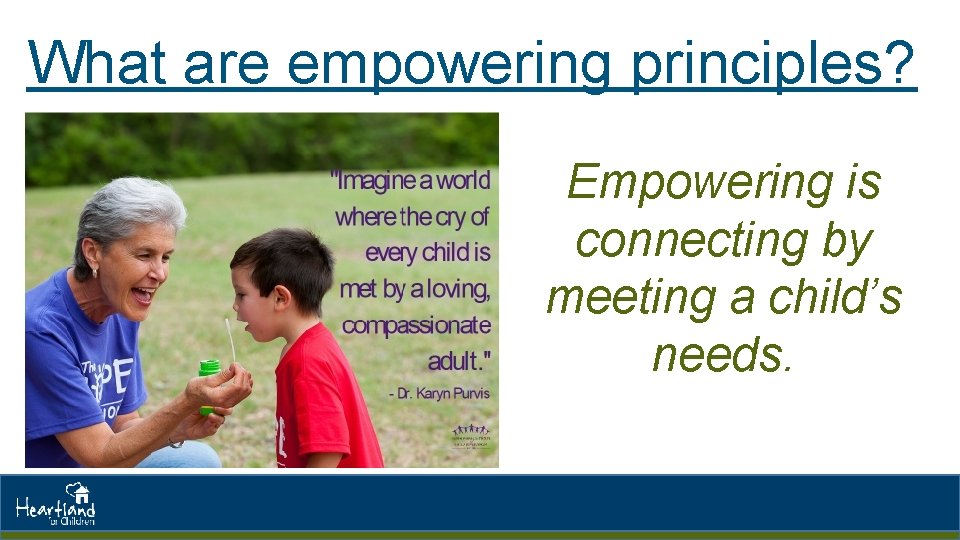
What are empowering principles? Empowering is connecting by meeting a child’s needs.
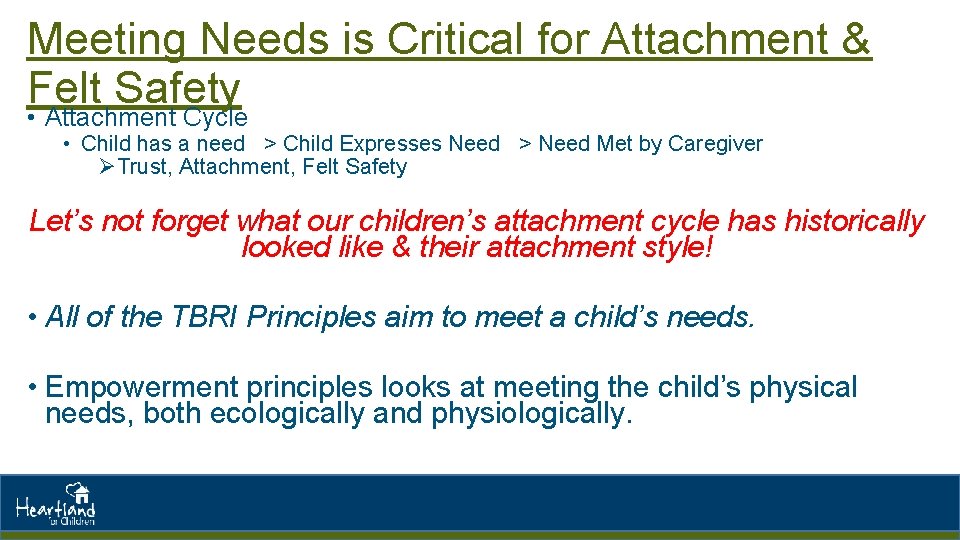
Meeting Needs is Critical for Attachment & Felt Safety • Attachment Cycle • Child has a need > Child Expresses Need > Need Met by Caregiver ØTrust, Attachment, Felt Safety Let’s not forget what our children’s attachment cycle has historically looked like & their attachment style! • All of the TBRI Principles aim to meet a child’s needs. • Empowerment principles looks at meeting the child’s physical needs, both ecologically and physiologically.
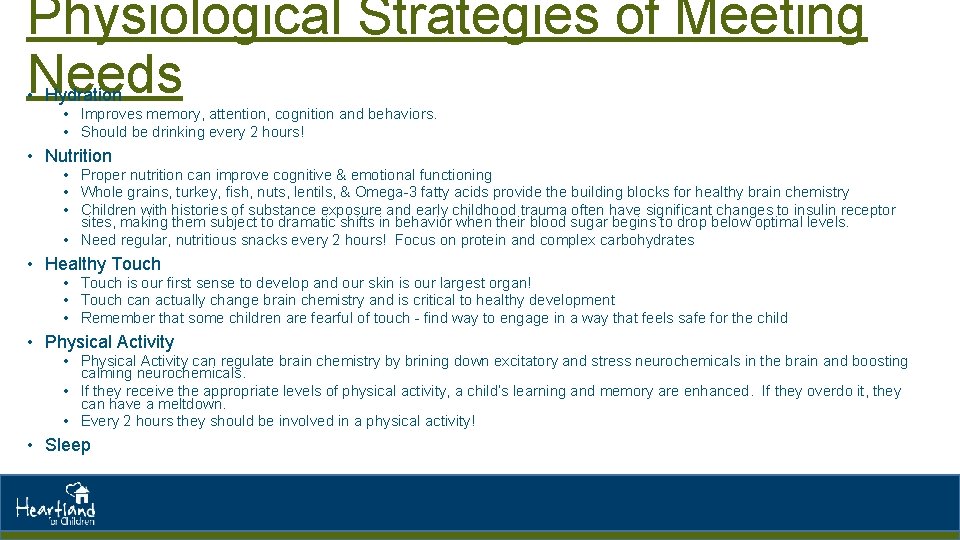
Physiological Strategies of Meeting Needs • Hydration • Improves memory, attention, cognition and behaviors. • Should be drinking every 2 hours! • Nutrition • Proper nutrition can improve cognitive & emotional functioning • Whole grains, turkey, fish, nuts, lentils, & Omega-3 fatty acids provide the building blocks for healthy brain chemistry • Children with histories of substance exposure and early childhood trauma often have significant changes to insulin receptor sites, making them subject to dramatic shifts in behavior when their blood sugar begins to drop below optimal levels. • Need regular, nutritious snacks every 2 hours! Focus on protein and complex carbohydrates • Healthy Touch • Touch is our first sense to develop and our skin is our largest organ! • Touch can actually change brain chemistry and is critical to healthy development • Remember that some children are fearful of touch - find way to engage in a way that feels safe for the child • Physical Activity can regulate brain chemistry by brining down excitatory and stress neurochemicals in the brain and boosting calming neurochemicals. • If they receive the appropriate levels of physical activity, a child’s learning and memory are enhanced. If they overdo it, they can have a meltdown. • Every 2 hours they should be involved in a physical activity! • Sleep
Physiological Needs Continued • Sensory Processing • 1 out of 20 children have sensory processing difficulties, with a higher than average rate for children who have experienced trauma. It is often undetected, overlooked, or diagnosed as something else. • Sensory Processing Disorder can be defined as a “practical inability to use information received through the senses so as to function smoothly and normally in everyday life. ” • This can lead to difficulties with eating, getting dressed, riding in a car, playing with others, etc. • Helpful to pay attention to input they are seeking and what they are avoiding. Journaling is sometimes helpful.
Physiological Strategies: Understanding Sensory Processing • Five external senses: sight, smell, touch, taste, and sound • The senses serve four primary functions: • • ALERT the body and brain to important cues PROTECT the body and brain from becoming overwhelmed SELECT what is important to pay attention to ORGANIZE the brain automatically • Three internal or body-centered senses help the brain create meaning from sensory input received from the environment • Vestibular • Proprioceptive • Tactile
How can we meet our children’s sensory needs? • Weight lifting (proprioceptive, calming, organizing) • Basketball (vestibular, hand-eye coordination) • Swimming (proprioceptive, tactile) • Trampoline (vestibular) • Climbing (proprioceptive, vestibular, hand-eye coordination) • Tight clothing (proprioceptive) • Massage (proprioceptive, tactile)
Empowering Principles, Ecological Strategies • Supporting our children in their environment, and ensuring they are seen, heard, and valued! • Felt Safety • To have felt safety, must feel connected, that they belong, and are being their true self • Transitions • Daily Transitions • Life Transitions • Prepare them for success! • Scaffolding Self-Regulation • Help your child learn to self-regulate
More Empowering Strategies • Daily Routine • Consistent, predictable, and prepares for what is coming next • Rituals • Routine that builds connection! • Artifacts • Object with meaning, sentimental
Reflection: • What elements of Mr. White video relates to what we talked about today? • What are some key words for you that has stuck in your mind related to the empowering principles? • After learning this information, where there any “ah ha” moments? • After learning this information, is there anything you may start doing differently in your everyday life? QUESTIONS?
Thank you! • Homework: • Empowering Strategies • Handouts: • • • The Healing Power of “Giving Voice” Dan Hughes’ 24 S’s: A Guide for Raising your Troubled or Sensitive Child 10 Tips for Stressed Out Parents Your 8 Senses Sensory Profiles Weighted Items: Tools for Helping Children Learn to Regulate