
AdolescentFriendly Health Services Objectives Identify three key barriers
Adolescent-Friendly Health Services
Objectives Identify three key barriers to health care access faced by adolescents. Describe three elements of adolescent-friendly health services. Utilize the HEEADSSS model of patient interviewing and review findings from Youth Risk Behavior Surveillance
When Do Adolescents Seek Sexual and Reproductive Health (SRH) Services? The average teen waits ? months after becoming sexually active to make her first family planning visit. “The pregnancy test is an admission of unprotected sexual activity and an indication of the need for appropriate reproductive counseling. ”* Guttmacher Institute (2000).
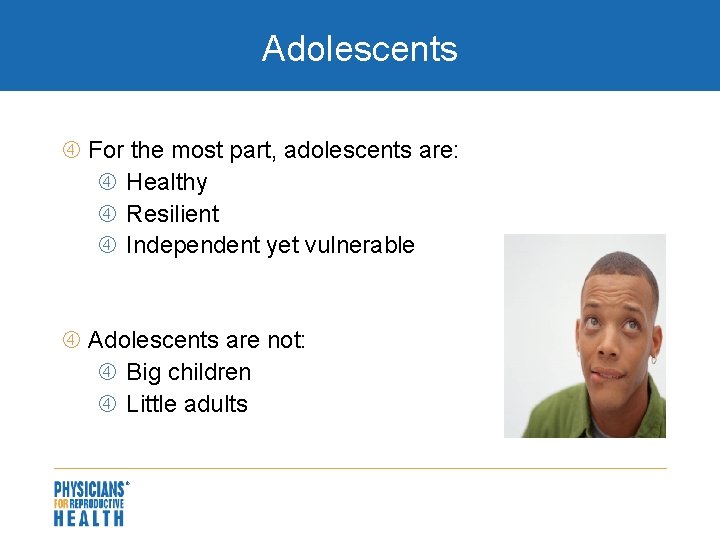
Adolescents For the most part, adolescents are: Healthy Resilient Independent yet vulnerable Adolescents are not: Big children Little adults

The Culture of Adolescence Peer dependent Egocentric Distinct language and dress Popular culture influence Ongoing search for identity
Why Focus on Adolescent Health? Reduce death and disease, now and for the rest of their lives Fulfill the rights of adolescents to health care, especially reproductive health care Increase the chances for healthy adulthood

Adolescence in Context Changes during adolescence are shaped by Race/Ethnicity Religion Socioeconomic Status Family Peers
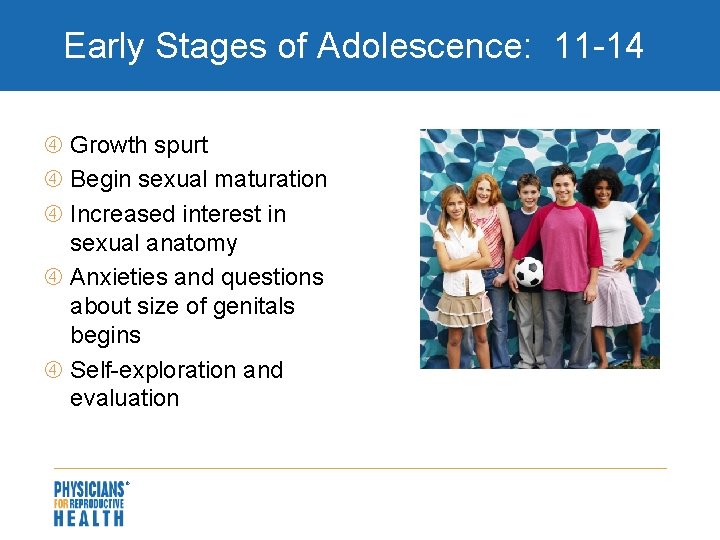
Early Stages of Adolescence: 11 -14 Growth spurt Begin sexual maturation Increased interest in sexual anatomy Anxieties and questions about size of genitals begins Self-exploration and evaluation
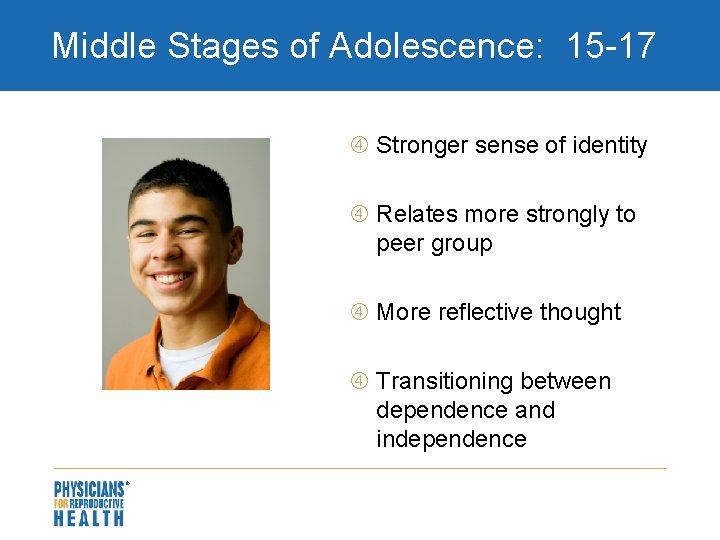
Middle Stages of Adolescence: 15 -17 Stronger sense of identity Relates more strongly to peer group More reflective thought Transitioning between dependence and independence
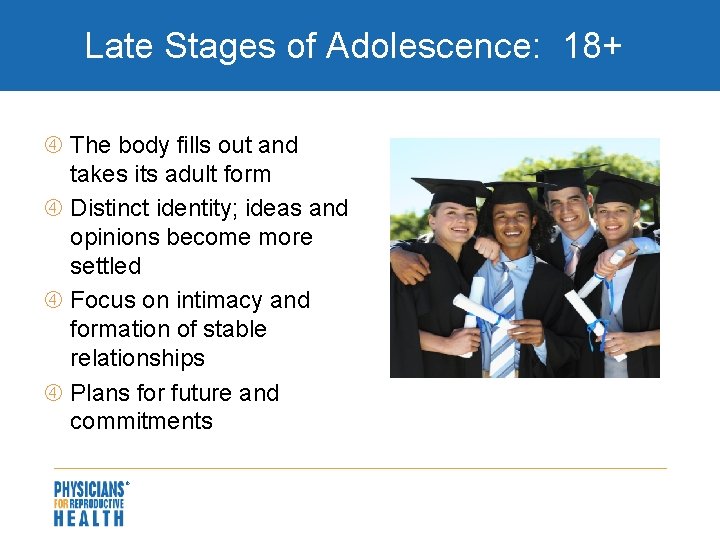
Late Stages of Adolescence: 18+ The body fills out and takes its adult form Distinct identity; ideas and opinions become more settled Focus on intimacy and formation of stable relationships Plans for future and commitments
External Barriers to Care Perceived lack of confidentiality and restrictions (parental consent/notification) Poor communication by providers Insensitive attitudes of care providers Lack of provider knowledge and skills Lack of money, insurance, and transportation Inaccessible locations and/or limited services Limited office hours
Adolescent-Friendly Health Services Adolescent-specific Multi- and interdisciplinary Accessible Financially affordable Adolescent-focused materials on display Peer educator component Adequate space Confidential Flexible scheduling Comprehensive services Continuity of care Help transitioning into the adult medical care system
Preparing for Clinical Visits
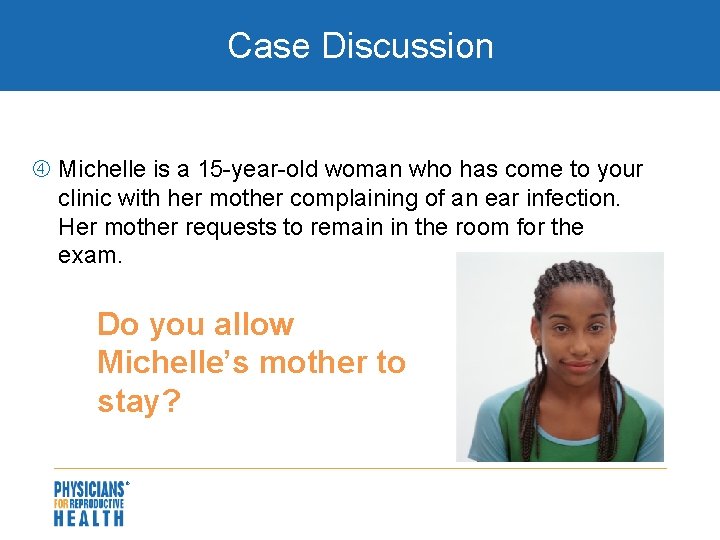
Case Discussion Michelle is a 15 -year-old woman who has come to your clinic with her mother complaining of an ear infection. Her mother requests to remain in the room for the exam. Do you allow Michelle’s mother to stay?
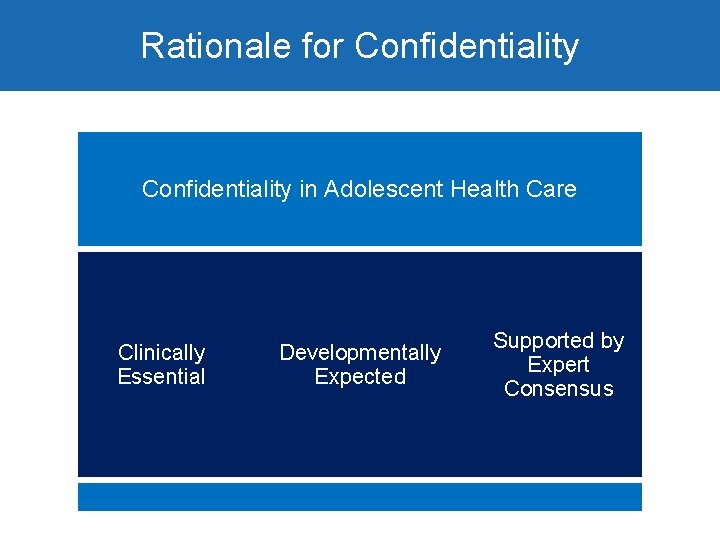
Rationale for Confidentiality in Adolescent Health Care Clinically Essential Developmentally Expected Supported by Expert Consensus
Confidentiality: Parental Perspective Parents are not the enemy. Parents are experiencing their own adjustment to their child’s adolescence. Providers have an opportunity to educate parents about the need for confidentiality in the providerpatient encounter.
Discuss Confidentiality in Advance Inform parents about the confidentiality policy up front before a visit. Send a letter home: • Detail when parent will or will not be included in the clinical visit • Discuss billing issues (e. g. , routine STI testing, etc. ) Display materials discussing importance of doctor/patient confidentiality.
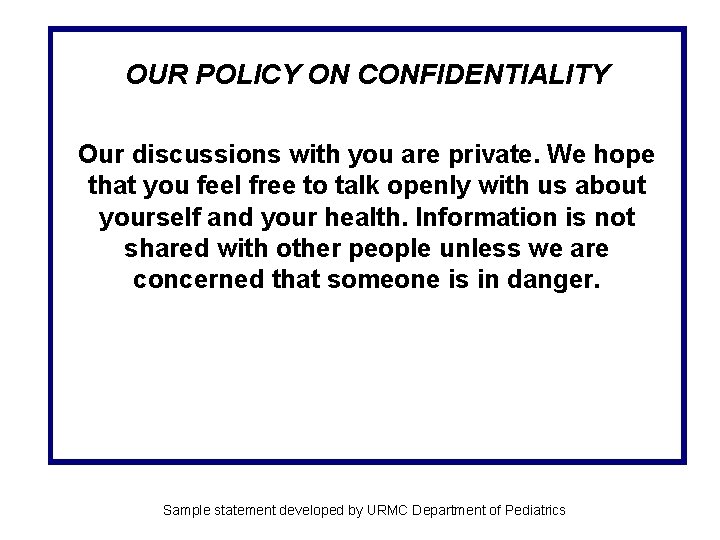
OUR POLICY ON CONFIDENTIALITY Our discussions with you are private. We hope that you feel free to talk openly with us about yourself and your health. Information is not shared with other people unless we are concerned that someone is in danger. Sample statement developed by URMC Department of Pediatrics
Develop Referral Network Social worker Nutritionist Psychologist or counselor Abortion, adoption, and prenatal care services STD clinics Department of Health clinics
Case 1 You have recently accepted a new position as practitioner at a pediatric office. The clinic sees a small population of adolescents but wishes to expand its efforts with this population. What are some initial steps that you take to ensure that your office is adolescent-friendly?
The Clinical Interview
Comprehensive HEEADSSS H: Home E: Education/Employment E: Eating A: Activities D: Drugs S: Sexuality S: Suicide/depression S: Safety *Additional questions: Strengths, Spirituality Klein DA, Goldenring JM & Adelman WP. Contemporary Pediatrics. 2014.
SHEEADSSS S: Strengths/Spirituality H: Home E: Education/Employment E: Eating A: Activities D: Drugs S: Sexuality S: Suicide/depression S: Safety Klein DA, Goldenring JM & Adelman WP. Contemporary Pediatrics. 2014.
Strengths-Based Approach Identify strengths early and Praise Look for examples of past difficulties that your patient has successfully overcome Use reflective listening and pause Create a comfortable, trusting, nonjudgmental setting Share your concerns
Spirituality* How do your beliefs influence your health and attitudes about sex and contraception? How important are your spiritual beliefs in your day-to -day life? How often do you participate in religious activities? What do you consider to be your religion?
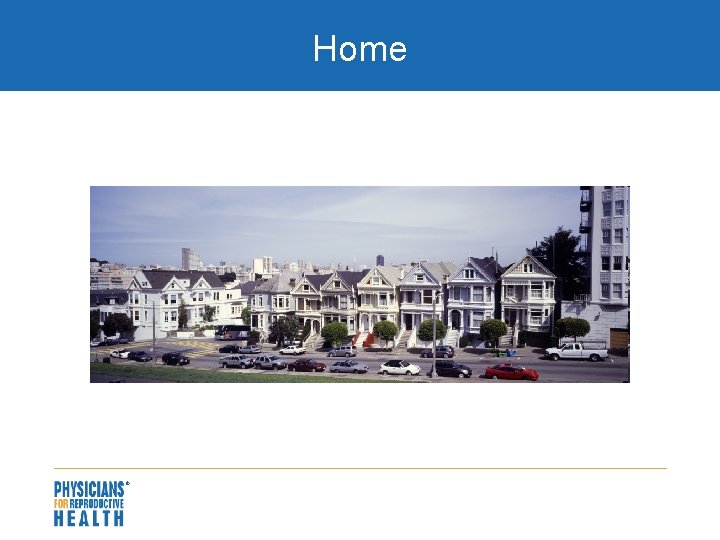
Home
Home Where do you live and who lives there with you? What are relationships like at home? Can you talk to anyone at home about stress? Who? What are the rules like at home? Is there a gun in your home? Ever been homeless or in shelter care? Ever been in foster care or group home?
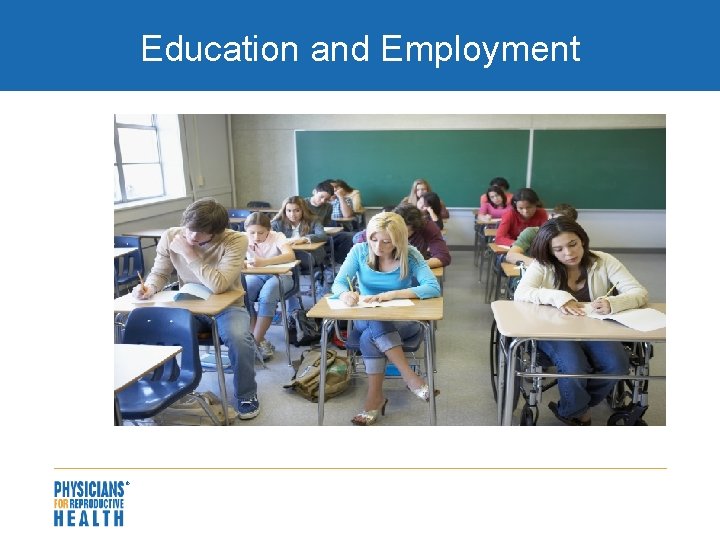
Education and Employment
Education Tell me about school. Do you feel connected to your school? Do you feel as if you belong? How many days have you missed in the past year and what was the reason? Have you ever had any educational setbacks? Why? Have there been any recent school changes? What are your educational and life goals?
Employment Are you working? Where? How much? What type of work do you do? How many hours a week? Do you help to pay for things at home? What are your future career interests? Do you have any home chores? Allowance?
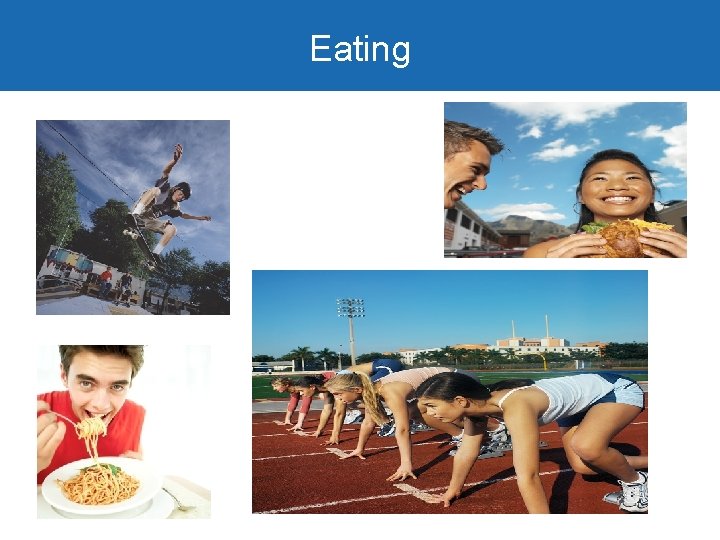
Eating
Case 2 A 15 -year-old female patient comes to your office. You notice that she has gained a bit of weight. When you ask her to stand on the scale, she begins to cry. n What questions do you ask her regarding her health and body weight? n How do you approach the subject sensitively?
Eating Does your weight or body shape cause you any stress? If so, tell me about it. Have there been any recent changes in your weight? Have you dieted in the past year? How often? What do you like and not like about your body? Tell me about your exercise routine.
Diet/Weight What’s your diet like? Do you think your diet is healthy or unhealthy? If healthy/unhealthy, what’s good or bad about it? How do you feel about your current weight? Do you worry that you weigh too much or too little? Depending on response to above. . . could ask more eating disorder questions, for which there are several validated questionnaires
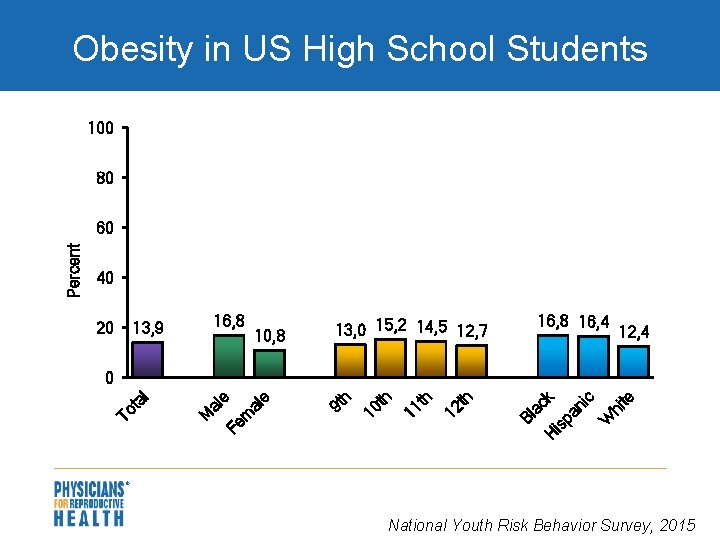
Obesity in US High School Students 100 80 40 20 16, 8 13, 9 10, 8 16, 4 13, 0 15, 2 14, 5 12, 7 12, 4 hi te W ni c is pa ac k H Bl th 12 th 11 th 10 h 9 t al e Fe m al e M l 0 To ta Percent 60 National Youth Risk Behavior Survey, 2015
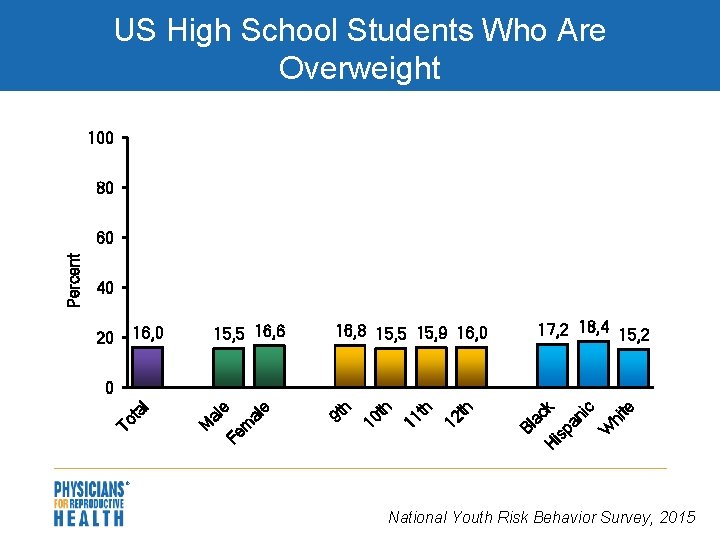
US High School Students Who Are Overweight 100 80 40 15, 5 16, 6 16, 0 20 17, 2 18, 4 15, 2 16, 8 15, 5 15, 9 16, 0 hi te W ni c is pa ac k H Bl th 12 th 11 th 10 h 9 t al e Fe m al e M l 0 To ta Percent 60 National Youth Risk Behavior Survey, 2015
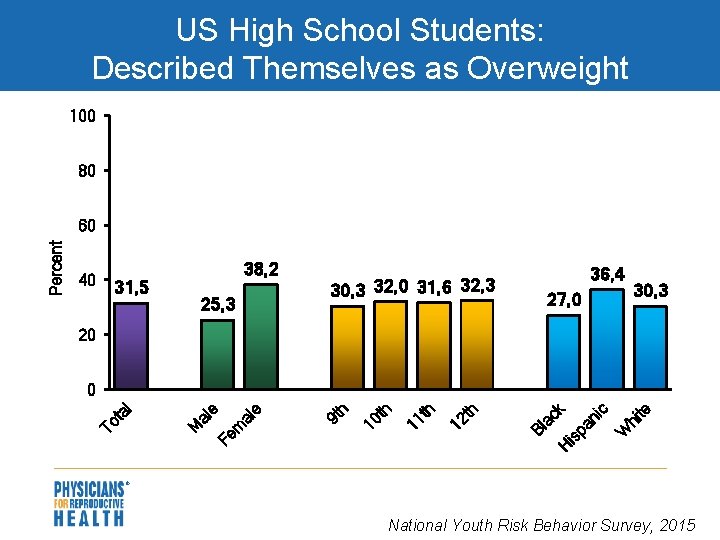
US High School Students: Described Themselves as Overweight 100 80 40 38, 2 31, 5 25, 3 30, 3 32, 0 31, 6 32, 3 36, 4 27, 0 30, 3 20 hi te W ni c H is pa ac k Bl th 12 th 11 th 10 h 9 t al e Fe m al e M l 0 To ta Percent 60 National Youth Risk Behavior Survey, 2015
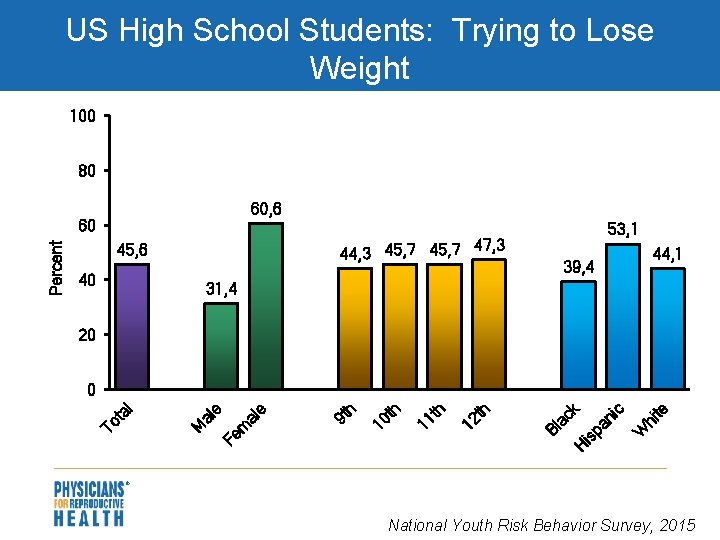
US High School Students: Trying to Lose Weight 100 80 60, 6 53, 1 47, 3 44, 3 45, 7 45, 6 40 44, 1 39, 4 31, 4 20 hi te W ni c H is pa ac k Bl th 12 th 11 th 10 h 9 t al e m Fe M al e 0 To ta l Percent 60 National Youth Risk Behavior Survey, 2015
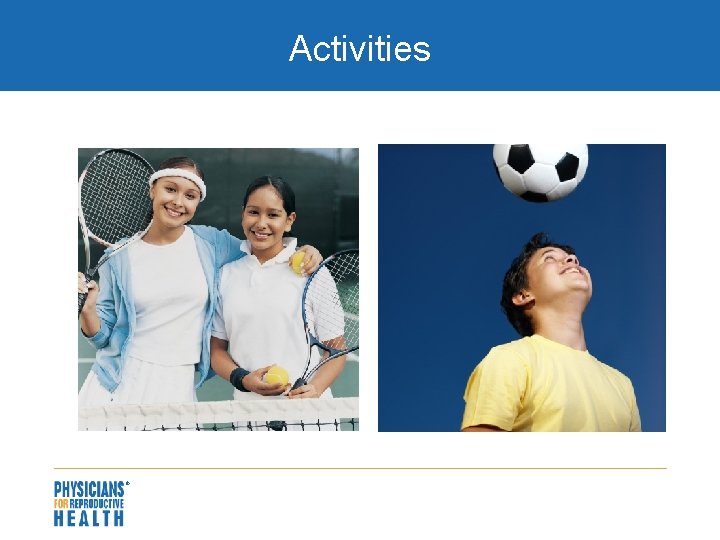
Activities
Activities What do you like to do for physical activity? How much do you do in a week? Do you feel you’re getting enough physical activity to be healthy? How do you like to spend your free time? Hobbies, clubs, religious/spiritual activities? Do you play any sports? How many hours of television/computer per day? Per week?
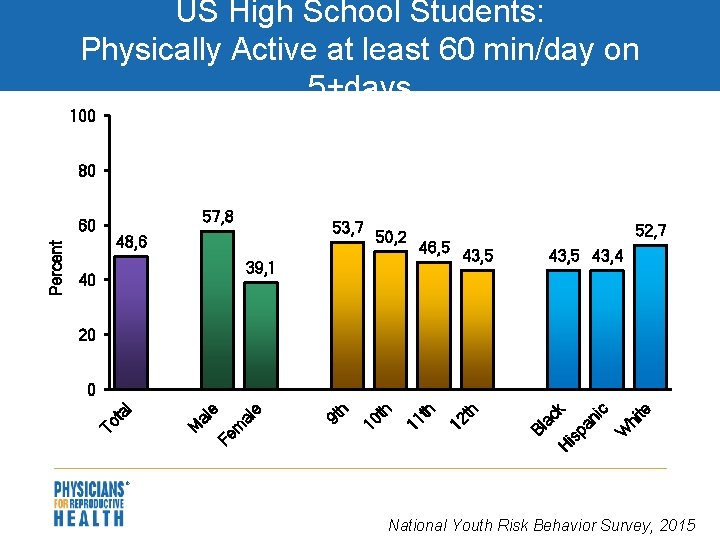
US High School Students: Physically Active at least 60 min/day on 5+days 100 80 57, 8 53, 7 48, 6 50, 2 46, 5 39, 1 40 52, 7 43, 5 43, 4 20 hi te W ni c H is pa ac k Bl th 12 th 11 th 10 h 9 t al e Fe m al e M l 0 To ta Percent 60 National Youth Risk Behavior Survey, 2015
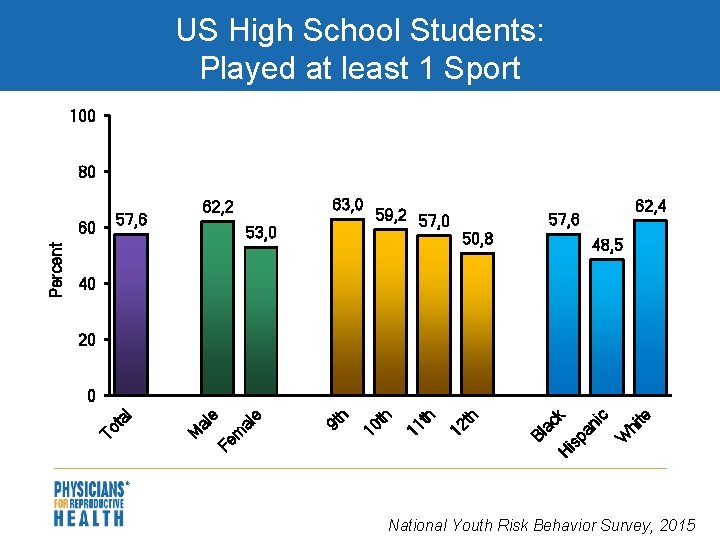
US High School Students: Played at least 1 Sport 100 80 57, 6 53, 0 59, 2 57, 0 62, 4 57, 6 50, 8 48, 5 40 20 hi te W ni c H is pa ac k Bl th 12 th 11 th 10 h 9 t al e Fe m al e M l 0 To ta Percent 60 63, 0 62, 2 National Youth Risk Behavior Survey, 2015
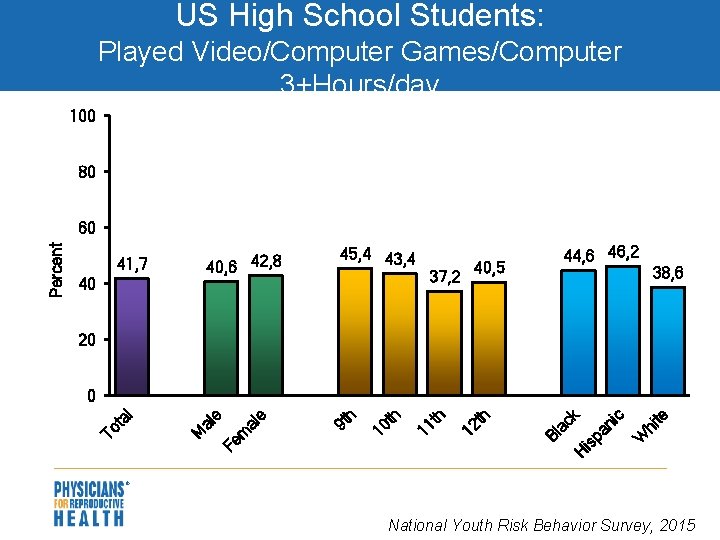
US High School Students: Played Video/Computer Games/Computer 3+Hours/day 100 80 40, 6 42, 8 41, 7 40 45, 4 43, 4 37, 2 44, 6 46, 2 40, 5 38, 6 20 hi te W ni c H is pa ac k Bl th 12 th 11 th 10 h 9 t al e m Fe M al e 0 To ta l Percent 60 National Youth Risk Behavior Survey, 2015
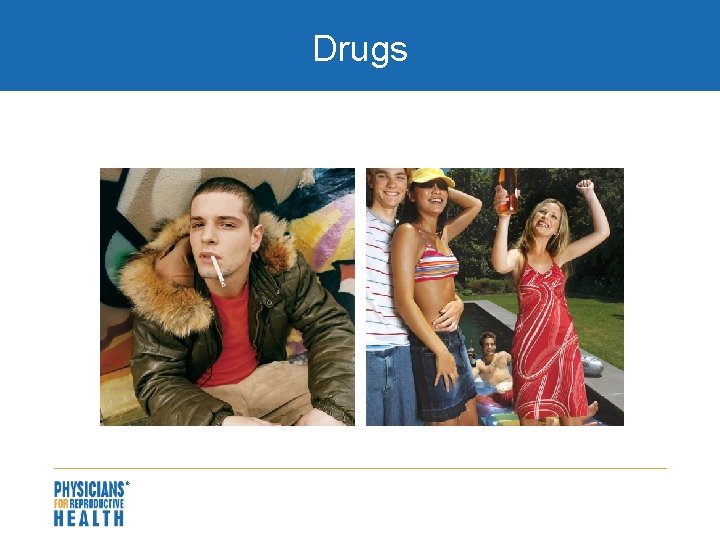
Drugs
Drugs and Alcohol Does anyone you hang out with smoke, drink, or use drugs? How frequently and how much? Do you use tobacco? Do you use electronic cigarettes? Do you drink alcohol? What kind: beer, wine, hard liquor? Any blackouts? Ever pass out? Vomit?
CRAFFT Questions: Identify Problem Use Have you ever ridden in a Car driven by someone who was high or had been using alcohol or drugs? Do you ever use alcohol or drugs to Relax, feel better about yourself, or fit in? Do you ever use drugs or alcohol when you are Alone? Do you Forget things while using drugs or alcohol? Do your family or Friends ever tell you that you should cut down on your drinking or drug use? Have you ever gotten into Trouble while using drugs or alcohol? Copyright © Children's Hospital Boston. All rights reserved
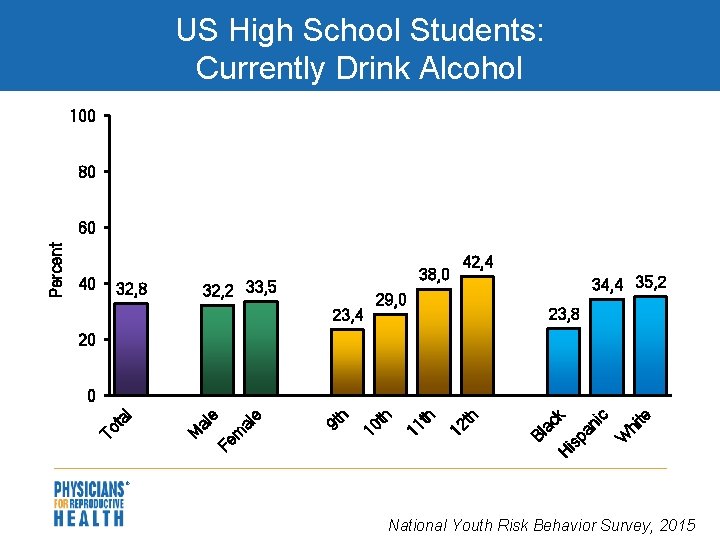
US High School Students: Currently Drink Alcohol 100 80 40 38, 0 32, 2 33, 5 32, 8 23, 4 42, 4 34, 4 35, 2 29, 0 23, 8 20 hi te W ni c H is pa ac k Bl th 12 th 11 th 10 h 9 t al e Fe m al e M l 0 To ta Percent 60 National Youth Risk Behavior Survey, 2015
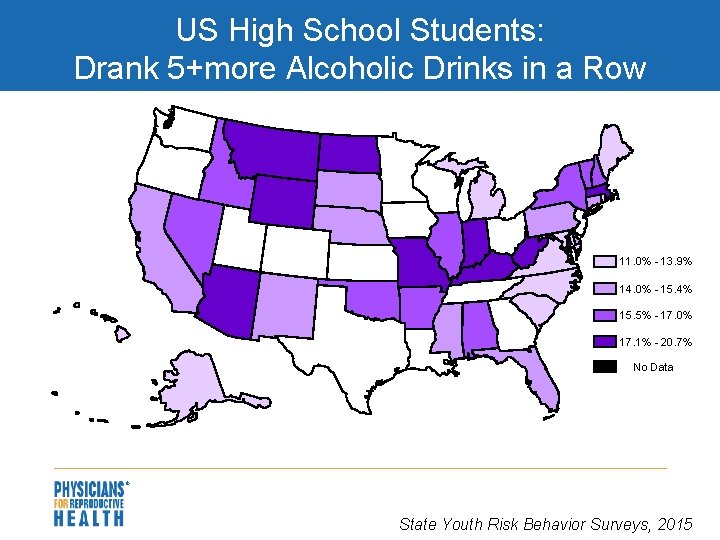
US High School Students: Drank 5+more Alcoholic Drinks in a Row 11. 0% - 13. 9% 14. 0% - 15. 4% 15. 5% - 17. 0% 17. 1% - 20. 7% No Data State Youth Risk Behavior Surveys, 2015
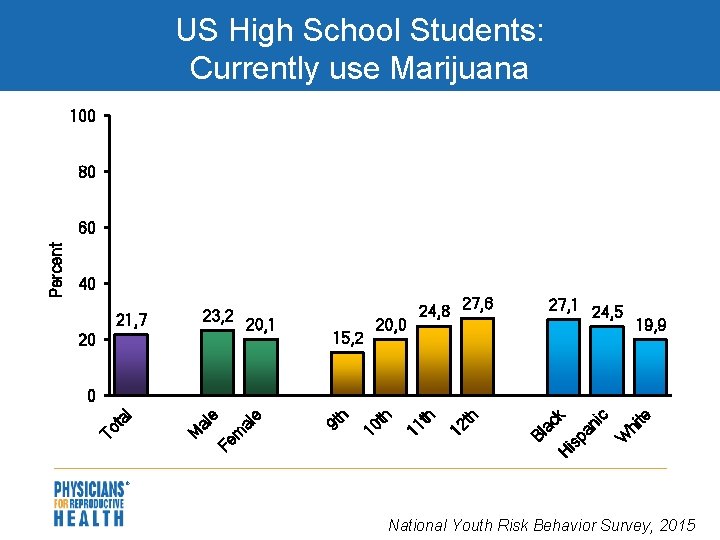
US High School Students: Currently use Marijuana 100 80 40 23, 2 21, 7 20 20, 1 15, 2 20, 0 24, 8 27, 6 27, 1 24, 5 19, 9 hi te W ni c H is pa ac k Bl th 12 th 11 th 10 h 9 t al e Fe m al e M l 0 To ta Percent 60 National Youth Risk Behavior Survey, 2015
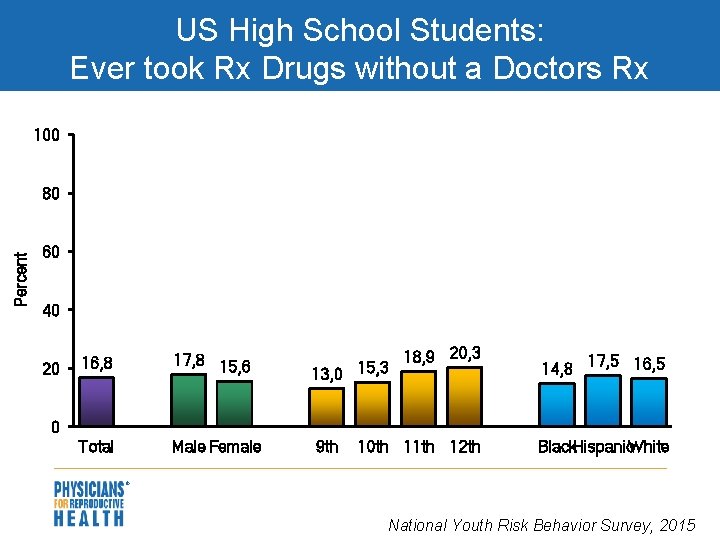
US High School Students: Ever took Rx Drugs without a Doctors Rx 100 Percent 80 60 40 20 16, 8 17, 8 15, 6 13, 0 15, 3 Total Male Female 9 th 18, 9 20, 3 14, 8 17, 5 16, 5 0 10 th 11 th 12 th Black. Hispanic. White National Youth Risk Behavior Survey, 2015
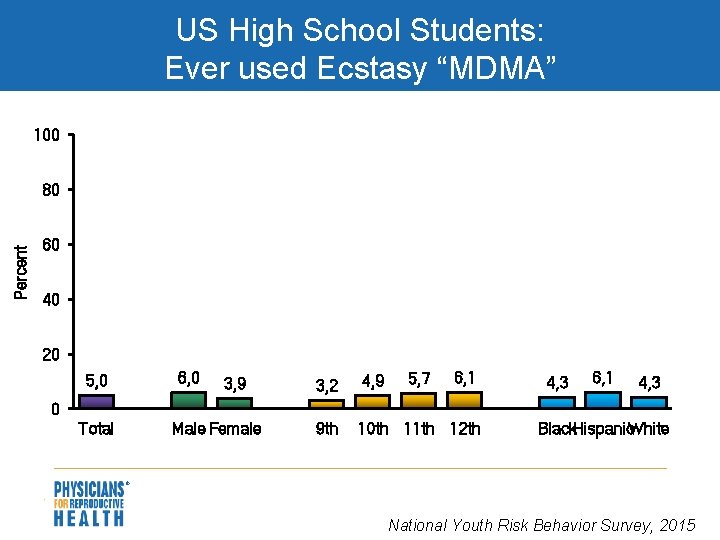
US High School Students: Ever used Ecstasy “MDMA” 100 Percent 80 60 40 20 6, 0 5, 0 3, 9 5, 7 6, 1 3, 2 4, 9 9 th 10 th 11 th 12 th 4, 3 6, 1 4, 3 0 Total Male Female Black. Hispanic. White . National Youth Risk Behavior Survey, 2015
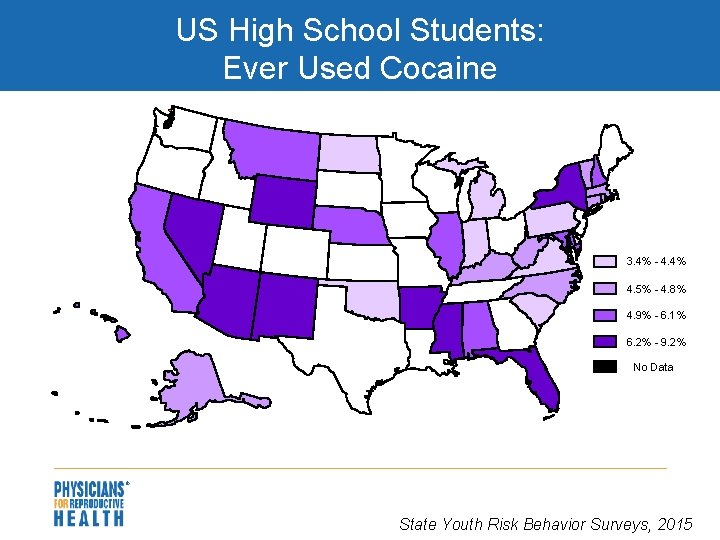
US High School Students: Ever Used Cocaine 3. 4% - 4. 4% 4. 5% - 4. 8% 4. 9% - 6. 1% 6. 2% - 9. 2% No Data State Youth Risk Behavior Surveys, 2015
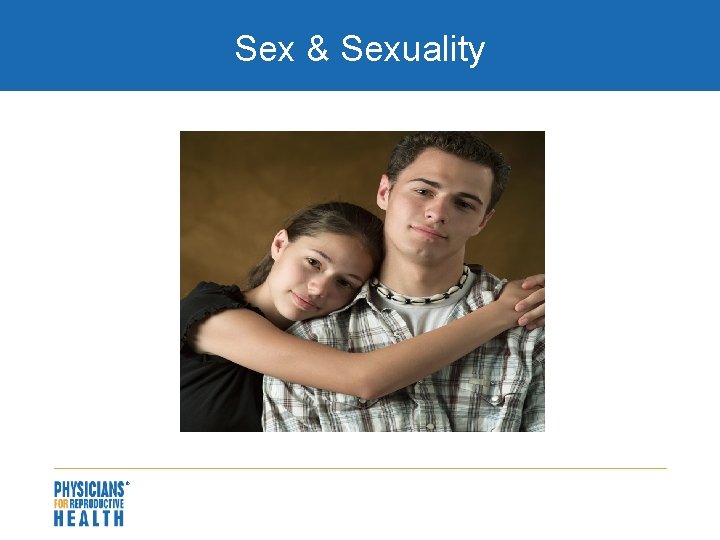
Sex & Sexuality
Sexuality Have you ever been in a romantic relationship? Tell me about the people that you’ve dated. Have any of your relationships ever been sexual relationships (such as involving kissing or touching)? Are you attracted to anyone now? Are you interested in boys? Girls? Both? Not yet sure?
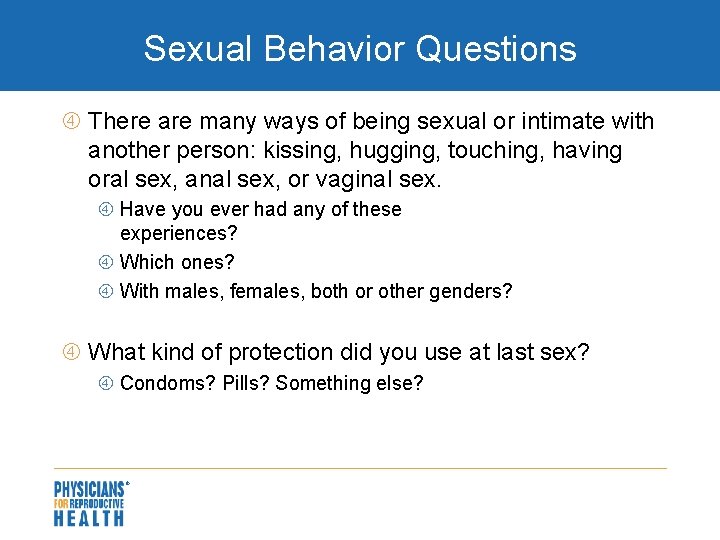
Sexual Behavior Questions There are many ways of being sexual or intimate with another person: kissing, hugging, touching, having oral sex, anal sex, or vaginal sex. Have you ever had any of these experiences? Which ones? With males, females, both or other genders? What kind of protection did you use at last sex? Condoms? Pills? Something else?
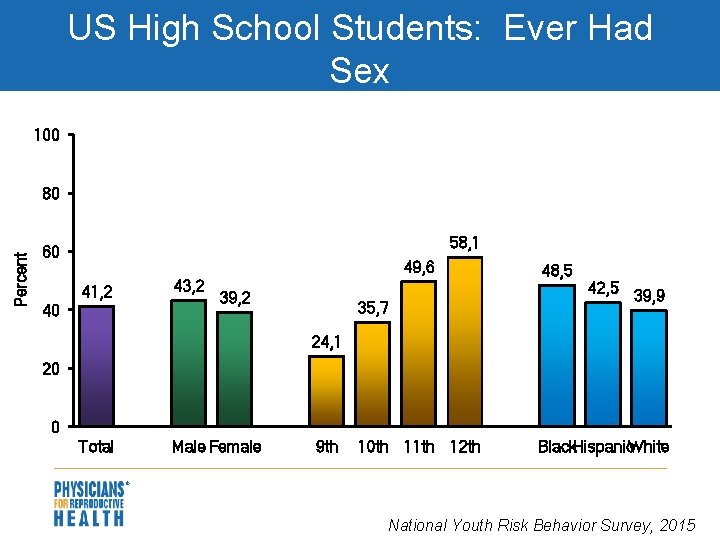
US High School Students: Ever Had Sex 100 Percent 80 58, 1 60 49, 6 43, 2 41, 2 40 39, 2 35, 7 48, 5 42, 5 39, 9 24, 1 20 0 Total Male Female 9 th 10 th 11 th 12 th Black. Hispanic. White National Youth Risk Behavior Survey, 2015
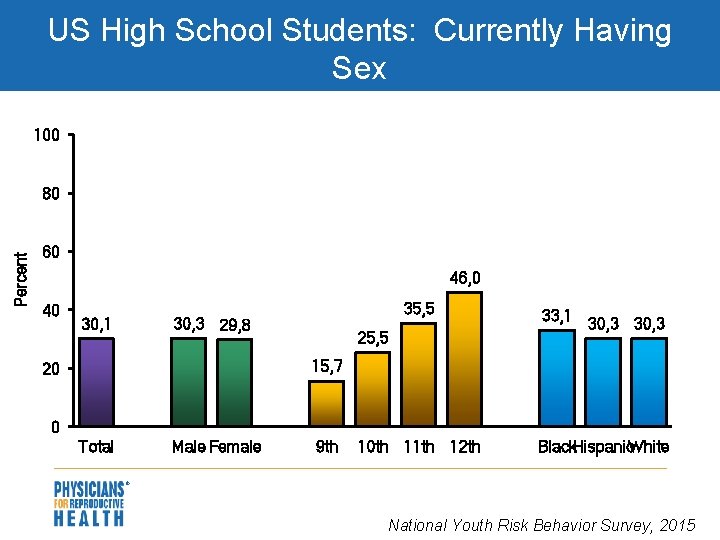
US High School Students: Currently Having Sex 100 Percent 80 60 46, 0 40 35, 5 30, 3 29, 8 30, 1 25, 5 33, 1 30, 3 15, 7 20 0 Total Male Female 9 th 10 th 11 th 12 th Black. Hispanic. White National Youth Risk Behavior Survey, 2015
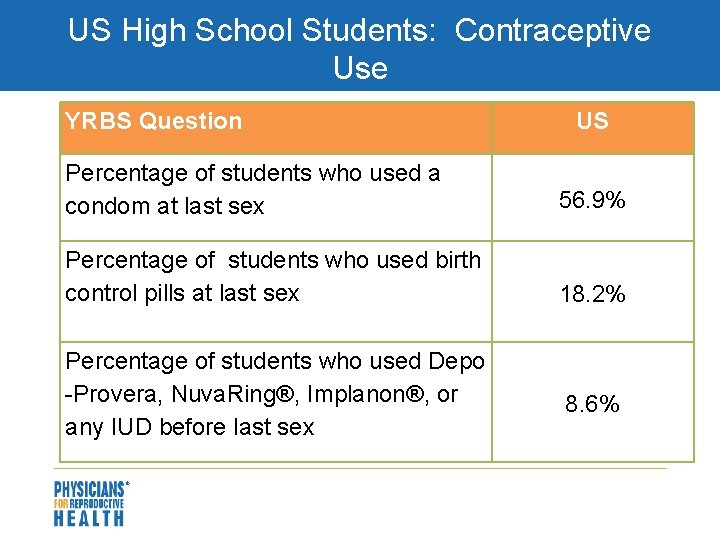
US High School Students: Contraceptive Use YRBS Question US Percentage of students who used a condom at last sex 56. 9% Percentage of students who used birth control pills at last sex 18. 2% Percentage of students who used Depo -Provera, Nuva. Ring®, Implanon®, or any IUD before last sex 8. 6%
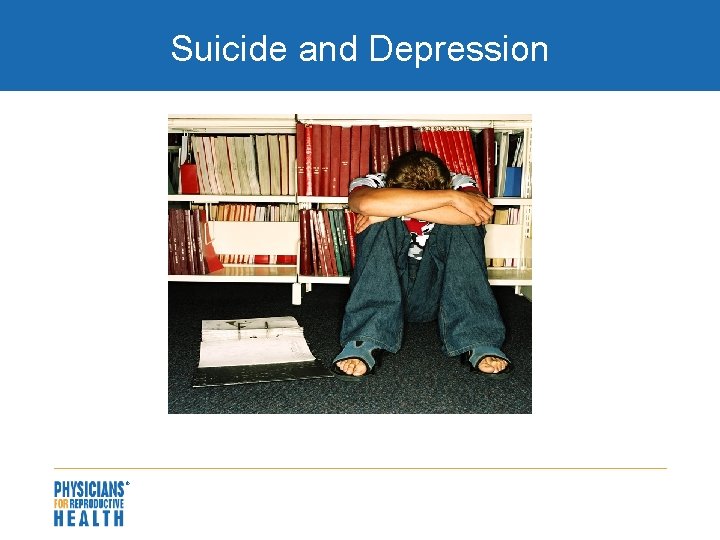
Suicide and Depression
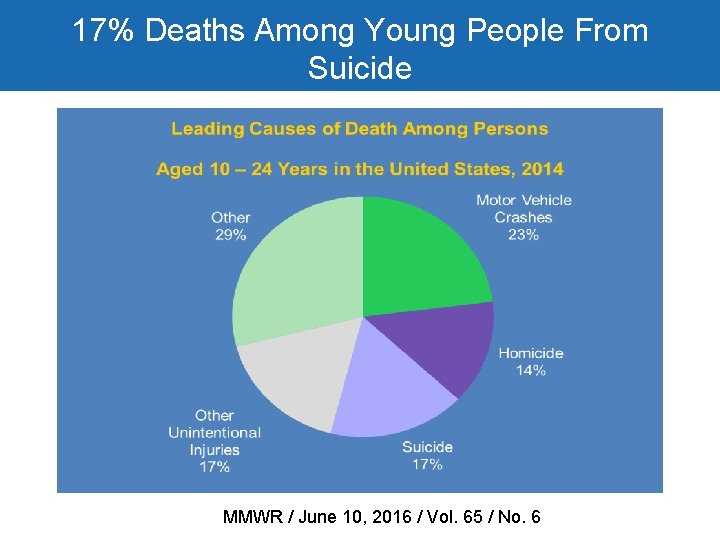
17% Deaths Among Young People From Suicide MMWR / June 10, 2016 / Vol. 65 / No. 6
Suicide and Depression Do you feel “stressed” or anxious more than usual? Do you feel sad or down more than usual? Have you ever received counseling and/or therapy? Are you having trouble getting to sleep? Tell me about a time when you felt sad while using social media sites like Facebook. Have you ever thought of hurting yourself or someone else?
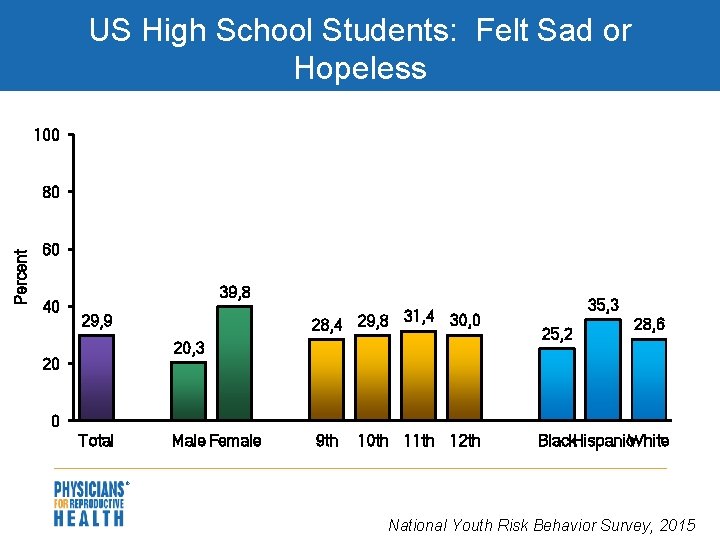
US High School Students: Felt Sad or Hopeless 100 Percent 80 60 40 39, 8 31, 4 30, 0 28, 4 29, 8 29, 9 20, 3 20 35, 3 25, 2 28, 6 0 Total Male Female 9 th 10 th 11 th 12 th Black. Hispanic. White National Youth Risk Behavior Survey, 2015
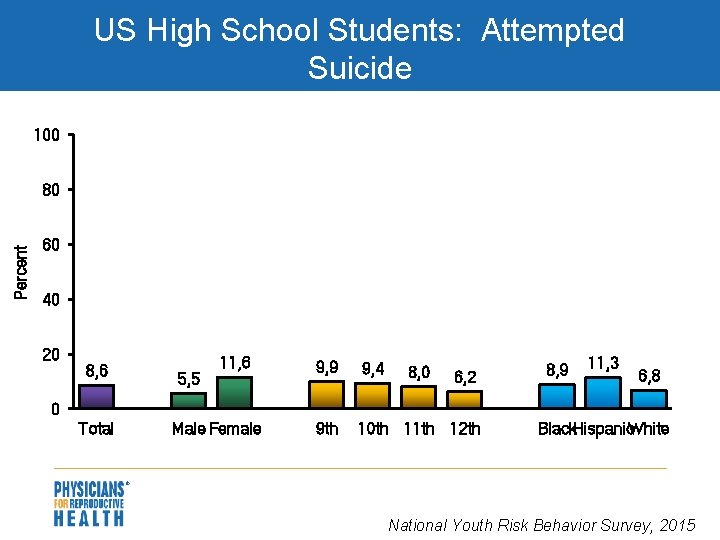
US High School Students: Attempted Suicide 100 Percent 80 60 40 20 8, 6 5, 5 11, 6 9, 9 9, 4 9 th 10 th 11 th 12 th 8, 0 6, 2 8, 9 11, 3 6, 8 0 Total Male Female Black. Hispanic. White National Youth Risk Behavior Survey, 2015
Safety
Sexual and Physical Abuse Have you ever been forced to have sex or been touched in a way against your will? By whom and is this still going on? Who did you tell? How does it affect your day-to-day life? In what ways does that experience affect your sexual relationships now? Has anyone ever hurt you on a repeated basis? At home, in school, or in your neighborhood?
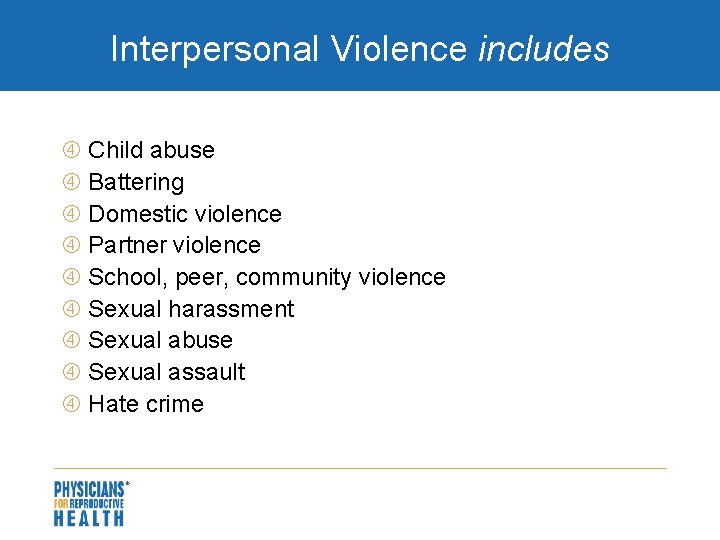
Interpersonal Violence includes Child abuse Battering Domestic violence Partner violence School, peer, community violence Sexual harassment Sexual abuse Sexual assault Hate crime
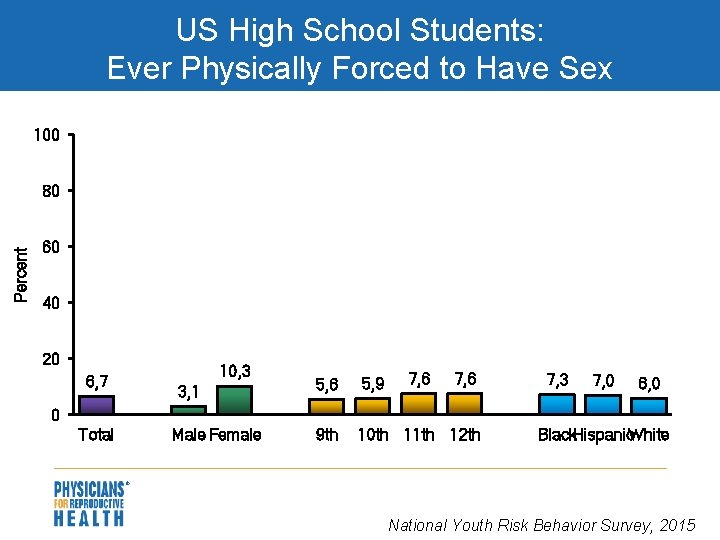
US High School Students: Ever Physically Forced to Have Sex 100 Percent 80 60 40 20 10, 3 6, 7 3, 1 7, 6 5, 9 9 th 10 th 11 th 12 th 7, 3 7, 0 6, 0 0 Total Male Female Black. Hispanic. White National Youth Risk Behavior Survey, 2015
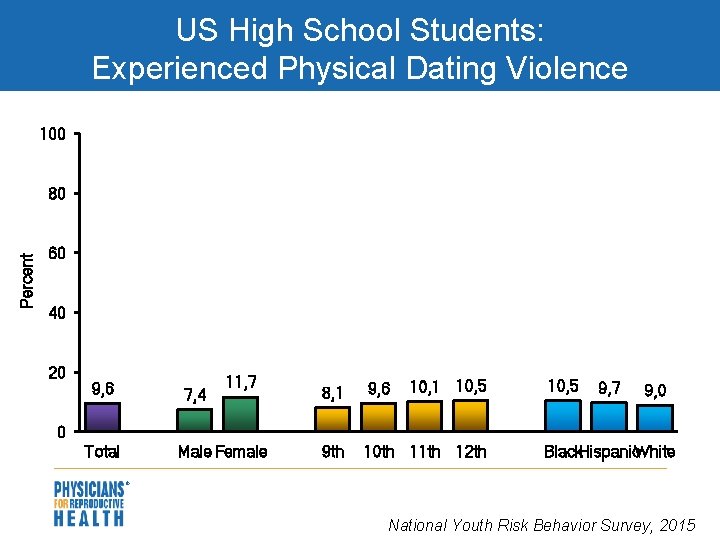
US High School Students: Experienced Physical Dating Violence 100 Percent 80 60 40 20 9, 6 7, 4 11, 7 10, 1 10, 5 8, 1 9, 6 9 th 10 th 11 th 12 th 10, 5 9, 7 9, 0 0 Total Male Female Black. Hispanic. White National Youth Risk Behavior Survey, 2015
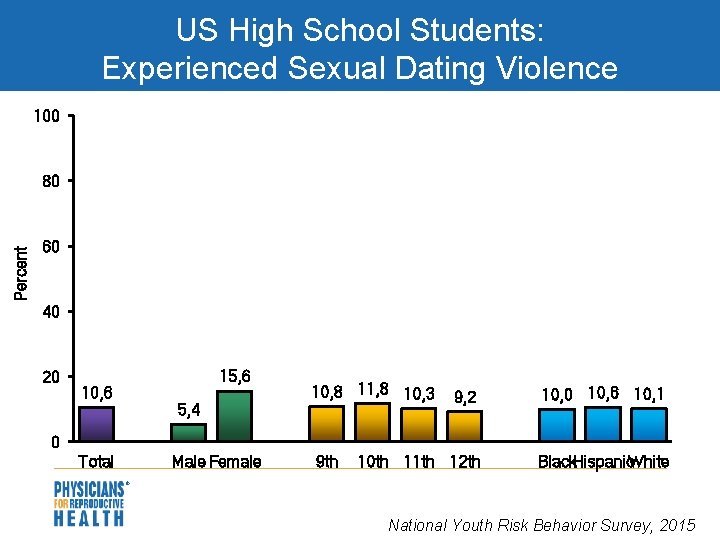
US High School Students: Experienced Sexual Dating Violence 100 Percent 80 60 40 20 15, 6 10, 6 5, 4 10, 8 11, 8 10, 3 9, 2 10, 0 10, 6 10, 1 10 th 11 th 12 th Black. Hispanic. White 0 Total Male Female 9 th National Youth Risk Behavior Survey, 2015
Safety Have you ever been seriously injured? (How? ) How about anyone else you know? Do you always wear a seatbelt in the car? When was the last time you sent a text message while driving? Tell me about a time when you have ridden with a driver who was drunk or high. When? How often?
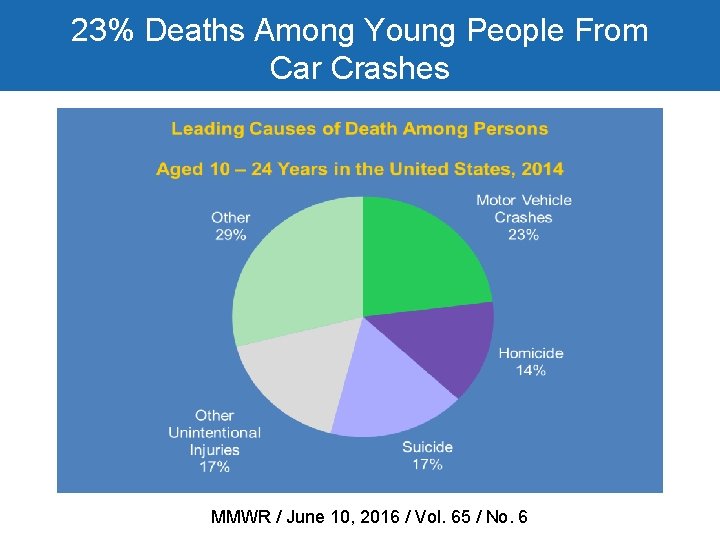
23% Deaths Among Young People From Car Crashes MMWR / June 10, 2016 / Vol. 65 / No. 6
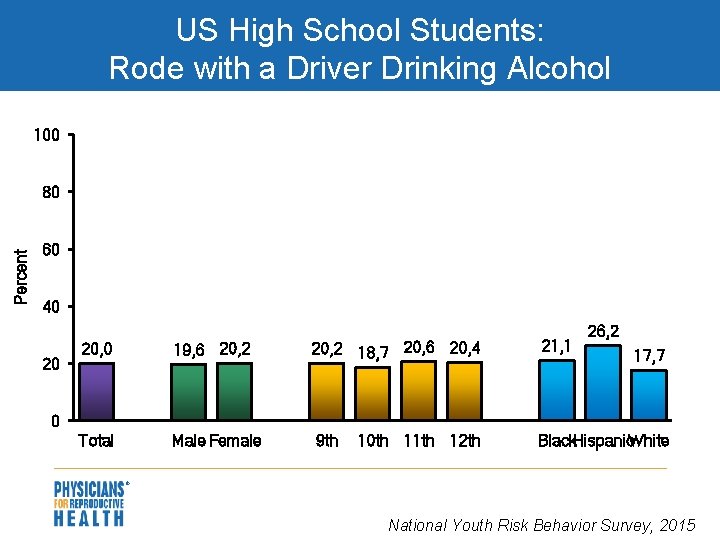
US High School Students: Rode with a Driver Drinking Alcohol 100 Percent 80 60 40 20 26, 2 20, 0 19, 6 20, 2 18, 7 20, 6 20, 4 21, 1 Total Male Female 9 th Black. Hispanic. White 17, 7 0 10 th 11 th 12 th National Youth Risk Behavior Survey, 2015
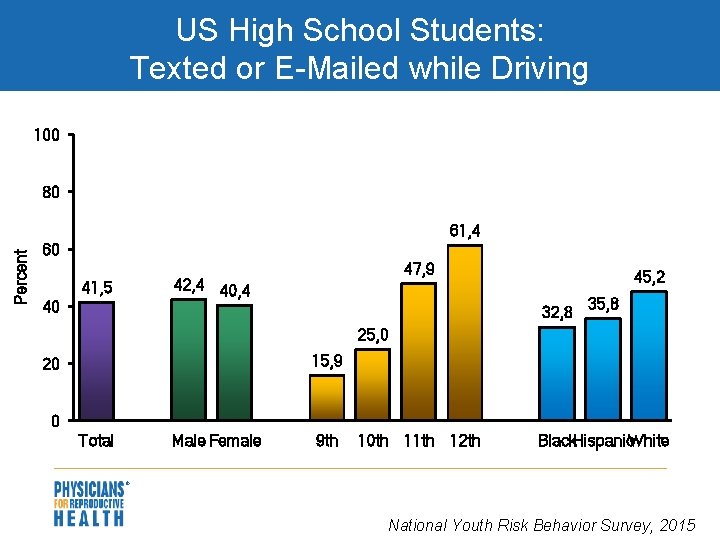
US High School Students: Texted or E-Mailed while Driving 100 80 Percent 61, 4 60 47, 9 42, 4 40, 4 41, 5 40 45, 2 32, 8 35, 8 25, 0 15, 9 20 0 Total Male Female 9 th 10 th 11 th 12 th Black. Hispanic. White National Youth Risk Behavior Survey, 2015
Wrap Up Emphasize that your approach is nonjudgmental and that you welcome future visits “I’m here for you, and I want you to feel comfortable confiding in me. If you have something personal to talk about, I’ll try to give you my best advice and answer your questions”
Resources AMAZE: online sex education resource http: //amaze. org/ CDC Youth Risk Behavior Surveillance System (YRBSS) http: //www. cdc. gov/healthyyouth/data/yrbs/results. htm
- Slides: 75