
Adolescent Psychology Chapter 3 The Brain Cognitive Development
Adolescent Psychology Chapter 3
The Brain & Cognitive Development (Chapter 3) Today We’ll discuss The Brain The Cognitive Developmental View The Information Processing View Psychometrics & Intelligence View Social Cognition
Brain Development Limited research Brain development linked to behavioral & cognitive changes Brain is still growing in adolescence
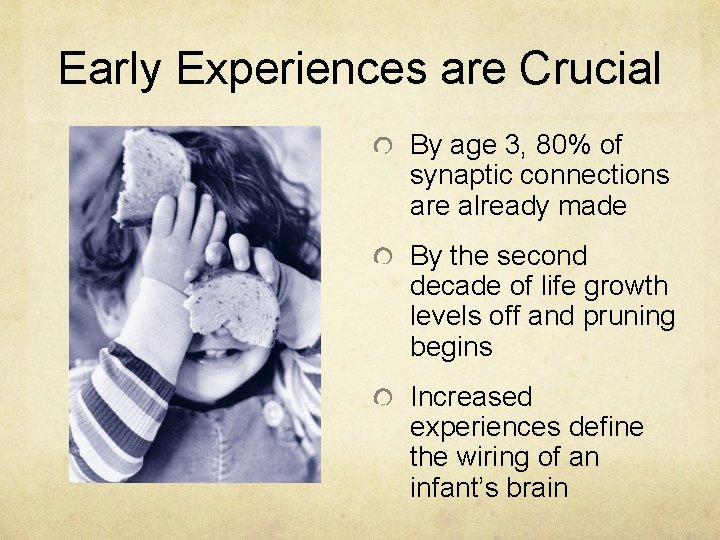
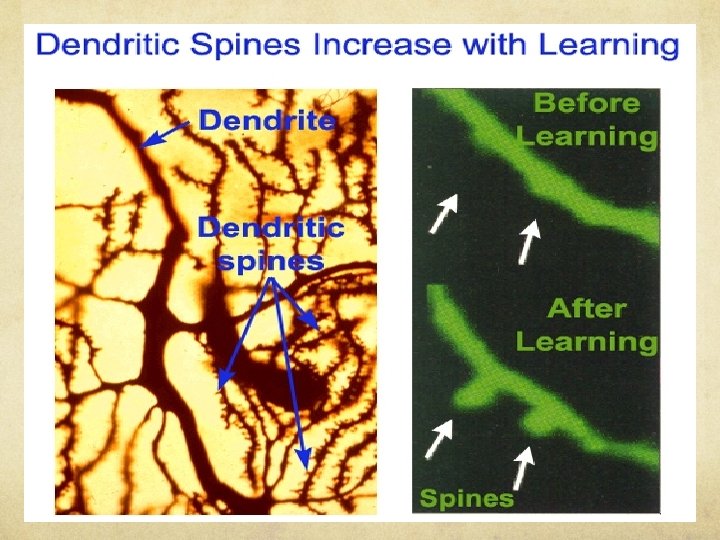
Early Experiences are Crucial By age 3, 80% of synaptic connections are already made By the second decade of life growth levels off and pruning begins Increased experiences define the wiring of an infant’s brain
Terms to Know Neurons: nerve cell; basic units of nervous system Cell body Axon: carries information away from cell Dendrite: receiving part Synapses: gaps between neurons Myelination: process by which axon is insulated with layers of fat cells, increasing speed & efficiency of information processing Continues to increase during adolescence Synaptogenesis: dramatic increase of connections between neurons Begins in infancy & continues through adolescence
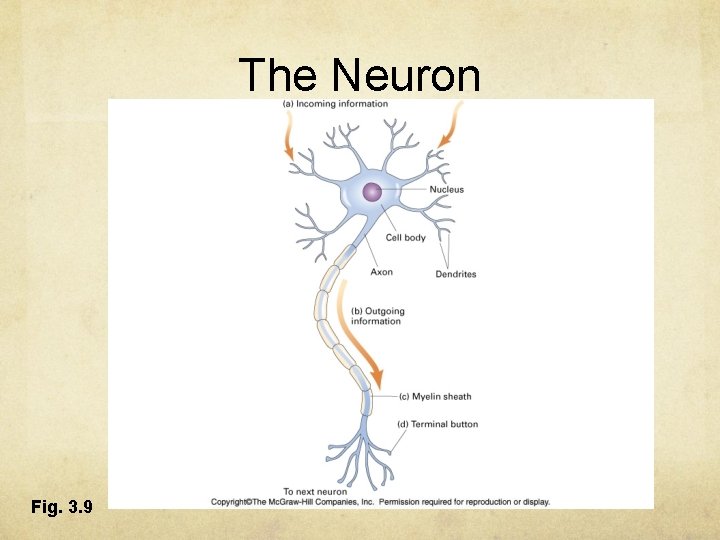
The Neuron Fig. 3. 9
The Brain’s Connections Nearly twice as many connections are made as are used Used connections strengthen, others are pruned Blooming & Pruning varies greatly by brain region Visual Cortex: peak overproduction, 4 th postnatal month Gradual reduction through preschool Auditory Cortex Peak for hearing development 2 nd peak during language development Prefrontal Cortex Peak overproduction, year 1 Adult density in mid to late adolescence
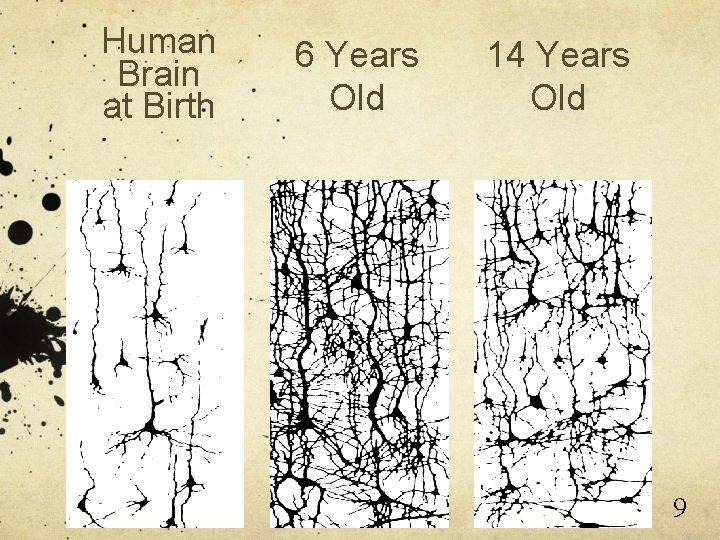
Human Brain at Birth 6 Years Old 14 Years Old 9
Neurotransmitters Chemical that carries information across synapses Levels changes during adolescence Dopamine increases in prefrontal cortex & limbic system Risk taking Use of drugs Onset of schizophrenia
Structural Changes in Adolescence Corpus Collosum: large bundle of axon fibers that connect left & right hemispheres Thickens in adolescence Improved information processing Prefrontal Cortex: highest level of frontal lobes Reasoning, decision making, self-control Advanced development through 18 – 25 years Amygdala: part of limbic system (seat of emotions) Develops much earlier than prefrontal cortex
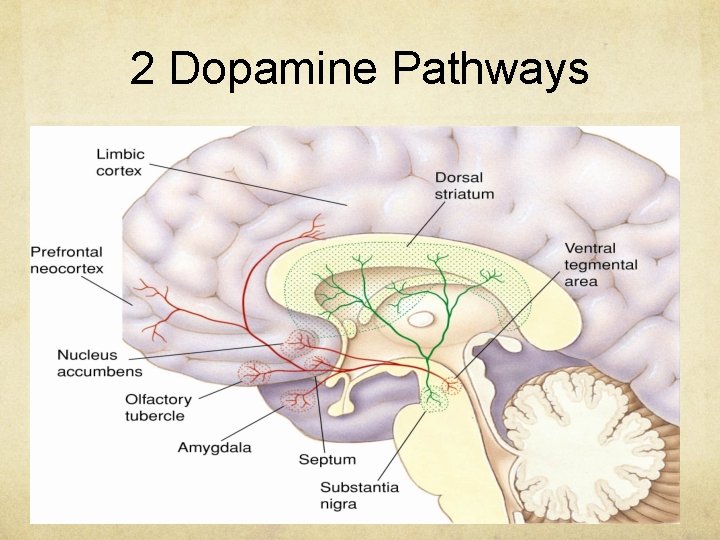
2 Dopamine Pathways
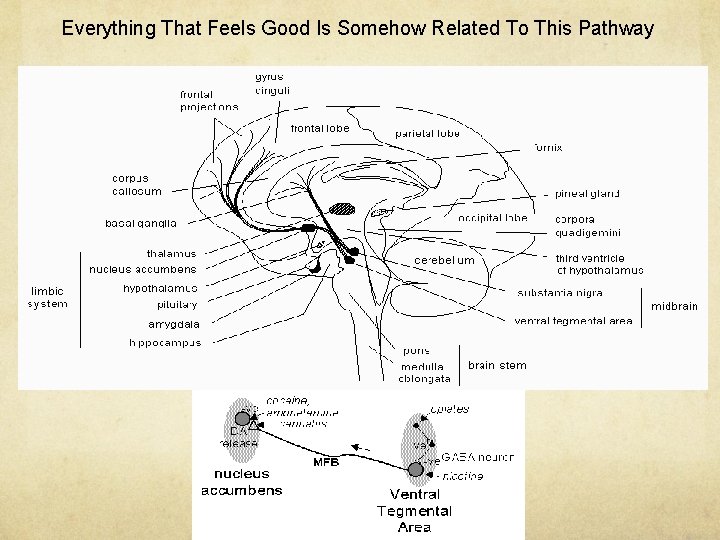
Everything That Feels Good Is Somehow Related To This Pathway
Experience & Plasticity Can new brain cells be generated in adolescence? Yes And research shows exercise & enrichment can produce new cells Can an adolescent’s brain recover from injury? Yes; in childhood & adolescence brain has the ability to repair itself Can we apply brain development research to education? Yes, but… Often applied incorrectly (right-brained vs. left brained)
The Cognitive Developmental View Piaget’s Theory Vygotsky’s View
Piaget’s Basic Assumptions Motivation to understand…biologically adaptive Actively construct one’s own cognitive world To make sense out of the world… Organize experiences separate & make connections Incorporate new information Schema: mental concept or framework that is useful in organizing & interpreting information
Piaget’s Cognitive Processes Assimilation: incorporation of new information into existing knowledge Accommodation: adjustment of schema to new information Equilibration: mechanism explaining shift from one state of thought to the next Cognitive conflict (disequilibrium) Resolve conflict to reach balance Constant shifting state of equilibrium disequilibrium
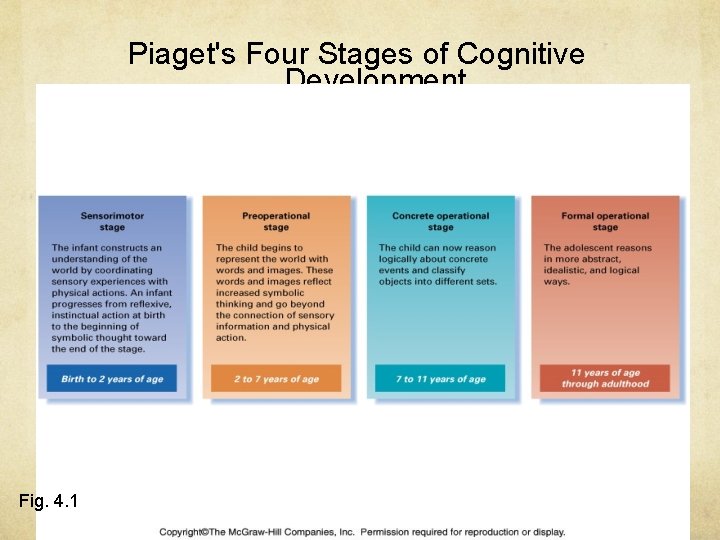
Piaget's Four Stages of Cognitive Development Fig. 4. 1
Concrete & Formal Operational Thought Concrete Operational: 7 -11 Logical replaced by intuitive…only if connected to concrete examples Operations, Conservation, Classification Formal Operational: 11 -15 (20) Hypothetical, abstract, verbal representations, metacognition Metacognition plays an important role in identity development Hypothetical – Deductive Reasoning Early Formal Operational Thought Unconstrained thoughts – subjective & idealistic Unlimited possibilities – flights of fantasy Assimilation Late Formal Operational Thought: mid to late adolescence Test reasoning against reality
Piaget’s Theory: Criticisms Timing & Stages Individual differences not accounted for… 1 in 3 eighth-graders is a formal operational thinker 17 - 67% of college students are formal operational thinkers Within-individual variation in thinking (content areas)
Cognitive Changes in Adulthood: Post Formal Stage? Realistic & pragmatic thinking Face reality, idealism decreases Reflective & relativistic thinking Become aware of diverse opinions & multiple perspectives
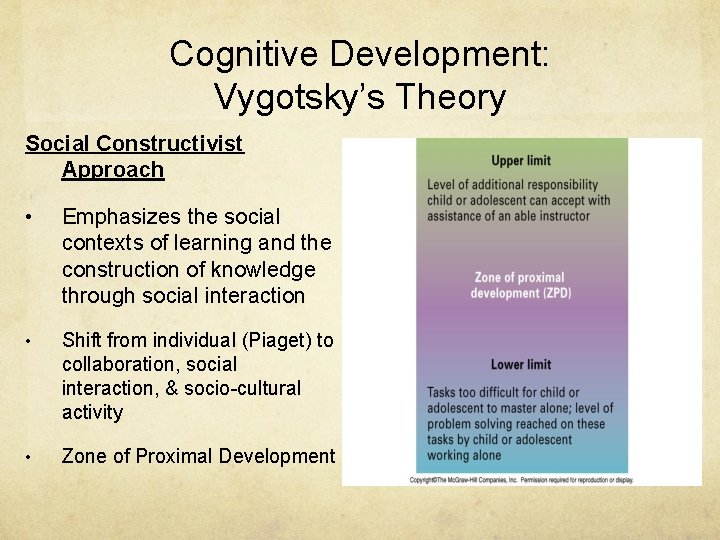
Cognitive Development: Vygotsky’s Theory Social Constructivist Approach • Emphasizes the social contexts of learning and the construction of knowledge through social interaction • Shift from individual (Piaget) to collaboration, social interaction, & socio-cultural activity • Zone of Proximal Development
Vygotsky’s Theory: Evaluated Ample opportunities needed for guided learning in adolescence Education plays central role in learning tools of one’s culture Potential pitfalls…. Collaboration & guidance Overbearing & controlling? ? ?
Information-Processing View Framework & Facet of development Cognitive Resources Capacity & speed Mechanisms of Change Encoding Automaticity Strategy construction Generalization Attention and Memory Executive Functioning
Executive Functioning Decision Making Reasoning Critical Thinking: thinking reflexively & productively & evaluating the evidence Creative Thinking: ability to think in novel & unusual ways & come up with unique solutions to problems Expertise Metacognition and Self-Regulatory Learning
Encouraging Creativity Brainstorming Environments that stimulate creativity Don’t Overcontrol Encourage internal motivation Introduce to creative people
Metacognition & Self-Regulatory Learning Metacognition Cognition about cognition, or “knowing about knowing” Self-Regulatory Learning Consists of self-generation and self-monitoring of thoughts, feelings, and behaviors to reach a goal
Intelligence Tests The Binet tests Mental age (MA): an individual’s level of mental development relative to others Intelligent quotient (IQ): a person’s tested mental age divided by chronological age, multiplied by 100
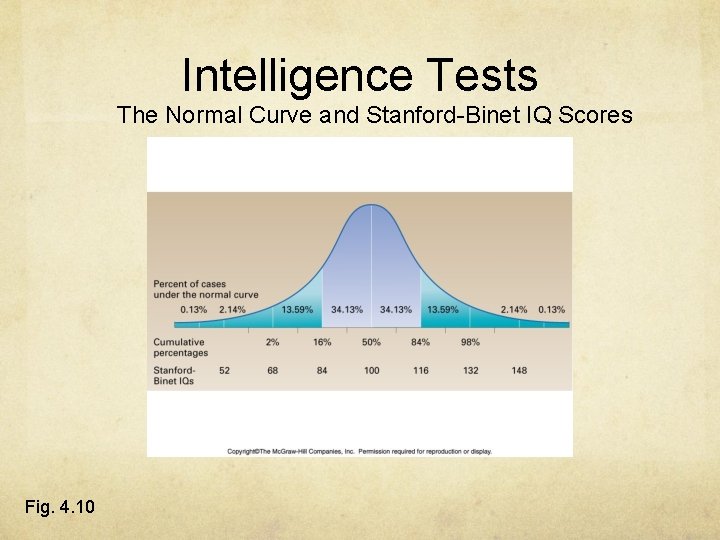
Intelligence Tests The Normal Curve and Stanford-Binet IQ Scores Fig. 4. 10
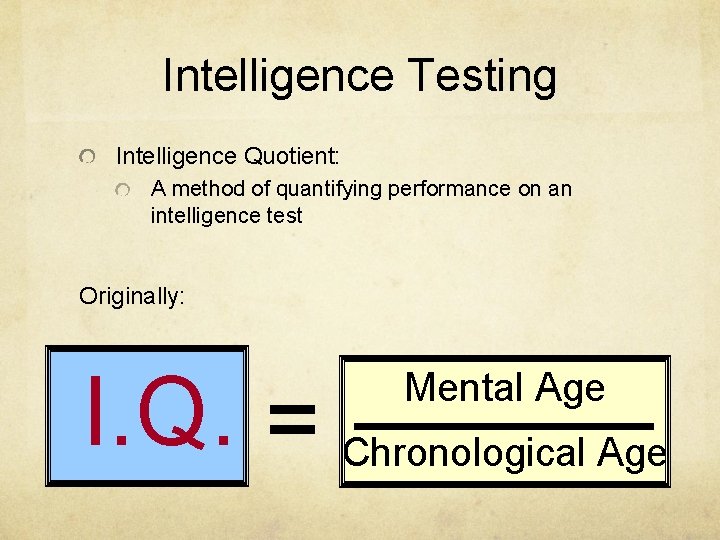
Intelligence Testing Intelligence Quotient: A method of quantifying performance on an intelligence test Originally: I. Q. = Chronological Age Mental Age
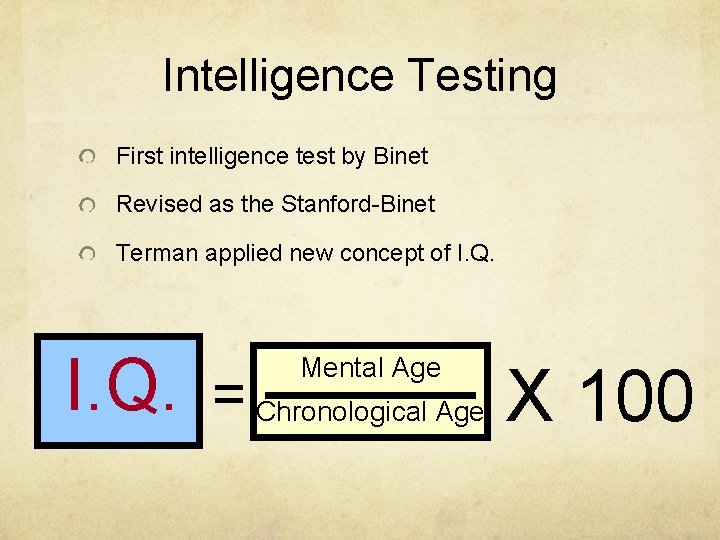
Intelligence Testing First intelligence test by Binet Revised as the Stanford-Binet Terman applied new concept of I. Q. = Mental Age Chronological Age X 100
So let’s try one…. If you had a client that was 18 years old and after testing you discovered that he had a mental age of 22, what would his IQ be? For those of you without a calculator, your client is 10 years-old and has a mental age of 20, what would her age be?
Intelligence Testing David Wechsler – Wechsler-Bellevue Intelligence Scale WAIS-III WISC-III WPPSI-III Wechsler scales now more widely used
The Use and Misuse of Intelligence Tests IQ scores correlate substantially with school grades IQ scores correlate moderately with work performance Many other factors contribute to work and school performance
Psychometric/Intelligence View Emotional Intelligence Perceive and express emotion accurately and adaptively Understand emotional knowledge Use feelings to facilitate thought and to manage emotions in oneself and others
Controversies in Intelligence The influence of heredity and environment Hereditability is the fraction of the variance in a population that is attributed to genetics Environment
Group Comparison in Intelligence Cross-Cultural Comparisons Cultural Bias in Testing Culture-fair tests Ethnic Comparisons Stereotype threat
Social Cognition The way one conceptualizes & reasons about their social worlds Adolescent Egocentrism Heightened self-consciousness of adolescents, reflected in their belief that others are as interested in them as they themselves are, and in their sense of personal uniqueness; invulnerability
Social Cognition Imaginary Audience Personal fable The part of adolescent egocentrism involving an adolescent’s sense of uniqueness
Social Cognition Perspective Taking The ability to assume another person’s perspective and understand his or her thoughts and feelings
- Slides: 40