
Adolescent Health and Development Lecture for MBBS Updated
Adolescent Health and Development Lecture for MBBS Updated June, 2020 By Prof. Kashyap. N. Shakya Department of Pediatrics, KMC KNS, Kathmandu Medical College, Sinamangal 1
Adolescence • Meaning: – derived from Latin, adolescere – meaning ‘to grow, to mature’ – ‘achieving an identity’ KNS, Kathmandu Medical College, Sinamangal 2
UNICEF definition: Adolescence An Age of Opportunity ---United Nations Children’s Fund (UNICEF) (Feb, 2011) KNS, Kathmandu Medical College, Sinamangal 3
Adolescence • WHO definition: (WHO, 1997) – Adolescent - the period of life between 10 -19 yrs – Youth - between 15 -24 yrs – Young people - between 10 -24 yrs of age • Adolescence: Second decade of life • A period of • • rapid development growth acceleration major physical changes accentuation of differences between boys and girls (WHO, 1998) KNS, Kathmandu Medical College, Sinamangal 4
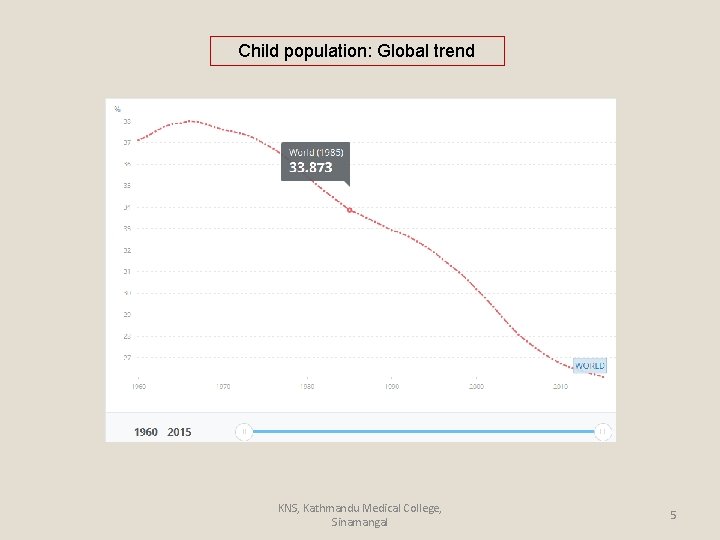
Child population: Global trend KNS, Kathmandu Medical College, Sinamangal 5
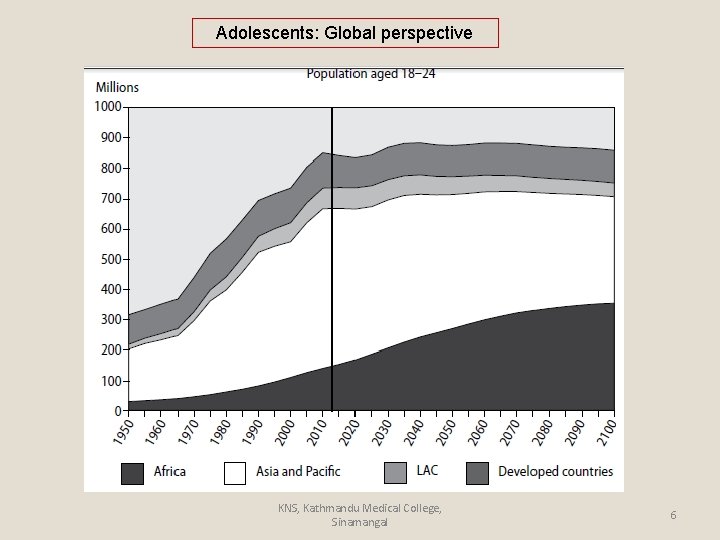
Adolescents: Global perspective KNS, Kathmandu Medical College, Sinamangal 6
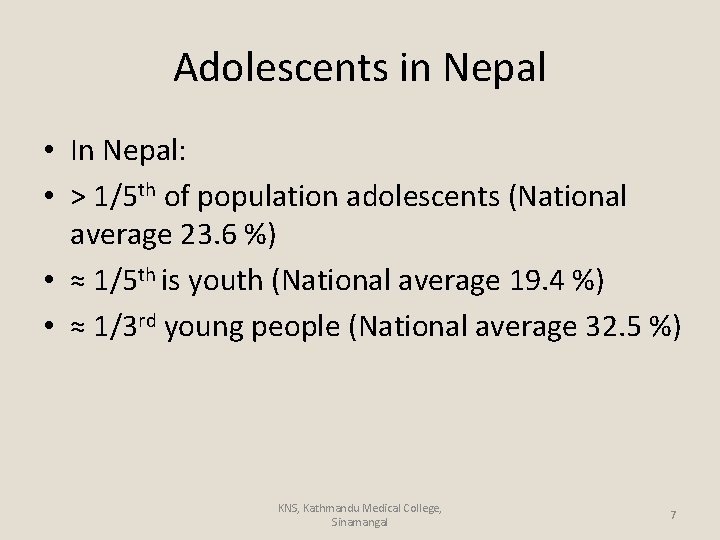
Adolescents in Nepal • In Nepal: • > 1/5 th of population adolescents (National average 23. 6 %) • ≈ 1/5 th is youth (National average 19. 4 %) • ≈ 1/3 rd young people (National average 32. 5 %) KNS, Kathmandu Medical College, Sinamangal 7
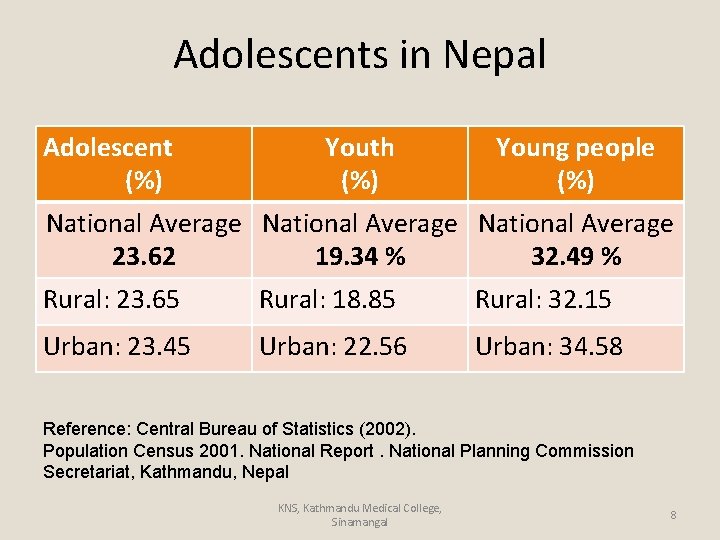
Adolescents in Nepal Adolescent (%) Youth (%) Young people (%) National Average 23. 62 19. 34 % 32. 49 % Rural: 23. 65 Rural: 18. 85 Rural: 32. 15 Urban: 23. 45 Urban: 22. 56 Urban: 34. 58 Reference: Central Bureau of Statistics (2002). Population Census 2001. National Report. National Planning Commission Secretariat, Kathmandu, Nepal KNS, Kathmandu Medical College, Sinamangal 8
Adolescence • A transition period from childhood to adulthood • Adolescents are ‘no longer children, not yet adults’ • A formative period with maximum change (formative =न रम ण तमक ) • Relating to the person's development: – physical – psychological – Behavioral • The period between onset of puberty to termination of physical growth and attainment of final adult height and characteristics • A critical link between childhood and adulthood • Time of sexual maturation and completion of growth • Period of biopsychosocial maturation leading to functional independence in adult life KNS, Kathmandu Medical College, Sinamangal 9
Adolescent and Youth in Nepal • Total population of children under 18 constitutes 44. 4% of the total population of Nepal 1. • The literacy rate among Adolescent & Youth is 92 % (boys 95%; girls 88%)2. • Adolescents comprise more than one fifth (National Average 23. 62 %) of the total population 3. References: 1. National Population and Housing Census 2011(National Report. Volume 01, NPHC 2011. Government of Nepal. National Planning Commission Secretariat Central Bureau of Statistics. 2. Ministry of Health and Population (Mo. HP) [Nepal] 2012, Nepal Adolescents and Youth Survey 2010/11. Kathmandu, Nepal: Ministry of Health and Population. 3. National Adolescent Health and Development Strategy, Family Health Division Department of Health Services Ministry of Health His Majesty's Government Nepal 2057 (2000)
Changes during adolescence Multidimensional changes: ‘GPEPS SDDS’ – Growth- rapid and uneven physical growth – Physical changes – Emotional changes – Psychological changes – Spiritual changes – Sexual maturity and sexual activity – Desire for experimentation – Development of adult mental processes – Self identity KNS, Kathmandu Medical College, Sinamangal 11

In summary • Changes are universal (= सरववय प ): Physical Cognitive Psychological • Context(= परसग – – – ) for change depend upon: culture family school peers chronic illnesses KNS, Kathmandu Medical College, Sinamangal 12

Adolescent development • Adolescent development is considered in terms of: • Biological changes • Psychological development • Social development KNS, Kathmandu Medical College, Sinamangal 13
Universal features of adolescent development All-round development- 1. 2. 3. 4. 5. Biological changes- onset of puberty Cognitive changes- advancement in cognitive abilities Social changes- self-image, intimacy, relations with adults and peers Transition into new roles in society Emotional changes KNS, Kathmandu Medical College, Sinamangal 14
Stages of adolescence Early- 9 -13 yr Mid- 14 -15 yr Late- 16 -19 yr KNS, Kathmandu Medical College, Sinamangal 15
Early adolescence • Early (9 -13 yr) • 1. Growth spurt • 2. Development of secondary sexual characteristics KNS, Kathmandu Medical College, Sinamangal 16
Mid adolescence • • Mid (14 -15 yr) 3. Development of a separate identity from parents 4. New relationships with peer groups and the opposite sex 5. Experimentation KNS, Kathmandu Medical College, Sinamangal 17
Late adolescence • • Late (16 -19 yr) 6. Have fully developed physical characteristics (like adults) 7. Have formed a distinct identity 8. Have well formed opinions and ideas KNS, Kathmandu Medical College, Sinamangal 18
Adolescent body image KNS, Kathmandu Medical College, Sinamangal 19
Adolescent “body image” • Definition: • “the way a person pictures his or her own body” KNS, Kathmandu Medical College, Sinamangal 20

Body image • An important part of self-concept • determines: 1. whether one accepts or rejects oneself 2. whether one feels confident in social relationships 3. whether one has an idealized or realistic idea of one’s appearance, strength, skills and liking by others KNS, Kathmandu Medical College, Sinamangal 21

Dimensions of body image 2 dimensions: 1. The perceptual - evaluation of size of one’s body 2. The affective/cognitive - evaluation of one’s abilities KNS, Kathmandu Medical College, Sinamangal 22
The perceptual (evaluation of size of one’s body) • Normal variation in physical growth, development and sexual maturation can be a cause of undue anxiety in some adolescents • Comparing themselves negatively to peers for one reason or the other may lead to loss of self-esteem and a feeling of inferiority KNS, Kathmandu Medical College, Sinamangal 23
Body image disturbances • May interfere with adolescents’ day to day functioning, studies etc. • May lead to problems in relationships with and other negative expressions • May lead to anorexia nervosa, bulimia and body dysmorphic disorders KNS, Kathmandu Medical College, Sinamangal 24

The affective/cognitive (evaluation of one’s abilities) • Body image is a powerful factor in coming to terms with how adolescents feel about themselves • Higher levels of body satisfaction are associated with higher levels of self-esteem KNS, Kathmandu Medical College, Sinamangal 25
Adolescent body image concerns • Arise from distorted perceptions rather than from reality • Indicate perception which adolescents have about their bodies – shortness or tallness causing anxiety in boys – dusky complexion or acne causing negative feeling in girls KNS, Kathmandu Medical College, Sinamangal 26
Adolescent Health KNS, Kathmandu Medical College, Sinamangal 27
Factors affecting adolescent health • • Social environment Protective factors Gender: (i) gender differences in morbidity and mortality (ii) gender-based discrimination KNS, Kathmandu Medical College, Sinamangal 28
Health Problems of Adolescents KNS, Kathmandu Medical College, Sinamangal 29
Health Problems of Adolescents Categories of problems: 1. General health problems 2. Sexuality problems 3. Nutritional problems 4. Mental health problems • The most common problems relate to: – – – Growth and development Childhood illnesses that continue into adolescence Mental health disorders Consequences of risky or illegal behaviors Infectious diseases KNS, Kathmandu Medical College, Sinamangal 30
General health problems • • Problems originating in childhood Problems originating in adolescence KNS, Kathmandu Medical College, Sinamangal 31
Problems originating in childhood • • Malnutrition Diarrheal and respiratory diseases Infections Differential access to food and care in infancy KNS, Kathmandu Medical College, Sinamangal 32
Problems originating in adolescence 1. 2. 3. 4. Tobacco, alcohol, drugs and other harmful substances abuse Unprotected sex and sexually transmitted diseases (STD) Accidental injury or violence Lack of status of girl child in family and society and consequent vulnerability KNS, Kathmandu Medical College, Sinamangal 33
Sexuality problems Problems related to: 1. Sexual identity 2. Sex drive and sexual behavior 3. Adolescent pregnancy 4. Unsafe abortion 5. Sexually transmitted infections (STI)
Adolescent nutritional problems 1. 2. 3. 4. Undernutrition Micronutrient deficiency Overweight and obesity Eating disorders KNS, Kathmandu Medical College, Sinamangal 35
Mental health problems 1. 2. 3. 4. 5. 6. 7. Mental disorders Emotional problems Behavioral problems Thinking and studying problems Identity problems Tobacco smoking Violence, injuries and sexual abuse KNS, Kathmandu Medical College, Sinamangal 36
MCQs on Adolescent Health and Development KNS, Kathmandu Medical College, Sinamangal 37
MCQs on Adolescent Health and Development MCQ 1 • Q 1. The meaning of adolescence is: A- Becoming an adolescent B- Moving beyond childhood C- Appearing like an adult D- Achieving an identity KNS, Kathmandu Medical College, Sinamangal 38
MCQs on Adolescent Health and Development MCQ 2 Q 2. According to the WHO definition ‘adolescence’ is: A- the period of life between 11 -20 yrs B- the period of life between 10 -19 yrs C- the period of life between 10 -24 yrs D- the period of life between 15 -24 yrs KNS, Kathmandu Medical College, Sinamangal 39
MCQs on Adolescent Health and Development MCQ 3 Q 3. Adolescence is a formative period of life with the following changes, except: A- Physical features B- Psychological aspects C- Behavioral perspectives D- Genetic makeup KNS, Kathmandu Medical College, Sinamangal 40
MCQs on Adolescent Health and Development MCQ 4 • Q 4. During adolescence ‘new relationships with peer groups and the opposite sex’ develops at: A- early adolescence - 9 -13 yr B- mid adolescence - 14 -15 yr C- late adolescence - 16 -19 yr D- throughout adolescence- 9 -19 yr KNS, Kathmandu Medical College, Sinamangal 41
MCQs on Adolescent Health and Development MCQ 5 • Q 5. Following are ‘problems originating in adolescence’, except: A. Tobacco, alcohol, drugs and other harmful substances abuse B. Unprotected sex and sexually transmitted diseases (STD) C. Accidental injury or violence D. Accidental poisoning KNS, Kathmandu Medical College, Sinamangal 42

Viva Questions KNS, Kathmandu Medical College, Sinamangal 43
Viva questions for Semester-VI • Q 1. What is the WHO definition of adolescence ? • A. According to WHO definition adolescence is the period of life between 10 -19 yrs or the second decade of life • Q 2. What percentage of population in Nepal comprises of adolescent? • A. Adolescent comprises > 1/5 th of the population in Nepal • (National average is 23. 6 %, according to CBS, 2002) • Q 3. What changes occur during adolescence ? • A. Changes are multidimensional and occur as: rapid growth along with physical, emotional, psychological, spiritual and sexual-maturational • Q 4. What is adolescent development? • A. Adolescent development is considered in terms of biological changes, psychological development and social development KNS, Kathmandu Medical College, Sinamangal 44
• Q 5. What are the stages of adolescence ? • A. Stages of adolescence are: early- 9 -13 yr , mid- 14 -15 yr and late- 16 -19 yr. • Q 6. What do you mean by adolescent body image ? • A. Adolescent body image is defined as the way a person pictures his or her own body • Q 7. What are the factors which affect adolescent health ? • A. The main factors are social environment, protective factors and gender in terms of gender differences in morbidity and mortality and genderbased discrimination • Q 8. What are the principal categories of adolescent health problems ? • A. The principal categories of problems are general health problems, sexuality problems, nutritional problems and mental health problems • KNS, Kathmandu Medical College, Sinamangal 45
• Q 9. What are the health problems which originate in adolescence ? • A. They are: tobacco, alcohol, drugs and other harmful substances abuse, unprotected sex and sexually transmitted diseases (STD), accidental injury or violence and lack of status of girl child in family and society and consequent vulnerability • • Q 10. What mental health problems occur during adolescence ? • A. They are: mental disorders, emotional problems, behavioral problems, thinking and studying problems, identity problems, tobacco smoking, violence, injuries and sexual abuse ---- KNS, Kathmandu Medical College, Sinamangal 46
Healthy Younger Generation is Key to Rebuilding Nations KNS, Kathmandu Medical College, Sinamangal 47

Thank Young people are the future of the nations ! They are the carts which carry the nation forward !! KNS, Kathmandu Medical College, Sinamangal 48
- Slides: 48