
Adolescent Engagement in Content Literacy John T Guthrie
- Slides: 55
Adolescent Engagement in Content Literacy John T. Guthrie University of Maryland State of Massachusetts Leadership Series May 2009
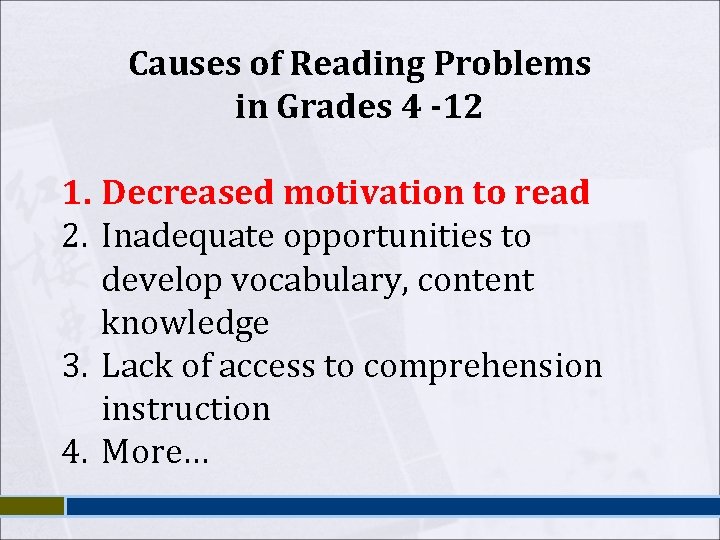
Causes of Reading Problems in Grades 4 -12 1. Decreased motivation to read 2. Inadequate opportunities to develop vocabulary, content knowledge 3. Lack of access to comprehension instruction 4. More…
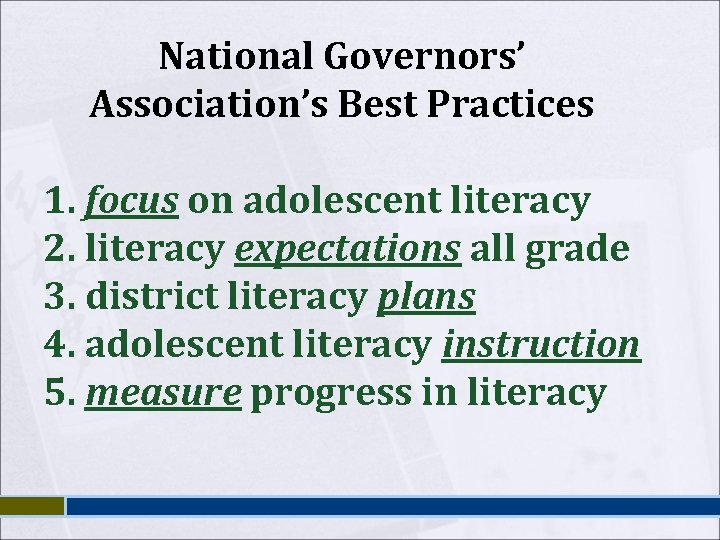
National Governors’ Association’s Best Practices 1. focus on adolescent literacy 2. literacy expectations all grade 3. district literacy plans 4. adolescent literacy instruction 5. measure progress in literacy
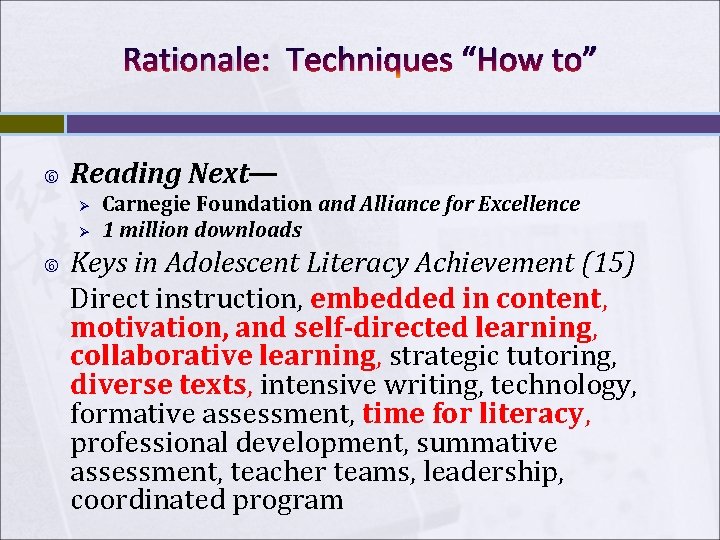
Rationale: Techniques “How to” Reading Next— Ø Ø Carnegie Foundation and Alliance for Excellence 1 million downloads Keys in Adolescent Literacy Achievement (15) Direct instruction, embedded in content, motivation, and self-directed learning, collaborative learning, strategic tutoring, diverse texts, intensive writing, technology, formative assessment, time for literacy, professional development, summative assessment, teacher teams, leadership, coordinated program
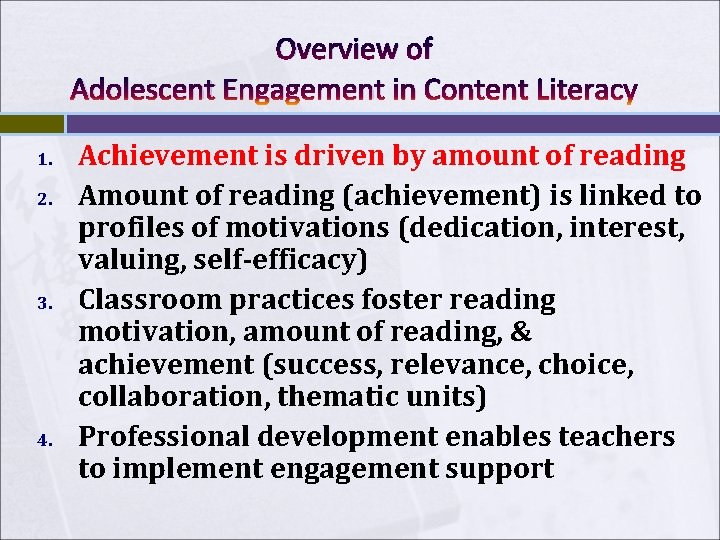
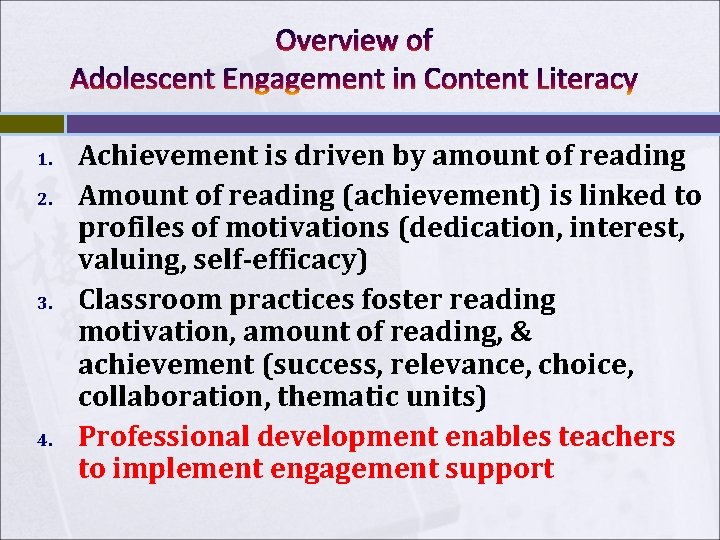
Overview of Adolescent Engagement in Content Literacy 1. 2. 3. 4. Achievement is driven by amount of reading Amount of reading (achievement) is linked to profiles of motivations (dedication, interest, valuing, self-efficacy) Classroom practices foster reading motivation, amount of reading, & achievement (success, relevance, choice, collaboration, thematic units) Professional development enables teachers to implement engagement support
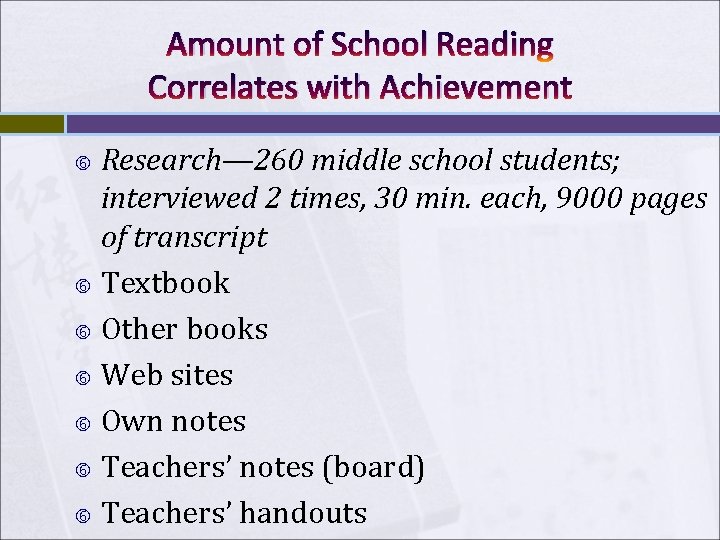
Amount of School Reading Correlates with Achievement Research— 260 middle school students; interviewed 2 times, 30 min. each, 9000 pages of transcript Textbook Other books Web sites Own notes Teachers’ notes (board) Teachers’ handouts
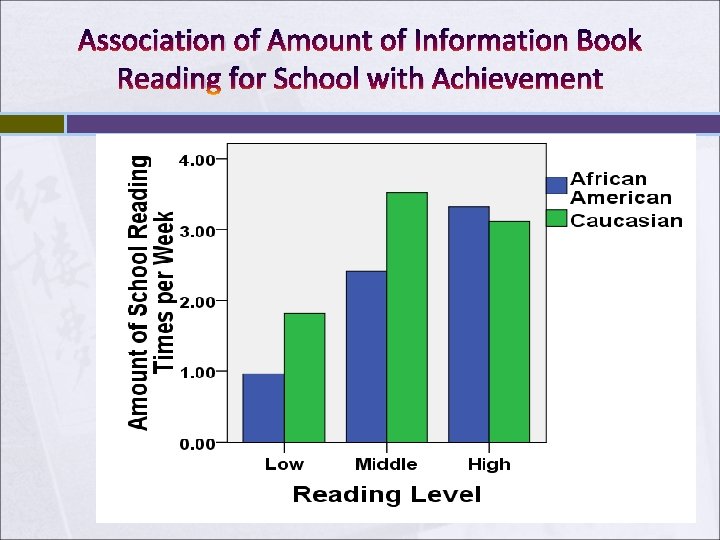
Association of Amount of Information Book Reading for School with Achievement
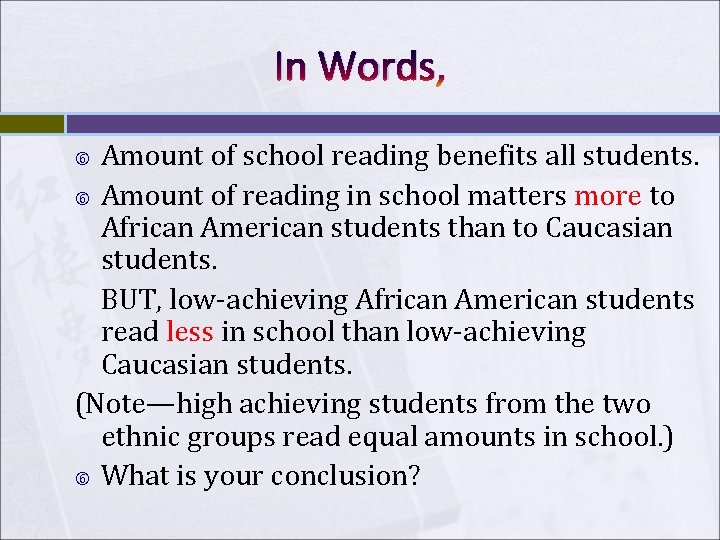
In Words, Amount of school reading benefits all students. Amount of reading in school matters more to African American students than to Caucasian students. BUT, low-achieving African American students read less in school than low-achieving Caucasian students. (Note—high achieving students from the two ethnic groups read equal amounts in school. ) What is your conclusion?
Overview of Adolescent Engagement in Content Literacy 1. 2. 3. 4. Achievement is driven by amount of reading Amount of reading (achievement) is linked to profiles of motivations (dedication, interest, valuing, self-efficacy) Classroom practices foster reading motivation, amount of reading, & achievement (success, relevance, choice, collaboration, thematic units) Professional development enables teachers to implement engagement support
Kaelyn’s Story 13 years old— 7 th grade Attached to her phone—any phone Loathes her braces— 3 months to go! Flew through elementary school--memorizing Answers more teacher questions than anyone Never misses homework Prides self on being the best student Gifted in basketball, soccer, and gymnastics Facebook: “I don’t like to read. ” DEDICATED AND DISINTERESTED
Motivations for Content Reading in School 1. 2. 3. 4. 5. 6. 7. 8. Interest Avoidance Self-efficacy Perceived difficulty Valuing De-valuing Peer acceptance Peer rejection
Motivations for Content Reading in School 1. 2. 3. 4. 5. 6. 7. 8. Interest Avoidance Self-efficacy Perceived difficulty Valuing De-valuing Peer acceptance Peer rejection
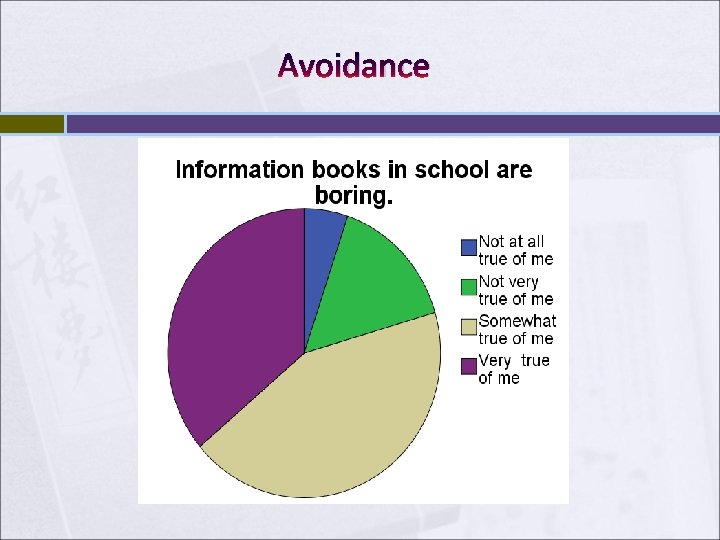
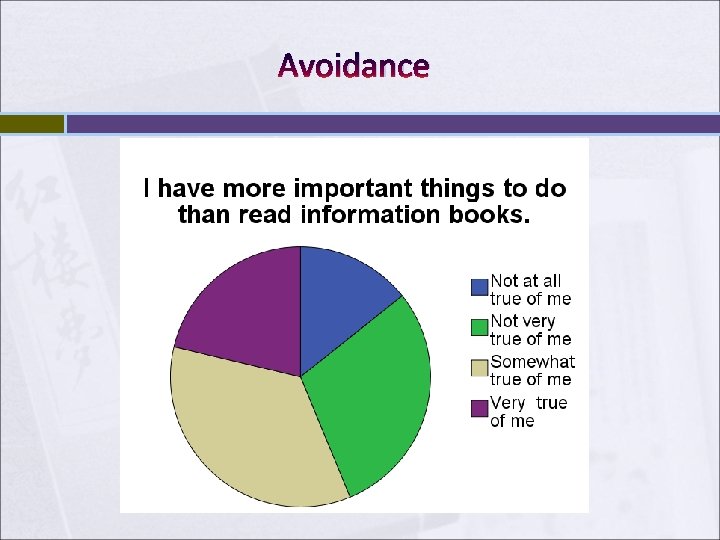
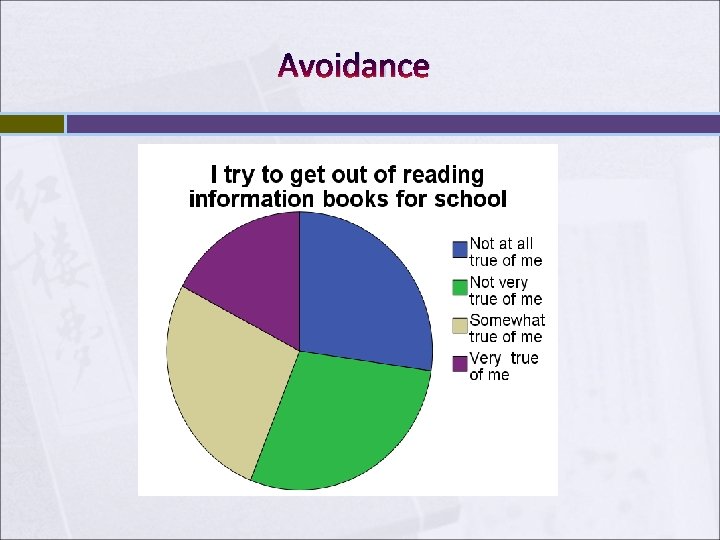
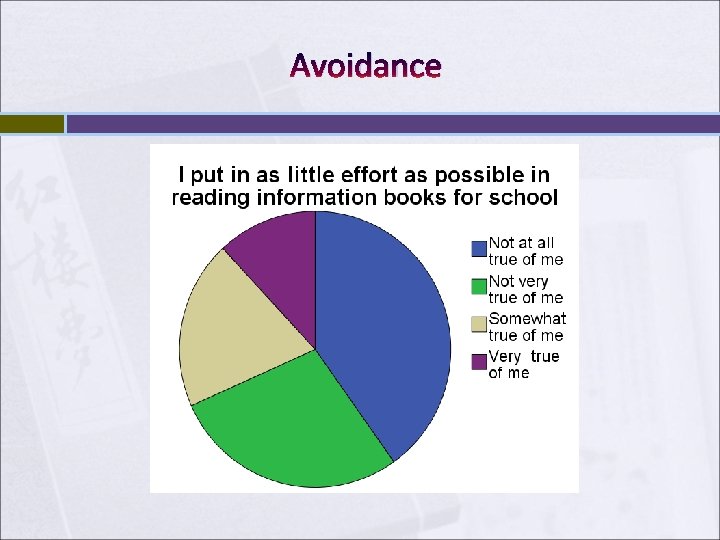
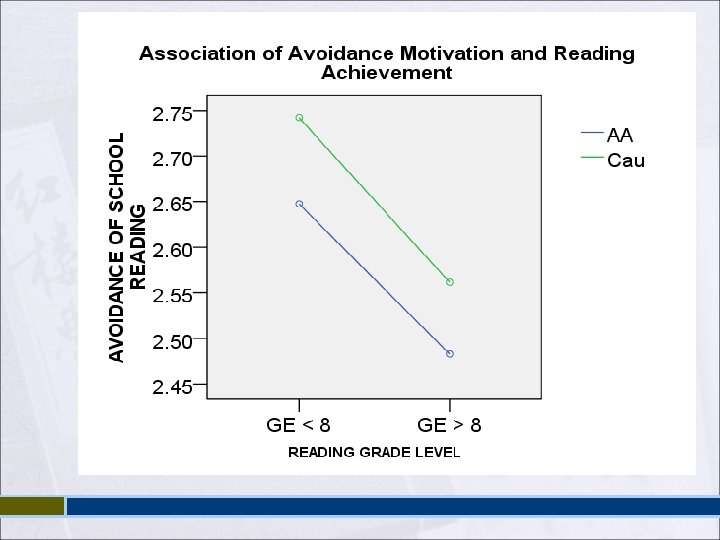
Avoidance
Avoidance
Avoidance
Avoidance
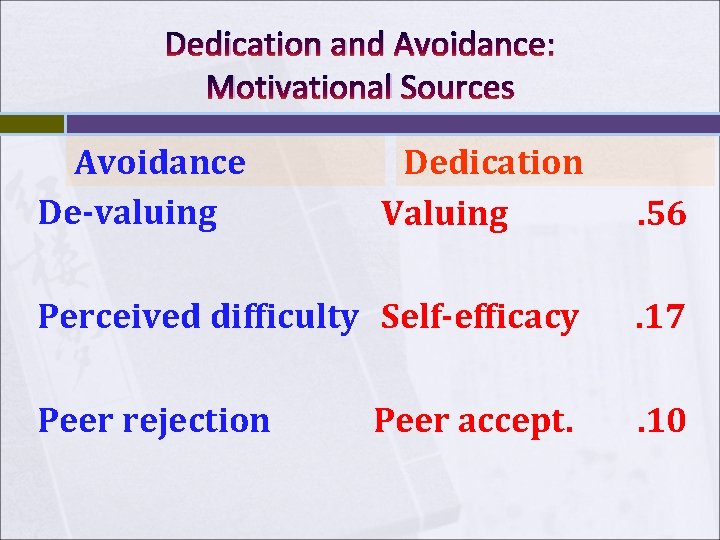
Dedication and Avoidance: Motivational Sources Avoidance De-valuing Dedication Valuing . 56 Perceived difficulty Self-efficacy . 17 Peer rejection . 10 Peer accept.
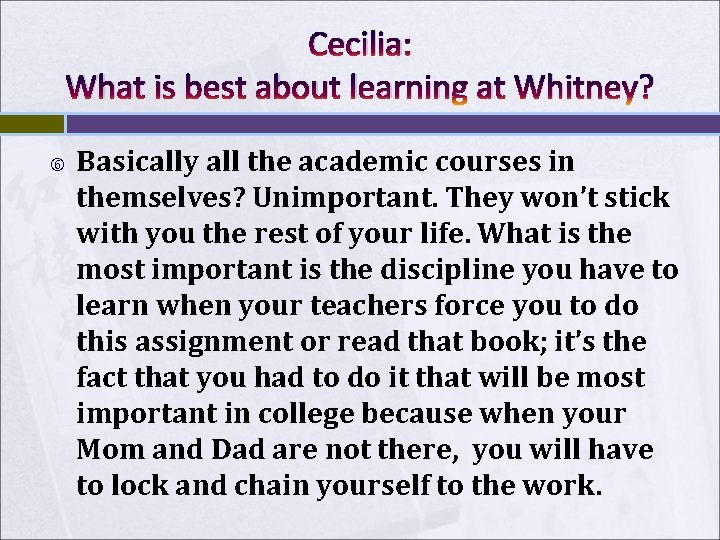
Cecilia: What is best about learning at Whitney? Basically all the academic courses in themselves? Unimportant. They won’t stick with you the rest of your life. What is the most important is the discipline you have to learn when your teachers force you to do this assignment or read that book; it’s the fact that you had to do it that will be most important in college because when your Mom and Dad are not there, you will have to lock and chain yourself to the work.
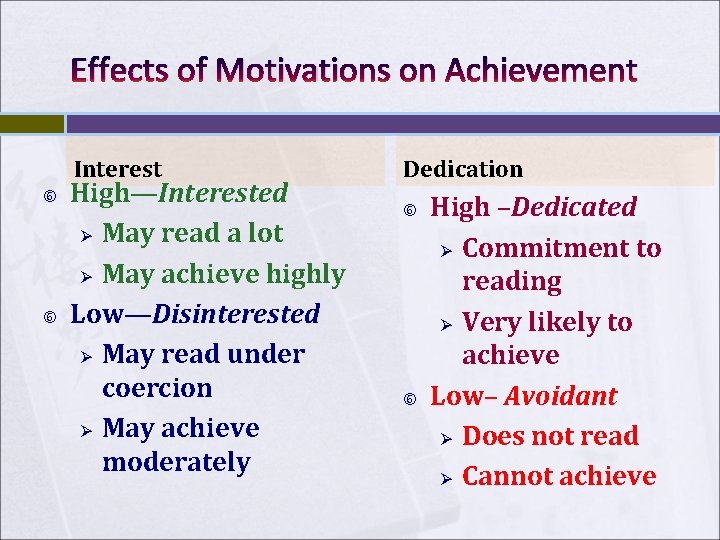
Effects of Motivations on Achievement Interest High—Interested Ø May read a lot Ø May achieve highly Low—Disinterested Ø May read under coercion Ø May achieve moderately Dedication High –Dedicated Ø Commitment to reading Ø Very likely to achieve Low– Avoidant Ø Does not read Ø Cannot achieve
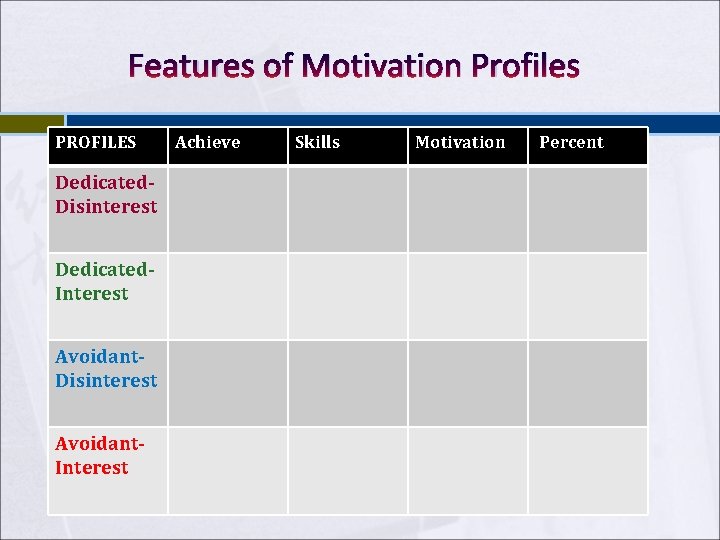
Features of Motivation Profiles PROFILES Dedicated. Disinterest Dedicated. Interest Avoidant. Disinterest Avoidant. Interest Achieve Skills Motivation Percent
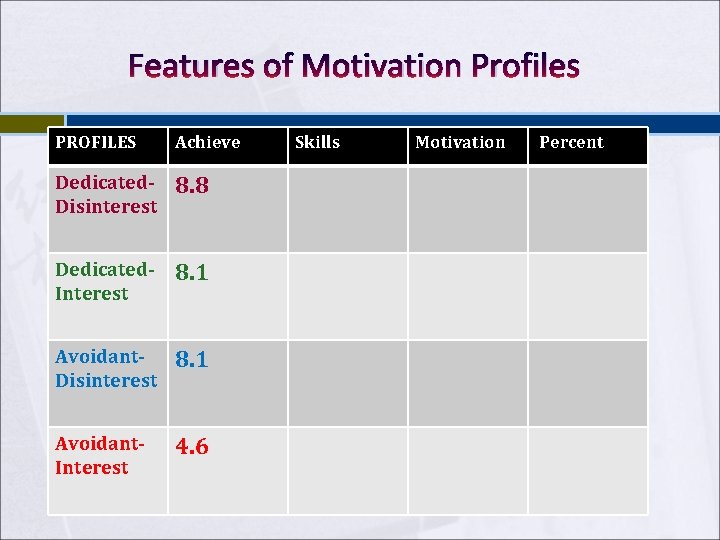
Features of Motivation Profiles PROFILES Achieve Dedicated. Disinterest 8. 8 Dedicated. Interest 8. 1 Avoidant. Disinterest 8. 1 Avoidant. Interest 4. 6 Skills Motivation Percent
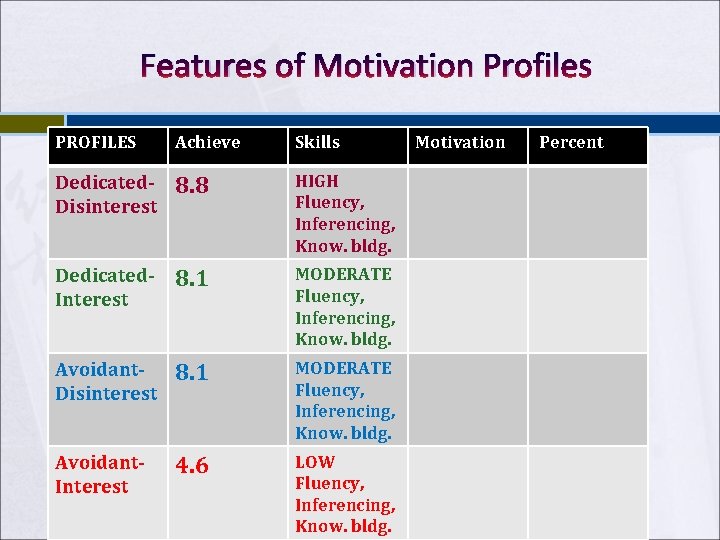
Features of Motivation Profiles PROFILES Achieve Skills Dedicated. Disinterest 8. 8 HIGH Fluency, Inferencing, Know. bldg. Dedicated. Interest 8. 1 MODERATE Fluency, Inferencing, Know. bldg. Avoidant. Disinterest 8. 1 MODERATE Fluency, Inferencing, Know. bldg. Avoidant. Interest 4. 6 LOW Fluency, Inferencing, Know. bldg. Motivation Percent
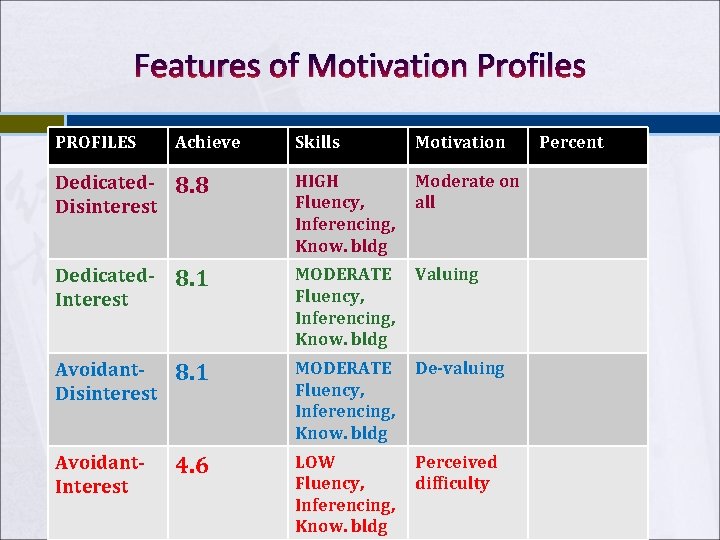
Features of Motivation Profiles PROFILES Achieve Skills Motivation Dedicated. Disinterest 8. 8 HIGH Fluency, Inferencing, Know. bldg Moderate on all Dedicated. Interest 8. 1 MODERATE Fluency, Inferencing, Know. bldg Valuing Avoidant. Disinterest 8. 1 MODERATE Fluency, Inferencing, Know. bldg De-valuing Avoidant. Interest 4. 6 LOW Fluency, Inferencing, Know. bldg Perceived difficulty Percent
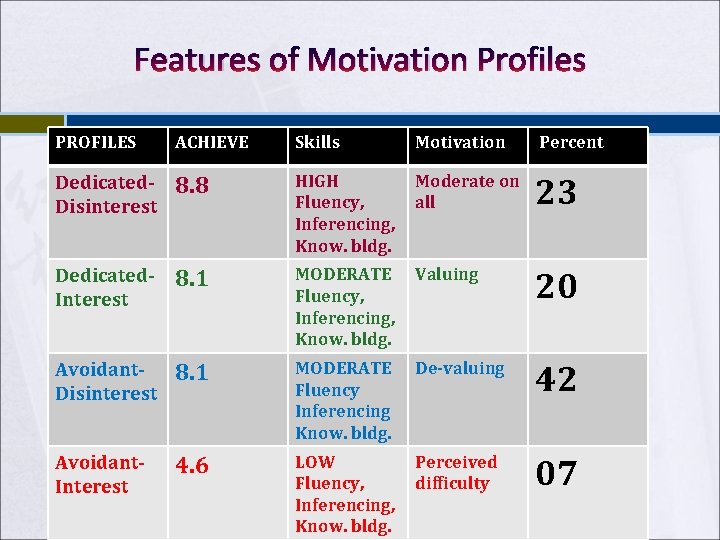
Features of Motivation Profiles PROFILES ACHIEVE Skills Motivation Percent Dedicated. Disinterest 8. 8 HIGH Fluency, Inferencing, Know. bldg. Moderate on all 23 Dedicated. Interest 8. 1 MODERATE Fluency, Inferencing, Know. bldg. Valuing 20 Avoidant. Disinterest 8. 1 MODERATE Fluency Inferencing Know. bldg. De-valuing 42 Avoidant. Interest 4. 6 LOW Fluency, Inferencing, Know. bldg. Perceived difficulty 07
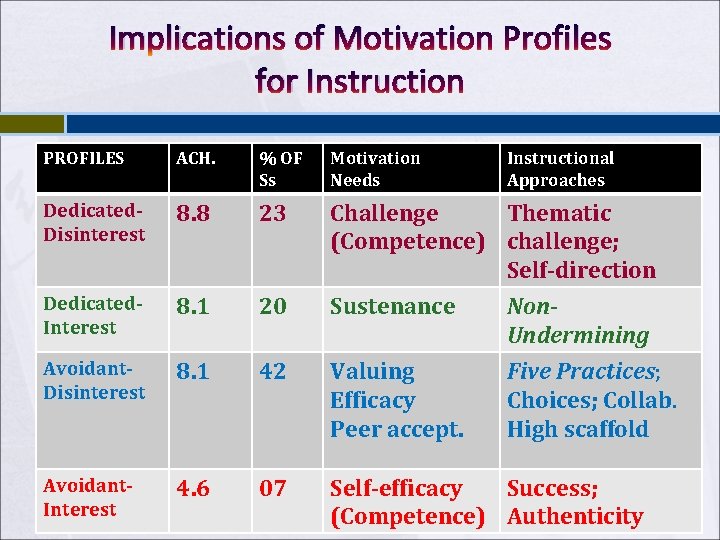
Implications of Motivation Profiles for Instruction PROFILES ACH. % OF Ss Motivation Needs Instructional Approaches Dedicated. Disinterest 8. 8 23 Dedicated. Interest 8. 1 20 Challenge Thematic (Competence) challenge; Self-direction Sustenance Non. Undermining Avoidant. Disinterest 8. 1 42 Valuing Efficacy Peer accept. Avoidant. Interest 4. 6 07 Self-efficacy Success; (Competence) Authenticity Five Practices; Choices; Collab. High scaffold
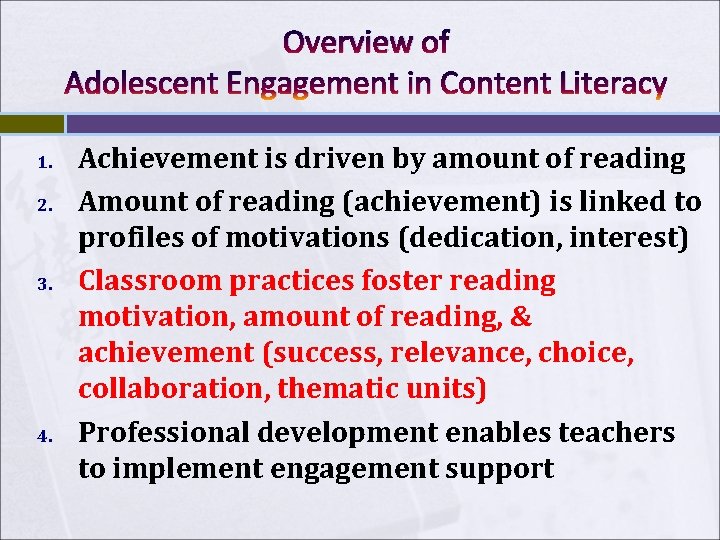
Overview of Adolescent Engagement in Content Literacy 1. 2. 3. 4. Achievement is driven by amount of reading Amount of reading (achievement) is linked to profiles of motivations (dedication, interest) Classroom practices foster reading motivation, amount of reading, & achievement (success, relevance, choice, collaboration, thematic units) Professional development enables teachers to implement engagement support
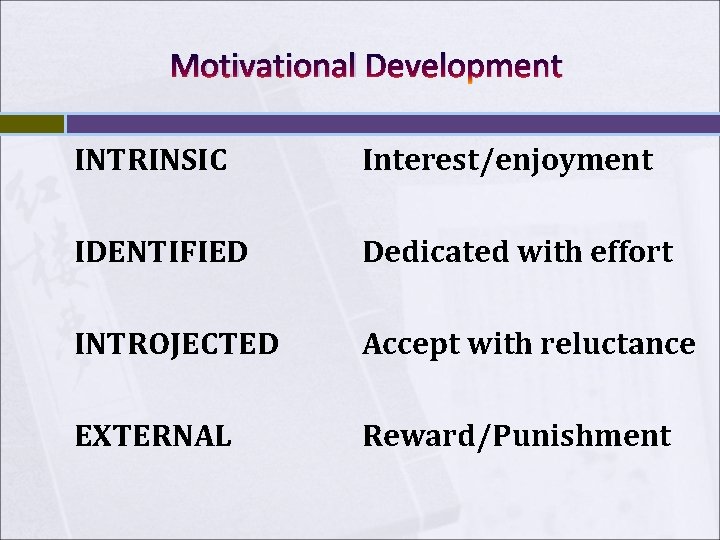
Motivational Development INTRINSIC Interest/enjoyment IDENTIFIED Dedicated with effort INTROJECTED Accept with reluctance EXTERNAL Reward/Punishment
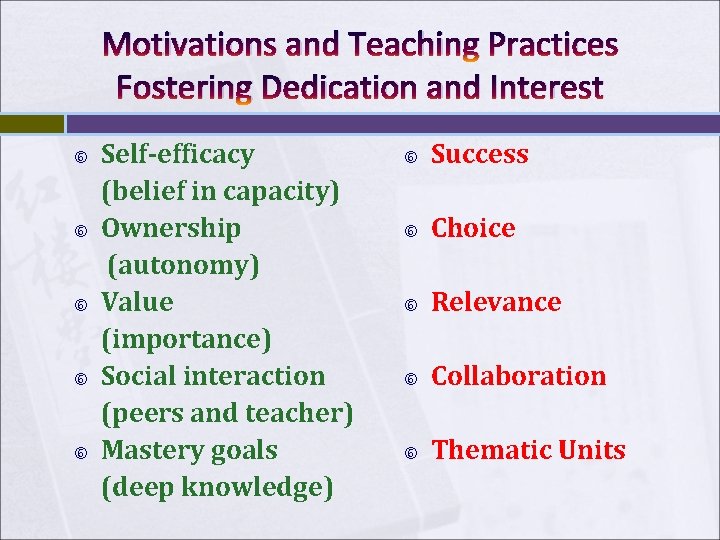
Motivations and Teaching Practices Fostering Dedication and Interest Self-efficacy (belief in capacity) Ownership (autonomy) Value (importance) Social interaction (peers and teacher) Mastery goals (deep knowledge) Success Choice Relevance Collaboration Thematic Units
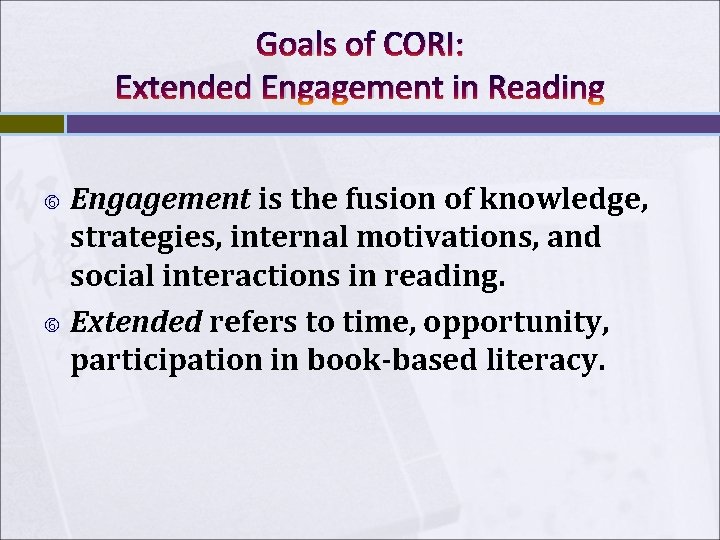
Goals of CORI: Extended Engagement in Reading Engagement is the fusion of knowledge, strategies, internal motivations, and social interactions in reading. Extended refers to time, opportunity, participation in book-based literacy.
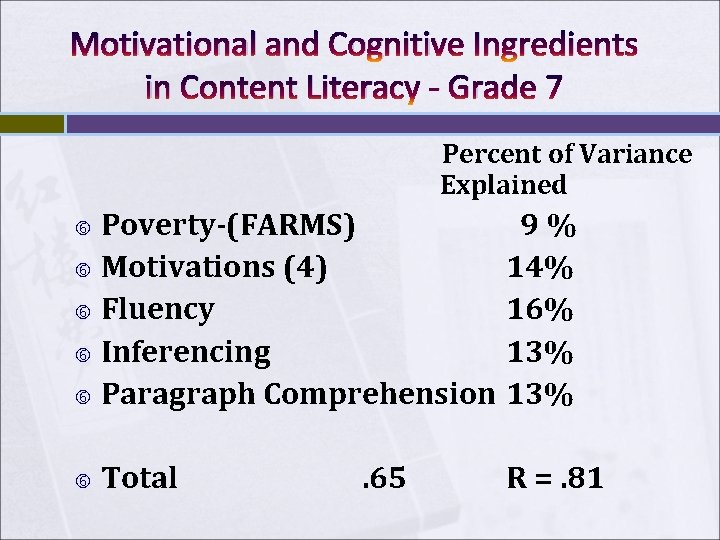
Motivational and Cognitive Ingredients in Content Literacy - Grade 7 Percent of Variance Explained Poverty-(FARMS) 9% Motivations (4) 14% Fluency 16% Inferencing 13% Paragraph Comprehension 13% Total . 65 R =. 81
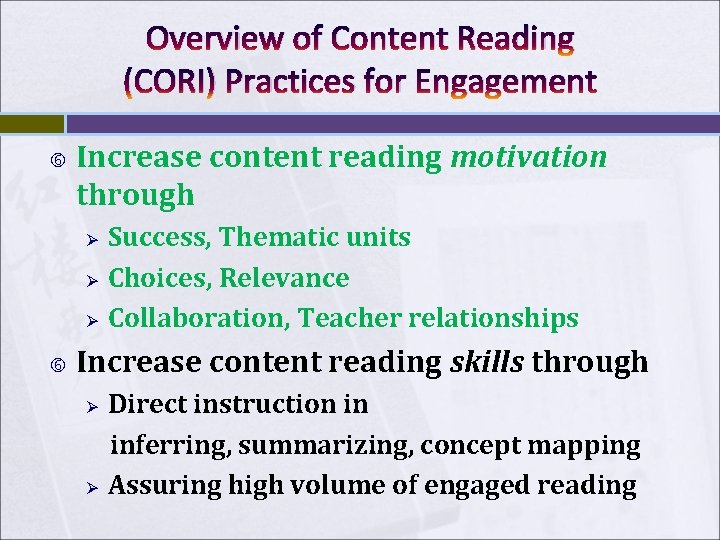
Overview of Content Reading (CORI) Practices for Engagement Increase content reading motivation through Ø Ø Ø Success, Thematic units Choices, Relevance Collaboration, Teacher relationships Increase content reading skills through Ø Ø Direct instruction in inferring, summarizing, concept mapping Assuring high volume of engaged reading
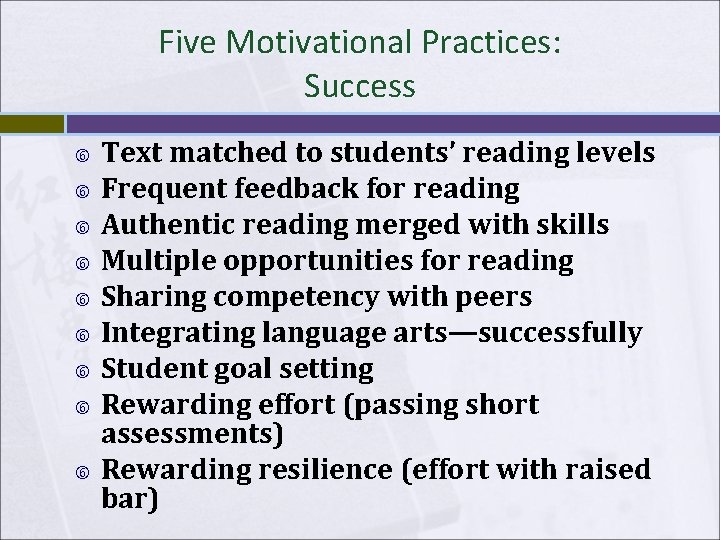
Five Motivational Practices: Success Text matched to students’ reading levels Frequent feedback for reading Authentic reading merged with skills Multiple opportunities for reading Sharing competency with peers Integrating language arts—successfully Student goal setting Rewarding effort (passing short assessments) Rewarding resilience (effort with raised bar)
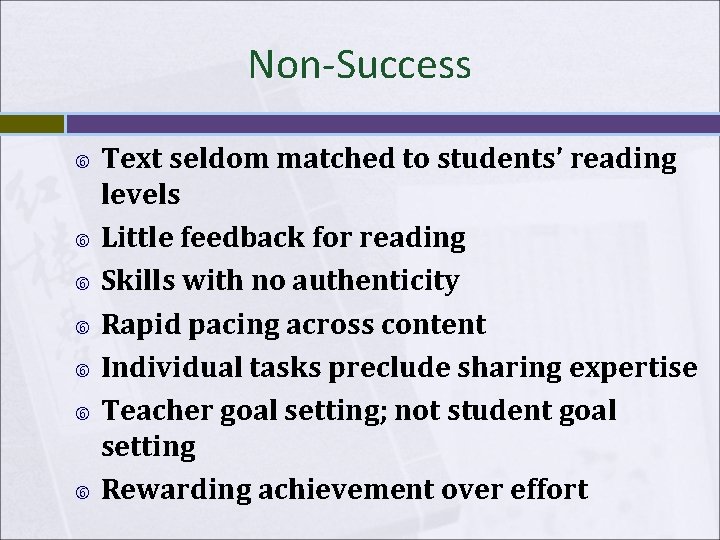
Non-Success Text seldom matched to students’ reading levels Little feedback for reading Skills with no authenticity Rapid pacing across content Individual tasks preclude sharing expertise Teacher goal setting; not student goal setting Rewarding achievement over effort
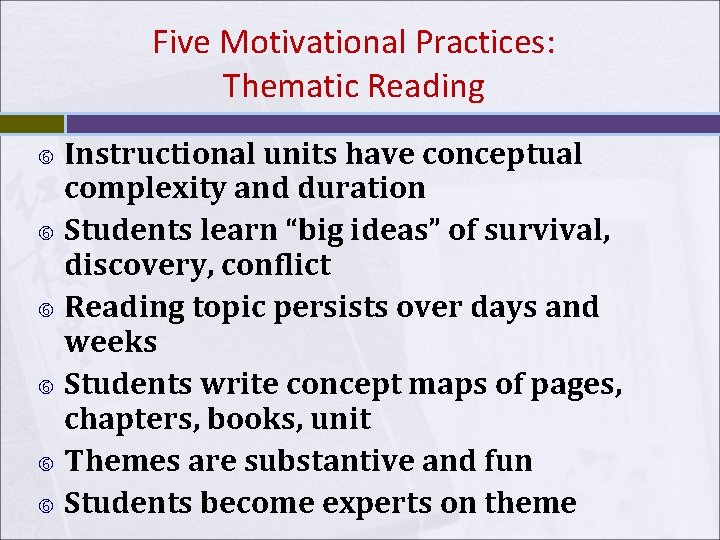
Five Motivational Practices: Thematic Reading Instructional units have conceptual complexity and duration Students learn “big ideas” of survival, discovery, conflict Reading topic persists over days and weeks Students write concept maps of pages, chapters, books, unit Themes are substantive and fun Students become experts on theme
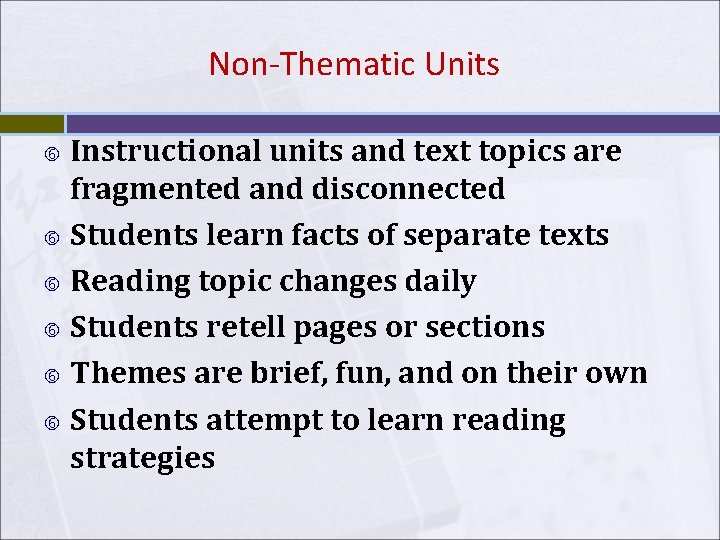
Non-Thematic Units Instructional units and text topics are fragmented and disconnected Students learn facts of separate texts Reading topic changes daily Students retell pages or sections Themes are brief, fun, and on their own Students attempt to learn reading strategies
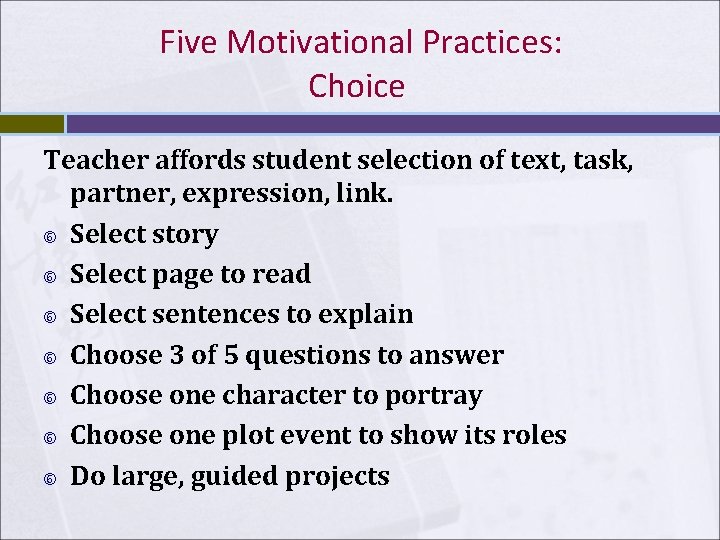
Five Motivational Practices: Choice Teacher affords student selection of text, task, partner, expression, link. Select story Select page to read Select sentences to explain Choose 3 of 5 questions to answer Choose one character to portray Choose one plot event to show its roles Do large, guided projects
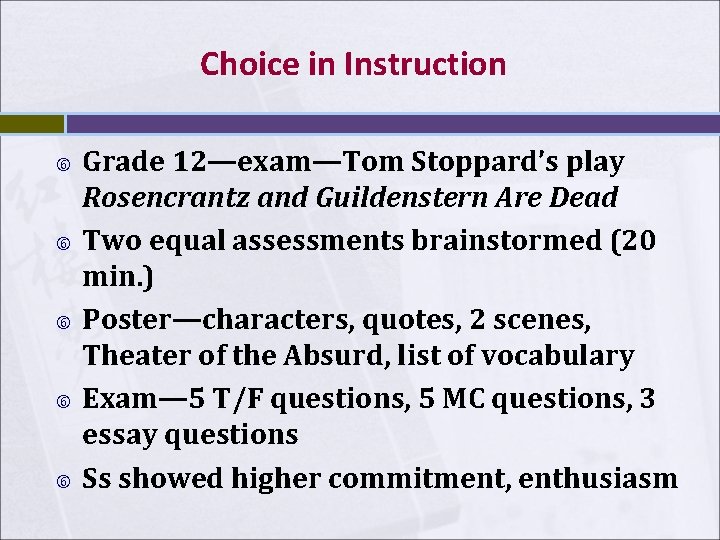
Choice in Instruction Grade 12—exam—Tom Stoppard’s play Rosencrantz and Guildenstern Are Dead Two equal assessments brainstormed (20 min. ) Poster—characters, quotes, 2 scenes, Theater of the Absurd, list of vocabulary Exam— 5 T/F questions, 5 MC questions, 3 essay questions Ss showed higher commitment, enthusiasm
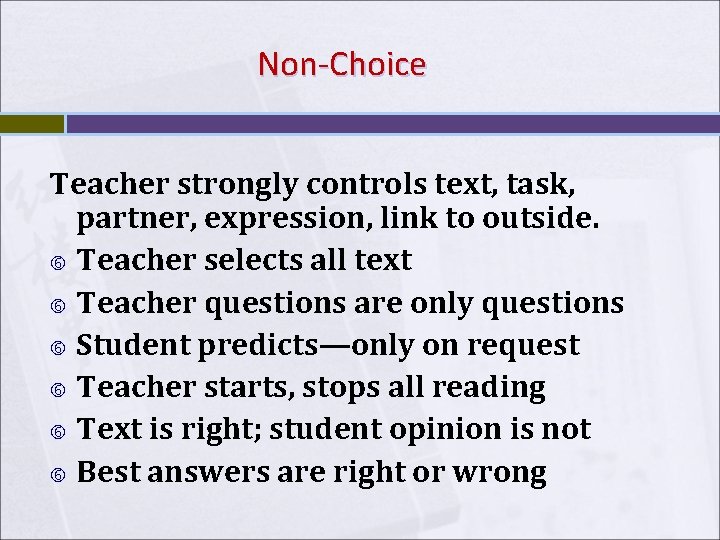
Non-Choice Teacher strongly controls text, task, partner, expression, link to outside. Teacher selects all text Teacher questions are only questions Student predicts—only on request Teacher starts, stops all reading Text is right; student opinion is not Best answers are right or wrong
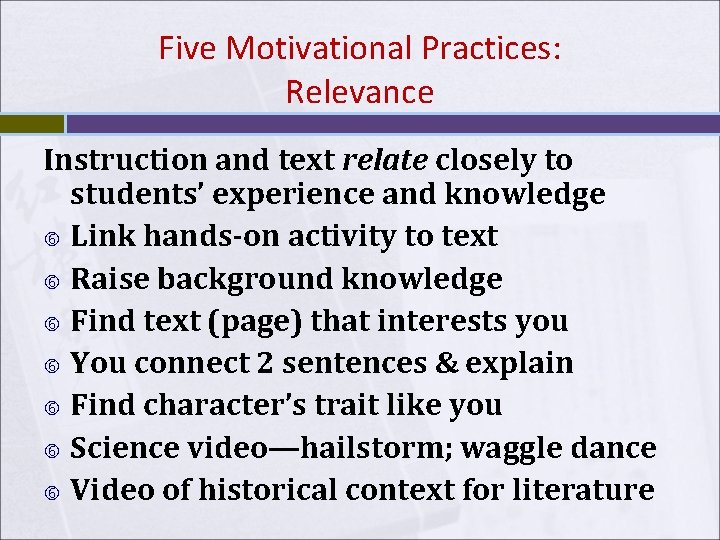
Five Motivational Practices: Relevance Instruction and text relate closely to students’ experience and knowledge Link hands-on activity to text Raise background knowledge Find text (page) that interests you You connect 2 sentences & explain Find character’s trait like you Science video—hailstorm; waggle dance Video of historical context for literature
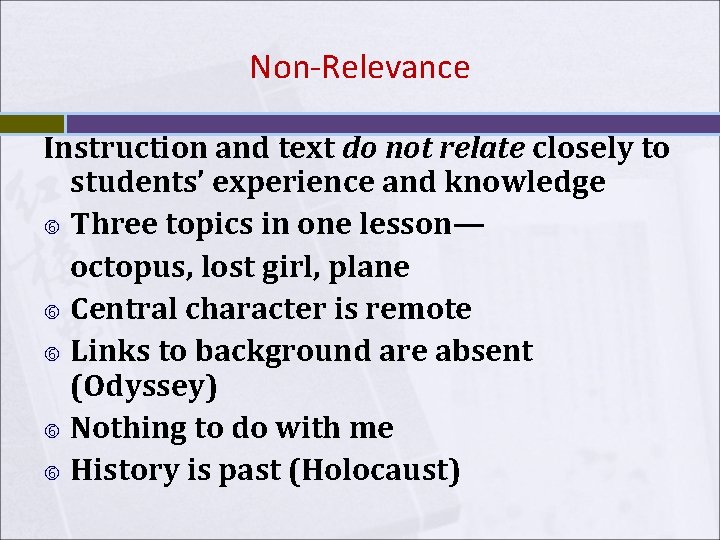
Non-Relevance Instruction and text do not relate closely to students’ experience and knowledge Three topics in one lesson— octopus, lost girl, plane Central character is remote Links to background are absent (Odyssey) Nothing to do with me History is past (Holocaust)
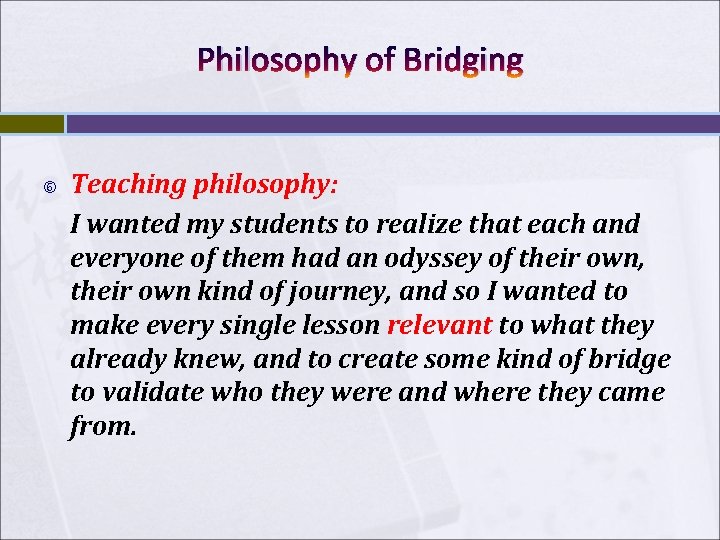
Philosophy of Bridging Teaching philosophy: I wanted my students to realize that each and everyone of them had an odyssey of their own, their own kind of journey, and so I wanted to make every single lesson relevant to what they already knew, and to create some kind of bridge to validate who they were and where they came from.
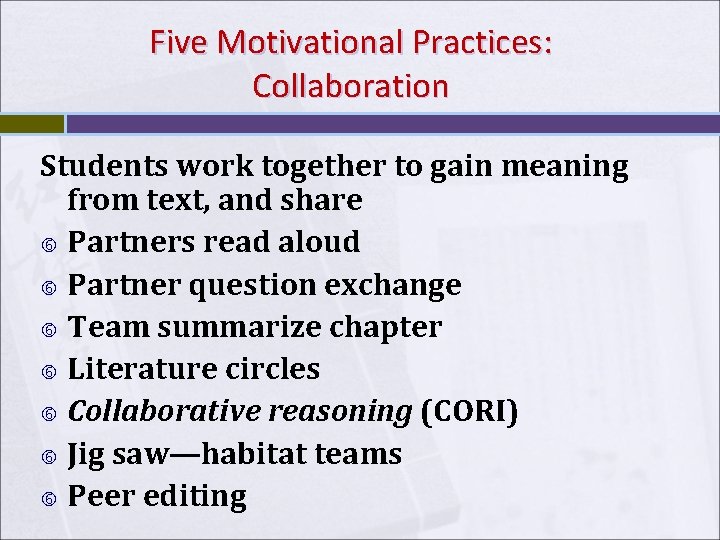
Five Motivational Practices: Collaboration Students work together to gain meaning from text, and share Partners read aloud Partner question exchange Team summarize chapter Literature circles Collaborative reasoning (CORI) Jig saw—habitat teams Peer editing
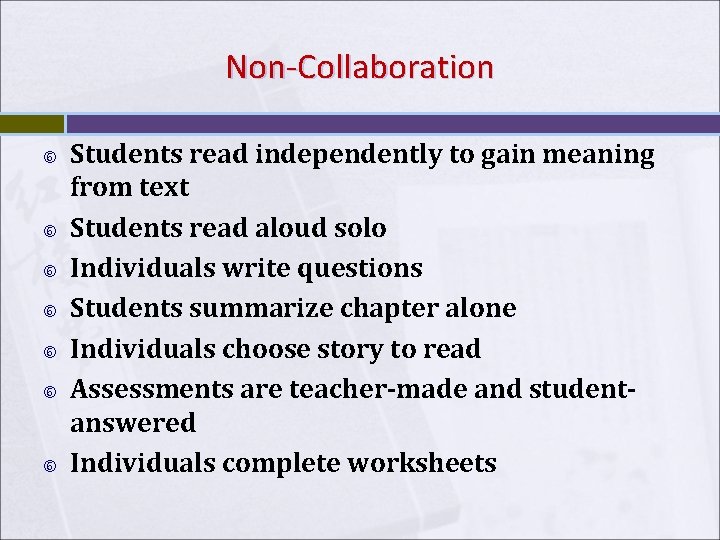
Non-Collaboration Students read independently to gain meaning from text Students read aloud solo Individuals write questions Students summarize chapter alone Individuals choose story to read Assessments are teacher-made and studentanswered Individuals complete worksheets
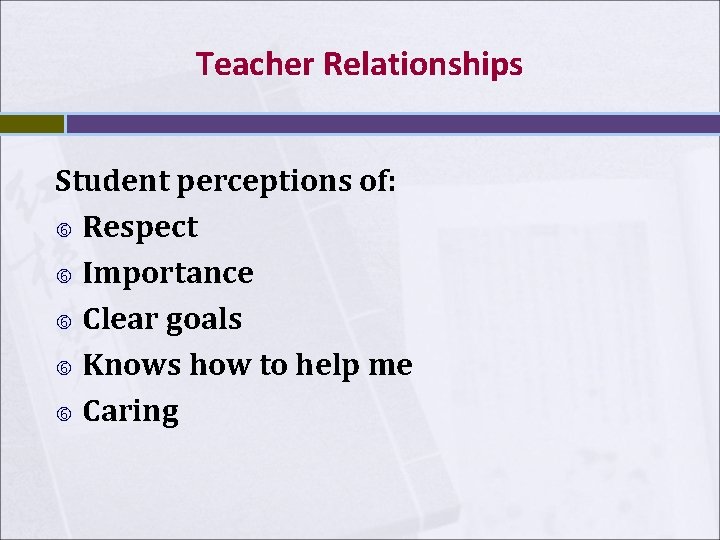
Teacher Relationships Student perceptions of: Respect Importance Clear goals Knows how to help me Caring
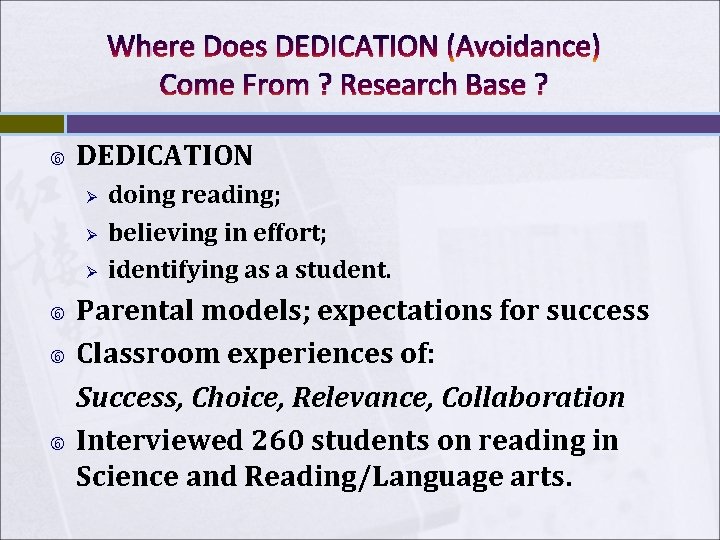
Where Does DEDICATION (Avoidance) Come From ? Research Base ? DEDICATION Ø Ø Ø doing reading; believing in effort; identifying as a student. Parental models; expectations for success Classroom experiences of: Success, Choice, Relevance, Collaboration Interviewed 260 students on reading in Science and Reading/Language arts.
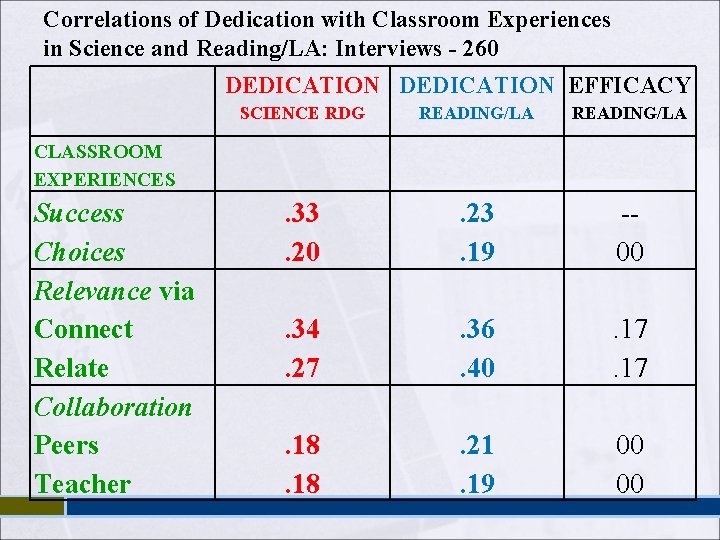
Correlations of Dedication with Classroom Experiences in Science and Reading/LA: Interviews - 260 DEDICATION EFFICACY SCIENCE RDG READING/LA . 33. 20 . 23. 19 -00 . 34. 27 . 36. 40 . 17 . 18 . 21. 19 00 00 CLASSROOM EXPERIENCES Success Choices Relevance via Connect Relate Collaboration Peers Teacher
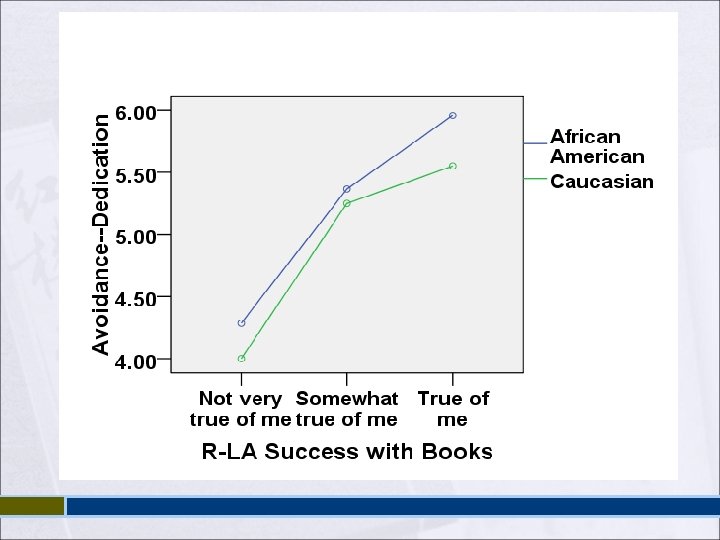
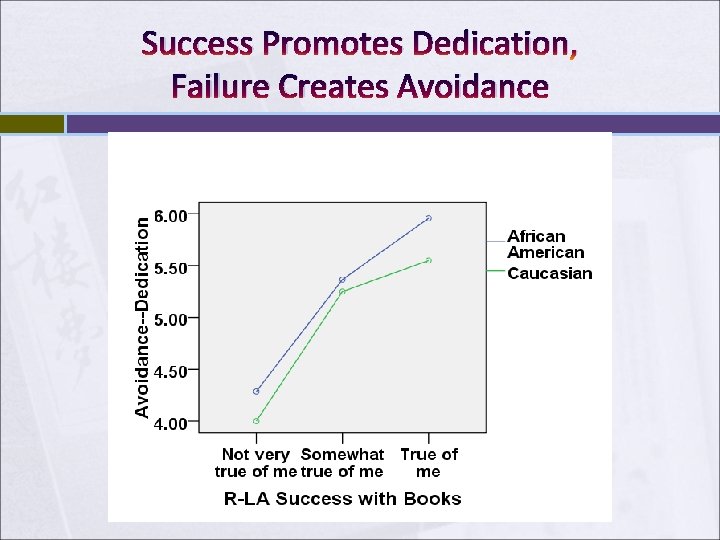
Success Promotes Dedication, Failure Creates Avoidance
Overview of Adolescent Engagement in Content Literacy 1. 2. 3. 4. Achievement is driven by amount of reading Amount of reading (achievement) is linked to profiles of motivations (dedication, interest, valuing, self-efficacy) Classroom practices foster reading motivation, amount of reading, & achievement (success, relevance, choice, collaboration, thematic units) Professional development enables teachers to implement engagement support
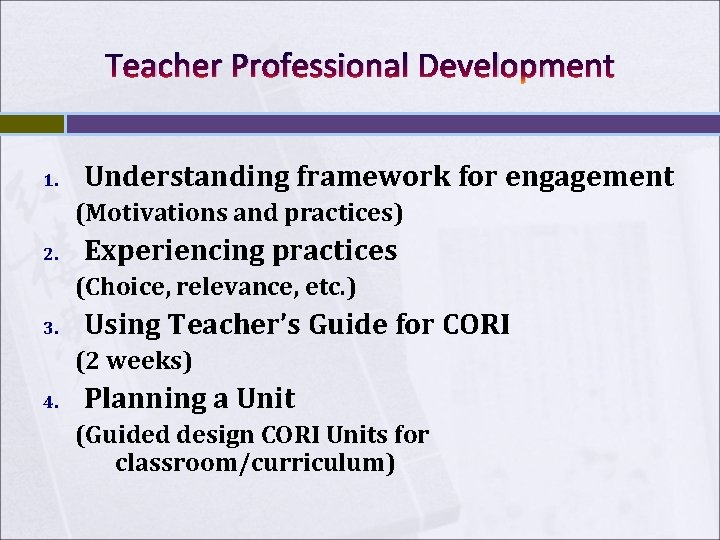
Teacher Professional Development 1. Understanding framework for engagement (Motivations and practices) 2. Experiencing practices (Choice, relevance, etc. ) 3. Using Teacher’s Guide for CORI (2 weeks) 4. Planning a Unit (Guided design CORI Units for classroom/curriculum)
Next Steps for Teachers— Engaging Adolescents in Reading - Chapter 9 Five Engagement Practices: Short-term change Long-term change Needs assessment questionnaires Curriculum evaluation rubric
Next Steps for Teachers - Chapter 9 Five Engagement Practices: Short-Term Change 1. Do I do this already? 2. How often do I do this? 3. When do I do this? 4. How well does it work? 5. How can I do this more? 6. How can I do this better? 7. How can I connect this to my teaching more deeply?
Cecilia: What I Would Never Change In Whitney, people were interested in who I was. They showed me I wasn’t worthless, and showed me that it’s possible to trust unconditionally. Whitney gave me something that nowhere else has truly given me: acceptance.