
ADOLESCENT BRAIN YOUR BRAIN Adolescence is a window
ADOLESCENT BRAIN
YOUR BRAIN Adolescence is a window of opportunity for developing a better, smarter, faster brain!
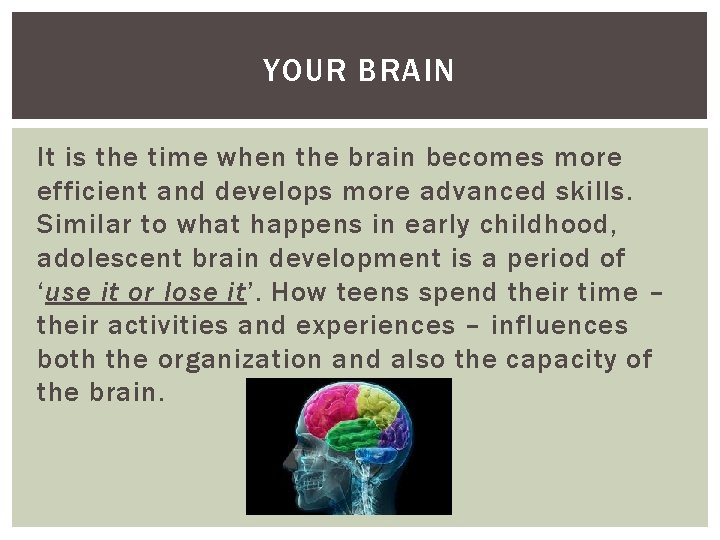
YOUR BRAIN It is the time when the brain becomes more efficient and develops more advanced skills. Similar to what happens in early childhood, adolescent brain development is a period of ‘use it or lose it’. How teens spend their time – their activities and experiences – influences both the organization and also the capacity of the brain.
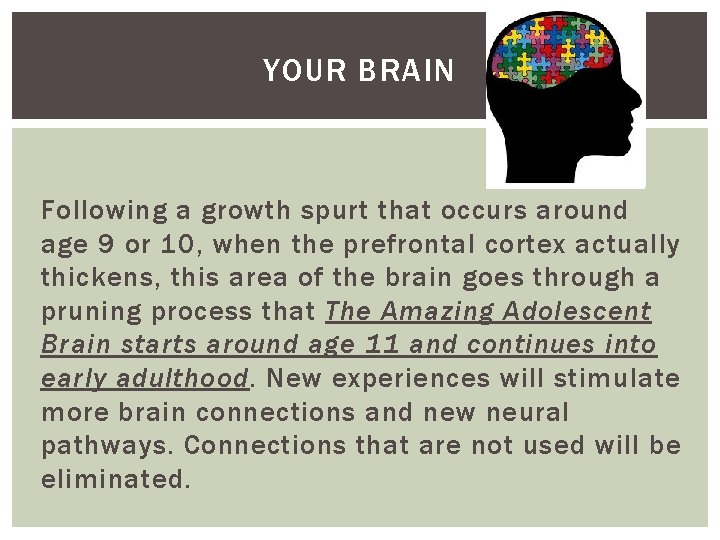
YOUR BRAIN Following a growth spurt that occurs around age 9 or 10, when the prefrontal cortex actually thickens, this area of the brain goes through a pruning process that The Amazing Adolescent Brain starts around age 11 and continues into early adulthood. New experiences will stimulate more brain connections and new neural pathways. Connections that are not used will be eliminated.
YOUR BRAIN As teens mature, their brains become faster, sharper, and more specialized. They begin to: develop advanced reasoning abilities; expand their capacity for abstract and critical thinking; understand ‘how’ and ‘why’ questions; analyze complex issues; and evaluate alternatives before making a decision. Although teens have an amazing capacity for learning and memorizing new information, they often experience difficulty with prefrontal cortex functions, such as prioritizing what is important and organizing tasks.
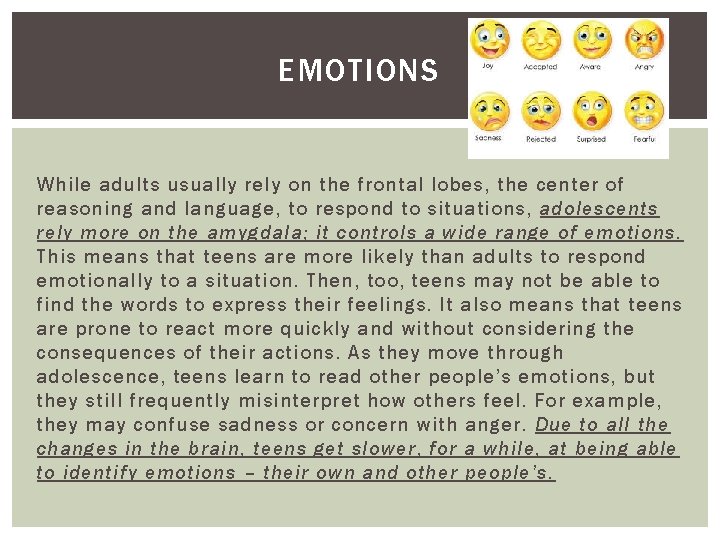
EMOTIONS While adults usually rely on the frontal lobes, the center of reasoning and language, to respond to situations, adolescents rely more on the amygdala; it controls a wide range of emotions. This means that teens are more likely than adults to respond emotionally to a situation. Then, too, teens may not be able to find the words to express their feelings. It also means that teens are prone to react more quickly and without considering the consequences of their actions. As they move through adolescence, teens learn to read other people’s emotions, but they still frequently misinterpret how others feel. For example, they may confuse sadness or concern with anger. Due to all the changes in the brain, teens get slower, for a while, at being able to identify emotions – their own and other people’s.
THERE ARE SEVERAL STRUCTURES IN THE BRAIN THAT GROW DIFFERENTLY IN ADOLESCENT FEMALES AND MALES The hippocampus helps to transfer new information to long-term memory. The hippocampus is sensitive to the female hormone, estrogen, and grows faster and larger in young women. Scientists believe that a larger hippocampus may explain females’ strong social skills. Females often excel at sizing up social situations, being emotionally supportive, and coordinating complex relationships. The amygdala and the hypothalamus are sensitive to male sex hormones and grow larger in young men. Both of these structures are involved in the body’s response to fear and danger. Enjoying contact sports, having increased sexual desire, and being more assertive are behaviors that make sense with the male growth spurt in the amygdala and hypothalamus. A busier, bigger amygdala may also explain why boys and young men need to move around more while learning compared to girls and young women, who tend to have a longer attention span that allows them to sit still and focus on one subject for longer periods of time.
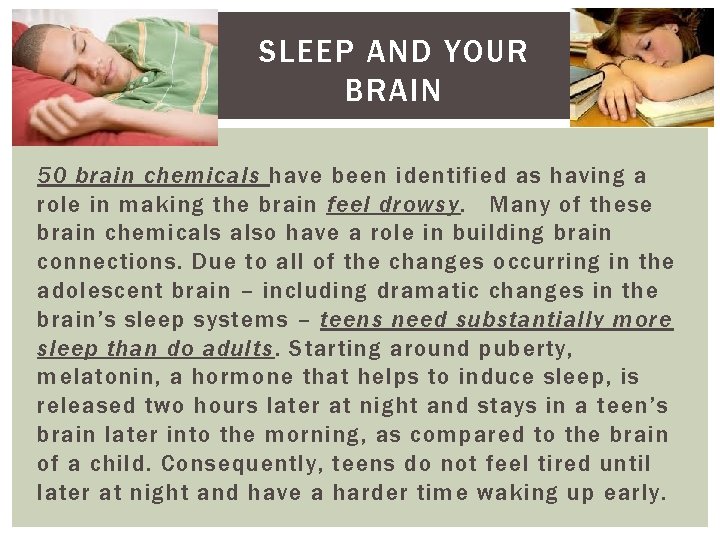
SLEEP AND YOUR BRAIN 50 brain chemicals have been identified as having a role in making the brain feel drowsy. Many of these brain chemicals also have a role in building brain connections. Due to all of the changes occurring in the adolescent brain – including dramatic changes in the brain’s sleep systems – teens need substantially more sleep than do adults. Starting around puberty, melatonin, a hormone that helps to induce sleep, is released two hours later at night and stays in a teen’s brain later into the morning, as compared to the brain of a child. Consequently, teens do not feel tired until later at night and have a harder time waking up early.
ALCOHOL AND YOUR BRAIN The hippocampus, which has an important role in forming new memories, is smaller in adolescents who are heavy drinkers than in other teens. Young drinkers have more learning problems as well as longterm memory impairment when compared to teens who don’t drink.
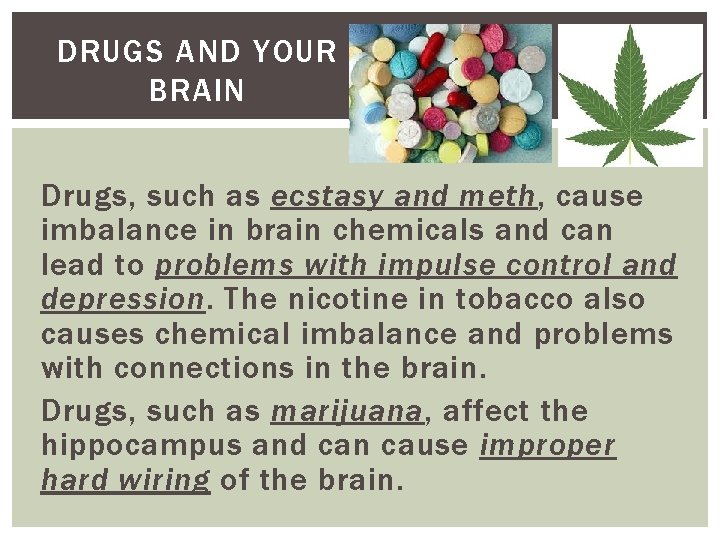
DRUGS AND YOUR BRAIN Drugs, such as ecstasy and meth, cause imbalance in brain chemicals and can lead to problems with impulse control and depression. The nicotine in tobacco also causes chemical imbalance and problems with connections in the brain. Drugs, such as marijuana, affect the hippocampus and can cause improper hard wiring of the brain.
MEDIA VIOLENCE INFLUENCE ON YOUR BRAIN The average American teen spends more than 70 hours a week with some form of media (Internet, television, and video games, etc. ), and a growing body of research indicates that high doses of media violence can compromise learning and increase aggressive behaviors. An additional concern is that adolescence is the time when the hidden epidemic of dating abuse begins. Physical, sexual, and emotional abuse by a dating partner is exceedingly common, starts early, and affects both females and males.
MEDIA VIOLENCE INFLUENCE ON YOUR BRAIN According to a national survey of high school students, nearly one in five female teens (17%) and nearly one in 10 male teens (9%) has experienced physical and/or sexual dating violence (Ackard et al, 2003). Equally disturbing is the fact that approximately one-half of the students who were experiencing dating abuse also reported that they were still in the relationship because they feared physical harm if they tried to get out of it. In a survey of male and female college students, more than onethird (35%) of students had experienced some form of relationship violence before coming to college and 1 in 4 (24. 9%) reported experiencing relationship violence during college (Forke et al, 2008).
- Slides: 12