
ADOLESCENCE Definition This is the transition from childhood







- Slides: 40
ADOLESCENCE Definition: This is the transition from childhood to adulthood OR A period begining with the onset of puberty and ending when individuals assume the roles and responsibilities of an adult
Where are we now. . . .
Adolescence
ADOLESCENCE * The time formulating a sense of personal identity * The time for gaining emancipation (feeling free) from the family unit * The time for driving moms and/or dads out of their minds. *The age of adolescence is generally regarded as 11 -19 years (this is very flexible) *Some persons continue to function as adolescents well into the 20’s or more
PUBERTY • The Period of rapid physical maturation involving hormonal and bodily changes that take place primarily in the early adolescence • The onset of reproductive life is called Puberty. • It is the time when the gonads develop both endocrine & gametogenic functions.
TRUE PUBERTY • This the point at which reproduction is possible • Reproductive capabilities are internal phenomena • True puberty, therefore, is noticeable externally
Adolescence-2 phases • Early adolescence: Onset of body changes. Is aware of the changes in the body. 12 to 16 years. • Late adolescence: Accepts the changes in the body and laerns to live with them. 1618 years. Stress by adolescence is on independence.
Physical Development What Happens During the Adolescent Growth Spurt? • Girls begin their growth spurt earlier than boys – Reach peak growth in height about 2 years after spurt began – Continue to grow at a slower rate for another 2 years – Weight spurt begins about 18 months after height spurt Boys catch up to girls and eventually are taller and heavier Body shapes differ by sex – Boys have broader shoulders – Girls gain almost twice as much fatty tissue
GENDER DIFFERENCES * Menarche The first menstrual period This event separates the pre -pubertal from the post-pubertal girl * Nocturnal Emissions This is a guy thing This is the division between pre-pubertal and post-pubertal boys
Primary and secondary sex characteristics • Primary characteristics involve the organs for reproduction. • Males have testicles & penis. This is followed by noctornal emission or ejaculation • Females have uterus & ovaries. Menarche or onset of menstruation -ends with menopause.
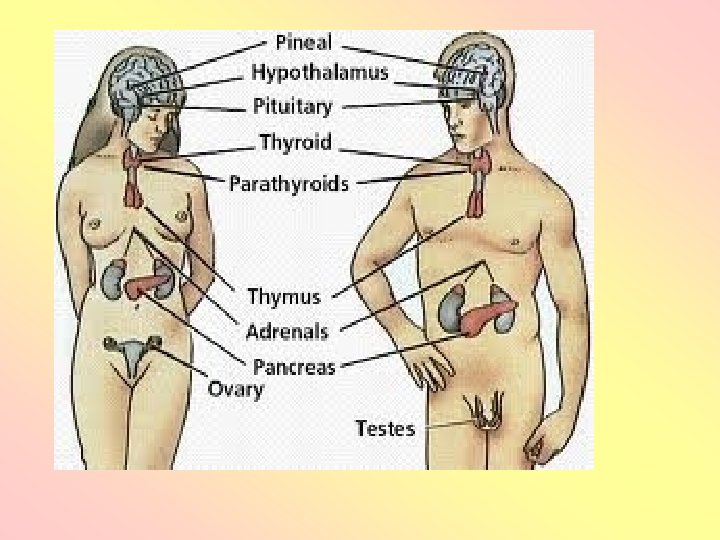
Secondary sex characteristics/effect of sex hormones on puberty • Secondary characteristics involve traits characterized by hormonal release by the pituitary glands stimulated by hypothalamus glands. • Girls-It includes breasts development, hip widens. • Boys-Facial hair, chest hair and voice deepens. • Both sexes develop the growth of pubic hair and underarm hair. sweat glands become active leading to pimples or acne.
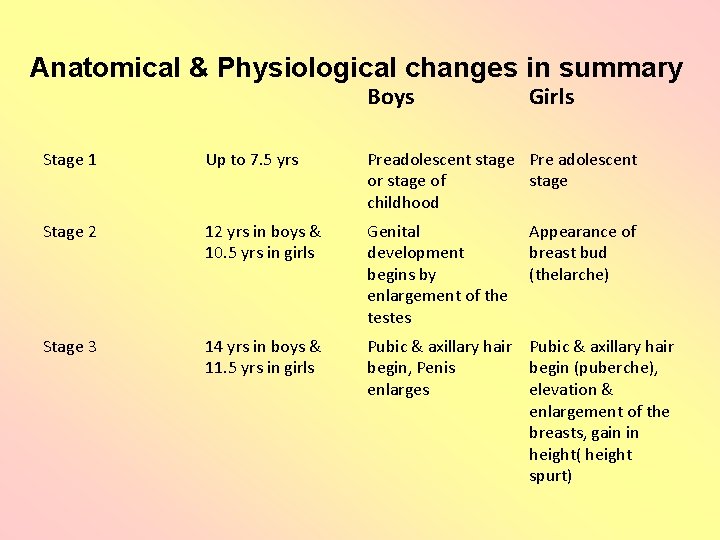
Anatomical & Physiological changes in summary Boys Girls Stage 1 Up to 7. 5 yrs Preadolescent stage Pre adolescent or stage of stage childhood Stage 2 12 yrs in boys & 10. 5 yrs in girls Genital development begins by enlargement of the testes Stage 3 14 yrs in boys & 11. 5 yrs in girls Pubic & axillary hair begin, Penis begin (puberche), enlarges elevation & enlargement of the breasts, gain in height( height spurt) Appearance of breast bud (thelarche)
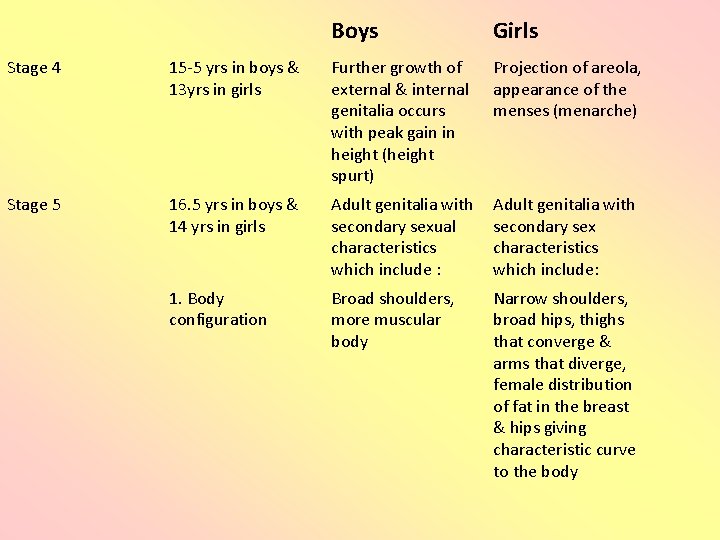
Boys Girls Stage 4 15 -5 yrs in boys & 13 yrs in girls Further growth of external & internal genitalia occurs with peak gain in height (height spurt) Projection of areola, appearance of the menses (menarche) Stage 5 16. 5 yrs in boys & 14 yrs in girls Adult genitalia with secondary sexual characteristics which include : Adult genitalia with secondary sex characteristics which include: 1. Body configuration Broad shoulders, more muscular body Narrow shoulders, broad hips, thighs that converge & arms that diverge, female distribution of fat in the breast & hips giving characteristic curve to the body
Boys Girls 2 Hair growth Hair appears all over body, in axilla, over the pubis, face & chest, hairline on scalp , male pattern of pubic hair (triangle with apex up) Appearance of hair in the axilla & pubis, less body hair & more scalp hair, hair in pubic region concave upwards 3 Voice Larynx enlarges, vocal chords increase in length, thickness, therefore voice becomes deep & breaks Larynx does not enlarge to that extent as in males, therefore voice becomes high pitch
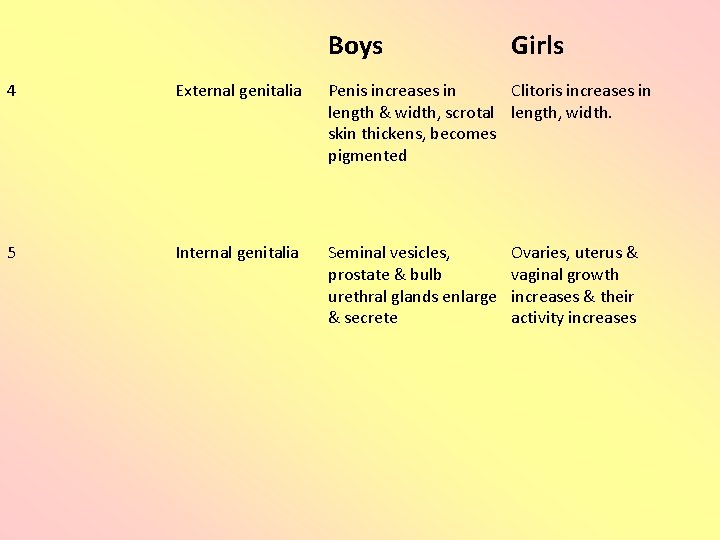
Boys Girls 4 External genitalia Penis increases in Clitoris increases in length & width, scrotal length, width. skin thickens, becomes pigmented 5 Internal genitalia Seminal vesicles, prostate & bulb urethral glands enlarge & secrete Ovaries, uterus & vaginal growth increases & their activity increases
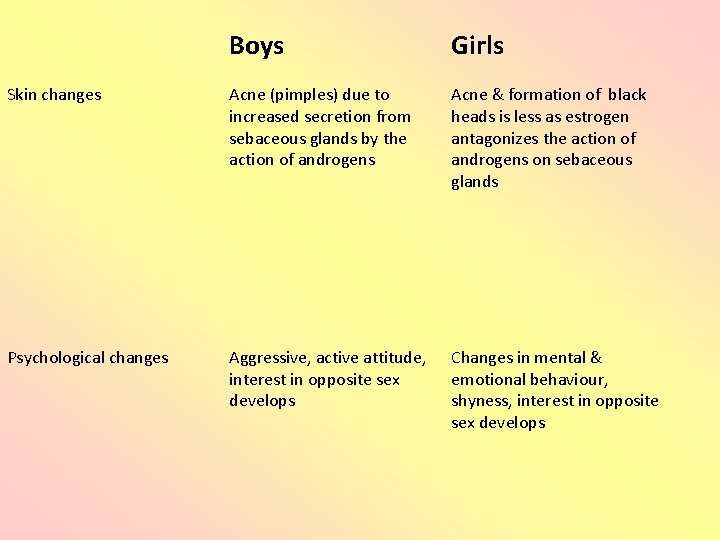
Boys Girls Skin changes Acne (pimples) due to increased secretion from sebaceous glands by the action of androgens Acne & formation of black heads is less as estrogen antagonizes the action of androgens on sebaceous glands Psychological changes Aggressive, active attitude, interest in opposite sex develops Changes in mental & emotional behaviour, shyness, interest in opposite sex develops
Body changes during adolescence(Internal) • Digestive system: Stomach - longer and less tubular, intestine -length, muscles in the walls thick and strong. • Circulatory-Heart grows rapidly. The length and thickness of wall of blood vessels increase. • Respiratory -Girls-lungs mature at 17 and boys later.
Role of Endocrine Glands • Hormones: Powerful chemicals secreted by the endocrine glands, carried through the body by the blood stream. Androgens: The main class of male hormone Estrogens: The main class of female hormone They are important for reproductive cycles and sexual maturity.
Function of endocrine glands • The glands of the endocrine system and the hormones they release influence almost every cell, organ, and function of our bodies. The endocrine system is instrumental in regulating mood, growth and development, tissue function, and metabolism, as well as sexual function and reproductive processes.
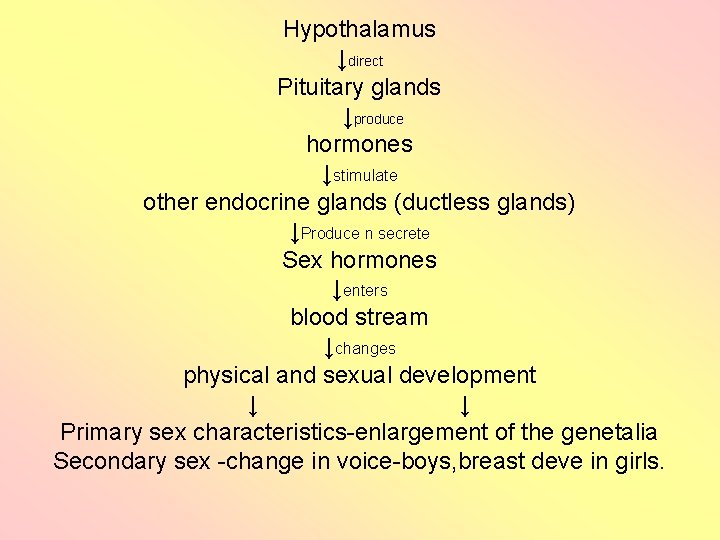
Hypothalamus ↓direct Pituitary glands ↓produce hormones ↓stimulate other endocrine glands (ductless glands) ↓Produce n secrete Sex hormones ↓enters blood stream ↓changes physical and sexual development ↓ ↓ Primary sex characteristics-enlargement of the genetalia Secondary sex -change in voice-boys, breast deve in girls.
GENERALITIES OF CHANGES IN ADOLESCENCE • • • Rapid growth (early in adolescence) Confused by changes Curious about final outcome Personal interest in their own development Measure my height!
• • • Puberty - Early Adolescence Rebellion against home Vacillation (fluctuation) between considerable maturity and babyishness Absorption with close friend of same age and sex Moodiness Sloppiness & disorder
• Establishment of independence of self: “Who am I? ” “ What kind of person am I? ” • Rapid growth • Body-conscious • Appearance of sexual maturity • Skin problems
• Constantly hungry (more than during young years) • Companionship at meals and at afterschool snacks provides dining pleasure • Sleeps more than during younger years • Sleepy at “getting up” times • Wants to sit up at night as sign of increasing maturity • Clash between physiology and culture
Early Maturation • Special Characteristics of Boys • Boisterous • Clumsy • Secretive, “clams up at home. ” • Aggressive • Dirty - Can’t seem to get the kid near the bathroom
Puberty - Early Adolescence (contd) Special characteristics of boys • Boys in puberty gain more weight and height than girls • Much talk about sex and girls • Out of house more and more
Puberty - Early Adolescence • • • Special Characteristics of Girls Vague and diffuse Crush on older men Interested in romantic love Playacting Talkative, but not communicative Giggly!!
Late Maturation • Striving for independence and autonomy is greatly increased • Parental conflicts occur which need confrontation and resolution • Teenage-parental conflicts are normal and necessary • Adolescents confide in each other
Cognitive Development • Concrete Operations - The child can deal with properties of the immediately present world in solving new problems Reason at this level is inductive (they make decisions based on the influence of others) • Ability to manipulate two or more variables at once • Must be able to demonstrate changes that come with time • Ability to hypothesize (imagine) about the logical consequences of events
Cognitive Development-Suggestions • Ability to foresee the consequences of his or her actions • Must be able to detect the logical consistency within a statement • Must think realistically about self, others, and their world • Must be able to think without egocentrism (thinks about the whole and not the self)
Psychological changes Emanicipation from home-Independence Search of identity-'I' Who am I? Re-examination of belief-Omnipotence Generation gap- parents and teachers are old to understand • Problems and solutions- • •
Personal Hygiene Adolescents
Healthy Skin • Acne affects about 80% of adolescents. • It is not caused by uncleanliness and food probably only plays a minor role. • Increased hormone levels stimulate the oil glands in the skin. These glands produce a substance that can block the pores and the result is blackheads and pimples. • Blackheads and pimples should never be picked at or squeezed as this can result in permanent scarring. • Almost all cases of acne can be treated successfully. • The treatment for acne is: • gently wash involved areas with a non-oiled soap and a face cloth, twice a day; • avoid moisturizers; • over-the-counter medications that contain benzoyl peroxide can be used in mild cases; • see a dermatologist if acne is severe and does not respond to normal treatment
Hair • The hormonal changes that occur during puberty can cause hair to become oily. • Glands are more active during puberty. The glands on the hair follicles deposit oil on each hair. This oil makes the hair shiny but it also attaches dirt to the hair. • Oily hair needs to be washed more frequently than dry or normal hair. If hair is very oily it should be washed every day. Choose a shampoo to suit hair type. Rinse out well with clean water
Body Odour • Sweating is a vital and normal process. When people sweat or perspire, the moisture combines with bacteria to create an odour. • The apocrine glands, located primarily under the arms and in the genital area become active at the onset of puberty. When these glands are stimulated, they produce perspiration. • When the sweat comes in contact with bacteria on the skin the result is body odour. • This odour is often unpleasant and increases with physical activity, stress, excitement, nerv o u s n e s s and warmth. Body odour can be effectively managed by: • daily showers or baths; • changing one’s clothes daily; • use of a deodorant or anti-perspirant.
Oral Hygiene Oral hygiene is important at all ages. In adolescence, in addition to cavity prevention there are new challenges such as maintaining fresh breath, an attractive smile and dealing with braces. – A clean mouth requires daily removal of plaque and food particles from between the teeth and under the gum line. – When teeth and gums are not cleaned regularly, the bacteria in the mouth increase. – Students with braces should pay special attention to cleaning their teeth because food particles around the wires can cause decay.
Genital (Males) • All boys need to wash the penis, scrotum and groin area daily. They must dry the area carefully to prevent jock itch (red, itchy scales on skin). • – Boys who are uncircumcised need to pull the foreskin back to clean the head of the penis.
Genital (Female) Washing the genital area daily is important for maintaining hygiene during menstruation, • changing menstrual pads , tampons or cloths at least four to five times a day • washing used menstrual cloths as soon as possible and drying them completely. • These practices can help avoid problems such as burning during urination and genital itching. • strict hand-washing practices before and after changing sanitary products. • Regular bath
THANK YOU visit homescienceweebly. com for notes and ppt