
Adnan Sljoka KGUCREST Japan How to inductively construct

- Slides: 9
Adnan Sljoka KGU/CREST, Japan How to inductively construct floating body-hinge / molecular Assur graphs?
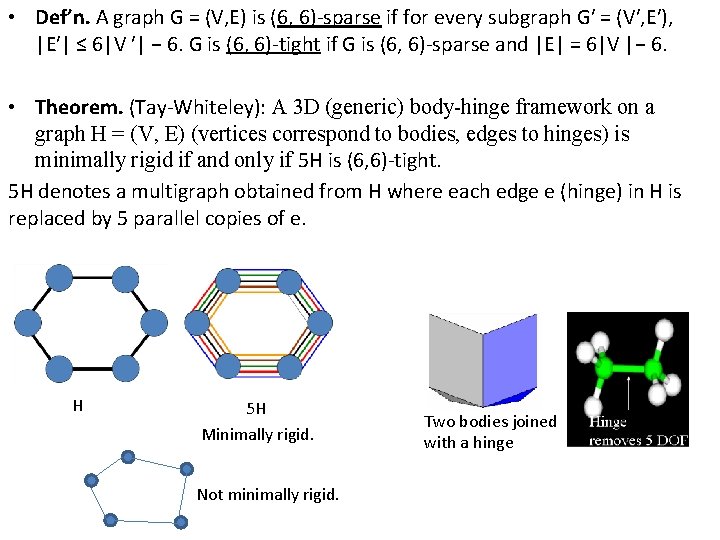
• Def’n. A graph G = (V, E) is (6, 6)-sparse if for every subgraph G′ = (V′, E′), |E′| ≤ 6|V ′| − 6. G is (6, 6)-tight if G is (6, 6)-sparse and |E| = 6|V |− 6. • Theorem. (Tay-Whiteley): A 3 D (generic) body-hinge framework on a graph H = (V, E) (vertices correspond to bodies, edges to hinges) is minimally rigid if and only if 5 H is (6, 6)-tight. 5 H denotes a multigraph obtained from H where each edge e (hinge) in H is replaced by 5 parallel copies of e. H 5 H Minimally rigid. Not minimally rigid. Two bodies joined with a hinge
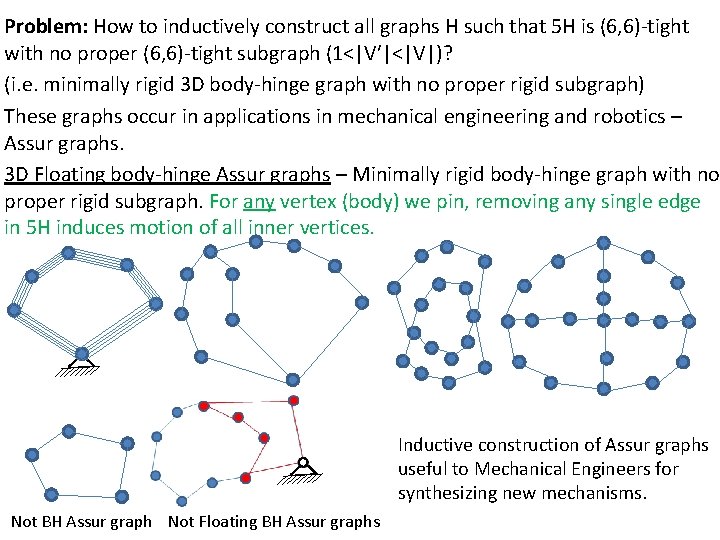
Problem: How to inductively construct all graphs H such that 5 H is (6, 6)-tight with no proper (6, 6)-tight subgraph (1<|V′|<|V|)? (i. e. minimally rigid 3 D body-hinge graph with no proper rigid subgraph) These graphs occur in applications in mechanical engineering and robotics – Assur graphs. 3 D Floating body-hinge Assur graphs – Minimally rigid body-hinge graph with no proper rigid subgraph. For any vertex (body) we pin, removing any single edge in 5 H induces motion of all inner vertices. Inductive construction of Assur graphs useful to Mechanical Engineers for synthesizing new mechanisms. Not BH Assur graph Not Floating BH Assur graphs
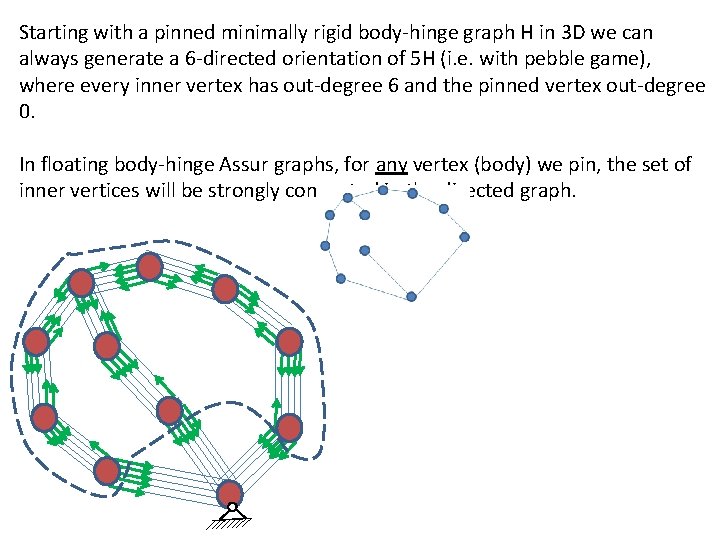
Starting with a pinned minimally rigid body-hinge graph H in 3 D we can always generate a 6 -directed orientation of 5 H (i. e. with pebble game), where every inner vertex has out-degree 6 and the pinned vertex out-degree 0. In floating body-hinge Assur graphs, for any vertex (body) we pin, the set of inner vertices will be strongly connected in the directed graph.
Thank you.
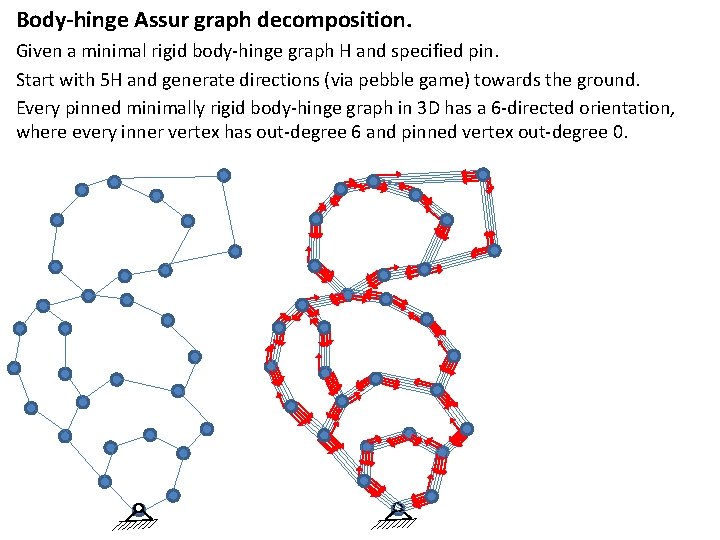
Body-hinge Assur graph decomposition. Given a minimal rigid body-hinge graph H and specified pin. Start with 5 H and generate directions (via pebble game) towards the ground. Every pinned minimally rigid body-hinge graph in 3 D has a 6 -directed orientation, where every inner vertex has out-degree 6 and pinned vertex out-degree 0.
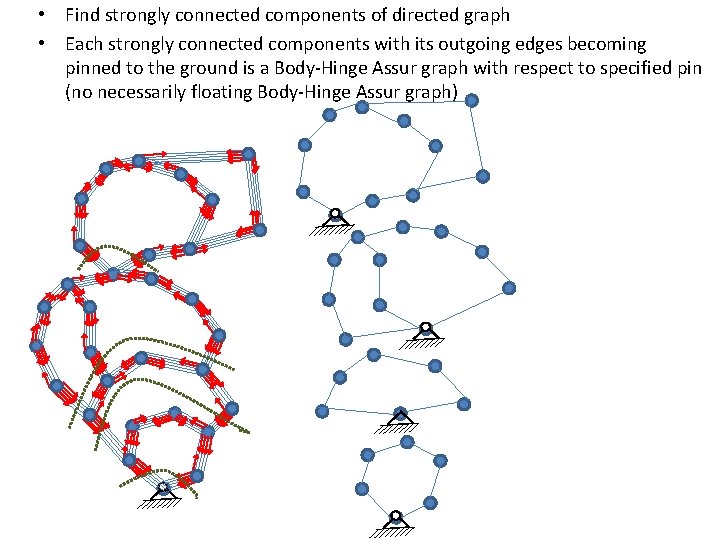
• Find strongly connected components of directed graph • Each strongly connected components with its outgoing edges becoming pinned to the ground is a Body-Hinge Assur graph with respect to specified pin (no necessarily floating Body-Hinge Assur graph)
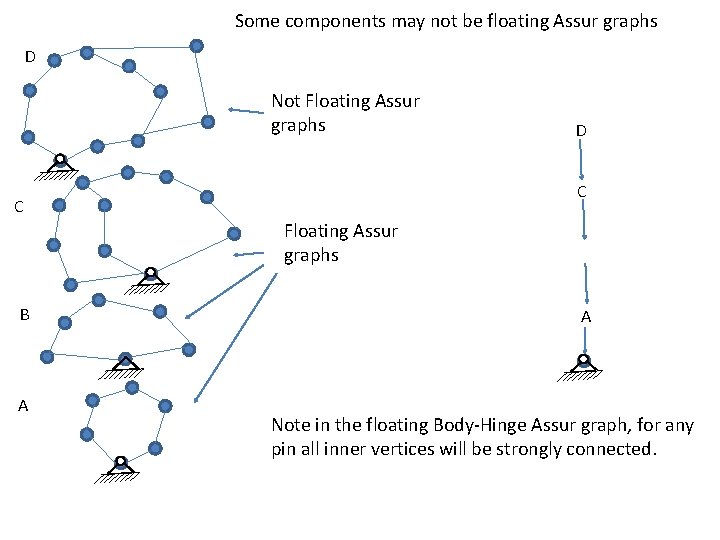
Some components may not be floating Assur graphs D Not Floating Assur graphs D C C Floating Assur graphs B A A Note in the floating Body-Hinge Assur graph, for any pin all inner vertices will be strongly connected.
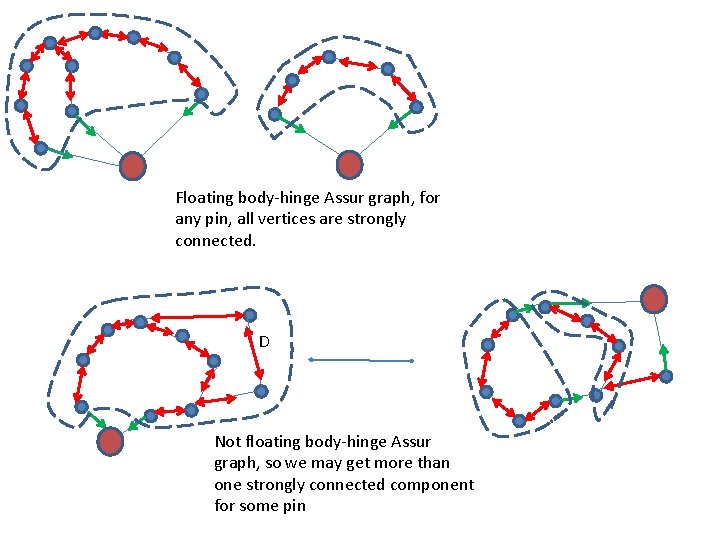
Floating body-hinge Assur graph, for any pin, all vertices are strongly connected. D Not floating body-hinge Assur graph, so we may get more than one strongly connected component for some pin