
Administration of Medication by Delegation Role and Responsibility
Administration of Medication by Delegation Role and Responsibility of the Teacher Modified by Karen Reed & Lori Leahy 2018
Objectives • Accurately identify the student for whom the medication is ordered • Become familiar with the medication administration plan/parent consent form for the student • Define the five rights of medication administration • Read the medication label accurately • Properly document medication administration • Describe procedure to follow if the medication is not give due to refusal, omission or if an error is made • Identify appropriate resources available if they should be needed
Role of the Teacher The teacher will, under the direction of the school nurse: • Administer medication to a student or remind a student to take their own medication with a self administration order. • Review with the school nurse the individual student’s medication administration record and follow the specific instructions for the student.
Role of the Teacher (continued) • Only administer a medication to a student who has a written signed order by a licensed provider (doctor, nurse practitioner, dentist), signed parent consent form and medication administration record • Document on the correct date and time the medication was given on the medication administration record (MAR) • Report any medication error to the school nurse immediately. If not available contact the parent.
What types of medications can a teacher give to a student? 1. A teacher may only give medication to a student that has been prescribed by a licensed provider and is routinely given to the student such as Ritalin and only under the direction of the school nurse.
Medications teachers can give to students (continued) 2. A teacher should not give “over the counter” medications such as Tylenol or Advil without consulting with and obtaining specific instructions from a school nurse
Medications teachers can give to students (continued) 3. Epinephrine (Epi. Pen)is the only medication that a teacher may administer by syringe because it is an auto-injector and only to a student with a known allergic reaction and appropriate licensed provider order, medication administration record and parent consent form.
Confidentiality All student health information, including any medication a student may be taking, is confidential. Medications and other student health information should not be discussed with others unless advised by the school nurse to do so. ! Confidentiality is key! Unless there is a need to know, health information and medications should not be shared with others!
What is Medication? It is a chemical substance that is used to treat, cure, prevent or diagnose a disease or disorder. Source: Wikipedia. com
Types of Medication There are two types: • Prescription - medications requiring a written order from a licensed provider (nurse practitioner, physician, dentist). • Over the Counter (OTC) - medications that generally can be purchased without an order from a health care provider. In the school setting, OTCs require a prescriber’s order just like all other medications that are administered in school.
Medications that teachers might administer: Antibiotics - used to treat infections (e. g. Penicillin, Amoxicillin) Anticonvulsants -used to control seizure activity (e. g. Dilantin, Tegretol) Psychotropics -used to affect behavior (e. g. Ritalin) Emergency Epinephrine - used to treat life threatening anaphylactic reactions (e. g. Epi. Pen®)
Five Rights of Medication Administration for Unlicensed Assistive Personnel Protecting student safety is the most important point to remember about administering medication. The five rights of medication administration are designed to prevent a medication error that could harm a student. Anyone administering medication must fully understand each steps and be able to follow them every single time a medication is given.
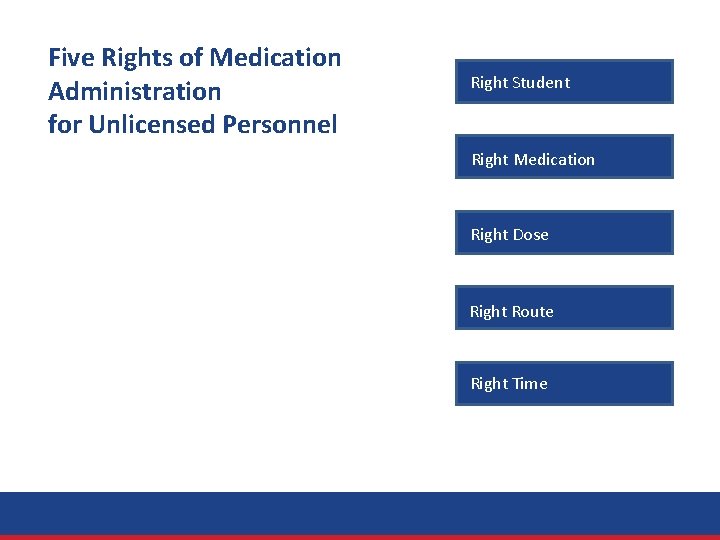
Five Rights of Medication Administration for Unlicensed Personnel Right Student Right Medication Right Dose Right Route Right Time
A Note about the Rights Registered Nurses are responsible for three additional rights: Documentation, Reason, and Response. The School Nurse will share with you three important documents that must be in place before any medication can be given: 1. Medication Administration Record 2. Signed Parent/Guardian Consent 3. Signed Medication Order from a licensed provider As appropriate, the School Nurse may also share information with you about the reason for the medication and the expected response.
Right Student You must know the student, don’t guess. If the student isn’t in your class, check IPass, meet with the student and the school nurse before taking responsibility to give a student medication on a field trip or at an off campus event.
Right Student - continued How do you check that you have the right student? • Ask the student to tell you their name – even if you know them well. • Ask the student to tell you their date of birth. • Look at the label on the bottle and state the name out loud to the student and ask: is this you? Be sure you have the student’s full attention when confirming they are the right student.
Right Medication • Before taking the medication from the health office, the teacher and the school nurse must check the licensed provider’s order and the pharmacy label to make sure they match • Double check to make sure the doctor’s order and the pharmacy label match, never do this in a rush
Right Medication - continued The nurse will prepare the medication and documents and review these with you. Before administering, review the medication with the student by following these steps: 1. Show the bottle to the student and read the name of the medication. Even young students typically know the name of the medication they take routinely. Ask: is this your medicine?
Right Medication - continued Steps to take before administering medication (continued) 2. Show the medication to the student. Before you allow them to take it, ask again: is this your medicine? Not only is this an important safety step, it is also an important teaching moment. Students need to learn to be responsible for their own medication. They are the last stop before taking a medication and it’s important for them to question what they are taking and confirm that any medication being offered to them is the correct one.
Right Medication -continued 3. Only give the medication if the student confirms yes to both of these questions. Ask questions if you do not understand If the student answers no, or raises the nurse's questions about the medication, contact instructions or if the nurse or the parent immediately. any medication looks different from Note: Medications may look different what you typically depending on the supplier. Changes will give to a particular confuse the student if they haven’t seen the new formulation. The nurse should review any student. changes with you before supplying you with medication.
Right Dose 1. When you review medications with the nurse, be sure to look at it and understand the dosage. Medications may look different from prescription to prescription. ! Dosage must be the same, not higher or lower than the order. Check with the school nurse if it is different. Do not give the medication if it doesn’t match.
Right Dose - continued 2. Compare the licensed provider’s order with the pharmacy label. Note: Sometimes pharmacies supply different formulations of a medication: • Maybe they only have a 10 mg pill on hand, but the dosage is 5 mg. The 10 mg pill is scored so it will be cut in half. • Maybe the student takes a 10 mg dose, but the pharmacy provided 5 mg pills. In this case, the student will need to take two pills.
Right Dose - continued 3. Read the medication label as it will tell you what’s inside the bottle and how much to deliver. Confirm that the medication prescription label, and the medication administration record match. If not, contact the school nurse or the parent for clarification.
Right Dose - continued 4. Double check it: It is the nurse’s responsibility to provide you with the correct dosage and clear instructions for administering the medication. It is the teacher’s responsibility to review and confirm the instructions and to ask questions. When receiving the medication from the nurse, carefully review the instructions and be sure you understand them.
Right Dose - continued 4. Medication Delegation is a Team Effort The teacher and the school nurse must schedule a time to meet together as a team to review the medications to be administered on the field trip before departure
Right Route • Medications come in different forms such as tablets, capsules, liquids, drops, ointments injections, inhalants • These forms of medication are given differently • Tablets, capsules and liquids are generally swallowed. These are oral medications
Right Route - continued • Ointments are usually applied to the skin. These are topical medications. • Inhalants are generally inhaled through the nose or mouth. These are inhalation medications. • Medications given in a syringe under the skin, such as epinephrine (Epi. Pen®) are injections, only epinephrine by auto-injector can be given by a teacher and that requires further training.
Right Time Giving medication at the right time is very important. Some students are on rigid medication schedules and delaying, missing, or giving a medication too early can create a significant problem for them or endanger their health.
Right Time - continued Example of a problem created by missing the Right Time: Methylphenidate (Ritalin) is commonly used to treat ADHD. Often students will take a mid-day dose. If it’s given too late in the day, they won’t be able sleep well that night. If the Right Time is missed, you may not be able to give the dose and the student will have trouble focusing and lose important time on learning.
Right Time - continued A window of time: Most medications can be given during a window of time, such as 60 minutes before or after the scheduled time. Others must be given exactly at the scheduled time. The nurse is responsible for providing you with clear directions about the Right Time to give medications and what to do if that time frame is missed. Don’t assume you should just give a missed medication at the time you realize you forgot to give it. If the nurse doesn’t give instruction on what to do if you miss a dose, ask for direction.
Situations that Constitute a Medication Error • • • Wrong Student Wrong Medication Wrong Dose Wrong Time Wrong Route If you make an error, don’t hide it. When discovered, report the error immediately to the school nurse. If the nurse is not available then contact the parent.
Documentation The medication administration record (MAR) must be maintained for all medication administration. The MAR should include: 1. The medication name and dose or amount of medication administered 2. The date and time of administration or omission of administration, including the reason for omission. 3. The signature of the person administering the medication.
Do’s for Safe Medication Administration • Give your full attention to the task • Review the signed medication order, the medication administration record and the parent consent form • Check the “ 5 Rights” carefully ! Being distracted is a common reason for making medication errors– be sure to give full attention to the task. Be sure to review the medications and orders every time, for every student. Check and double check every one of the 5 Rights before administering.
Do’s for Safe Medication Administration - continued • Ask the student to identify his/her medication before you give it: What does your medication look like? • Stay with the student until the medication has been taken and you are sure the student has swallowed it
Eight Steps in Medication Administration You will read label three times before administering medication 1. Identify the student 2. Read medication administration record (MAR) 3. Wash hands 4. Select medication and read label making sure it is correct for the student 5. Prepare the medication and read the label a second time
Eight Administration Steps - continued 6. Read label a third time and administer the medication to the student 7. Replace medication to a secure location 8. Document the correct date and time on the medication administration record (MAR) Upon return from a field trip report to the school nurse to review medication administration, documentation and inventory any returned medications
Don’ts for Safe Medication Administration 1. Never give medication from a container you can’t read. 2. Never give a medication to a student without a signed order from a licensed provider, written parent permission and a completed medication administration record (MAR). 3. Never give medication from another student’s container (even if it’s the same medication).
Don’ts for Safe Medication Administration 3. Never leave medications unattended 4. Never change the dose of medication to be given 5. Never hide a medication error, be sure to report it to the school nurse and/or the parent as soon as you are aware of the error
Safety First Administering medication is not just handing a pill to a student, it is a thoughtful step-bystep process. For each step, we must confirm that each condition is right, and if not, to stop and ask questions. Medication errors can harm students. Medication errors do happen and a common reason is being distracted and missing one of these steps. When administering medication, take your time-- administer the medication deliberately by checking and double checking yourself through each and every step. Protecting student safety is the most important point to remember about administering medication.
You have finished the medication delegation online training Please see Gayle Ripley to obtain and complete the Medication Delegation Written Competency Test. You must get at least 10 of the 14 questions correct for a passing score. A passing competency post test is required (per MDPH Regulations) for all faculty planning on taking students off campus. You may also arrange to meet with the school nurse anytime to further review the medication administration procedure.
- Slides: 40